
Lubricant Packaging Market Size and Share
Market Overview
| Study Period | 2021 - 2031 |
|---|---|
| Market Size (2026) | USD 11.35 Billion |
| Market Size (2031) | USD 15.43 Billion |
| Growth Rate (2026 - 2031) | 6.34 % |
| Fastest Growing Market | Asia-Pacific |
| Largest Market | Asia-Pacific |
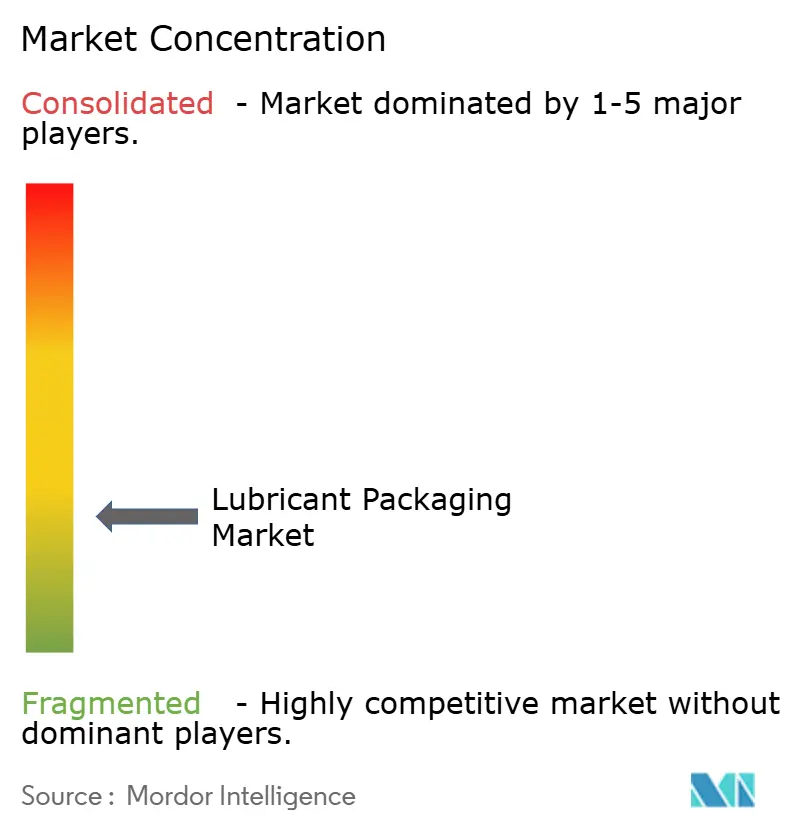
| Market Concentration | Low |
Major Players *Disclaimer: Major Players sorted in no particular order Image © Mordor Intelligence. Reuse requires attribution under CC BY 4.0. | |
Lubricant Packaging Market Analysis by Mordor Intelligence
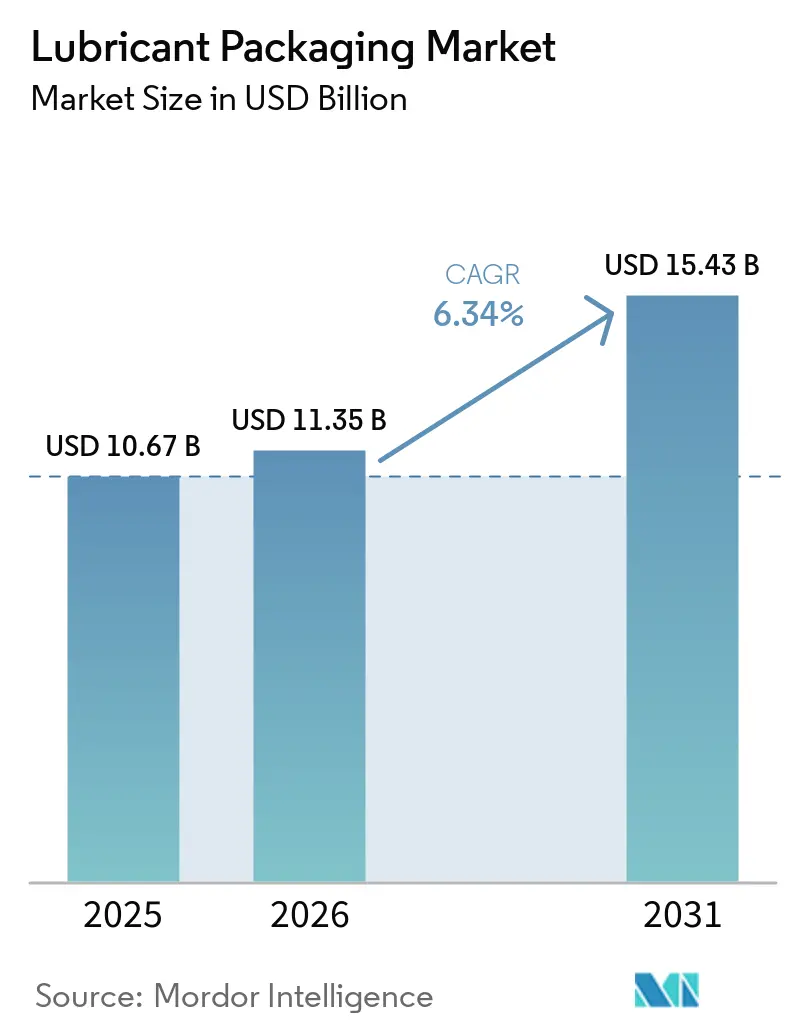
The Lubricant Packaging Market size was valued at USD 10.67 billion in 2025 and is estimated to grow from USD 11.35 billion in 2026 to reach USD 15.43 billion by 2031, at a CAGR of 6.34% during the forecast period (2026-2031). The lubricant packaging market is supported by a global vehicle fleet exceeding 1.4 billion units, which sustains replacement demand through the automotive after-sales channel. Industrial activity in Asia-Pacific, the Middle East and Africa, and Latin America is also raising demand for containers used in manufacturing, construction, mining, and energy operations. Packaging value is rising as lubricant brands use formats with stronger barriers, smart closures, and traceable product identifiers. Suppliers that combine format range, material expertise, and regulatory readiness are better placed to serve this changing demand. Resin volatility, container contamination, and producer-responsibility rules will continue to shape costs and purchasing decisions in the lubricant packaging market. The resulting opportunity centers on containers that protect product quality, meet transport requirements, and provide credible evidence of material performance. This puts greater emphasis on packaging development that considers both the end user’s handling needs and the brand owner’s operational obligations.
Key Report Takeaways
- By packaging type, bottles held 29.46% of the lubricant packaging market share in 2025, while intermediate bulk containers (IBCs) are projected to advance at a 6.84% CAGR through 2031.
- By material, plastic held 56.33% of the lubricant packaging market share in 2025, while metal is projected to advance at a 6.97% CAGR through 2031.
- By lubricant type, engine oils held 42.17% of the lubricant packaging market share in 2025, while transmission and hydraulic fluids are projected to advance at a 7.23% CAGR through 2031.
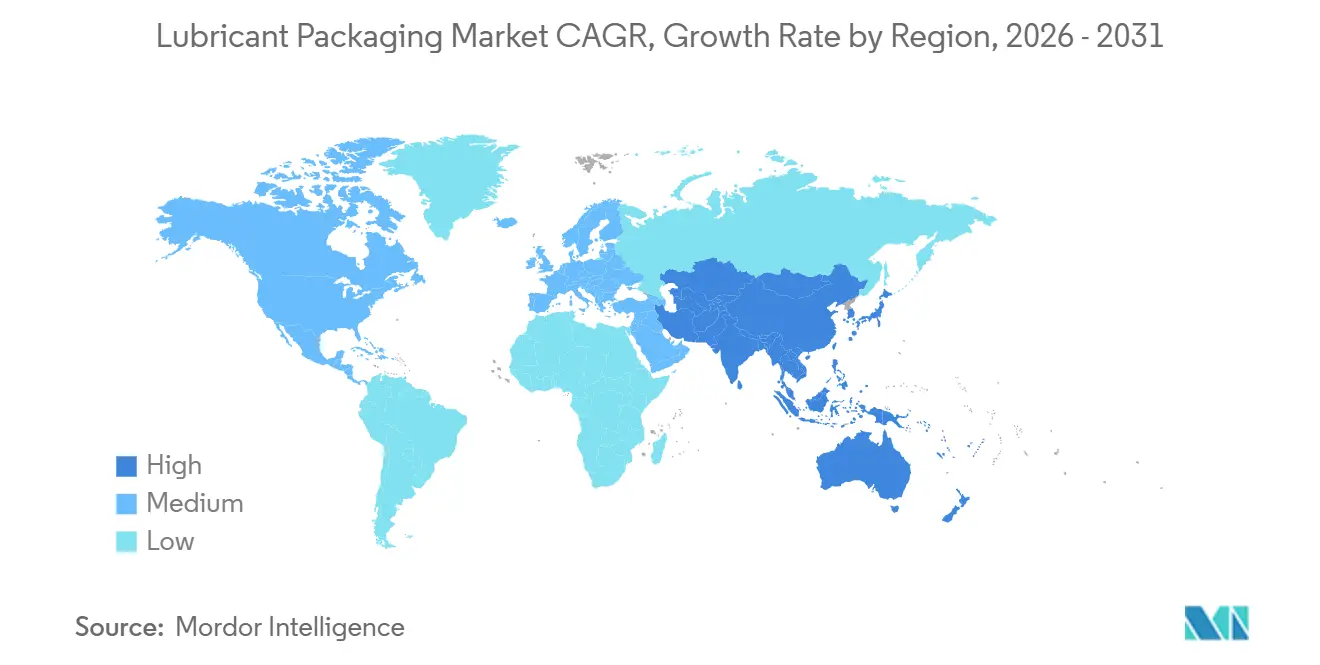
- By geography, Asia-Pacific held 36.20% of the lubricant packaging market share in 2025 and is projected to advance at a 7.06% CAGR through 2031.
Note: Market size and forecast figures in this report are generated using Mordor Intelligence’s proprietary estimation framework, updated with the latest available data and insights as of January 2026.
Global Lubricant Packaging Market Trends and Insights
Drivers Impact Analysis*
| Driver | (~) % Impact on CAGR Forecast | Geographic Relevance | Impact Timeline |
|---|---|---|---|
| Growth in Vehicle Ownership and Automotive After-Sales | +2.1% | Global, concentrated in Asia-Pacific, Latin America, and Middle East and Africa | Medium term (2-4 years) |
| Industrialization and Expansion of Manufacturing, Construction, Mining, and Energy | +1.7% | APAC core, spillover to Middle East and Africa and Latin America | Long term (≥ 4 years) |
| Shift Toward Lightweight, Recyclable, and Convenient Packaging | +1.2% | North America & EU; secondary spillover to APAC | Medium term (2-4 years) |
| Growth in Specialty Lubricants and Performance-Specific Formulations | +0.9% | Global, led by North America & EU, with growth in APAC | Long term (≥ 4 years) |
| Packaging-Level Traceability for Counterfeit Control and Recall Readiness | +0.5% | Global, with highest urgency in South and Southeast Asia and Middle East | Short term (≤ 2 years) |
| Source: Mordor Intelligence | |||
Growth in Vehicle Ownership and Automotive After-Sales
The lubricant packaging market benefits from a global in-use vehicle fleet that has exceeded 1.4 billion units. Each vehicle generates recurring demand for lubricants and the containers used for service and retail sales. India recorded 28.2 million vehicle registrations in 2025, while automotive production reached 34.7 million units in fiscal year 2025-26[1]Federation of Automobile Dealers Associations, “FADA Releases CY’25 and December 2025 Vehicle Retail Data,” FADA India, fada.in. Two-wheelers accounted for more than 26.6 million units of production in fiscal year 2025-26 and require frequent use of smaller lubricant packs. India’s vehicle retail volume grew 7.71% in calendar year 2025, while passenger vehicle retail sales increased 9.70%. In formal after-sales networks in Southeast Asia and the Middle East, sales are moving from unbranded dispensing toward labeled and tamper-evident packs, increasing container use per unit of lubricant sold. The transition also gives lubricant brands more control over presentation, authentication, and product information at the point of sale. As vehicle ownership rises, packs designed for convenient use can support service intervals and retail replenishment across a broader network of workshops and distributors.
Industrialization and Expansion of Manufacturing, Construction, Mining, and Energy
The lubricant packaging market also serves industrial users who operate construction equipment, mining machinery, and energy assets. These users need drums and IBCs that support larger fills, safe handling, and controlled dispensing. Construction programs in Saudi Arabia, infrastructure spending in India, and mining activity in Indonesia are widening the demand base for industrial containers. IBCs with 1,000-liter capacity can reduce handling steps and dispensing costs compared with 200-liter drums. Reconditioning networks improve the reuse case for these units in large industrial centers. Energy applications, including offshore wind servicing, also require synthetic oils in United Nations-certified containers, which supports demand for more specialized formats. Industrial customers also value packages that protect fluids during storage and allow safe, consistent transfer at operating sites. Their specifications can favor robust formats that remain reliable during frequent movement, extended storage, and demanding operating conditions.
Shift Toward Lightweight, Recyclable, and Convenient Packaging
The lubricant packaging market is moving toward lighter formats that can reduce material use and improve transport efficiency. Bag-in-box systems, multilayer pouches, and lighter high-density polyethylene bottles can offer alternatives to heavy rigid canisters. MOL-LUB Ltd. introduced bag-in-box packaging in December 2025 that allowed 88% more units per pallet than the 20-liter canister it replaced. Repsol launched lubricant containers with 60% post-consumer recycled plastic in March 2024[2]Repsol, “New Repsol Packaging Made from 60% Recycled Plastic,” Repsol Lubricants, lubricants.repsol.com. Schütz GmbH & Co. KGaA now offers Green Layer variants with up to 30% regranulate in the middle layers. The European Union Packaging and Packaging Waste Regulation, effective August 12, 2026, increases the value of recyclable designs because producers face recyclability requirements and related fee structures. Packaging choices now need to balance material reduction, product protection, practical collection, and the cost of meeting changing rules. The lubricant packaging market is consequently seeing greater interest in designs that preserve functional performance while using less virgin material.
Growth in Specialty Lubricants and Performance-Specific Formulations
Specialty lubricants require packaging that protects product quality and identifies the intended application. Electric vehicle drivetrains use dielectric thermal fluids that need static-safe containers. Wind turbine gearboxes use synthetic oils that require contamination barriers and United Nations-certified IBCs. Food-grade lubricants also need National Sanitation Foundation (NSF) H1-compliant closures and labeling systems. These technical requirements increase the value of packaging design beyond basic containment. The lubricant packaging market, therefore, favors producers that can offer bottles, drums, IBCs, and pouches with suitable quality documentation and machine-readable codes. It also increases the need for clear labels, compatible closures, and reliable product identification across varied service environments. Lubricant producers need packaging systems that can distinguish technically different fluids and reduce the risk of incorrect use in the field. This requirement applies throughout the chain, from filling operations and distributor warehouses to workshops and industrial maintenance locations. A clearly identified container can also make it easier for customers to follow the required handling and disposal instructions. Packaging also needs to maintain its protective performance throughout distribution, storage, and use, even where fluids have demanding chemical or temperature characteristics.
Restraints Impact Analysis*
| Restraint | (~) % Impact on CAGR Forecast | Geographic Relevance | Impact Timeline |
|---|---|---|---|
| Volatility in Petrochemical Resin and Metal Prices | -1.3% | Global (APAC and EU most exposed to Hormuz-linked supply shock) | Short term (≤ 2 years) |
| Rising Compliance Costs for EPR, Hazardous-Product Handling, and Transport | -0.9% | North America & EU; secondary spillover to APAC | Medium term (2-4 years) |
| Residual-Lubricant Contamination Weakening Recycling Economics | -0.5% | North America & EU | Long term (≥ 4 years) |
| Source: Mordor Intelligence | |||
Volatility in Petrochemical Resin and Metal Prices
Petrochemical resin price volatility is a direct cost challenge for lubricant packaging market suppliers. High-density polyethylene is widely used in bottles, cans, and drums, leaving converters exposed to changes in feedstock availability. Polyethylene and polypropylene prices increased 25%–30% year over year in the first quarter of 2026 following the disruption to the Strait of Hormuz trade routes. Metal cans and drums face similar pressure because tin-plated steel and aluminum prices follow commodity markets. Suppliers without long-term resin agreements or secured feedstock face a greater risk of margin pressure. This uncertainty can limit capacity investment even when demand for lubricant containers remains strong. It also makes contract pricing, material sourcing, and inventory planning more important for both pack suppliers and lubricant blenders. The effect is especially material for formats that use large volumes of polymer resin or metal and are supplied under fixed customer agreements.
Rising Compliance Costs for EPR, Hazardous-Product Handling, and Transport
Extended Producer Responsibility programs have moved from planning to active enforcement in several jurisdictions. Oregon issued its first packaging program invoices in July 2025, Colorado began charging producers in January 2026, and California’s SB 54 regulations took effect in May 2026. Lubricant containers have added compliance complexity because residual petroleum contents can limit access to normal collection programs. Hazardous-product transport rules add separate documentation and handling requirements across national markets. The European Union Packaging and Packaging Waste Regulation became effective on August 12, 2026, and added a harmonized recyclability grading framework. These requirements favor lubricant packaging market suppliers that can document materials, product safety, and recycling performance across regions. Smaller businesses may face a heavier administrative burden where programs require registrations and reporting in several jurisdictions.
*Our forecasts treat driver/restraint impacts as directional, not additive. The impact forecasts reflect baseline growth, mix effects, and variable interactions.
Segment Analysis
By Packaging Type: Bottles Lead Retail Demand While IBCs Improve Industrial Logistics
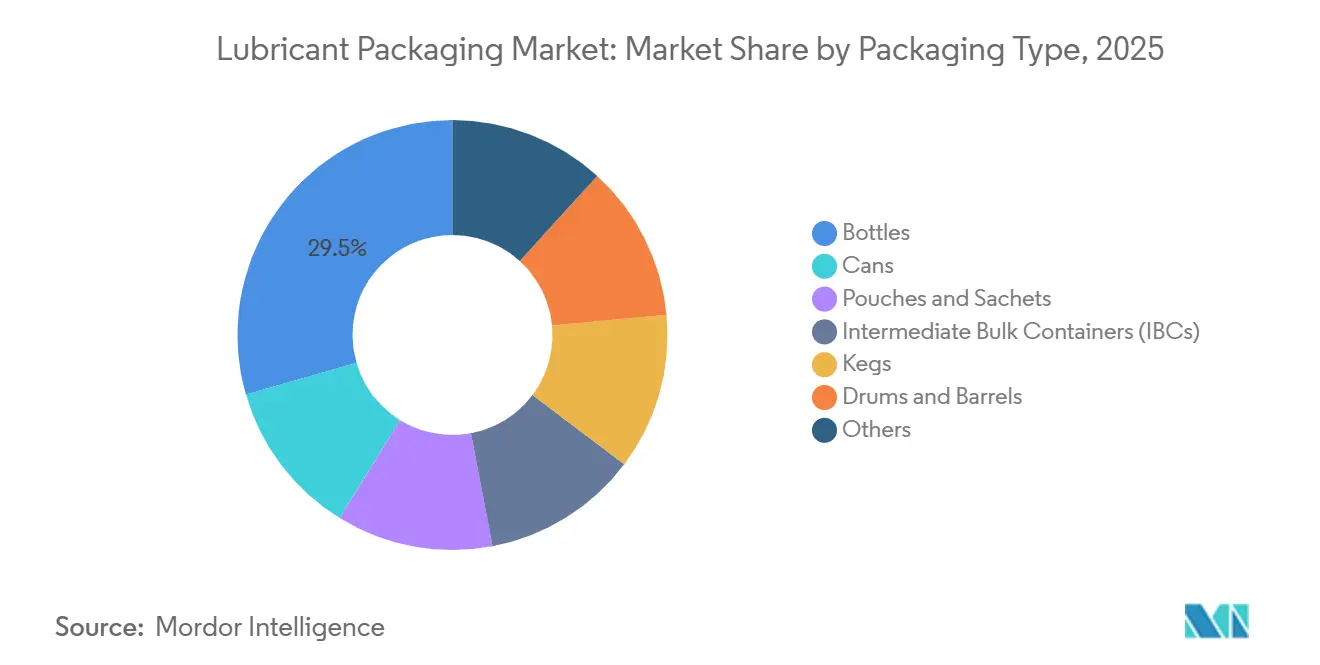
Bottles accounted for 29.46% of the lubricant packaging market size in 2025. Their position reflects the importance of retail automotive after-sales channels, where shelf visibility, pack size, and ease of pouring matter. Bottle design is shaped by in-mold labeling, recycled content, ergonomic handling, and tamper-evident closures. These features help lubricant brands differentiate products in do-it-yourself and workshop settings. Small formats also suit the replacement cycle for engine oils and other vehicle fluids. The bottle segment remains closely tied to the scale and formalization of automotive retail networks. Its continued relevance depends on how effectively suppliers combine affordability, safe handling, and distinctive brand presentation in compact formats. Manufacturers also need to maintain consistent container quality across the varied sizes supplied to retail stores, workshops, and service chains.
IBCs are projected to grow at a 6.84% CAGR from 2026 to 2031 within the lubricant packaging market. Industrial buyers use 1,000-liter reusable units to reduce handling steps and lower costs relative to 200-liter drums. Schütz GmbH & Co. KGaA introduced its SC2 jerrycan series at interpack 2026 with 6-layer, perfluoroalkyl and polyfluoroalkyl substances-free ethylene vinyl alcohol barrier structures. The range includes Green Layer variants with up to 30% regranulate content. Cans continue to serve premium retail and lower-volume industrial fills. Pouches and sachets are gaining use in workshops, while drums and barrels remain important for industrial users that do not require IBC capacity. Kegs and related formats serve specialized aviation and lubricant supply applications that need precise fills and secure closures.



By Material: Plastic Retains Broad Use While Metal Serves Premium Industrial Needs
Plastic accounted for 56.33% of the lubricant packaging market size in 2025. High-density polyethylene offers a practical balance of cost, durability, and performance across retail bottles and industrial drums. Its use ranges from 500-milliliter bottles to 220-liter containers. Repsol’s March 2024 launch of containers with 60% post-consumer recycled plastic showed how suppliers are adding circular material content without abandoning plastic formats. Schütz GmbH & Co. KGaA has also incorporated up to 30% regranulate in its Green Layer IBC products. Composite materials, bio-based materials, and multilayer films remain part of the others category and address more specific handling needs.
Metal is projected to grow at a 6.97% CAGR from 2026 to 2031 in the lubricant packaging market. The format is suited to industrial uses involving temperature cycles, longer storage periods, and strict fill-integrity requirements. Metal cans and drums are often specified for premium applications that need strong barrier performance. Large industrial customers also use metal drums where refill logistics and unit economics favor larger fills. This creates a durable role for metal even as plastic retains wider use across packaging formats. Material selection increasingly depends on application conditions, recycling expectations, and the cost of regulatory compliance. Buyers must also consider how a format performs during transport, storage, dispensing, and subsequent recovery.
By Lubricant Type: Engine Oils Support Core Demand While Transmission and Hydraulic Fluids Advance
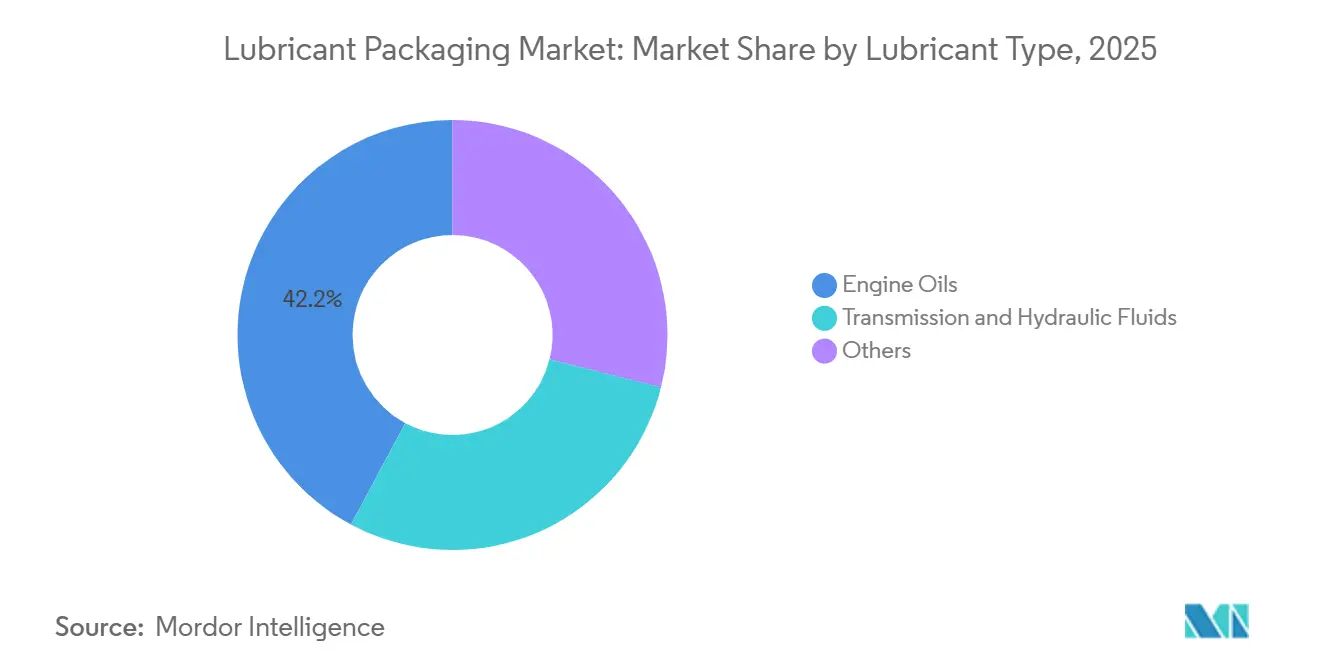
Engine oils accounted for 42.17% of the lubricant packaging market size in 2025. This demand is supported by the global internal combustion engine vehicle base and its recurring oil-change cycle. Small high-density polyethylene bottles remain the main pack format in this category. These packs serve retail, workshops, and quick-lube outlets, where label clarity and pouring convenience influence purchasing choices. Counterfeit risk is highest in consumer-facing engine oil channels, which has encouraged authentication features on packages. The lubricant packaging industry uses these systems to protect brands and improve product verification.
Transmission and hydraulic fluids are projected to grow at a 7.23% CAGR from 2026 to 2031. Mechanization in construction and mining supports demand for hydraulic fluid packs in drums and IBCs. The shift from manual to automatic transmissions in Association of Southeast Asian Nations countries also increases automatic transmission fluid volume per vehicle. Greases, compressor oils, food-grade lubricants, and metalworking fluids require varied fill sizes and specialized closures. These applications may also require NSF or International Organization for Standardization documentation in the labeling system. This diversity helps sustain demand for application-specific packages across the lubricant packaging industry.
Geography Analysis
Asia-Pacific held 36.20% of the lubricant packaging market share in 2025 and is projected to grow at a 7.06% CAGR through 2031. India produced 34.7 million vehicles in fiscal year 2025-26, including more than 26.6 million two-wheelers. These vehicles support frequent use of smaller lubricant containers. China’s expanding vehicle fleet is creating a large replacement demand for engine oils in retail packs. Thailand, Vietnam, and Indonesia are seeing a move toward passenger vehicles with automatic transmissions, which supports demand for automatic transmission fluid bottles and IBCs. Japan and South Korea also support premium synthetic lubricants in packs with advanced authentication and recycled-content features. These markets reinforce the value of formats that combine technical protection with clear consumer-facing product identification. Organized retail environments also make it easier for branded suppliers to communicate recycling and authentication features through the pack.
North America drives demand through a large in-service vehicle fleet and demand for premium synthetic lubricants. Oregon issued its first producer invoices under its packaging Extended Producer Responsibility program in July 2025, Colorado began charging in January 2026, and California’s SB 54 regulations took effect in May 2026. Europe is supported by an aging car base and recurring aftermarket lubricant demand. The European Union Packaging and Packaging Waste Regulation adds pressure for recyclable format redesigns and transparent material reporting. These conditions reward suppliers that can manage product safety, recycled content, and cross-border compliance. They also create a clearer commercial case for early investment in redesigned containers and documented lifecycle performance. Suppliers must account for these requirements when they plan product ranges intended for multiple national and regional markets.
South America relies on Brazil and Argentina as important demand centers for commercial fleets and agricultural machinery. Greif reported a Net Promoter Score of +87 among its Brazilian lubricant packaging customers in 2024. The Middle East and Africa is developing more regional production capacity for industrial packs. Schütz GmbH & Co. KGaA signed a license agreement with National Plastic Factory Company in Saudi Arabia in January 2025 for ECOBULK IBC production. Mining, energy, and infrastructure activity support demand for drums and IBCs across the region. Retail formalization in Argentina, South Africa, and the United Arab Emirates also shifts lubricant sales into branded and labeled containers.

Competitive Landscape
The lubricant packaging market is lowly concentrated, with the top five players including Amcor plc, Greif, Mauser Packaging Solutions, ALPLA, and Schütz GmbH & Co. KGaA. Industrial specialists are investing in IBC barrier technologies, smart closures, and lifecycle tools. Retail-oriented suppliers focus on in-mold label decoration, recycled-content certification, and compact packs. Greif’s Green Tool provides an International Organization for Standardization lifecycle-assessment calculator that helps customers measure packaging impacts.
Companies increasingly compete on compliance documentation and data as well as physical pack performance. Mauser Packaging Solutions has deployed radio-frequency identification-enabled closures to improve supply-chain visibility. Lubricant brands also need packaging that can support serialization, Quick Response verification, and digital product passport requirements. This favors manufacturers with multiple format capabilities and established quality systems. There remains a gap in national-scale collection and take-back systems designed specifically for lubricant containers. That gap creates an opening for suppliers that can build practical recovery models alongside container production. A workable solution would need to address collection, cleaning, recycled-material quality, and the economics of returning containers from dispersed users.
Regionally focused companies are expanding in high-growth Asian markets through cost advantages and local regulatory knowledge. Mold-Tek Packaging Ltd. and Time Technoplast Ltd. are active in India and Southeast Asia. Packaging suppliers that cannot provide traceability, documented recyclability, and Extended Producer Responsibility support may face more difficult contract negotiations with multinational lubricant brands. The competitive focus is moving toward packages that can be specified, verified, and managed across several markets. This shift benefits businesses that can combine local production knowledge with consistent technical and compliance support for global customers. It also raises the importance of manufacturing footprints that can respond quickly to regional demand while maintaining common quality standards. Greif completed its acquisition of Envaplast in July 2026, expanding its customized polymer solutions activity and manufacturing presence in Southern Europe. CCL Industries completed its acquisition of Sleever International in June 2026, strengthening its specialty decoration and authentication capabilities. Schütz GmbH & Co. KGaA expanded its jerrycan range at interpack 2026 with the SC2 series, including barrier and recycled-content options.
Lubricant Packaging Industry Leaders
Amcor plc
Greif
Mauser Packaging Solutions
ALPLA
Schütz GmbH & Co. KGaA
- *Disclaimer: Major Players sorted in no particular order

Recent Industry Developments
- August 2026: CCL Industries signed an agreement to acquire Sleever International, strengthening its sleeve, film, and packaging technology portfolio across consumer and healthcare markets. The expanded packaging capabilities support lubricant brands that use shrink sleeves and specialty films for product labeling, branding, and container decoration.
- July 2026: Greif completed the acquisition of Envaplast, a manufacturer of premium small polymer containers in Spain, expanding its Customized Polymer Solutions business and polymer packaging manufacturing footprint. The additional container capacity strengthens the supply of rigid polymer packaging formats that can be used for smaller lubricant packs and specialty lubricant products.


Global Lubricant Packaging Market Report Scope
Lubricant packaging refers to containers and packaging formats used to store, protect, transport, and dispense lubricants. These packaging solutions help preserve product quality, prevent contamination and leakage, and support efficient handling across the lubricant supply chain.
The Lubricant Packaging Market is segmented by packaging type, material, lubricant type, and geography. By packaging type, the market is segmented into bottles, cans, pouches and sachets, drums and barrels, intermediate bulk containers (IBCs), kegs, and others. By material, the market is segmented into plastic, metal, and others. By lubricant type, the market is segmented into engine oils, transmission and hydraulic fluids, and others. The report also covers the market size and forecasts for lubricant packaging in 15 countries across major regions. For each segment, the market sizing and forecasts have been done on the basis of value (USD).
| Bottles |
| Cans |
| Pouches and Sachets |
| Drums and Barrels |
| Intermediate Bulk Containers (IBCs) |
| Kegs |
| Others |
| Plastic |
| Metal |
| Others |
| Engine Oils |
| Transmission and Hydraulic Fluids |
| Others |
| Asia-Pacific | China |
| India | |
| Japan | |
| South Korea | |
| ASEAN Countries | |
| Rest of Asia-Pacific | |
| North America | United States |
| Canada | |
| Mexico | |
| Europe | Germany |
| United Kingdom | |
| France | |
| Italy | |
| NORDIC Countries | |
| Rest of Europe | |
| South America | Brazil |
| Argentina | |
| Rest of South America | |
| Middle East and Africa | Saudi Arabia |
| South Africa | |
| Rest of Middle East and Africa |
| By Packaging Type | Bottles | |
| Cans | ||
| Pouches and Sachets | ||
| Drums and Barrels | ||
| Intermediate Bulk Containers (IBCs) | ||
| Kegs | ||
| Others | ||
| By Material | Plastic | |
| Metal | ||
| Others | ||
| By Lubricant Type | Engine Oils | |
| Transmission and Hydraulic Fluids | ||
| Others | ||
| By Geography | Asia-Pacific | China |
| India | ||
| Japan | ||
| South Korea | ||
| ASEAN Countries | ||
| Rest of Asia-Pacific | ||
| North America | United States | |
| Canada | ||
| Mexico | ||
| Europe | Germany | |
| United Kingdom | ||
| France | ||
| Italy | ||
| NORDIC Countries | ||
| Rest of Europe | ||
| South America | Brazil | |
| Argentina | ||
| Rest of South America | ||
| Middle East and Africa | Saudi Arabia | |
| South Africa | ||
| Rest of Middle East and Africa | ||


Key Questions Answered in the Report
What is the size of the lubricant packaging market?
The lubricant packaging market stands at USD 11.35 billion in 2026 and is projected to reach USD 15.43 billion by 2031.
What is driving demand for lubricant packaging?
Growth in vehicle ownership, formal automotive after-sales networks, industrial activity, and demand for specialized lubricants support container demand.
Which packaging type is expected to grow fastest through 2031?
Intermediate bulk containers (IBCs) are projected to advance at a 6.84% CAGR through 2031 as industrial users seek reusable large-volume formats.
Which material held the largest share in 2025?
Plastic held 56.33% of the material segment in 2025 because high-density polyethylene serves many retail and industrial formats.
Page last updated on:


 Your data is secure and never sold or shared.


