
Low-Voltage Switchgear Market Size and Share
Market Overview
| Study Period | 2021 - 2031 |
|---|---|
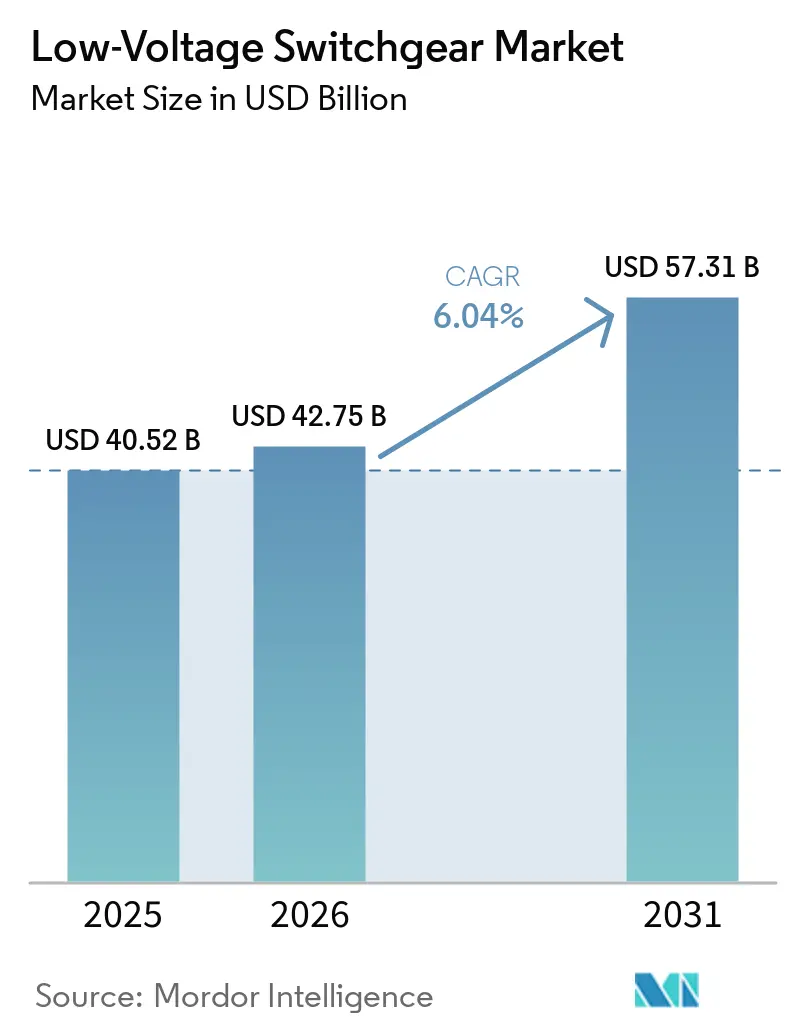
| Market Size (2026) | USD 42.75 Billion |
| Market Size (2031) | USD 57.31 Billion |
| Growth Rate (2026 - 2031) | 6.04 % |
| Fastest Growing Market | Asia-Pacific |
| Largest Market | Asia-Pacific |
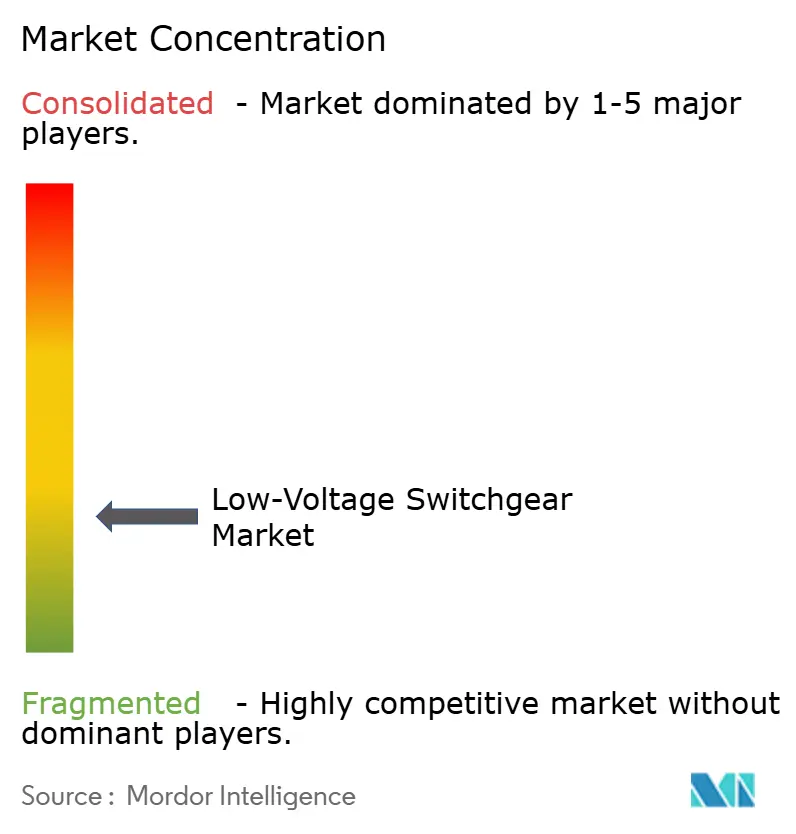
| Market Concentration | Low |
Major Players *Disclaimer: Major Players sorted in no particular order Image © Mordor Intelligence. Reuse requires attribution under CC BY 4.0. | |
Low-Voltage Switchgear Market Analysis by Mordor Intelligence
The Low-Voltage Switchgear Market size is projected to expand from USD 40.52 billion in 2025 and USD 42.75 billion in 2026 to USD 57.31 billion by 2031, at a CAGR of 6.04% between 2026 and 2031. Demand is moving beyond replacement purchases toward multi-year capacity commitments, as buyers seek equipment supply before projects are ready for energization. Data center campuses, renewable interconnections, and industrial electrification are adding demand at the same time, which is extending order books for electrical equipment. Data center electricity use is expected to rise from 485 TWh in 2025 to 945 TWh by 2030, placing switchgear between new computing loads and grid supply.[1] The Low voltage switchgear market is therefore shaped by delivery capacity, product specifications, and the ability to support long-running infrastructure programs. Input costs, integration requirements, and connected-system security risks continue to limit the pace at which some buyers adopt advanced assemblies.
Key Report Takeaways
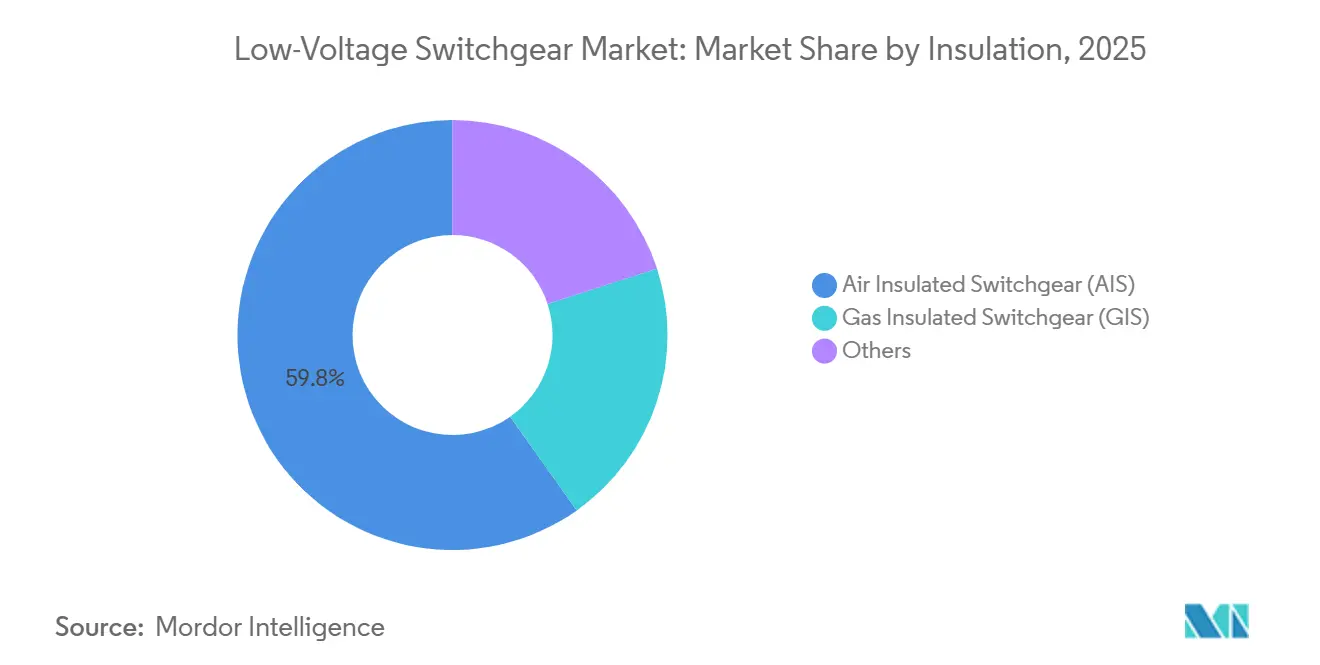
- By insulation, AIS held 59.8% of the Low voltage switchgear market share in 2025, while Others are forecast to expand at an 11.3% CAGR through 2031.
- By current type, AC held 84% in 2025, while DC is forecast to expand at a 7.1% CAGR through 2031.
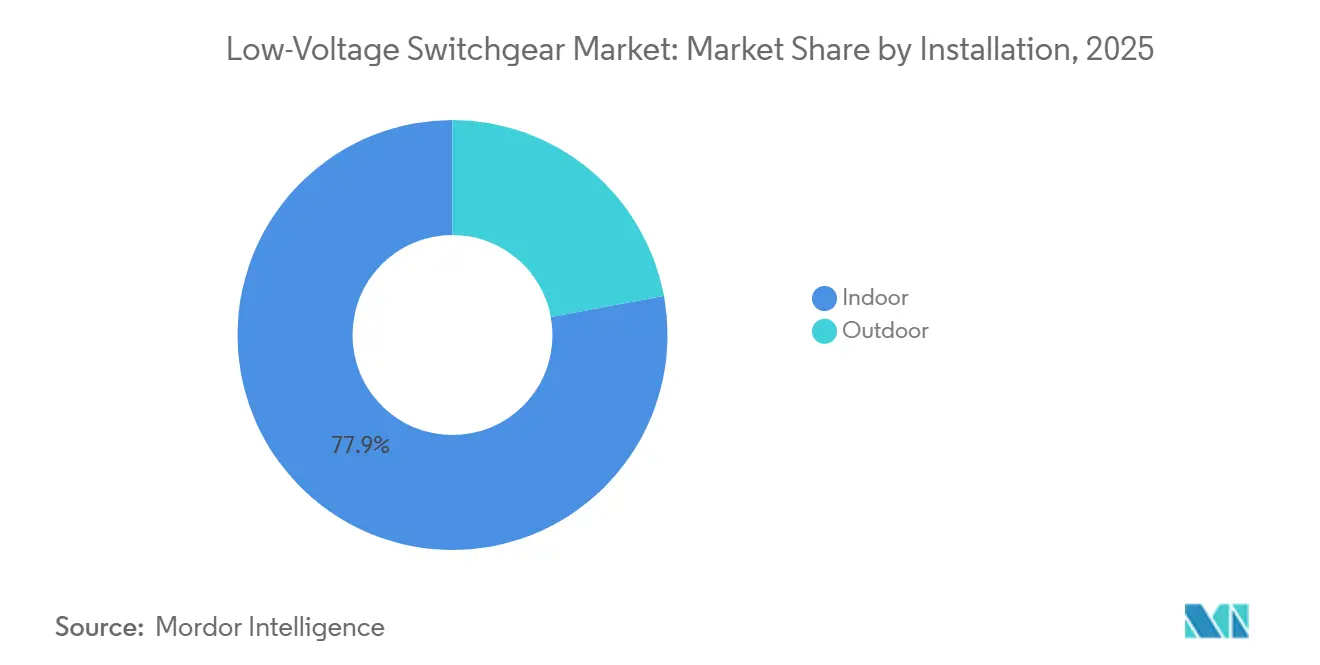
- By installation, indoor systems accounted for 77.9% in 2025, while outdoor systems are forecast to expand at an 8.7% CAGR through 2031.
- By end-user, industrial users held 39.6% in 2025, while commercial users are forecast to expand at a 7.5% CAGR through 2031.
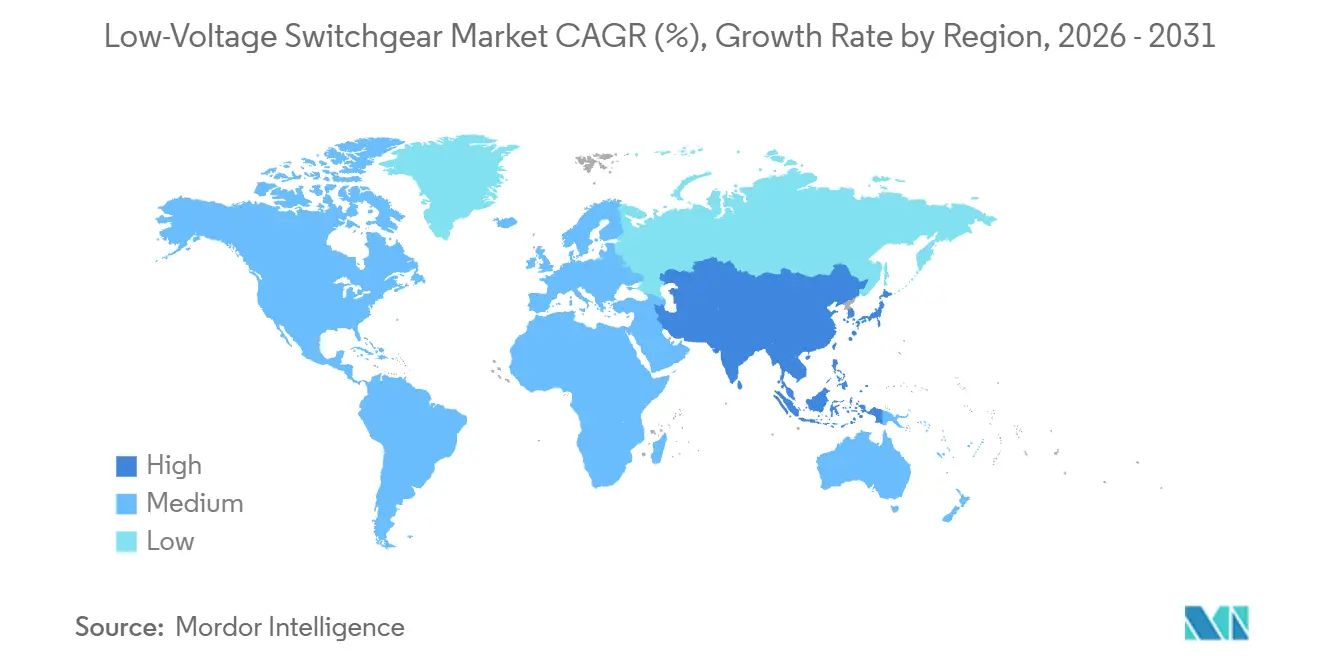
- By geography, Asia-Pacific region held 47.6% in 2025, is forecast to expand at a 8.1% CAGR through 2031.
Note: Market size and forecast figures in this report are generated using Mordor Intelligence’s proprietary estimation framework, updated with the latest available data and insights as of January 2026.
Global Low-Voltage Switchgear Market Trends and Insights
Drivers Impact Analysis*
| Driver | (~) % Impact on CAGR Forecast | Geographic Relevance | Impact Timeline |
|---|---|---|---|
| Data Center and AI Computing Expansion | +1.4% | Global, concentrated in North America, Asia-Pacific, and Northern Europe | Short term (≤ 2 years) |
| Grid Modernization and Asset Replacement | +1.2% | North America and Europe, with spillover to Asia-Pacific and Middle East and Africa | Medium term (2-4 years) |
| Renewable Energy, Storage, and EV Interconnection | +1.0% | Global, led by Asia-Pacific and expanding into Middle East and Africa and South America | Medium term (2-4 years) |
| Building and Industrial Electrification | +0.8% | Asia-Pacific, followed by North America and Europe | Medium term (2-4 years) |
| Digital Monitoring and Predictive Maintenance | +0.6% | Global, concentrated in mature economies | Long term (≥ 4 years) |
| Modular Protection for Distributed Energy Resources | +0.5% | Asia-Pacific, Europe, and North America | Long term (≥ 4 years) |
| Source: Mordor Intelligence | |||
Expansion of Data Centers and AI Computing Loads
The Low voltage switchgear market is increasingly tied to the power path between utility supply and computing racks. Global data center electricity consumption is forecast to nearly double between 2025 and 2030, and the United States is expected to absorb the largest share of that increase. This demand places greater importance on the availability of distribution and protection equipment within campus power designs. Hyperscale buyers are using multi-year block commitments rather than ordering equipment only when construction reaches the electrical fit-out stage. Eaton recorded a USD 19.6 billion data center backlog and 200% year-on-year order growth, showing the scale of commitments extending from 2026 through 2028.[2] NVIDIA’s Vera Rubin platform is shipping with 800 V high-voltage DC architecture, which raises the specification requirement for DC switchgear and supports products with solid-state circuit-breaker capability.
Grid Modernization and Aging-Asset Replacement
The Low voltage switchgear market benefits when aging grids are modernized for new load patterns. U.S. and European grids are 40-50 years old and were designed for electricity use patterns from the 1960s and 1970s. These networks now need to accommodate data centers, electric vehicle charging corridors, and distributed storage. FirstEnergy’s JCP&L subsidiary deployed a USD 202.5 million grid automation program for 2025-2028 that specifies remotely controlled distribution switchgear.[3] Replacement work at medium-voltage substations commonly requires related upgrades to low-voltage switchgear. This link between substation work and downstream equipment increases order volumes beyond direct replacement demand.
Renewable Energy, Battery Storage, and EV Interconnection
The Low voltage switchgear market is also supported by renewable generation, battery storage, and electric vehicle interconnection. These systems create bidirectional power flows that legacy AC equipment was not designed to manage. IEC TR 63534:2025 addresses distributed photovoltaic integration into low-voltage DC systems, while IEC SRD 63460:2025 defines electric vehicle grid-support use cases. These frameworks improve specification clarity for suppliers and buyers. Utility-scale solar and wind account for 45-55% of global DC switchgear procurement, while battery storage adds further requirements at the interconnection point. China’s DL/T 1441-2025 standard requires intelligent low-voltage distribution box designs that support distributed photovoltaics, electric vehicle charging, and energy storage, creating a retrofit requirement across the installed base.[4]
Electrification of Buildings and Industrial Processes
The Low voltage switchgear market gains demand when industrial processes and buildings replace fuel use with electricity. Process heating, conveying, and materials handling projects require new power distribution panels, motor-control centers, and protection equipment. European data center electricity use reached 70 TWh in 2024 and is projected to increase by more than 45 TWh by 2030. Battery gigafactories, green hydrogen plants, and other net-zero facilities are placing orders for advanced assemblies. Commercial developers are treating electrical distribution as a core infrastructure purchase, which shortens delivery windows for suppliers without multi-year agreements. Eaton invested USD 75 million in SPAN in March 2026 to integrate smart-panel and circuit-protection technologies for home electrification.
Restraints Impact Analysis*
| Restraint | (~) % Impact on CAGR Forecast | Geographic Relevance | Impact Timeline |
|---|---|---|---|
| High Cost of Intelligent and Customized Assemblies | -0.6% | Global, most acute in price-sensitive emerging markets | Short term (≤ 2 years) |
| Legacy-System Integration and Retrofit Complexity | -0.4% | North America and Europe, with secondary exposure in Asia-Pacific | Medium term (2-4 years) |
| Raw-Material Price Volatility and Supply-Chain Exposure | -0.5% | Global | Short term (≤ 2 years) |
| Cybersecurity Risk from Connected Protection Systems | -0.3% | Global, concentrated in North America and Europe | Medium term (2-4 years) |
| Source: Mordor Intelligence | |||
High Upfront Cost of Intelligent and Customized Assemblies
Intelligent assemblies with IoT sensors, arc-flash detection, and real-time energy monitoring carry a 30% - 50% premium over standard mechanical units. This difference limits adoption where infrastructure budgets are constrained. Hyperscale operators can absorb the premium and may commit orders early to secure delivery positions. Mid-market industrial and commercial buyers in emerging economies face a different affordability limit. Custom assemblies for oil, gas, petrochemical, and complex industrial applications extend engineering and approval cycles by 6-18 months. The low-voltage switchgear market therefore divides between well-capitalized buyers using intelligent products and a larger volume base using lower-specification electromechanical units.
Raw-Material Price Volatility and Supply-Chain Exposure
Copper represents more than 40% of low-voltage switchgear manufacturing cost, making price changes material for suppliers and buyers. Copper traded at USD 5.9 per pound in May 2026, 24.7% higher year-on-year. Demand from grids, electric vehicles, and data centers is adding to supply pressure. Silver used in arc-suppression contacts rose more than 400% from 2024, increasing the cost of high-specification equipment. Manufacturers with long-term copper sourcing contracts or recycled-content feedstocks have a cost advantage. Large buyers are increasingly considering these sourcing capabilities alongside technical compliance when selecting suppliers.
*Our forecasts treat driver/restraint impacts as directional, not additive. The impact forecasts reflect baseline growth, mix effects, and variable interactions.
Segment Analysis
By Insulation: AIS Dominance Tested by Eco-Efficient Alternatives
AIS held 59.8% in 2025 because it offers lower installed cost, simple maintenance, and established availability across global supply chains. It remains the usual specification for commercial buildings, utility substations, and a wide range of industrial applications where space is available. Its installed base also gives maintenance teams familiarity with its operating and servicing requirements. GIS retains a role in dense urban substations and in locations where equipment footprint carries a higher value. The Low voltage switchgear industry uses GIS in these cases when compact equipment can justify the additional cost. Other insulation technologies includes vacuum-insulated, solid-dielectric, and clean-air alternatives. These options are gaining attention because they reduce reliance on SF6 gas. Their progress depends on certification, buyer qualification, and the ability to fit established project specifications. The shift creates a need for suppliers to develop alternatives that meet environmental and operating requirements.
China’s DL/T 1441-2025 standard requires low-voltage distribution box designs to support distributed energy resources and electric vehicle charging loads. The requirement supports a retrofit need across installed low-voltage equipment in the country. It also makes compatibility with these loads a more important element of product design. North American buyers apply a compliance-led approach to low-voltage and medium-voltage circuit-breaker procurement. This approach gives added importance to certified products in utility and data center projects. Environmental requirements and technical standards can therefore influence equipment selection alongside cost and available footprint. Suppliers without certified SF6-free alternatives could face qualification gaps as project requirements develop. Those gaps may become more apparent over the forecast period. Existing AIS demand remains substantial because its cost and maintenance profile still suit many applications. The Low voltage switchgear market consequently contains both established AIS demand and faster growth for alternative insulation technologies.

By Current Type: DC Switchgear Gains Ground Driven by AI and Storage
AC equipment dominated the market share in 2025 because alternating-current distribution remains standard across commercial, industrial, and utility applications. Its installed base is supported by established building and grid distribution practices. Intelligent monitoring and arc-flash detection are becoming expected features in higher-value AC equipment bids. Data center operators are adopting 380 V DC distribution, while battery storage systems need DC-native protection at inverter interfaces. These uses require equipment that can manage the operating conditions of direct-current networks. The U.S. Department of Energy found that equivalent data center configurations using DC distribution can deliver 10-20% energy efficiency gains over AC configurations. This finding supports formal DC architecture requirements in some hyperscale specifications. DC growth is therefore tied to both efficiency goals and new power-system designs. The Low voltage switchgear market is expanding its DC product requirements as these applications develop.
Eaton and VoltServer formed a partnership in July 2026 to advance fault-managed DC power distribution for data centers and commercial buildings. The partnership reflects supplier interest in DC-native protection as a standard product category within the forecast period. Solid-state circuit breakers are expected to increase from less than 2% of new DC installations in 2026 to 5% - 10% by 2030. Early deployments are concentrated in data center and marine applications. These applications provide initial operating experience for a technology with limited current penetration. Suppliers investing in solid-state protection can position products for the growing DC requirement. Their opportunity depends on demonstrating reliable protection performance in operating projects. Wider use will also require buyers to accept new equipment designs and qualification approaches. AC equipment will continue to dominate because most distribution systems use it. The Low voltage switchgear market thus combines a large installed AC base with a smaller but faster-growing DC opportunity.
By Installation: Indoor Dominance Supported by Data Center Specifications
Indoor equipment accounted for 77.9% of the Low voltage switchgear market size in 2025, supported by data centers, manufacturing sites, commercial service rooms, and hospital electrical rooms. These locations use controlled environments and integrated electrical layouts. Data center systems require arc-flash-rated enclosures, real-time monitoring, and redundant bus arrangements. These specifications make indoor assemblies more customized than standard equipment. They also carry higher prices than conventional indoor units. Schneider Electric signed a USD 373 million supply capacity agreement with Digital Realty in November 2025, including a dedicated indoor low-voltage switchgear production line. The agreement illustrates demand for factory-tested and custom-configured indoor assemblies. It also shows how data center procurement can secure designated supplier capacity. Indoor demand remains closely tied to the construction schedule of high-load commercial facilities. The Low voltage switchgear market continues to rely on indoor products for a large share of installed demand.
Utility-scale solar and wind projects require protection at exposed distribution points. Rural grid extensions and electric vehicle charging corridors create similar outdoor requirements. These installations require equipment suited to site conditions while supporting grid-edge control. Anaheim Public Utilities received a U.S. Department of Energy grant in 2025 to replace gas-insulated distribution switches with automated solid-dielectric units. The project reflects outdoor replacement activity within grid-hardening programs. Municipal projects can add to demand from renewable and charging infrastructure. The replacement cycle is expected to support outdoor demand in the later forecast years. Indoor systems remain larger because many buyers operate in controlled settings. The Low voltage switchgear market is nevertheless adding outdoor demand as more grid investment occurs at exposed locations.
By End-User: Industrial Sector Leads, Commercial Sector Accelerates
Industrial users is dominant in 2025, the largest share among end-user groups. Manufacturing, processing industries, petrochemicals, and mining require assemblies rated for demanding environments and high fault currents. Many sites also require motor-control center configurations as part of their power distribution systems. Their equipment requirements are often embedded in larger production and process investments. Utility users were the second-largest group because grid investment continues across North America, Europe, and Asia-Pacific. Residential users had the smallest share in 2025. Home electrification and smart-panel deployments are creating a new volume category for compact protection devices. These applications have different product requirements from large industrial assemblies. Industrial procurement remains central because of its large installed need and demanding performance requirements. The Low voltage switchgear industry therefore continues to depend on industrial project activity.
Hyperscale data centers are commercial buyers that procure switchgear in campus-scale volumes. Their requirements can equal the power needs of mid-sized manufacturing complexes. They also require predictable deliveries and customized assemblies. Schneider Electric’s Digital Realty agreement included a dedicated low-voltage switchgear production line, showing how data center procurement is changing supply planning. This approach moves commercial orders toward capacity-reservation arrangements. The scale of commercial data center development affects the timing and volume of demand. Suppliers able to reserve capacity can better serve this procurement model. Other commercial facilities continue to require conventional indoor distribution equipment. The Low voltage switchgear market is increasingly exposed to large commercial projects while retaining demand from established user groups.
Geography Analysis
Asia-Pacific held 47.6% of the Low voltage switchgear market share in 2025 and is forecast to grow at an 8.1% CAGR through 2031. China anchors demand through distribution modernization, data center expansion in tier-one and tier-two cities, and renewable interconnection projects. Domestic Chinese brands collectively surpassed foreign incumbents in China for the first time in 2025. This result reflects local demand scale and stronger domestic product capabilities. India’s low-voltage switchgear demand is growing at 8% -10% annually as Smart Cities development, industrial corridors, and data center construction add procurement needs. More than 500 MW of new data center capacity is under construction in India in 2026.
Vietnam, Indonesia, and Thailand are contributing high-single-digit CAGR growth through foreign manufacturing investment and domestic electrification programs. ABB introduced its ArTu Formula low-voltage switchgear in India in January 2026 for commercial, residential, industrial, and infrastructure applications. The Low voltage switchgear market in North America is supported by grid hardening, data center expansion, semiconductor facilities, and electric vehicle charging networks. The U.S. grid must accommodate loads that were not part of its original design. Federal investment under the Infrastructure Investment and Jobs Act is supporting distribution-grid automation. ABB announced USD 110 million of U.S. manufacturing investment in September 2025, including capacity for circuit breakers, grid components, and switching devices.
Europe is upgrading electrical infrastructure as the EU F-Gas Regulation supports SF6 phase-outs and eco-insulated equipment. Germany leads regional demand through industrial and energy infrastructure activity. Poland and Romania are growing faster than the regional average as EU cohesion funding supports grid modernization. South America and Middle East and Africa are smaller in revenue but provide longer-term project opportunities. Brazil supports South American demand through renewable targets and mining electrification, while Chile and Argentina add grid-extension and industrial projects. Saudi Arabia and the UAE are increasing demand through large construction programs and grid capacity expansion, while projects in South Africa, Morocco, and Egypt are attracting Korean and Japanese suppliers.
Competitive Landscape
The low-voltage switchgear market is fragmented. ABB, Schneider Electric, Siemens, and Eaton collectively dominate the revenue in premium-specification segments. Their positions rest on certified portfolios, service networks, and manufacturing scale for block orders. Regional suppliers in China, India, South Korea, and Southeast Asia compete in mid-tier commercial and industrial applications. They use local-content compliance, lower cost structures, and shorter delivery times for standard products. Domestic Chinese brands surpassing foreign incumbents in China in 2025 shows the strength of regional competition in that market.
Schneider Electric’s USD 373 million supply capacity agreement with Digital Realty included a dedicated low-voltage switchgear production line. It shows the move from equipment transactions toward supply relationships that reserve manufacturing capacity. Eaton’s USD 19.6 billion data center backlog and its Beam Rubin DSX platform with NVIDIA show how co-engineering can link product supply with customer infrastructure plans. Siemens and Jabil announced a USD 30 million facility in Virginia in May 2026 for switchgear and power distribution production. The facility responds to buyer demand for shorter delivery times and domestic supply capacity. These actions show that production availability is becoming a key part of competition.
Open areas remain in SF6-free equipment, solid-state protection, 800 V DC-native products, and modular assemblies for renewable projects. Suppliers that meet IEC 62443 security requirements and offer IEC 61850-compatible communications can access utility and data center requests that require connected systems. The Low voltage switchgear market also has room for suppliers that can qualify environmental alternatives at scale. Lucy Electric UK Limited has limited relevance to the low-voltage competitive set because its portfolio centers on 11 kV - 33 kV distribution automation equipment. Socomec Group and Havells India Limited are more relevant replacements because they offer low-voltage power management, switching, protection, and power distribution products. Competition remains strongest where supplier certification, delivery reliability, and local market access are required together.
Low-Voltage Switchgear Industry Leaders
-
Siemens AG
-
Schneider Electric SE
-
ABB Ltd
-
Eaton Corporation PLC
-
Mitsubishi Electric Corporation
- *Disclaimer: Major Players sorted in no particular order
Recent Industry Developments
- August 2026: GE Vernova introduced a medium-voltage UPS for data centers and AI factories, designed to maintain power continuity for energy-intensive facilities. The MV-UPS complements GE Vernova's existing data center portfolio of transformers, switchgear, and energy management systems, with shipping expected in mid-2027.
- July 2026: Eaton and VoltServer announced a strategic partnership to advance fault-managed DC power distribution, targeting data center and commercial building DC architectures that reduce conversion losses.
- August 2025: ABB announced an investment of more than CAD 130 million (approximately USD 100 million) to expand power protection manufacturing in Montreal, Quebec, consolidating two facilities into a new 340,000 sq. ft. greenfield site targeting utilities, renewables, and infrastructure, with opening expected in mid-2027.
Global Low-Voltage Switchgear Market Report Scope
Low-voltage switchgear refers to a collection of electrical equipment used to control, protect, and isolate electrical circuits with a voltage rating of up to 1000V AC (alternating current) or 1500V DC (direct current). Its main function is to distribute electrical power from the power source to various electrical equipment and loads, and to protect equipment and circuits from overloads, short circuits, and other faults. Low-voltage switchgear is essential to any electrical distribution system, ensuring the safe and reliable delivery of electrical power.
The low-voltage switchgear market is segmented into insulation, current type, installation, end-user, and geography. By insulation, the market is divided among gas insulated switchgear (GIS), air insulated switchgear (AIS), and others. By current type, the market is segmented into AC switchgear, and DC switchgear. By installation, the market is divided among indoor and outdoor. By end-user, the market is segmented into utilities, residential, commercial, and industrial. By geography, the market is divided among North America, South America, Europe, Asia-Pacific, Middle East and Africa. For each segment, the market sizing and forecasts have been done based on revenue (USD).
| Gas Insulated Switchgear (GIS) |
| Air Insulated Switchgear (AIS) |
| Others |
| AC Switchgear |
| DC Switchgear |
| Indoor |
| Outdoor |
| Utilities |
| Residential |
| Commercial |
| Industrial |
| North America | United States |
| Canada | |
| Mexico | |
| Europe | Germany |
| France | |
| Italy | |
| Spain | |
| United Kingdom | |
| Poland | |
| Russia | |
| Rest of Europe | |
| Asia-Pacific | China |
| India | |
| Japan | |
| South Korea | |
| Australia | |
| Indonesia | |
| Vietnam | |
| Thailand | |
| Rest of Asia-Pacific | |
| South America | Brazil |
| Argentina | |
| Chile | |
| Rest of South America | |
| Middle East and Africa | Saudi Arabia |
| United Arab Emirates | |
| Egypt | |
| South Africa | |
| Morocco | |
| Rest of Middle East and Africa |
| By Insulation | Gas Insulated Switchgear (GIS) | |
| Air Insulated Switchgear (AIS) | ||
| Others | ||
| By Current Type | AC Switchgear | |
| DC Switchgear | ||
| By Installation | Indoor | |
| Outdoor | ||
| By End-User | Utilities | |
| Residential | ||
| Commercial | ||
| Industrial | ||
| By Geography | North America | United States |
| Canada | ||
| Mexico | ||
| Europe | Germany | |
| France | ||
| Italy | ||
| Spain | ||
| United Kingdom | ||
| Poland | ||
| Russia | ||
| Rest of Europe | ||
| Asia-Pacific | China | |
| India | ||
| Japan | ||
| South Korea | ||
| Australia | ||
| Indonesia | ||
| Vietnam | ||
| Thailand | ||
| Rest of Asia-Pacific | ||
| South America | Brazil | |
| Argentina | ||
| Chile | ||
| Rest of South America | ||
| Middle East and Africa | Saudi Arabia | |
| United Arab Emirates | ||
| Egypt | ||
| South Africa | ||
| Morocco | ||
| Rest of Middle East and Africa | ||
Key Questions Answered in the Report
What is the low voltage switchgear market size?
The Low-Voltage Switchgear Market size is projected to expand from USD 40.52 billion in 2025 and USD 42.75 billion in 2026 to USD 57.31 billion by 2031, at a CAGR of 6.04% between 2026 and 2031. The forecast reflects demand from data center construction, grid upgrades, renewable interconnection, and wider building and industrial electrification.
What is driving demand for low voltage switchgear?
Data centers need distribution equipment between utility supply and computing racks. Grid modernization, battery storage, renewable projects, electric vehicle charging, and industrial electrification are also adding orders. Buyers increasingly reserve supply capacity in advance when delivery schedules are important.
Which insulation type leads low voltage switchgear demand?
AIS led with 59.8% share in 2025 because it combines lower installed cost, simple maintenance, and broad supply availability. It remains suitable for many commercial, utility, and industrial applications. Other insulation technologies are expected to grow faster as buyers reduce reliance on SF6.
Why is DC switchgear growing faster than AC switchgear?
DC switchgear is forecast to grow at a 7.1% CAGR as data centers use 380 V DC systems and storage projects require DC-native protection. DC distribution can improve energy efficiency in comparable data center configurations. Solid-state circuit breakers are also expected to gain use in data center and marine applications.
Which region leads low voltage switchgear demand?
Asia-Pacific held 47.6% share in 2025 and is forecast to grow at an 8.1% CAGR through 2031. China, India, Vietnam, Indonesia, and Thailand support regional demand through grid, manufacturing, renewable, and data center investment. India had more than 500 MW of new data center capacity under construction in 2026.
What affects supplier selection for low voltage switchgear?
Buyers consider product certification, delivery reliability, local content, cybersecurity compliance, technical performance, and sourcing capability. Large data center buyers also value suppliers that can reserve production capacity for multi-year projects. For advanced applications, buyers also assess support for DC systems, monitoring, and environmentally compliant insulation choices.