
Low Volatile Organic Compounds Coating Additives Market Size and Share
Market Overview
| Study Period | 2020 - 2031 |
|---|---|
| Forecast Data Period | 2026 - 2031 |
| Historical Data Period | 2020 - 2024 |
| Growth Rate | 5.08 % |
| Fastest Growing Market | Asia Pacific |
| Largest Market | Asia Pacific |
| Market Concentration | High |
Major Players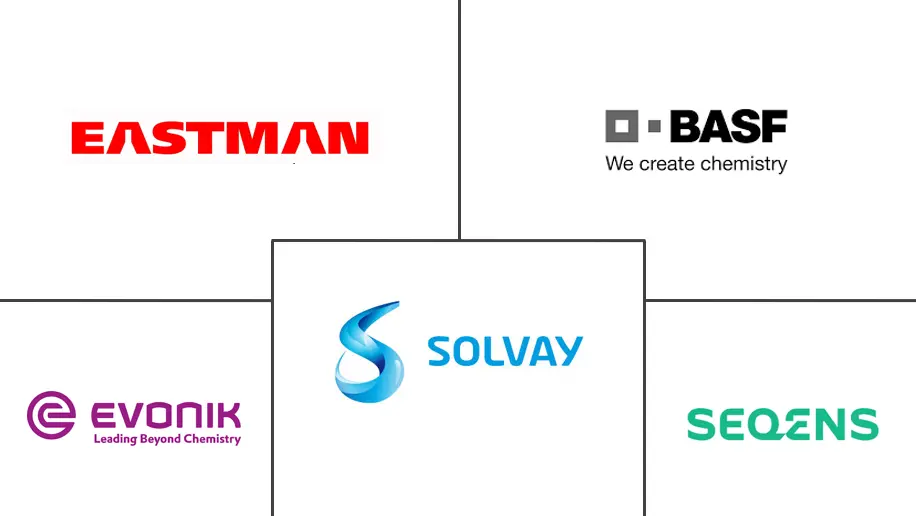
*Disclaimer: Major Players sorted in no particular order Image © Mordor Intelligence. Reuse requires attribution under CC BY 4.0. |
|
Low Volatile Organic Compounds Coating Additives Market Analysis by Mordor Intelligence
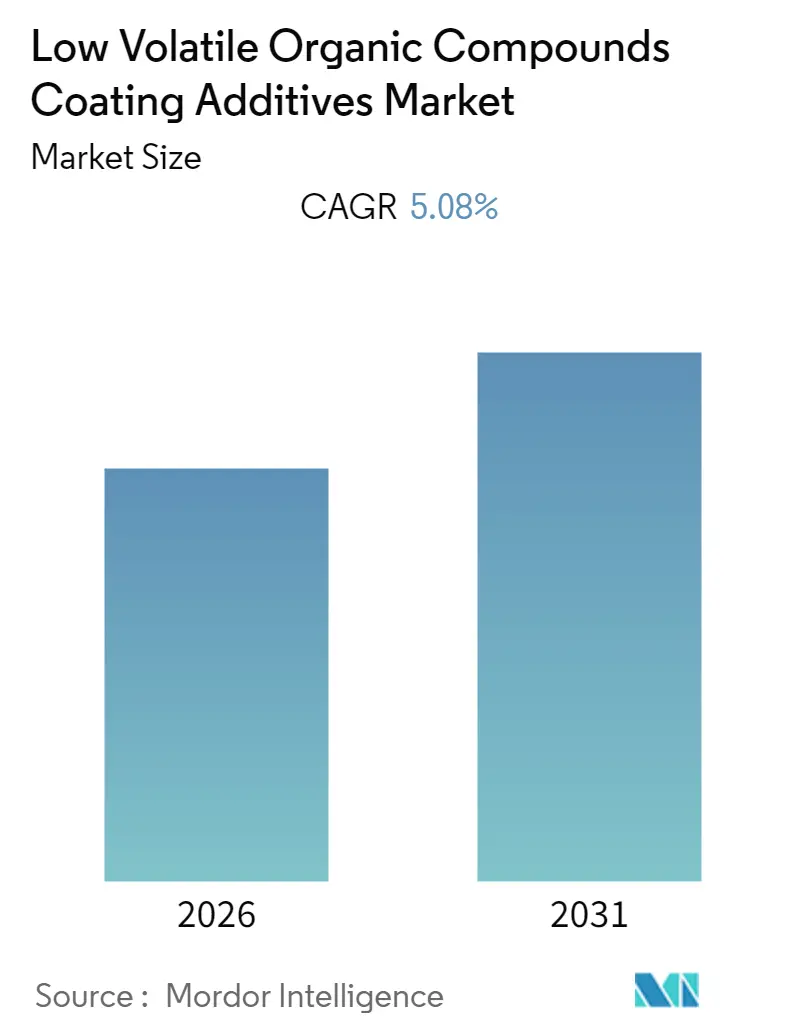
The Low Volatile Organic Compounds Coating Additives Market size is expected to register a CAGR of 5.08% during the forecast period.
- However, the outbreak of coronavirus across the globe is likely to hinder the growth of the studied market.
- The growing awareness and regulatory initiatives towards sustainability & environment-friendly products are likely to provide opportunities for the studied market, during the forecast period.
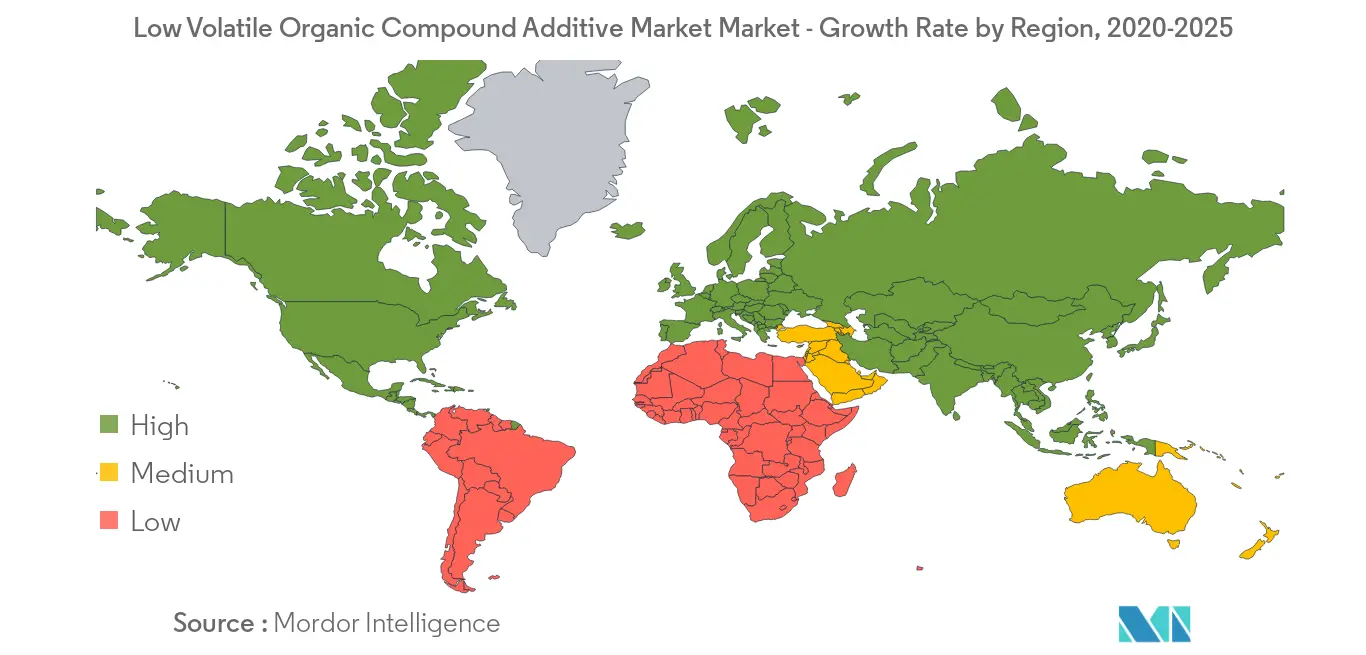
- Asia-Pacific region dominated across the world with increasing consumption from China, Vietnam, and India.
Note: Market size and forecast figures in this report are generated using Mordor Intelligence’s proprietary estimation framework, updated with the latest available data and insights as of 2026.
Global Low Volatile Organic Compounds Coating Additives Market Trends and Insights
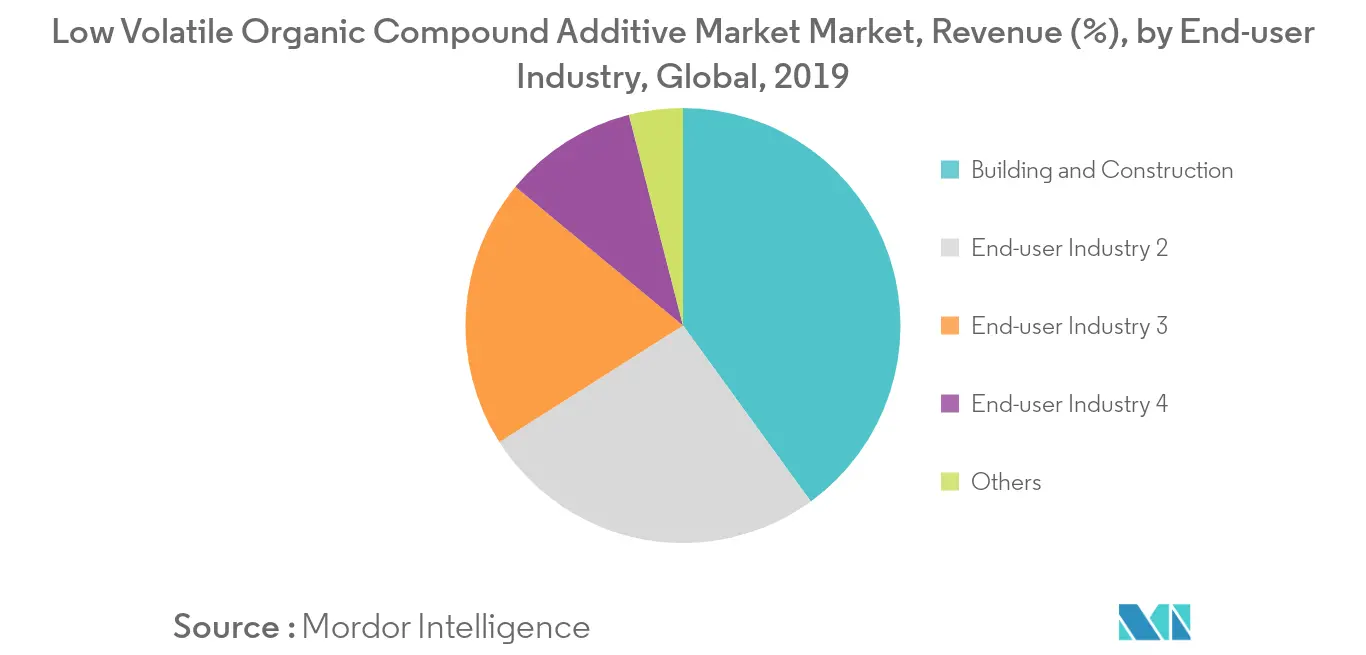
Building and Construction Industry to Dominate the Market
- Building and Construction industry stands to be the dominating segment owing to the continuous need for better and more advanced infrastructures.
- The building and construction segment includes low volatile organic compounds coating additives used in paints and coatings for commercial purposes, such as office buildings, warehouses, retail convenience stores, shopping malls, and residential buildings.
- The low volatile organic compounds coating additives are added to change their physical properties and employ properties such as stable color, high gloss, low environmental impact, and excellent surface appearance.
- The architectural coatings market is expected to register a CAGR of over 6%, during the forecast period. The increasing demand for decorative architectural coatings in houses, for greater aesthetics, is estimated to boost the demand for low volatile organic compounds coating additives in paints and coatings at a significant rate in the next few years.
- Volatile organic compounds evaporate, subsequently transfers harmful chemicals into the air that can be dangerous. Poor air quality can have a detrimental effect on the public's health, as well as the environment. Therefore, growing health concern and Stringent environmental regulations from agencies such as Environmental Protection Agency (EPA) and Registration, Evaluation, Authorization and Restriction of Chemicals (REACH) are expected to drive the market growth.
- Throughout the forecast timeframe, all the above conditions are anticipated to boost the demand for low volatile organic compounds coating additives.


Asia-Pacific Region to Dominate the Market
- Asia-Pacific has seen substantial growth in the demand for low volatile organic compounds coating additives in the recent past, especially from countries such as China, South Korea, and India owing to increasing infrastructural projects in the region.
- The Asia-Pacific paints and coatings market is estimated to witness significant growth, at an estimated CAGR of over 5%, over the forecast period. China is expected to witness the highest growth in construction activities, followed by India.
- In the Asia-Pacific region, the building and construction sector is experiencing good growth which is expected to provide a boost to the demand for paints and coating over the forecast period.
- For instance, China's 13th Five Year Plan started in 2016 as it was an important year for the country's engineering, procurement, and construction (EPC) industry. In addition to this, the country ventured into new business models domestically and internationally, during the year.
- Furthermore in India, the infrastructure sector has been one of the main areas of policy focus. The Government wants to improve the development of buildings in the country and has agreed to set up a single-window clearance system in order to provide swift approval of the construction projects.
- The growth in commercial and residential sectors is expected to boost the paints and coatings market in the country. Thus, driving the demand for low volatile organic compounds coating additives during the forecast period.

Regulatory Landscape
Regulation of low-VOC coating additives is anchored by VOC limits and reporting frameworks that constrain coating formulations, and in turn the additive packages used to deliver performance in waterborne and high-solids systems. In the United States, the Clean Air Act Section 183(e) framework is implemented via 40 CFR Part 59, covering categories such as architectural coatings and aerosol coatings, with compliance driven by federal standards and reinforced by state and local air-quality programs.
Recent rulemaking has tightened the compliance bar for related coating categories. The US EPA finalized amendments to the National VOC Emission Standards for Aerosol Coatings (January 2025), with compliance effective July 17, 2025, updating product-weighted reactivity limits and reactivity factors that push formulations toward lower-reactivity ingredients. In Europe, VOC controls for paints and varnishes are governed by Directive 2004/42/EC, while certification-led pull is reinforced by the EU Ecolabel. The European Commission adopted Commission Decision 2025/2607 (December 17, 2025) and confirmed updated EU Ecolabel requirements on February 5, 2026, including lower VOC and SVOC emission limits valid until December 31, 2032, which increases the importance of additives that enable compliant, low-emission formulations.
Value Chain Analysis
The value chain starts with upstream feedstocks (petrochemical and bio-attributed intermediates, siloxanes, waxes, surfactants, and polymer building blocks), followed by additive synthesis, blending, and performance tailoring by specialty chemical producers. Key supply-side participants include large additive manufacturers such as BASF, Evonik, Syensqo, Nouryon, and Borregaard, complemented by distributors that support regional availability and technical service for formulators, and certification/testing bodies that validate compliance claims for coatings sold into regulated end markets.
Downstream, additives are formulated into architectural, industrial/protective, wood, marine, and specialty coatings, then supplied through paint and coatings manufacturers to construction, automotive refinish, aerospace, furniture, and other end users. Specification and documentation demands increasingly shape the chain, as regulatory and ecolabel criteria translate into stricter raw-material screening (for low VOC/SVOC and low-SVHC profiles) and more frequent reformulation cycles. Regulatory tightening provides more direct pull-through: China implemented GB 30981.1-2025 and GB 30981.2-2025 in June 2026, lowering VOC limits for architectural interior wall flat coatings/primers (from 80 g/L to 50 g/L) and adding an SVOC limit (<=5 g/L), which raises demand for dispersants, wetting agents, defoamers, and rheology modifiers that enable application and appearance at reduced solvent levels.
Competitive Landscape
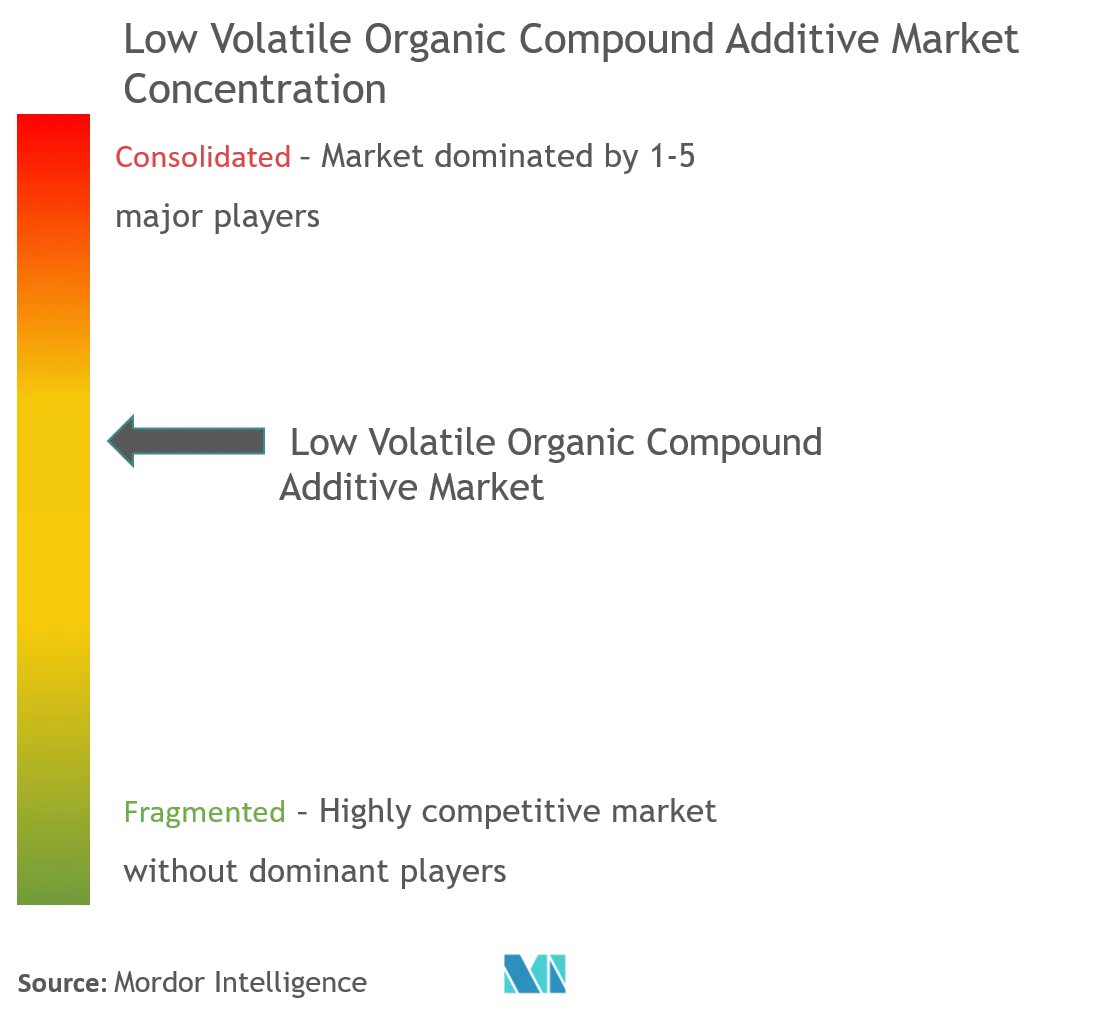
The global low volatile organic compounds coating additives market is partially consolidated in nature. Some of the major companies are Evonik AG, SEQENS, Eastman Chemical Company, BASF SE, and Solvay amongst others.
Low Volatile Organic Compounds Coating Additives Industry Leaders
-
Evonik AG
-
SEQENS
-
Eastman Chemical Company
-
Solvay
-
BASF SE
- *Disclaimer: Major Players sorted in no particular order

Market Opportunities and Future Outlook
Opportunities concentrate in additive technologies that help coatings meet tighter VOC and SVOC constraints while maintaining flow, open time, scrub resistance, corrosion performance, and low odor in waterborne and high-solids systems. Product activity in 2026 shows where suppliers are investing: Nouryon launched Alcosperse OTA-100 (April 2026) to help reduce reliance on glycol in low-odor, low-VOC water-based architectural paints; Evonik introduced Ancamine 2873 (April 2026), positioned as an ultra-low emission epoxy curing agent for protective and marine coatings with fast curing at low temperatures; and BASF expanded biomass-balanced additive offerings (July 2026) with new Dispex and Rheovis grades aimed at architectural formulations.
A second area of opportunity is sustainable-by-design additive portfolios that address both emissions and material-footprint requirements, including bio-based and microplastic-free solutions used in water-based coatings. Lubrizol announced Lanco 8020 SF (July 2026), a 100% bio-based, microplastic-free micronized wax additive for water-based wood coatings, reinforcing a shift toward renewable and non-migratory additive chemistries. On the demand side, tightening compliance and certification thresholds, including the updated EU Ecolabel requirements announced on February 5, 2026 and valid through 2032, creates recurring reformulation needs for decorative paints and varnishes, supporting higher-value additive bundles (dispersants, rheology modifiers, wetting agents, and defoamers) designed to meet low-emission criteria without sacrificing appearance and durability.
Recent Industry Developments
- April 2026: Evonik introduced Ancamine 2873, an ultra-low-emission epoxy curing agent for protective and marine coatings designed to retain performance at temperatures as low as 5 degrees Celsius. The launch addresses a common trade-off in low-VOC, high-solids systems where winter curing and productivity constraints can force formulators back toward higher-solvent options.
- June 2025: Evonik Coating Additives launched TEGO Foamex 8051, a new defoamer aimed at improving foam control in waterborne coatings. Stronger foam management supports higher solids and lower co-solvent formulations by reducing defects and rework, helping manufacturers meet tighter VOC targets while protecting finish quality.
- April 2024: Syensqo introduced Rhodoline HBR, an additive positioned to enable the phase-out of fluorosurfactants in architectural paint formulations, with VOC content of less than 1%. This development supports reformulation pathways where low-VOC requirements intersect with broader scrutiny of fluorinated chemistries in coatings supply chains.


Research Methodology Framework and Report Scope
Market Definition and Coverage
For this methodology, the market covers coating additives that help formulators meet low-VOC coating requirements by improving coating performance (such as flow, dispersion, foam control, and viscosity) with lower solvent contribution.
Scope exclusions: We exclude base resins, pigments, fillers, solvents, and VOC measurement or abatement equipment.
Segmentation Overview
-
Product Type
- Defoamers
- Dispersants
- Wetting Agents
- Rheology Modifiers
- Others
-
End-user Industry
- Building and Construction
- Automotive
- Aerospace
- Furniture
- Others
-
Geography
-
Asia-Pacific
- China
- India
- Japan
- South Korea
- Rest of Asia-Pacific
-
North America
- United States
- Canada
- Mexico
-
Europe
- Germany
- United Kingdom
- France
- Italy
- Rest of Europe
-
South America
- Brazil
- Argentina
- Rest of South America
-
Middle-East and Africa
- Saudi Arabia
- South Africa
- Rest of Middle-East and Africa
-
Asia-Pacific
Data Sources, Market Sizing, and Validation
Desk Research
We start by mapping the regulatory and demand backdrop that is pushing low-VOC coating formulations, since this sets realistic adoption levels by region and end-use. Public sources such as the US EPA VOC rules and guidance, the European Chemicals Agency (REACH) updates, and national air-quality agencies are used to understand compliance direction and timing.
Next, we connect coatings demand to additives consumption using industry-level production and trade signals. Sources such as the US Census Bureau manufacturing data, UN Comtrade trade statistics, Eurostat industrial production series, and peer-reviewed coatings journals help validate which end uses are expanding and where formulation changes are most visible. Company annual reports, investor presentations, association websites, and reputable press are used to cross-check capacity additions and product mix, and paid subscriptions for company financials and patent databases are used selectively to fill gaps for smaller private entities and track technology shifts. The sources named here are illustrative only, and other public and paid references were used for data collection, validation, and clarification.
Primary Interviews and Surveys
Our primary work focuses on coating formulators, additive suppliers, and downstream users in construction and industrial coatings, since the low-VOC push is strongest there and price sensitivity also differs by region. We use interviews and surveys to confirm adoption rates of low-VOC additive packages, typical dosage ranges, and how pricing is changing by additive family, then re-check results across APAC, EMEA, and the Americas to reduce regional bias.
Distribution of primary research fieldwork respondents
| Company type | Respondent position | Region |
|---|---|---|
| Top tier: 31% | CXOs: 14% | APAC: 50% |
| Mid tier: 49% | Functional/Unit leaders: 26% | EMEA: 29% |
| Smaller Players: 20% | Managers: 60% | Americas: 21% |
Market-Sizing & Forecasting
Our sizing starts with a top-down build that reconstructs the addressable coatings pool by end-use and region, then applies low-VOC formulation penetration to that pool before translating it into additive demand. To keep the model grounded, we use market fingerprints such as architectural and industrial coatings output trends, tightening VOC limits for key applications, the shift toward waterborne and high-solids systems, typical additive treat rates by function (defoaming, wetting, dispersing, and rheology control), and price movement patterns for specialty chemicals.
After the first pass, the totals are corroborated with selective bottom-up checks, including sampled supplier revenue splits, channel feedback on volume movement, and an ASP-times-volume approximation for a small set of additive categories. Where bottom-up detail is missing for smaller countries, gaps are handled using proxy indicators such as coatings production, construction activity, and import intensity, then sanity-checked using interview inputs. Forecasting uses scenario analysis supported by expert views on regulation timing, substitution pace, and formulation upgrades, and the final path is smoothed to reflect practical change rates seen in real purchasing cycles.
Data Validation & Update Cycle
We validate results through several layers of checks so the final numbers do not rely on a single assumption. Model outputs are compared against independent signals such as coatings production trends, trade flows of relevant chemical groups, and the direction of VOC regulations, and then outliers are reviewed and corrected through follow-up discussions.
Before sign-off, another analyst reviews key assumptions, recalculates sensitive lines, and tests how much the total moves under small shifts in penetration and pricing. Reports are refreshed annually, with interim updates when material events occur (for example, major regulation changes or large capacity moves). Before delivery, an analyst performs a fresh pass so clients receive the latest updated view.
Mordor Intelligence's Low Volatile Organic Compounds Coating Additives Market Size Measured Against Other Published Estimates
Different published sizes for this market are common because the boundary between low-VOC additives and the wider coating additives universe is not handled the same way by every publisher, and base years also vary. We keep the comparison focused on current-year values and the scope rules behind them, since that is usually where the spread starts.
Key gap drivers for this market usually come from what is counted as an additive versus a low-VOC enabling component, and whether solvent-borne performance additives are included even when they do not reduce VOC. Assumptions on treat rates and pricing also move totals, since the same coatings volume can translate into different additive value depending on dosage and the chosen average selling price progression, and some estimates are not rechecked when VOC rules shift in a region.
Benchmark comparison
| Source | Market Size | Gaps in Research Methodology |
|---|---|---|
| Mordor Intelligence | USD 4.52 B (2024) | |
| Industry Publisher A | USD 5.62 B (2025) | Uses a later base year and appears to include a broader set of coating additive spend tied to low-VOC coatings, which can lift value even if actual low-VOC enabling dosage does not change as much. |
| Trade Journal B | USD 4.52 B (2024) | Often reflects a headline market value from a press-style summary with limited detail on additive-family boundaries, so overlaps with adjacent specialty additives may not be fully removed. |
Coatings production direction and VOC regulation timing are the two checks that keep Mordor Intelligence's estimate tied to a clear low-VOC demand pool rather than the full additives basket. The comparison shows that year choice and scope edges around what counts as low-VOC enabling additives explain most differences, so a repeatable model with transparent treat-rate and pricing logic helps users interpret the numbers consistently.


Key Questions Answered in the Report
What is the current Low Volatile Organic Compounds Coating Additives Market size?
The Low Volatile Organic Compounds Coating Additives Market is projected to register a CAGR of 5.08% during the forecast period (2026-2031)
Who are the key players in Low Volatile Organic Compounds Coating Additives Market?
Evonik AG, SEQENS, Eastman Chemical Company, Solvay and BASF SE are the major companies operating in the Low Volatile Organic Compounds Coating Additives Market.
Which is the fastest growing region in Low Volatile Organic Compounds Coating Additives Market?
Asia Pacific is estimated to grow at the highest CAGR over the forecast period (2026-2031).
Which region has the biggest share in Low Volatile Organic Compounds Coating Additives Market?
In 2025, the Asia Pacific accounts for the largest market share in Low Volatile Organic Compounds Coating Additives Market.
What years does this Low Volatile Organic Compounds Coating Additives Market cover?
The report covers the Low Volatile Organic Compounds Coating Additives Market historical market size for years: 2019, 2020, 2021, 2022, 2023 and 2024. The report also forecasts the Low Volatile Organic Compounds Coating Additives Market size for years: 2026, 2027, 2028, 2029, 2030 and 2031.
Page last updated on:


 Your data is secure and never sold or shared.



