
Long-chain Dicarboxylic Acid Market Size and Share
Market Overview
| Study Period | 2020 - 2031 |
|---|---|
| Market Size (2026) | USD 243.78 Million |
| Market Size (2031) | USD 308.92 Million |
| Growth Rate (2026 - 2031) | 4.85 % |
| Fastest Growing Market | Asia Pacific |
| Largest Market | Asia Pacific |
| Market Concentration | Medium |
Major Players *Disclaimer: Major Players sorted in no particular order Image © Mordor Intelligence. Reuse requires attribution under CC BY 4.0. | |
Long-chain Dicarboxylic Acid Market Analysis by Mordor Intelligence
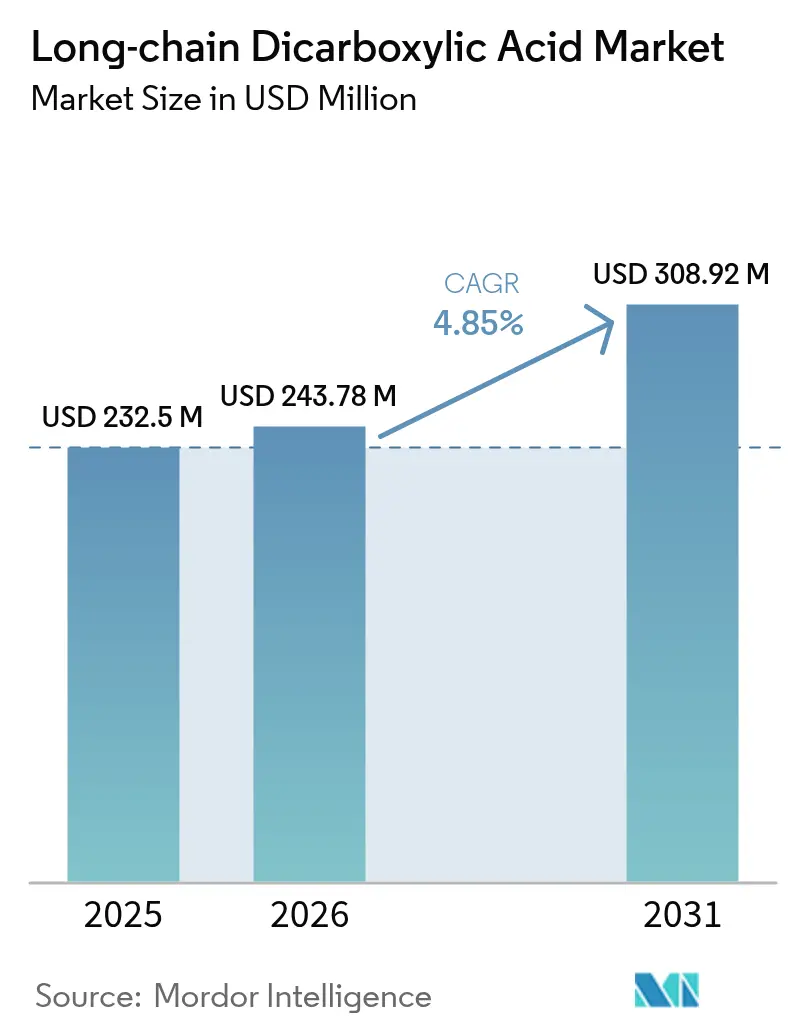
The Long-chain Dicarboxylic Acid market size is expected to grow from USD 232.5 Million in 2025 to USD 243.78 Million in 2026 and is forecast to reach USD 308.92 Million by 2031 at 4.85% CAGR over 2026-2031. Strong demand from high-performance coatings, specialty polyamides, and implant-grade polymers is elevating both volume and value creation. Powder-coated electric‐vehicle battery casings, high-temperature nylons for e-mobility, and bio-based capacity additions in Asia-Pacific are the primary engines of growth. Elevated qualification hurdles in aerospace and medical applications lend pricing power to incumbent suppliers, while tightening sustainability regulations push formulators toward bio-based routes that cut greenhouse-gas emissions by up to 90%. Raw-material volatility, notably in tall-oil feedstocks, keeps cost structures under pressure and spurs diversification of bio-based supply chains.
Key Report Takeaways
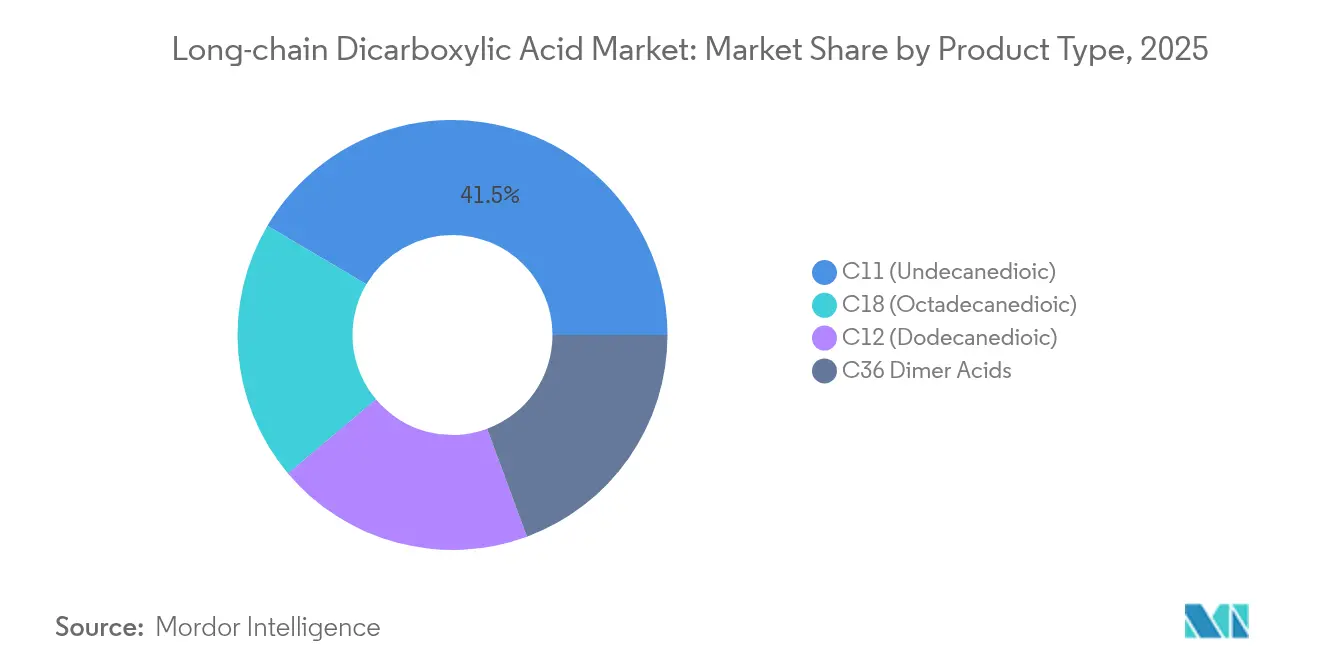
- By product type, C11 (undecanedioic) acid led with the largest share of 41.51% in the Long-chain Dicarboxylic Acid market in 2025. However, C18 (octadecanedioic) acid is projected to expand with the fastest CAGR of 5.22% through 2031.
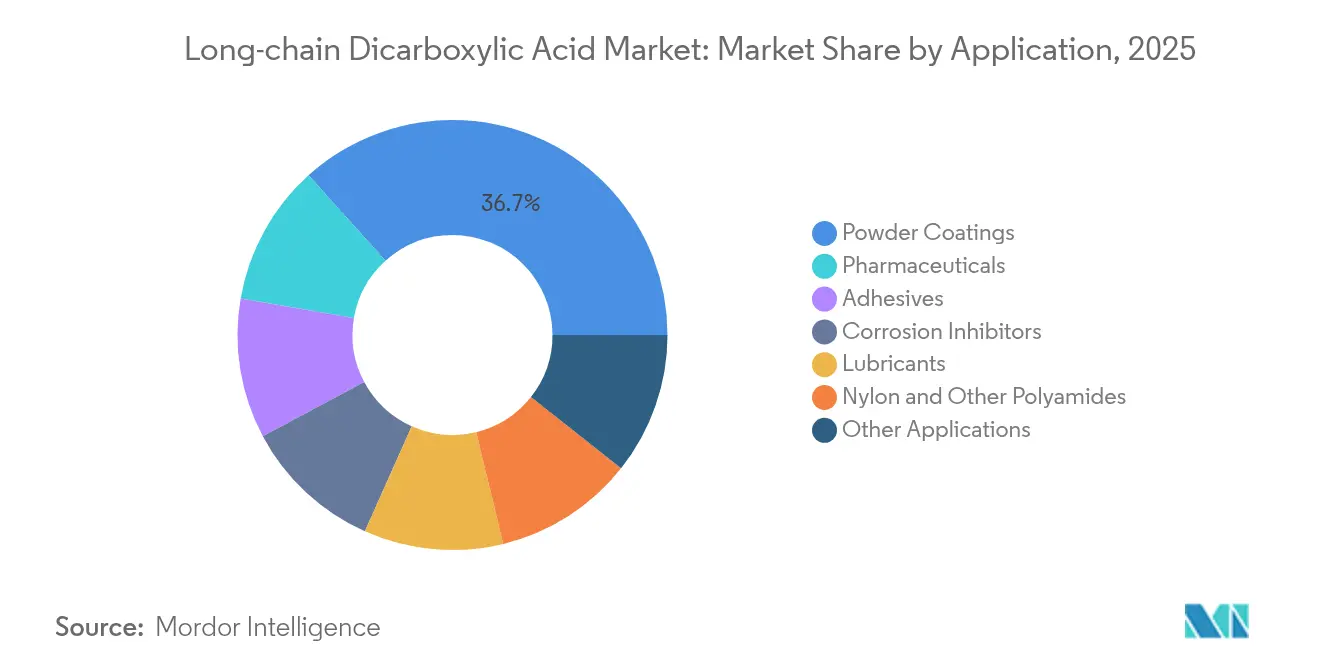
- By application, powder coatings accounted for the largest share of 36.68% in the Long-chain Dicarboxylic Acid market revenue. However, pharmaceuticals application is forecasted to grow the fastest CAGR of 5.63% by 2031.
- By geography, Asia-Pacific contributed 43.98% revenue share in 2025, growing at a 6.05% CAGR through 2031.
Note: Market size and forecast figures in this report are generated using Mordor Intelligence’s proprietary estimation framework, updated with the latest available data and insights as of 2026.
Global Long-chain Dicarboxylic Acid Market Trends and Insights
Drivers Impact Analysis*
| Driver | (~) % Impact on CAGR Forecast | Geographic Relevance | Impact Timeline |
|---|---|---|---|
| Growth in Powder Coatings for EV Battery Casings | +1.2% | Global, with concentration in China, Europe, North America | Medium term (2-4 years) |
| Demand for High-Temperature Nylon in E-mobility | +0.9% | APAC core, spill-over to North America and Europe | Medium term (2-4 years) |
| Expanding Aerospace Use of Corrosion-resistant Polyamides | +0.7% | North America & Europe, emerging in APAC | Long term (≥ 4 years) |
| Asia-Pacific's Specialty Polyamide Capacity Additions | +0.8% | APAC core, global supply impact | Short term (≤ 2 years) |
| Niche Medical Demand for LCDA-based Implants | +0.5% | Global, led by North America and Europe | Long term (≥ 4 years) |
| Source: Mordor Intelligence | |||
Growth in Powder Coatings for EV Battery Casings
Safety-critical electric-vehicle battery housings increasingly specify powder coatings formulated with long-chain dicarboxylic acids for dielectric strength, corrosion resistance, and thermal-shock durability. AkzoNobel introduced a single-spray coating line in 2024 that meets Importer Exporter Code (IEC) battery insulation norms while reducing process steps [1]AKZONOBEL Staff, “Battery-Safe Powder Coatings for EV Platforms,” AkzoNobel, akzonobel.com. Automakers now treat coating performance as a functional component of battery safety, bolstering premium demand for C11-rich crosslinkers. The addressable market widens as commercial-vehicle fleets scale electrification and stationary energy-storage systems demand robust enclosures. Regulatory tightening in China, the United States, and the European Union on battery-fire risk further underpins this driver.
Demand for High-Temperature Nylon in E-mobility
Motor housings, inverter connectors, and fast-charging components in electrified drivetrains operate above 200°C, outstripping the thermal ceilings of legacy polyamides. Long-chain dicarboxylic acids impart molecular flexibility, allowing nylon 6T and 9T to sustain mechanical integrity at 230°C continuous service. BASF’s Ultramid ENDURE platform illustrates the commercial traction for such resins, combining weight savings with chemical resistance to glycol coolants. Broader charging-infrastructure build-out pushes demand into grid-scale enclosures and heat-management systems, sustaining double-digit volume growth for lauric diacid (LCDA)-modified polyamides.
Expanding Aerospace Use of Corrosion-Resistant Polyamides
Composite air-frame parts and cabin-interior panels increasingly substitute metal sub-assemblies with flame-smoke-toxicity compliant polyamides derived from long-chain dicarboxylic acids. Qualification cycles lasting 2-4 years create high switching costs, so suppliers that clear Federal Aviation Administration (FAA) and European Union Aviation Safety Agency (EASA) testing secure multi-decade revenue streams. The materials deliver weight reductions and resistance to hydraulic fluids, while retaining strength after salt-spray exposure. New flame, smoke, and toxicity (FST)-rated grades are expanding addressable use in seat structures and galley fittings, widening aerospace pull-through over the forecast horizon.
Asia-Pacific Specialty Polyamide Capacity Additions
Cathay Industrial Biotech’s USD 500 Million investment at Wusu doubles regional LCDA output to meet rising domestic and export demand. China’s five-year plan endorses bio-based chemical self-sufficiency, accelerating additional projects in Jiangsu and Shandong. Near-term capacity growth eases supply bottlenecks for nylon compounds and powder coatings, allowing formulators to design new applications without rationing constraints. Nevertheless, customer concerns over single-country dependency stimulate interest in alternative production hubs across India and Southeast Asia.
Restraints Impact Analysis*
| Restraint | (~) % Impact on CAGR Forecast | Geographic Relevance | Impact Timeline |
|---|---|---|---|
| Volatile Tall-oil Supply Impacting Cost Base | -0.8% | Global, particularly North America and Europe | Short term (≤ 2 years) |
| Slow Qualification Cycles in Aerospace and Medical | -0.6% | North America & Europe primarily | Long term (≥ 4 years) |
| Limited Global Production Capacity Concentration | -0.4% | Global, with acute impact in Europe | Medium term (2-4 years) |
| Source: Mordor Intelligence | |||
Volatile Tall-oil Supply Impacting Cost Base
Tall oil supply volatility creates significant cost pressures for long-chain dicarboxylic acid producers, as this kraft pulping byproduct is a primary feedstock for bio-based production routes. The global production of tall oil approximates 1.2 Million tonnes annually, with supply fluctuations directly tied to paper industry dynamics and forest product demand cycles. Supply chain disruptions in the forestry sector, particularly in North America and Scandinavia, create cascading effects on tall oil fatty acid availability and pricing, directly impacting production costs for downstream dicarboxylic acids. This constraint becomes more pronounced as producers shift toward bio-based feedstocks to meet sustainability requirements, creating increased competition for limited tall oil supplies. The challenge intensifies during periods of reduced paper production, when tall oil generation decreases while demand for bio-based chemicals continues growing.
Slow Qualification Cycles in Aerospace and Medical
Extended qualification timelines in aerospace and medical applications create market entry barriers that constrain rapid adoption of new long-chain dicarboxylic acid formulations. Aerospace material qualification processes typically require 2-4 years of testing and documentation, with requirements for extensive environmental exposure testing and mechanical property validation under various conditions NASA. Medical device applications face similar constraints, with biocompatibility testing and regulatory approval processes extending development timelines and increasing market entry costs. These qualification requirements create a dual constraint: they limit the speed at which innovative formulations can reach market while simultaneously creating barriers for new suppliers seeking to establish relationships with aerospace and medical customers.
*Our forecasts treat driver/restraint impacts as directional, not additive. The impact forecasts reflect baseline growth, mix effects, and variable interactions.
Segment Analysis
By Product Type: C11 Dominance Drives Crosslinking Innovation
C11 acid accounted for 41.51% of the Long-chain Dicarboxylic Acid market in 2025, anchoring its status as the go-to crosslinker for powder coatings and reactive adhesives. This chain length delivers optimal melt viscosity and crosslink density, translating into hard yet flexible films for EV battery enclosures. The long-chain dicarboxylic acids market size for C11 applications will advance steadily as automakers widen electric vehicle (EV) portfolios and industrial original equipment manufacturers (OEMs) phase out solvent-borne paints. C18 acid, though only 19.62% of 2025 volume, leads incremental gains at a 5.22% CAGR owing to its role in high-temperature polyamide fibers that service e-mobility and aerospace wire harnesses.
Bio-fermentation technology tilts the competitive field: Cathay Industrial Biotech and several Chinese start-ups operate proprietary yeast strains that yield C11 and C12 diacids at 30% lower unit energy, securing contracts with coating majors and compounders . Western producers respond by improving petrochemical oxidation routes and seeking licensing deals for fermentation know-how. Intellectual-property depth and consistent product purity remain decisive competitive levers across the product spectrum.



By Application: Pharmaceuticals Accelerate Despite Powder-Coating Leadership
Powder-coating formulations consumed 36.68% of 2025 volumes, reinforcing the application’s dominant place in the Long-chain Dicarboxylic Acid market. Robust demand from electrified mobility, architectural cladding, and general-industrial components sustains mid-single-digit growth, even as formulators extract higher functionality per kilogram. Pharmaceuticals captured just 10.60% volume in 2025 but posted a leading 5.63% CAGR, leveraging LCDA-based polyesters that biodegrade without acidic by-products, a key attribute for resorbable sutures and drug-eluting stents. As clinical evidence accumulates, the Long-chain Dicarboxylic Acids market share of pharmaceuticals will double by 2031.
Nylon and other polyamide uses remain the second-largest application block, supported by automotive lightweighting mandates and the shift to metal-replacement in electrical connectors. Adhesives and lubricants combine niche technical requirements, chemical resistance, high-temperature stability, and hydrophobicity, which LCDA chemistries meet uniquely. Corrosion-inhibitor demand gathers momentum in offshore wind foundations and marine shipping, where legacy chromate systems face regulatory phase-out.
Geography Analysis
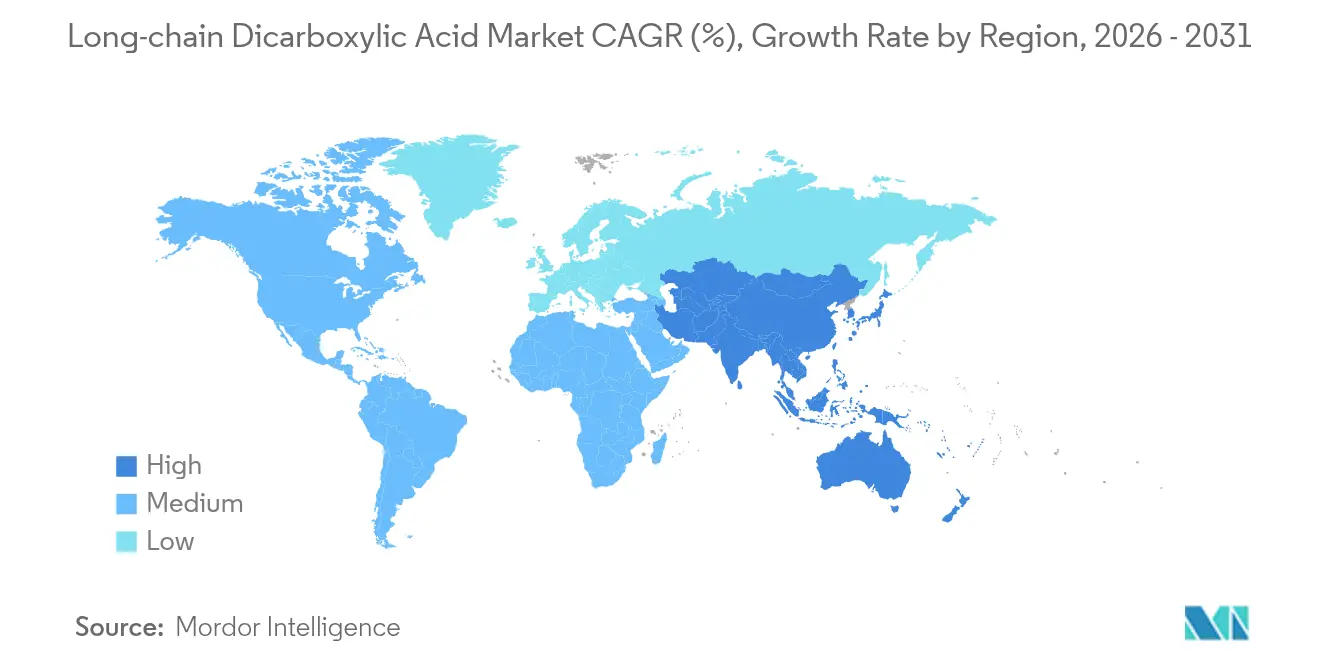
Asia-Pacific generated 43.98% of global sales in 2025, sustaining the fastest regional CAGR at 6.05% through 2031. The region hosts integrated value chains from tall-oil derivatives to EV and smartphone assembly, ensuring captive demand for C11-C18 diacids. Cathay Industrial Biotech’s USD 500 million doubling of Wusu output exemplifies government-backed capacity build-outs that de-risk supply security for downstream users. India and Vietnam are deploying fermentation hubs tied to sugar-ethanol corridors, widening regional diversification beyond China.
North America represents an innovation-driven hub where aerospace and medical OEMs adopt LCDA-based materials under rigorous performance protocols. INVISTA is re-commissioning hexamethylene-diamine assets with a USD 23 million CAD upgrade to ensure backward integration into high-temperature nylon franchises. Eastman Chemical’s USD 375 million Department of Energy grant for a second methanolysis site illustrates federal incentives harnessed to circular-economy objectives. Such moves reinforce domestic supply resilience amid a growing policy emphasis on strategic materials.
Europe contends with energy-price inflation that compresses margins for oxidation-based LCDA routes, but regulatory leadership on sustainability favors bio-based imports and local biotech collaborations. Croda International’s partnership with the United Kingdom universities aims to unlock biodegradable polymer platforms that embed undecanedioic acid for home-care and crop-care formulations. The European Commission’s biotechnology roadmap targets higher-value niches, encouraging corporate alignment toward specialty LCDA derivatives. Emerging markets in South America and the Middle East & Africa are building demand off low bases, centered on lubricants for mining fleets and corrosion inhibitors for infrastructure expansion.

Value Chain Analysis
The long-chain dicarboxylic acid (LCDA) value chain begins with feedstocks split between petro-based paraffins/n-alkanes and renewable fatty-acid streams (including vegetable oils and tall-oil-derived fatty acids). Conversion is typically handled through oxidation routes, with bio-based fermentation and omega-oxidation using engineered yeast strains playing an increasing role, where process economics and product purity determine fit for downstream engineering plastics, coatings, and implant-grade polymer applications. Upstream participation is concentrated among integrated and fermentation-focused producers such as Cathay Biotech, along with other specialists referenced in the market (for example, Novacid and Shandong Guangtong New Materials for straight-chain diacids).
On the downstream side, LCDA is sold as commodity or intermediate grades into compounders and formulators, while high-purity grades flow into specialty polyamides and medical materials. In these higher-spec applications, qualification and consistency requirements raise switching costs. Distribution is commonly organized around direct sales to large coating, polymer, and chemical customers supported by application-development services, while smaller volumes typically move through chemical distributors. Capacity and consistency constraints center on renewable feedstock availability (notably tall oil) and on qualified production for consistent C11-C18 grades, which supports multi-source strategies and, where feasible, backward integration.
Competitive Landscape
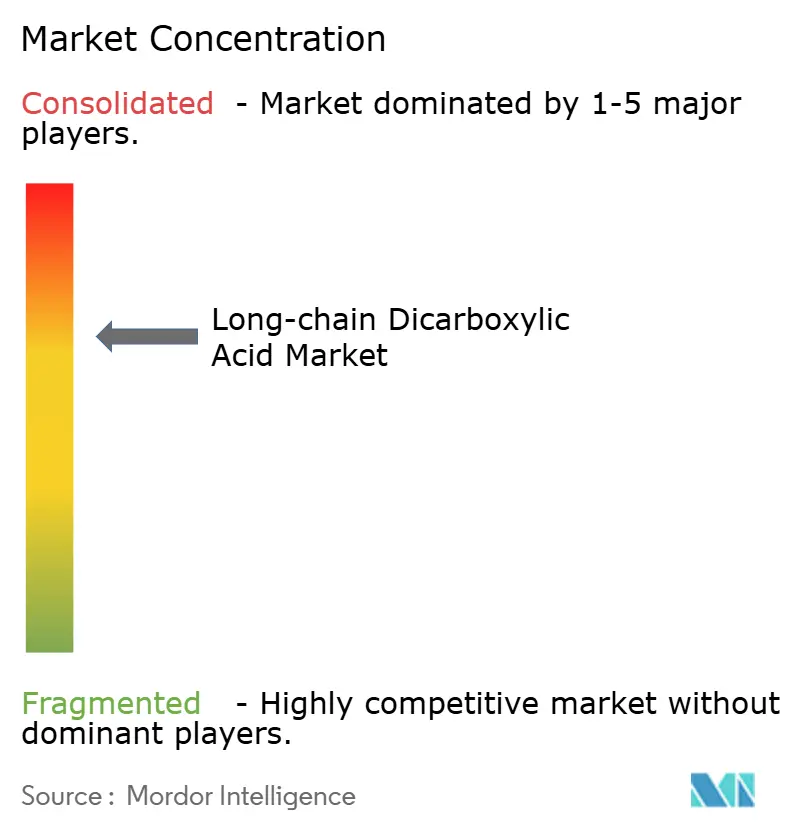
The Long-chain Dicarboxylic Acid market is moderately consolidated with major players, such as Cathay Biotech Inc., INVISTA, dsm-firmenich, Zibo Guangtong Chemical Co., Ltd., and Henan Junheng Industrial Group Biotechnology Co., Ltd. INVISTA and Eastman Chemical command entrenched positions in nylon intermediates, leveraging integrated monomer streams and multi-regional production footprints. Cathay Biotech Inc. possesses cost-efficient fermentation, shipping C11 diacid at benchmark quality while pioneering C12 production with a greenhouse-gas advantage. Investment patterns highlight a pivot to sustainability. Eastman’s USD 2.25 billion circular-chemistry program and Hyosung’s USD 1 billion Vietnamese plant underline capital re-allocation toward low-carbon intermediates. Qualification moats in aerospace and medical create durable revenue streams for incumbents, yet high entry costs hinder diversification, keeping overall market concentration moderate.
Long-chain Dicarboxylic Acid Industry Leaders
Cathay Biotech Inc.
INVISTA
Henan Junheng Industrial Group Biotechnology Co., Ltd.
Zibo Guangtong Chemical Co., Ltd.
dsm-firmenich
- *Disclaimer: Major Players sorted in no particular order

Market Opportunities and Future Outlook
Opportunities cluster around bio-based LCDA supply and around application-specific grades that lower qualification and processing friction for coatings, high-temperature nylons, and medical polymers. The report context points to large, dedicated fermentation investments as a lever for expanding available capacity, including Cathay Industrial Biotech's USD 500 million Wusu expansion and Hyosung's USD 1 billion Vietnam fermentation facility aimed at 50,000 metric tonnes per year by 2026. Together, these actions indicate room for additional regional supply hubs, along with tolling and partnership models that can diversify feedstocks beyond tall oil and improve supply security for Asia-Pacific and export customers.
From the demand perspective, powder coatings and specialty polyamides remain the main pull-through areas. The report context also cites AkzoNobel activity in battery-safe powder coatings and BASF traction in high-temperature nylon platforms. Beyond these core uses, whitespace is present in adhesives, lubricants, and corrosion inhibitors, where performance depends on chain-length and purity control (C11 to C18 and beyond) and where buyers increasingly seek lower-carbon raw-material declarations. Eastman Chemical’s Department of Energy-backed methanolysis build-out (USD 375 million grant referenced in the report context) supports circular polymer feedstock availability, which in turn creates adjacent opportunities for LCDA-linked materials in recycled-content polymer systems and sustainability-targeted specialty formulations.
Recent Industry Developments
- April 2026: Cathay Biotech disclosed in its 2025 annual reporting that its long-chain dicarboxylic acids production capacity reached 115,000 tons and ran at 96.2% utilization. The same disclosure indicated its 2025 LCDA sales volume exceeded 100,000 tons for the first time, reinforcing scale advantages in fermentation-based supply for C11-C18 grades.
- August 2025: China National Aviation Fuel Company (CNAF) announced an investment tied to a sustainable aviation fuel (SAF) plant controlled by Henan Junheng Industrial Group Biotechnology. The investment signaled state-backed funding momentum for bio-based processing chains that overlap with fermentation capabilities used to make long-chain diacids and related intermediates.
- April 2024: Hyosung announced a USD 1 billion investment in a Vietnam fermentation facility with targeted capacity of 50,000 metric tonnes per year by 2026 for biobased products. The project underlined Asia-Pacific capital allocation toward fermentation infrastructure that can support broader bio-based chemical supply chains relevant to long-chain dicarboxylic acids.


Research Methodology Framework and Report Scope
Market Definition and Coverage
For this study, the market covers the value of long-chain dicarboxylic acids sold for downstream use, including key chain-length products that are commonly tracked across the industry and traded globally.
Scope exclusions: We exclude captive internal transfers that are not priced as external sales, and we also exclude downstream finished polymers, coatings, or lubricants that only use these acids as an input.
Segmentation Overview
- By Product Type (Chain Length)
- C11 (Undecanedioic)
- C12 (Dodecanedioic)
- C18 (Octadecanedioic)
- C36 Dimer Acids
- By Application
- Powder Coatings
- Nylon and Other Polyamides
- Adhesives
- Lubricants
- Pharmaceuticals
- Corrosion Inhibitors
- Other Applications
- By Geography
- Asia-Pacific
- China
- India
- Japan
- South Korea
- Rest of APAC
- North America
- United States
- Canada
- Mexico
- Europe
- Germany
- United Kingdom
- Italy
- France
- Rest of Europe
- South America
- Brazil
- Argentina
- Rest of South America
- Middle East and Africa
- Saudi Arabia
- South Africa
- Rest of Middle East and Africa
- Asia-Pacific
Data Sources, Market Sizing, and Validation
Desk Research
Desk work starts by mapping what is produced, traded, and consumed, then narrowing it down to long-chain dicarboxylic acid use cases. We rely on public sources such as USITC and UN Comtrade trade statistics, U.S. EPA and ECHA chemical substance records, World Bank and IMF macro series for industrial activity, and journal literature that describes application trends (including polyamides and coatings).
After that, we layer in company filings, investor presentations, press releases, and association websites to understand capacity additions, plant operating patterns, and end-use pull. When needed, we also use paid subscriptions for company financials and intelligence, patent databases, and shipment-level import and export tracking to sanity-check directionally. The sources named above are illustrative and not exhaustive, and many other references were also used for data collection, validation, and research clarification.
Primary Interviews and Surveys
Primary work is used to confirm the practical boundaries of the market and the price and volume logic behind each key application. We speak with producers, distributors, and downstream users across major consuming regions so items like application split, typical contract terms, and recent price movement can be checked and then fed back into the model.
Distribution of primary research fieldwork respondents
| Company type | Respondent position | Region |
|---|---|---|
| Top tier: 27% | CXOs: 19% | APAC: 40% |
| Mid tier: 52% | Functional/Unit leaders: 22% | EMEA: 33% |
| Smaller Players: 21% | Managers: 59% | Americas: 27% |
Market-Sizing & Forecasting
Sizing is built using top-down and bottom-up logic, where production and trade indicators are used to reconstruct the addressable demand pool by region, and then totals are checked against selective supplier and channel approximations. In practice, we start from end-use demand signals that are visible, then translate them into long-chain dicarboxylic acid consumption using typical use rates and conversion factors that were confirmed in interviews.
Key inputs include end-use activity in nylon and other polyamides, powder coatings output trends, lubricants blending demand, adhesives and sealants production indicators, and the spread between contract pricing and spot pricing for relevant grades. Since the market is sensitive to feedstock and energy cost swings, pricing assumptions are refreshed using recent transaction ranges and normalized for the model year. Forecasting is done using scenario analysis supported by short-run time series smoothing on demand indicators, and then adjusted using expert views on capacity additions, bio-based process adoption, and application substitution trends. Where bottom-up checks are missing for smaller regions, we fill the gap using per-industry intensity proxies that are cross-checked with trade flow direction and local manufacturing presence.
Data Validation & Update Cycle
Validation is done through cross-checks that look for mismatches between the model and independent signals, and then the drivers are re-tested before sign-off. We compare implied consumption with trade balances, known capacity changes, and application-level growth rates, and anomalies are reviewed again by another analyst so errors do not propagate.
The report is refreshed annually, and interim updates are made when there is a material event such as a major capacity start-up, prolonged shutdown, or sharp pricing shock. Before delivery, a final check pass is completed so clients receive the most current version of the model and commentary that matches the latest market situation.
Mordor Intelligence's Long Chain Dicarboxylic Acid Market Estimate Compared With Other Published Estimates
Published market sizes for long-chain dicarboxylic acid often look different because each publisher draws the product set and application coverage differently, and they also use different price-year assumptions. The timing of the estimate (base year versus forecast start year) matters as well, since LCDA pricing and specialty polymer demand can shift the value even when volumes move slowly.
Trade-flow direction, application-level demand checks (nylon and other polyamides, powder coatings, lubricants, and adhesives), and recent contract price ranges are used as evidence to keep Mordor Intelligence tied to external sales of C11, C12, C18, and C36 dimer acids in 2026, instead of mixing in adjacent specialty acids or downstream finished materials. Other figures can move higher when additional end-user lenses are summed on top of applications, or when currency timing and average grade mix are not refreshed to match the pricing year being reported.
Benchmark comparison
| Source | Market Size | Gaps in Research Methodology |
|---|---|---|
| Mordor Intelligence | USD 243.78 M (2026) | |
| Industry Publisher A | USD 281.10 M (2025) | Uses a 2025 base year and a broader scope description that can bundle adjacent diacids, and the market value depends on a different assumed average price level and regional mix than a 2026 price-year view. |
| Industry Publisher B | USD 293.20 M (2025) | Reports a higher 2025 value that may reflect added end-user groupings and a less explicit separation between application totals and property or end-use lenses, which can inflate the summed value if overlaps are not removed. |
Across the three figures, most of the spread comes from the year used for pricing and the exact product basket treated as LCDA, followed by how overlaps across application and end-use groupings are handled. When those items are defined consistently and checked against trade balance and capacity signals, the resulting number stays easier to trace and repeat during updates.


Key Questions Answered in the Report
What is the projected size of the Long-chain Dicarboxylic Acid market by 2031?
The Long-chain Dicarboxylic Acid market size is forecast to reach USD 308.92 Million by 2031, driven by a 4.85% CAGR.
Which region leads demand and growth for long-chain dicarboxylic acids?
Asia-Pacific commands 43.98% of 2025 revenue and is expanding fastest at 6.05% CAGR thanks to large-scale bio-based capacity additions.
Why are long-chain dicarboxylic acids critical to EV battery casings?
They enable powder-coating formulations with high dielectric strength and corrosion resistance, improving battery safety and longevity.
Which product type dominates the market today?
C11 (undecanedioic) acid holds 41.51% market share due to its optimal crosslinking performance in coatings and adhesives.
What is the main constraint on market growth?
Volatile tall-oil feedstock supply raises production costs, clearing 0.8% points off forecast CAGR.
Page last updated on:


 Your data is secure and never sold or shared.


