
Liquid Crystal Polymer (LCP) Films And Laminates Market Size and Share
Market Overview
| Study Period | 2020 - 2031 |
|---|---|
| Market Volume (2026) | 67.85 Million square meters |
| Market Volume (2031) | 90.64 Million square meters |
| Growth Rate (2026 - 2031) | 5.99 % |
| Fastest Growing Market | Asia Pacific |
| Largest Market | Asia Pacific |
| Market Concentration | Medium |
Major Players
*Disclaimer: Major Players sorted in no particular order Image © Mordor Intelligence. Reuse requires attribution under CC BY 4.0. |
|
Liquid Crystal Polymer (LCP) Films And Laminates Market Analysis by Mordor Intelligence
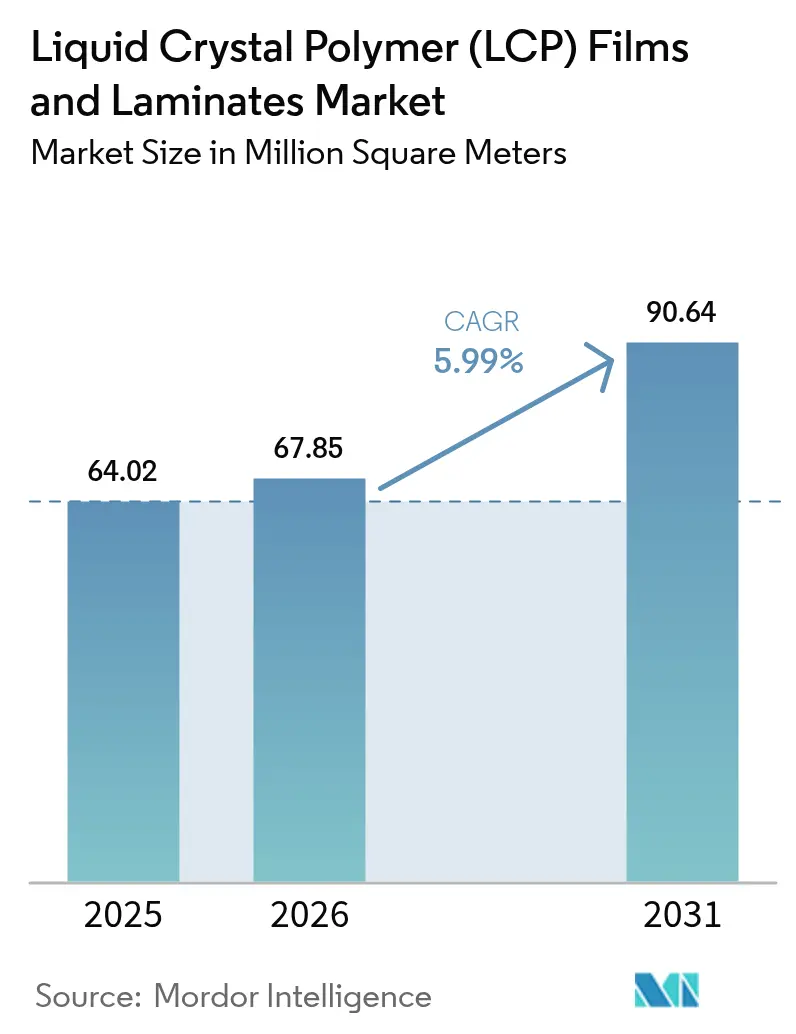
Liquid Crystal Polymer (LCP) Films And Laminates Market size in 2026 is estimated at 67.85 million square meters, growing from 2025 value of 64.02 million square meters with 2031 projections showing 90.64 million square meters, growing at 5.99% CAGR over 2026-2031. Momentum stems from 5G infrastructure, foldable device form factors, and automotive imaging radar, which together reinforce demand resilience despite raw material volatility. Manufacturers continue to migrate away from polyimide and PTFE substrates because Liquid Crystal Polymer (LCP) Films and Laminates market materials maintain a 2.9 – 3.5 dielectric constant and <0.004 dissipation factor across millimeter-wave bands, preserving signal integrity even in high-humidity climates. Localization of capacity in East Asia now shortens lead times for handset and base-station customers, while sustainability-driven mass-balance grades create a new premium niche. Cost headwinds linger in Europe and North America where elevated energy tariffs inflate processing expenses, yet incremental productivity gains from ultra-high-flow grades and adhesiveless laminates temper margin pressure. Competitive strategy centers on vertical integration, patent-protected monomer routes, and regional technical support centers that expedite design-in cycles for advanced antenna modules.
Key Report Takeaways
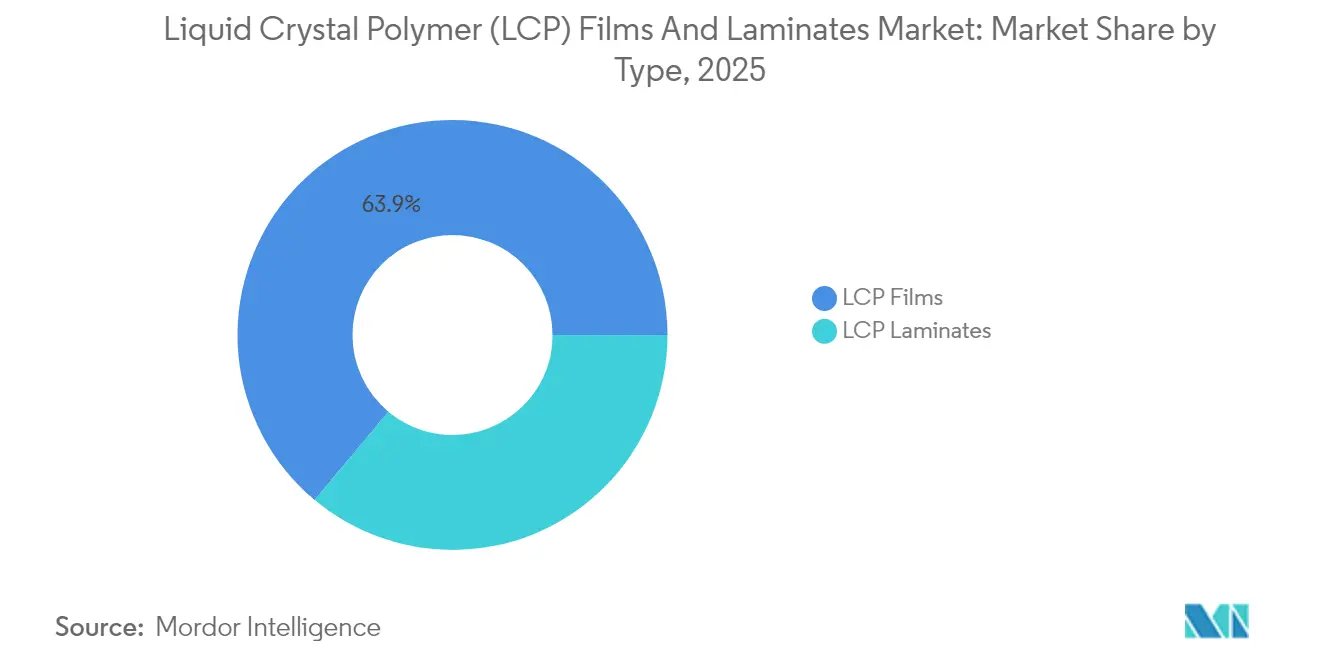
- By type, LCP films captured 63.92% of Liquid Crystal Polymer (LCP) Films and Laminates market share in 2025, while laminates are poised to expand at a 6.05% CAGR through 2031.
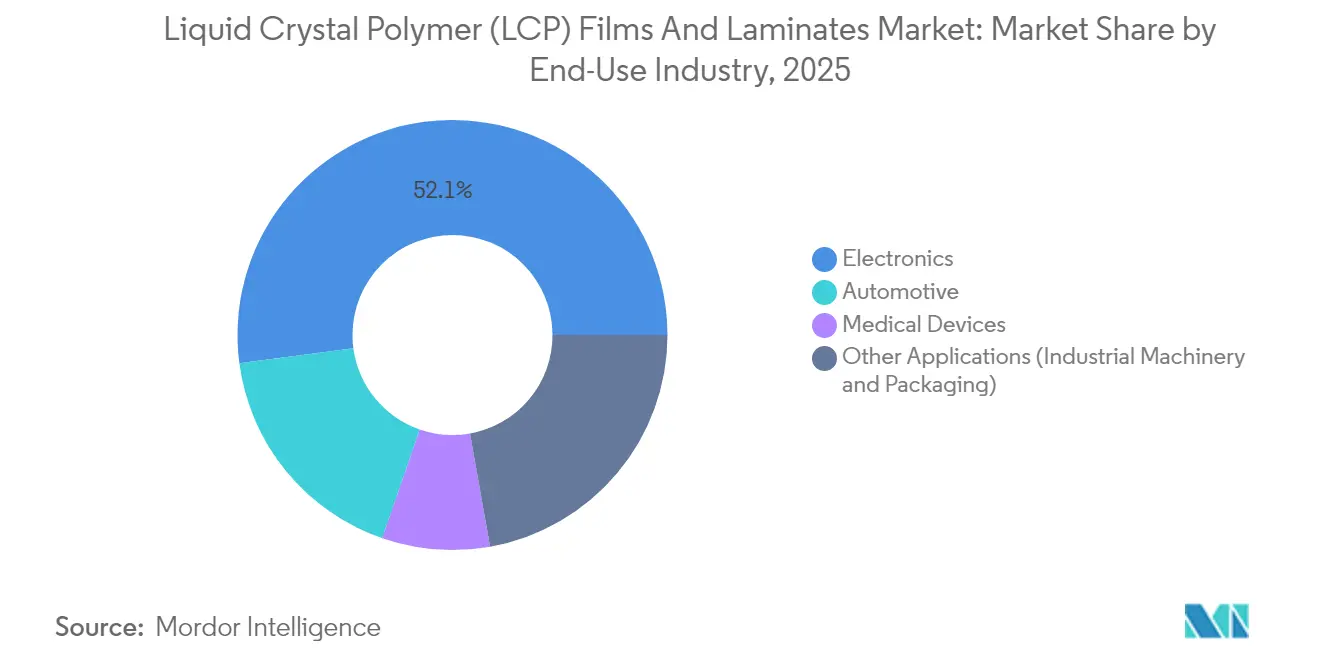
- By end-use industry, electronics accounted for 52.10% of Liquid Crystal Polymer (LCP) Films and Laminates market size in 2025 and is forecast to grow at 6.62% CAGR to 2031.
- By geography, Asia-Pacific contributed 63.10% of 2025 volume; the region will outpace global growth at a 6.41% CAGR between 2026 and 2031.
Note: Market size and forecast figures in this report are generated using Mordor Intelligence’s proprietary estimation framework, updated with the latest available data and insights as of 2026.
Market Trends and Insights
Drivers Impact Analysis of Liquid Crystal Polymer (LCP) Films And Laminates Market*
| Driver | (~) % Impact on CAGR Forecast | Geographic Relevance | Impact Timeline |
|---|---|---|---|
| Miniaturization of electronic and electrical components | +1.8% | Global, concentrated in APAC consumer electronics hubs (Shenzhen, Seoul, Tokyo) | Medium term (2–4 years) |
| Surge in 5G / high-frequency communication infrastructure | +2.1% | Global, led by China, South Korea, U.S. metro markets; spillover to India, Brazil by 2027 | Short term (≤ 2 years) |
| Lightweighting and thermal-management needs in EV/ADAS | +1.2% | North America, Europe, China EV corridors; limited uptake in cost-sensitive markets | Long term (≥ 4 years) |
| Growing demand for minimally-invasive medical devices | +0.5% | North America, Western Europe; regulatory-driven adoption in Japan | Long term (≥ 4 years) |
| Flex-CCL adoption for mmWave antenna modules | +1.4% | APAC (China, South Korea, Taiwan); early adoption in North America 5G small cells | Medium term (2–4 years) |
| Source: Mordor Intelligence | |||
Miniaturization of Electronic and Electrical Components
Wearables and foldable phones now require interconnect pitches below 50 µm, a threshold at which polyimide flex circuits exhibit copper-adhesion failures under cyclic bending. Liquid Crystal Polymer (LCP) Films and Laminates market substrates dispense with adhesive layers, trimming total stack thickness by up to 20 µm and sustaining more than 100,000 bend cycles[1]. The design win cadence accelerated in 2024 when flagship Android models adopted adhesiveless LCP antennas to fit sub-0.1 mm z-height constraints. Industrial IoT sensors deployed in rail and wind-turbine environments mirror this migration, citing 10-year durability with no delamination events. Suppliers respond by scaling plasma and chemical-etch surface treatments that raise copper-peel strength beyond 1.2 N/mm, closing historical reliability gaps against polyimide.
Surge in 5G / High-Frequency Communication Infrastructure
Millimeter-wave deployments in the 24–29 GHz range reveal the high insertion losses of FR-4 and standard polyimide. Liquid Crystal Polymer (LCP) Films and Laminates market laminates, with <0.003 dissipation factor in the n258 band, enable beam-forming architectures that extend cell radius without heavier ceramic substrates. China Mobile’s 2024 procurement of LCP-based flexible transmission modules for pole-mounted microcells highlights volume traction, while open-RAN disaggregation necessitates rugged, low-CTE interconnects that tolerate outdoor temperature swings from –40°C to +70°C. Accelerated spectrum auctions in India and Brazil suggest spill-over demand within two years.
Lightweighting and Thermal-Management Needs in EV/ADAS
Automotive radar moving to 4D imaging across 76 – 81 GHz requires dielectric stability over broad bandwidths. Liquid Crystal Polymer (LCP) Films and Laminates market grades satisfy this window, whereas optimized polyphenylene ether substitutes plateau at 0.002 dissipation factor only at center frequency. Rogers Corporation’s AMB power-substrate design win with an Asian EV OEM signals broader busbar-insulation adoption, leveraging LCP’s 0.3 W/m·K thermal conductivity to shed heat in compact battery packs[2].
Growing Demand for Minimally-Invasive Medical Devices
MRI-guided cardiology and neurovascular interventions rely on metal-free guidewires to avoid imaging artifacts. LCP monofilament offers a tensile strength of over 150 MPa and radiolucency, anchoring a niche but profitable segment where per-kilogram pricing triples that of electronics-grade film. Celanese’s VECTRA MT targets wearable injector housings that must survive gamma sterilization without dimensional creep. Lengthy 510(k) cycles dampen startup enthusiasm, yet large device OEMs continue to spec LCP for MRI-compatibility mandates.
Restraints Impact Analysis of Liquid Crystal Polymer (LCP) Films And Laminates Market*
| Restraint | (~) % Impact on CAGR Forecast | Geographic Relevance | Impact Timeline |
|---|---|---|---|
| High manufacturing and processing costs | -1.5% | Global, most acute in Europe and North America where labor and energy costs are elevated | Short term (≤ 2 years) |
| Competition from lower-cost high-frequency polymers (PI, PPE) | -1.0% | Global, strongest in automotive and mid-tier consumer electronics | Medium term (2–4 years) |
| Supply-chain concentration in specialty diacids and biphenols | -0.6% | Global, with acute exposure in Japan and Europe dependent on single-source monomers | Long term (≥ 4 years) |
| Source: Mordor Intelligence | |||
High Manufacturing and Processing Costs
Extruding LCP films requires melt temperatures exceeding 300 °C and corrosion-resistant twin-screw lines, which can cost upwards of USD 5 million, deterring new entrants. Trim waste can reach 12% because low melt viscosity causes edge beading, resulting in twice the scrap compared to polyimide lines. Energy consumption is 40% higher than that of polyimide due to prolonged cooling cycles, and European tariffs exacerbate the gap. Celanese’s Zenite 16236(N) lowers processing temperatures to 280°C, reducing utility use; however, the step change still leaves LCP above standard molding ceilings, compelling converters to maintain dedicated cells.
Competition from Lower-Cost High-Frequency Polymers (PI, PPE)
Ester-ether polyimides now exhibit dissipation of 0.0015 – 0.0024 at 10 GHz, which is adequate for sub-6 GHz radios, and cost roughly half that of comparable LCP material. PPE blends capture 77 GHz radar substrates when range requirements stay under 200 m, supported by an established injection-molding infrastructure that Liquid Crystal Polymer (LCP) Films and Laminates market lacks. Sustainability differentials narrow as PPE suppliers adopt chemically recycled feedstocks, challenging LCP’s nascent bio-balanced grades and compressing its premium positioning.
*Our forecasts treat driver/restraint impacts as directional, not additive. The impact forecasts reflect baseline growth, mix effects, and variable interactions.
Liquid Crystal Polymer (LCP) Films And Laminates Market Segment Analysis
By Type:
Films Retain Volume Lead while Laminates Accelerate on Integration DemandLCP films claimed 63.92% of the 2025 volume in the Liquid Crystal Polymer (LCP) Films And Laminates Market, underscoring their foundational role in antenna-in-package circuits that dominate flagship smartphone architectures. Stable spot pricing near USD 180/kg throughout 2024 signals that capacity expansions in Japan and South Korea largely matched handset demand cycles. Laminates, although smaller, are forecast to outgrow films at a 6.05% CAGR through 2031, as integrated antenna modules favor copper-clad substrates that simplify assembly flows. Murata’s adhesiveless laminate qualification cut module reduced the z-height by 30 µm and improved thermal cycling reliability, illustrating why Liquid Crystal Polymer (LCP) Films and Laminates market customers are pivoting toward laminate solutions. Plasma-etched laminate surfaces now achieve a peel strength of over 1.2 N/mm, solving the surface-energy hurdle that once limited widespread adoption. Geographically, North American orders skew towards laminates for aerospace and defense, where pre-qualified stacks simplify certification, while APAC handset hubs still drive over 70% of film uptake.
Second-order dynamics suggest that thicker laminate formats (75 – 125 µm) are suitable for base-station antenna feeds, while thinner films (<50 µm) are more suitable for foldable devices, enabling regional suppliers to specialize. Chinese entrants such as Shenzhen WOTE tout next-generation grades with elevated glass-transition temperatures to capture local 5G infrastructure business . Concurrently, Japanese incumbents protect premium niches through patent-reinforced monomer syntheses that yield ultra-low ionics required for high-reliability aerospace boards.

By End-Use Industry:
Electronics Dominate while Automotive Continues to LagElectronics accounted for 52.10% of the 2025 volume and are expected to remain the fastest-growing user, with a 6.62% CAGR to 2031, as Liquid Crystal Polymer (LCP) Films and laminates become indispensable market substrates for millimeter-wave smartphone antennas. Wi-Fi 7 routers, data-center optical transceivers, and smartwatches extend the demand base, each leveraging LCP’s moisture resistance to mitigate performance drift in humid home-network environments. Base-station flexible transmission modules further widen the scope, a shift underscored by tier-one OEM qualification pipelines logged in 2025.
The automotive sector maintained an 17.60% volume share in 2025, as PPE substrates meet current 77 GHz radar cost targets. Adoption momentum rises post-2027 with the introduction of 4D imaging radar, where frequency stability from 76 to 81 GHz propels LCP to the forefront. Battery-management-system busbars represent a parallel opportunity, leveraging the thinness of LCP laminates to reduce pack weight while safeguarding 800 V architectures. Medical devices, roughly 8.10% of demand, benefit from price inelasticity as MRI-guided catheter makers prioritize biocompatibility over resin cost. Other industrial uses, including high-temperature connectors in renewable-energy inverters, round out the Liquid Crystal Polymer (LCP) Films and Laminates market landscape.
Geography Analysis
APAC Liquid Crystal Polymer (LCP) Films and Laminates Market
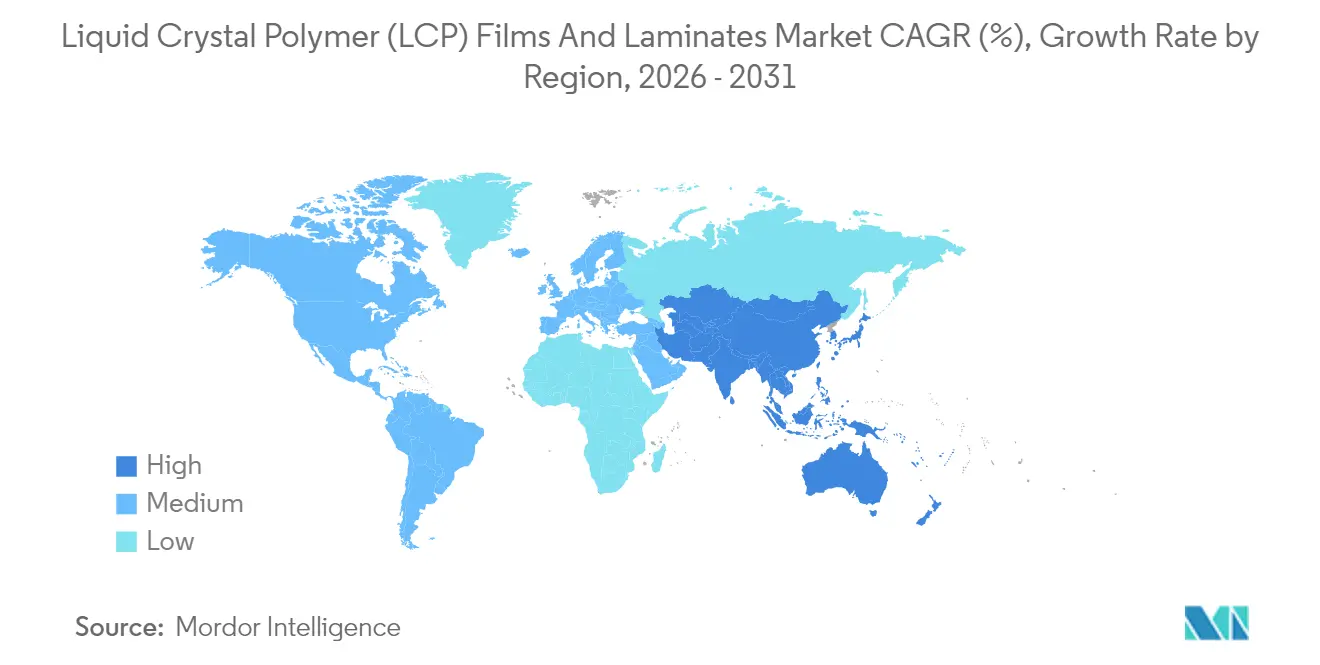
Asia-Pacific held 63.10% of 2025 volume in Liquid Crystal Polymer (LCP) Films And Laminates Market, a dominance aligned with the region’s dense handset assembly clusters and its vertically integrated LCP supply chain. Kuraray, Toray, and Sumitomo Chemical maintain technology leadership in film extrusion, while Celanese’s 2024 Nanjing plant added 15% to global resin capacity, bringing resin synthesis closer to Chinese EV and 5G customers. South Korea focuses on laminate conversion for foldable-display antennas, where ultra-thin films enable 1.5 mm bend radius hinges. India’s first wave of 5.5 G base-stations, set for 2027, should lift regional demand as spectrum auctions conclude, maintaining a 6.41% CAGR through 2031.
North America Liquid Crystal Polymer (LCP) Films and Laminates Market
North America's demand is concentrated in aerospace radar arrays, medical implants, and data-center interconnects. Rogers Corporation decided in October 2024 to locate its next power-substrate plant in China, aiming to service Asian EV customers, as it faces cost hurdles on US soil. Still, defense budgets sustain local laminate demand, insulating the region from the cyclicality of consumer electronics. Mexico’s emerging electronics assembly corridors may gradually replace some Asia-bound imports if near-shoring incentives deepen.
EMEA and South America Liquid Crystal Polymer (LCP) Films and Laminates Market
Europe faces eroded price competitiveness due to high electricity tariffs. German institutes investigate end-of-life LCP recycling under EU circular-economy mandates, potentially offsetting carbon costs and bolstering regional appeal. Eastern-European EMS plants show tentative interest in LCP flex boards for industrial IoT gateways, yet scale remains small. South America and the Middle East & Africa share the remaining <10%, with rollout pace tied directly to sovereign 5G capital-expenditure timetables.
Value Chain Analysis
The value chain starts with specialty aromatic monomers and intermediates that feed LCP resin polymerization, then moves to film extrusion and orientation steps that require high-temperature processing and tightly controlled equipment. Film producers supply finished films or upstream resin to converters that manufacture copper-clad laminates, including adhesiveless formats. Those laminates then reach PCB and flex-circuit fabricators and module assemblers serving smartphones, 5G infrastructure, automotive radar, and selected medical-device applications.
The chain is concentrated in East Asia, with resin and film production clustered in Japan (including Kuraray, Sumitomo Chemical, Toray, and Polyplastics) and laminate conversion in South Korea and Taiwan. Downstream, distribution commonly passes through regional compounders and electronics-materials distributors to shorten lead times for handset and base-station customers, while technical service centers support qualification for mmWave antenna modules and reliability-driven end uses (aerospace/defense and medical). Bottlenecks center on single-source specialty monomers and high-capex film orientation assets, which elevates the value of vertical integration and localized conversion capacity near electronics hubs and logistics gateways.
Competitive Landscape
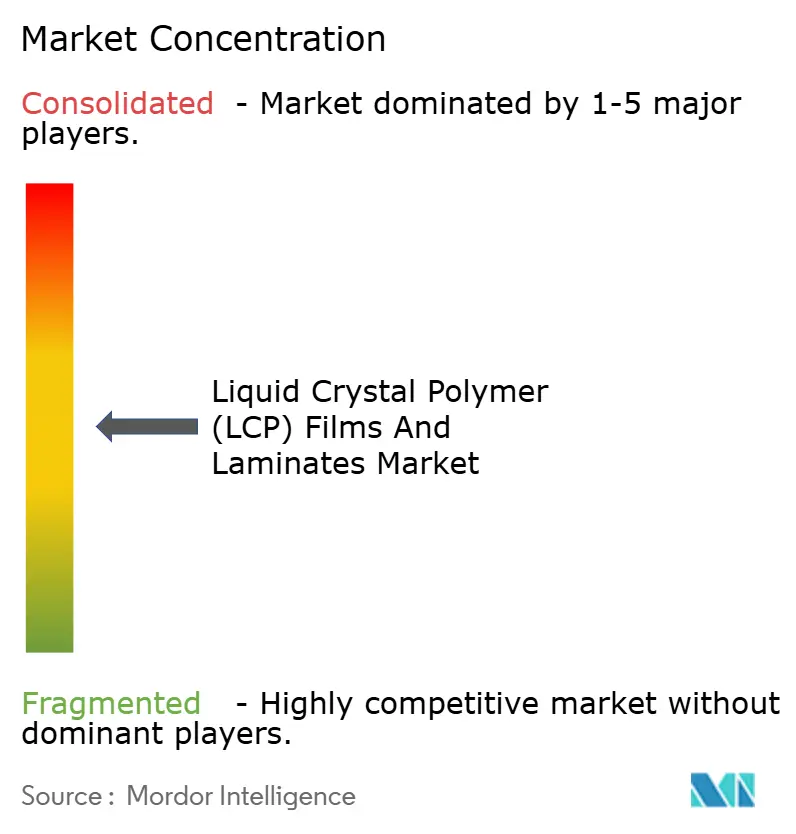
The Liquid Crystal Polymer (LCP) Films And Laminates Market is moderately consolidated. Japanese incumbents defend positions with patent-protected monomer chemistries, deterring Western entrants, while Chinese challengers develop alternative synthetic paths that skirt existing IP claims. Celanese introduced 60% renewable-content Zenite ECO-B in April 2024, targeting OEMs that confront Scope 3 emission targets despite a 20% price premium. Polyplastics’ biomass-balanced LAPEROS bG-LCP, slated for commercial release in 2025, aims for similar adoption in sustainability-minded markets.
Liquid Crystal Polymer (LCP) Films And Laminates Industry Leaders
-
Celanese Corporation
-
KURARAY CO. LTD.
-
Polyplastics Co. Ltd.
-
Sumitomo Chemical Advanced Technologies
-
TORAY INDUSTRIES INC.
- *Disclaimer: Major Players sorted in no particular order
Liquid Crystal Polymer (LCP) Films And Laminates Market Companies Covered in this Report
- Celanese Corporation
- Chang Chun Group
- DZT Design & Mfg.
- KGK Chemical Corporation
- Kingfa Sci. & Tech.
- KURARAY CO. LTD.
- Murata Manufacturing Co. Ltd
- Panasonic Industry Co., Ltd.
- Polyplastics Co., Ltd.
- Rogers Corporation
- RTP Company
- Shanghai PRET Composites
- SHENGYI TECHNOLOGY CO., LTD.
- Shenzhen WOTE Advanced Materials Co.,Ltd
- Sumitomo Chemical Advanced Technologies
- Syensqo
- TORAY INDUSTRIES INC.
- UENO FINE CHEMICALS INDUSTRY LTD
- Zeus Company Inc.
Market Opportunities and Future Outlook
Ultra-thin LCP film and laminate formats remain a visible whitespace as device makers push z-height and bend-radius limits in foldables and wearable electronics, and as 24-29 GHz deployments pull demand for low-loss substrates. Kuraray announced an expansion of Vecstar LCP film production capacity at its Saijo plant in Ehime Prefecture in March 2024, specifically targeting ultra-thin grades (<25 micrometres) for 5G millimeter-wave antenna substrates. This signals that qualification pipelines are shifting toward thinner, tighter-tolerance constructions rather than commodity thicknesses.
Regionalization and sustainability-linked sourcing are also opening procurement-led opportunities in electronics supply chains. Polyplastics began operations at a new LAPEROS LCP plant in Taiwan in February 2025 (reported at 5,000 tons per year) and moved to full-scale operation by May 2025, supporting shorter lead times and a more integrated Asia supply footprint for electronics customers. In parallel, bio-attributed and mass-balance programs are moving from concept to product portfolios, with Polyplastics launching biomass-balanced LAPEROS bG-LCP (September 2024) and Sumitomo Chemical reporting progress toward mass-production technology using biomass-based monomers (June 2025). This creates a premium lane for OEMs managing Scope 3 targets while meeting performance needs for high-frequency interconnects.
Recent Industry Developments in Liquid Crystal Polymer (LCP) Films And Laminates Market
- June 2026: Celanese announced the availability of Zenite LCP 5245L, positioned as a high-flow, low-warp material for thin-wall electrical components. The launch broadens the processing window for complex, miniaturized geometries, supporting converters and molders that need tighter dimensional stability while maintaining LCP performance attributes.
- December 2025: Polyplastics expanded its LAPEROS LCP range with new LH and TF series grades aimed at electronics applications that are tightening miniaturization and performance requirements. The broader grade slate gives OEMs and fabricators more options to balance flow, mechanical stability, and dielectric performance across different component and interconnect designs.
- March 2025: Kuraray announced plans to discontinue Vecstar FCCL (flexible copper-clad laminate) production by the end of June 2026, while continuing production and sales of Vecstar LCP film. This refocuses Kuraray on upstream film supply and can shift laminate sourcing toward other converters, which affects qualification roadmaps for customers that previously specified Vecstar FCCL stacks.
Liquid Crystal Polymer (LCP) Films And Laminates Market Report Scope and Research Methodology
Market Definition and Coverage
This market covers liquid crystal polymer (LCP) films and laminates that are converted and supplied for industrial use, measured as total material volume shipped and consumed, in square meters, across the covered geographies.
Scope exclusions: We exclude LCP resin sales that are not converted into films or laminates. We also exclude multi-material flexible substrates where the LCP layer cannot be reasonably isolated.
Segments Covered in This Report
-
By Type
- LCP Films
- LCP Laminates
-
By End-Use Industry
- Automotive
- Electronics
- Medical Devices
- Other Applications (Industrial Machinery, Packaging)
-
By Geography
-
Asia-Pacific
- China
- Japan
- South Korea
- India
- Malaysia
- Thailand
- Indonesia
- Vietnam
- Rest of Asia-Pacific
-
North America
- United States
- Canada
- Mexico
-
Europe
- Germany
- United Kingdom
- France
- Italy
- Spain
- Russia
- Turkey
- NORDIC Countries
- Rest of Europe
-
South America
- Brazil
- Argentina
- Rest of South America
-
Middle East and Africa
- Saudi Arabia
- South Africa
- Rest of Middle-East and Africa
-
Asia-Pacific
Data Sources, Market Sizing, and Validation
Desk Research
Desk research was used to build the initial view of supply and demand signals for LCP films and laminates, then to sanity check what we heard in interviews. We leaned on public sources that explain electronics and materials demand, including U.S. International Trade Commission data, UN Comtrade trade series, World Intellectual Property Organization patent filings, and standards or technical publications from groups such as IPC.
To make the market model usable, we also reviewed company filings and investor presentations, association websites, and reputable press coverage that signal capacity additions, pricing pressures, and end-use ramps. In a few cases, we referenced paid subscriptions for company financials and intelligence, patent databases, and shipment-level import and export checks to validate directional trends. The desk sources listed here are not exhaustive, and we used additional sources throughout the study for data collection, validation, and clarification.
Primary Interviews and Surveys
Primary interviews and surveys were used to confirm real buying behavior and the most practical volume drivers behind LCP film and laminate usage. We spoke with a mix of material suppliers, film converters, laminate and circuit supply chain participants, and downstream users across major regions. This helped tighten assumptions such as adoption timing and usable area per device.
Interviews also helped resolve gaps that desk research cannot fully explain, including conversion yields, typical thickness choices for high frequency uses, and where demand is shifting between standard flex builds and low-loss LCP constructions.
Distribution of primary research fieldwork respondents
| Company type | Respondent position | Region |
|---|---|---|
| Top tier: 32% | CXOs: 14% | APAC: 52% |
| Mid tier: 53% | Functional/Unit leaders: 35% | EMEA: 30% |
| Smaller Players: 15% | Managers: 51% | Americas: 18% |
Market-Sizing & Forecasting
For sizing, we start from a demand pool that can be rebuilt from end-use activity and then expressed in square meters. We apply a top-down approach by translating electronics and automotive demand into addressable LCP area through penetration rates, average layers or panels per application, and typical usable area per unit, then mapping that to the covered countries and regions.
Next, we corroborate totals with selective bottom-up approximations, using sampled supplier and converter shipments, channel checks on laminate availability, and practical volume-to-area conversions based on thickness and yield. Where company level numbers are not visible, we handle gaps by using capacity utilization ranges, import and export direction, and expert validated split factors so the missing portion is still traceable.
Forecasts are built using scenario analysis, since adoption of low-loss materials can move faster or slower depending on device cycles and qualification timing. Key inputs used in the model include 5G and high frequency circuit build-outs, flexible circuit demand intensity, 77 GHz automotive radar adoption, typical conversion yields, and average selling price movement. We convert the ASP movement into the volume logic so the square meter totals remain consistent.
Data Validation & Update Cycle
Outputs are checked against independent signals such as trade movement, capacity announcements, and practical consumption constraints, then any large variances are reviewed before sign-off. If a segment total grows faster than the related device or build activity, we re-check penetration assumptions and re-contact sources to confirm whether a step change is real.
We also run a second analyst review to confirm arithmetic consistency across regions and to verify that the market definition is applied the same way throughout the model. Reports are refreshed annually, with interim updates when material events occur, such as major capacity additions or abrupt demand slowdowns. Before delivery, an analyst runs a fresh pass so clients receive an updated view aligned to the latest available inputs.
Mordor Intelligence's Liquid Crystal Polymer Lcp Films Laminates Market Size Compared Against Other Published Estimates
Published estimates for LCP films and laminates can look far apart because not everyone measures the same scope, and because volume-based markets are sometimes converted into dollars using different price and thickness assumptions. Differences also show up when forecasts assume faster 5G material substitution than what qualification cycles allow, or when currency timing is applied inconsistently.
Some sources publish a value number by bundling adjacent flexible substrate materials and then applying blended pricing. In the Mordor Intelligence approach, the market is kept to LCP films and laminates only, and sized in square meters. This avoids mixing resin, finished circuits, or other dielectric films into the same total.
Benchmark comparison
| Source | Market Size | Gaps in Research Methodology |
|---|---|---|
| Mordor Intelligence | USD 67.85 M (2026) | |
| Industry Association A | USD 120.00 M (2026) | Often reported as a value pool that includes other low-loss flexible substrate films and sometimes counts resin and conversion value-add, which inflates totals versus pure LCP film and laminate area. |
| Global Consultancy B | USD 0.18 B (2026) | Commonly converts square meters into dollars using aggressive blended ASP progression and thicker build assumptions, and the refresh cadence may not reflect recent yield improvements that reduce consumed area. |
The spread in the table mainly comes from scope mixing and from how square meters are translated into dollars. By keeping the demand pool tied to device build activity and by validating conversion yields with interviews, the estimate stays repeatable and easier to audit when inputs change.
Key Questions Answered in the Report
What is the projected volume of Liquid Crystal Polymer (LCP) Films and Laminates in 2031?
The market is forecast to reach 90.64 million m² by 2031, rising from 67.85 million m² in 2026.
How fast is demand for LCP laminates expected to grow?
Laminates are projected to register a 6.05% CAGR through 2031 as antenna-in-package modules become standard.
Which region leads consumption of LCP films and laminates?
Asia-Pacific held 63.10% of 2025 volume and is set to expand faster than any other region through 2031.
Why are LCP substrates preferred for millimeter-wave 5G devices?
LCP maintains a <0.004 dissipation factor and low moisture absorption that preserve signal quality above 24 GHz.
What is the main restraint limiting wider LCP adoption in automotive radar?
Premium resin cost and adequate performance from lower-cost PPE substrates delay LCP penetration until 4D imaging radar ramps after 2027.