
Lipase Market Size and Share
Market Overview
| Study Period | 2020 - 2030 |
|---|---|
| Market Size (2025) | USD 684.55 Million |
| Market Size (2030) | USD 963.71 Million |
| Growth Rate (2025 - 2030) | 7.08 % |
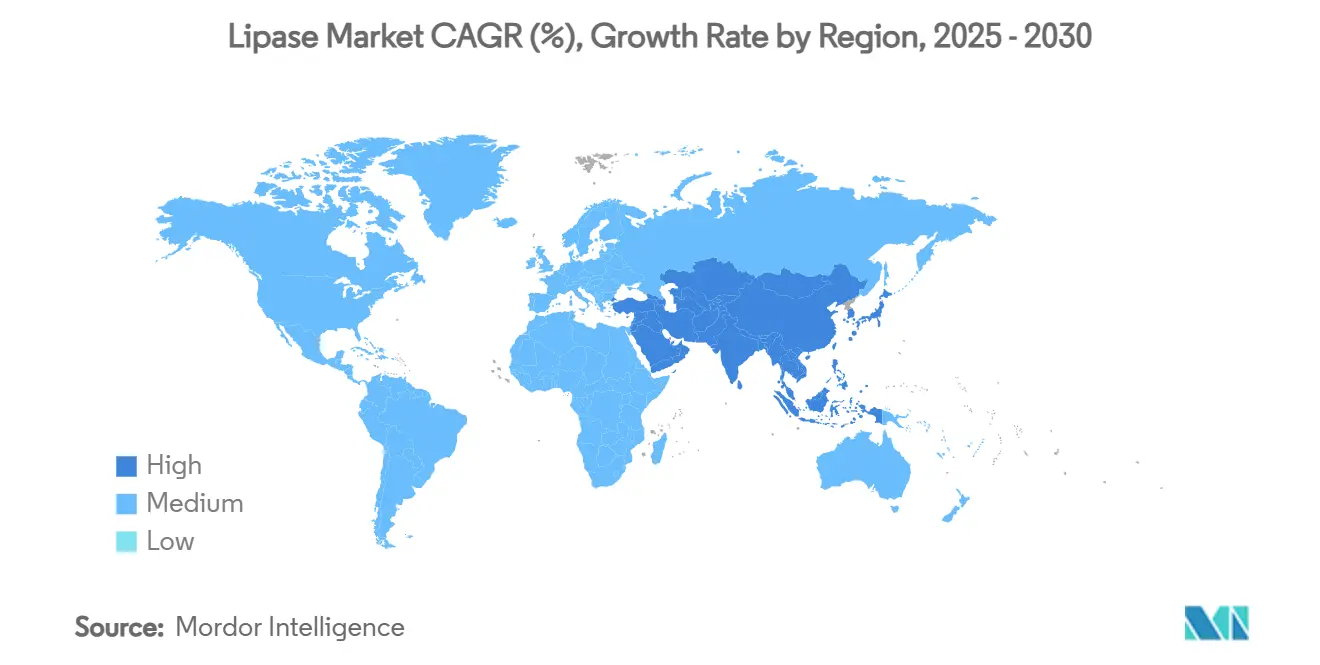
| Fastest Growing Market | Asia Pacific |
| Largest Market | North America |
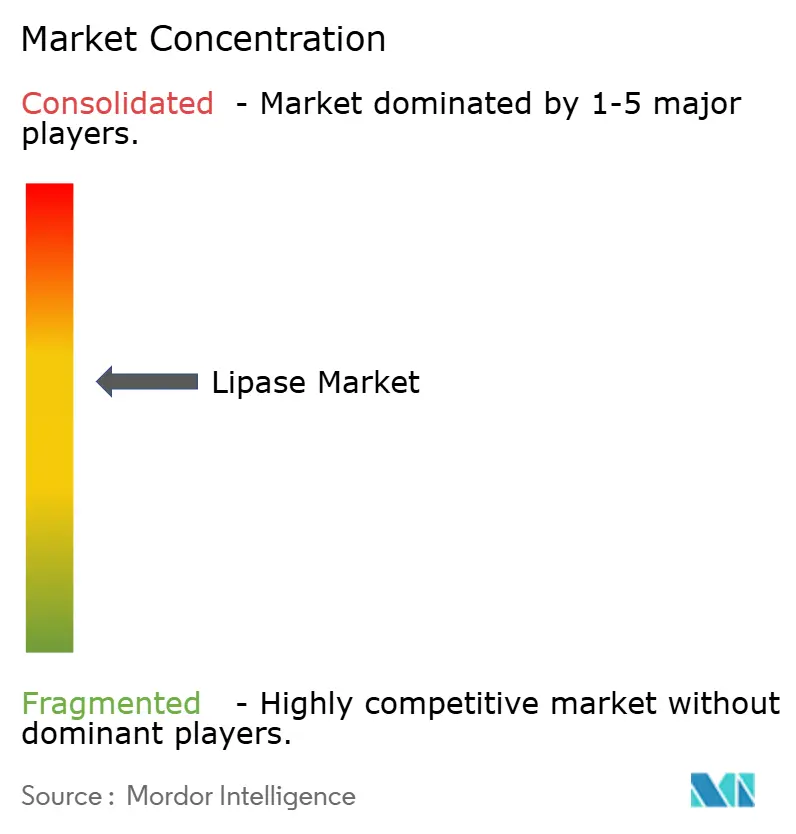
| Market Concentration | Medium |
Major Players
*Disclaimer: Major Players sorted in no particular order Image © Mordor Intelligence. Reuse requires attribution under CC BY 4.0. |
|
Lipase Market Analysis by Mordor Intelligence
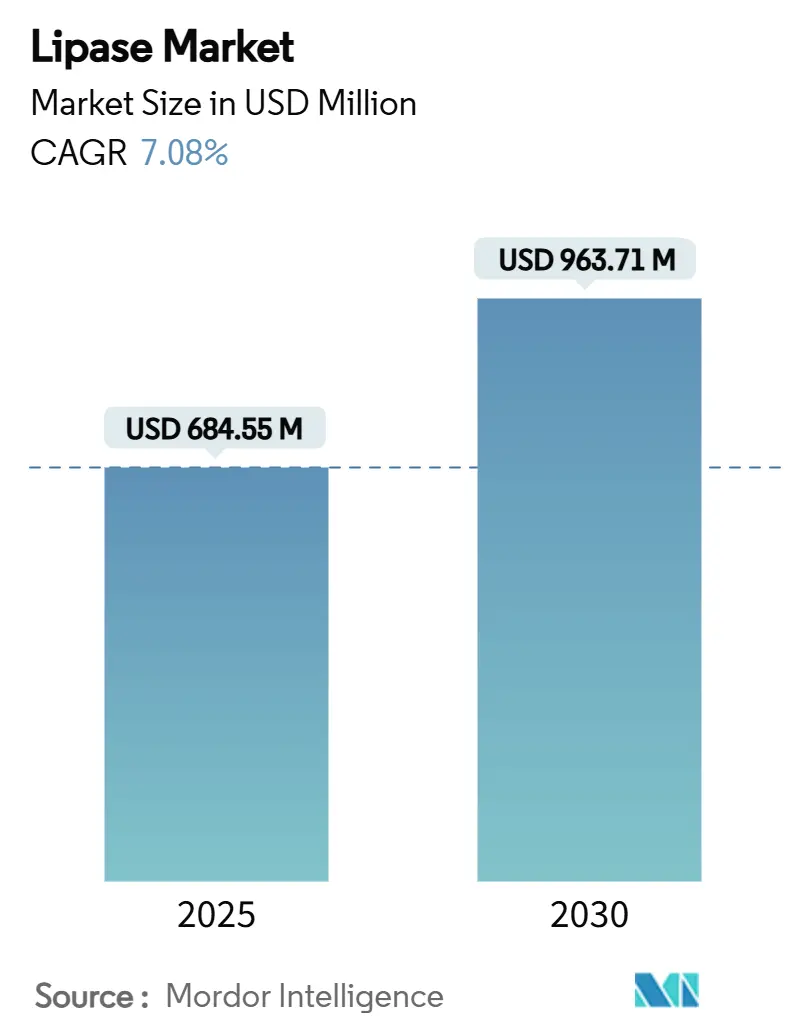
The global lipase market size is expected to grow from USD 684.55 million in 2025 to USD 963.71 million by 2030, at a CAGR of 7.08%. This growth is driven by the increasing adoption of precision-fermentation technologies that produce high-purity enzymes while meeting environmental and safety standards. The market expansion is supported by rising demand across food processing, personal care, and industrial biocatalysis applications, where lipases serve as alternatives to chemical additives, improve flavor profiles, and reduce energy consumption. Microbial production methods are preferred due to their scalability, faster regulatory approval processes, and compatibility with vegan, kosher, and halal certifications. While liquid formulations remain dominant in automated systems, powder formats are gaining traction in regions with warmer climates due to their enhanced stability. North America maintains market leadership due to established FDA regulatory frameworks and advanced biotechnology infrastructure, while the Asia-Pacific region demonstrates the highest growth rate as food processing industries modernize and enzyme production capacity expands.
Key Report Takeaways
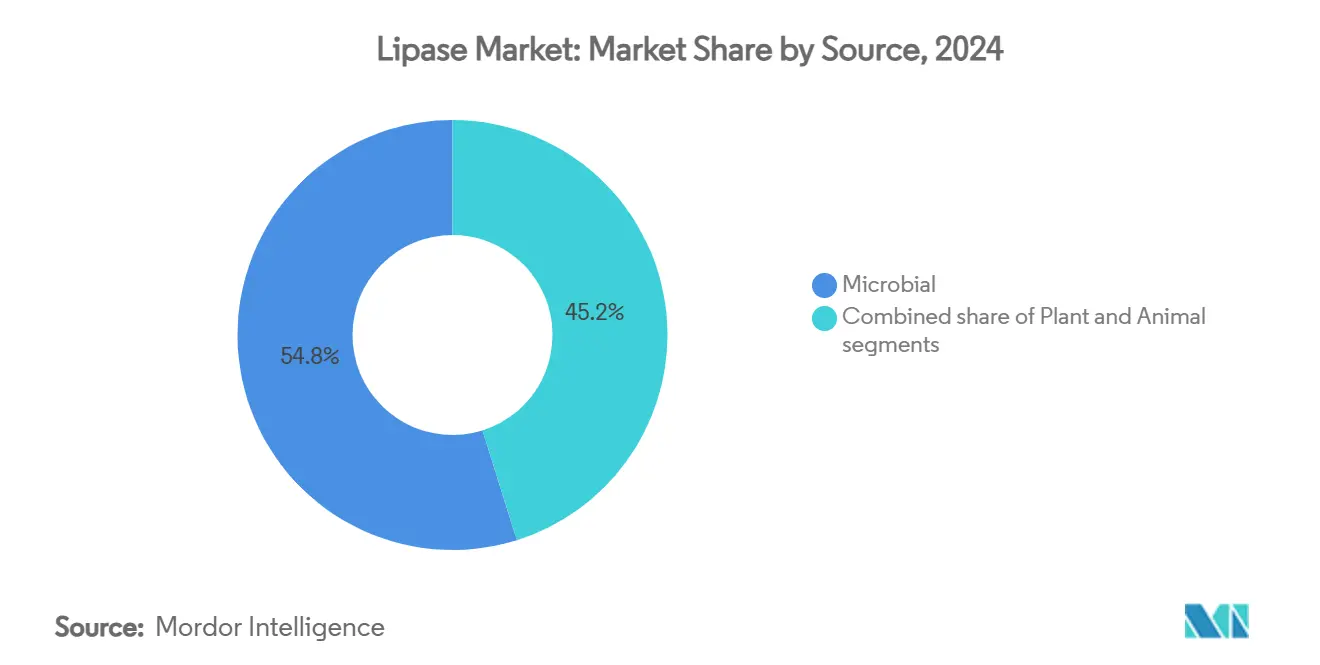
- By source, microbial preparations held 54.84% of lipase market share in 2024 and plant-based sources are poised to expand at an 8.24% CAGR through 2030.
- By form, liquid formulations commanded 42.14% revenue in 2024, while powder variants are set to rise at a 7.99% CAGR during the forecast.
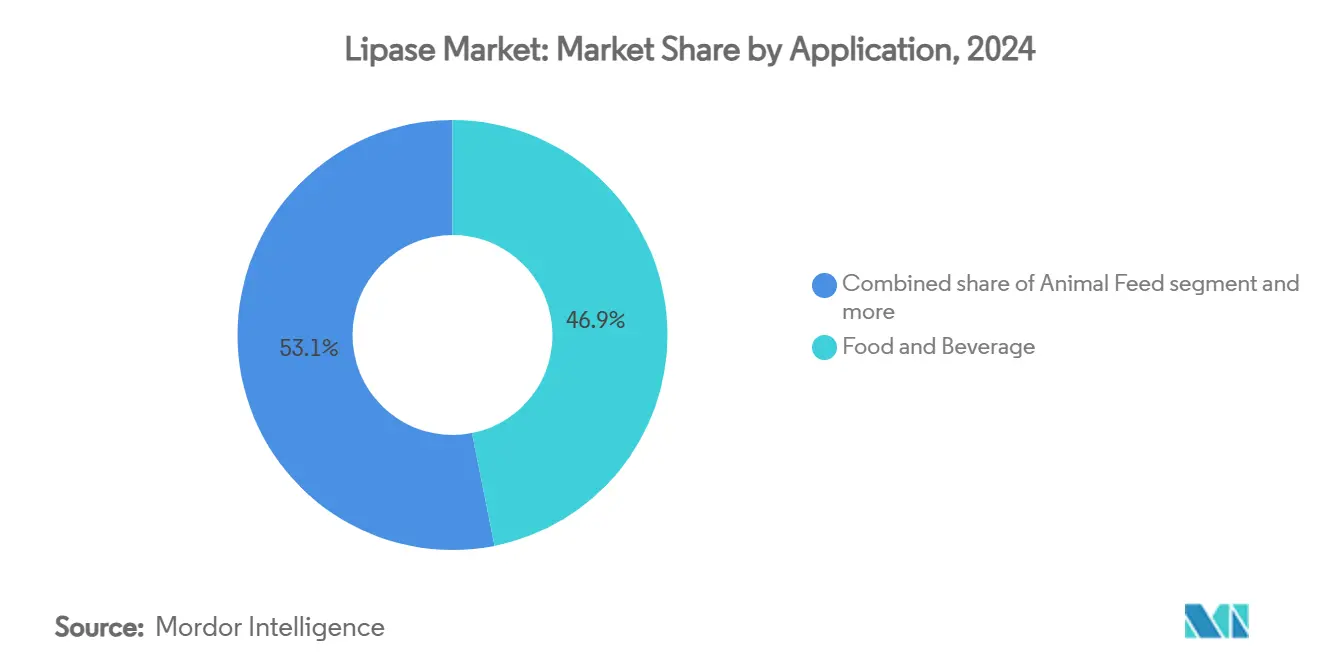
- By application, food and beverage contributed 46.88% of 2024 revenues; cosmetics and personal care is projected to achieve the fastest 8.63% CAGR to 2030.
- By geography, North America captured 38.36% of 2024 sales, whereas Asia-Pacific is forecast to lead growth with an 8.22% CAGR through 2030.
Note: Market size and forecast figures in this report are generated using Mordor Intelligence’s proprietary estimation framework, updated with the latest available data and insights as of January 2026.
Market Trends and Insights
Drivers Impact Analysis of Lipase Market*
| Driver | (~) % Impact on CAGR Forecast | Geographic Relevance | Impact Timeline |
|---|---|---|---|
| Utilisation in bakery products for dough conditioning and volume enhancement | +1.2% | Global, with strong adoption in North America and Europe | Medium term (2-4 years) |
| Microbial lipases support vegan, kosher and halal food processing | +1.8% | Global, particularly strong in Asia-Pacific and Middle East | Long term (≥ 4 years) |
| Used in personal care for gentle degreasing and exfoliation | +1.5% | North America and Europe, expanding to Asia-Pacific | Medium term (2-4 years) |
| Enables lactose-free and fat-modified dairy diets | +0.9% | Global, with highest impact in developed markets | Short term (≤ 2 years) |
| Application in alcoholic beverage clarification | +0.6% | Global, concentrated in major wine and beer producing regions | Medium term (2-4 years) |
| Customized lipase blends for ethnic dairy products | +0.8% | Asia-Pacific core, spill-over to Middle East and Africa, and diaspora markets | Long term (≥ 4 years) |
| Source: Mordor Intelligence | |||
Utilisation in Bakery Products for Dough Conditioning and Volume Enhancement
Lipase enzymes in bakery production serve multiple functions, including strengthening dough, extending shelf life, and modifying fats. The enzyme hydrolyzes triglycerides to enhance gas retention, crumb softness, and moisture distribution, reducing the need for synthetic emulsifiers. There is a growing demand for bakery products, like bread, buns, and biscuits from consumers for daily use, and the huge consumption of bakery products is creating a propelling market for food additives, like natural food preservatives which play an important role in bakery products, while improving their shelf life as well as sensory qualities. For instance, the Bureau of Labor Statistics reports that United States households spent an average of USD 574 on bakery products in 2023[1]Source: Bureau of Labor Statistics, "Average annual expenditures and characteristics of all consumer units, Consumer Expenditure Surveys, 2021-2021," bls.gov. The growing gluten-free segment increases lipase demand, as these enzymes help redistribute fats to compensate for the absence of gluten. This redistribution improves product texture and maintains structural integrity throughout the baking process. Industrial bakeries primarily use liquid lipase formulations for precise dosing control and consistent product quality. The industry's shift toward clean-label products has elevated lipases from auxiliary additives to essential ingredients, driven by consumer demand for natural alternatives to synthetic additives. This transition has led manufacturers to develop specialized lipase blends optimized for specific bakery applications.
Microbial Lipases Support Vegan, Kosher and Halal Food Processing
Microbial lipase production addresses religious and dietary restrictions while delivering superior performance characteristics compared to animal-derived alternatives. Plant-based food manufacturers leverage microbial lipases for fat modification in dairy alternatives, meat substitutes, and confectionery products, eliminating animal-derived ingredients without compromising functionality. Regulatory advantages favor microbial sources, as the Food and Drug Administration (FDA) Generally Recognised as Safe (GRAS) pathways streamline approval processes compared to novel animal-derived enzymes. The increasing use of microbial lipases reflects consumer demand for clean-label, ethical, and sustainable products. Food manufacturers seek enzyme solutions that meet vegan, kosher, and halal certifications to serve diverse markets without multiple product reformulations. The replacement of animal-derived lipases enables companies to expand their customer base while avoiding regulatory complexities associated with animal-based processing aids, which reduces product launch times.
Used in Personal Care for Gentle Degreasing and Exfoliation
Enzymatic skincare represents a paradigm shift from mechanical and chemical exfoliation toward biological processes that preserve skin barrier function while delivering therapeutic benefits. Lipases facilitate gentle degreasing by selectively hydrolyzing sebum triglycerides without disrupting the skin's natural lipid balance, addressing consumer demand for effective yet mild formulations. Cosmetic formulators increasingly incorporate lipases into waterless products and solid formulations, aligning with sustainability trends while enhancing product stability. The enzyme's dual functionality in both cleansing and treatment applications positions lipases as multifunctional ingredients that justify premium pricing in personal care formulations.
Enables Lactose-Free and Fat-Modified Dairy Diets
Dairy processing applications leverage lipases for fat modification and flavor development in lactose-free and specialty dairy products targeting health-conscious consumers. Countries like South Korea, Yemen, and Ghana report approximately 99% lactose intolerance rates as of 2025, according to World Population Review[2]Source: World Population Review, "Lactose Intolerance by Country 2025," worldpopulationreview.com. This high prevalence increases the demand for lactose-free and fat-modified dairy products. Microbial lipases enable fat hydrolysis and texture development in plant-based and lactose-free dairy products, helping manufacturers achieve the creamy texture of traditional dairy without lactose. Enzymatic interesterification using lipases enables trans-fat-free margarine production and cocoa butter substitute manufacturing, addressing regulatory pressures and consumer health concerns. Lipases facilitate the production of structured lipids with improved nutritional profiles, enabling dairy manufacturers to create products with enhanced bioavailability and reduced saturated fat content. The enzyme's role in enabling both nutritional improvement and regulatory compliance positions lipases as essential tools for dairy innovation in health-focused market segments.
Restraints Impact Analysis of Lipase Market*
| Restraint | (~) % Impact on CAGR Forecast | Geographic Relevance | Impact Timeline |
|---|---|---|---|
| Enzyme instability under high-temperature | -1.4% | Global, particularly affecting industrial processing applications | Short term (≤ 2 years) |
| Allergen and safety concerns in animal-derived lipase | -0.8% | Europe and North America, with regulatory scrutiny | Medium term (2-4 years) |
| Limited compatibility with organic solvents | -0.6% | Global, affecting chemical and pharmaceutical applications | Long term (≥ 4 years) |
| Biosecurity concerns in fermentation facilities | -0.9% | Global, with heightened focus in developed markets | Medium term (2-4 years) |
| Source: Mordor Intelligence | |||
Enzyme Instability Under High-Temperature
Lipase applications in food processing and industrial operations face significant limitations due to thermal stability constraints. These constraints necessitate the implementation of costly cooling systems or the development of alternative processing methods to maintain enzyme functionality. The ultra-high-temperature (UHT) and high-temperature short-time (HTST) processes, commonly used in juice and beverage production, can substantially reduce lipase activity and overall processing efficiency. Current protein engineering methods focus on enhancing thermostability through strategic approaches, including the introduction of disulfide bonds and modification of structural elements. These research efforts have produced enzyme variants demonstrating improved half-lives and enhanced specific activities under high-temperature conditions.
Biosecurity Concerns in Fermentation Facilities
Contamination risks in large-scale fermentation operations create operational challenges and regulatory compliance burdens that increase production costs and limit facility scalability. Precision fermentation facilities require stringent biosecurity protocols to prevent cross-contamination and maintain product quality, with implementation costs affecting economic viability. Facility design considerations include air filtration systems, personnel protocols, and waste management procedures that add complexity to fermentation operations. Viscosity challenges in continuous cultivation systems, particularly for peptide and protein production, require specialized equipment and monitoring systems that increase capital requirements
*Our forecasts treat driver/restraint impacts as directional, not additive. The impact forecasts reflect baseline growth, mix effects, and variable interactions.
Lipase Market Segment Analysis
By Source:
Microbial Dominance Accelerates Sustainability TransitionMicrobial preparations dominate the lipase market with a 54.84% share in 2024. This dominance stems from their predictable yields, efficient scale-up capabilities, and simplified GRAS certification process compared to animal enzymes. The segment's growth is supported by continuous fermentation facilities that enable biomass recycling and waste reduction.
Plant-derived lipases, while representing a smaller market share, are growing at an 8.24% CAGR driven by increasing demand for vegan-certified ingredients. Research programs investigating frangipani and sea-mango latex indicate potential new botanical sources. Animal lipases continue to decline due to consumer preference for cruelty-free products and stricter allergen regulations. The consistent activity profiles achieved through precision fermentation strengthen the position of microbial sources in the lipase market.



By Form:
Liquid Formulations Lead Despite Powder GrowthLiquid enzyme formulations accounted for 42.14% of the 2024 revenue, driven by their compatibility with automated dosing systems in dairy, bakery, and detergent manufacturing facilities. These liquid formulations reduce processing time and eliminate dust-related safety concerns.
Powder enzyme products are growing at a 7.99% CAGR, supported by advances in encapsulation and carrier technologies that enhance stability in humid environments. The powder format appeals to detergent manufacturers due to its ease of blending, while personal care companies utilize micro-granulated enzymes in water-free cleansers to support sustainability initiatives. Both liquid and powder formats continue to improve in stability through various technologies - liquid enzymes benefit from polyol protectants and silica immobilization, while powder enzymes maintain quality through spray-drying processes using nitrogen.
By Application:
Food Processing Dominance Faces Personal Care ChallengeFood and beverage processing accounted for 46.88% of the lipase market revenue in 2024. The segment's dominance stems from lipases' essential role in cheese ripening, dough conditioning, and beverage clarification. In dairy applications, enzymatic fat modification enables the production of lactose-free cheeses while maintaining texture. In beverage processing, lipase treatments eliminate haze without requiring animal-based fining agents.
The cosmetics and personal care segment demonstrates the highest growth rate at 8.63% CAGR. This growth is driven by increasing demand for gentle exfoliants and enzymatic fat-reduction treatments. Manufacturers develop multi-enzyme complexes by combining lipases with proteases to create products that simultaneously cleanse and smooth skin.
Geography Analysis
North America Lipase Market
North America holds 38.36% market share in 2024, supported by its advanced biotechnology infrastructure and efficient regulatory frameworks for enzyme commercialization. The region's FDA GRAS approval system facilitates streamlined pathways for lipase applications in food processing, enabling quicker market entry. United States food processing companies adopt enzymatic solutions for clean-label formulations, while the personal care sector increases demand for natural ingredients. Canada's research capabilities and biotechnology clusters, combined with Mexico's growing food processing industry, further strengthen the regional market. North American companies leverage precision fermentation technology for applications in alternative proteins and sustainable manufacturing. The collaboration between Thyssenkrupp Uhde and Novonesis in enzymatic esterification technology demonstrates the region's industrial biotechnology innovation.
APAC Lipase Market
Asia-Pacific registers the highest growth rate at 8.22% CAGR through 2030, driven by industrialization and expanding food processing capabilities. China's enzyme manufacturing benefits from government support in biotechnology and increased demand for processed foods and personal care products. India's expanding middle class and changing dietary preferences create opportunities for lipase applications in food processing. Japan maintains consistent demand for high-quality enzymes in specialized applications, with the United States remaining the primary foreign supplier under existing trade agreements[3]Source: United States Department of Agriculture "Food Processing Ingredients Annual," apps.fas.usda.gov .
Europe Lipase Market
Europe demonstrates stable growth through environmental regulations and clean-label requirements that favor enzymatic solutions over chemical alternatives. The region's environmental compliance standards increase adoption of microbial and plant-based lipases in food processing and industrial applications. Germany and France lead enzyme consumption through their established food processing industries, while the United Kingdom's post-Brexit regulations create new market opportunities. Italy's food processing sector, particularly in dairy and confectionery, represents a key market for specialized lipase formulations.

Competitive Landscape
The global lipase market maintains moderate concentration, with competition balanced between established global companies and emerging players. Major companies, including Novonesis(Novozymes A/S), DSM-Firmenich, Amano Enzyme Inc., and BASF SE, among others, maintain market positions through extensive enzyme portfolios, global production networks, and comprehensive regulatory documentation. Regional manufacturers, such as Advanced Enzyme Technologies (India) and Sunson Industry Group (China), compete effectively through efficient production facilities and local technical support. Recent market entrants utilize synthetic biology approaches, combining AI-driven design with high-throughput screening to reduce development timelines.
The market dynamics continue to evolve through strategic partnerships. The February 2025 partnership between Thyssenkrupp Uhde and Novonesis developed an enzymatic esterification flow-reactor that reduces energy consumption by 60% compared to conventional acid catalysis, addressing FMCG companies' Scope-3 emissions reduction goals. The collaboration between Prozomix and Ginkgo Bioworks combines enzyme libraries with data-driven selection methods for pharmaceutical synthesis applications. Market success now depends on intellectual property in process integration, stability enhancement, and immobilization matrices rather than production volume. Companies that provide integrated solutions to customers secure premium prices and long-term contracts.
Market opportunities exist in regional taste preferences, halal and kosher certifications, and specialized personal care products. Companies offering customized enzyme blends gain advantages where standard products are insufficient. Development of thermostable variants addresses requirements in high-temperature snack processing and glucose syrup production. Competitive advantage depends on product pipeline diversity, regulatory expertise, and ability to minimize customer process transition risks, beyond basic cost efficiency.
Lipase Industry Leaders
-
DSM-Firmenich
-
Novonesis (Novozymes A/S)
-
International Flavors & Fragrances Inc.
-
BASF SE
-
AB Enzymes GmbH
- *Disclaimer: Major Players sorted in no particular order
Lipase Market Companies Covered in this Report
- Novonesis (Novozymes A/S)
- DSM-Firmenich
- BASF SE
- International Flavors & Fragrances Inc.
- AB Enzymes GmbH
- Advanced Enzyme Technologies Ltd.
- Amano Enzyme Inc.
- Sacco System
- Fermenta Biotech Limited
- Renco New Zealand Ltd.
- Biocatalysts Ltd
- Creative Enzymes
- Thermo Fisher Scientific Inc.
- Kerry Group plc
- Novus Biologicals
- Sunson Industry Group Co., Ltd.
- Otto Chemie Pvt. Ltd.
- Boli Bioproducts
- Aum Enzymes
- Enzyme Development Corporation

Recent Industry Developments in Lipase Market
- September 2024: Biocatalysts Ltd. announced the launch of its lipase enzyme, Lipomod™ 70MDP, designed for the hydrolysis of plant-derived oils. The enzyme enhances the breakdown of plant oils into their constituent components, improving process efficiency and product quality. This specialized enzyme formulation enables manufacturers to achieve consistent results in food processing and industrial manufacturing applications while maintaining product stability across various operating conditions.
- July 2024: Amano Enzyme USA initiated an expansion of its manufacturing facility in Elgin, Illinois. The project, set for completion in April 2025, will add 29,827 square feet of space for warehouse operations, production, offices, and technical services. This expansion enhances Amano's ability to supply specialty enzymes across North, Central, and South American markets, supporting applications in food processing, dietary supplements, and industrial enzyme production.
- January 2024: Novozymes A/S and Chr. Hansen completed their merger to form Novonesis, a biosolutions company focused on improving business outcomes and health benefits. The merger combines the expertise and capabilities of both companies to deliver innovative biological solutions across various industries.


Global Lipase Market Report Scope
The lipase is derived from two main sources which include animals and microorganisms (fungal lipase). The lipase different sources have wide applications in different end-user industries such as dairy. bakery and confectionery, animal feed and others. Also, the market is studied for different countries under each region to give a broader perspective.
| Animal |
| Microbial |
| Plant |
| Powder |
| Liquid |
| Others |
| Food and Beverage | Bakery and Confectionery |
| Dairy and Dairy Products | |
| Beverage | |
| Others | |
| Animal Feed | |
| Cosmetics and Personal Care | |
| Others |
| North America | United States |
| Canada | |
| Mexico | |
| Rest of North America | |
| Europe | Germany |
| United Kingdom | |
| Italy | |
| France | |
| Spain | |
| Poland | |
| Rest of Europe | |
| Asia-Pacific | China |
| India | |
| Japan | |
| Australia | |
| Rest of Asia-Pacific | |
| South America | Brazil |
| Argentina | |
| Rest of South America | |
| Middle East and Africa | South Africa |
| Saudi Arabia | |
| United Arab Emirates | |
| Rest of Middle East and Africa |
| By Source | Animal | |
| Microbial | ||
| Plant | ||
| By Form | Powder | |
| Liquid | ||
| Others | ||
| By Application | Food and Beverage | Bakery and Confectionery |
| Dairy and Dairy Products | ||
| Beverage | ||
| Others | ||
| Animal Feed | ||
| Cosmetics and Personal Care | ||
| Others | ||
| By Geography | North America | United States |
| Canada | ||
| Mexico | ||
| Rest of North America | ||
| Europe | Germany | |
| United Kingdom | ||
| Italy | ||
| France | ||
| Spain | ||
| Poland | ||
| Rest of Europe | ||
| Asia-Pacific | China | |
| India | ||
| Japan | ||
| Australia | ||
| Rest of Asia-Pacific | ||
| South America | Brazil | |
| Argentina | ||
| Rest of South America | ||
| Middle East and Africa | South Africa | |
| Saudi Arabia | ||
| United Arab Emirates | ||
| Rest of Middle East and Africa | ||


Key Questions Answered in the Report
What is the current size and forecast growth of the lipase market?
The lipase market size is USD 684.55 million in 2025 and is projected to reach USD 963.71 million by 2030, reflecting a 7.08% CAGR during 2025-2030.
Which source segment holds the largest share of the lipase market?
Microbial preparations lead with 54.84% share in 2024 due to scalable fermentation and faster regulatory approval pathways.
Which application is growing fastest?
Cosmetics and personal care is expected to register the highest 8.63% CAGR through 2030 as brands adopt enzymatic exfoliation and gentle degreasing solutions.
Why are liquid lipase formulations preferred in industry?
Liquids dominate because they integrate seamlessly into automated dosing systems, reduce dust hazards, and deliver immediate enzymatic activity for continuous processing.
Which region shows the highest growth potential for the lipase market?
Asia-Pacific is forecast to advance at an 8.22% CAGR through 2030, propelled by expanding food processing capacity and government support for biotechnology.
Page last updated on:


 Your data is secure and never sold or shared.


