
Market Overview
| Study Period | 2020 - 2031 |
|---|---|
| Forecast Data Period | 2026 - 2031 |
| Base Year Market Size (2025) | USD 293.67 Million |
| Market Size (2026) | USD 322.83 Million |
| Market Size (2031) | USD 518.34 Million |
| Growth Rate (2026 - 2031) | 9.93 % |
| Market Concentration | Medium |
Major Players *Disclaimer: Major Players sorted in no particular order Image © Mordor Intelligence. Reuse requires attribution under CC BY 4.0. | |
Latvia Facility Management Market Analysis by Mordor Intelligence
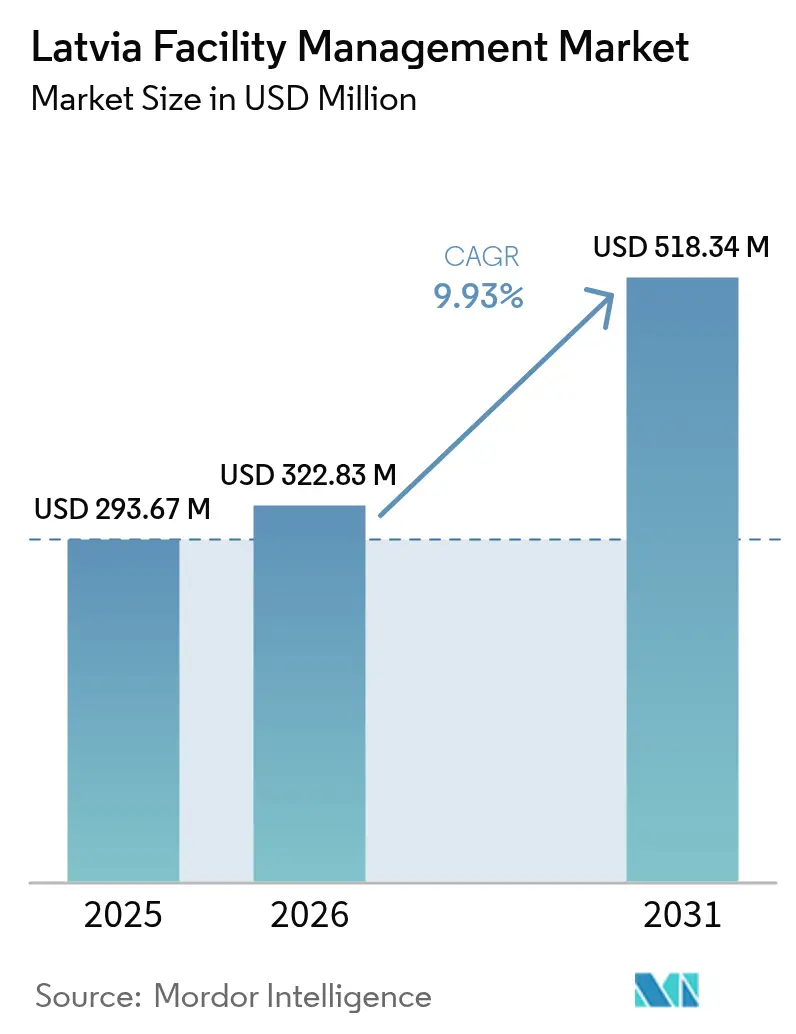
The Latvia facility management market size is expected to grow from USD 293.67 million in 2025 to USD 322.83 million in 2026 and is forecast to reach USD 518.34 million by 2031 at 9.93% CAGR over 2026-2031. Sustained outsourcing adoption, mounting ESG disclosure obligations and acute labor shortages are reshaping service delivery models, while energy-efficiency mandates, smart-building investments and large urban regeneration schemes add new revenue streams. Corporate occupiers continue to trade fixed costs for variable service contracts in response to GDP growth that remains below 2% and inflation holding near 3.4%.[1] Capital-intensive hard services dominate value creation, yet faster expansion in soft-service categories signals rising client preference for integrated workplace experiences. Medium-scale regional providers gain share by pairing local know-how with digital tools, even as global majors use scale, analytics and ESG credentials to win national tenders.
Key Report Takeaways
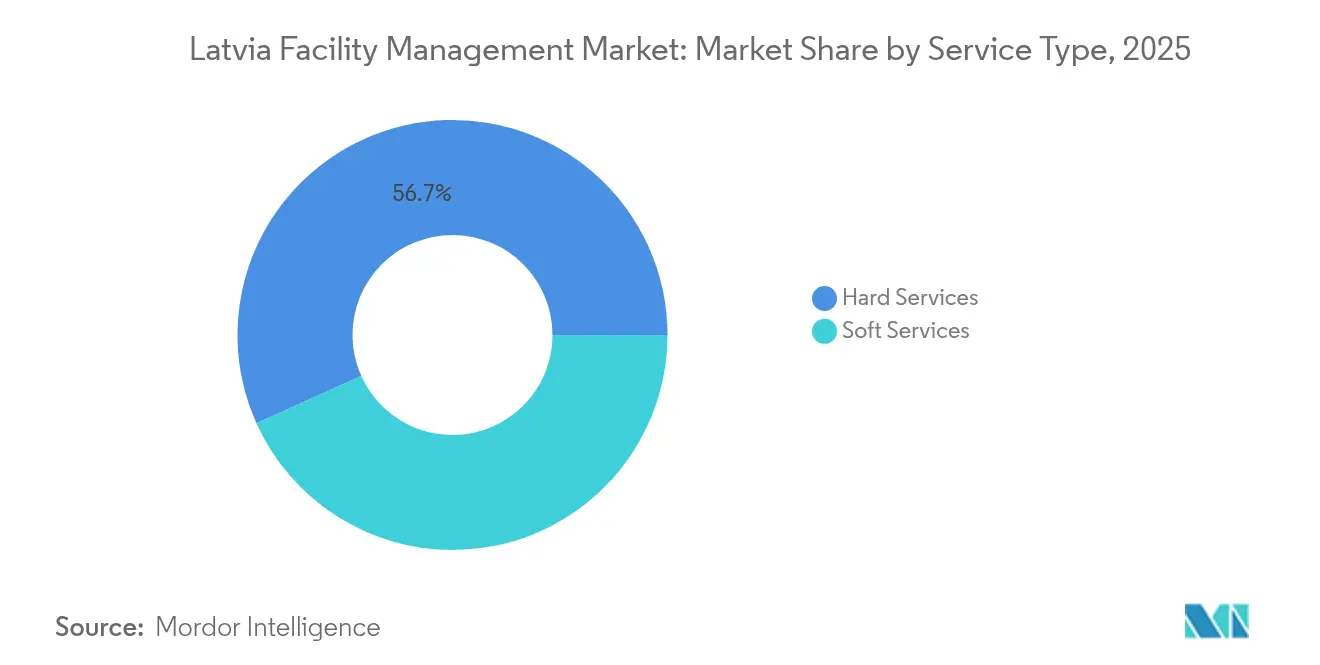
- By service type, Hard Services led with 56.73% revenue share in 2025, while Soft Services is accelerating at an 11.02% CAGR through 2031.
- By offering type, the Outsourced model held 63.62% share of the Latvia facility management market size in 2025 and is expanding at 11.78% CAGR to 2031.
- By end-user industry, Commercial facilities commanded 39.63% of the Latvia facility management market share in 2025, whereas Institutional & Public Infrastructure shows the highest forecast CAGR at 12.16% to 2031.
Note: Market size and forecast figures in this report are generated using Mordor Intelligence’s proprietary estimation framework, updated with the latest available data and insights as of 2026.
Latvia Facility Management Market Trends and Insights
Drivers Impact Analysis*
| Driver | (~) % Impact on CAGR Forecast | Geographic Relevance | Impact Timeline |
|---|---|---|---|
| Rising Adoption of Outsourced Facility Management Services | +2.8% | National, with concentration in Riga and Pierīga regions | Medium term (2-4 years) |
| Growing Focus on Energy Efficiency and Sustainability | +2.1% | National, with early adoption in commercial buildings | Long term (≥ 4 years) |
| Increasing Implementation of IoT and Smart Building Technologies | +1.9% | Urban centers, particularly Riga metropolitan area | Medium term (2-4 years) |
| Rising Demand for Integrated Facility Management Solutions | +1.7% | Commercial and institutional sectors nationwide | Medium term (2-4 years) |
| CSRD roll-out forcing large enterprises to hire ESG-capable FM providers | +1.2% | Large enterprises and public interest entities | Short term (≤ 2 years) |
| Corporate occupiers bundling hard and soft services | +1.0% | Commercial office buildings and industrial facilities | Medium term (2-4 years) |
| Source: Mordor Intelligence | |||
Rising Adoption of Outsourced Facility Management Services
A sustained shift toward external service provision underpins the Latvia facility management market as organizations counter labor scarcity and cost volatility. The outsourced segment’s 64.26% share in 2024 and 12.02% growth outlook highlight preference for single-partner accountability. Stricter rules on third-country hires imposed in 2025 constrain internal staffing pipelines, tilting procurement toward providers that can mobilize multi-skilled teams nationwide. Public financiers such as Altum booked EUR 26.6 million (USD 28.99 million) profit in 9M 2024, channeling fresh credit to SMEs that outsource non-core functions. Flagship projects like the EUR 3 billion (USD 3.27 billion) Riga Waterfront create long-run pipelines for bundled FM contracts spanning waste, energy and lifecycle asset management.
Growing Focus on Energy Efficiency and Sustainability
Mandatory ESG reporting introduced in 2024 compels more than 200 Latvian enterprises to declare building-level environmental metrics by 2026, propelling demand for measurable energy outcomes. A smart-lighting retrofit in Riga’s Ķīpsala district cut power bills by 79%, saving EUR 4,685 (USD 5,107) annually and proving the payback of sensor-based controls.[2] AI-driven HVAC pilots achieved 12.5% energy reduction without sacrificing indoor air-quality targets.[3] Military dormitories consume 270 kWh/m², far above theoretical norms, pointing to retrofit potential that could unlock 77.6–79.3% savings. These case studies shift procurement criteria from lowest cost to lowest carbon, altering bid evaluations across the Latvia facility management market.
Increasing Implementation of IoT and Smart Building Technologies
Sensor networks, BIM and data-driven workflows are redefining service scopes in the Latvia facility management market. Riga Technical University’s solar-powered, IoT waste platform automates fill-level alerts and route planning, showcasing the operational benefits of real-time analytics. More than 20,000 micro-generators already feed renewables into the grid, feeding data streams into building-management dashboards that optimize demand response. Rezekne Olympic Centre blends BIM, heat recuperation and PV arrays to shrink lifecycle maintenance budgets. Local patent activity around Modbus-enabled smart switches indicates emerging domestic tech supply chains. Lindström’s deployment of Nortal’s Industry 4.0 suite raised plant productivity, proving the ROI of predictive maintenance across textile service lines.
Rising Demand for Integrated Facility Management Solutions
Hybrid workplace models push occupiers to bundle cleaning, maintenance and workplace technology within one contract, fueling integrated FM uptake. ISS A/S elevated ESG to group-level oversight in 2024, signalling that sustainable operations are now a core component of integrated bids. CBRE’s facilities-management revenue jumped 18% in Q2 2024, buoyed by tech, healthcare and life-science clients seeking portfolio-wide service harmonization. RIX Riga Airport’s EUR 75 million (USD 81.75 million) terminal upgrade, designed for BREEAM certification, exemplifies the need for providers able to integrate hard services, soft services and carbon accounting across critical infrastructure. Latvijas Pasts invested EUR 1.4 million (USD 1.53 million) in automated sorting, demanding FM partners versed in equipment uptime and data security.
Restraints Impact Analysis*
| Restraint | (~) % Impact on CAGR Forecast | Geographic Relevance | Impact Timeline |
|---|---|---|---|
| Skilled Labor Shortages in Specialized Facility Services | -1.8% | National, with acute impact in Riga and industrial centers | Medium term (2-4 years) |
| Economic Uncertainty and Inflationary Pressures | -1.4% | National, with regional variations | Short term (≤ 2 years) |
| Inflation-driven spikes in energy and materials costs | -1.2% | National, with higher impact on energy-intensive facilities | Short term (≤ 2 years) |
| Stricter 2025 rules on hiring third-country nationals | -0.9% | National, with concentration in urban service centers | Medium term (2-4 years) |
| Source: Mordor Intelligence | |||
Skilled Labor Shortages in Specialized Facility Services
Seven of ten Latvian employers report difficulties sourcing qualified workers, and 85% struggle to secure competent hires, a pattern that directly constricts technical FM capacity. New compliance inspections intensify the need for certified safety professionals, yet restrictions on foreign labor added in 2025 extend recruitment timelines and costs. Residence permits issued to non-EU nationals more than doubled between 2015 and 2024, but tighter quotas now limit the pool for FM trades such as HVAC technicians. Investors rank workforce scarcity as Latvia’s top business risk, lowering the FICIL sentiment index to 1.9 in 2023, the weakest since 2016. Providers react by automating routine tasks and upskilling existing staff, yet wage escalation squeezes margins across the Latvia facility management market.
Economic Uncertainty and Inflationary Pressures
GDP growth below 2% and consumer-price inflation near 3.4% compress client budgets for non-critical services. The OECD warns that wage-led inflation and slow EU-fund absorption hinder construction pipelines that normally underpin FM demand. Banks such as BluOr highlight higher sanctions-compliance and cybersecurity spend that raise overheads for FM contracts linked to financial institutions. Elevated interest rates temper real-estate starts, though Citadele signals a gradual rebound in sentiment contingent on energy-price stability. These macro headwinds collectively shave more than 1 percentage point from forecast growth in the Latvia facility management market.
*Our forecasts treat driver/restraint impacts as directional, not additive. The impact forecasts reflect baseline growth, mix effects, and variable interactions.
Segment Analysis
By Service Type: Technical Reliability Sustains Hard-Service Supremacy
Hard Services controlled 56.73% of 2025 revenue within the Latvia facility management market, confirming the strategic role of asset integrity and compliance. Legacy building stock and stringent fire-safety rules keep demand high for mechanical, electrical and plumbing maintenance. Studies on military dormitories reveal 270 kWh/m² actual consumption versus 186 kWh/m² theoretical benchmarks, signaling untapped retrofit scope for energy-oriented hard-service contractors.
Soft Services, however, outpace overall growth at 11.02% CAGR, buoyed by heightened hygiene standards and flexible workplace protocols. The smart-lighting trial in Ķīpsala validates how digital tools can blend cleaning, security and workspace analytics into one data pool, elevating service quality. CleanR Grupa’s revenue gains through 9M 2024 illustrate rising outsourcing of janitorial and waste streams, with ESG dashboards becoming part of service-level agreements.

By Offering Type: Outsourcing Moves from Cost Play to Capability Play
The outsourced delivery model captures 63.62% of Latvia facility management market size and is projected to climb at 11.78% CAGR, reflecting occupiers’ shift from transactional contracting to strategic partnerships. CBRE’s Baltic earnings surge underscores appetite for bundled and integrated FM, especially among technology clusters and life-science parks.
In-house operations persist where critical infrastructure-such as RIX Riga Airport’s EUR 75 million (USD 81.75 million) passenger-terminal project-requires continual knowledge transfer and security sovereignty. Pauls Stradins Clinical University Hospital posted EUR 179.3 million (USD 195.44 million) turnover in 2023, maintaining large internal estates teams while subcontracting niche tasks under tight infection-control protocols. This hybrid adoption pattern balances core-mission focus with risk management in the Latvia facility management market.
By End-User Industry: Commercial Dominance Meets Institutional Acceleration
Commercial assets contributed 39.63% of 2025 revenue, driven by the service-sector orientation of Latvia’s economy. Real-estate data shows EUR 105 million (USD 114.45 million) of Riga apartment sales in Q1 2025, signalling sustained transaction volumes that translate into FM retainer contracts. The EUR 3 billion (USD 3.27 billion) waterfront scheme alone will add 8,000 homes and 1,000 hotel rooms, ensuring a decade-long pipeline for property-management and hospitality FM.
Institutional & Public Infrastructure sites, from government offices to military training grounds, are forecast to grow fastest at 12.16% CAGR. Defense allocations rising to 5% of GDP underwrite the Selonia Training Area build-out across Aizkraukle and Jēkabpils, opening specialized FM mandates for security, logistics and environmental oversight. Parallel upgrades in education and healthcare expand demand for infection-control, energy-retrofit and accessibility services across the Latvia facility management market.
Geography Analysis
Facility demand is heavily concentrated in the Riga metropolitan and Pierīga corridor, reflecting the agglomeration of corporate headquarters, government ministries and modern retail malls. Roughly half of Latvia’s new building permits are issued in this zone, and property deals in Riga alone tallied EUR 105 million (USD 114.45 million) in Q1 2025. Smart-city pilots such as Ķīpsala’s lighting project position the capital as an innovation sandbox that shapes national procurement standards.
Secondary cities increasingly adopt advanced FM tools to support tourism, sports and industrial zones. Rezekne Olympic Centre’s award-winning complex validates that regional authorities value BIM-enabled maintenance and renewable integration. Cesis County promotes circular-economy business models across 5,137 registered firms, creating pockets of demand for waste-auditing and resource-efficiency services.
Distributed energy producers now exceed 20,000 connections, many in peri-urban industrial parks, requiring FM support for inverter upkeep, panel cleaning and grid compliance. The evolving spread reduces dependence on the capital and diversifies growth drivers for the Latvia facility management market.
Regulatory Landscape
Facility management in Latvia is shaped by the construction and building-operation framework overseen by the Ministry of Economics (Ekonomikas ministrija), with the State Construction Control Bureau (BVKB) responsible for control and supervision of construction works and building operation. The Construction Law (Buvniecibas likums) sets requirements for the construction process and building lifecycle, while Cabinet Regulation No. 907 (as amended) defines expectations for residential building surveys, technical maintenance, and routine repair, reinforcing documentation and scheduled inspection practices that flow into hard-service scopes.
From 2025-01-01, the Latvian standard LVS 1077:2023 became mandatory for residential building administrators, raising the bar for consistent visual inspections and technical maintenance of residential building territories, structures, equipment, and engineering communications. Alongside national rules, recognized management-system standards such as ISO 41001 (facility management) are used by public-sector entities, including State Real Estate (VNĪ). Regulatory direction is also supported through digitalization of permitting and operation processes via the Construction Information System (BIS), including BVKB guidance and trainings (for example, an April 2026 webinar on declarations within the unified building registration process).
Value Chain Analysis
The Latvia facility management value chain begins with building owners and occupiers (commercial, institutional, and residential associations) that define service-level requirements, increasingly combining technical compliance, energy performance tracking, and user-experience outcomes. Upstream inputs include labor (HVAC, electrical, fire safety, cleaning, security), consumables and spare parts, and building-technology components such as meters, sensors, controllers, and BMS software supplied through OEM channels and local system integrators.
In delivery, FM providers and specialized subcontractors execute higher-value hard services through maintenance planning, statutory inspections, and lifecycle replacements, while soft services are provided through bundled or integrated FM contracts. A downstream enabler is building-automation and systems integration: projects such as LAFI’s March 2026 delivery at Satekles Business Centre in Riga demonstrate full-cycle integration (design, installation, programming, commissioning, and ongoing service) around a centralized Siemens Desigo CC platform and controllers, linking ventilation, heating, cooling, lighting (DALI), and resource metering. These systems feed client reporting, energy optimization, and compliance workflows, supporting recurring demand for remote monitoring, calibration, cybersecurity hygiene, and continuous commissioning services.
Competitive Landscape
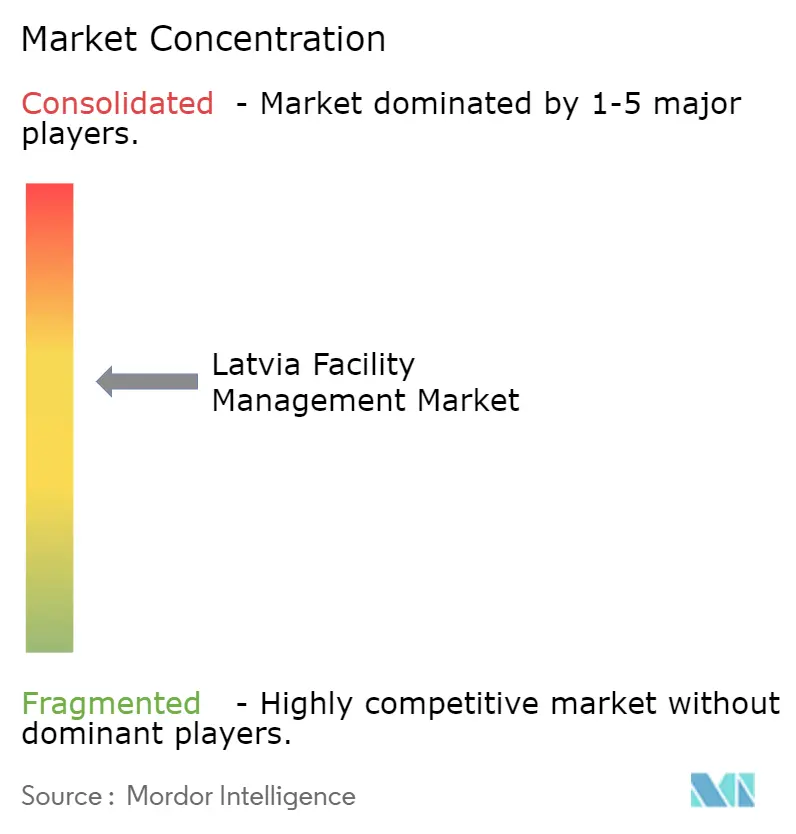
International majors and nimble local specialists foster a moderately concentrated arena. ISS A/S posted DKK 83.7 billion (USD 12.56 billion) 2024 revenue and launched a DKK 2.5 billion (USD 375 million) share-buyback, signalling firepower to pursue Latvian public-sector tenders. CBRE extends data analytics and workplace-experience apps to differentiate on outcome-based pricing.
Regional champions such as CleanR Grupa deep-link cleaning, waste and landscaping services under Latvian regulatory frameworks, enabling agile contract turnarounds. Civic-owned newcomers win niche lots by demonstrating ESG reporting tools aligned with national disclosure law.
Technology forms the next competitive frontier. Lindström leverages IoT laundry workflows to lift plant productivity, while university spin-offs commercialize Modbus-ready smart-switch platforms that could embed into FM packages. The Latvia facility management market therefore rewards scale in compliance, breadth in service scope and depth in digital capability.
Latvia Facility Management Industry Leaders
-
Hagberg
-
Clean House
-
Elis
-
Civnity Solutions
-
City Service
- *Disclaimer: Major Players sorted in no particular order
Market Opportunities and Future Outlook
A clear opportunity sits at the intersection of energy performance compliance and measurable building operations, where FM providers can package metering, monitoring, and optimization as contracted outcomes rather than ad hoc projects. The evidence in scope includes integrated automation deployments such as the March 2026 Satekles Business Centre implementation (Siemens Desigo CC, DALI lighting integration, and resource metering), which shows how modern Class A assets generate recurring demand for BMS operation, analytics, and maintenance linked to uptime and energy KPIs. As ESG reporting obligations tighten for larger enterprises, service providers with auditable maintenance logs and building-level environmental metrics gain an edge in competitive tenders.
Technology-led FM also creates whitespace for vendors and service firms that can connect BIM-based asset data to maintenance execution, supporting predictive maintenance and digital-twin workflows that reduce emergency callouts and improve spares planning. Public and cross-sector initiatives provide additional proof points for data-centric services: the MATRYCS project involving the Latvian Environmental Investment Fund is deploying a modular, cloud-based analytics toolbox for smart, energy-efficient buildings, supporting demand for FM partners that can ingest heterogeneous building data securely and translate it into operational actions. This shifts differentiation toward commissioning expertise, interoperability across HVAC, lighting, and metering stacks, and the ability to deliver portfolio-wide dashboards that support both operational control and sustainability disclosures.
Recent Industry Developments
- June 2026: HAGBERG opened apartment reservations for its Brizes residential development in Liepaja. The step moves the project from planning into commercial execution, expanding the pipeline of newly delivered assets that require property and facility services from handover through stabilization.
- May 2026: HAGBERG announced a EUR 12 million co-living development in central Riga (Lacplesa iela 106), with the first phase targeted for completion in summer 2027. Co-living formats typically require higher-frequency soft services and tighter building-operations control, creating demand for integrated FM packages across cleaning, security, and technical maintenance.
- March 2026: LAFI reported completion of building management systems and automation solutions for the Satekles Business Centre, a Class A office complex in Riga, built around the Siemens Desigo CC platform with integrated HVAC, lighting (DALI), and resource metering. This type of full-stack commissioning raises the baseline for FM delivery, increasing the need for providers capable of operating, maintaining, and optimizing interconnected building systems over the asset lifecycle.
Research Methodology Framework and Report Scope
Market Definition and Coverage
For this methodology, the Latvia facility management market is defined as the revenues earned from managing and operating buildings and sites through hard and soft services, delivered either in-house or through outsourced contracts, across commercial, public, and industrial facilities.
Scope exclusions: Pure construction work, property sale and leasing activity, and standalone facility software licenses are excluded when they are not part of a facility management service contract.
Segmentation Overview
- By Service Type
- Hard Services
- Asset Management
- MEP and HVAC Services
- Fire Systems and Safety
- Other Hard FM Services
- Soft Services
- Office Support and Security
- Cleaning Services
- Catering Services
- Other Soft FM Services
- Hard Services
- By Offering Type
- In-house
- Outsourced
- Single FM
- Bundled FM
- Integrated FM
- By End-user Industry
- Commercial (IT and Telecom, Retail and Warehouses)
- Hospitality (Hotels, Eateries, Large-scale Restaurants)
- Institutional and Public Infrastructure (Govt, Education, Transportation)
- Healthcare (Public and Private Facilities)
- Industrial and Process (Manufacturing, Energy, Mining)
- Other End-user Industries (Multi-housing, Entertainment, Sports and Leisure)
Data Sources, Market Sizing, and Validation
Desk Research
Desk research was used to set the demand context and to anchor the model in Latvia-specific building activity and service spend signals. We relied on public sources such as Latvia's Central Statistical Bureau (construction output, business services, employment), Eurostat (construction and commercial building indicators), the European Commission and related EU energy efficiency and renovation publications, and the European Environment Agency for building-related energy signals.
Alongside these, company annual reports and investor presentations helped us understand service mix and typical contract structures, while reputed press and association websites were used to validate adoption trends for outsourced and integrated services. We also referenced a paid company financials and intelligence subscription to standardize financial years and to sanity-check reported service revenues for relevant operators. This desk source list is illustrative only, and many other public sources were also checked for data collection, validation, and clarification.
Primary Interviews and Surveys
Interviews and surveys with facility buyers, service providers, technical managers, procurement leads, and public property administrators in Latvia are used to check how contracts are priced and renewed. Respondents help clarify outsourcing rates, labor pressure, service prices, and gaps in official classifications, which are then compared with Latvian desk evidence before the estimates are finalized.
Distribution of primary research fieldwork respondents
| Company type | Respondent position |
|---|---|
| Top tier: 26% | CXOs: 15% |
| Mid tier: 49% | Functional/Unit leaders: 30% |
| Smaller Players: 25% | Managers: 55% |
Market-Sizing & Forecasting
Market sizing was built using top-down and bottom-up checks so the final totals stay realistic for Latvia. In the top-down layer, we reconstructed the addressable pool by linking Latvia's commercial and institutional building base and activity to the share of spend that typically flows into hard and soft facility services, and then split it by in-house versus outsourced delivery based on observed contracting behavior.
The outputs were then corroborated with selective bottom-up approximations such as sampled contract values for cleaning, security, and technical maintenance, along with typical frequency and labor intensity, which are then scaled to relevant facility counts. Key inputs used in the model include the mix of hard versus soft services, outsourced penetration by end-user type, average contract duration and renewal timing, local labor cost movement for service delivery, and the pace of building renovation and compliance upgrades that influence maintenance intensity.
For forecasting, scenario analysis was used so that different paths for outsourcing adoption, wage inflation, and renovation-driven maintenance demand could be reflected without overfitting limited national data series. Where bottom-up evidence was thin for smaller towns or niche services, gaps were handled by using conservative service intensity ratios confirmed in interviews and then tested against the overall spend envelope.
Data Validation & Update Cycle
Validation was handled through triangulation across service mix, outsourcing shares, and independent signals such as construction and renovation activity, employment patterns in building services, and operator revenue disclosures. When an outlier appeared, the drivers were reviewed first, and then assumptions on contract scope, pricing, or penetration were adjusted only after a second-pass check and a re-contact with relevant interviewees.
Before sign-off, the model and outputs go through multi-step analyst reviews so that unit economics, implied spend per facility, and year-on-year movements remain consistent with what market participants report. The report is refreshed annually, with interim updates triggered by material events like sharp currency moves, major regulatory changes affecting buildings, or visible shifts in outsourcing behavior, and then a final freshness pass is completed before delivery.
Mordor Intelligence's Latvia Facility Management Market Size Compared Against Other Published Estimates
Published market sizes for Latvia facility management can vary even when the topic label looks the same, because firms do not always count the same service boundaries or use the same pricing and currency timing. Differences also show up when one estimate leans more on broad business services totals, while another builds from contract-led facility service demand and then checks it against operator revenues.
The spread is often driven by how frequently assumptions are refreshed and how pricing is handled for multi-year service contracts, since wages and material inputs move quickly in facility services. In this study, exchange rates are aligned to the year being sized and average selling price logic is re-validated through recent contract discussions before the total is locked. This refresh-led discipline is a key reason the 2025 value differs across sources, a modeling choice applied by Mordor Intelligence.
Benchmark comparison
| Source | Market Size | Gaps in Research Methodology |
|---|---|---|
| Mordor Intelligence | USD 293.67 M (2025) | |
| Regional Consultancy A | USD 509.57 M (2026) | Uses a later year and appears to apply a broader service envelope, including wider facility support activities and longer-horizon assumptions that can lift ASP and penetration in early forecast years. |
| Industry Dataset B | USD 85.00 M (2026) | Likely reflects a narrower statistical industry bucket focused on combined facilities support activities, which can exclude several outsourced hard and soft service lines captured in a full facility management definition. |
The table shows that timing and scope explain most of the gap, since one estimate is anchored on a broader 2026 envelope and another is built from a narrow activity classification. By keeping the service boundary tied to facility management contracts and then re-checking implied spend levels against operator realities, the final number stays traceable to a few practical variables that can be revisited and repeated each update.
Key Questions Answered in the Report
What is the forecast CAGR for the Latvia facility management market to 2031?
The market is projected to grow at 9.93% CAGR between 2026 and 2031, increasing from USD 322.83 million to USD 518.34 million.
Which service type commands the largest revenue share?
Hard Services account for 56.73% of 2025 revenue due to the criticality of technical maintenance and regulatory compliance.
Why are outsourced models gaining traction?
Outsourcing mitigates labor-shortage risk, supports ESG reporting, and offers single-point accountability, leading to a 63.62% share in 2025.
Which end-user segment is expanding fastest?
Institutional & Public Infrastructure facilities are forecast to grow at 12.16% CAGR because of defense and government infrastructure spending.
How does Latvia’s ESG disclosure law influence FM demand?
The law obliges over 200 companies to publish sustainability metrics by 2026, driving adoption of energy-efficient and data-rich FM solutions.
What technological trends are reshaping service delivery?
IoT sensors, BIM, AI-optimized HVAC and smart-lighting systems are enhancing efficiency and forming competitive differentiators among providers.