
Kubernetes Runtime Security Market Size and Share
Market Overview
| Study Period | 2020 - 2031 |
|---|---|
| Market Size (2026) | USD 0.61 Billion |
| Market Size (2031) | USD 1.77 Billion |
| Growth Rate (2026 - 2031) | 23.75 % |
| Fastest Growing Market | Asia-Pacific |
| Largest Market | North America |
| Market Concentration | Medium |
Major Players *Disclaimer: Major Players sorted in no particular order Image © Mordor Intelligence. Reuse requires attribution under CC BY 4.0. | |
Kubernetes Runtime Security Market Analysis by Mordor Intelligence
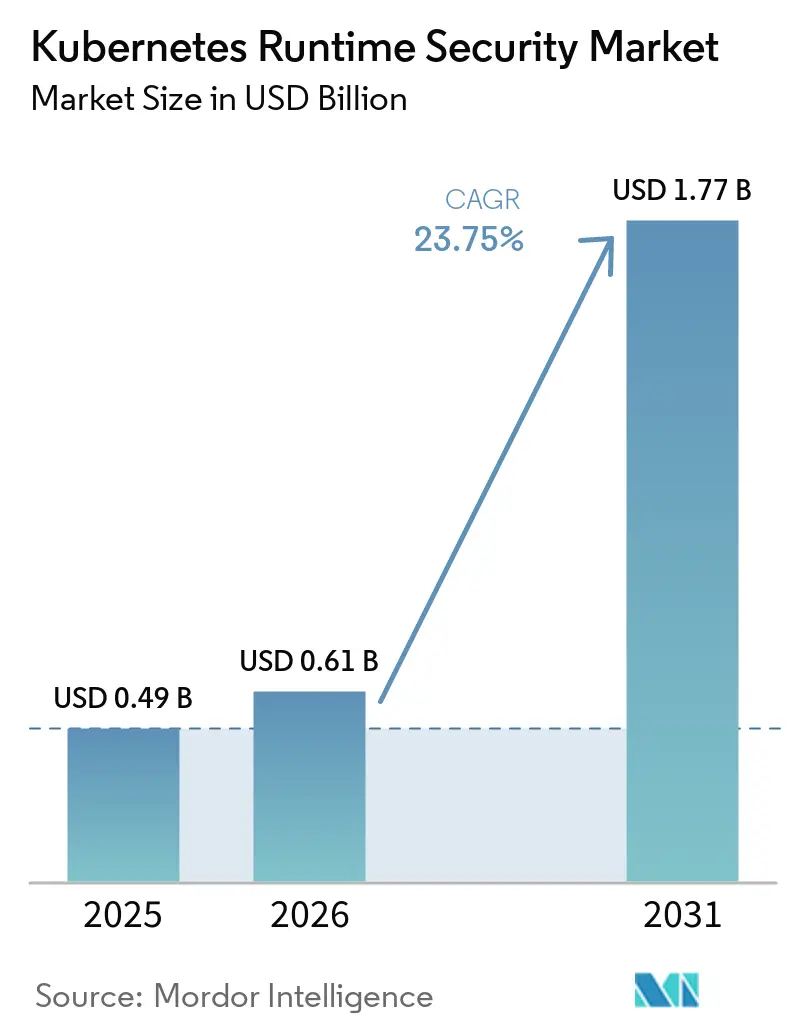
The Kubernetes runtime security market size was valued at USD 0.49 billion in 2025 and estimated to grow from USD 0.61 billion in 2026 to reach USD 1.77 billion by 2031, at a CAGR of 23.75% during the forecast period (2026-2031). Production Kubernetes use has become central to cloud-native application delivery and AI inference environments. The growing number of production clusters has increased the number of live workloads that require visibility and enforcement. Buyers are placing greater weight on continuous monitoring, automated response, and policy enforcement. Providers are responding by combining runtime telemetry with AI-enabled investigation and remediation tools. The Kubernetes runtime security market is also seeing stronger demand for platforms that work across cloud, private, and hybrid environments.
Key Report Takeaways
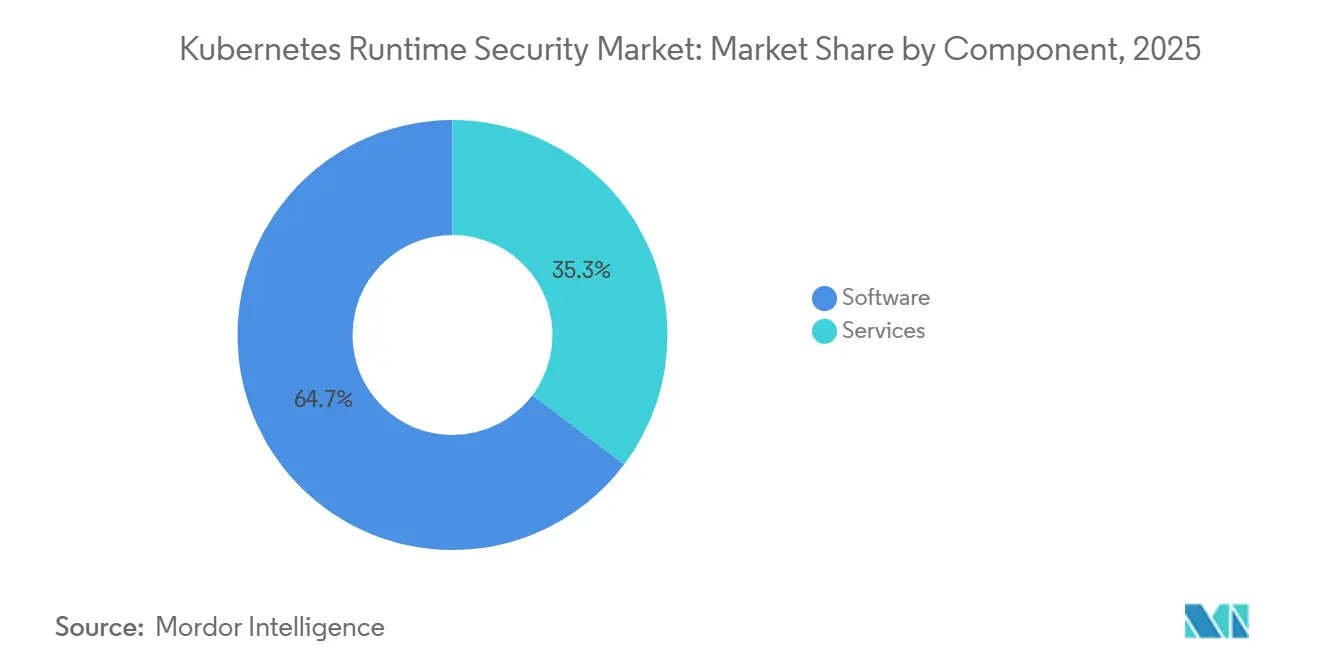
- By component, software led with a 64.73% revenue share in the Kubernetes runtime security market in 2025, while services are projected to expand at a 26.47% CAGR through 2031.
- By deployment model, cloud-based deployment held 59.84% of the Kubernetes runtime security market share in 2025 and is projected to expand at a CAGR of 27.82% through 2031.
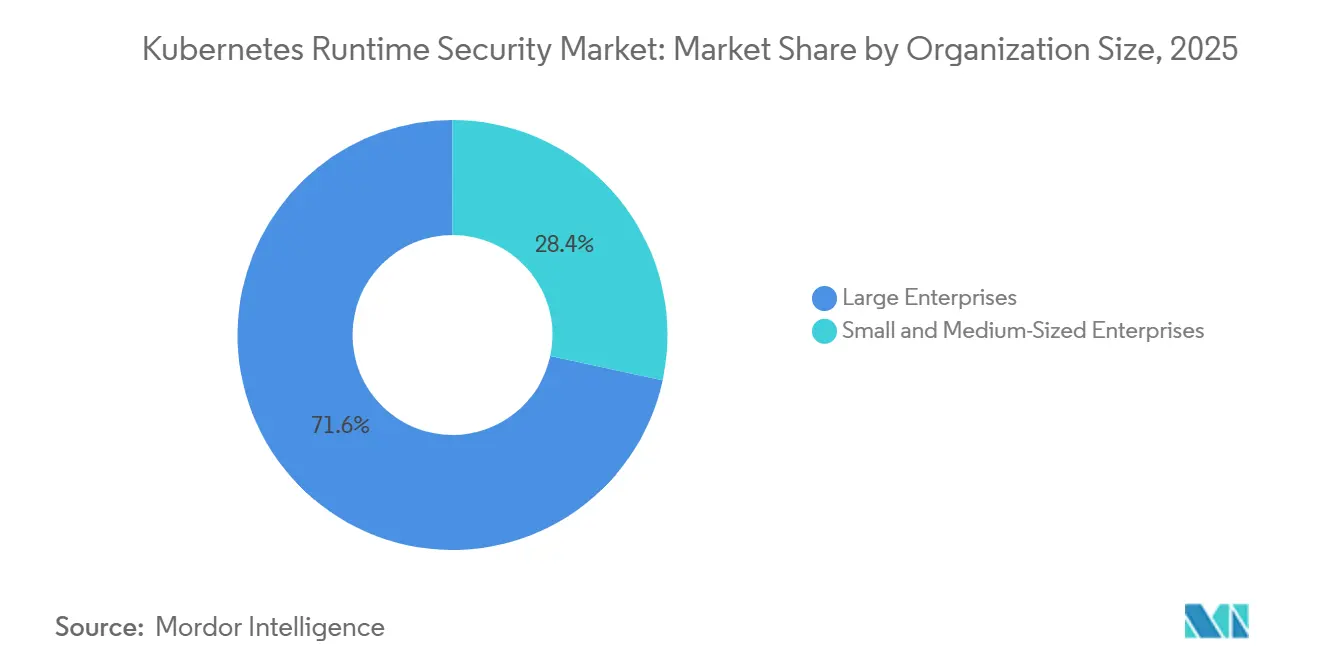
- By organization size, large enterprises accounted for 71.62% of revenue in 2025, while SMEs are projected to record the highest CAGR at 25.49% through 2031.
- By end-use industry, BFSI held 26.81% revenue share in 2025, while the government and public administration industry is projected to expand at a CAGR of 26.72% through 2031.
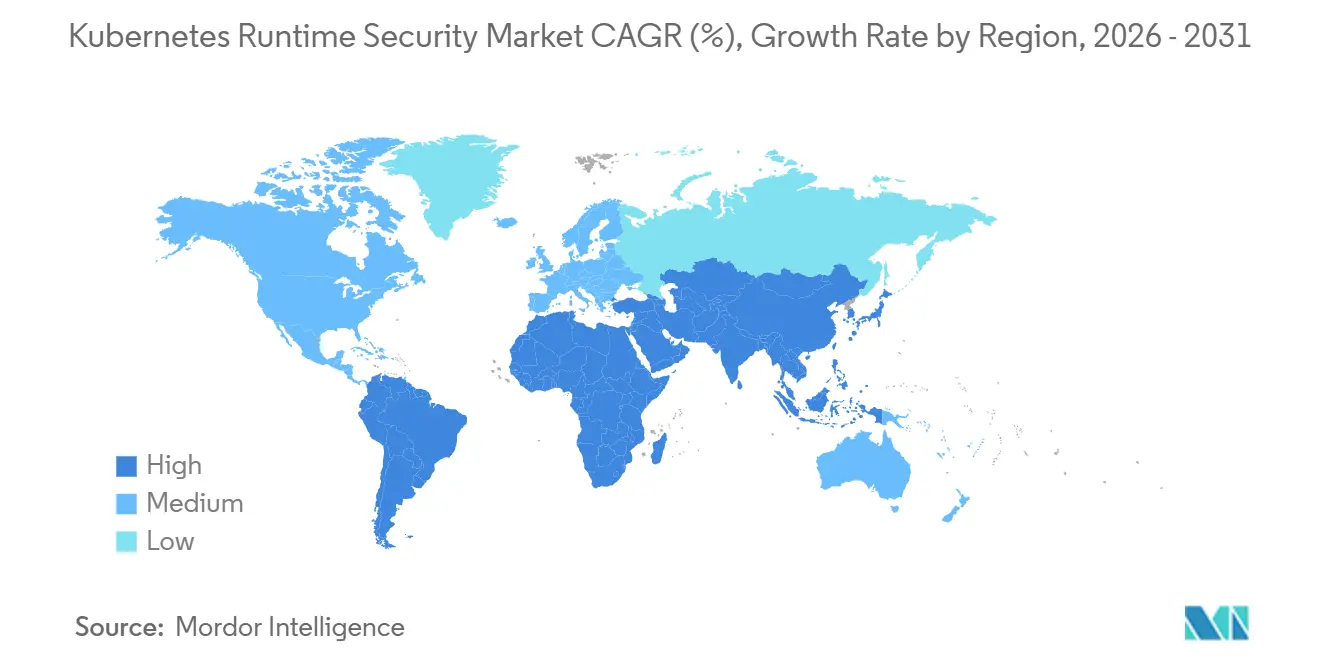
- By geography, North America accounted for 37.28% of revenue in the Kubernetes runtime security market in 2025, while Asia-Pacific is projected to expand at a CAGR of 27.59% through 2031.
Note: Market size and forecast figures in this report are generated using Mordor Intelligence’s proprietary estimation framework, updated with the latest available data and insights as of January 2026.
Global Kubernetes Runtime Security Market Trends and Insights
Drivers Impact Analysis*
| DRIVER | (~) % IMPACT ON CAGR FORECAST | GEOGRAPHIC RELEVANCE | IMPACT TIMELINE |
|---|---|---|---|
| Accelerating Kubernetes and Cloud-Native Workload Adoption | +7.2% | Global | Short term (≤ 2 years) |
| Rising Container Escape, Privilege Escalation, and Runtime Attack Risks | +5.5% | Global | Short term (≤ 2 years) |
| Growing Need for Continuous Runtime Threat Detection and Automated Response | +4.0% | North America and EU core, spill-over to APAC | Medium term (2-4 years) |
| Regulatory Pressure for Continuous Workload Monitoring | +2.8% | North America, EU, APAC, Singapore, Japan, and South Korea | Medium term (2-4 years) |
| Increasing Adoption of eBPF-Based Runtime Visibility and Enforcement | +2.5% | Global, with early gains in North America and EU | Medium term (2-4 years) |
| Expansion of AI, GPU, and Machine-Driven Kubernetes Workloads | +2.0% | North America, APAC, China, Japan, and South Korea | Long term (≥ 4 years) |
| Source: Mordor Intelligence | |||
Accelerating Kubernetes and Cloud-Native Workload Adoption
Kubernetes has moved beyond a developer tool and now supports a broad range of production infrastructure. The Cloud Native Computing Foundation reported that 82% of container users ran Kubernetes in production in 2025, up from 66% in 2023.[1] The same survey found that 59% of organizations classified much or nearly all of their development and deployment activities as cloud-native. Higher workload density can expose shared nodes, service-account tokens, and cluster secrets when a runtime control fails. Each new production cluster increases the need for monitoring and enforcement, thereby supporting demand in the Kubernetes runtime security market. Organizations moving legacy applications into containers can also face gaps, as older monitoring tools lack Kubernetes-native threat detection.
Rising Container Escape, Privilege Escalation, and Runtime Attack Risks
Container escape and privilege escalation weaknesses remain material concerns for production clusters. Red Hat disclosed CVE-2026-53362, a Linux kernel IPv6 fragmentation flaw that could allow an attacker with local container access to bypass SELinux enforcement and gain host root access.[2] The company issued fixes for affected Red Hat products and classified the issue as Important. These weaknesses show why runtime visibility must cover activity beyond static images and pre-deployment configuration checks. Autonomous attack workflows can reduce the time available to analysts to identify and contain abnormal activity. Sysdig reported that attacks can now unfold in under 8 minutes and that vulnerabilities can be weaponized within 10 hours of public disclosure.
Growing Need for Continuous Runtime Threat Detection and Automated Response
The period between vulnerability disclosure and active exploitation has narrowed sharply in live cloud environments. Sysdig reported that attacks can occur in under 8 minutes, while public vulnerabilities can be weaponized within 10 hours. This timing makes a fully manual investigation difficult for teams operating large Kubernetes estates. In May 2026, Sysdig introduced a headless cloud security architecture intended for AI coding agents and other automated operators. Aqua Security introduced Aqua Compass in April 2026 to support agentic investigation, containment, and remediation of runtime incidents. The Kubernetes runtime security market favors offerings that combine detection with policy enforcement, containment, and evidence for continuous monitoring requirements. eBPF telemetry supports these workflows by delivering kernel-level events that automation can evaluate quickly.
Regulatory Pressure for Continuous Workload Monitoring
Regulatory obligations are making continuous workload monitoring a more direct buying consideration. Financial institutions operating containerized applications need audit evidence that links runtime activity to operating controls. This requirement is particularly relevant for banks and insurers that use Kubernetes for payment, trading, and customer-facing services. Buyers increasingly prefer platforms that map runtime telemetry to control requirements rather than leave teams to assemble evidence manually. Public-sector guidance is placing greater attention on anomaly detection, network policies, secrets management, and access controls. These requirements strengthen the case for runtime platforms that provide clear operational records.
Restraints Impact Analysis*
| RESTRAINT | (~) % IMPACT ON CAGR FORECAST | GEOGRAPHIC RELEVANCE | IMPACT TIMELINE |
|---|---|---|---|
| Runtime Sensor Overhead and Production Performance Concerns | -0.9% | Global, most acute in high-throughput trading, media, and transaction environments | Short term (≤ 2 years) |
| Shortage of Kubernetes Runtime Security Expertise | -0.7% | Global, most severe in South America, Middle East, and Africa | Medium term (2-4 years) |
| Alert Fatigue and Limited Runtime Context Correlation | -0.5% | North America and EU, largest deployments and highest signal volumes | Medium term (2-4 years) |
| Complexity of Securing Multi-Cluster and Multi-Cloud Environments | -0.4% | Global enterprises with distributed hybrid infrastructure | Long term (≥ 4 years) |
| Source: Mordor Intelligence | |||
Runtime Sensor Overhead and Production Performance Concerns
Production teams can be cautious about deploying runtime sensors across every node. This concern is strongest in latency-sensitive trading, media processing, and transaction environments. eBPF-based agents have reduced overhead compared with earlier kernel-module agents, but performance validation remains part of the purchasing process. Teams may retain concerns from heavier earlier-generation tools when they assess newer implementations. Staged proof-of-concept deployments can help buyers compare coverage and resource use in their own environment. Reduced instrumentation can leave gaps when new runtime vulnerabilities emerge, including the containerd runAsNonRoot restriction bypass tracked as CVE-2026-46680.
Shortage of Kubernetes Runtime Security Expertise
Kubernetes operations and runtime security engineering require an uncommon mix of skills. The CNCF survey identified lack of training and security skills as an adoption barrier for 36% of surveyed organizations. Teams must understand Kubernetes identities, kernel events, policy controls, and incident response workflows. The shortage is more acute for SMEs and for organizations in South America, the Middle East, and Africa. Products that expose raw telemetry can create a practical barrier when security teams lack tools for triage. Managed detection and response, automated remediation guidance, and simpler policy workflows can make adoption more workable for smaller teams.
*Our forecasts treat driver/restraint impacts as directional, not additive. The impact forecasts reflect baseline growth, mix effects, and variable interactions.
Segment Analysis
By Component: Software Anchors Revenue While Services Expand
Software accounted for 64.73% of the Kubernetes runtime security market share in 2025. Runtime detection and prevention platforms, eBPF sensor suites, and policy-as-code tools accounted for the largest share of revenue. The CNCF found that 59% of organizations described much or nearly all of their development and deployment as cloud-native. This shift expands the live workload perimeter that software platforms must monitor. Large enterprises often favor tenant-isolated or locally installed sensor configurations when data residency and air-gap requirements limit telemetry transfer. Falco provides an open-source baseline for runtime monitoring that commercial providers can extend through policy management, threat intelligence, and CI/CD integration.[3]
Services are projected to grow at a CAGR of 26.47% from 2026 to 2031. Managed services address the operational gap for organizations without dedicated Kubernetes security specialists. Professional services support multi-cluster deployment, hybrid policy harmonization, and compliance mapping work. JFrog introduced 9 platform innovations in March 2026 for AI-native software supply chain governance. Such controls can increase the need for implementation and policy-tuning support across diverse cluster estates. The Kubernetes runtime security industry, therefore, has room for providers that combine software licenses with operational guidance. Services also help customers align sophisticated platform features with existing security processes.
By Deployment Model: Cloud Delivery Leads Adoption and Growth
Cloud-based deployment accounted for 59.84% of the Kubernetes runtime security market in 2025. Managed Kubernetes services such as Amazon EKS, Azure AKS, and Google GKE are important channels for onboarding runtime sensors. Cloud deployment is projected to grow at a CAGR of 27.82% through 2031. The CNCF reported that 66% of organizations deploying generative AI models used Kubernetes for inference. This places more valuable inference workloads in cloud environments where continuous runtime controls are needed. Wiz expanded its coverage in 2026 with runtime threat detection for Google Cloud Run containers.[4]
Cloud delivery can reduce manual kernel configuration for platform teams. It can also support managed sensor operations for organizations with limited internal capacity. Providers are extending coverage beyond Linux Kubernetes nodes as customer environments become more diverse. Wiz announced a runtime sensor for Windows environments in 2026. On-premises deployment remains relevant in regulated settings that require data residency, air-gapped clusters, or sovereign-cloud policies. These environments can require more engineering work for kernel-level instrumentation. The Kubernetes runtime security market continues to need products that support both public-cloud and private-cluster operating models.
By Organization Size: Enterprises Dominate While SMEs Gain Ground
Large enterprises held 71.62% of the Kubernetes runtime security market share in 2025. These buyers often operate hundreds or thousands of nodes across multi-cluster and multi-cloud environments. Their scale creates extensive exposure and compliance needs that support dedicated runtime security investments. Financial institutions and technology companies running large container estates are a core buyer group. CrowdStrike and NVIDIA introduced a Secure-by-Design AI Blueprint in March 2026 to integrate Falcon capabilities into NVIDIA OpenShell for AI agents.[5] This example reflects the more demanding runtime requirements in enterprise AI and GPU environments.
SMEs are projected to grow at a CAGR of 25.49% from 2026 to 2031. Managed Kubernetes services can reduce the operational barrier for smaller organizations that deploy containerized applications. Those organizations still face runtime threats even if they lack large platform security teams. Consumption-based pricing, AI-assisted triage, and managed service options can therefore appeal to this buyer group. SMEs are likely to depend more on automated response and guided remediation than on specialized internal analysts. Providers that embed these functions in their platforms can address a clear operational need. This pattern broadens participation in the Kubernetes runtime security market beyond the largest enterprises.
By End Use Industry: BFSI Holds Share While Government Grows Fastest
BFSI held 26.81% of the Kubernetes runtime security market share in 2025. Banks, financial services firms, and insurers are containerizing payment, core banking, trading, and fraud detection workloads. Their spending is shaped by both threat exposure and the need to demonstrate audit readiness. Persistent runtime telemetry can provide a record of activity that post-event log reconstruction may not provide. China Merchants Bank received a CNCF end-user case study award in September 2026 for using Kubernetes to unify AI training and inference for financial use cases. The case illustrates the growing role of Kubernetes in critical financial AI infrastructure.
The government and public administration industry is projected to grow at a CAGR of 26.72% from 2026 to 2031. National digital transformation programs are moving citizen services onto containerized platforms. IT and telecommunications providers need lightweight telemetry for latency-sensitive edge and 5G workloads. Healthcare and life sciences organizations must align runtime records with audit and logging requirements. Industrial manufacturers are bringing Kubernetes into OT and IT environments, as well as edge processing locations. Retail, e-commerce, transportation, logistics, energy, utilities, media, entertainment, and education are also part of the addressable base. Each of these fields is at a different stage of cloud-native adoption and runtime security maturity.
Geography Analysis
North America accounted for 37.28% of the Kubernetes runtime security market in 2025. The region has a high concentration of cloud-native enterprises and large buyers of managed security services. Financial services and healthcare organizations increasingly use specialist providers for continuous runtime monitoring. These customers require operational support across complex environments and around-the-clock security processes. Competition is particularly active among runtime specialists, CNAPP providers, and cloud security divisions of broader cybersecurity companies.
Asia-Pacific is projected to grow at a CAGR of 27.59% from 2026 to 2031. The region combines rising Kubernetes adoption with digital government programs and evolving security expectations. Japan has a large cloud-native developer base, while factories and telecommunications operators are using edge Kubernetes for IoT and 5G workloads. India’s digital public infrastructure and financial data localization requirements support demand for private- and sovereign-cloud-compatible deployments. China’s sovereign-cloud requirements also encourage locally aligned container security stacks. Singapore’s security guidance signals closer attention to runtime anomaly detection and access controls among critical infrastructure operators.
Europe has substantial demand in Germany, the United Kingdom, and France. Financial and industrial organizations in the region operate dense, multi-cloud container estates that require enterprise-grade controls. Germany presents demand from industrial and financial users, while the United Kingdom has containerized government and financial workloads. France’s large companies are also increasing Kubernetes adoption across financial services and defense settings. South America remains earlier in adoption but has potential in fintech and government digital services. The Middle East is investing in sovereign cloud and digital government programs, while demand in Africa is emerging from fintech and telecommunications organizations.
Competitive Landscape
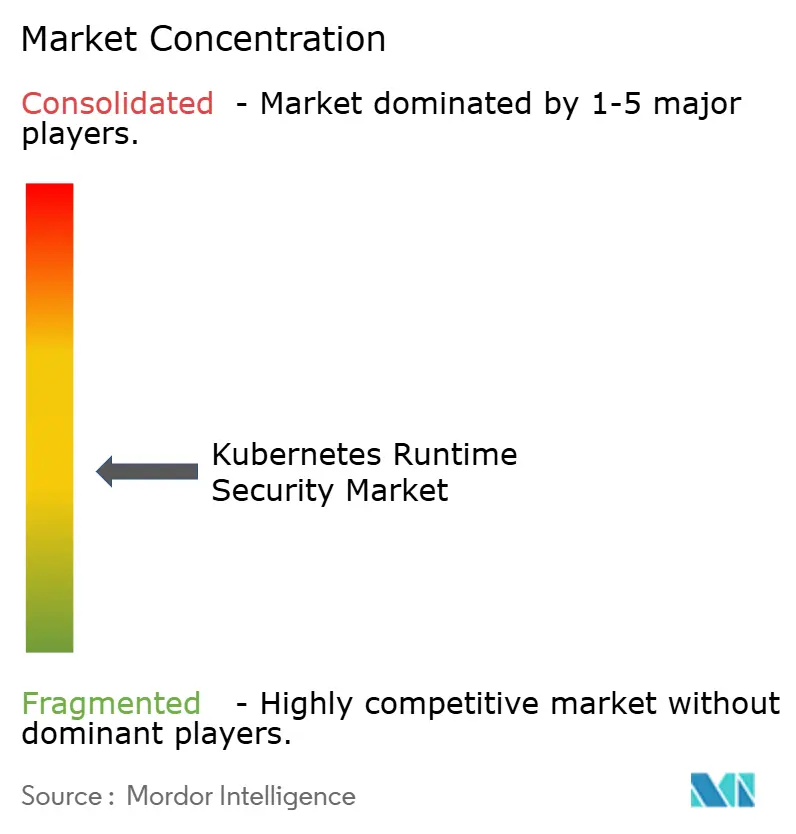
The Kubernetes runtime security market is moderately to highly fragmented. eBPF-native specialists and CNAPP providers compete with broader cybersecurity platforms that have added container security products. Runtime specialists focus on detection depth and kernel-level telemetry. Larger platforms emphasize existing security operations workflows and cross-domain correlation. Consolidation pressure is encouraging smaller vendors to focus on specialized runtime needs. This dynamic makes cloud integration and clear technical differentiation increasingly important.
AI-native response automation, eBPF telemetry, and ecosystem integration are central areas of competition in 2026. Vendors are integrating runtime information with developer workflows, SIEM and SOAR tools, and CI/CD pipelines. Sysdig introduced a headless cloud security architecture in May 2026 for automated operators and AI coding agents.[6] Aqua Security released Aqua Compass in April 2026 for agentic investigation and response to runtime incidents. These moves show a shift from dashboard-led monitoring toward more automated security operations. GPU-intensive workloads and AI agents remain areas where behavioral rules are still developing.
Multi-cluster policy federation is a notable gap for enterprises that operate different Kubernetes distributions across private and cloud settings. This need is especially clear for regulated organizations that operate air-gapped or sovereign clusters alongside public-cloud workloads. Falco remains a widely used open-source reference for kernel-level syscall monitoring. Commercial vendors can differentiate through in-kernel enforcement, automated containment, and AI-assisted triage. Offerings that only replicate baseline monitoring face greater pressure to differentiate. The Kubernetes runtime security industry also values compliance reporting that links runtime data with relevant security controls. The market concentration score is 3, because the supplied content describes a fragmented field and does not provide combined market shares for leading vendors.
Kubernetes Runtime Security Industry Leaders
-
Sysdig, Inc.
-
Aqua Security Software Ltd.
-
Palo Alto Networks, Inc.
-
Wiz, Inc.
-
Red Hat, Inc.
- *Disclaimer: Major Players sorted in no particular order
Recent Industry Developments
- September 2026: CrowdStrike introduced Falcon Guardian at Fal.Con 2026, an AI Detection and Response solution providing runtime visibility into AI agents executing across endpoints, cloud, and Kubernetes environments. The platform introduced agent inventory, execution-chain reconstruction, and runtime enforcement for AI-driven threats across CrowdStrike-instrumented endpoints.
- September 2026: JFrog introduced Zero-Touch Remediation as part of JFrog Unified Security at swampUP 2026. The capability enabled automated supply-chain remediation from code to running Kubernetes containers and addressed the operational gap between vulnerability discovery and corrected artifact deployment.
- August 2026: Sysdig launched Sysdig Secure AI at Black Hat USA. The AI-native cloud defense platform enabled AI agents to investigate incidents, hunt threats, generate fixes, and contain risks across Kubernetes environments, while recording each agent action for auditability.
- May 2026: Sysdig introduced headless cloud security for AI coding agents, including Claude Code, Codex, and Cursor. The architecture used kernel-level Falco instrumentation and was delivered through plug-ins, CLIs, MCP services, and APIs.
- May 2026: Edera and Minimus announced a partnership for an integrated container security stack aimed at critical infrastructure, federal government, and regulated financial services. Edera provided runtime isolation through a container-native Type-1 hypervisor, while Minimus provided hardened container images for high-security Kubernetes environments.
Global Kubernetes Runtime Security Market Report Scope
The Kubernetes runtime security market includes tools and platforms that monitor, detect, and respond to threats in real-time within running Kubernetes clusters and containerized workloads. This market leverages kernel-level visibility through eBPF and syscall monitoring (via tools like Falco, the CNCF-backed open-source runtime security standard) to detect anomalous container behavior, container escapes, privilege escalations, and zero-day attacks that bypass preventive controls. Runtime security solutions build behavioral baselines for workloads, continuously analyze process execution, network activity, and file operations at the kernel level, and automatically contain or remediate active threats in production environments without requiring application restarts or redeployment.
The Kubernetes Runtime Security Market Report is Segmented by Component (Software, and Services [Proffesional Services, and Managed Services]), Deployment Model (Cloud, and On-Premises), Organization Size (Large Enterprises, and Small and Medium-Sized Enterprises), End Use Industry (Government and Public Administration, Industrial Manufacturing, Retail and E-Commerce, Transportation and Logistics, Energy and Utilities, IT and Telecommunication, Media and Entertainment, Education and Research Institutions, Healthcare and Life Sciences, Banking, Financial Services, and Insurance (BFSI), and Other End Use Industries), and Geography (North America, South America, Europe, Asia-Pacific, Middle East, and Africa). The Market Forecasts are Provided in Terms of Value (USD).
| Software | |
| Services | Proffesional Services |
| Managed Services |
| Cloud |
| On-Premises |
| Large Enterprises |
| Small and Medium-Sized Enterprises |
| Government and Public Administration |
| Industrial Manufacturing |
| Retail and E-Commerce |
| Transportation and Logistics |
| Energy and Utilities |
| IT and Telecommunication |
| Media and Entertainment |
| Education and Research Institutions |
| Healthcare and Life Sciences |
| Banking, Financial Services, and Insurance (BFSI) |
| Other End Use Industries |
| North America | United States |
| Canada | |
| South America | Brazil |
| Argentina | |
| Rest of South America | |
| Europe | Germany |
| United Kingdom | |
| France | |
| Italy | |
| Spain | |
| Rest of Europe | |
| Asia-Pacific | China |
| Japan | |
| India | |
| South Korea | |
| Australia | |
| Southeast Asia | |
| Rest of Asia-Pacific | |
| Middle East | Saudi Arabia |
| United Arab Emirates | |
| Israel | |
| Turkey | |
| Rest of Middle East | |
| Africa | South Africa |
| Nigeria | |
| Egypt | |
| Rest of Africa |
| By Component | Software | |
| Services | Proffesional Services | |
| Managed Services | ||
| By Deployment Model | Cloud | |
| On-Premises | ||
| ByOrganization Size | Large Enterprises | |
| Small and Medium-Sized Enterprises | ||
| By End Use Industry | Government and Public Administration | |
| Industrial Manufacturing | ||
| Retail and E-Commerce | ||
| Transportation and Logistics | ||
| Energy and Utilities | ||
| IT and Telecommunication | ||
| Media and Entertainment | ||
| Education and Research Institutions | ||
| Healthcare and Life Sciences | ||
| Banking, Financial Services, and Insurance (BFSI) | ||
| Other End Use Industries | ||
| By Geography | North America | United States |
| Canada | ||
| South America | Brazil | |
| Argentina | ||
| Rest of South America | ||
| Europe | Germany | |
| United Kingdom | ||
| France | ||
| Italy | ||
| Spain | ||
| Rest of Europe | ||
| Asia-Pacific | China | |
| Japan | ||
| India | ||
| South Korea | ||
| Australia | ||
| Southeast Asia | ||
| Rest of Asia-Pacific | ||
| Middle East | Saudi Arabia | |
| United Arab Emirates | ||
| Israel | ||
| Turkey | ||
| Rest of Middle East | ||
| Africa | South Africa | |
| Nigeria | ||
| Egypt | ||
| Rest of Africa | ||
Key Questions Answered in the Report
What is the Kubernetes runtime security market size?
The Kubernetes runtime security market was valued at USD 0.49 billion in 2025 and is estimated at USD 0.61 billion in 2026. It is forecast to reach USD 1.77 billion by 2031 at a CAGR of 23.75%. The forecast reflects the wider use of production Kubernetes and the growing need to monitor live workloads continuously.
What is driving demand for Kubernetes runtime security?
Demand is supported by production Kubernetes adoption, container escape risks, and the need for continuous monitoring. The CNCF reported that 82% of container users ran Kubernetes in production during 2025. Organizations also need faster investigation and containment as live environments become more complex.
Which component leads Kubernetes runtime security spending?
Software led revenue with a 64.73% share in 2025, while services are projected to grow at a CAGR of 26.47% through 2031. Software provides the detection, prevention, and policy tools used across runtime environments. Services are important when customers require assistance with deployment, policy tuning, hybrid environments, and compliance mapping.
Which deployment model is growing fastest?
Cloud-based deployment held 59.84% share in 2025 and is projected to grow at a CAGR of 27.82% through 2031. Cloud delivery can simplify sensor operations and supports the managed Kubernetes environments used for application and AI inference workloads. Private deployments remain important for customers with air-gap, data residency, or sovereign-cloud requirements.
Which end-use sector is the largest buyer?
BFSI led with 26.81% share in 2025 because containerized financial workloads require strong runtime visibility and audit support. Government and public administration is projected to grow at a CAGR of 26.72% through 2031. Telecommunications, healthcare, manufacturing, and other sectors also have different runtime monitoring needs as adoption advances.
Which region is expected to grow fastest?
Asia-Pacific is projected to grow at a CAGR of 27.59% from 2026 to 2031, supported by cloud-native adoption and public-sector digitization. North America held the largest share at 37.28% in 2025. Regional demand includes managed runtime monitoring, private-cluster controls, and tools that operate across hybrid or sovereign-cloud environments.