
Kubernetes Admission Control Market Size and Share
Market Overview
| Study Period | 2020 - 2031 |
|---|---|
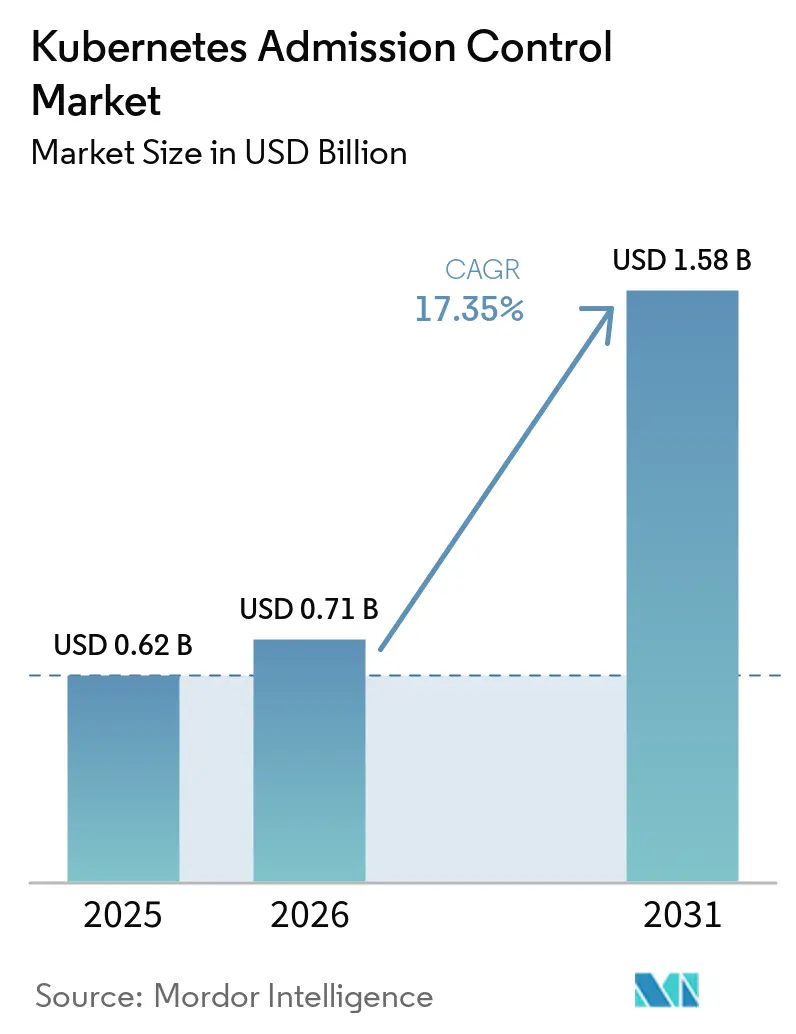
| Market Size (2026) | USD 0.71 Billion |
| Market Size (2031) | USD 1.58 Billion |
| Growth Rate (2026 - 2031) | 17.35 % |
| Fastest Growing Market | Asia-Pacific |
| Largest Market | North America |
| Market Concentration | Medium |
Major Players *Disclaimer: Major Players sorted in no particular order Image © Mordor Intelligence. Reuse requires attribution under CC BY 4.0. | |
Kubernetes Admission Control Market Analysis by Mordor Intelligence
The Kubernetes admission control market size was valued at USD 0.62 billion in 2025 and USD 0.71 billion in 2026 and is projected to reach USD 1.58 billion by 2031, growing at a CAGR of 17.35% during 2026-2031. Enterprise adoption is making admission controls a standard part of platform governance as production clusters spread across cloud, on-premises, and edge environments. Regulatory requirements for software provenance and verifiable deployment controls are moving these tools into procurement and audit processes. Built-in Kubernetes policy features are reducing reliance on external webhooks for simpler controls, while creating demand for tools that manage more complex and distributed policies. Vendors are responding with managed offerings, compliance reporting, multi-cluster administration, and controls for AI workloads that cannot be fully governed by static deployment specifications.
Key Report Takeaways
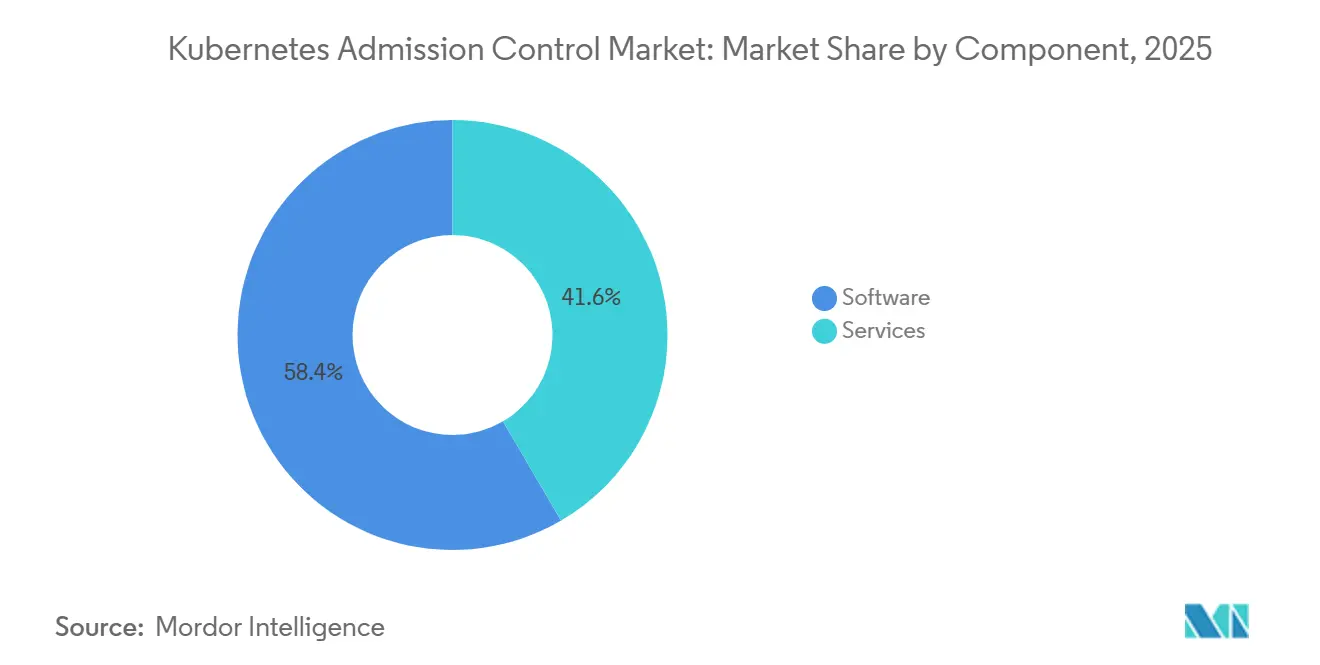
- By component, software led with 58.42% of the Kubernetes admission control market share in 2025, while services are projected to expand at a 19.68% CAGR through 2031.
- By deployment, cloud accounted for 62.39% of the Kubernetes admission control market size in 2026 and is projected to grow at a 22.43% CAGR through 2031.
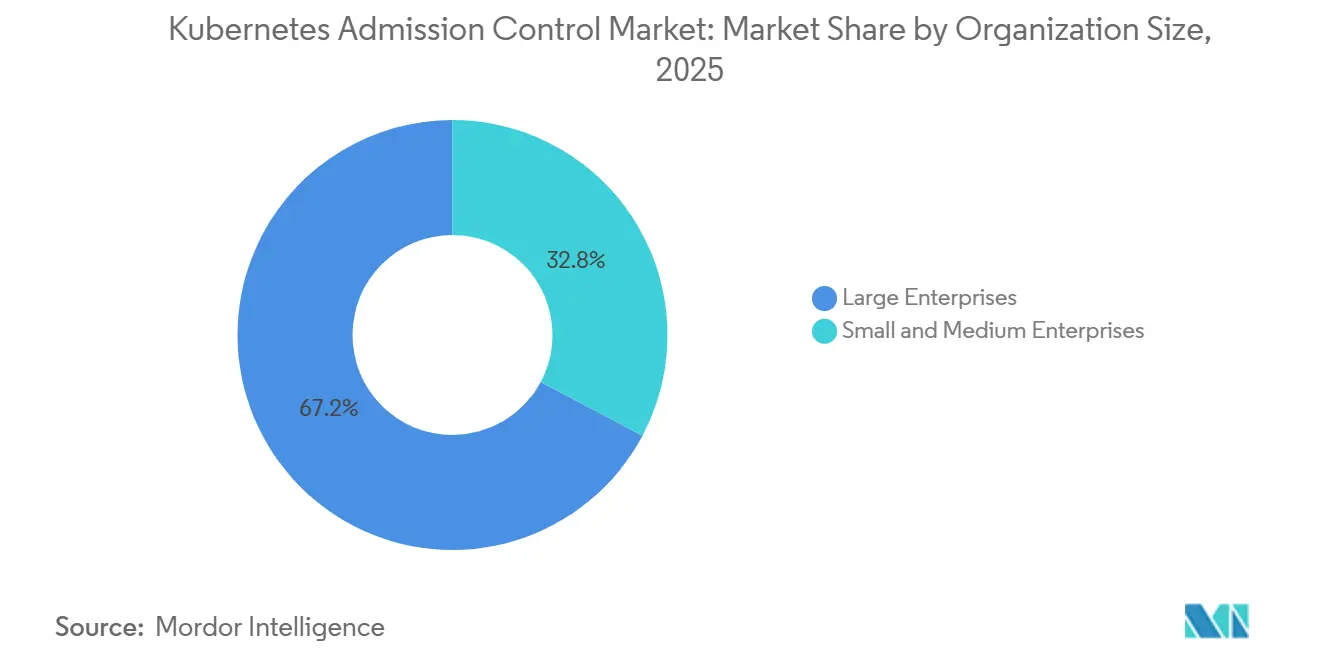
- By organization size, large enterprises held 67.23% of the Kubernetes admission control market share in 2025, while SMEs are projected to expand at a 19.88% CAGR through 2031.
- By industry vertical, BFSI accounted for 29.31% of the market in 2025, while industrial manufacturing is projected to grow at a 22.85% CAGR through 2031.
- By geography, North America held 43.71% of the blockchain in energy market share in 2025, while the Asia-Pacific is projected to expand at a 21.56% CAGR through 2031.
Note: Market size and forecast figures in this report are generated using Mordor Intelligence’s proprietary estimation framework, updated with the latest available data and insights as of January 2026.
Global Kubernetes Admission Control Market Trends and Insights
Drivers Impact Analysis*
| DRIVER | (~) % IMPACT ON CAGR FORECAST | GEOGRAPHIC RELEVANCE | IMPACT TIMELINE |
|---|---|---|---|
| Enterprise Kubernetes and Multi-Cluster Expansion | +4.8% | Global, strongest in North America and Asia-Pacific | Short term (≤ 2 years) |
| Regulatory and Software Supply Chain Compliance | +3.6% | North America and Europe primarily, with spillover to Asia-Pacific | Medium term (2-4 years) |
| Shift-Left DevSecOps and Policy as Code Adoption | +3.1% | Global | Short term (≤ 2 years) |
| Cloud-Native Workload and Image Risk Escalation | +2.4% | Global | Short term (≤ 2 years) |
| In-Process CEL Policy Adoption in Kubernetes | +1.1% | Global, fastest in technically advanced multi-cluster environments | Medium term (2-4 years) |
| Policy Evidence Automation for Air-Gapped and Sovereign Clusters | +0.7% | Government and defense sectors, Middle East, Europe, and Asia-Pacific | Long term (≥ 4 years) |
| Source: Mordor Intelligence | |||
Enterprise Kubernetes and Multi-Cluster Expansion
Kubernetes adoption has reached a point where enterprise platform teams need consistent controls at deployment. The CNCF reported that 82% of container users ran Kubernetes in production in 2025, compared with 66% in 2023, and 98% of respondents used cloud-native techniques in some form. The same survey found that 66% of organizations hosting generative AI models used Kubernetes for some or all inference workloads. Each production cluster has an API server, so inconsistent admission policies can leave gaps between environments. The Kubernetes admission control market is therefore moving toward centralized policy administration for multi-cluster estates. Nirmata introduced Runtime for Kyverno in August 2026 to extend policy decisions to process execution, file access, and egress control for AI workloads.
Regulatory and Software Supply Chain Compliance
Software supply chain security is becoming a legal and audit issue for organizations that deploy regulated applications. NIST SP 800-218 provides the Secure Software Development Framework that federal software suppliers use to structure secure development practices.[1] CISA's Secure Software Development Attestation Form requires software producers to attest to secure development practices for covered federal software. The SLSA specification gives organizations a framework for evaluating software supply chain integrity. Admission policies can turn signed-image and provenance requirements into deployment controls that cannot be bypassed in routine workflows. This demand shifts vendor selection toward long-term support, verified images, and automated compliance evidence in the Kubernetes admission control market. Compliance automation is becoming a central purchasing requirement in the Kubernetes admission control market.
Shift-Left DevSecOps and Policy as Code Adoption
Admission controllers provide a final deployment gate in a security process that begins earlier in development. Red Hat found that more than 60% of surveyed organizations planned to automate security in CI/CD pipelines during the next 1 to 2 years, and 42% had advanced DevSecOps initiatives. A shared policy definition can be checked in the development environment, in CI, and at the Kubernetes API server. This approach gives developers the same feedback before and during deployment. It also reduces the need to repair policy failures after a workload reaches a later stage. The Kubernetes admission control market benefits when policy definitions are managed alongside application code and reviewed through established delivery workflows.
Cloud-Native Workload and Image Risk Escalation
Container images from external registries, AI frameworks, and third-party Helm charts increase the importance of pre-deployment checks. Red Hat reported that 97% of organizations experienced at least 1 cloud-native security incident in the previous year, while 78% reported misconfigurations and 49% had deployed container image signing and verification. Kubernetes v1.37 made Pod Certificates and Cluster Trust Bundles generally available in August 2026, adding core support for X.509 certificate issuance for pod-level TLS and mTLS.[2] These features strengthen workload identity, which can support policy decisions based on both identity and resource attributes. Sysdig's August 2026 Secure AI release used runtime intelligence from Falco to investigate, prioritize, and remediate cloud-native threats. The resulting connection between runtime signals and deployment controls is expanding the role of the Kubernetes admission control market.
Restraints Impact Analysis*
| RESTRAINT | (~) % IMPACT ON CAGR FORECAST | GEOGRAPHIC RELEVANCE | IMPACT TIMELINE |
|---|---|---|---|
| Admission Latency and Control Plane Availability Risk | -2.2% | Global, most acute in high-throughput BFSI and e-commerce clusters | Short term (≤ 2 years) |
| Shortage of Policy Engineering Skills | -1.6% | Acute in Asia-Pacific and emerging markets, present globally in regulated contexts | Medium term (2-4 years) |
| Policy Engine and Language Fragmentation | -1.1% | Global | Medium term (2-4 years) |
| False Positives and Exception Sprawl in High-Velocity Delivery | -0.7% | Global, most prevalent in software-native and DevOps-mature organizations | Short term (≤ 2 years) |
| Source: Mordor Intelligence | |||
Admission Latency and Control Plane Availability Risk
Admission webhooks run synchronously with API server requests, so a timeout can delay deployments across a cluster. A fail-open configuration can permit an unintended deployment, while a fail-closed configuration can halt delivery when the webhook is unavailable. This concern is pronounced in high-throughput BFSI and e-commerce environments. Kubernetes v1.36 introduced manifest-based admission control as an alpha feature, allowing policies to load from files at API server startup. In-process policy enforcement reduces external call overhead, but cannot conduct external registry checks or custom API calls. Organizations with detailed governance needs must therefore retain hybrid designs that balance availability, latency, and policy depth in the Kubernetes admission control market.
Shortage of Policy Engineering Skills
Policy engineering requires teams to author, test, version, and maintain admission policies across multiple clusters. Broadcom reported that 38% of enterprise IT leaders in Asia-Pacific and Japan identified cloud-native Kubernetes management as their most significant skills gap, and 84% depended on outsourcing or professional services. Regulated users also need to map policies to control frameworks such as CIS benchmarks, NIST guidance, and PCI DSS requirements. This combination of platform and compliance expertise is difficult to find in a single role. Vendors can address the shortage through curated policy libraries, exception workflows, and compliance reporting. The shortage still limits independent adoption where organizations cannot outsource policy operations. This constraint makes managed support relevant across the Kubernetes admission control market.
*Our forecasts treat driver/restraint impacts as directional, not additive. The impact forecasts reflect baseline growth, mix effects, and variable interactions.
Segment Analysis
By Component: Software Leads Revenue While Services Address Multi-Cluster Operations
Software held 58.42% of the Kubernetes admission control market size in 2025. Enterprises often begin with a defined and auditable policy enforcement product before entering managed service contracts. The software segment includes commercial distributions of Kyverno, OPA Gatekeeper, other policy engines, and controllers integrated into managed Kubernetes platforms. Enterprise distributions provide support commitments, validated policy packs, and hardened images. These characteristics suit buyers who need predictable governance within regulated deployment processes.
Services are projected to record the highest component CAGR at 19.68% through 2031. Organizations with many clusters need help developing policy libraries, migrating clusters, managing exceptions, and collecting compliance evidence across cloud, on-premises, and edge estates. Nirmata launched Runtime for Kyverno in August 2026, extending policy enforcement to runtime controls for process activity, file access, and network egress. Nirmata also made Nirmata Enterprise for Kyverno available through AWS Marketplace in May 2025. These developments show how software distribution and recurring governance support can operate together in the Kubernetes admission control industry.
By Deployment: Cloud Concentrates Spending in Managed Environments
Cloud represented 62.39% of the Kubernetes admission control market size in 2026. It is also projected to be the fastest-growing deployment model, at a 22.43% CAGR through 2031. Managed Kubernetes services embed admission capabilities within their platform layers. Google Kubernetes Engine offers Binary Authorization and Policy Controller, Azure Kubernetes Service offers Azure Policy, and AWS environments support admission controller integrations. These native options can create switching costs and direct policy spending toward cloud-managed operations.
On-premises deployment remains important in data-sovereign, regulated, and air-gapped settings where public cloud migration is limited by policy, data residency, or operational constraints. Kubernetes v1.36 introduced manifest-based admission control to define webhooks and CEL policies as files loaded at API server startup.[3] This design limits the ability of a cluster administrator to remove critical policy configurations through the API. Defense, energy, and public-sector users can apply this feature where tamper resistance and local control are priorities. The Kubernetes admission control market, therefore, includes both cloud-led growth and sustained on-premises governance needs.
By Organization Size: Large Enterprises Lead While SMEs Expand Faster
Large enterprises held 67.23% of the Kubernetes admission control market share in 2025. Their larger cluster estates and regulatory exposure make systematic admission controls more necessary. Financial institutions increasingly formalize requirements for acquiring open-source software with verified provenance. Nirmata rebundled its enterprise portfolio in April 2026, following JPMorgan Chase's guidance on open-source software provenance, and collaborated with Broadcom in June 2026 on VMware Cloud Foundation governance. These programs address enterprise demand for centralized policy management and audit reporting.
SMEs are projected to expand at a 19.88% CAGR through 2031. Kubernetes-native ValidatingAdmissionPolicy enables teams to apply baseline controls without running external webhook servers. Cloud marketplace distribution can reduce procurement steps, while Fairwinds released Goldilocks v4.15.0 in April 2026 with hardened, immutable, Cosign-signed images through Google Artifact Registry.[4] Such policy-adjacent tools can be adopted incrementally with admission controls. Lower operational effort and built-in primitives are narrowing the historic adoption gap between SMEs and larger enterprises.
By Industry Vertical: BFSI Holds the Largest Position While Manufacturing Grows Fastest
BFSI accounted for 29.31% of the Kubernetes admission control market in 2025. Financial services organizations run containerized applications under extensive security and compliance requirements, including PCI DSS v4.0, SOC 2 Type II, and sector-specific obligations. Admission controller configurations can serve as evidence of privilege constraints, image trust requirements, and deployment controls. The 2025 shift by Styra's founders and core OPA team to Apple created uncertainty for some organizations that use OPA and Rego. BFSI platform teams may evaluate Kyverno as a Kubernetes-native alternative with different policy language and governance characteristics.
Industrial manufacturing is projected to expand at a 22.85% CAGR through 2031. IT and OT convergence is extending Kubernetes to factory-floor edge nodes that may lack established security tooling. Hyundai Motor advertised a container and Kubernetes security inspection role in June 2026 that required NIST, CIS, and ISO 27001-based policy management for its internal PaaS platform. Cisco reported that 20% of organizations achieved fully collaborative IT and OT data operations, while 52% had moved OT security responsibility to CISOs as of 2025. Government, healthcare, IT and telecommunications, energy, retail, education, and research organizations are also adopting controls as platform engineering practices spread across operational settings.
Geography Analysis
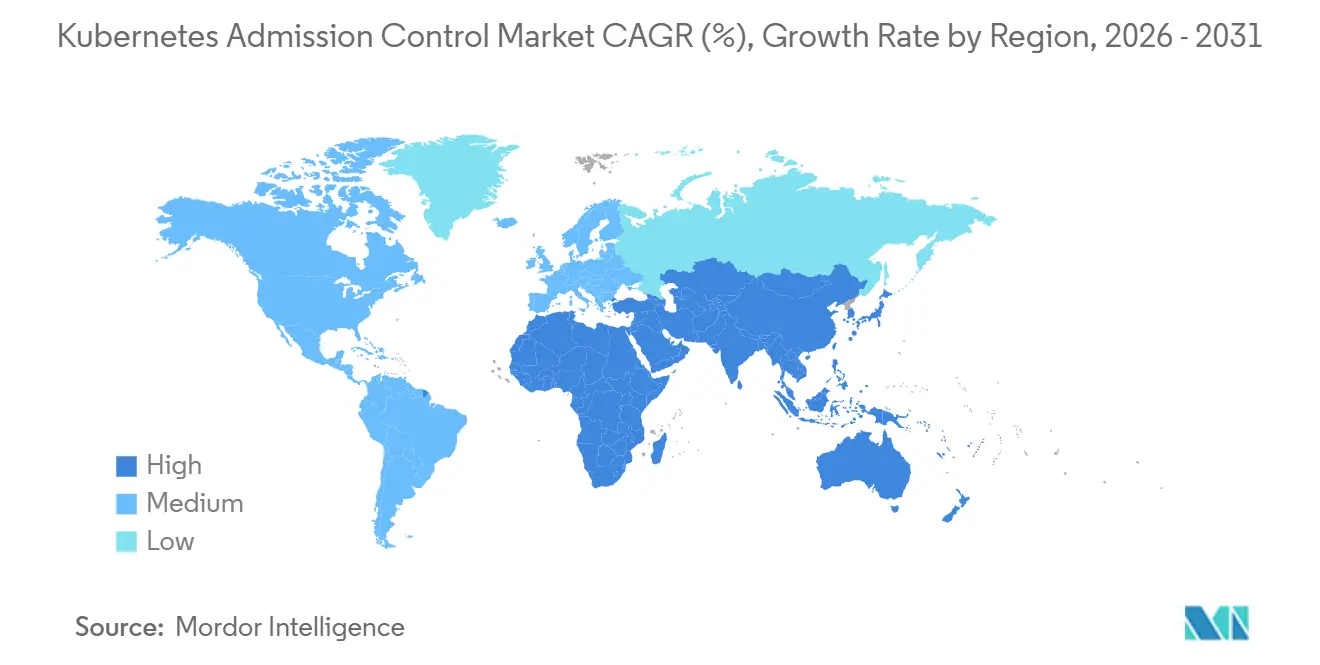
North America held 43.71% of the Kubernetes admission control market share in 2025. The United States has a high concentration of cloud-native enterprise infrastructure and federal supply chain requirements. Executive Order 14028 directed federal action to improve software supply chain security, and CISA established an attestation process for secure software development practices.[5] These requirements support spending by federal contractors, defense technology firms, healthcare technology organizations, and banks with regulated products. Nirmata Enterprise for Kyverno became available on AWS Marketplace in May 2025, shortening the route from open-source trial to contracted support for AWS-focused organizations.
Europe accounts for a significant share of global demand in the Kubernetes admission control market. The EU Cyber Resilience Act and GDPR are making component attestation and workload placement more relevant to enterprise governance. Germany, the United Kingdom, and France lead adoption across financial services, automotive manufacturing, and public administration. Red Hat found that 64% of survey respondents expected the EU Cyber Resilience Act to influence cloud-native security investments within the following year. Spain, Italy, and other European countries are at earlier stages but operate within a more harmonized regulatory environment.
Asia-Pacific is projected to be the fastest-growing region at a 21.56% CAGR through 2031. China, Japan, South Korea, India, and Australia are expanding cloud-native operations while regulatory frameworks become more formal. Singapore's Cyber Security Agency published a Kubernetes security advisory in 2026, providing security guidance for organizations operating container environments. China’s Graded Protection 2.0 Level 3 requirements support admission controls and audit logging for containerized financial and government applications. South America, the Middle East, and Africa remain earlier-stage regions, while sovereign cloud programs in Saudi Arabia and the United Arab Emirates create demand for air-gapped policy evidence automation. These conditions broaden the geographic opportunity for the Kubernetes admission control market and support demand within it.
Competitive Landscape
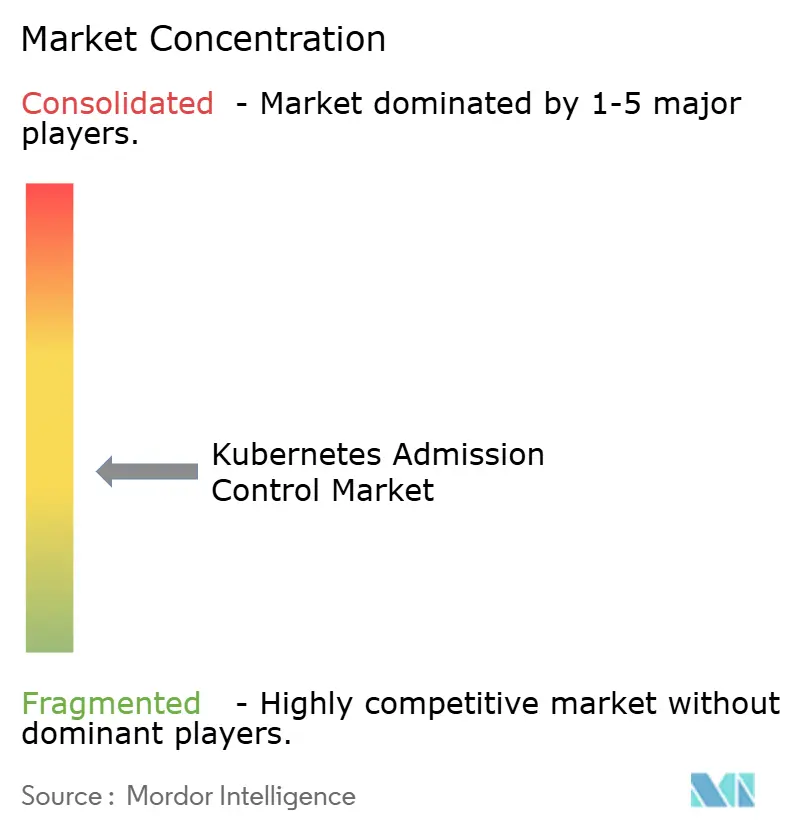
The Kubernetes admission control market is moderately fragmented across cloud providers, cloud-native application protection platform vendors, and policy governance specialists. Cloud providers benefit from native capabilities in managed Kubernetes services. Google Cloud offers Binary Authorization and Policy Controller, Microsoft provides Azure Policy for AKS, and AWS supports admission controller integrations. These capabilities can limit separate procurement because controls are closely tied to the platform. Red Hat OpenShift, SUSE Rancher, and Broadcom VMware Tanzu package policy governance within enterprise Kubernetes distributions. Aqua Security and Palo Alto Networks integrate admission controls into broader code-to-cloud security workflows.
The 2025 departure of Styra's founders and core OPA team to Apple altered the competitive context for buyers committed to OPA and Rego. Nirmata maintains Kyverno, a CNCF-graduated project, and positions it as a Kubernetes-native alternative. Nirmata released Runtime for Kyverno in August 2026, adding runtime enforcement for AI workload behavior. Aqua Security introduced Aqua Compass in April 2026 as a Model Context Protocol server for agentic runtime investigation, containment, and remediation. Sysdig launched Secure AI in August 2026 to investigate, prioritize, and remediate cloud-native risks using runtime intelligence. These offerings position admission control alongside runtime response rather than as a standalone deployment check.
Enterprises managing multiple clusters need consistent policies without maintaining each environment separately. This need favors vendors that provide federation, policy lifecycle management, and compliance reporting. ISO 27001 and CIS Kubernetes Benchmark validation can be important in requests for proposal where buyers need evidence of control coverage. Built-in Kubernetes policies eliminate the need for an external webhook for simple checks. External tools retain a role where policies require registry verification, external identity checks, cross-cluster data, or richer custom logic.
Kubernetes Admission Control Industry Leaders
-
Aqua Security Software Ltd.
-
Amazon Web Services, Inc.
-
Microsoft Corporation
-
Google LLC
-
Red Hat, Inc.
- *Disclaimer: Major Players sorted in no particular order
Recent Industry Developments
- August 2026: Sysdig launched Sysdig Secure AI at Black Hat USA, Las Vegas, an AI-native offering built on the Sysdig Secure CNAPP. The platform deploys coordinated AI security experts capable of conducting more than 10 times the investigations of human analysts alone at 88% lower cost, using runtime intelligence powered by Falco, 200 million+ downloads, adopted by 60% of Fortune 500 companies, to investigate, prioritize, and remediate cloud-native threats across Kubernetes and cloud environments at machine speed.
- August 2026: Nirmata introduced Nirmata Runtime for Kyverno, extending Kubernetes admission control into kernel-level runtime enforcement using BPF-LSM programs. The product governs process execution, file access, and network egress for AI workloads, addressing non-deterministic LLM-driven application behavior that cannot be governed from a pod specification, while reusing CEL for policy authorship to unify admission and runtime enforcement under a single policy language.
- August 2026: Mirantis released a Mirantis Kubernetes Engine patch incorporating Cosign integration for image trust enforcement, enabling platform teams to require cryptographically verified container images at admission time within MKE-managed clusters.
- June 2026: Nirmata announced a collaboration with Broadcom to deliver enterprise Kubernetes governance for VMware Cloud Foundation environments through VMware vSphere Kubernetes Service, VKS, providing multi-cluster admission policy management, centralized compliance monitoring, GitOps-native policy lifecycle governance, and automated audit reporting for organizations running the VCF platform.
- April 2026: Aqua Security launched Aqua Compass, a Model Context Protocol, MCP, server enabling agentic investigation, containment, and remediation of runtime incidents alongside new runtime risk dashboards that translate runtime telemetry into quantified monetary risk exposure, shifting admission control adjacent to autonomous incident response.
Global Kubernetes Admission Control Market Report Scope
The kubernetes admission control market includes security solutions that intercept and assess API requests before Kubernetes stores them in the cluster state. These solutions enforce policies, validate configurations, and prevent unauthorized or non-compliant resource deployments or changes. Key capabilities include custom policy enforcement, image validation, resource quota and network policy checks, security context controls, compliance assessments against standards such as the CIS Kubernetes Benchmark and Pod Security Standards, CI/CD integration, and audit logging. They help organizations prevent misconfigurations, block vulnerable images, maintain compliance, and support secure Kubernetes operations across production, development, and multi-cloud environments.
The Kubernetes Admission Control Market Report is Segmented by Component (Software, and Services), Deployment (Cloud, and On-premises), Organization Size (Large Enterprises, and Small and Medium-Sized Enterprises), Industry Vertical (Government and Public Administration, Industrial Manufacturing, Retail and E-Commerce, Transportation and Logistics, Energy and Utilities, Oil and Gas, IT and Telecommunication, Media and Entertainment, Education and Research Institutions, Healthcare and Life Sciences, Banking, Financial Services, and Insurance (BFSI), and Other Industry Verticals), and Geography (North America, South America, Europe, Asia-Pacific, Middle East, and Africa). The Market Forecasts are Provided in Terms of Value (USD).
| Software |
| Services |
| Cloud |
| On-premises |
| Large Enterprises |
| Small and Medium Enterprises |
| Government and Public Administration |
| Industrial Manufacturing |
| Retail and E-Commerce |
| Transportation and Logistics |
| Energy and Utilities |
| Oil and Gas |
| IT and Telecommunication |
| Media and Entertainment |
| Education and Research Institutions |
| Healthcare and Life Sciences |
| Banking, Financial Services, and Insurance (BFSI) |
| Other Industry Verticals |
| North America | United States |
| Canada | |
| Mexico | |
| South America | Brazil |
| Argentina | |
| Rest of South America | |
| Europe | Germany |
| United Kingdom | |
| France | |
| Italy | |
| Spain | |
| Rest of Europe | |
| Asia-Pacific | China |
| Japan | |
| India | |
| South Korea | |
| Australia | |
| Rest of Asia-Pacific | |
| Middle East | Saudi Arabia |
| United Arab Emirates | |
| Rest of Middle East | |
| Africa | South Africa |
| Nigeria | |
| Rest of Africa |
| By Component | Software | |
| Services | ||
| By Deployment | Cloud | |
| On-premises | ||
| By Organization Size | Large Enterprises | |
| Small and Medium Enterprises | ||
| By Industry Vertical | Government and Public Administration | |
| Industrial Manufacturing | ||
| Retail and E-Commerce | ||
| Transportation and Logistics | ||
| Energy and Utilities | ||
| Oil and Gas | ||
| IT and Telecommunication | ||
| Media and Entertainment | ||
| Education and Research Institutions | ||
| Healthcare and Life Sciences | ||
| Banking, Financial Services, and Insurance (BFSI) | ||
| Other Industry Verticals | ||
| By Geography | North America | United States |
| Canada | ||
| Mexico | ||
| South America | Brazil | |
| Argentina | ||
| Rest of South America | ||
| Europe | Germany | |
| United Kingdom | ||
| France | ||
| Italy | ||
| Spain | ||
| Rest of Europe | ||
| Asia-Pacific | China | |
| Japan | ||
| India | ||
| South Korea | ||
| Australia | ||
| Rest of Asia-Pacific | ||
| Middle East | Saudi Arabia | |
| United Arab Emirates | ||
| Rest of Middle East | ||
| Africa | South Africa | |
| Nigeria | ||
| Rest of Africa | ||
Key Questions Answered in the Report
What is the Kubernetes admission control market size?
The Kubernetes admission control market size was valued at USD 0.62 billion in 2025 and USD 0.71 billion in 2026 and is projected to reach USD 1.58 billion by 2031, growing at a CAGR of 17.35% during 2026-2031.
What is driving adoption of Kubernetes admission controls?
Multi-cluster operations, software supply chain controls, policy as code, and container image risks are increasing the need for deployment governance.
Which deployment model leads Kubernetes admission control adoption?
Cloud deployment held 62.39% in 2026 and is projected to grow at a 22.43% CAGR through 2031.
Which organizations are adopting these controls fastest?
SMEs are projected to expand at a 19.88% CAGR as built-in Kubernetes policy features and marketplace distribution reduce operating effort.
Which vertical has the strongest growth outlook?
Industrial manufacturing is projected to grow at a 22.85% CAGR through 2031 as Kubernetes reaches factory and edge environments.
Why do enterprises use policy as code for Kubernetes?
A common policy can be checked during development, CI, and deployment, improving consistency across the delivery process.