
Market Overview
| Study Period | 2020 - 2031 |
|---|---|
| Forecast Data Period | 2026 - 2031 |
| Base Year Market Size (2025) | USD 29.30 Billion |
| Market Size (2026) | USD 30.5 Billion |
| Market Size (2031) | USD 37.24 Billion |
| Growth Rate (2026 - 2031) | 4.08 % |
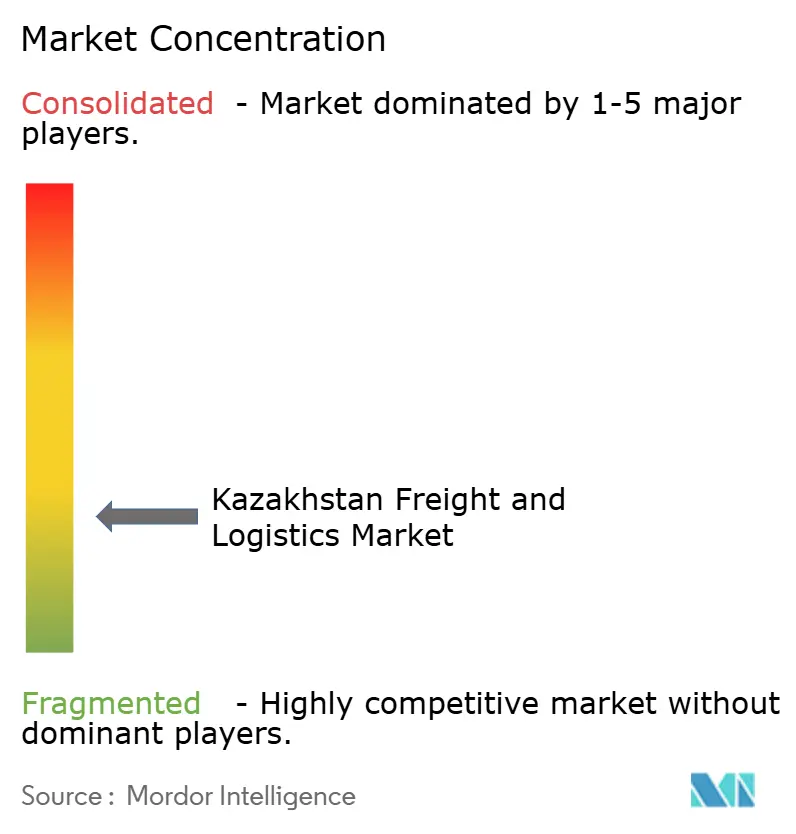
| Market Concentration | Low |
Major Players *Disclaimer: Major Players sorted in no particular order Image © Mordor Intelligence. Reuse requires attribution under CC BY 4.0. | |
Kazakhstan Freight And Logistics Market Analysis by Mordor Intelligence
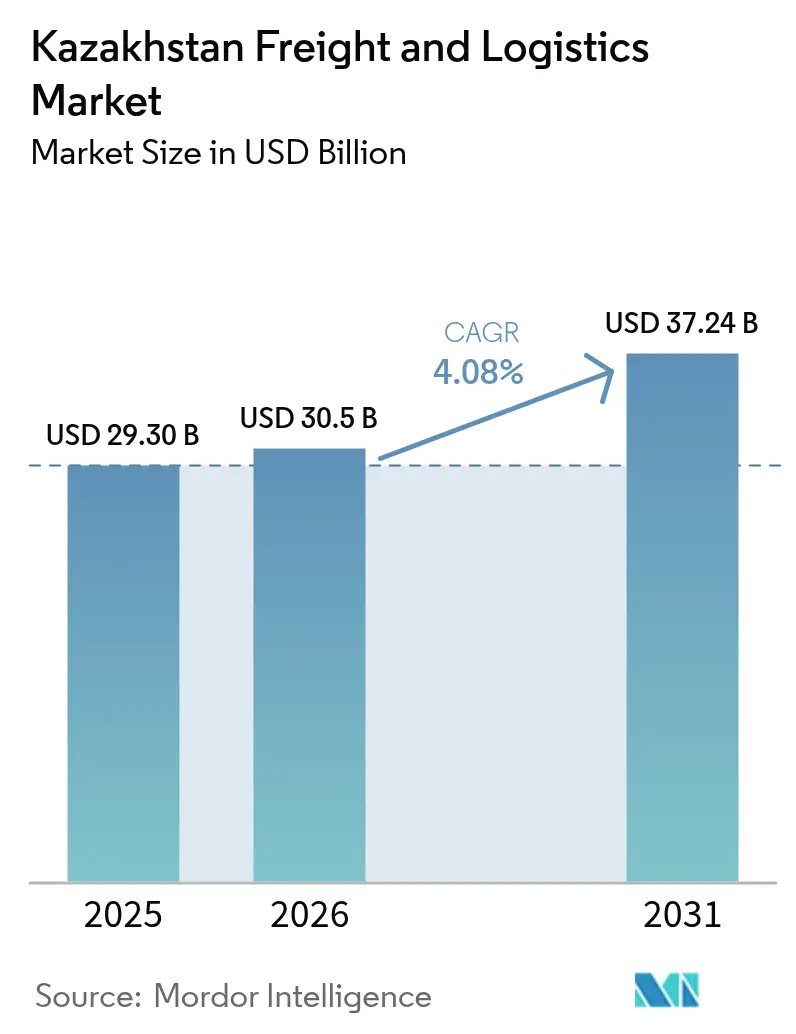
The Kazakhstan Freight And Logistics Market size was valued at USD 29.30 billion in 2025 and estimated to grow from USD 30.5 billion in 2026 to reach USD 37.24 billion by 2031, at a CAGR of 4.08% during the forecast period (2026-2031).
The growth trajectory is underpinned by Kazakhstan’s role in the Belt and Road Initiative, accelerating public–private infrastructure spending, and the steady diversification of export routes through the Trans-Caspian International Transport Route. Rising e-commerce volumes, free-zone incentives, and near-shoring by automotive OEMs further widen demand for multimodal services, while digital customs reforms compress dwell times at key borders. Capacity constraints at Aktau seaport and the Khorgos dry port create attractive investment openings for operators capable of scaling rail, road, and cold-chain assets. Meanwhile, volatile fuel prices and fragmented trucking fleets temper operating margins but accelerate the modal shift toward rail and pipeline options.
Key Report Takeaways
- By logistics function, freight transport led with 73.65% Kazakhstan freight and logistics market share in 2025, while Courier, Express, and Parcel (CEP) registered the fastest 4.32% CAGR through 2031.
- By CEP sub-segment, domestic parcels captured 66.60% of the Kazakhstan freight and logistics market size in 2025; international parcels are forecast to expand at a 4.45% CAGR to 2031.
- By freight forwarding mode, sea and inland waterways commanded a 57.76% share of the Kazakhstan freight and logistics market size in 2025, whereas air forwarding is advancing at a 4.27% CAGR through 2031. By freight transport mode, road retained a 57.35% share in 2025, yet air freight is projected to post a 4.18% CAGR between 2026-2031.
- By warehousing type, non-temperature-controlled facilities held a 90.12% share in 2025; temperature-controlled space is set to grow at a 4.16% CAGR.
- By end user, Wholesale and Retail Trade accounted for 33.78% Kazakhstan freight and logistics market share in 2025, while Manufacturing is on track for a 4.42% CAGR through 2031.
Note: Market size and forecast figures in this report are generated using Mordor Intelligence’s proprietary estimation framework, updated with the latest available data and insights as of 2026.
Kazakhstan Freight And Logistics Market Trends and Insights
Drivers Impact Analysis*
| Driver | (~) % Impact on CAGR Forecast | Geographic Relevance | Impact Timeline |
|---|---|---|---|
| Strategic Eurasian Transit Hub and Middle Corridor Expansion | +1.0% | Trans-Caspian corridor, Aktau & Kuryk ports, Khorgos dry port | Long term (≥ 4 years) |
| State-led Infrastructure Modernization Across Rail, Roads, and Dry Ports | +0.8% | National, focused on Almaty, Astana, and border regions | Medium term (2-4 years) |
| Growth in Industrial Production and Extractive Exports Requiring Bulk and Project Logistics | +0.7% | Western oil & gas basins, mining areas, industrial zones | Medium term (2-4 years) |
| Rising Domestic and Cross-Border E-commerce Stimulating CEP and Fulfillment Demand | +0.6% | National, Almaty & Astana urban centers | Short term (≤ 2 years) |
| Digitalization of Customs, Border, and Transport Documentation Processes | +0.4% | Border checkpoints with China, Uzbekistan, Turkmenistan | Short term (≤ 2 years) |
| Entry and Expansion of International Logistics Operators and 3PL Platforms | +0.3% | Major cities & strategic corridors, Khorgos, Aktau | Medium term (2-4 years) |
| Source: Mordor Intelligence | |||
Strategic Eurasian Transit Hub and Middle Corridor Expansion
Kazakhstan’s role as the land bridge of the Trans-Caspian International Transport Route reshapes regional trade lanes by shortening Asia-Europe transit times and reducing geopolitical risk away from northern corridors. Bilateral accords signed with Georgia in February 2025 target capacity coordination, underpinning long-range capital flows into port cranes, rail wagons, and digital tracking layers [1]. While extensive broad-gauge rail mileage gives the country scale advantages, chokepoints at Aktau and Khorgos expose investment gaps that private 3PLs can monetize through integrated intermodal solutions. In the long run, the corridor elevates revenue streams beyond transit fees toward higher-margin consolidation, customs brokerage, and regional fulfillment services.
State-led Infrastructure Modernization Across Rail, Roads, and Dry Ports
The National Infrastructure Plan 2024-2029 funnels resources into 59 transport projects and anchors an unprecedented USD 4.2 billion locomotive framework plus the USD 405 million Wabtec order secured in October 2024 [2]. Parallel rail projects, from Darbaza-Maktaaral to the Ayagoz-Tachen route, knit the network to Uzbekistan and a third China border gate, while AD Ports Group’s USD 775 million pledge lifts Aktau’s container throughput. High-capacity roads such as the Big Almaty Ring Road ease urban distribution friction. Each asset stimulates clustered demand for warehouses, cranes, telecom systems, and workforce reskilling, magnifying growth multipliers across the Kazakhstan freight and logistics market.
Growth in Industrial Production and Extractive Exports Requiring Bulk and Project Logistics
Oil, mining, and new-energy projects drive complex transport tasks, from heavy-lift rig modules to time-critical spare parts. CPC shipped 54.9 million tons of crude in 2024, and September 2025 saw KazMunayGas redirect volumes through the Baku-Tbilisi-Ceyhan line, diversifying haulage lanes [3]. Korean interest in East Kazakhstan lithium and nine renewable-energy builds totaling 455.5 MW commissioned in 2025, intensifies demand for project freight and specialized handling.
Rising Domestic and Cross-Border E-commerce Stimulating CEP and Fulfillment Demand
More than 300,000 e-commerce jobs and a significant number of Kaspi.kz orders routed via proprietary couriers showcase a nationwide shift toward integrated payment-logistics ecosystems [4]. Government directives to scale Kazpost complement locker rollouts and rural service expansion, while single-window customs modules streamline B2C imports. Operators that combine fulfillment, brokerage, and last-mile data visibility capture the lion’s share of the fast-moving Kazakhstan freight and logistics market.
Restraints Impact Analysis*
| Restraint | (~) % Impact on CAGR Forecast | Geographic Relevance | Impact Timeline |
|---|---|---|---|
| Border Transshipment, Gauge / Modal-break Inefficiencies at China-Europe Interfaces | -0.6% | Khorgos dry port, China-Kazakhstan border | Medium term (2-4 years) |
| Tariff, Regulatory, and Administrative Inefficiencies Raising Transit Costs and Dwell Times | -0.5% | Customs checkpoints nationwide | Short term (≤ 2 years) |
| Capacity Bottlenecks and Terminal Congestion along the Middle Corridor and Caspian Segment | -0.4% | Aktau, Kuryk, Khorgos, Caspian ferry routes | Medium term (2-4 years) |
| Fragmented SME Logistics Base with Low Digital Maturity and Skilled-Labor Gaps | -0.3% | Rural and secondary cities | Long term (≥ 4 years) |
| Source: Mordor Intelligence | |||
Border Transshipment, Gauge / Modal-break Inefficiencies at China-Europe Interfaces
Standard-gauge Chinese trains meet broad-gauge Kazakh tracks, forcing costly bogie swaps and up to 48-hour delays. Although Khorgos’ capacity rose to 18,000 TEU, congestion and IT outages undermine schedule reliability. The planned Ayagoz-Tachen line adds volume headroom but not gauge parity, so container damage risk and perishable spoilage persist, dampening high-value traffic potential.
Tariff, Regulatory, and Administrative Inefficiencies Raising Transit Costs and Dwell Times
Despite single-window advances, multi-agency documentation and fluid tariff rules inflate compliance burdens. January 2025 reforms to cut border times at nine crossings are promising but hinge on cross-border coordination and staff reskilling. Cumbersome permit regimes still weigh on small forwarders.
*Our forecasts treat driver/restraint impacts as directional, not additive. The impact forecasts reflect baseline growth, mix effects, and variable interactions.
Segment Analysis
By End User Industry: Wholesale Trade Leadership Amid Manufacturing Acceleration
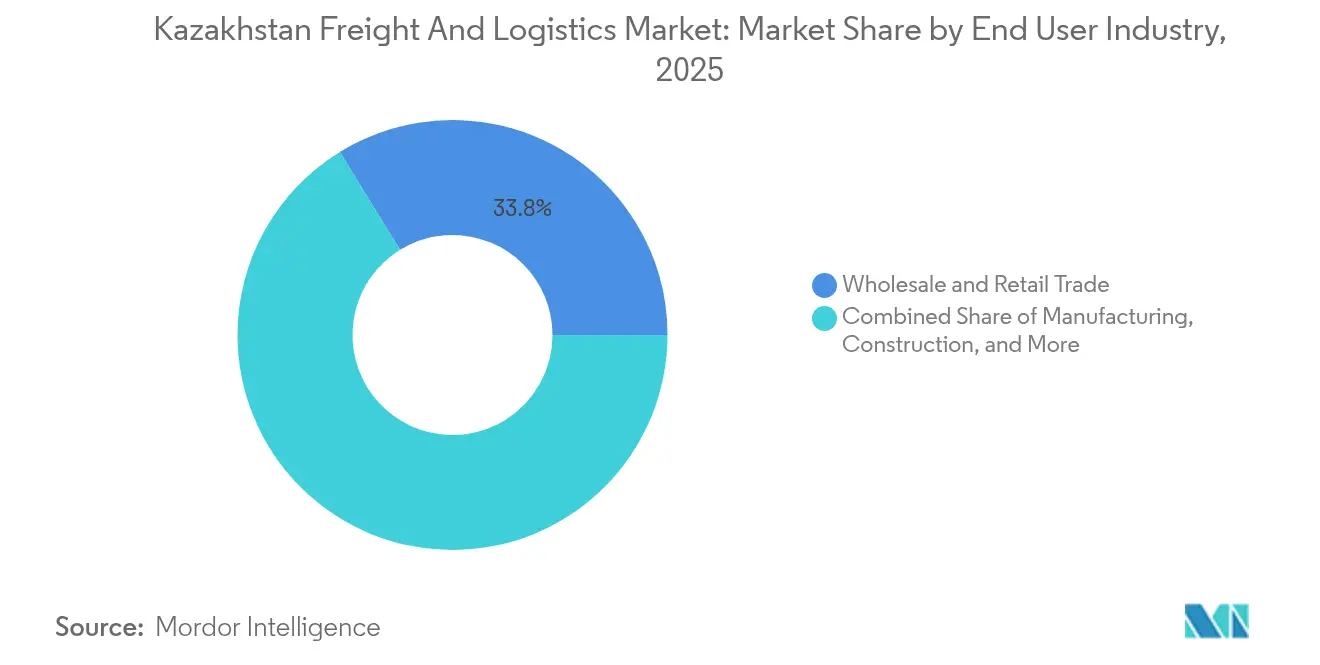
Wholesale and Retail Trade generated 33.78% of the Kazakhstan freight and logistics market revenue in 2025, underpinned by imported consumer goods and nationwide hypermarket expansion. Omnichannel strategies demand regional DC networks, interactive voice-picking, and returns processing.
Manufacturing posts the swiftest 4.42% CAGR (2026-2031), courtesy of industrial diversification into autos, renewables, and processing. Korean investors in lithium mining and battery packs amplify inbound flows of chemicals and export-ready cathode materials. As plants synchronize with JIT dashboards, logistics providers deploy milk-run shuttles and line-side feed solutions to minimize WIP inventories.

By Logistics Function: Freight Transport Dominance Drives Market Evolution
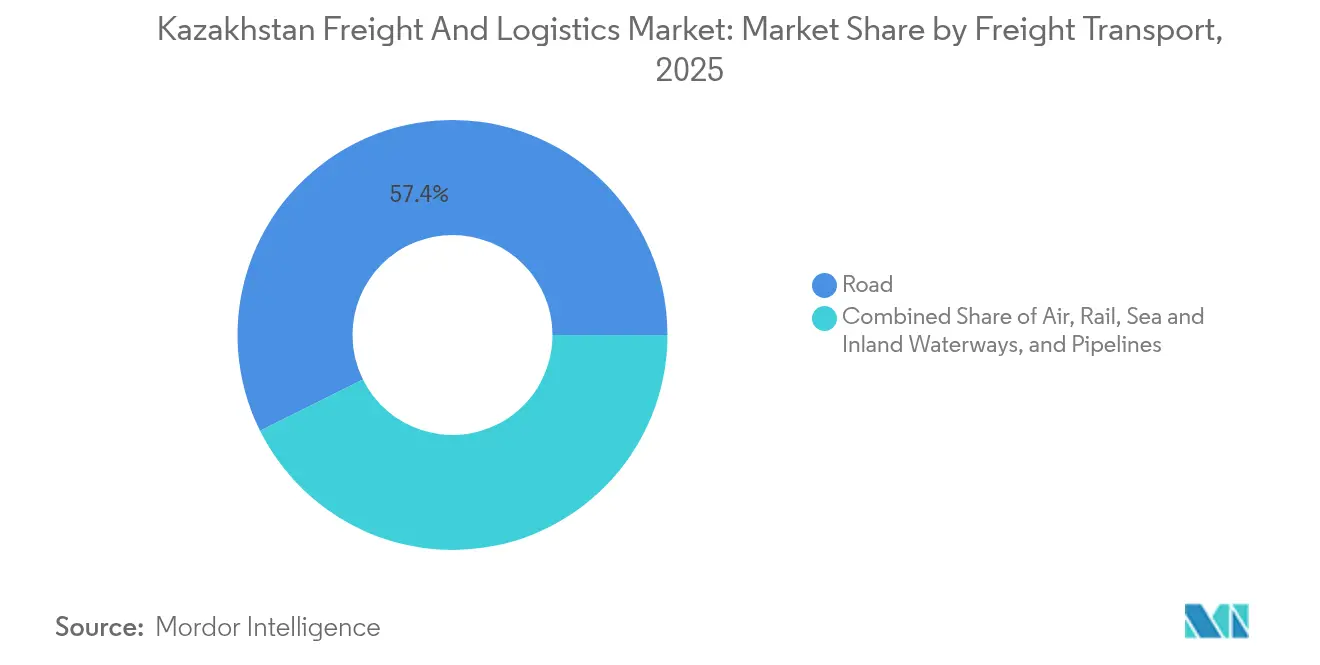
Freight Transport captured 73.65% of the Kazakhstan freight and logistics market in 2025, owing to bulk commodities and transit shipments that rely on road, rail, and pipeline assets. Road preserved a 57.35% slice, but investment in Wabtec locomotives in late-2024 raises rail capacity, improving competitiveness on east-west corridors. The Kazakhstan freight and logistics market size for Freight Transport is projected to expand in tandem with multimodal corridor upgrades linking China to the Caspian.
Growth momentum tilts toward CEP, advancing at a 4.32% CAGR (2026-2031). Domestic parcels dominate today, yet cross-border orders rise in double digits as digital customs slash processing times. Warehousing demand mirrors this shift: temperature-controlled space, just 9.88% of capacity, records a brisk 4.16% CAGR (2026-2031) as pharma and fresh-food exports multiply. Providers with automation, pick-to-light technology, and micro-fulfillment centers secure long-term contracts from retailers pivoting to omnichannel models.
By Courier, Express, and Parcel (CEP): Domestic Dominance Amid International Acceleration
Domestic CEP held 66.60% of the Kazakhstan freight and logistics market size in 2025, backed by nationwide locker rollouts and same-day delivery promises in Almaty and Astana. Astana-1’s automated risk-profiling clears 90% of parcels via the green channel, raising throughput for domestic e-tailers.
International CEP is the fastest-rising slice at a 4.45% CAGR (2026-2031) as merchants tap Chinese suppliers for electronics and fashion. Khorgos dry port’s revamped crane yard lifts daily parcel handling, while new scheduled freighters in Almaty funnel outbound returns to Europe within 48 hours. Temperature-controlled CEP emerges for insulin, vaccines, and gourmet foods, bolstering demand for GDP-compliant packaging and data loggers.
By Warehousing and Storage Temperature Control: Cold-Chain Expansion Accelerates
Non-temperature-controlled facilities ruled at 90.12% in 2025, serving FMCG, machinery, and bulk mineral stockpiles. The Kazakhstan freight and logistics market size for temperature-controlled warehousing is climbing on a 4.16% CAGR (2026-2031), spurred by 16.1 million tons of agri-exports and mounting pharma imports.
Modern Grade-A stock faces a shortage: Almaty registers 95% occupancy, and speculative projects such as Griffin Park’s 106,000 m² hub pre-lease over half their space before completion. IoT sensors, lithium-battery back-ups, and WMS integration become baseline requirements as shippers enforce GDP and HACCP standards.
By Freight Transport Mode: Road Supremacy Challenged by Modal Diversification
Road transport retained a 57.35% share in 2025, thanks to last-mile reach and flexible scheduling. However, air freight’s 4.18% CAGR (2026-2031) reflects time-sensitive cargo trends, especially pharma and high-tech components. Kazakhstan's freight and logistics market share is gradually rebalancing as rail garners subsidies for China-EU block trains, and pipeline throughput remains pivotal, moving 54.9 million tons of crude through CPC in 2024.
Sea shipments hinge on Caspian weather windows, yet ferry expansions diversify routing. Environmental policies encourage modal shifts from road to rail, but wagon shortages and gauge breaks at Khorgos still cap achievable volumes. Hybrid solutions-truck-rail-sea chains managed via a single waybill-gain traction for fast-fashion apparel headed to Western Europe.
By Freight Forwarding: Sea Routes Lead Amid Air Growth Acceleration
Sea and inland waterways forwarding commanded 57.76% of the Kazakhstan freight and logistics market in 2025, reflecting crude exports via the Caspian and growing container traffic on feeder services to Baku. The Kazakhstan freight and logistics market size for forwarding is expected to widen as the USD 775 million Aktau upgrade lifts box capacity and embeds IoT-enabled yard management.
Air forwarding, posting a 4.27% CAGR (2026-2031), benefits from electronics, perishables, and urgent automotive spares. Transit incentives at Almaty International Airport halve warehousing charges for re-exported cargo, luring regional consolidations. Forwarders embed API links with the Digital Trade Corridor platform to deliver real-time milestone updates, strengthening value propositions for multinational shippers.
Geography Analysis
Kazakhstan’s vast landmass mandates multimodal arteries that link mineral-rich regions with demand centers. The Trans-Kazakhstan Railway carries the bulk of east-west trade, while federal road upgrades improve feeder access to rural silos. Border reforms in early 2025 shaved average crossing delays by 40% at nine checkpoints, accelerating cross-border truck and rail throughput.
The Caspian littoral anchors maritime logistics. Aktau managed 3.6 million tons of oil in 2024 and will soon feature a green customs lane and reefer plugs to handle fruit transshipments from Central Asia to the Gulf. Western regions reliant on oil pipelines simultaneously welcome wind-farm components, creating backhaul opportunities for project carriers.
Regulatory Landscape
Kazakhstan's freight and logistics sector is regulated primarily by the Ministry of Transport of the Republic of Kazakhstan, including its Committee of Road Transport and Transport Control (market supervision and enforcement for road transport) and the Committee of Highways (road infrastructure management). Core operating requirements are defined under the Law of the Republic of Kazakhstan No. 156-XIII, On Transport in the Republic of Kazakhstan, which sets out state controls across licensing, technical regulation, and compliance oversight for freight carriage and infrastructure activities.
Market access and compliance are increasingly administered through digital government channels. Railway freight transport requires a state-issued license via the e-license portal (elicense.kz), while related permits and business services are handled through egov.kz. Sector direction is anchored by the Concept of Development of the Transport and Logistics Potential of the Republic of Kazakhstan until 2030, which prioritizes transit capacity and corridor connectivity and feeds into ministerial rules for day-to-day carriage and safety requirements across road and rail.
Value Chain Analysis
Kazakhstan's freight and logistics value chain begins with shippers in extractives (oil, mining), manufacturing, agriculture, and wholesale and retail, and then moves through freight forwarders and 3PLs that assemble multimodal routings across road, rail, Caspian maritime legs, and air for time-sensitive cargo. State-linked infrastructure and operating entities, especially KTZ and its subsidiaries, sit at the center of the rail and terminal layer, linking inland production and consumption nodes such as Almaty and Astana to gateways including Khorgos/Altynkol (China interface) and Aktau/Kuryk (Caspian interface). Value-added services such as customs brokerage, consolidation, track-and-trace, and fulfillment become more important for e-commerce and higher-value cargo, while project logistics supports renewables and other industrial builds.
Bottlenecks and enabling investments influence where value is captured. Gauge and transshipment steps at the China border create time and handling risk, which increases demand for stronger terminal processes and reliability at dry ports such as Khorgos. In response, upstream finance and infrastructure programs are expanding the rail and corridor layer, including AIIB-approved financing (March 2026) for a 322.3 km Mointy to Kyzylzhar rail section and internationally backed projects such as the electrified Almaty railway bypass. The chain is also integrating more international partners and platforms, including AD Ports Group and KTZ launching the Gulflink joint venture (July 2025), and KTZ Express discussing expanded cooperation with COSCO SHIPPING Lines (June 2026) around the Aktau Container Hub and TITR connectivity, reinforcing the forwarding and gateway segments that monetize Middle Corridor flows.
Competitive Landscape
The market remains moderately fragmented. State-owned KTZ subsidiaries dominate rail haulage and terminal operations, benefiting from infrastructure ownership and policy alignment. Kazpost leverages an unrivaled postal network to secure CEP volume spikes linked to domestic e-tailing. International 3PLs such as Rhenus Logistics and CJ Logistics deploy joint ventures to gain know-how on local regulations while injecting global SOPs and IT platforms.
Capacity around critical nodes—including Khorgos dry port and Aktau seaport—drives localized concentration where early movers negotiate preferential slots and long concessions. Digital differentiation is accelerating: KTZ’s blockchain pilot for wagon tracking and Prometeo’s smart-contract platform enhance transparency for shippers wary of transit disruptions.
White-space remains in temperature-controlled logistics, heavy-lift project cargo, and integrated rail-truck services linking SEZ factories to Caspian ports. Consolidation trends emerge as larger 3PLs absorb owner-operators unable to finance Euro-6 truck upgrades or comply with GDP standards. Overall, intense competition on line-haul rates coexists with premium niches commanding double-digit margins.
Kazakhstan Freight And Logistics Industry Leaders
-
KTZ-Freight Transportation LLC
-
Kazpost JSC
-
KTZ Express JSC
-
Pandora Logistics
-
KM Logistics
- *Disclaimer: Major Players sorted in no particular order
Market Opportunities and Future Outlook
Middle Corridor capacity build-outs and targeted cross-border hubs create room for operators that can raise throughput and improve reliability at constrained nodes. One clear investment signal is the transport agreements announced with European partners in June 2026 (USD 462 million) to strengthen TITR connectivity, supported by multilateral financing such as AIIB approval (March 2026) aimed at removing rail bottlenecks on key sections. This setup supports opportunities in intermodal terminals, container handling, and service layers that reduce friction at interfaces including Khorgos and the Caspian segment, spanning scheduled rail-sea products as well as higher-margin consolidation and customs brokerage tied to transit growth.
Digitization and data integration also create near-term implementation opportunities across CEP, trucking dispatch, and border processes. The Government of Kazakhstan has advanced initiatives around centralized digital transport management, including a stated goal (June 2026) to complete a centralized digital transport data lake by year-end 2026 for real-time logistics oversight, alongside ongoing Smart Cargo and KEDEN-related platform work referenced in official and national media. For private providers, this expands the addressable market for API-connected visibility, compliance automation, and route optimization services, particularly for fragmented SME trucking fleets, and for cold-chain operators where proof-of-condition and exception management can differentiate services at ports, airports, and cross-border hubs.
Recent Industry Developments
- July 2026: The Government of Kazakhstan signed a term sheet with UAE-based Presight to develop an intelligent national transport network. The initiative centers on data-driven traffic and logistics management, supporting real-time visibility across freight corridors and strengthening the digital layer underpinning multimodal operations.
- June 2026: Sarens announced a USD 56 million investment to develop an 82-hectare logistics and commercial hub near the Khorgos border crossing with China. The project targets border-adjacent storage and handling capacity, reinforcing the China-Kazakhstan interface where transshipment and dwell time management materially affect corridor competitiveness.
- October 2024: LX Pantos signed an MOU with PTC Group to co-develop Trans-Caspian International Transport Route-based freight services and optimize shared assets. The collaboration broadened commercial offerings tied to the Middle Corridor, supporting more structured multimodal products that connect Kazakhstan with Caspian and onward routes.
Research Methodology Framework and Report Scope
Market Definition and Coverage
This market is defined as the revenues earned from moving, handling, and storing goods within Kazakhstan and across its borders, where service providers get paid for transport execution and related logistics support.
Scope exclusions: Passenger transport, pure construction of transport infrastructure, and standalone vehicle sales are not counted in the market totals.
Segmentation Overview
- By Logistics Function
- Courier, Express, and Parcel (CEP)
- By Destination Type
- Domestic
- International
- By Destination Type
- Freight Forwarding
- By Mode of Transport
- Air
- Sea and Inland Waterways
- Others
- By Mode of Transport
- Freight Transport
- By Mode of Transport
- Air
- Rail
- Road
- Sea and Inland Waterways
- Pipelines
- By Mode of Transport
- Warehousing and Storage
- By Temperature Control
- Non-Temperature Control
- Temperature Control
- By Temperature Control
- Other Services
- Courier, Express, and Parcel (CEP)
- By End User Industry
- Agriculture, Fishing, and Forestry
- Construction
- Manufacturing
- Oil and Gas, Mining and Quarrying
- Wholesale and Retail Trade
- Others
Data Sources, Market Sizing, and Validation
Desk Research
Desk work starts with public statistics that explain how goods move in and out of Kazakhstan and how activity changes by mode. We typically anchor early assumptions using sources such as Kazakhstan's national statistics releases, customs and border trade data, the World Bank logistics and trade indicators, and UN Comtrade direction of trade series.
To keep the model realistic, we also review corridor updates from official transport agencies, plus international bodies that publish rail and road connectivity notes and transit flow indicators. Company annual reports, press releases, and investor decks help validate the service mix, margin direction, and where capacity is being added. For shipment and route signals, we use a paid import and export shipment level database and a logistics supply chain and freight rate database selectively. These desk sources are not exhaustive, and we cross-check with other public references to clarify assumptions and reduce definition drift.
Primary Interviews and Surveys
Interviews and surveys with shippers, carriers, freight forwarders, warehouse operators, customs specialists, and logistics managers in Kazakhstan are used to test freight rates, utilization, mode shifts, and disclosure gaps. Respondents help clarify how corridor demand, capacity use, and tariffs differ across operating segments, allowing the analysis to challenge secondary data, fill missing inputs, and reconcile assumptions before finalization.
Distribution of primary research fieldwork respondents
| Company type | Respondent position |
|---|---|
| Top tier: 30% | CXOs: 15% |
| Mid tier: 50% | Functional/Unit leaders: 30% |
| Smaller Players: 20% | Managers: 55% |
Market-Sizing & Forecasting
The core sizing uses a top-down build where transport activity and trade signals are converted into a value pool by mode and service type, and then summed after adjusting for domestic versus cross-border mixes. The totals are corroborated using selective bottom-up approximations, like sampled price per ton-km for road and rail, warehousing space monetization checks, and channel checks on forwarding and parcel revenues, which are then used to correct any drift.
Inputs are kept practical and repeatable, so we focus on indicators such as freight volumes by mode, cross-border trade values, corridor and terminal throughput signals, fuel and labor cost direction that influences pricing, and warehouse capacity additions in key hubs. When a bottom-up proxy is thin for a niche service, the gap is handled through penetration rates applied to the relevant shipper base, followed by interview validation.
For forecasting, scenario analysis is used around transit intensity and domestic demand, and the year-by-year path is shaped by a multivariate regression that relates market value to trade growth, industrial output direction, and transport volume momentum. Assumptions are aligned with what operators and shippers expect for pricing and utilization, so short-term spikes are not extended mechanically.
Data Validation & Update Cycle
Validation is done through several passes so the final number is consistent with what the wider transport system can support. We compare model outputs against independent signals like mode shares, trade and throughput trends, and implied revenue per unit moved, and then we review outliers before sign-off.
If large variances show up by mode or service line, analysts re-check source definitions, rerun currency and inflation treatments, and re-contact experts when needed. Reports are refreshed annually, and interim updates are made when material events change trade flows, capacity availability, or regulation in the Kazakhstan logistics context. Before delivery, a final quality pass is completed so clients receive the most current view available.
Mordor Intelligence's Kazakhstan Freight and Logistics Market Sizing Compared With Other Published Estimates
Published market values for Kazakhstan freight and logistics can differ because authors pick different service boundaries, years, and pricing logic, and they also vary in how they treat transit activity versus domestic moves. Differences also come from whether warehousing, value added services, and parcel type activity are bundled together or shown more narrowly.
In practice, the spread is usually explained by scope choices and how pricing is projected, since some estimates inflate future values using aggressive rate growth or include adjacent transport services that are not paid logistics revenues. The main gap here comes from keeping the total tied to mode level freight activity and service revenues inside the country definition, which tends to exclude non-logistics transport categories and avoids double counting across forwarding and transport legs. This alignment approach is applied by Mordor Intelligence.
Benchmark comparison
| Source | Market Size | Gaps in Research Methodology |
|---|---|---|
| Mordor Intelligence | USD 29.30 B (2025) | |
| Global Consultancy A | USD 4.50 B (2024) | Uses a narrower interpretation of logistics that can undercount freight transport execution revenues, and the base year and forecast window differ, which makes the value pool look smaller versus a full freight and logistics view. |
| Industry Publisher B | USD 32.10 B (2026) | Starts from a forward year and can embed stronger pricing expansion for cross-border services, with limited disclosure on how transit volumes and warehousing value are separated, which can lift the total if overlaps are not removed. |
The table shows that most differences are not about math, but about what is included and how prices are carried forward by year. By keeping assumptions linked to observable freight activity, clear service definitions, and cross-checks from interviews, our estimate stays traceable and easier to replicate when conditions change.
Key Questions Answered in the Report
What is the current value of the Kazakhstan freight and logistics market?
The sector is valued at USD 30.5 billion in 2026 and is projected to reach USD 37.24 billion by 2031.
Which logistics function generates the most revenue?
Freight Transport accounts for 73.65% of total revenue thanks to bulk commodity shipments and transit trade.
Which segment is growing the fastest?
The Courier, Express, and Parcel segment shows the quickest expansion with a 4.32% CAGR through 2031.
What role does the Trans-Caspian corridor play?
It channels rising China-Europe volumes, with cargo on the route targeted to double to 10 million tons by 2027.
How will port investments affect capacity?
A USD 775 million upgrade at Aktau is set to lift container handling and embed digital customs, easing bottlenecks.
What is the biggest operational challenge for trucking companies?
Volatile fuel prices and fleet fragmentation drive up costs and complicate service standardization.