
Italy Pharmaceutical Logistics Market Size and Share
Market Overview
| Study Period | 2020 - 2031 |
|---|---|
| Forecast Data Period | 2026 - 2031 |
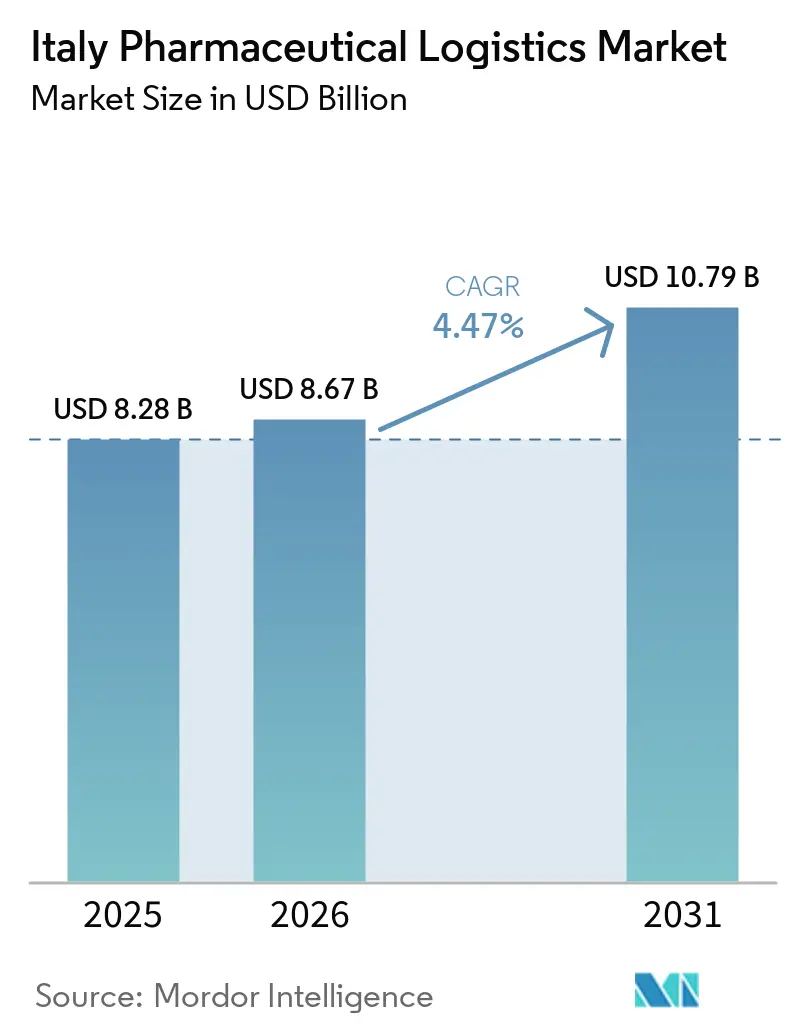
| Base Year Market Size (2025) | USD 8.28 Billion |
| Market Size (2026) | USD 8.67 Billion |
| Market Size (2031) | USD 10.79 Billion |
| Growth Rate (2026 - 2031) | 4.47 % |
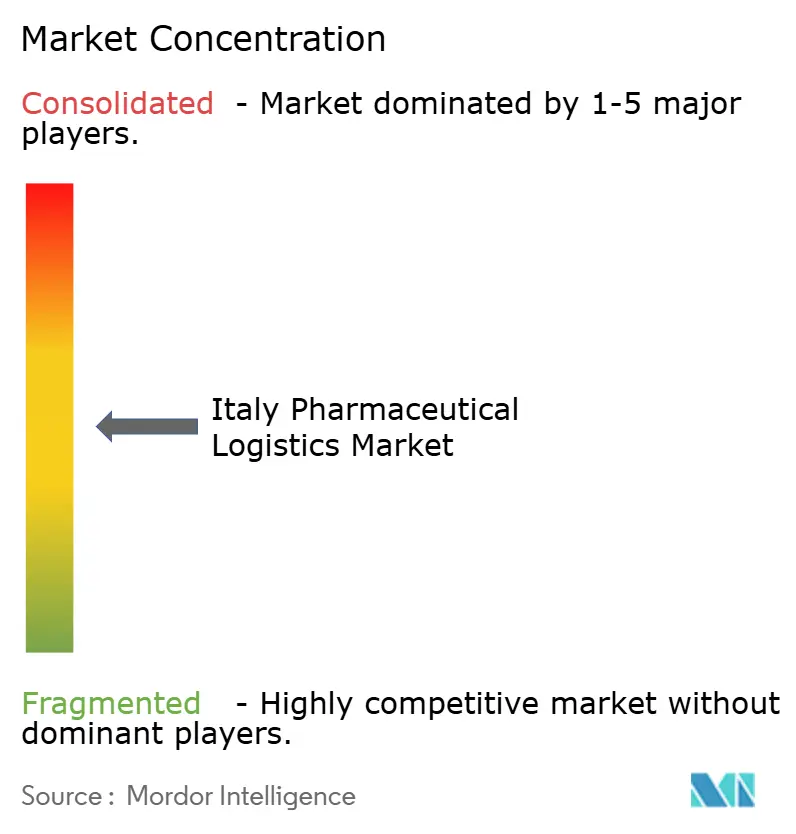
| Market Concentration | Medium |
Major Players *Disclaimer: Major Players sorted in no particular order Image © Mordor Intelligence. Reuse requires attribution under CC BY 4.0. | |
Italy Pharmaceutical Logistics Market Analysis by Mordor Intelligence
The Italy pharmaceutical logistics market size was valued at USD 8.28 billion in 2025 and is estimated to grow from USD 8.67 billion in 2026 to reach USD 10.79 billion by 2031, at a CAGR of 4.47% during the forecast period (2026-2031).
Italy’s pharmaceutical production base creates recurring inbound flows of active pharmaceutical ingredients and outbound flows of finished medicines. The country held 24% of EU contract development and manufacturing organization output at BIO 2026, supporting demand for specialized transport and distribution services. Biologics, vaccines, and advanced therapies require controlled handling and closer temperature oversight across the supply chain. Larger logistics providers are investing in automation, traceability, and cold-chain capacity, while local specialists compete through regional coverage and regulatory knowledge. Demand is also moving toward smaller, more frequent shipments, which increases the importance of reliable route planning and documented service performance.
Key Report Takeaways
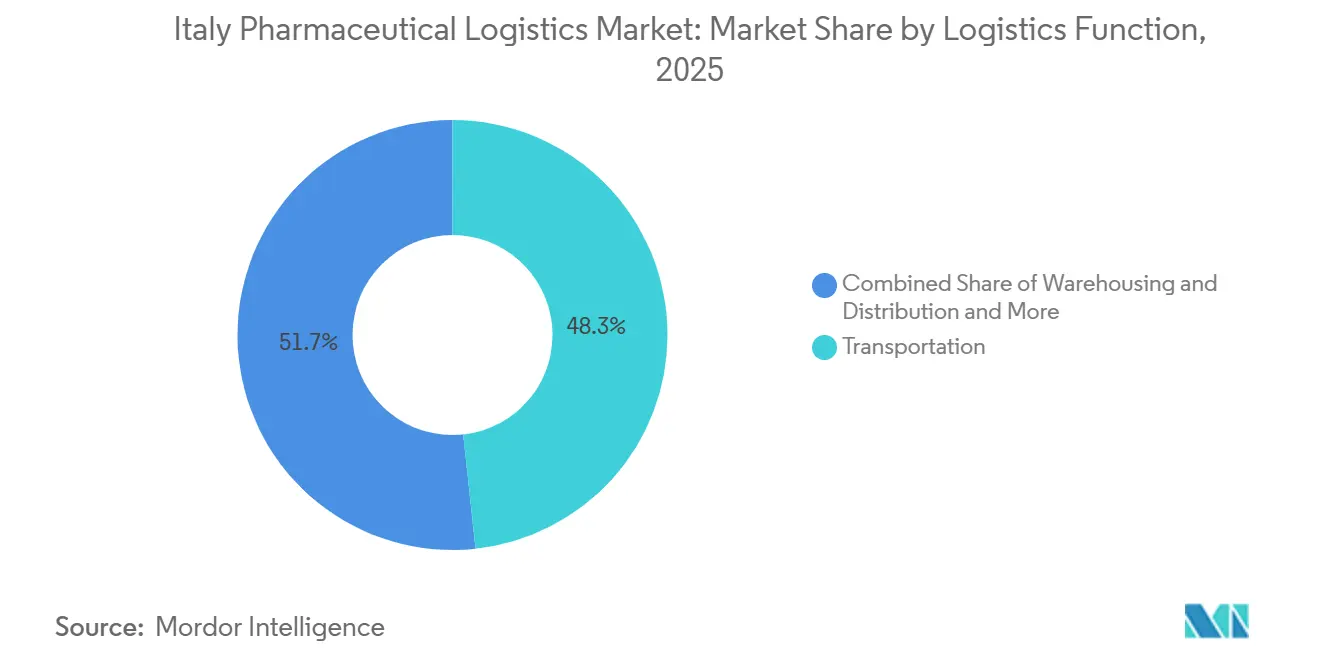
- By logistics function, transportation held 48.29% of the Italy pharmaceutical logistics market share in 2025, while the value-added services and others segment is forecast to grow at a 7.30% CAGR through 2031.
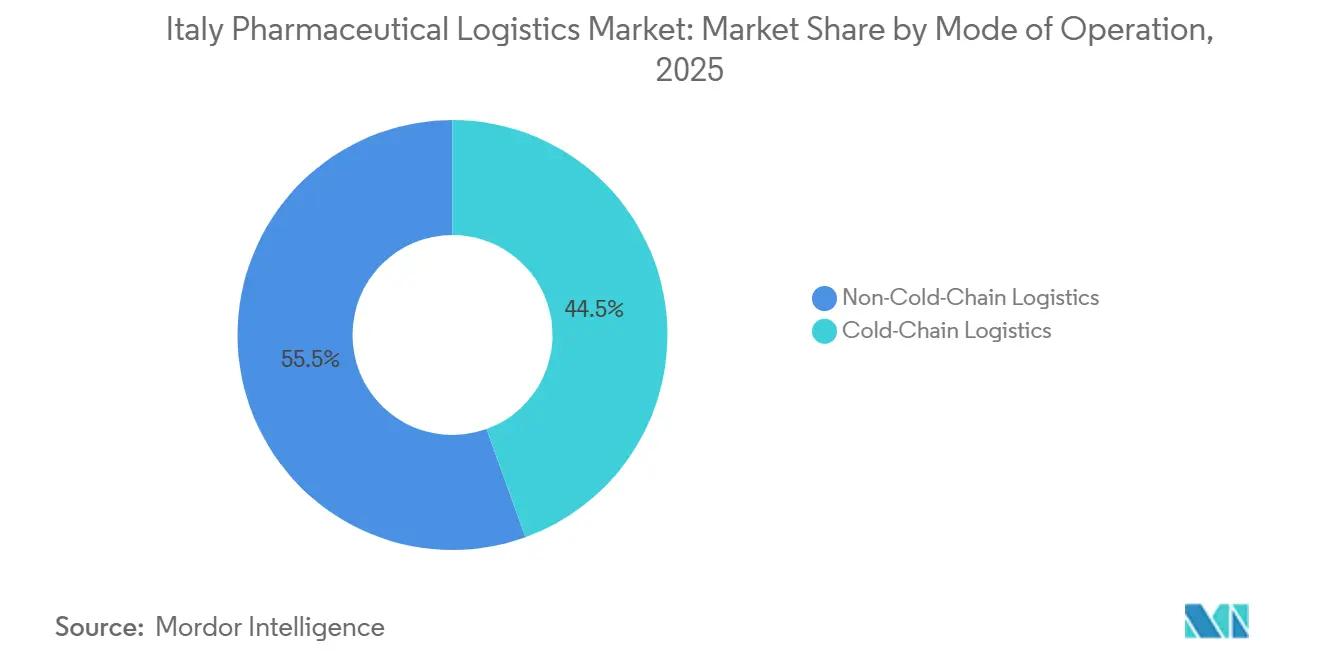
- By mode of operation, non-cold-chain logistics held 55.51% of the Italy pharmaceutical logistics market size in 2025, while cold-chain logistics is forecast to grow at a 6.47% CAGR through 2031.
- By product type, prescription drugs held 52.13% of the Italy pharmaceutical logistics market share in 2025, while the cell and gene therapies segment is forecast to grow at a 7.61% CAGR through 2031.
- By region, Northern Italy held 55.01% of the Italy pharmaceutical logistics market size in 2025, while Southern Italy and the Islands are forecast to grow at a 9.85% CAGR through 2031.
Note: Market size and forecast figures in this report are generated using Mordor Intelligence’s proprietary estimation framework, updated with the latest available data and insights as of January 2026.
Italy Pharmaceutical Logistics Market Trends and Insights
Drivers Impact Analysis*
| Driver | (~) % Impact on CAGR Forecast | Geographic Relevance | Impact Timeline |
|---|---|---|---|
| Growth Of Biologics, Vaccines, And Advanced Therapies | +1.4% | Global, with concentrated impact in Northern and Central Italy | Medium term (2-4 years) |
| Expansion Of Temperature-Controlled And Specialty Logistics | +0.9% | National, with hub investment concentrated in Northern Italy | Medium term (2-4 years) |
| Pharmaceutical Manufacturing And Export Concentration | +0.8% | Northern and Central Italy, with secondary effects in Southern Italy | Short term (≤ 2 years) |
| Outsourcing To GDP-Compliant Third-Party Logistics Providers | +0.7% | National | Medium term (2-4 years) |
| High-Value, Time-Critical Cell And Gene Therapy Flows | +0.5% | Northern Italy primary hubs, with emerging last-mile demand in Southern Italy | Long term (≥ 4 years) |
| Regionalization Of Clinical-Trial And Direct-To-Patient Networks | +0.4% | National, with early clinical trial activity in Lombardy, Lazio, and Campania | Medium term (2-4 years) |
| Source: Mordor Intelligence | |||
Growth of Biologics, Vaccines, and Advanced Therapies
Italian manufacturing generates a substantial share of the country’s need for specialized pharmaceutical logistics. Pharmaceutical facilities in Italy produced EUR 74 billion (USD 87.04 billion) of output in 2025[1]Farmindustria, “Farmaceutica Italiana, Export a Oltre 69 Miliardi nel 2025,” FarmaciaVirtuale, farmaciavirtuale.it. Biologics and vaccines need validated packaging, continuous temperature monitoring, and complete transport records. These requirements apply from manufacturing release through storage, transport, and delivery. The Italy pharmaceutical logistics market, therefore, benefits from higher service intensity as production shifts toward sensitive therapies. Cell and gene therapies extend this need because each shipment requires strict chain-of-custody controls and carefully planned delivery steps.
Expansion of Temperature-Controlled and Specialty Logistics
Smaller order sizes are changing the operating model for pharmaceutical distribution. Parcels per shipment in the Italian pharmacy channel increased 17% in 2025[2]Optivo Logistics, “DIF Shipment Fragmentation 2026, Polimi Data and Route Impact,” Optivo Logistics, optivologistics.com. More deliveries require more vehicle preparation, packaging checks, temperature records, and route controls. These activities are needed even when the shipment contains a small product volume. This pattern supports demand for temperature-controlled and specialty services in the Italy pharmaceutical logistics market. It also increases the value of automated distribution centers that can process frequent orders with consistent handling standards. DHL Supply Chain Italy opened a robotic system at its Livraga Health Logistics Campus in July 2025, reflecting the focus on warehouse productivity and traceability.
Outsourcing to GDP-Compliant Third-Party Logistics Providers
Manufacturers are transferring more warehousing and distribution work to qualified third-party logistics providers. The shift reflects the cost of maintaining documented procedures, validated temperature systems, and trained staff. Providers with GDP-compliant operations can spread these fixed costs across several customer contracts. This makes outsourced service models more attractive when manufacturers need to focus facility capacity on production. The 2025 Italian Budget Law raised the pharmaceutical wholesaler margin to 3.7%, following a period in which the prior margin structure limited infrastructure investment. The Italy pharmaceutical logistics industry benefits when specialist providers assume routine compliance and distribution responsibilities for manufacturing clients.
Regionalization of Clinical-Trial and Direct-to-Patient Networks
Clinical trials and direct-to-patient programs require a different service model from standard pharmacy distribution. Shipments may need to reach a patient’s home or a remote hospital on a scheduled basis. These deliveries can require cold-chain packaging, patient-specific documentation, and close delivery coordination. Italy’s 20 regional health systems add complexity because procurement and distribution practices differ across the country. Operators need regional execution capabilities rather than a single national routing plan. The Italy pharmaceutical logistics market also gains from this operational complexity because verified last-mile coverage becomes a meaningful service requirement. Direct-to-patient flows and clinical trial work can support specialized providers that maintain consistent performance across several Italian regions.
Restraints Impact Analysis*
| Restraint | (~) % Impact on CAGR Forecast | Geographic Relevance | Impact Timeline |
|---|---|---|---|
| High Cost Of Validated Cold-Chain Infrastructure | -0.4% | National, most acute in Southern Italy and the Islands | Long term (≥ 4 years) |
| Stringent GDP, GMP, And AIFA Compliance Burden | -0.3% | National | Long term (≥ 4 years) |
| Fragmented Regional Healthcare Delivery And Last-Mile Complexity | -0.2% | Southern Italy and the Islands, with secondary effects in Central Italy | Long term (≥ 4 years) |
| Limited Viability Of Low-Volume Ultra-Cold And Cryogenic Routes | -0.1% | Southern Italy and the Islands | Long term (≥ 4 years) |
| Source: Mordor Intelligence | |||
High Cost of Validated Cold-Chain Infrastructure
A GDP-compliant cold-chain site requires more investment than a standard warehouse. Operators need controlled temperature zones, continuous monitoring, backup cooling, calibrated equipment, and documented qualification processes. Italian healthcare logistics operating margins were recorded at 3% in 2025, compared with 6% for the broader Italian logistics sector[3]MM Operations, “Logistica Pharma e Cosmoceutica 2026,” MM Operations, mmoperations.it. This limits the ability of smaller providers to finance new cold-chain capacity from internal resources. Larger integrated providers can invest more readily in controlled assets and digital systems. The resulting gap is most visible outside the main Northern Italian logistics corridor. Cell and gene therapy deliveries to Southern Italy and Sicily also require cryogenic packaging and specialized local courier coordination.
Stringent GDP, GMP, and AIFA Compliance Burden
Pharmaceutical distribution in Italy involves obligations at every stage from manufacturer release to pharmacy delivery. GDP and GMP requirements need formal procedures, verified temperature management, qualified personnel, and continuous records. Electronic verification systems and anti-tampering measures also add equipment, software, and training costs. These costs weigh more heavily on smaller providers that cannot spread investments over a broad customer base. Compliance spending can limit funds available for warehouse expansion and regional service coverage. The Italy pharmaceutical logistics market remains dependent on providers that can maintain authorization standards while building capacity. This reinforces the role of established operators that already have validated systems and experienced quality teams.
*Our forecasts treat driver/restraint impacts as directional, not additive. The impact forecasts reflect baseline growth, mix effects, and variable interactions.
Segment Analysis
By Logistics Function: Transportation Anchors Revenue While Value-Added Services Accelerate
Transportation held 48.29% of the Italy pharmaceutical logistics market share in 2025. The segment’s scale reflects the need to move medicines between production sites, wholesale depots, hospitals, pharmacies, and export gateways. Road freight remains the foundation of domestic pharmaceutical distribution because it serves routine multi-stop delivery networks. GDP-certified refrigerated fleets support products that require controlled temperature conditions. Air freight carries smaller volumes but has a higher service value for biologics, clinical trial materials, and advanced therapies. Milan and Rome provide important connections for international pharmaceutical flows. Rail, sea, and inland waterway services have smaller roles, although rail supports selected temperature-controlled intermodal movements in the Northern industrial corridor.
The value-added services and others segment is forecast to expand at a 7.30% CAGR between 2026 and 2031. This category includes secondary packaging, serialization code verification, quality documentation, and cold-chain repackaging. Manufacturers use these services when they redirect internal capacity toward production activities. The Italy pharmaceutical logistics market size for this function is supported by the growing need for compliance-related tasks after manufacturing. Warehousing and distribution also benefit as customers outsource inventory management and controlled storage. GDP-certified hubs in Central and Northern Italy add capacity for ambient and temperature-controlled inventory. Transportation will remain essential for revenue, while service bundles can increase the role of specialist logistics contracts. The pattern favors providers that combine freight operations with documented quality and handling capabilities.



By Mode of Operation: Cold-Chain Logistics Outpaces Ambient Volumes in a Biologics-Driven Market
Non-cold-chain logistics held 55.51% of the Italy pharmaceutical logistics market size in 2025. The segment includes ambient-temperature prescription medicines, over-the-counter products, and products that move under controlled room-temperature conditions. Its large revenue base reflects the continued volume of standard medicines distributed through hospital and pharmacy networks. Multi-stop delivery routes remain central to this operating model. Operators still need close route control as orders become smaller and delivery frequency increases. Ambient products do not remove the need for accurate records and reliable dispatch timing. The segment also provides stable volumes that support the national distribution networks of large providers.
Cold-chain logistics is forecast to grow at a 6.47% CAGR from 2026 to 2031. Italian CDMO production creates demand for validated storage and transport at 2 °C to 8 °C. Biologics, vaccines, and specialty medicines depend on these controlled conditions during distribution. Ultra-cold and cryogenic therapies require an additional level of equipment, planning, and monitoring. The Italy pharmaceutical logistics market share of cold-chain services is expected to benefit from the growing commercial use of advanced therapies. Specialist providers have developed dedicated ultra-cold storage networks to serve these products across Europe. Northern Italy has the strongest existing infrastructure, but demand is increasing across the country. This creates a need for providers that can connect specialist hubs with dependable final delivery services.
By Product Type: Prescription Drugs Hold the Revenue Base as Cell and Gene Therapies Push Frontier Growth
Prescription drugs held 52.13% of the Italy pharmaceutical logistics market size in 2025. National health service distribution routes move reimbursable medicines to hospitals and community pharmacies throughout the country. This creates a broad base of recurring distribution work for GDP-certified operators. A meaningful share of these products requires validated temperature handling because Italy manufactures vaccines and monoclonal antibodies. Over-the-counter drugs and veterinary medicines provide additional ambient-temperature volumes. These flows help sustain regular national route activity. Medical devices and diagnostics also use related hospital distribution infrastructure. Their role supports a wider mix of logistics work across healthcare supply chains.
The cell and gene therapies segment is forecast to grow at a 7.61% CAGR between 2026 and 2031. These products require ultra-low or cryogenic conditions, real-time temperature data, emergency resupply plans, and chain-of-custody documentation. The Italy pharmaceutical logistics market for these therapies is shaped by the operational work required for every individual shipment. Delivery procedures continue to the point of patient administration, which increases the importance of precise coordination. Biologics and biosimilars, vaccines, and blood products also require validated cold-chain storage and transport. Clinical trial materials add further demand as study sponsors need controlled, time-sensitive distribution. Providers need trained teams and suitable equipment for each product class. The product mix favors networks that can operate conventional distribution services and high-acuity specialty flows.
Geography Analysis
Northern Italy held 55.01% of the Italy pharmaceutical logistics market share in 2025. The Milan, Lodi, Pavia, and Bergamo corridor contains a high concentration of pharmaceutical manufacturing and distribution activity. This location supports a dense base of GDP-certified cold-chain providers. Northern hubs also serve as the main national staging points for cell and gene therapy shipments. Specialist couriers often use the region before moving sensitive products toward central and southern destinations. Milan Malpensa and Bologna airports strengthen the region’s role in pharmaceutical air freight. These airports connect manufacturing clusters with export flows to the United States, Switzerland, and Belgium.
Central Italy has the country’s second-largest pharmaceutical manufacturing cluster. Pharmaceutical exports from Tuscany, Lazio, and Abruzzo reached EUR 41.8 billion (USD 49.2 billion) in 2025. The Fiano Romano and Latina districts combine pharmaceutical production with GDP-certified distribution infrastructure. Logista Pharma’s Fiano Romano site received GDP certification in December 2025. Rome also supports coordination activities for pharmaceutical clinical studies recruited across the country. Central Italy, therefore, links national distribution activity with major manufacturing and clinical supply requirements.
Southern Italy and the Islands are forecast to grow at a 9.85% CAGR from 2026 to 2031. The Italy pharmaceutical logistics market size in this area is supported by new infrastructure development and expanding manufacturing activity. Campania and Abruzzo reported stronger pharmaceutical export activity in 2025. The region has historically had less cold-chain capacity than the main Northern corridor. Deliveries to Sicily and Sardinia can require tailored courier arrangements and contingency packaging. Healthcare announced a new Rome healthcare facility in June 2026 as part of a European temperature-controlled expansion. New facilities can improve access to specialty products, but final delivery remains a demanding part of the regional operating model.
Competitive Landscape
The Italy pharmaceutical logistics market has moderate concentration among global integrators and specialized Italian providers. International companies hold contract logistics roles across several pharmaceutical manufacturers. Italian operators compete in hospital distribution, clinical trial supply, and advanced therapy services. Large providers use technology investment to improve consistency and manage more fragmented order flows. DHL Supply Chain Italy installed a robotic automation system at its Livraga campus in July 2025. The facility uses automated storage and retrieval technology and RFID-enabled tracking. This supports faster processing while maintaining pharmaceutical handling controls.
Specialist operators compete through local network density, product knowledge, and established compliance procedures. Southern Italy cold-chain coverage and direct-to-patient advanced therapy delivery remain areas with room for additional service capacity. Cryogenic distribution also requires equipment and procedures that are not available across every regional network. PHSE acquired an 80% stake in L.S. Logistica Sanitaria in Verona in July 2026[4]PHSE Group, “PHSE Acquires L.S. Logistica Sanitaria to Expand Operations,” PHSE Group, phse.com. The acquisition combines hospital ward stock management with temperature-controlled pharmaceutical distribution. This move expands PHSE’s reach in hospital logistics and shows the value of integrating services that are close to patient care.
Digital traceability, automated storage, and electronic temperature records are becoming routine operating requirements. Providers that cannot maintain these capabilities face higher compliance and service risks. The Italy pharmaceutical logistics industry also requires strong last-mile execution for hospitals, pharmacies, and patient-specific deliveries. Global scale is useful for international air freight and multi-country cold-chain flows. Local specialization is important when services need to reflect regional healthcare practices or urgent clinical requirements. Movianto has developed ultra-cold pharmaceutical storage capabilities for vaccine and biotechnology products across Europe.
Italy Pharmaceutical Logistics Industry Leaders
DHL Group
United Parcel Service, Inc.
Kuehne + Nagel International AG
CEVA Logistics SA
DSV A/S
- *Disclaimer: Major Players sorted in no particular order

Recent Industry Developments
- July 2026: PHSE Group acquired an 80% stake in L.S. Logistica Sanitaria S.r.l. in Verona, extending PHSE’s hospital logistics coverage in Veneto and Lombardy. The Verona hub is AIFA GMP-certified with WMS-integrated pharmaceutical traceability.
- June 2026: UPS Healthcare announced a USD 48 million expansion of its European temperature-controlled logistics operations, including a new healthcare facility in Rome. The facility is designed as a regional endpoint for specialty and clinical-grade pharmaceutical products, with sub-zero and controlled-ambient storage capabilities.
- December 2025: Logista Pharma’s 25,000 sqm Fiano Romano hub, serving Central Italy hospitals, pharmacies, and wholesale customers, received GDP certification from Bureau Veritas Italia, confirming compliance with EU GDP guidelines and Italian AIFA standards for pharmaceutical distribution.
- July 2025: DHL Supply Chain Italy inaugurated a EUR 14 million (USD 16.5 million) robotic automation system at its Health Logistics Campus in Livraga (Lodi). Described as Italy's first fully automated life sciences warehouse, the facility deploys Exotec Skypod ASRS with RFID-enabled real-time pharmaceutical tracking.


Italy Pharmaceutical Logistics Market Report Scope
| Transportation | Road |
| Air | |
| Sea and Inland Waterways | |
| Rail | |
| Warehousing and Distribution | |
| Value-added Services and Others |
| Cold-Chain Logistics |
| Non-Cold-Chain Logistics |
| Prescription Drugs |
| OTC Drugs |
| Biologics and Biosimilars |
| Vaccines and Blood Products |
| Clinical Trial Materials |
| Cell and Gene Therapies |
| Medical Devices and Diagnostics |
| Veterinary Medicine |
| Others |
| Northern Italy |
| Central Italy |
| Southern Italy (incl. the Islands) |
| By Logistics Function | Transportation | Road |
| Air | ||
| Sea and Inland Waterways | ||
| Rail | ||
| Warehousing and Distribution | ||
| Value-added Services and Others | ||
| By Mode of Operation | Cold-Chain Logistics | |
| Non-Cold-Chain Logistics | ||
| By Product Type | Prescription Drugs | |
| OTC Drugs | ||
| Biologics and Biosimilars | ||
| Vaccines and Blood Products | ||
| Clinical Trial Materials | ||
| Cell and Gene Therapies | ||
| Medical Devices and Diagnostics | ||
| Veterinary Medicine | ||
| Others | ||
| By Region | Northern Italy | |
| Central Italy | ||
| Southern Italy (incl. the Islands) |


Key Questions Answered in the Report
What is the projected value of pharmaceutical logistics in Italy by 2031?
The Italy pharmaceutical logistics market is forecast to reach USD 10.79 billion by 2031, growing at a 4.47% CAGR from 2026.
Which logistics function held the largest share in Italy during 2025?
Transportation led logistics functions with a 48.29% share in 2025, supported by national distribution and export delivery needs.
Why is cold-chain logistics growing faster than ambient pharmaceutical distribution?
Cold-chain logistics is projected to grow at a 6.47% CAGR because biologics, vaccines, and advanced therapies need validated temperature-controlled handling.
Which pharmaceutical product group is projected to grow fastest through 2031?
Cell and gene therapies is projected to grow at a 7.61% CAGR, supported by complex cryogenic handling and patient-specific delivery requirements.
Which region is expected to grow fastest in Italy through 2031?
Southern Italy and the Islands is forecast to grow at a 9.85% CAGR as pharmaceutical logistics capacity expands from a lower base.
How concentrated is the Italian pharmaceutical logistics market?
The market receives a concentration score of 5 out of 10 because international integrators and Italian specialists both compete.
Page last updated on:





