
Market Overview
| Study Period | 2017 - 2029 |
|---|---|
| Forecast Data Period | 2025 - 2029 |
| Historical Data Period | 2017 - 2023 |
| Market Size (2025) | USD 0.95 Billion |
| Market Size (2029) | USD 1.25 Billion |
| Growth Rate (2025 - 2029) | 6.96 % |
| Market Concentration | Low |
Major Players *Disclaimer: Major Players sorted in no particular order Image © Mordor Intelligence. Reuse requires attribution under CC BY 4.0. | |

Italy E-bike Market Analysis by Mordor Intelligence
The Italy E-bike Market size is estimated at 0.95 billion USD in 2025, and is expected to reach 1.25 billion USD by 2029, growing at a CAGR of 6.96% during the forecast period (2025-2029).
The Italian e-bike industry is experiencing a significant transformation driven by technological advancements and changing consumer preferences. Manufacturers are focusing on developing innovative features, fully integrated electric bike batteries and drives, appealing designs, and high-quality materials to meet evolving customer demands. The shift towards lithium-ion batteries has been particularly noteworthy, with this technology commanding 99.98% of the market share in 2023, primarily due to their superior performance characteristics and declining costs. The industry is also witnessing substantial investments in manufacturing infrastructure, exemplified by Italvolt's announcement to construct a 45 GWh battery cell factory in the northwestern Italian region of Piedmont.
Urban mobility solutions are reshaping the e-bike market landscape, with city/urban bikes emerging as the dominant segment. This segment captured 78% of the market share in 2022, reflecting the growing preference for Italian electric bikes as a practical transportation solution in urban areas. The trend is further supported by significant infrastructure investments, such as the EUR 250 million Cambio Super Cycle project approved in Milan in February 2022, which focuses on developing 24 bicycle lanes to decrease emissions and traffic congestion. These developments are complemented by innovative product launches from leading manufacturers, who are incorporating smart features and urban-specific designs.
The market is witnessing a notable shift in consumer behavior, particularly in urban commuting patterns. Approximately 16% of the working population utilized bicycles for their daily commute in 2022, indicating a growing acceptance of electric bikes as a viable transportation alternative. This trend is being reinforced by the emergence of new business models, including electric bike sharing services and corporate fleet solutions. Companies like GetHenry are expanding their presence in the Italian market, offering specialized last-mile delivery bikes and securing significant funding for market expansion.
The competitive landscape is evolving with manufacturers focusing on product innovation and strategic partnerships. Trek Bicycle Corporation maintains its market leadership with a 6.19% share in 2022, followed by other major players who are continuously introducing new models with advanced features. The industry is seeing increased collaboration between traditional bicycle manufacturers and technology companies, leading to the development of smart electric bikes with enhanced connectivity features. These partnerships are driving innovation in areas such as battery technology, motor efficiency, and integrated digital solutions, setting new standards for the industry and creating more sophisticated product offerings for consumers.
Italy E-bike Market Trends and Insights
Italy demonstrates a consistent and robust growth in E-Bike adoption rates, indicating an expanding market and consumer base.
- The increase in interest in bicycles as an ideal mode of exercise, high traffic congestion on the roads of Italy during peak hours, and increasing government practices to promote e-bicycles due to environmental concerns are improving the adoption of e-bicycles in the country. Fewer fuel and maintenance costs increased the e-bicycle adoption rate by 1.70% in 2019.
- The growth in COVID-19 cases in 2020 positively impacted the Italian e-bike market. People feared taking public transport and rental services due to the fear of contracting the virus, which hiked the demand for personal vehicles such as e-bicycles. An increase in the sales of e-bikes among the people of Italy further accelerated the adoption rate of e-bikes by around 2.40% in 2020.
- Declining COVID-19 cases led to the relaxation of restrictions and lockdowns and the resumption of business operations and offices, which increased the adoption of e-bikes at the end of 2021, by 14.90%, compared to 13.90% in 2020. The introduction of new e-bikes with advanced features such as a long battery range, good speed limits, and fast charging features have highly encouraged consumers to invest in e-bikes. As a result, the country is expected to witness a growth in the adoption rate of e-bikes, by more than 30%, during the forecast period.


Italy shows a gradual increase in the population commuting 5-15 km daily, reflecting a slow but consistent change in travel distances.
- Italy is witnessing a significant demand for bicycles every year as more individuals opt to travel by bicycle. The increase in the demand for bicycles is also increasing the number of commuters who travel 5-15 km per day. Approximately more than 18% of bicycle users commute daily for work and other places at shorter distances in various cities across Italy.
- Due to the lockdown, transportation systems were halted, and gyms were closed, which led people to take up cycling and increased the demand for bicycles in 2020 and 2021. People with the habit of cycling opted for bicycles as the daily mode of commuting to offices, businesses, and other nearby places in Italy. The trend of cycling has increased the number of commuters traveling 5-15 km by 0.4% in 2021 over 2020.
- The relaxation of COVID-19 restrictions encouraged many people to travel by bicycle to workplaces, businesses, and nearby markets within a range of 5-15 km. Around 16% of the working population commuted by bicycle in 2022. Developments in the bicycle infrastructure and growth in bicycle lanes have also encouraged more people to opt for bicycles for commute, thus increasing the share of bicycle users by 0.4% in 2022 over 2021.

OTHER KEY INDUSTRY TRENDS COVERED IN THE REPORT
- Italy's bicycle sales peak in 2020, followed by a slight decline, pointing to a market that experienced a surge in demand, now normalizing.
- Italy demonstrates a peak in inflation in 2022, with a gradual return to lower rates, suggesting successful price stabilization efforts.
- Italy is experiencing a gradual decrease in e-bike battery prices, signaling market expansion and technological improvements.
- Italy's growth in dedicated bicycle lanes indicates an increasing recognition of cycling's benefits for health, environment, and urban mobility.
- Italy shows a consistent decrease in E-bike charging times, highlighting progress in electric mobility solutions and charging infrastructure.
- Italy's GDP per capita reflects gradual growth, indicating a steady recovery and economic improvement.
- Italy's bicycle rental market experienced a surge in 2020 and maintains steady growth, indicating a solid market base and potential for expansion.
- Italy's hyper-local delivery sector is witnessing growth, suggesting a rising trend in consumer demand for localized digital services.
- Italy's trekker numbers are consistently increasing, reflecting an enhanced engagement with the country's varied terrain and cultural landscapes.
- Italy's Traffic Congestion Index demonstrates a gradual decrease, suggesting improvements in traffic management or alterations in travel behavior.
Segment Analysis: Propulsion Type
Pedal-Assisted Segment in Italy E-bike Market
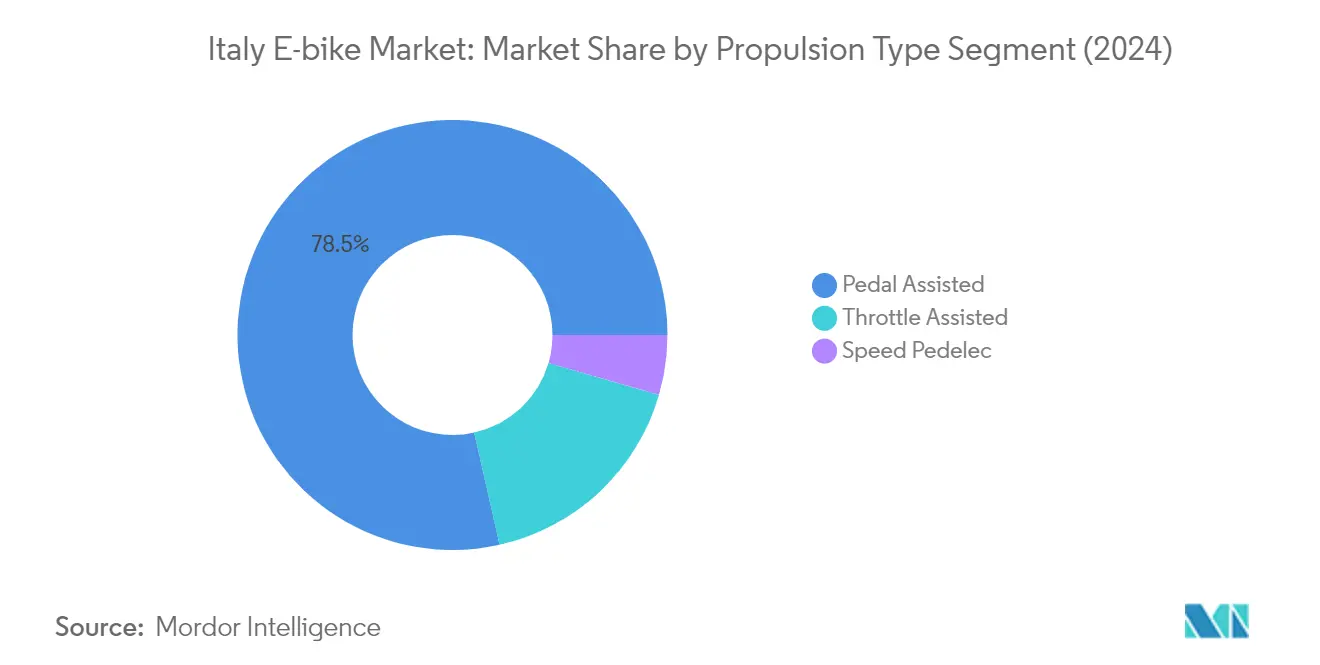
The pedal-assisted segment dominates the Italian electric bike market, commanding approximately 79% market share in 2024. This significant market position is driven by several key advantages that pedal-assist bikes offer to consumers. These bikes feature low maintenance costs, extended battery life, and multiple pedal-assist modes that provide riders with flexibility in choosing their preferred level of electric assistance. The segment's popularity is further enhanced by the growing environmental consciousness among Italian consumers who value the eco-friendly nature of pedal-assisted e-bikes. Manufacturers in this segment are focusing on producing lightweight models with noiseless operation, making them particularly attractive for daily urban commuting. The segment's strong performance is also supported by increasing consumer interest in physical fitness and sustainable transportation options.

Throttle-Assisted Segment in Italy E-bike Market
The throttle-assisted segment is emerging as the fastest-growing category in the Italian electric bike market, projected to grow at approximately 7% during 2024-2029. This growth trajectory is primarily driven by the segment's appeal to riders seeking enhanced speed capabilities and reduced physical exertion, particularly in challenging terrains. Throttle-assisted e-bikes are gaining popularity among commuters who need to navigate hilly areas or cover longer distances with minimal effort. The segment's growth is supported by technological advancements in motor efficiency and battery performance, enabling manufacturers to offer models with improved range and power delivery. Despite regulatory requirements such as insurance and licensing in some cases, the convenience and performance benefits of throttle-assisted e-bikes continue to attract a growing consumer base.
Remaining Segments in Propulsion Type
The speed pedelec segment represents an important niche in the Italian electric bicycle market, offering a balance between traditional pedal-assisted bikes and throttle-assisted models. These e-bikes are designed to provide motor assistance up to 45 km/h, making them particularly attractive for longer-distance commuters and riders seeking higher-speed capabilities. While this segment faces certain regulatory requirements under EU directives, including the need for moped driving licenses and motor liability insurance, it continues to attract consumers who prioritize faster commuting times and enhanced performance capabilities. The segment's development is supported by ongoing infrastructure improvements and dedicated bike lanes in major Italian cities.
Segment Analysis: Application Type
City/Urban Segment in Italy E-bike Market
The electric city bike segment dominates the Italian e-bike market, commanding approximately 78% market share in 2024, driven by increasing adoption of e-bikes for daily urban commuting. This significant market position is attributed to growing awareness of health benefits and the increased preference for cleaner modes of transportation in urban areas. City/Urban e-bikes are particularly favored as they offer practical advantages such as time savings in traffic, zero fuel costs, affordability, and carbon-free rides for daily commutes to offices, schools, and other urban destinations. The segment's strong performance is further supported by enhanced infrastructure development, including dedicated bike lanes in major Italian cities, making urban e-bikes an increasingly attractive transportation option for city dwellers.
Cargo/Utility Segment in Italy E-bike Market
The electric cargo bike segment is emerging as the fastest-growing category in the Italian e-bike market, driven by the expanding e-commerce sector and increasing demand for sustainable last-mile delivery solutions. This segment is projected to experience robust growth between 2024 and 2029, supported by various government initiatives and tax incentives specifically targeting cargo e-bikes. The segment's growth is further accelerated by major logistics companies and retailers adopting electric cargo bikes for urban deliveries, recognizing their efficiency in navigating congested city streets and reducing operational costs. The Italian government's allocation of funds for companies purchasing cargo e-bikes and the increasing focus on sustainable urban logistics solutions are expected to maintain this segment's strong growth trajectory in the coming years.
Remaining Segments in Application Type
The Trekking segment represents a significant niche in the Italian e-bike market, catering to recreational cyclists and adventure enthusiasts. This segment has established itself as an important category, particularly benefiting from Italy's diverse terrain and growing interest in outdoor activities. Trekking e-bikes are gaining popularity among recreational cyclists who prefer longer rides without excessive physical exertion, especially in mountainous regions. The segment's growth is supported by the expanding tourism sector, with many visitors seeking adventure experiences through e-bike rentals for exploring Italy's scenic routes and trails.
Segment Analysis: Battery Type
Lithium-ion Battery Segment in Italy E-bike Market
The Lithium-ion battery segment dominates the Italian electric bicycle market, commanding approximately 99.99% of the market share in 2024, owing to its superior performance characteristics and declining costs. The segment's prominence is driven by several key advantages including lighter weight, higher energy density, longer lifespan, and faster charging capabilities compared to traditional battery technologies. Manufacturers are increasingly preferring lithium-ion batteries due to their compact size and ability to be integrated seamlessly into e-bike designs. The continuous technological advancements in lithium-ion battery technology have led to improved power-to-weight ratios and enhanced range capabilities, making them the preferred choice for both manufacturers and consumers. The segment's growth is further supported by the decreasing costs of lithium-ion batteries, which have seen significant price reductions over recent years, making e-bikes more accessible to a broader consumer base. The Italian government's focus on sustainable transportation and various incentive programs has also contributed to the widespread adoption of lithium-ion battery-powered bicycles.
Remaining Segments in Battery Type
The lead-acid battery segment in the Italian e-bike market represents a declining technology that is gradually being phased out due to its limitations compared to lithium-ion alternatives. Despite their lower initial cost, lead-acid batteries face significant drawbacks including heavier weight, longer charging times, shorter lifespan, and lower energy density. These limitations have made them increasingly less attractive for both manufacturers and consumers in the evolving e-bike market. The transition away from lead-acid batteries reflects the industry's broader shift towards more efficient and environmentally friendly power solutions. Environmental concerns and stricter regulations regarding lead content in batteries have also contributed to the declining popularity of lead-acid batteries in the e-bike sector. The market's clear preference for advanced battery technologies has led manufacturers to focus their research and development efforts on improving lithium-ion technology rather than maintaining lead-acid battery production lines.
Competitive Landscape
Top Companies in Italy E-bike Market
The Italian electric bike market features prominent players like Trek Bicycle Corporation, Giant Manufacturing, Merida Industry, and Bianchi, who are driving innovation through advanced product development. These companies are focusing on launching new e-bike models with integrated technologies, improved battery systems, and enhanced performance capabilities to meet evolving consumer demands. Market leaders are expanding their distribution networks while simultaneously strengthening their manufacturing capabilities through strategic facility expansions. Companies are also pursuing partnerships and collaborations, particularly in areas like bicycle-to-vehicle communication technology and sustainable mobility solutions. The competitive landscape is characterized by continuous product launches featuring cutting-edge features such as fully integrated batteries, appealing designs, and high-quality materials, while companies are also investing in expanding their service networks and after-sales support to enhance customer experience.
Mixed Market Structure with Growing Consolidation
The Italian electric bike market presents a blend of global manufacturers and local specialists, with international players holding significant market share while domestic companies maintain a strong regional presence through their heritage and local market understanding. The market structure is relatively fragmented, with multiple players competing across different price segments and application categories. Traditional bicycle manufacturers have successfully transitioned into the e-bike segment, leveraging their existing expertise and distribution networks, while new specialized Italian bike companies have emerged to capture growing market opportunities. The presence of both established brands and innovative startups has created a dynamic competitive environment, driving continuous improvement in product quality and technology.
The market is witnessing increasing consolidation through strategic acquisitions and partnerships, as larger companies seek to expand their technological capabilities and market reach. Companies are forming strategic alliances to strengthen their position in specific market segments or to gain access to new technologies and distribution channels. Local manufacturers are partnering with global players to enhance their competitive position and expand their product portfolios. The market is also seeing increased investment in research and development facilities, particularly in areas like battery technology and motor systems, as companies strive to differentiate their offerings.
Innovation and Sustainability Drive Future Success
Success in the Italian electric bicycle market increasingly depends on companies' ability to innovate while maintaining competitive pricing strategies. Market leaders are investing in advanced manufacturing processes and supply chain optimization to achieve cost efficiencies while maintaining product quality. Companies are also focusing on developing specialized products for different user segments, from urban commuters to sports enthusiasts. Building strong brand recognition through effective marketing strategies and establishing robust after-sales service networks have become crucial for maintaining market position. The ability to adapt to changing consumer preferences and integrate new technologies while ensuring product reliability and safety will be key determinants of success.
Future market success will require companies to address environmental concerns and sustainability requirements while meeting evolving regulatory standards. Players must focus on developing eco-friendly manufacturing processes and sustainable supply chains to align with growing environmental consciousness among consumers. Companies need to strengthen their distribution networks and enhance their digital presence to improve market reach and customer engagement. The ability to offer comprehensive mobility solutions, including services like maintenance, insurance, and financing options, will become increasingly important. Companies must also prepare for potential regulatory changes regarding Italian electric bikes specifications, safety standards, and urban mobility policies, while maintaining flexibility to adapt their business models accordingly.
Italy E-bike Industry Leaders
Atala SpA
Fabbrica Italiana Velocipedi Edoardo Bianchi SpA (Bianchi)
Giant Manufacturing Co. Ltd.
Merida Industry Co. Ltd.
Trek Bicycle Corporation
- *Disclaimer: Major Players sorted in no particular order


Recent Industry Developments
- January 2023: Campagnolo and Rapha launched a global partnership to enable RCC members to ride Campagnolo’s 13-speed gravel groupset and gravel-specific wheelset.
- November 2022: The company chose a prestigious platform at Rouleur, London, for the public debut of the Bianchi Oltre RC and the entire new Oltre range.
- October 2022: Bianchi Reparto Corse was created in line with the company’s constant desire for improvement.


Italy E-bike Market Report Scope
Pedal Assisted, Speed Pedelec, Throttle Assisted are covered as segments by Propulsion Type. Cargo/Utility, City/Urban, Trekking are covered as segments by Application Type. Lead Acid Battery, Lithium-ion Battery, Others are covered as segments by Battery Type.Propulsion Type
| Pedal Assisted |
| Speed Pedelec |
| Throttle Assisted |
Application Type
| Cargo/Utility |
| City/Urban |
| Trekking |
Battery Type
| Lead Acid Battery |
| Lithium-ion Battery |
| Others |
| Propulsion Type | Pedal Assisted |
| Speed Pedelec | |
| Throttle Assisted | |
| Application Type | Cargo/Utility |
| City/Urban | |
| Trekking | |
| Battery Type | Lead Acid Battery |
| Lithium-ion Battery | |
| Others |


Market Definition
- By Application Type - E-bikes considered under this segment include city/urban, trekking, and cargo/utility e-bikes. The common types of e-bikes under these three categories include off-road/hybrid, kids, ladies/gents, cross, MTB, folding, fat tire, and sports e-bike.
- By Battery Type - This segment includes lithium-ion batteries, lead-acid batteries, and other battery types. The other battery type category includes nickel-metal hydroxide (NiMH), silicon, and lithium-polymer batteries.
- By Propulsion Type - E-bikes considered under this segment include pedal-assisted e-bikes, throttle-assisted e-bikes, and speed pedelec. While the speed limit of pedal and throttle-assisted e-bikes is usually 25 km/h, the speed limit of speed pedelec is generally 45 km/h (28 mph).
| Keyword | Definition |
|---|---|
| Pedal Assisted | Pedal-assist or pedelec category refers to the electric bikes that provide limited power assistance through torque-assist system and do not have throttle for varying the speed. The power from the motor gets activated upon pedaling in these bikes and reduces human efforts. |
| Throttle Assisted | Throttle-based e-bikes are equipped with the throttle assistance grip, installed on the handlebar, similarly to motorbikes. The speed can be controlled by twisting the throttle directly without the need to pedal. The throttle response directly provides power to the motor installed in the bicycles and speeds up the vehicle without paddling. |
| Speed Pedelec | Speed pedelec is e-bikes similar to pedal-assist e-bikes as they do not have throttle functionality. However, these e-bikes are integrated with an electric motor which delivers power of approximately 500 W and more. The speed limit of such e-bikes is generally 45 km/h (28 mph) in most of the countries. |
| City/Urban | The city or urban e-bikes are designed with daily commuting standards and functions to be operated within the city and urban areas. The bicycles include various features and specifications such as comfortable seats, sit upright riding posture, tires for easy grip and comfortable ride, etc. |
| Trekking | Trekking and mountain bikes are special types of e-bikes that are designed for special purposes considering the robust and rough usage of the vehicles. These bicycles include a strong frame, and wide tires for better and advanced grip and are also equipped with various gear mechanisms which can be used while riding in different terrains, rough grounded, and tough mountainous roads. |
| Cargo/Utility | The e-cargo or utility e-bikes are designed to carry various types of cargo and packages for shorter distances such as within urban areas. These bikes are usually owned by local businesses and delivery partners to deliver packages and parcels at very low operational costs. |
| Lithium-ion Battery | A Li-ion battery is a rechargeable battery, which uses lithium and carbon as its constituent materials. The Li-Ion batteries have a higher density and lesser weight than sealed lead acid batteries and provide the rider with more range per charge than other types of batteries. |
| Lead Acid Battery | A lead acid battery refers to sealed lead acid battery having a very low energy-to-weight and energy-to-volume ratio. The battery can produce high surge currents, owing to its relatively high power-to-weight ratio as compared to other rechargeable batteries. |
| Other Batteries | This includes electric bikes using nickel–metal hydroxide (NiMH), silicon, and lithium-polymer batteries. |
| Business-to-Business (B2B) | The sales of e-bikes to business customers such as urban fleet and logistics company, rental/sharing operators, last-mile fleet operators, and corporate fleet operators are considered under this category. |
| Business-to-Customers (B2C) | The sales of electric scooters and motorcycles to direct consumers is considered under this category. The consumers acquire these vehicles either directly from manufacturers or from other distributers and dealers through online and offline channel. |
| Unorganized Local OEMs | These players are small local manufacturers and assemblers of e-bikes. Most of these manufacturers import the components from China and Taiwan and assemble them locally. They offer the product at low cost in this price sensitive market which give them advantage over organized manufacturers. |
| Battery-as-a-Service | A business model in which the battery of an EV can be rented from a service provider or swapped with another battery when it runs out of charge |
| Dockless e-Bikes | Electric bikes that have self-locking mechanisms and a GPS tracking facility with an average top speed of around 15mph. These are mainly used by bike-sharing companies such as Bird, Lime, and Spin. |
| Electric Vehicle | A vehicle which uses one or more electric motors for propulsion. Includes cars, scooters, buses, trucks, motorcycles, and boats. This term includes all-electric vehicles and hybrid electric vehicles |
| Plug-in EV | An electric vehicle that can be externally charged and generally includes all-electric vehicles as well as plug-in hybrids. In this report we use the term for all-electric vehicles to differentiate them from plug-in hybrid electric vehicles. |
| Lithium-Sulphur Battery | A rechargeable battery that replaces the liquid or polymer electrolyte found in current lithium-ion batteries with sulfur. They have more capacity than Li-ion batteries. |
| Micromobility | Micromobility is one of the many modes of transport involving very-light-duty vehicles to travel short distances. These means of transportation include bikes, e-scooters, e-bikes, mopeds, and scooters. Such vehicles are used on a sharing basis for covering short distances, usually five miles or less. |
| Low Speed Electric Vehicls (LSEVs) | They are low speed (usually less than 25 kmph) light vehicles that do not have an internal combustion engine, and solely use electric energy for propulsion. |


Research Methodology
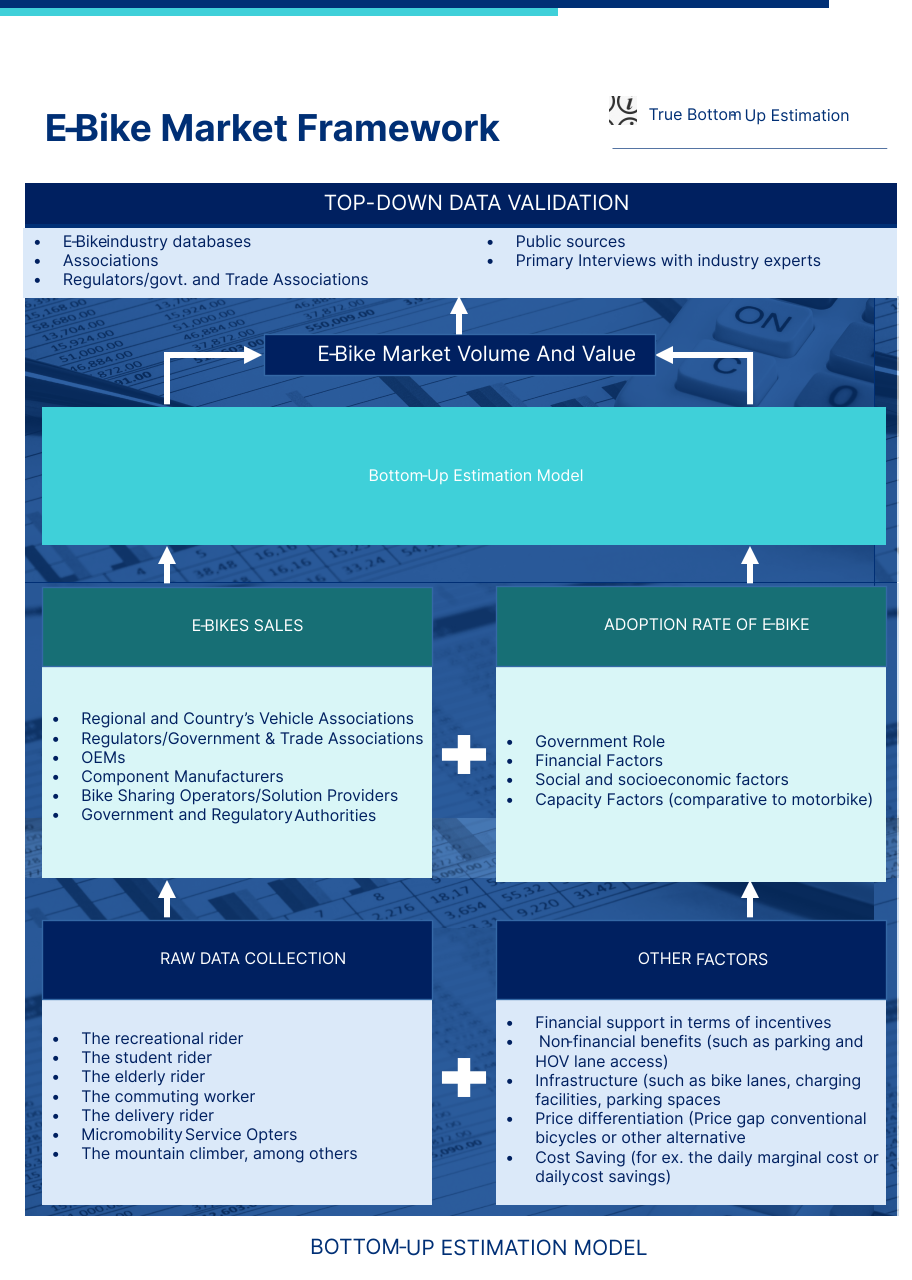
Mordor Intelligence follows a four-step methodology in all its reports.
- Step-1: Identify Key Variables: To build a robust forecasting methodology, the variables and factors identified in Step-1 are tested against available historical market numbers. Through an iterative process, the variables required for market forecast are set and the model is built based on these variables.
- Step-2: Build a Market Model: Market-size estimations for the historical and forecast years have been provided in revenue and volume terms. Market revenue is calculated by multiplying the volume demand with volume-weighted average battery pack price (per kWh). Battery pack price estimation and forecast takes into account various factors affecting ASP, such as inflation rates, market demand shifts, production costs, technological developments, and consumer preferences, providing estimations for both historical data and future trends.
- Step-3: Validate and Finalize: In this important step, all market numbers, variables, and analyst calls are validated through an extensive network of primary research experts from the market studied. The respondents are selected across levels and functions to generate a holistic picture of the market studied.
- Step-4: Research Outputs: Syndicated Reports, Custom Consulting Assignments, Databases & Subscription Platforms





 Your data is secure and never sold or shared.


