
Invoice Financing Market Size and Share
Market Overview
| Study Period | 2020 - 2031 |
|---|---|
| Market Size (2026) | USD 3.92 Trillion |
| Market Size (2031) | USD 4.82 Trillion |
| Growth Rate (2026 - 2031) | 4.22 % |
| Fastest Growing Market | Asia-Pacific |
| Largest Market | Europe |
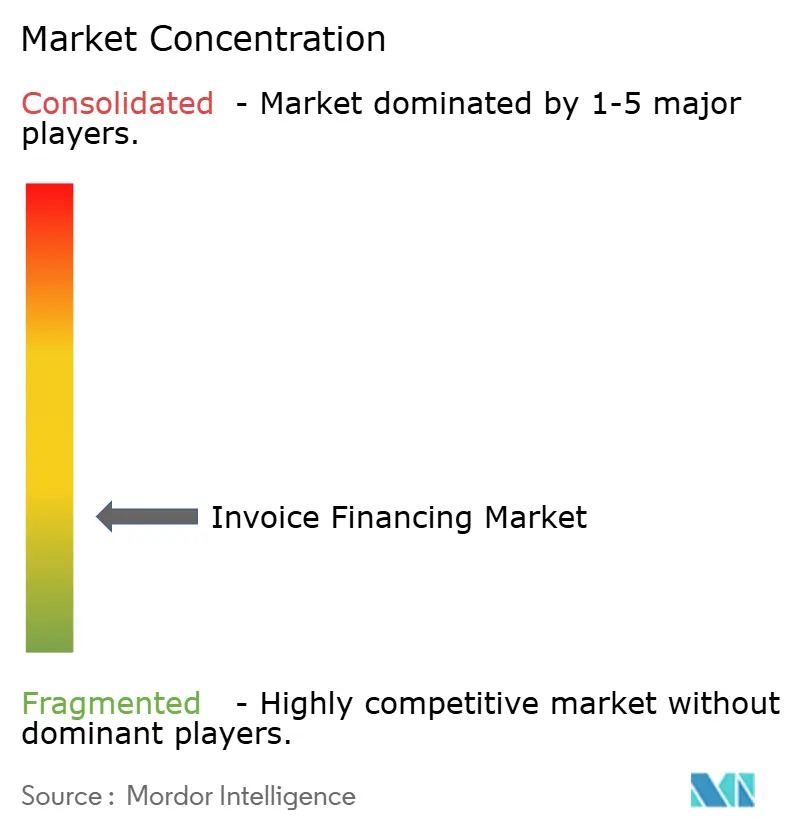
| Market Concentration | Low |
Major Players *Disclaimer: Major Players sorted in no particular order Image © Mordor Intelligence. Reuse requires attribution under CC BY 4.0. | |
Invoice Financing Market Analysis by Mordor Intelligence
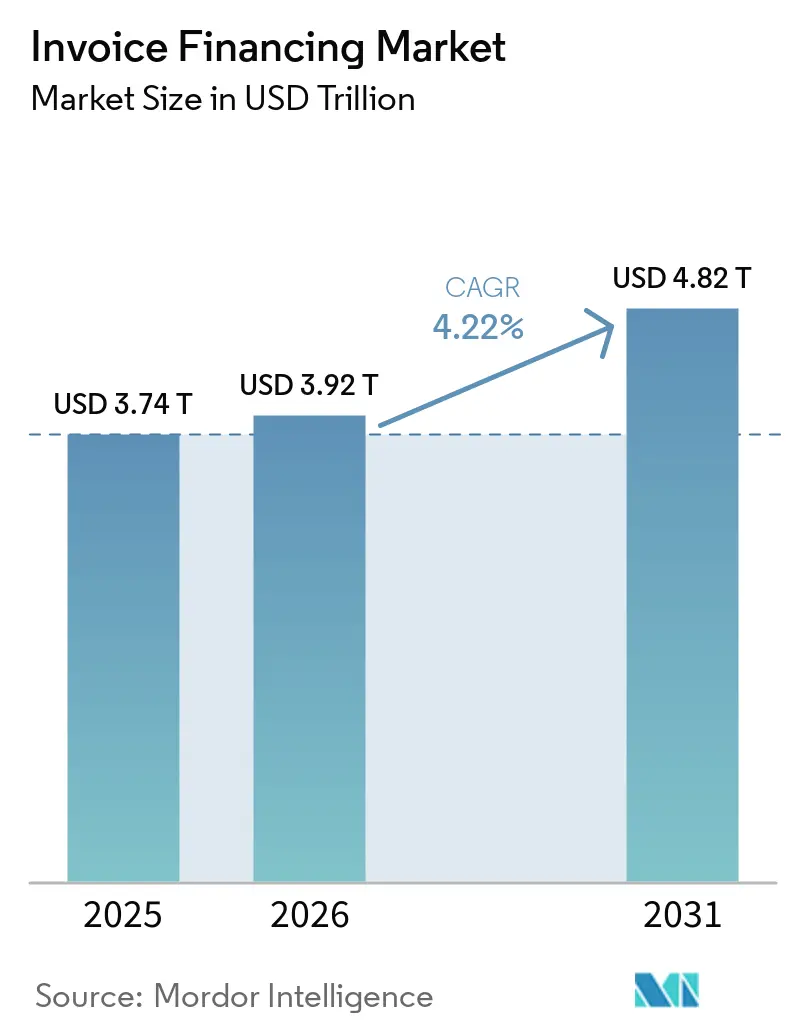
The Invoice Financing Market size was valued at USD 3.74 trillion in 2025 and is estimated to grow from USD 3.92 trillion in 2026 to reach USD 4.82 trillion by 2031, at a CAGR of 4.22% during the forecast period (2026-2031).
The invoice financing market is moving beyond its earlier role as a bank-led tool used mainly by large companies. It is increasingly supporting liquidity within procurement, enterprise resource planning, and e-commerce workflows. Demand is supported by longer buyer payment cycles and the need for suppliers to convert verified receivables into cash. Providers are competing through faster onboarding, multi-currency support, and integration with business software. Margin pressure in established factoring products is also making technology, funding resilience, and debtor assessment more important to the invoice financing market.
Key Report Takeaways
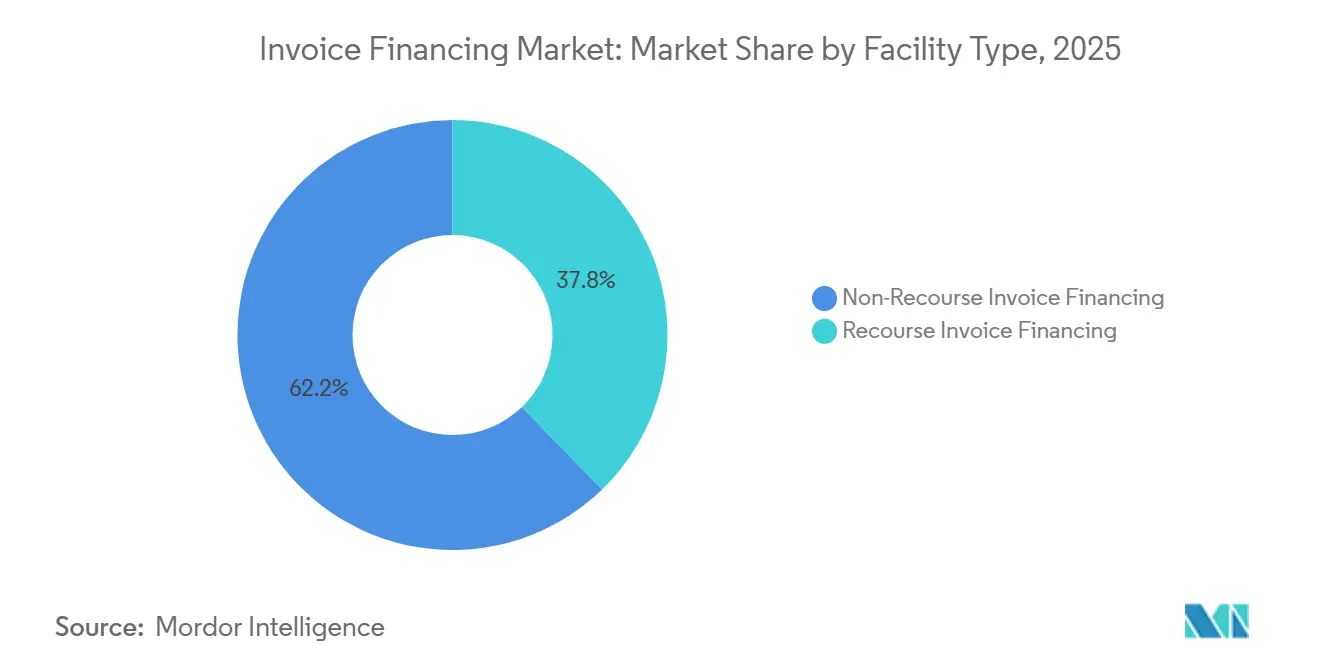
- By facility type, non-recourse invoice financing captured 62.2% of the invoice financing market share in 2025 and is projected to grow at a 5.1% CAGR through 2031.
- By transaction scope, domestic invoice financing accounted for 78.5% of the invoice financing market share in 2025, while cross-border invoice financing is projected to grow at a 5.8% CAGR through 2031.
- By financing structure, traditional invoice financing and factoring captured 87.9% of the invoice financing market share in 2025, while reverse factoring and supply chain finance are projected to grow at an 8.9% CAGR through 2031.
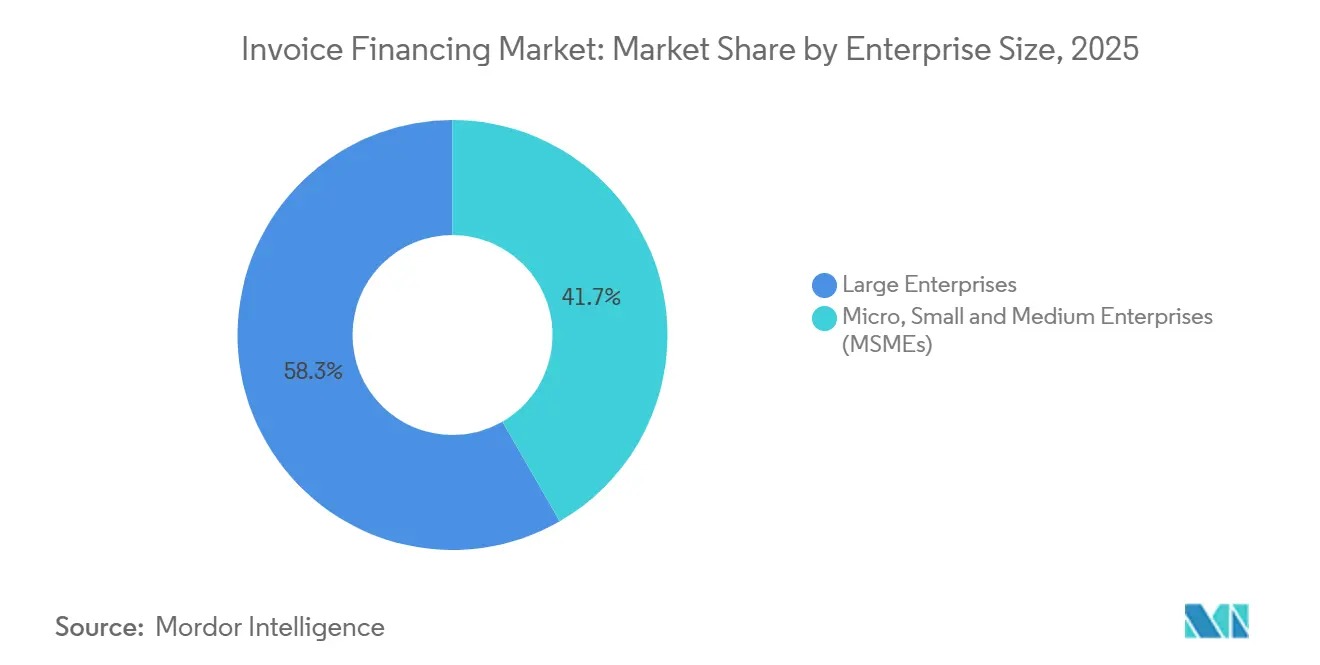
- By enterprise size, large enterprises held 58.3% of the invoice financing market share in 2025, while MSMEs are projected to grow at a 5.0% CAGR through 2031.
- By end user, manufacturing captured 26.2% of the invoice financing market share in 2025, while healthcare is projected to grow at a 6.8% CAGR through 2031.
- By geography, Europe captured 62.1% of the invoice financing market share in 2025, while Asia-Pacific is projected to grow at a 5.51% CAGR through 2031.
Note: Market size and forecast figures in this report are generated using Mordor Intelligence’s proprietary estimation framework, updated with the latest available data and insights as of January 2026.
Global Invoice Financing Market Trends and Insights
Drivers Impact Analysis*
| Drivers | (~) % Impact on CAGR Forecast | Geographic Relevance | Impact Timeline |
|---|---|---|---|
| SME Working Capital Gaps Across Buyer-Supplier Networks | +1.2% | Global, with intensity in Asia-Pacific, Middle East and Africa, and South America | Short term (≤ 2 years) |
| Shift From Bank Overdrafts to Receivables-Backed Liquidity | +0.8% | North America and Europe, spreading to Asia-Pacific | Medium term (2-4 years) |
| Embedded Financing in B2B Procurement and ERP Platforms | +0.5% | North America, Europe, and Asia-Pacific | Medium term (2-4 years) |
| Cross-Border Trade and Multi-Currency Receivables | +0.5% | Asia-Europe corridors, the Americas, and global markets | Medium term (2-4 years) |
| Digital Underwriting, Open Banking, and API Credit Decisions | +0.4% | Europe, Asia-Pacific, and North America | Long term (≥ 4 years) |
| Demand for Balance-Sheet-Light Liquidity | +0.4% | Europe, North America, and Asia-Pacific | Medium term (2-4 years) |
| Source: Mordor Intelligence | |||
SME Working Capital Gaps and Receivables-Backed Liquidity
The gap between issuing an invoice and receiving payment remains a core reason suppliers use the invoice financing market. Automotive and manufacturing supply chains commonly operate on payment terms of 60-90 days, while smaller suppliers still face near-term payroll, inventory, and operating costs. More than 90% of global trade relied on trade finance infrastructure in 2025, but over 40% of small- and medium-sized enterprise trade finance applications were rejected by traditional banks due to risk and compliance constraints. This leaves a role for receivables-backed funding when an underlying invoice is valid but conventional credit is unavailable. Suppliers also value facilities that link funding to a specific receivable and can support a balance-sheet-light approach. The invoice financing market benefits when providers can assess both the supplier and the debtor quickly while maintaining clear credit controls.
Embedded Financing, Digital Underwriting, and Cross-Border Trade
The invoice financing market is becoming easier to access as financing moves into B2B procurement and enterprise resource planning systems. J.P. Morgan Payments launched a supply chain finance solution integrated with Oracle Fusion Cloud ERP in July 2025, and FedEx adopted the solution[1] J.P. Morgan Payments, “J.P. Morgan Payments Launches Cutting-Edge Supply Chain Finance Solution with Oracle,” Business Wire, businesswire.com. The integration reduced what had been a 6-month custom development process to platform activation and setup. Cleo launched InvoicePay within its EDI Fulfillment Portal in October 2025, allowing suppliers to receive cash settlement within 24 hours through their existing workflow. These developments move financing closer to the transaction rather than requiring users to begin in a separate lending portal. This model can reduce manual steps and make receivables funding more practical for suppliers operating within established digital workflows.
Digital Underwriting, Open Banking, and API Credit Decisions
Data access is changing how providers assess applications and service smaller companies in the invoice financing market. NatWest worked with Validis in 2026 to automate financial data collection for its invoice finance business via integrations with QuickBooks, Xero, Sage, and NetSuite[2]NatWest and Validis, “NatWest Works with Validis to Automate Financial Data Collection Within Invoice Finance,” Open Banking Expo, openbankingexpo.com. Société Générale Factoring introduced a service in 2025 that provides micro-businesses with an invoice eligibility decision in under 1 minute and funding within 24 hours via online banking. These tools can reduce manual document collection and improve underwriting consistency. Open banking rules and account aggregation systems also make customer consent, audit trails, and data governance central to product design. Providers will benefit when they can use these systems without weakening debtor verification or compliance processes.
Cross-Border Trade and Multi-Currency Receivables
Cross-border demand is supporting the invoice financing market because suppliers need funding that can work across currencies, legal systems, and buyer locations. Drip Capital exceeded USD 9 billion in cumulative cross-border MSME trade finance transactions by April 2026, including USD 2 billion in FY25-26[3]Drip Capital partners with YES BANK to boost trade finance access for MSMEs - The Economic Times, economictimes.indiatimes.com. The company partnered with YES BANK to combine digital underwriting with the bank's MSME distribution network in India. FCI data showed double-digit factoring volume growth in India, Singapore, and Taiwan in 2025, with Singapore growing 15.9% as its trade finance role expanded. Foreign exchange exposure and local documentation requirements remain central operating issues in this setting. Providers with integrated settlement, hedging, and trade expertise can better serve suppliers participating in changing Asia-Europe and Americas trade corridors.
Restraints Impact Analysis*
| Restraint | (~) % Impact on CAGR Forecast | Geographic Relevance | Impact Timeline |
|---|---|---|---|
| Customer Concentration Risk in Large Buyer Portfolios | -0.5% | Global, most acute in the United Kingdom, Germany, and North America | Medium term (2-4 years) |
| Credit Discipline Under Delinquent or Volatile Payment Cycles | -0.4% | Asia-Pacific, North America, and Middle East and Africa | Medium term (2-4 years) |
| Limited Adoption Among Informal and Low-Documentation SMEs | -0.4% | Middle East and Africa, South Asia, and South America | Long term (≥ 4 years) |
| Legal and Enforcement Frictions in Receivables Assignment | -0.2% | Cross-border corridors, Middle East and Africa, and Asia-Pacific | Long term (≥ 4 years) |
| Source: Mordor Intelligence | |||
Buyer Concentration, Credit Discipline, and Legal Frictions
The invoice financing market is constrained when a small number of buyers account for a significant share of a supplier's receivables, as financiers often apply concentration limits or additional reserve requirements to manage credit risk. This can delay funding even when the primary buyer has a strong credit profile, particularly for suppliers serving government procurement programmes or large healthcare systems where customer diversification is naturally limited. Payment delays, delinquencies, uncertain recoveries, and differences in cross-border receivables assignment and debt recovery laws further increase underwriting complexity. Although legal reforms, such as the Netherlands' Abolition of Pledge Prohibitions Act, have strengthened the enforceability of receivables assignments under Dutch law, providers still require clear documentation, enforceable legal rights, and reliable debtor information, underscoring the importance of disciplined credit assessment and established trade corridors.
Limited Access for Informal and Low-Documentation SMEs
The invoice financing market remains limited for informal businesses and low-documentation SMEs because many lack verified invoices, receivables records, formal buyer contracts, and established credit histories required for financing. As a result, many small domestic suppliers and exporters cannot access formal receivables finance despite having genuine working capital needs. Digital records are gradually improving access by providing financiers with greater visibility into business transactions and payment behaviour through sources such as GST filings, digital payment histories, and electronic invoice verification. Initiatives such as India's TReDS framework have further strengthened the formal infrastructure for MSME receivables by supporting greater participation from anchor buyers and financiers, but broader market access will continue to depend on improvements in documentation, legal enforceability, and financing capacity.
*Our forecasts treat driver/restraint impacts as directional, not additive. The impact forecasts reflect baseline growth, mix effects, and variable interactions.
Segment Analysis
By Facility Type: Non-Recourse Structures Lead Credit Risk Transfer
Non-recourse invoice financing captured 62.2% of revenue in 2025 and is projected to expand at a 5.1% CAGR through 2031. The structure transfers approved buyer default risk from the supplier to the factor. It can support derecognition of receivables and related advances when a transaction meets the applicable true-sale accounting tests under IFRS 9 and FRS 102. This can improve reported leverage and liquidity measures for companies seeking to transfer credit risk fully. The invoice financing industry, therefore, uses non-recourse facilities, where balance-sheet treatment and protection against debtor default are important. Italy provides a clear example, as non-recourse contracts accounted for 79% of its factoring volume in January 2026.
The higher share of non-recourse structures requires careful buyer credit assessment, as the funder bears the loss on approved invoices in the event of default. Providers are responding by expanding their debtor information, credit insurance links, and underwriting capabilities. This is especially visible in Italy, Germany, and the Netherlands, where trade credit and factoring are well established. Recourse invoice financing remains relevant for suppliers with long-standing buyer relationships and strong debtor quality. It can also be more suitable where cost sensitivity makes a non-recourse premium less attractive. The invoice financing market continues to support both structures, as the appropriate choice depends on risk transfer, pricing, and the supplier's financing objectives.


By Transaction Scope: Domestic Volume Supports Cross-Border Growth
Domestic invoice financing held 78.5% of revenue in 2025, supported by the large volume of domestic receivables in Europe, North America, and Asia. The segment benefits from familiar legal frameworks and established local banking relationships. Italy recorded cumulative factoring turnover of EUR 109.75 billion (USD 129.1 billion) from January through May 2026, up 2.2% year over year. This shows the continuing depth of domestic receivables activity in mature markets. Domestic financing also gives providers a more consistent basis for assessing debtors, documentation, and collection processes. These features help preserve its leading position in the invoice financing market.
Cross-border invoice financing is projected to grow at a 5.8% CAGR through 2031, making it the faster-growing transaction scope. Supply chain diversification is increasing the need to finance invoices across the Asia-Europe and Americas corridors. The Netherlands' 2025 legal reform removed a barrier to the assignment of receivables under Dutch-governed contracts. Drip Capital facilitated USD 2 billion in cross-border MSME transactions during FY25-26. Multi-currency settlement and foreign exchange risk management remain central requirements for the invoice financing market in this segment.
By Financing Structure: Traditional Factoring Retains Scale While Reverse Factoring Grows Faster
Traditional invoice financing and factoring captured 87.9% of revenue in 2025, reflecting established banking infrastructure and long-standing client use. The product remains particularly strong in domestic European markets. Bank-affiliated factors can use existing corporate relationships to offer receivables facilities alongside other commercial banking products. Traditional structures also provide clear processes for assignment, collection, and funding. This scale makes them the primary base of the invoice financing market. The invoice financing industry continues to rely on this structure because it serves a broad range of suppliers and debtor arrangements.
Reverse factoring and supply chain finance are projected to grow at an 8.9% CAGR through 2031. The approach uses the buyer's credit profile to support financing for participating suppliers. Italy's supply chain finance volume grew 6.0% through May 2026, indicating expansion in a market with a strong conventional factoring base. C2FO reported cumulative funding above USD 500 billion and operates across more than 1 million businesses in over 180 countries. The faster growth of reverse factoring shows the importance of buyer-led programs in the invoice financing market. It also increases the need for transparent supplier finance structures and dependable anchor-buyer participation.
By Enterprise Size: Large Enterprises Provide the Base While MSMEs Expand Access
Large enterprises held 58.3% of revenue share in 2025, mainly through large-scale supply chain finance programs that encompass broad supplier networks. These companies have the scale and buyer relationships needed to sponsor programs across many vendors. Their established systems also make invoice data easier to integrate into financing platforms. This supports sizable and repeatable receivables flows for funders. Large enterprise activity remains an important source of volume for the invoice financing market. It also gives providers a route to serve suppliers linked to major anchor companies.
MSMEs are projected to grow at a 5.0% CAGR through 2031 as onboarding and financing processes become easier to use. The RBI's 2026 TReDS directions expanded formal support for MSME receivables financing. The 5 authorized TReDS platforms processed 140,972 invoices worth INR 298.69 billion (USD 3.6 billion) in April 2026. This activity shows how a structured platform can bring financiers and MSME invoices together. The invoice financing market can better serve smaller businesses when verified transaction data reduces administrative costs. The invoice financing industry also benefits when public-sector buyers participate consistently in these platforms.
By End User: Manufacturing Leads Volume While Healthcare Expands Faster
Manufacturing captured 26.2% of revenue share in 2025 because the sector has extensive supply chains and 60-90-day recurring payment cycles. Automotive, electronics, and consumer goods suppliers commonly hold documented receivables from large buyers. These receivables are suited to established underwriting and anchor-supplier programs. Transportation and logistics, construction, wholesale and distribution, and IT and telecom comprise a broad middle tier with distinct invoice records and payment patterns. Other end users add diversification and can include receivables from the government or large corporate buyers. Manufacturing remains a principal source of volume in the invoice financing market.
Healthcare is projected to grow at a 6.8% CAGR through 2031, driven by the gap between hospital billing and payments to insurance payers. Suppliers may face payroll and purchasing obligations while invoices remain outstanding for 60-120 days. FGI Finance provided Concordance Healthcare Solutions with a USD 150 million asset-based lending facility in March 2026. The example demonstrates the scale of working capital needs among healthcare distributors. Healthcare financing also requires attention to insurance-related receivables and sensitive data handling. These conditions make specialist documentation and compliance processes relevant to the invoice financing market.
Geography Analysis
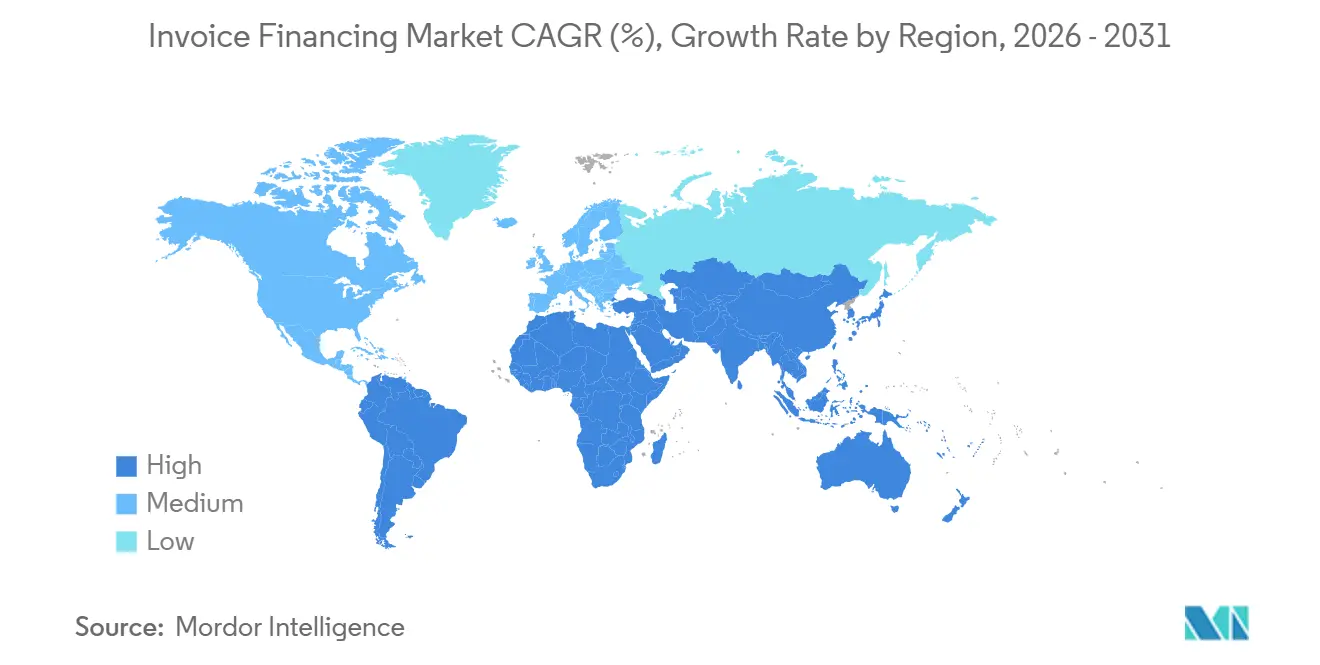
Europe captured 62.1% of the invoice financing market share in 2025, reflecting the region's established use of factoring in corporate finance. France, Germany, the United Kingdom, Italy, and Spain formed the main base of regional activity. Germany recorded EUR 423.5 billion (USD 498.2 trillion) in factoring volume during 2025, an increase of 6.2%. Germany's B2B e-invoicing requirement began in January 2025, while France began its phased rollout in September 2026. These initiatives are creating more standardized invoice information for financing providers.
The European invoice financing market also benefits from legal and regulatory changes that improve data availability and the assignment of receivables. Poland's KSeF began for large taxpayers in February 2026, adding another source of machine-readable invoice records. The EU's VAT in the Digital Age framework requires digital reporting for intra-EU B2B transactions from July 1, 2030. These changes can reduce document friction and support faster credit decisions. The Netherlands' July 2025 reform removed contractual limits on receivables assignment under Dutch-governed contracts. The EU Late Payment Directive and Basel III changes are also affecting how banks design supplier finance programs.
Asia-Pacific is projected to grow at a 5.5% CAGR through 2031, making it the fastest-growing regional area. FCI reported Asia-Pacific factoring turnover of EUR 995 billion (USD 1,170.4 billion) in 2025, or 24.6% of global volume. India grew 13.9%, while Singapore grew 15.9% as its role in trade finance developed. China's factoring volume reached EUR 713 billion (USD 838.7 billion) in 2025 after 5% growth. India's TReDS framework allows competitive multi-financier bidding on MSME invoices and has institutional support from the 2026 RBI directions. Indonesia, Vietnam, Thailand, and Malaysia remain relevant as export-oriented supply chains seek quicker receivables monetization.
North America has established a finance infrastructure and growing bank-to-fintech referral activity. Commercial credit standards tightened in the first quarter of 2026, increasing the relevance of receivables-backed alternatives. South America is supported by Brazil's FIDC structure and a 2025 judicial rule on fiduciary-assigned credits. The Middle East and Africa have substantial potential but face more uneven documentation and enforcement conditions. C2FO and IFC launched CycleFlow in Nigeria in April 2026 as the first stage of a working capital platform strategy. The platform targets USD 25-30 billion in annual MSME financing capacity when fully scaled.

Competitive Landscape
The invoice financing market combines bank-owned finance divisions, specialist independent providers, and technology-led platforms. Lloyds Bank Commercial Finance, HSBC, BNP Paribas Factor, and Barclays are important bank-affiliated providers. Bibby Financial Services, eCapital, and Close Brothers are specialist providers with a strong focus on smaller businesses. Drip Capital, C2FO, and Demica represent technology-led participants in the wider receivables and supply chain finance landscape. Each provider's competitive position depends on funding capacity, debtor assessment, operating speed, and the ability to support different transaction types. The invoice financing market remains fragmented globally because national legal structures and buyer networks vary widely.
Bank-owned providers retain advantages through their balance sheets, established corporate relationships, and broad product ranges. Independent providers compete through relationship-based underwriting and industry specialization, particularly for smaller companies. Bibby Financial Services secured a EUR 250 million (USD 284.69 million) HSBC United Kingdom facility in July 2026 to support SME receivables financing across 7 jurisdictions. The arrangement kept its total available funding above GBP 1.1 billion (USD 1.5 billion). It also connected the business with HSBC Global Trade Solutions' international specialist network. This illustrates how independent providers can use bank funding while competing for customer-facing relationships in the invoice financing market.
Technology has become a significant part of competitive strategy. J.P. Morgan Payments embedded supply chain finance in Oracle Fusion Cloud ERP in 2025, making the program available through a core enterprise system. Cleo added InvoicePay to its EDI Fulfillment Portal in 2025, combining operational and financing workflows. These moves show why enterprise system links, fraud controls, and multi-currency settlement are increasingly relevant. The December 2024 administration of Stenn Technologies, with USD 1 billion in outstanding invoice assets, also showed the risks of insufficient invoice validation and funding resilience. The invoice financing market rewards growth that is supported by sound debtor underwriting and diversified funding lines.
Invoice Financing Industry Leaders
Bibby Financial Services
Tradewind Finance
eCapital
Lloyds Bank Commercial Finance
BNP Paribas Factor
- *Disclaimer: Major Players sorted in no particular order

Recent Industry Developments
- July 2026: Bibby Financial Services secured a EUR 250 million (USD 284.69 million) facility from HSBC United Kingdom to expand SME receivables financing across 7 jurisdictions in Europe and Asia, keeping BFS's total available funding above GBP 1.1 billion (USD 1.47 billion). The arrangement gives BFS access to HSBC Global Trade Solutions' network of 150+ working capital specialists in 50 countries, reinforcing BFS's position as the United Kingdom's largest independent invoice finance provider serving 8,500+ companies.
- June 2026: The Reserve Bank of India issued the TReDS Directions 2026, Circular RBI/DPSS/2026-27/406 dated June 23, 2026, allowing credit guarantee cover from government-backed trusts for financiers on TReDS platforms and simplifying MSME onboarding. The Government of India simultaneously mandated that all Central Public Sector Enterprises route MSME invoice settlements through TReDS, substantially widening anchor-buyer participation.
- April 2026: C2FO and IFC launched CycleFlow in Nigeria, the first phase of a nationwide working capital platform strategy targeting USD 25-30 billion in annual MSME financing capacity and 480,000+ direct jobs upon full scale. The platform was supported by multiple banking partners and followed IFC's designation of C2FO as Best Supply Chain Trade Partner at the 9th Global Trade Partners Meeting.
- April 2026: Drip Capital crossed USD 9 billion in cumulative MSME cross-border trade finance transactions and facilitated USD 2 billion in FY25-26. It announced a partnership with YES BANK at GTR India 2026 to combine Drip's digital underwriting with YES BANK's MSME client distribution network.


Global Invoice Financing Market Report Scope
| Recourse Invoice Financing |
| Non-Recourse Invoice Financing |
| Domestic Invoice Financing |
| Cross-border Invoice Financing |
| Traditional Invoice Financing / Factoring |
| Reverse Factoring / Supply Chain Finance |
| Micro, Small, and Medium Enterprises |
| Large Enterprises |
| Manufacturing |
| Transportation and Logistics |
| Construction |
| Wholesale and Distribution |
| IT and Telecom |
| Healthcare |
| Other End Users |
| North America | United States |
| Canada | |
| Mexico | |
| South America | Brazil |
| Argentina | |
| Rest of South America | |
| Europe | United Kingdom |
| Germany | |
| France | |
| Italy | |
| Spain | |
| Rest of Europe | |
| Asia-Pacific | China |
| Japan | |
| India | |
| South Korea | |
| Australia | |
| Indonesia | |
| Thailand | |
| Malaysia | |
| Singapore | |
| Vietnam | |
| Rest of Asia-Pacific | |
| Middle East and Africa | Saudi Arabia |
| United Arab Emirates | |
| Turkey | |
| South Africa | |
| Egypt | |
| Rest of Middle East and Africa |
| By Facility Type | Recourse Invoice Financing | |
| Non-Recourse Invoice Financing | ||
| By Transaction Scope | Domestic Invoice Financing | |
| Cross-border Invoice Financing | ||
| By Financing Structure | Traditional Invoice Financing / Factoring | |
| Reverse Factoring / Supply Chain Finance | ||
| By Enterprise Size | Micro, Small, and Medium Enterprises | |
| Large Enterprises | ||
| By End User | Manufacturing | |
| Transportation and Logistics | ||
| Construction | ||
| Wholesale and Distribution | ||
| IT and Telecom | ||
| Healthcare | ||
| Other End Users | ||
| By Geography | North America | United States |
| Canada | ||
| Mexico | ||
| South America | Brazil | |
| Argentina | ||
| Rest of South America | ||
| Europe | United Kingdom | |
| Germany | ||
| France | ||
| Italy | ||
| Spain | ||
| Rest of Europe | ||
| Asia-Pacific | China | |
| Japan | ||
| India | ||
| South Korea | ||
| Australia | ||
| Indonesia | ||
| Thailand | ||
| Malaysia | ||
| Singapore | ||
| Vietnam | ||
| Rest of Asia-Pacific | ||
| Middle East and Africa | Saudi Arabia | |
| United Arab Emirates | ||
| Turkey | ||
| South Africa | ||
| Egypt | ||
| Rest of Middle East and Africa | ||


Key Questions Answered in the Report
What is invoice financing?
Invoice financing allows a business to obtain funding against outstanding customer invoices rather than waiting for the buyer to pay.
How large is the invoice financing market?
The invoice financing market is projected to rise from USD 3.92 trillion in 2026 to USD 4.82 trillion by 2031 at a 4.2% CAGR.
Which facility type leads receivables financing?
Non-recourse invoice financing led with 62.2% revenue share in 2025 and is projected to grow at a 5.1% CAGR through 2031.
Why is reverse factoring growing faster?
Reverse factoring uses the buyer's credit profile to finance suppliers and is projected to expand at an 8.9% CAGR through 2031.
Which region has the largest share of receivables financing?
Europe held 62.1% share in 2025, supported by established factoring systems and extensive corporate use of receivables finance.
How does TReDS support MSME financing in India?
TReDS provides a platform for financiers to bid on MSME invoices, while the 2026 RBI directions expanded credit guarantee support and public-sector participation.
Page last updated on:





