
Intravitreal (IVT) Injectables Market Size and Share
Market Overview
| Study Period | 2020 - 2031 |
|---|---|
| Market Size (2026) | USD 15.09 Billion |
| Market Size (2031) | USD 21.01 Billion |
| Growth Rate (2026 - 2031) | 6.85 % |
| Fastest Growing Market | Asia-Pacific |
| Largest Market | North America |
| Market Concentration | Medium |
Major Players *Disclaimer: Major Players sorted in no particular order Image © Mordor Intelligence. Reuse requires attribution under CC BY 4.0. | |
Intravitreal (IVT) Injectables Market Analysis by Mordor Intelligence
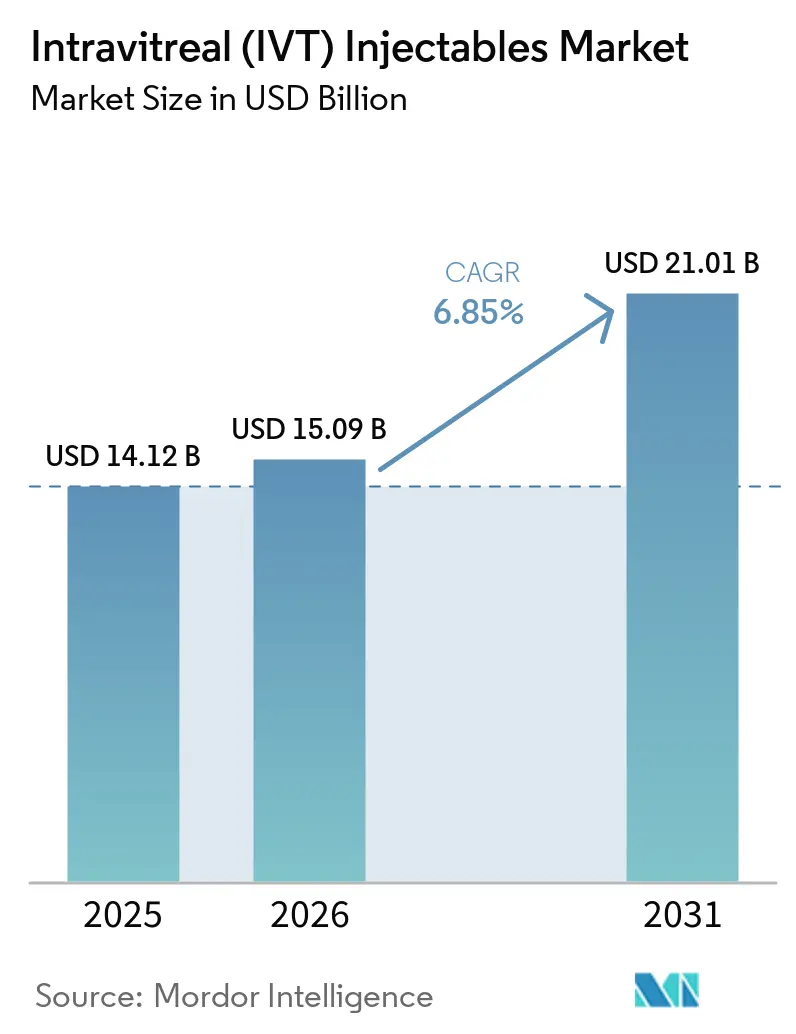
The Intravitreal (IVT) Injectables Market size is projected to be USD 14.12 billion in 2025, USD 15.09 billion in 2026, and reach USD 21.01 billion by 2031, growing at a CAGR of 6.85% from 2026 to 2031.
Population aging and a rising burden of chronic metabolic disease are expanding the number of patients who need repeated retinal treatment. Diabetes also increases the need for care for diabetic retinopathy, which supports demand for intravitreal therapies. The Intravitreal (IVT) injectables market is moving toward treatments that can maintain clinical results with fewer administration visits. Companies are responding with higher-dose products, longer dosing intervals, delivery platforms, and biosimilars. Price pressure from biosimilars may reduce branded revenue per dose, while better access could expand treatment in underserved settings.
Key Report Takeaways
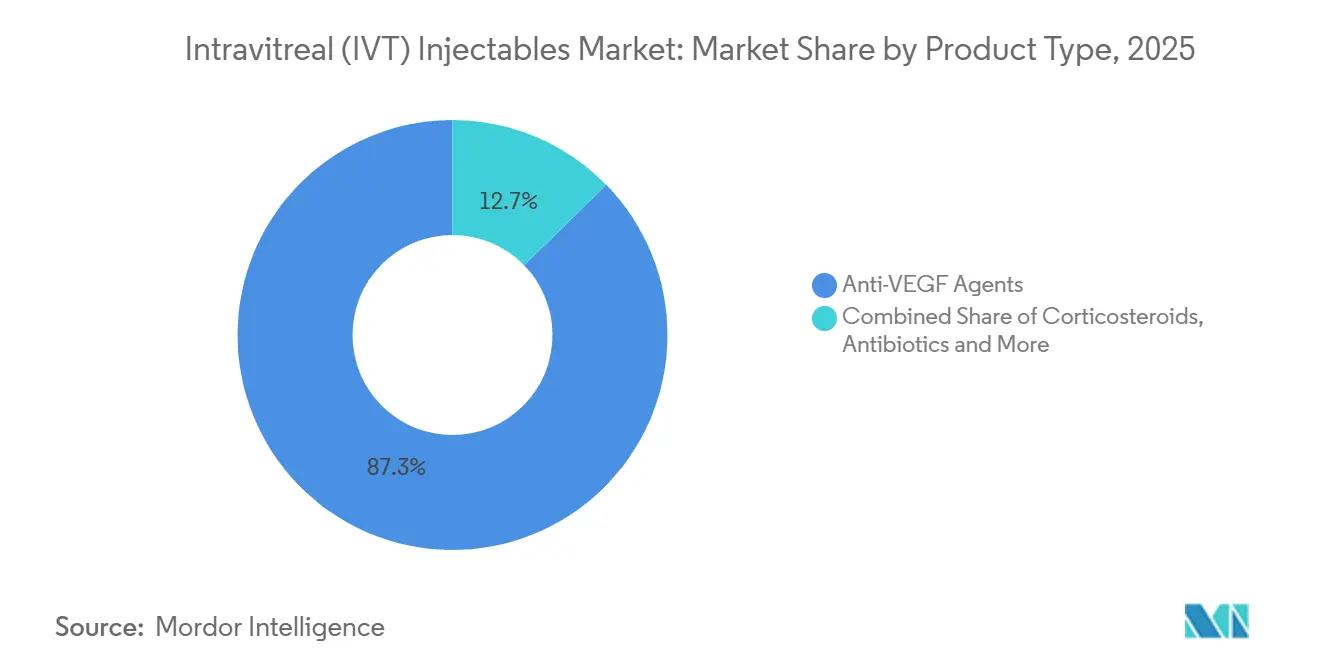
- By product type, anti-VEGF agents held 87.31% revenue share in 2025, while corticosteroids are forecast to expand at a 7.65% CAGR through 2031 in the Intravitreal (IVT) injectables market.
- By indication, age-related macular degeneration held 32.24% revenue share in 2025, while diabetic retinopathy is forecast to expand at an 8.22% CAGR through 2031 in the Intravitreal (IVT) injectables market.
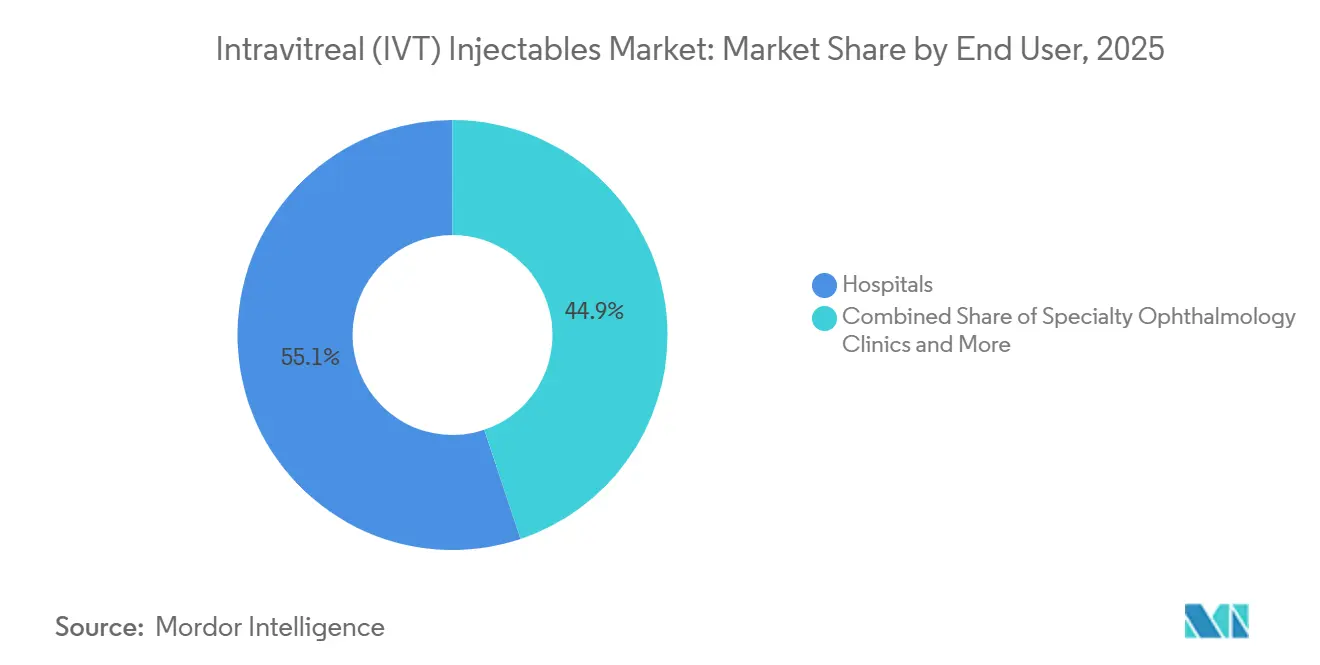
- By end user, hospitals held 55.14% revenue share in 2025, while specialty ophthalmology clinics are forecast to expand at an 8.42% CAGR through 2031 in the Intravitreal (IVT) injectables market.
- By distribution channel, hospital pharmacies held 36.54% revenue share in 2025, while online pharmacies are forecast to expand at a 9.12% CAGR through 2031 in the Intravitreal (IVT) injectables market.
- By geography, North America held 38.61% revenue share in 2025, while Asia-Pacific is forecast to expand at an 8.65% CAGR through 2031 in the Intravitreal (IVT) injectables market.
Note: Market size and forecast figures in this report are generated using Mordor Intelligence’s proprietary estimation framework, updated with the latest available data and insights as of January 2026.
Global Intravitreal (IVT) Injectables Market Trends and Insights
Drivers Impact Analysis*
| Driver | (~) % Impact on CAGR Forecast | Geographic Relevance | Impact Timeline |
|---|---|---|---|
| Rising Prevalence of Retinal Diseases and Diabetes | +1.8% | Global, with concentrated growth in APAC, MEA, and South America | Long term (≥ 4 years) |
| Aging Population and Increasing Age-Related Macular Degeneration | +1.4% | North America, Western Europe, Japan, Australia | Long term (≥ 4 years) |
| Expanding Adoption of Anti-VEGF Therapies | +1.3% | Global, with rapidly expanding adoption in APAC emerging markets | Medium term (2-4 years) |
| Growth of Biosimilar and Lower-Cost Retinal Therapies | +0.7% | North America and EU core, spill-over to APAC and South America | Medium term (2-4 years) |
| Longer-Acting Delivery Platforms Reducing Injection Burden | +0.9% | North America, EU, Japan, Australia | Short term (≤ 2 years) |
| Suprachoroidal and Gene-Therapy Delivery Enabling New Treatment Paradigms | +0.5% | North America and select EU markets, limited global reach until post-2028 | Long term (≥ 4 years) |
| Source: Mordor Intelligence | |||
Rising Prevalence of Retinal Diseases and Diabetes
The Intravitreal (IVT) injectables market is supported by a growing number of people living with diabetes and by the wider identification of retinal complications in routine diabetes care. Diabetic retinopathy affects 1 in 3 people with diabetes. The International Diabetes Federation projected the adult diabetes population to rise from 537 million in 2021 to 783 million by 2045. Growth is concentrated in low- and middle-income countries in South and Southeast Asia, where eye-care capacity is also improving. A U.S. retrospective analysis of 571,545 intravitreal injections across 238 million patient records found that diabetic eye disease represented 26.9% of treated diagnoses, and annual injection volume tripled between 2017 and 2023. Screening programs and wider use of treatment in proliferative disease bring more patients into active care.
Aging Population and Increasing Age-Related Macular Degeneration
The market also benefits from the increasing number of older patients with age-related macular degeneration, or AMD. A Global Burden of Disease analysis reported 8.06 million people with AMD-related vision impairment in 2021 and projected 21.34 million by 2050. The increase reflects demographic change more than any reduction in disease burden from current treatment patterns. The same analysis found that removing tobacco exposure could reduce projected 2050 AMD cases by 9%. Japan provides an early view of demand in aging Asian populations because it has high prevalence among people older than 70 and a developed reimbursement system. These conditions support recurring treatment demand in established retinal-care systems.
Longer-Acting Delivery Platforms Reducing Injection Burden
Longer-acting products are changing treatment patterns in the Intravitreal (IVT) injectables market by reducing the frequency of eligible follow-up injections. Regeneron received FDA approval in April 2026 for EYLEA HD dosing intervals of up to 20 weeks in wet AMD and diabetic macular edema after 1 year of demonstrated response[1]Regeneron Pharmaceuticals, Inc., “EYLEA HD Approved by FDA as First and Only Injectable Anti-VEGF with Dosing Intervals Up to 5 Months,” Regeneron. Roche received a CE mark for Contivue, its Susvimo Port Delivery Platform, in September 2025. Roche also received a positive CHMP opinion for Susvimo in July 2026 and FDA approval for diabetic retinopathy in May 2025. These options may shift more treatment activity toward specialist sites that can manage advanced administration pathways. Roche also reported sustained 2-year results for Vabysmo in polypoidal choroidal vasculopathy in August 2026.
Growth of Biosimilar and Lower-Cost Retinal Therapies
Biosimilars are reshaping the cost and access profile of the Intravitreal (IVT) injectables market, particularly in established anti-VEGF treatment pathways. Biocon received FDA approval for Yesafili in May 2024, while Celltrion received FDA approval for EYDENZELT in October 2025[2]Biocon Biologics Ltd., “Biocon Biologics Obtains U.S. FDA Approval for Biosimilar Aflibercept for Yesafili,” Biocon Biologics. Sandoz and Samsung Bioepis obtained European Commission approvals for Afqlir and Opuviz in November 2024. Lower-cost alternatives can increase affordability for treatment-eligible patients who do not receive therapy today. They also intensify pressure on originator products and hospital formularies. Regulatory decisions on substitution and formulary placement will determine which products gain broad use.
Restraints Impact Analysis*
| Restraint | (~) % Impact on CAGR Forecast | Geographic Relevance | Impact Timeline |
|---|---|---|---|
| High Treatment Cost and Reimbursement Restrictions | -1.0% | Global, most acute in emerging markets and U.S. out-of-pocket settings | Long term (≥ 4 years) |
| Injection-Related Safety Risks and Ocular Adverse Events | -0.6% | Global, disproportionately affects high-volume, low-resource settings | Medium term (2-4 years) |
| Retina-Specialist Capacity and Sterile Administration Constraints | -0.5% | North America, UK, Australia, India, and nonmetro and rural geographies globally | Long term (≥ 4 years) |
| Treatment Fatigue, Missed Doses, and Patient Dropout | -0.7% | Global, amplified in distance-sensitive and elderly populations | Medium term (2-4 years) |
| Source: Mordor Intelligence | |||
High Treatment Cost and Reimbursement Restrictions
Treatment costs limit access in the Intravitreal (IVT) injectables market, especially where coverage is incomplete or patients face substantial out-of-pocket obligations. U.S. wholesale acquisition costs in 2023 ranged from USD 50 to USD 80 per dose for off-label bevacizumab, USD 1,957.50 for aflibercept 2 mg, USD 2,190 for faricimab, and USD 2,625 for aflibercept 8 mg. The Medicare Part B deductible is USD 283 in 2026, and Original Medicare patients face 20% coinsurance. UnitedHealthcare used step-therapy requirements for VEGF inhibitors in its 2025 commercial medical benefit policy. A 2025 survey found that 85% of retina specialists were concerned about patient access during a compounded bevacizumab shortage, and 63.9% expected treatment-plan changes. Such limits can delay initiation and increase reliance on lower-cost treatments.
Treatment Fatigue, Missed Doses, and Patient Dropout
Treatment fatigue constrains the Intravitreal (IVT) injectables market because many therapies require repeated clinic visits over long treatment periods. A 2026 study of 657 patients on pro re nata anti-VEGF protocols found that 52.8% met lost-to-follow-up criteria. Among contacted patients, 56% cited a belief that they were cured, 26% cited fear of injections, 28% cited travel difficulties, and 15% cited time burden. A 2025 study also found that 28.5% of a real-world AMD cohort discontinued therapy, with poorer visual acuity predicting clinician-led discontinuation. Extended-interval regimens can reduce travel and injection anxiety for some patients. Their uptake could improve continuity of care when the clinical response remains durable.
*Our forecasts treat driver/restraint impacts as directional, not additive. The impact forecasts reflect baseline growth, mix effects, and variable interactions.
Segment Analysis
By Product Type: Anti-VEGF Agents Lead While Corticosteroids Grow Faster
Anti-VEGF agents held 87.31% of the intravitreal (IVT) injectables market share in 2025. Their position reflects broad use in AMD, diabetic macular edema, retinal vein occlusion, and diabetic retinopathy. Prescribers also have long experience with anti-VEGF injection protocols. Faricimab was the first bispecific antibody approved for the eye in the United States in January 2022. U.S. injection rates for faricimab increased more than 5-fold from 2022 to 2023, and the product surpassed ranibizumab use within its first 2 years. The pattern indicates that clinicians may change products when longer durability is established.
Corticosteroids are forecast to be the fastest-growing product type at a 7.65% CAGR through 2031. Their use is increasing in uveitis, refractory diabetic macular edema, and cases with an inadequate anti-VEGF response. Antibiotics and antivirals continue to serve smaller roles in endophthalmitis and viral retinitis. Their demand is linked to the number of intravitreal procedures rather than to the incidence of the main retinal diseases. Antifungals remain the smallest category because use is limited to immunocompromised populations. Biosimilar competition is likely to move investment toward extended-interval products and gene therapies across the Intravitreal (IVT) injectables industry.



By Indication: AMD Leads While Diabetic Retinopathy Expands
AMD held 32.24% of the revenue share in 2025. Its scale rests on clinical evidence, established payer support, and a growing older population in North America, Europe, and Japan. Many patients require ongoing anti-VEGF treatment to maintain vision. The age profile of these regions supports continued demand for retinal services across the Intravitreal (IVT) injectables market. Established care pathways also make AMD a durable source of procedure volume. AMD does not have the highest forecast growth rate among the indications.
Diabetic retinopathy is forecast to grow at an 8.22% CAGR from 2026 to 2031. Rising diabetes prevalence increases the pool of patients at risk of retinal damage. Wider use of anti-VEGF therapy in proliferative diabetic retinopathy can replace or defer panretinal photocoagulation in selected patients. Longer-interval options may also help patients who struggle with monthly or every-2-month schedules. EYLEA HD received FDA approval for macular edema following retinal vein occlusion in November 2025. Uveitis, endophthalmitis, and other retinal disorders remain smaller indications with steady treatment needs.
By End User: Hospitals Lead While Specialized Clinics Expand
Hospitals held 55.14% of the revenue share in 2025. Sterile preparation needs, specialist access, and emergency capability support their role. The American Academy of Ophthalmology identified endophthalmitis, retinal detachment, cataract development, and sustained elevated intraocular pressure as serious complications that require prompt specialist response[3]American Academy of Ophthalmology, “Intravitreal Injections, 2025 Clinical Statement,” American Academy of Ophthalmology. These requirements have historically favored hospital care in the Intravitreal (IVT) injectables market. Hospital injection centers also face pressure to manage volume and costs efficiently. This creates room for other supervised treatment settings.
Specialty ophthalmology clinics are forecast to grow at an 8.42% CAGR through 2031. These clinics can concentrate retinal expertise and improve throughput per injection chair. They may also offer shorter scheduling windows than hospital outpatient departments. A 2026 survey found that 46% of practices increased in-office procedures to address limited hospital operating-room access. Ambulatory surgical centers have a role where facility reimbursement supports operations. Mobile injection units and nursing-led services remain small but can support task-sharing where specialist availability is limited.
By Distribution Channel: Hospital Pharmacies Lead While Online Pharmacies Accelerate
Hospital pharmacies held 36.54% of the revenue share in 2025. Most intravitreal procedures require dispensing at the care site in a controlled setting. Anti-VEGF agents and corticosteroids are often physician-administered biologics covered under medical benefits. This payment structure directs much of the volume through institutional channels in the Intravitreal (IVT) injectables market. Retail pharmacies retain a role in systems that support compounded bevacizumab, biosimilar programs, or prefilled-syringe supply. They can also serve smaller satellite clinics under appropriate handling arrangements.
Online pharmacies are forecast to grow at a 9.12% CAGR from 2026 to 2031. Their activity is centered on delivery to clinics, patient-assistance fulfillment, and distribution partnerships rather than unsupervised home injections. Pre-filled syringe delivery can support facilities using extended-interval therapy. Interchangeable biosimilar classifications in the United States may allow substitution at dispensing under applicable rules. Better cold-chain logistics and biologics packaging reduce distribution barriers. These changes can redirect some incremental supply activity within the Intravitreal (IVT) injectables market.
Geography Analysis
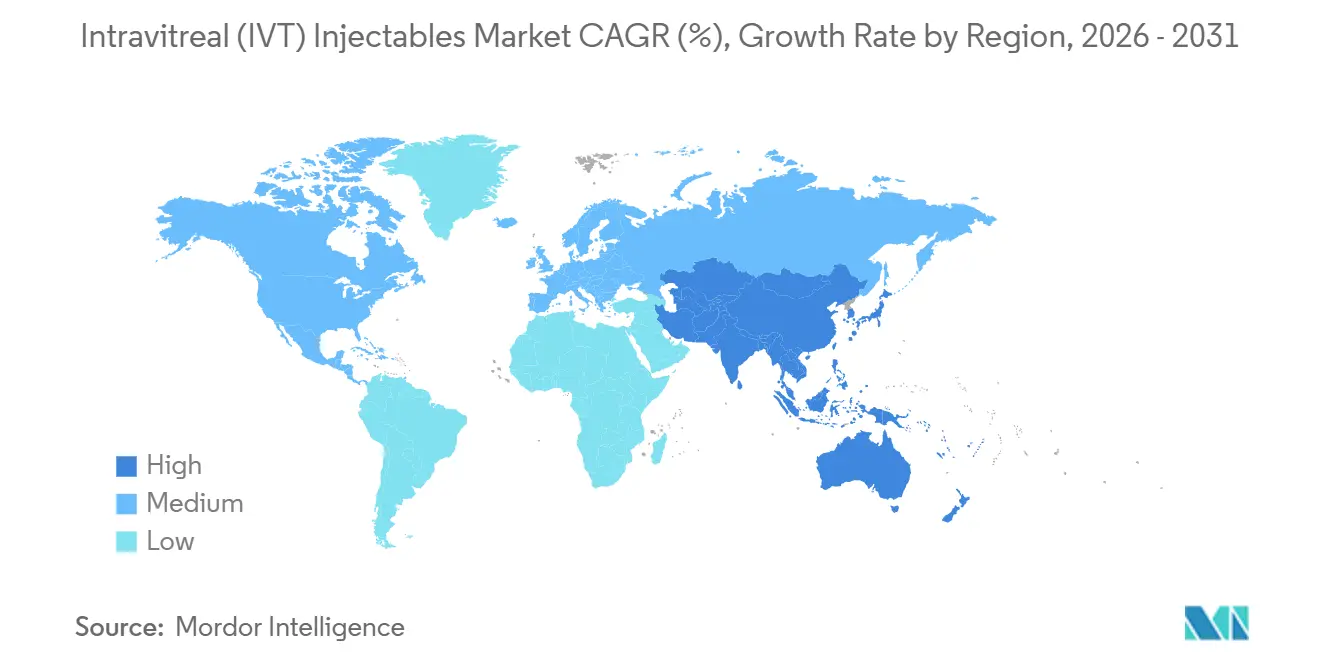
North America held 38.61% of the Intravitreal (IVT) injectables market share in 2025. The region has a high concentration of retina specialists, active clinical trials, and broad reimbursement for branded anti-VEGF therapies. Payer pressure still affects treatment choice and payment levels. Biocon confirmed the Canadian launch of Yesafili no later than July 2025. Mexico is attracting interest as private ophthalmology networks extend coverage in major cities.
Europe remains the second-largest geography in the Intravitreal (IVT) injectables market. Germany, the United Kingdom, France, Italy, and Spain have established reimbursement pathways for anti-VEGF treatment. European Commission approvals for Afqlir and Opuviz in November 2024 broadened biosimilar choice. Hospital tenders can alter product use quickly after a new biosimilar enters the formulary. The United Kingdom has used off-label bevacizumab to control costs, and approved lower-cost options may gain further use.
Asia-Pacific is forecast to expand at an 8.65% CAGR from 2026 to 2031 in the Intravitreal (IVT) injectables market. Aging populations, diabetes, and improving ophthalmology infrastructure are supporting regional demand. Santen launched the EYLEA 8 mg prefilled syringe in Japan on May 21, 2025, at JPY 146,286 (USD 970). Novartis received Japanese approval for Beovu in proliferative diabetic retinopathy in November 2025. India has substantial unmet need and an affordability gap, while regulatory pathways for ophthalmic biologics are developing. The Middle East and Africa and South America remain smaller but increasingly relevant as biosimilar pricing supports access.

Competitive Landscape
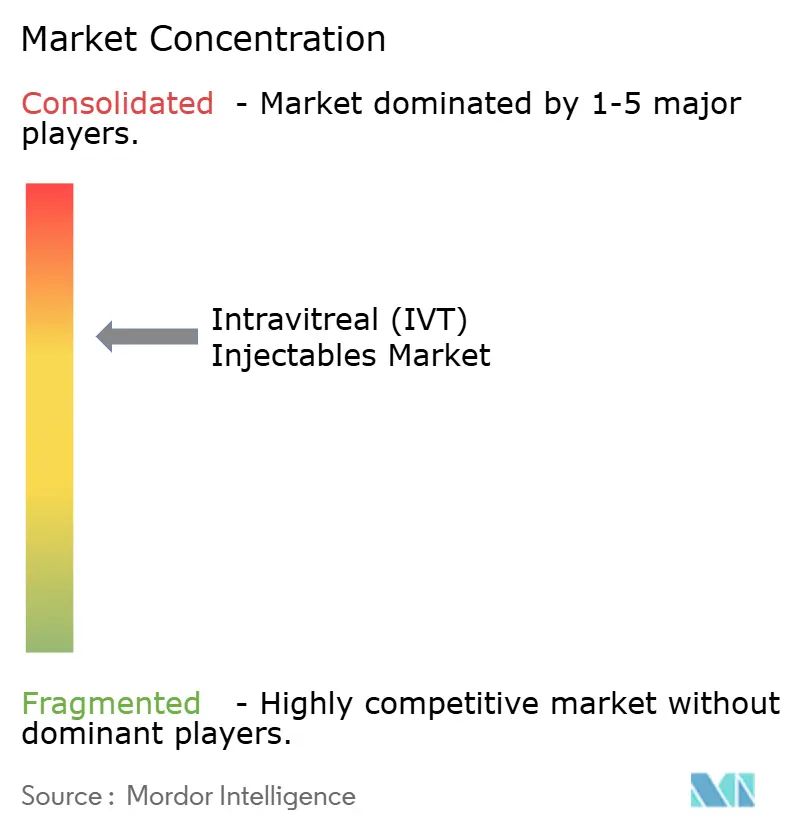
The Intravitreal (IVT) injectables market is moderately consolidated among the leading branded franchises. Regeneron Pharmaceuticals, Roche, Genentech, Novartis, and Bayer AG are the principal companies in anti-VEGF therapy. Regeneron leads the U.S. aflibercept franchise through EYLEA and EYLEA HD. Bayer commercializes aflibercept outside the United States, which gives the partnership broad geographic reach. Roche is competing through Vabysmo and the Susvimo delivery platform. The competitive focus is moving to new indications, higher doses, longer intervals, and delivery systems.
Regeneron expanded EYLEA HD with FDA approval for dosing intervals up to 20 weeks in wet AMD and diabetic macular edema in April 2026. Roche obtained a CE mark for Contivue in September 2025, advancing a continuous delivery option for neovascular AMD. Roche also reported 2-year Vabysmo data in polypoidal choroidal vasculopathy in August 2026. These actions seek to preserve product value as biosimilar competition expands in the Intravitreal (IVT) injectables market. Novartis is also extending the use of Beovu in Japan after approval for proliferative diabetic retinopathy. Product differentiation is therefore increasingly based on durability and indication breadth.
Mid-tier companies are more fragmented in the Intravitreal (IVT) injectables market. EyePoint Pharmaceuticals focuses on sustained-release microsphere technology for chronic retinal conditions. Alimera Sciences focuses on sustained-release corticosteroid implants for chronic diabetic macular edema. Gene therapy could change the recurring injection model if durable results are achieved. 4D Molecular Therapeutics reported positive 2-year Phase 2b data for 4D-150 in July 2026. Companies that develop both injection and gene-therapy platforms may be better positioned for changes after 2028.
Intravitreal (IVT) Injectables Industry Leaders
Regeneron Pharmaceuticals, Inc.
F. Hoffmann-La Roche Ltd
Bayer AG
Novartis AG
AbbVie Inc.
- *Disclaimer: Major Players sorted in no particular order

Recent Industry Developments
- August 2026: Roche announced positive 2-year data from the Phase IIIb/IV SALWEEN study of Vabysmo (faricimab) in polypoidal choroidal vasculopathy, a severe AMD subtype, at the 19th Asia-Pacific Vitreo-retina Society Congress. The study showed 74% of patients had no retinal fluid at year 2 and 61% on extended 20-week dosing intervals.
- July 2026: 4D Molecular Therapeutics announced positive 2-year Phase 2b data from the PRISM trial of 4D-150, an intravitreal gene therapy designed to deliver sustained anti-VEGF from the retina with a single injection in a broad wet AMD population. The data were presented at the ASRS Annual Meeting and support the company’s Phase 3 program.


Global Intravitreal (IVT) Injectables Market Report Scope
As per the scope of the report, intravitreal (IVT) injectables are medications administered directly into the vitreous humor, the gel-like substance inside the eye, through an injection. These injections are used to treat various retinal and vitreous conditions, such as age-related macular degeneration, diabetic retinopathy, and retinal vein occlusion, by delivering drugs like anti-VEGF agents, corticosteroids, or antibiotics directly to the retina and vitreous body.
The intravitreal (IVT) injectables market is segmented by product type into anti-VEGF agents, corticosteroids, antibiotics, antivirals, antifungals, and other product types; by indication into age-related macular degeneration, diabetic retinopathy, retinal vein occlusion, uveitis, endophthalmitis, macular edema associated with other retinal disorders, and other indications; by end user into hospitals, specialty ophthalmology clinics, ambulatory surgical centers, and other end users; by distribution channel into hospital pharmacies, retail pharmacies, online pharmacies, and other distribution channels; and by geography into North America, Europe, Asia-Pacific, the Middle East and Africa, and South America. The market report also covers the estimated market sizes and trends for 17 countries across major regions globally. For each segment, the market size and forecast are provided in terms of value (USD).
| Anti-VEGF Agents |
| Corticosteroids |
| Antibiotics |
| Antivirals |
| Antifungals |
| Other Product Types |
| Age-Related Macular Degeneration |
| Diabetic Retinopathy |
| Retinal Vein Occlusion |
| Uveitis |
| Endophthalmitis |
| Macular Edema Associated With Other Retinal Disorders |
| Other Indications |
| Hospitals |
| Specialty Ophthalmology Clinics |
| Ambulatory Surgical Centers |
| Other End Users |
| Hospital Pharmacies |
| Retail Pharmacies |
| Online Pharmacies |
| Other Distribution Channels |
| North America | United States |
| Canada | |
| Mexico | |
| Europe | Germany |
| United Kingdom | |
| France | |
| Italy | |
| Spain | |
| Rest of Europe | |
| Asia-Pacific | China |
| Japan | |
| India | |
| Australia | |
| South Korea | |
| Rest of Asia-Pacific | |
| Middle East and Africa | GCC |
| South Africa | |
| Rest of Middle East and Africa | |
| South America | Brazil |
| Argentina | |
| Rest of South America |
| By Product Type | Anti-VEGF Agents | |
| Corticosteroids | ||
| Antibiotics | ||
| Antivirals | ||
| Antifungals | ||
| Other Product Types | ||
| By Indication | Age-Related Macular Degeneration | |
| Diabetic Retinopathy | ||
| Retinal Vein Occlusion | ||
| Uveitis | ||
| Endophthalmitis | ||
| Macular Edema Associated With Other Retinal Disorders | ||
| Other Indications | ||
| By End User | Hospitals | |
| Specialty Ophthalmology Clinics | ||
| Ambulatory Surgical Centers | ||
| Other End Users | ||
| By Distribution Channel | Hospital Pharmacies | |
| Retail Pharmacies | ||
| Online Pharmacies | ||
| Other Distribution Channels | ||
| By Geography | North America | United States |
| Canada | ||
| Mexico | ||
| Europe | Germany | |
| United Kingdom | ||
| France | ||
| Italy | ||
| Spain | ||
| Rest of Europe | ||
| Asia-Pacific | China | |
| Japan | ||
| India | ||
| Australia | ||
| South Korea | ||
| Rest of Asia-Pacific | ||
| Middle East and Africa | GCC | |
| South Africa | ||
| Rest of Middle East and Africa | ||
| South America | Brazil | |
| Argentina | ||
| Rest of South America | ||


Key Questions Answered in the Report
What is driving demand for intravitreal injectables?
Aging populations, diabetes, and the related growth in AMD and diabetic retinopathy are increasing the number of patients who require retinal treatment.
How large is the intravitreal injectables market?
The intravitreal injectables market is estimated at USD 15.09 billion in 2026 and is forecast to reach USD 21.01 billion by 2031 at a 6.85% CAGR.
Which product category holds the largest revenue position?
Anti-VEGF agents held 87.31% revenue share in 2025 because they are widely used across major retinal indications.
Which indication is growing fastest?
Diabetic retinopathy is forecast to grow at an 8.22% CAGR through 2031 as diabetes prevalence and treatment access increase.
Why are longer dosing intervals important for retinal care?
Longer-interval treatments can reduce clinic visits and injection burden while supporting continuity of care for suitable patients.
Which region is growing fastest?
Asia-Pacific is forecast to grow at an 8.65% CAGR through 2031, supported by aging, diabetes, and improving ophthalmology infrastructure.
Page last updated on:





