
Interchangeable Biosimilars Market Size and Share
Market Overview
| Study Period | 2020 - 2031 |
|---|---|
| Market Size (2026) | USD 3.62 Billion |
| Market Size (2031) | USD 4.96 Billion |
| Growth Rate (2026 - 2031) | 6.50 % |
| Fastest Growing Market | Asia-Pacific |
| Largest Market | North America |
| Market Concentration | Medium |
Major Players *Disclaimer: Major Players sorted in no particular order Image © Mordor Intelligence. Reuse requires attribution under CC BY 4.0. | |
Interchangeable Biosimilars Market Analysis by Mordor Intelligence
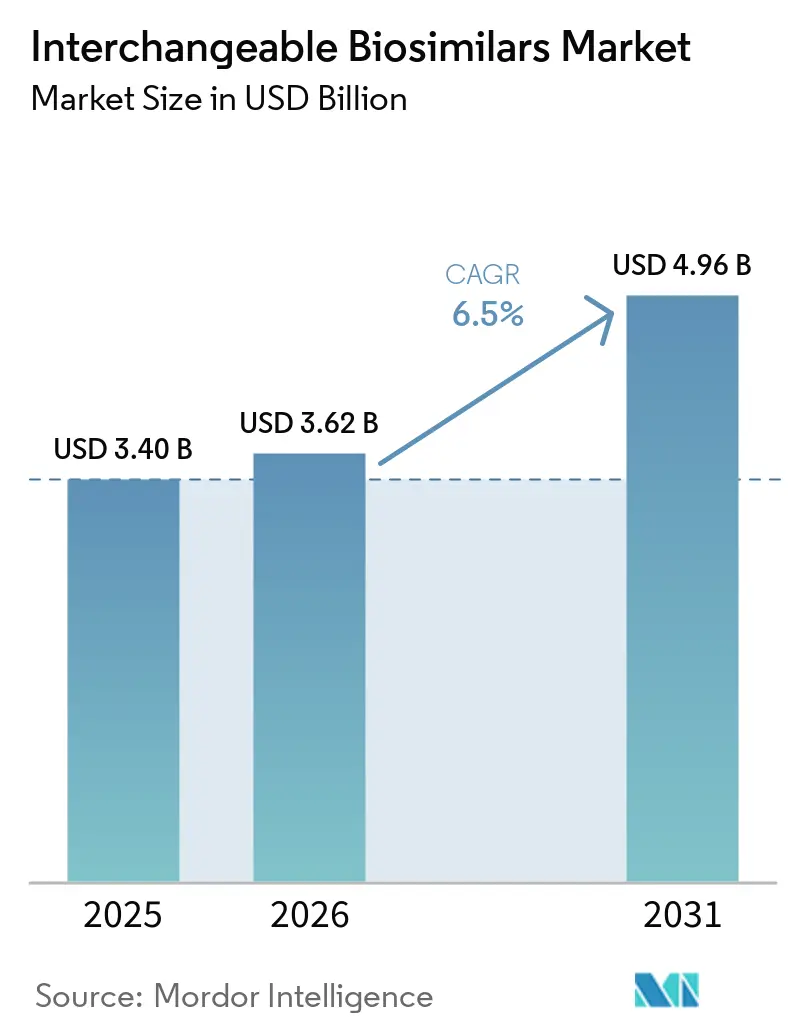
The Interchangeable Biosimilars Market size was valued at USD 3.40 billion in 2025 and is estimated to grow from USD 3.62 billion in 2026 to reach USD 4.96 billion by 2031, at a CAGR of 6.5% during the forecast period (2026-2031).
The interchangeable biosimilars market in the United States has moved beyond its early regulatory stage. A distinct FDA interchangeability pathway supports pharmacy substitution, while payer formularies and pharmacy benefit managers make product selection more systematic for medicines with established biosimilar alternatives. The FDA’s streamlined approach allows manufacturers to pursue biosimilarity and interchangeability within the same development plan, potentially accelerating formulary consideration. However, Medicare price negotiations may narrow the savings gap between reference biologics and competing biosimilars, creating uneven market incentives. Companies with robust regulatory, manufacturing, contracting, and distribution capabilities are better positioned to convert approvals into sustained market adoption.
Key Report Takeaways
- By product type, interchangeable monoclonal antibodies led with 47.45% of revenue in 2025, while interchangeable insulins are projected to record the highest CAGR of 7.45% through 2031.
- By therapeutic area, autoimmune and inflammatory diseases held 39.76% of revenue in 2025, while oncology and hematology are projected to grow at a CAGR of 7.98% through 2031.
- By distribution channel, specialty pharmacies accounted for 45.88% of revenue in 2025, while online pharmacies are expected to expand at a CAGR of 8.56% through 2031.
- By end user, hospitals and clinics held 54.66% of revenue in 2025, while ambulatory infusion centers are projected to grow at a CAGR of 9.22% through 2031.
- By geography, North America accounted for 40.35% of revenue in 2025, while Asia-Pacific is projected to advance at a CAGR of 8.76% through 2031.
Note: Market size and forecast figures in this report are generated using Mordor Intelligence’s proprietary estimation framework, updated with the latest available data and insights as of January 2026.
Global Interchangeable Biosimilars Market Trends and Insights
Drivers Impact Analysis*
| DRIVER | (~) % IMPACT ON CAGR FORECAST | GEOGRAPHIC RELEVANCE | IMPACT TIMELINE |
|---|---|---|---|
| High-value biologic patent expiries | +1.8% | Global, with concentrated gains in North America and Europe | Medium term (2-4 years) |
| Pharmacy-level substitution potential | +1.3% | North America primary, Europe member-state dependent | Short term (≤ 2 years) |
| Payer pressure to reduce biologic treatment costs | +1.1% | North America and EU | Short term (≤ 2 years) |
| Expansion of interchangeable designations across major molecules | +0.9% | North America, with spillover to APAC regulatory convergence | Medium term (2-4 years) |
| Formulary automation and specialty pharmacy dispensing data | +0.5% | North America core, with emerging EU centralized procurement interest | Short term (≤ 2 years) |
| Demand capture in underserved treatment channels | +0.4% | Asia-Pacific, Middle East and Africa, and South America | Long term (≥ 4 years) |
| Source: Mordor Intelligence | |||
Patent Expiry of High-Value Biologics
A study published in 2026 identified a USD 234 billion opportunity associated with 118 biologics expected to lose U.S. exclusivity through 2034. As of mid-2024, only 12 biosimilars for these molecules were in development, indicating less crowded opportunities for developers that can fund complex programs.[1]Lisa E. Hines et al., “Regulatory Requirements for Interchangeable Biosimilar Designation,” Therapeutic Innovation & Regulatory Science The 2026-2029 period includes major oncology patent expiries, increasing development interest in large biologic therapies. Formycon reported positive clinical data for FYB206, its pembrolizumab biosimilar candidate, in 2025. Alvotech’s 2026 vedolizumab filings indicate that developers are pursuing interchangeability from the outset, increasing competition for formulary access as reference biologics lose protection.
Pharmacy-Level Substitution Potential
Pharmacy-level substitution provides the interchangeable biosimilars market with a practical advantage in dispensing settings where state laws permit substitution. A 2025 JAMA Health Forum study found that insulin glargine biosimilar dispensing increased by more than 47,000 prescriptions after Semglee received an interchangeable designation in November 2021. The increase occurred across retail, mail, and long-term care channels, demonstrating the designation’s impact across dispensing pathways.[2]Formycon AG, “Formycon Announces Positive Clinical Data for Keytruda Biosimilar Candidate FYB206,” EQS News California considered SB 1094 in 2026 to permit substitution of non-interchangeable biosimilars, while Tennessee enacted 2025 legislation allowing health carriers to require biosimilar use without an interchangeable designation. Commercial adoption continues to depend on payer policies and pharmacy operations.
Payer Pressure to Reduce Biologic Treatment Costs
Payer formulary decisions drive demand for interchangeable biosimilars by influencing product preferences across large patient populations. CVS Health reported USD 3.3 billion in gross savings for commercial clients from biosimilar adoption between April 2024 and December 2025, following the removal of Humira from commercial formularies in April 2024. In May 2026, CVS Caremark announced that its common commercial template formularies would prefer interchangeable ustekinumab biosimilars over Stelara from July 1, 2026, with eligible members paying USD 0 out of pocket. The Inflation Reduction Act increased Part B biosimilar reimbursement to the average sales price plus 8% of the reference product’s average sales price, compared with the previous 6% differential, supporting buy-and-bill dispensing economics.
Expansion of Interchangeable Designations Across Major Molecules
FDA guidance released in June 2024 reduced the emphasis on clinical switching studies and placed greater weight on analytical and pharmacokinetic evidence. This approach reduces development duplication when sponsors already have evidence supporting biosimilarity. In October 2025, the FDA’s draft guidance proposed that comparative efficacy studies would not be a default requirement, potentially reducing development costs and timelines. Hines and colleagues found that the average interval from biologics license application submission to interchangeability approval declined from 798 days for 2020 applications to 364 days for 2024 applications. Earlier designation supports timely formulary discussions and reduces the disadvantage of pursuing interchangeability after biosimilar approval.
Restraints Impact Analysis*
| RESTRAINT | (~) % IMPACT ON CAGR FORECAST | GEOGRAPHIC RELEVANCE | IMPACT TIMELINE |
|---|---|---|---|
| Variation in automatic substitution laws | -0.5% | United States, with state differences in notification, recordkeeping, and cost-equivalence requirements | Short term (≤ 2 years) |
| Reimbursement and channel-contracting complexity | -0.4% | North America and the EU | Medium term (2-4 years) |
| Interchangeability confusion among prescribers and patients | -0.3% | Global | Short term (≤ 2 years) |
| Limited manufacturing flexibility for complex cold-chain and device operations | -0.2% | Global, with an acute impact in the Middle East, Africa, and South America | Long term (≥ 4 years) |
| Source: Mordor Intelligence | |||
State-Level Variation in Automatic Substitution Laws
State-level variation limits the operational simplicity that interchangeability is intended to provide. A 2025 analysis reported that 90% of states imposed stricter requirements for interchangeable biologics than for generic drugs, including prescriber notification, record retention, and, in some cases, written consent. These requirements increase pharmacy workloads, particularly when systems do not readily connect with prescriber networks. A JAMA Health Forum study reported lower substitution rates in states with more restrictive notification requirements. This finding indicates that an FDA designation alone does not ensure consistent dispensing practices across states.[3]CVS Health, “CVS Caremark Expands Biosimilar Adoption Through Formulary Updates to Improve Affordability and Access,” CVS Health The FDA applies interchangeability between a biosimilar and its named reference product, rather than among biosimilars for the same molecule, which can complicate formulary changes when multiple options are available.
Reimbursement and Channel-Contracting Complexity
Reimbursement policies, PBM rebates, and formulary contracting schedules create conflicting incentives for stakeholders in the interchangeable biosimilars market. Medicare’s negotiated price for Stelara took effect in January 2026, narrowing the price differential available to ustekinumab biosimilars. The Inflation Reduction Act establishes a formal process for negotiating prices for selected Medicare drugs, adding considerations for manufacturers and health plans. Hospital-administered products operate under buy-and-bill arrangements that differ from retail pharmacy dispensing. Hospitals and infusion centers may need to negotiate purchasing agreements with individual suppliers. Specialty pharmacies can implement formulary changes more quickly for self-administered products, while hospital outpatient departments face more complex purchasing and reimbursement processes. Smaller and later entrants may therefore face a longer path to broad market access.
*Our forecasts treat driver/restraint impacts as directional, not additive. The impact forecasts reflect baseline growth, mix effects, and variable interactions.
Segment Analysis
By Product Type: Monoclonal Antibodies Lead While Insulins Gain Dispensing Momentum
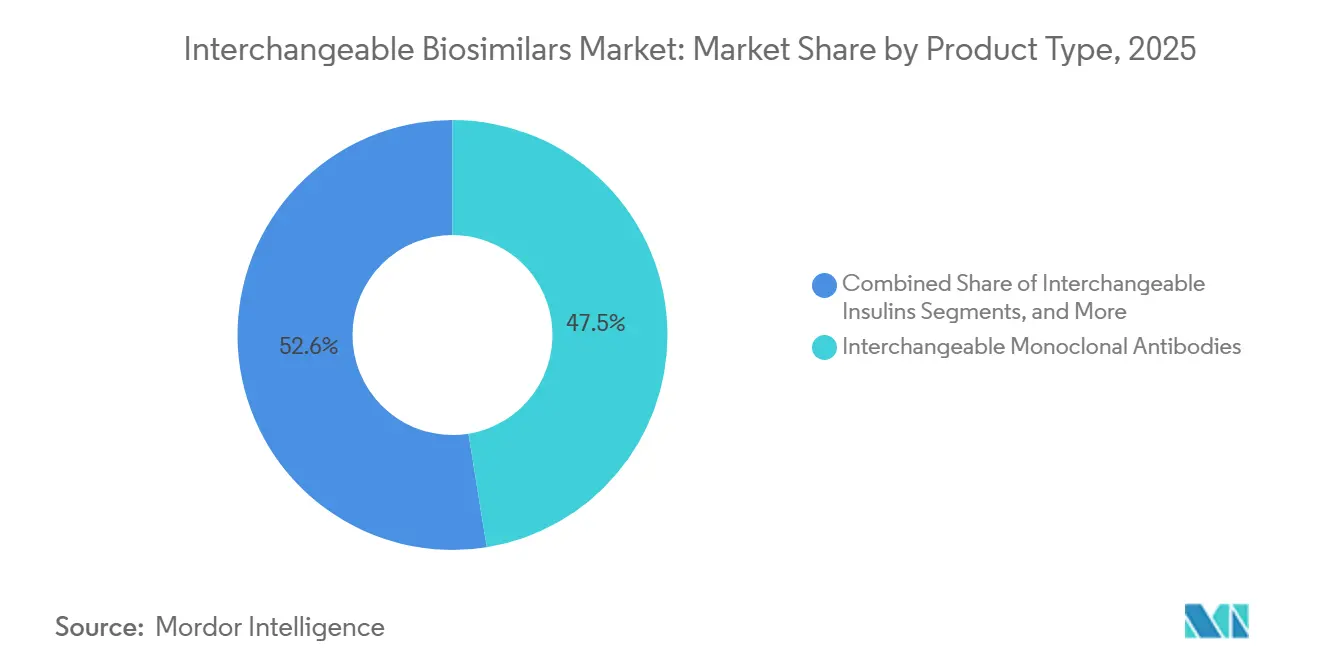
Interchangeable monoclonal antibodies accounted for 47.45% of revenue in 2025, representing the largest interchangeable biosimilars market share by product type. Their position reflected the commercial importance of adalimumab and ustekinumab, where manufacturers competed for payer coverage and pharmacy access. Denosumab also emerged as a competitive product category, shifting focus toward supply reliability and payer contracting.
Interchangeable insulins are forecast to grow at a CAGR of 7.45% through 2031, the highest among product types. Established retail and mail-order prescription workflows make interchangeability more practical for insulin dispensing. Increased insulin glargine dispensing following Semglee's designation supported this trend. Growth factors, fusion proteins, and recombinant proteins remain smaller segments due to cold-chain and device requirements.



By Therapeutic Area: Autoimmune Disease Remains Largest While Oncology Builds a Pipeline
Autoimmune and inflammatory diseases accounted for 39.76% of revenue in 2025, retaining the largest therapeutic-area share. Rheumatoid arthritis, psoriatic arthritis, and inflammatory bowel disease have large treated populations and established biologic prescribing patterns. Adalimumab biosimilars achieved meaningful formulary placement across major payer networks, while step-therapy protocols supported recurring demand.
Oncology and hematology are projected to expand at a CAGR of 7.98% through 2031, making it the fastest-growing therapeutic area. Samsung Bioepis reported that bevacizumab, rituximab, and trastuzumab biosimilars reached average market shares of 52% to 81% five years after launch. Growth is driven by pipeline development, as these molecules have biosimilar competition but no interchangeable entry. Diabetes and ophthalmic care also contribute through insulin glargine, ranibizumab, and aflibercept alternatives.
By Distribution Channel: Specialty Pharmacy Leads and Online Pharmacy Expands
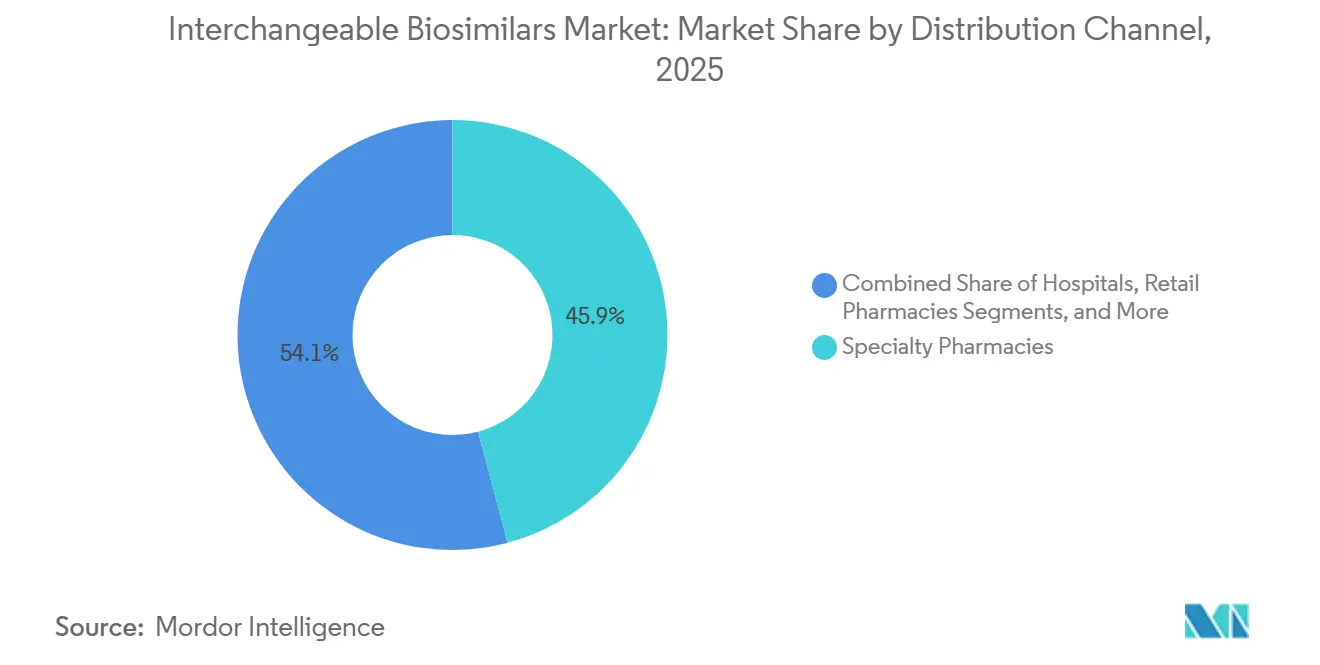
Specialty pharmacies accounted for 45.88% of revenue in 2025, representing the largest distribution-channel share. They provide therapy management, prior authorization support, clinical coordination, and temperature-controlled delivery. These capabilities support patient transitions from reference biologics to interchangeable products. Specialty pharmacies also manage outreach during formulary transitions.
Online pharmacies are forecast to grow at a CAGR of 8.56% through 2031, the fastest rate among distribution channels. Mail-order dispensing continues to gain acceptance for chronic therapies, supporting channel growth. Increased mail-order insulin glargine dispensing after its interchangeability designation demonstrated the response of digital channels to interchangeability signals. Performance depends on prior authorization, notification requirements, and formulary management.
By End User: Hospitals and Clinics Lead While Ambulatory Infusion Centers Grow
Hospitals and clinics accounted for 54.66% of revenue in 2025, representing the largest interchangeable biosimilars market size among end-user settings. Pharmacy and therapeutics committees select preferred products for infused treatments in these institutions. Autoimmune and oncology therapies are commonly administered in these settings. Purchasing agreements, reimbursement policies, and clinical protocols shape product utilization.
Ambulatory infusion centers are projected to grow at a CAGR of 9.22% through 2031, the fastest rate among end users. Payers are shifting clinically stable infusion patients from hospital outpatient departments to freestanding facilities. Specialty oncology and rheumatology centers are gaining relevance as biosimilar economics support supplier agreements. Medicare price changes affecting Part B infusion drugs in 2026 add uncertainty to hospital buy-and-bill decisions.
Geography Analysis
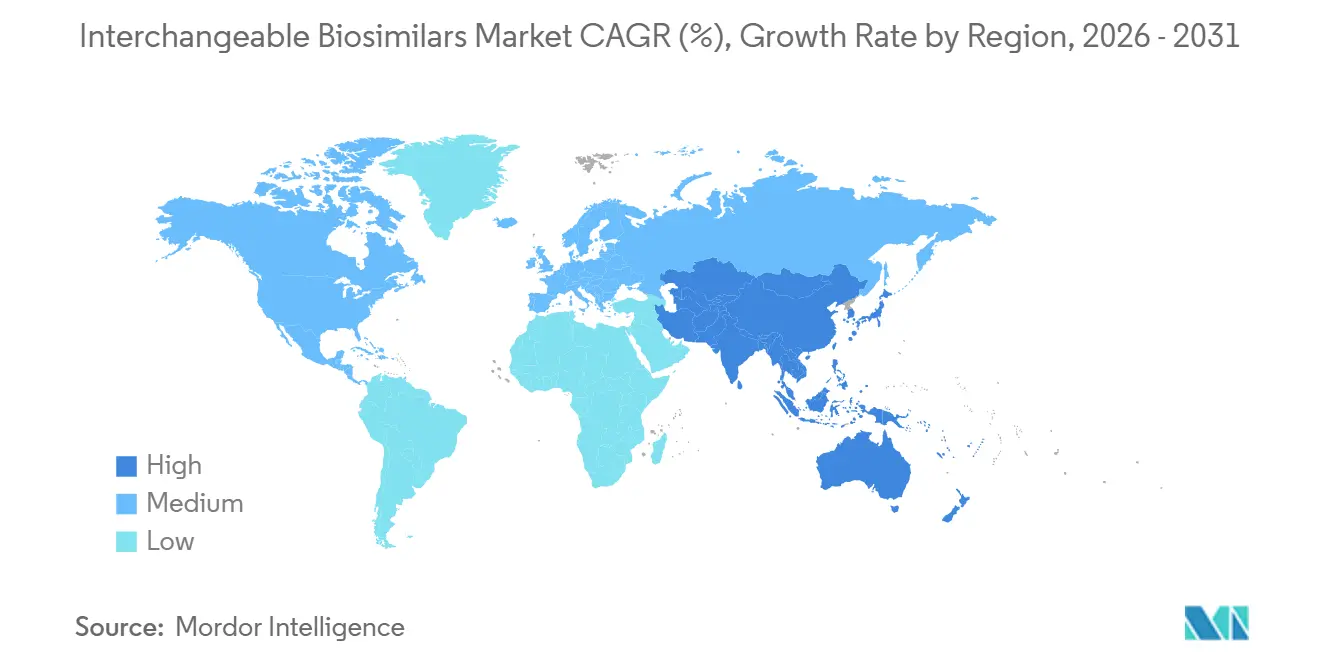
North America held 40.35% of revenue in 2025, representing the largest regional share of the interchangeable biosimilars market. The United States has a distinct FDA pathway and a payer and PBM structure that enables large-scale formulary changes. CVS Caremark transitioned to preferred interchangeable ustekinumab biosimilars in July 2026, while CVS Health reported USD 3.3 billion in gross client savings from biosimilar adoption between April 2024 and December 2025. Canada follows provincial formulary processes, while Mexico remains more dependent on reference products in public procurement.
Asia-Pacific is forecast to grow at a CAGR of 8.76% through 2031, the fastest rate among regions. In September 2025, Japan’s PMDA removed mandatory clinical study requirements specific to Japanese subjects, aligning more closely with international practices. Japan had 47 approved biosimilar products as of March 2026, although physicians continued to direct substitution decisions. China has not established a formal interchangeability framework, while India revised its Similar Biologics guidelines in May 2025 to strengthen analytical tools and align with major regulatory practices.
Europe operates under a different framework, as member states determine many substitution and prescribing policies. Denmark, the Netherlands, and France have adopted more active biosimilar-first approaches than several southern and eastern European markets. The Middle East and Africa and South America remain smaller contributors to the interchangeable biosimilars market due to reimbursement gaps, cold-chain infrastructure limitations, and constrained regulatory capacity. Regional progress depends on practical implementation as well as approval standards.

Competitive Landscape
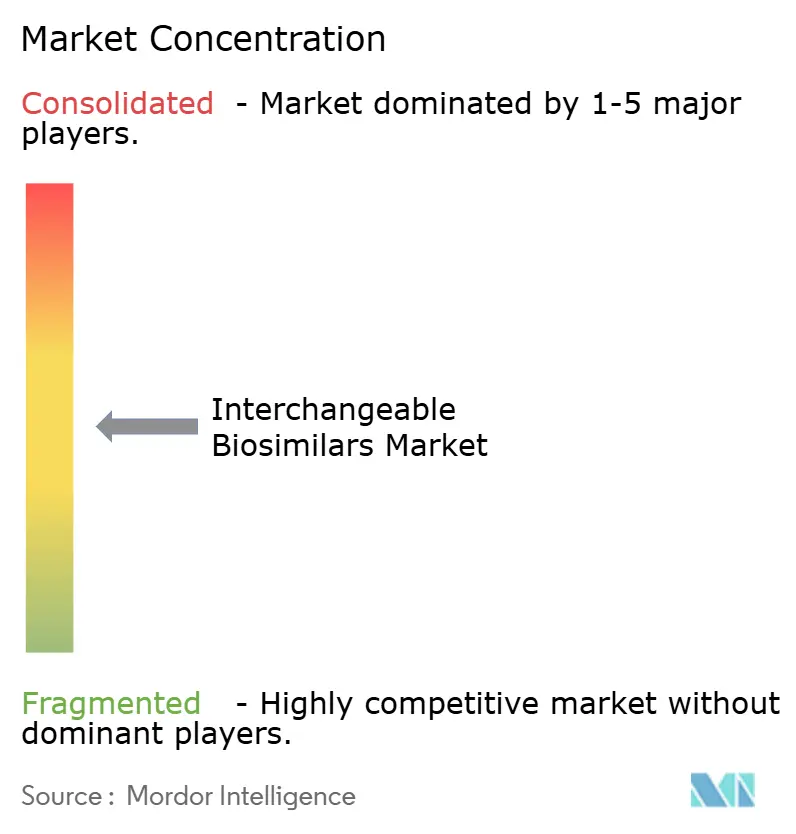
The interchangeable biosimilars market is moderately concentrated among companies with regulatory, manufacturing, and large-scale commercialization capabilities. As of June 2026, the supplied data reports 22 interchangeable product entries for Celltrion, 17 for Samsung Bioepis, 16 for Sandoz, 14 for Amgen, and 14 for Biocon Biologics. These five companies accounted for 83 of 127 entries, while competition intensifies as multiple suppliers target the same reference medicine.
Samsung Bioepis and Sandoz signed a global licensing, development, and commercialization agreement in March 2026 for up to five biosimilar candidates, including SB36, a vedolizumab candidate from Samsung Bioepis. The agreement aligns development, regulatory planning, and commercialization activities before approval. Alvotech has filed applications for intravenous and subcutaneous vedolizumab formats; AVT16 was accepted in June 2026, while AVT80 is accepted in August 2026. This approach addresses hospital infusion and home self-injection use.
Bevacizumab, rituximab, trastuzumab, infliximab, and pegfilgrastim have approved biosimilars but no interchangeable products in the supplied data. These molecules offer opportunities for additional applications under the evolving FDA approach. Denosumab highlights the rapid crowding of a single molecule, increasing the importance of payer contracts, manufacturing costs, and execution. Indian and South Korean developers, including Zydus, Dr. Reddy’s, and Biocon, leverage domestic manufacturing scale while meeting FDA standards, supported by India’s 2025 guideline update.
Interchangeable Biosimilars Industry Leaders
Amgen Inc.
Celltrion, Inc.
Pfizer Inc.
Biocon Biologics Limited
Sandoz Group AG
- *Disclaimer: Major Players sorted in no particular order

Recent Industry Developments
- August 2026: Alvotech received FDA acceptance for AVT80, an interchangeable vedolizumab biosimilar in subcutaneous prefilled syringe and autoinjector formats, complementing its AVT16 IV program.
- June 2026: Alvotech received FDA acceptance for AVT16, an interchangeable vedolizumab biosimilar in lyophilized vial format for IV administration; Teva served as its U.S. commercialization partner.
- May 2026: CVS Health shifted its commercial template formularies from branded Stelara to preferred interchangeable ustekinumab biosimilars Pyzchiva and Yesintek, effective July 1, 2026.
- March 2026: Samsung Bioepis and Sandoz signed a global agreement to license, develop, and commercialize up to five biosimilar candidates, including SB36.


Global Interchangeable Biosimilars Market Report Scope
As per the scope of the report, an interchangeable biosimilar is a biologic medical product that may be substituted for an original reference product by a pharmacist without consulting the prescribing doctor, subject to regional laws.
The interchangeable biosimilars market is segmented by product type, therapeutic area, distribution channel, end user, and geography. By product type, the market includes interchangeable monoclonal antibodies, interchangeable insulins, interchangeable growth factors, interchangeable fusion proteins, interchangeable recombinant proteins, and other interchangeable biological products. By therapeutic area, the market is segmented into autoimmune and inflammatory diseases, oncology and hematology, diabetes, ophthalmic diseases, and others. By distribution channel, the market is categorized into specialty pharmacies, retail pharmacies, hospital pharmacies, online pharmacies, and others. By end user, the market is segmented into hospitals and clinics, ambulatory infusion centers, specialty treatment centers, and others. By geography, the market is analyzed across North America, Europe, Asia-Pacific, the Middle East and Africa, and South America. The report also covers the estimated market sizes and trends for 17 countries across major regions globally. The report offers market sizes and forecasts in terms of value (USD) for the above segments.
| Interchangeable Monoclonal Antibodies |
| Interchangeable Insulins |
| Interchangeable Growth Factors |
| Interchangeable Fusion Proteins |
| Interchangeable Recombinant Proteins |
| Other Interchangeable Biological Products |
| Autoimmune and Inflammatory Diseases |
| Oncology and Hematology |
| Diabetes |
| Ophthalmic Diseases |
| Others |
| Specialty Pharmacies |
| Retail Pharmacies |
| Hospital Pharmacies |
| Online Pharmacies |
| Others |
| Hospitals and Clinics |
| Ambulatory Infusion Centers |
| Specialty Treatment Centers |
| Others |
| North America | United States |
| Canada | |
| Mexico | |
| Europe | Germany |
| United Kingdom | |
| France | |
| Italy | |
| Spain | |
| Rest of Europe | |
| Asia-Pacific | China |
| India | |
| Japan | |
| Australia | |
| South Korea | |
| Rest of Asia-Pacific | |
| Middle East and Africa | GCC |
| South Africa | |
| Rest of Middle East and Africa | |
| South America | Brazil |
| Argentina | |
| Rest of South America |
| By Product Type | Interchangeable Monoclonal Antibodies | |
| Interchangeable Insulins | ||
| Interchangeable Growth Factors | ||
| Interchangeable Fusion Proteins | ||
| Interchangeable Recombinant Proteins | ||
| Other Interchangeable Biological Products | ||
| By Therapeutic Area | Autoimmune and Inflammatory Diseases | |
| Oncology and Hematology | ||
| Diabetes | ||
| Ophthalmic Diseases | ||
| Others | ||
| By Distribution Channel | Specialty Pharmacies | |
| Retail Pharmacies | ||
| Hospital Pharmacies | ||
| Online Pharmacies | ||
| Others | ||
| By End User | Hospitals and Clinics | |
| Ambulatory Infusion Centers | ||
| Specialty Treatment Centers | ||
| Others | ||
| By Geography | North America | United States |
| Canada | ||
| Mexico | ||
| Europe | Germany | |
| United Kingdom | ||
| France | ||
| Italy | ||
| Spain | ||
| Rest of Europe | ||
| Asia-Pacific | China | |
| India | ||
| Japan | ||
| Australia | ||
| South Korea | ||
| Rest of Asia-Pacific | ||
| Middle East and Africa | GCC | |
| South Africa | ||
| Rest of Middle East and Africa | ||
| South America | Brazil | |
| Argentina | ||
| Rest of South America | ||


Key Questions Answered in the Report
What is driving demand for interchangeable biosimilars?
FDA pathway changes, pharmacy substitution, payer formulary actions, and biologic patent expiries support adoption. These forces matter most when a product can be supplied reliably and added to a payer's preferred treatment pathway.
How large is the interchangeable biosimilars market in 2026?
The interchangeable biosimilars market size is USD 3.62 billion in 2026 and is forecast to reach USD 4.96 billion by 2031. The forecast reflects a 6.50% CAGR during 2026-2031.
Which product type leads to interchangeable biosimilars?
Interchangeable monoclonal antibodies led product types with 47.45% of revenue in 2025. Adalimumab and ustekinumab support this position because they have mature prescribing pathways and several approved alternatives.
Which therapeutic area is growing fastest?
Oncology and hematology is forecast to grow at a CAGR of 7.98% through 2031. Future growth depends on candidates moving from development into approved interchangeable options for major cancer biologics.
Why are specialty pharmacies important for biosimilar uptake?
They manage prior authorization, patient outreach, clinical coordination, and cold-chain delivery during treatment transitions. These tasks can reduce disruption when a payer moves patients to a preferred alternative.
Which region is expected to grow fastest through 2031?
Asia-Pacific is forecast to expand at a CAGR of 8.76% through 2031. Regulatory changes in Japan and India can support development activity, although substitution practices remain different across the region.
Page last updated on:





