
Intent Management Platforms For The Telecom Market Size and Share
Market Overview
| Study Period | 2020 - 2031 |
|---|---|
| Market Size (2026) | USD 489.66 Million |
| Market Size (2031) | USD 951.32 Million |
| Growth Rate (2026 - 2031) | 14.21 % |
| Fastest Growing Market | Asia-Pacific |
| Largest Market | North America |
| Market Concentration | Medium |
Major Players *Disclaimer: Major Players sorted in no particular order Image © Mordor Intelligence. Reuse requires attribution under CC BY 4.0. | |
Intent Management Platforms For The Telecom Market Analysis by Mordor Intelligence
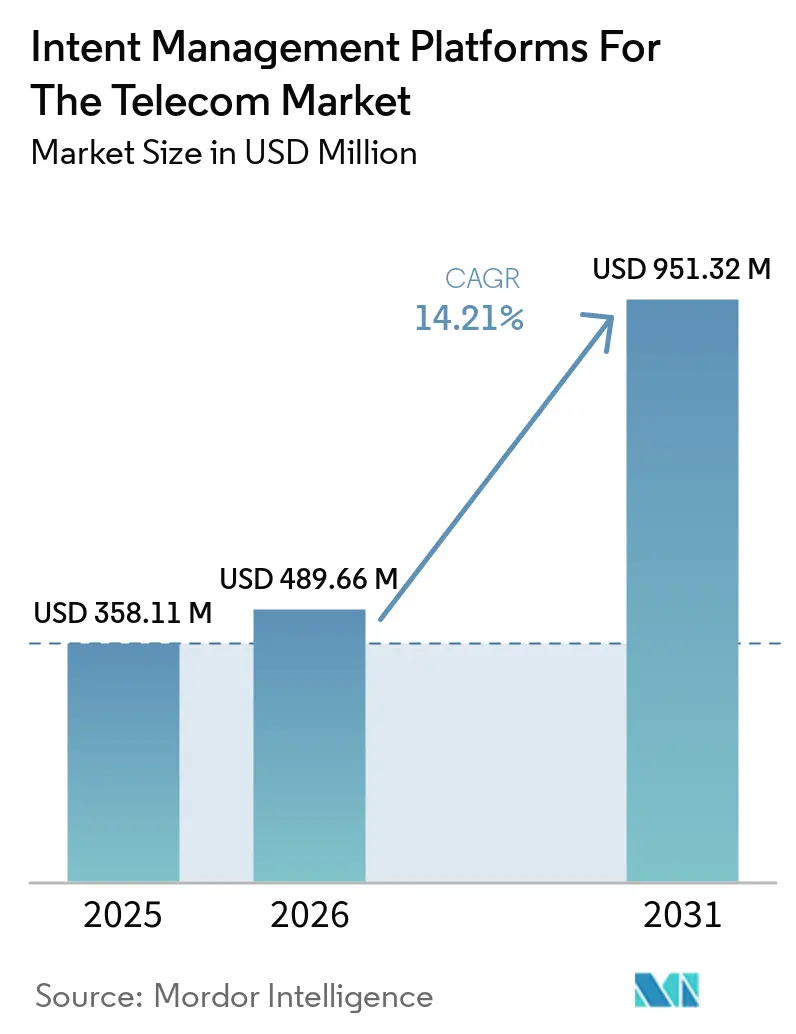
The intent management platforms for the telecom market size is expected to increase from USD 358.11 million in 2025 to USD 489.66 million in 2026 and reach USD 951.32 million by 2031, expanding at a CAGR of 14.21% over 2026-2031. The intent management platforms for the telecom market are being shaped by operators that need to control 5G standalone networks across radio, transport, and core domains. Network slicing has made manual configuration less practical because each service requires defined latency, throughput, isolation, and priority levels. Automation programs also link network performance to operating costs, energy use, and service quality, thereby increasing the value of reliable policy execution. Cloud-native deployments and multi-vendor networks broaden the addressable opportunity, but they also make integration, data consistency, and auditability more important in purchasing decisions.
Key Report Takeaways
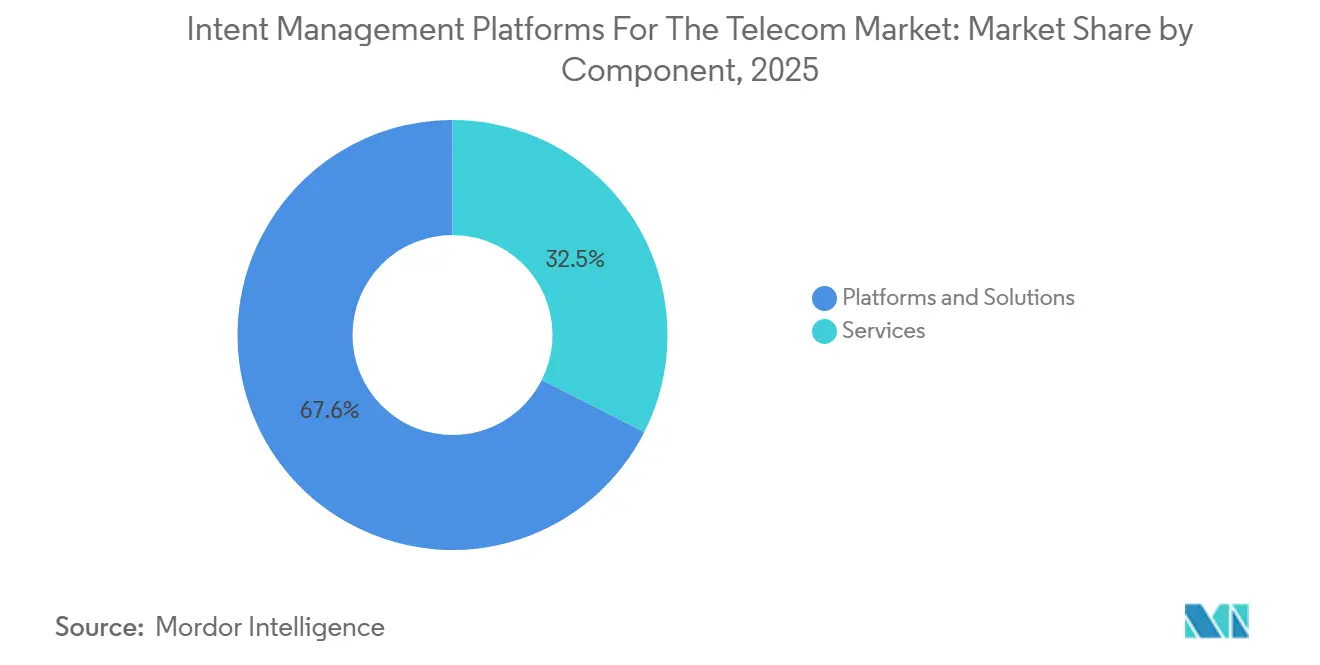
- By component, Platforms and Solutions held 67.55% of the intent management platforms for the telecom market share in 2025, while Services is projected to expand at a 15.76% CAGR through 2031.
- By deployment model, Cloud held 57.88% of the intent management platforms for the telecom market share in 2025, while Hybrid is expected to expand at a 16.41% CAGR through 2031.
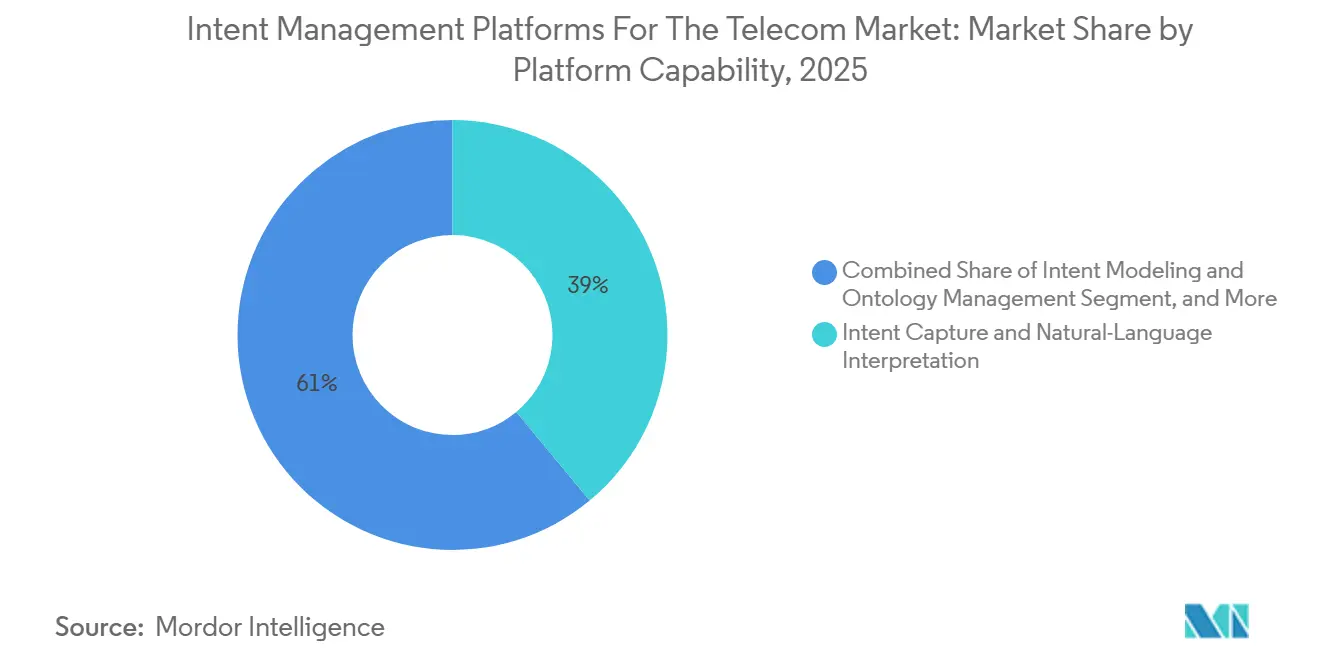
- By platform capability, Intent Capture and Natural-Language Interpretation accounted for 38.99% of revenue in 2025, while Policy Translation and Configuration Generation is projected to advance at a 14.98% CAGR through 2031.
- By enterprise size, Large Telecom Operators accounted for 40.32% of revenue in 2025, while Private Network and Neutral-Host Operators are expected to expand at a 15.88% CAGR through 2031.
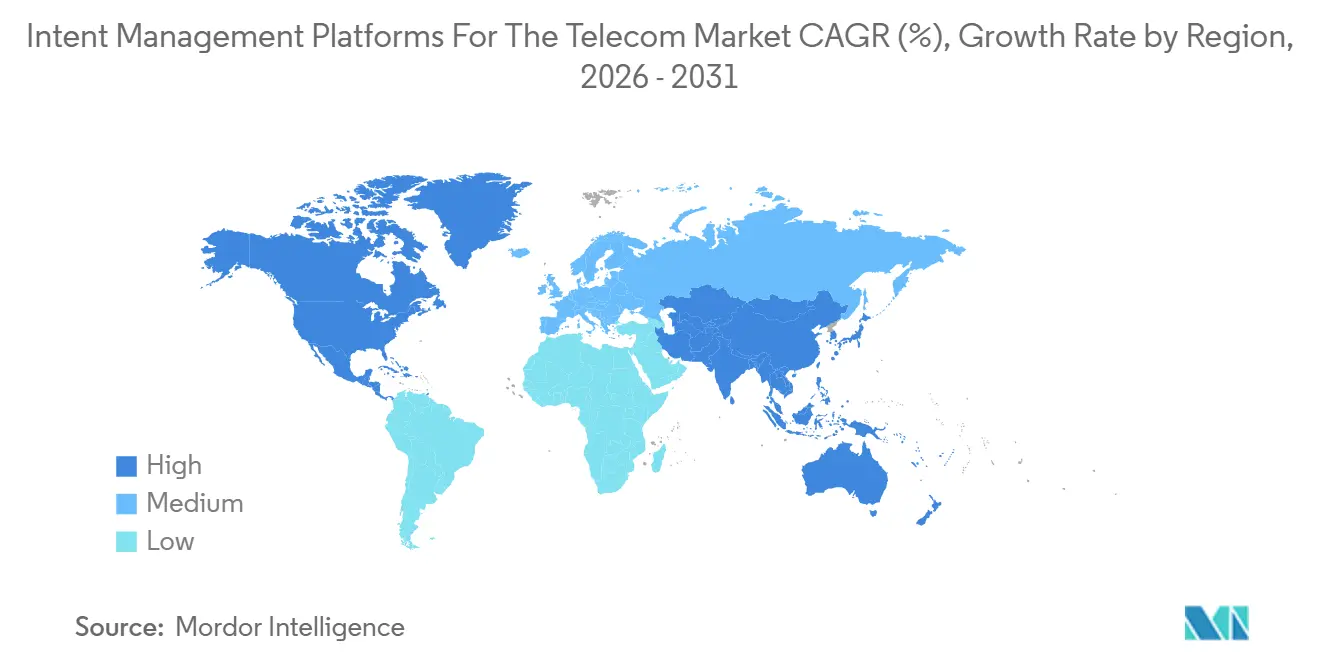
- By geography, North America held 27.66% of revenue in 2025, while Asia-Pacific is projected to expand at a 16.65% CAGR through 2031.
Note: Market size and forecast figures in this report are generated using Mordor Intelligence’s proprietary estimation framework, updated with the latest available data and insights as of January 2026.
Market Trends and Insights
Drivers Impact Analysis of Intent Management Platforms For The Telecom Market*
| DRIVER | (~) % IMPACT ON CAGR FORECAST | GEOGRAPHIC RELEVANCE | IMPACT TIMELINE |
|---|---|---|---|
| 5G Standalone and Network Slicing Complexity | +4.2% | Global, concentrated in North America and the Asia-Pacific | Short term (≤ 2 years) |
| Demand for Closed-Loop Network Automation | +3.1% | Global, with an early-mover advantage in Europe and North America | Short term (≤ 2 years) |
| Growth of Cloud-Native and Multi-Vendor Telecom Infrastructure | +2.4% | North America, Europe, and the Asia-Pacific, with spillover to the Middle East and Africa | Medium term (2-4 years) |
| Network-as-Code and Programmable Connectivity Monetization | +1.8% | Europe, North America, and Asia-Pacific, with spillover to the Middle East and Africa | Medium term (2-4 years) |
| Agentic AI for Context-Aware Telecom Operations | +1.6% | Global, concentrated in North America and Asia-Pacific | Short term (≤ 2 years) |
| Intent-Aware Energy Optimization in Radio and Transport Networks | +1.3% | Global, with early traction in Asia-Pacific and Europe | Medium term (2-4 years) |
| Source: Mordor Intelligence | |||
5G Standalone and Network Slicing Complexity
5G standalone deployments require operators to coordinate radio, transport, core, and application resources against a common service objective. TM Forum approved its IG1358 Intent-Based Operation User Guide in March 2026, establishing a shared framework for expressing and reporting intent across multi-domain environments.[1]TM Forum, “IG1358 Intent Based Operation User Guide v1.2.0,” TM Forum, tmforum.org That framework supports intent management platforms in the telecom market by providing vendors and operators with a clearer basis for interoperability. Mavenir supported Deutsche Telekom’s video telephony service over a 5G standalone network slice, showing how service delivery depends on coordination between network functions and applications.[2]Mavenir, “Mavenir Powers Deutsche Telekom’s Latest 5G Network Slicing Use Case for Video Telephony Deployed Over 5G Standalone Network,” Mavenir, mavenir.com Operators must keep the cost of configuring and maintaining a slice below the revenue it can generate. Intent-based orchestration addresses this requirement by turning service objectives into repeatable network actions and reducing the configuration burden across domains.
Demand for Closed-Loop Network Automation
Closed-loop automation compares live network conditions with a declared service target and applies corrective actions when performance differs from that target. 3GPP’s Coordinated Closed Control Loop framework supports performance-based control loops, including targets such as minimum slice throughput.[3]3GPP, “Coordinated Closed Control Loop - Enabling Autonomous Networks,” 3GPP, 3gpp.org This standard work provides intent management platforms for the telecom market with a route from policy definition to live network execution. Rakuten Mobile received TM Forum Level 4 Autonomy validation in February 2026 for RAN energy efficiency optimization in a live Open RAN environment.[4]Rakuten Symphony, “Rakuten Mobile Receives World First Level 4 Autonomy Validation for RAN Energy Efficiency Optimization in a Live Open RAN Network from TM Forum,” Rakuten Symphony, symphony.rakuten.com The deployment was estimated to reduce RAN energy consumption by 20% through autonomous, intent-driven operations. Operators that can automate repetitive correction cycles can improve cost control and shorten response times for service assurance.
Growth of Cloud-Native and Multi-Vendor Telecom Infrastructure
Cloud-native network functions have replaced many fixed hardware configurations with software workloads that change across distributed infrastructure. Deutsche Telekom described its Horizontal Telco Cloud as an environment involving 40 vendors across infrastructure, applications, and automation domains.[5]Deutsche Telekom, “Deutsche Telekom’s Horizontal Telco Cloud Establishes a New Industry Blueprint for Telco Clouds,” Deutsche Telekom, telekom.com This operating model creates a need for vendor-neutral policy layers in the intent management platforms for the telecom market. The EANTC Transport and Cloud Networks Interoperability Test 2026 involved 12 vendors, 56 device types, more than 1,600 engineering days, and over 1,300 result datasets. The scale of this testing shows that cross-vendor automation is becoming an industry-wide engineering requirement. It also broadens the platform's scope, since the software must recognize both changing cloud resources and traditional network equipment.
Network-as-Code and Programmable Connectivity Monetization
Network-as-code allows enterprises and software applications to request connectivity functions through programmable interfaces. Nokia expanded its Network as Code ecosystem in March 2026 through a Google Cloud partnership that connected Gemini models through the Model Context Protocol. Nokia stated that its platform connected more than 70 partners and 20+ network APIs. This model expands the intent management platforms for the telecom market because requests can originate outside traditional BSS and OSS systems. Enterprise applications and AI agents may create higher volumes of service requests with wider variation in intent. Operators need controls that can interpret these requests, allocate resources in real time, and maintain clear records of the resulting network decisions.
Restraints Impact Analysis of Intent Management Platforms For The Telecom Market*
| RESTRAINT | (~) % IMPACT ON CAGR FORECAST | GEOGRAPHIC RELEVANCE | IMPACT TIMELINE |
|---|---|---|---|
| Legacy OSS and BSS Integration Complexity | -2.1% | Global, most pronounced in South America, the Middle East and Africa, and parts of the Asia-Pacific | Short term (≤ 2 years) |
| Shortage of Telecom Automation and AI Engineering Skills | -1.4% | Global | Medium term (2-4 years) |
| Non-Deterministic Behavior of Generative AI Policy Engines | -0.9% | Global | Short term (≤ 2 years) |
| Fragmented Intent Ontologies and Cross-Vendor Interoperability | -0.7% | Global | Long term (≥ 4 years) |
| Source: Mordor Intelligence | |||
Legacy OSS and BSS Integration Complexity
Legacy OSS and BSS environments can slow the rollout of intent management platforms in the telecom market. Many operators retain mediation layers and OSS components that were designed before 4G, with proprietary interfaces and batch-processing patterns. These systems do not readily support the real-time data exchange required by intent-driven control. Operators often need to update data access methods, normalize inventory records, and expose reliable APIs before a platform can be deployed at scale. This work can extend deployment schedules and increase the role of systems integrators. The issue is particularly relevant in South America, the Middle East, and Africa, as well as parts of Asia-Pacific, where network modernization can outpace OSS refresh cycles.
Shortage of Telecom Automation and AI Engineering Skills
The deployment of intent management platforms requires expertise in network automation, AI and machine learning, data engineering, cloud operations, and cybersecurity. Operators without these skills may take longer to move a pilot into full production. The skills gap also adds cost when vendors need to provide integration and managed operations support. Demand for specialists is broad across the technology sector, making it difficult for telecom operators to build large internal teams. This constraint supports demand for managed services but limits the number of partners capable of delivering complex, multi-domain programs. The restraint can therefore slow implementation even when an operator has defined a clear automation strategy.
*Our forecasts treat driver/restraint impacts as directional, not additive. The impact forecasts reflect baseline growth, mix effects, and variable interactions.
Intent Management Platforms For The Telecom Market Segment Analysis
By Component:
Platforms Lead Early Spending While Services Gain ImportancePlatforms and Solutions accounted for 67.55% of the telecom market share in intent management platforms in 2025. Early adoption focused on acquiring core software that captures intent, sets policies, and controls network actions. Operators often prefer platforms that integrate with their existing OSS environments, as replacing deeply embedded systems can be costly and disruptive. Ericsson, Nokia, Amdocs, and Netcracker have established strong positions through these integrations and long-term operational relationships. As a result, platform revenue remains significant during the initial phases of large-scale automation programs.
Services are projected to grow at a 15.76% CAGR from 2026 to 2031, outpacing the overall telecom intent management platforms market. Following initial software deployment, demand is shifting toward integration, managed operations, AI model tuning, and ongoing policy maintenance. In February 2026, Amdocs launched aOS, a BSS- and OSS-agnostic intelligence layer for telecom operators. Amdocs stated that the platform was designed for more than 350 service providers. Therefore, intent management platforms for the telecom industry depend not only on software capabilities but also on the delivery capacity needed to deploy and operate them across live networks.


By Deployment Model:
Cloud Provides Scale While Hybrid Supports TransitionCloud deployment accounted for 57.88% of the telecom market share for intent management platforms in 2025. Operators use cloud environments to scale processing capacity for policy evaluation, assurance data, and dynamic network workloads. Deutsche Telekom reported that AI-driven workload scheduling could deliver up to 65% energy savings in 5G core operations. These operational efficiencies strengthen the case for cloud deployment among operators that have started modernizing their network functions. Cloud environments also enable faster software updates and integration with data-driven automation tools.
Hybrid deployment is projected to grow at a CAGR of 16.41% from 2026 to 2031 in the intent management platforms for the telecom market. Many operators cannot migrate all network functions to cloud environments because they continue to operate long-lived equipment and have established on-premises systems. A hybrid platform can apply policies across legacy domains and cloud-native functions without requiring an immediate, full-scale migration. On-premises deployment remains relevant for sovereign networks and private enterprise 5G applications that require local processing or stringent data controls. Therefore, the intent management platforms for the telecom industry must support diverse deployment conditions rather than a single operating model.
By Platform Capability:
Policy Translation Becomes the Main Implementation FocusIntent Capture and Natural-Language Interpretation accounted for 38.99% of the telecom market share in intent management platforms in 2025. These capabilities enable network and business users to define desired outcomes through language interfaces, service models, and policy editors. They reduce the need to express every request as a low-level network command. This capability has helped operators establish a practical front end for intent-based operations and enables more operational teams to participate in setting service objectives.
Policy Translation and Configuration Generation is projected to grow at a CAGR of 14.98% from 2026 to 2031 in the intent management platforms for the telecom market. This capability converts broad service requirements into machine-executable configuration steps and must meet real-time service-level requirements. TM Forum’s Intent Toolkit provides resources for common intent concepts and implementation approaches. Intent Modeling and Ontology Management also remain important because they link user intent to network data models. Even with partial alignment among industry models, custom bridging work may still be required for each deployment, keeping translation reliability central to vendor selection.

By Enterprise Size:
Large Operators Sustain Revenue While Private Networks ExpandLarge Telecom Operators accounted for 40.32% of the telecom market share in intent management platforms in 2025. Their scale enables them to fund platform licenses, data integration, and multi-year modernization programs. They also operate complex networks, where a single automation improvement can apply across large subscriber and infrastructure bases. In October 2025, Ericsson and Vodafone announced a five-year programmable networks partnership covering network modernization and automation. Such relationships can generate long-term demand for platform software and operational support.
Private Network and Neutral-Host Operators are projected to grow at a CAGR of 15.88% from 2026 to 2031. Industrial sites, ports, and smart venues are adopting 5G standalone infrastructure that requires defined service levels and controlled network slices. These operators may initially deploy focused automation in radio access or transport before expanding to broader orchestration. Their requirements differ from those of national carriers because deployments are linked to site operations, localized control, and specific enterprise service commitments. This trend creates a distinct growth opportunity in the telecom market for vendors offering intent management platforms with simpler, more flexible deployment options.
Geography Analysis
North America Intent Management Platforms for the Telecom Market
North America is projected to account for 27.66% of the intent management platforms for the telecom market in 2025. The region benefits from advanced 5G standalone deployments and sustained investment in autonomous network programs. Proximus is expected to report that standalone architecture will represent 32% of North American 5G connections in April 2026. This environment provides U.S. and Canadian operators with greater commercial experience in the service and operational requirements of network slicing. Ericsson has positioned its Intelligent Automation Platform for multi-vendor RAN management and intent-based operations. Mexico presents a developing opportunity as operators expand 5G coverage through spectrum allocation programs.
Europe Intent Management Platforms for the Telecom Market
Europe continues to be shaped by 5G standalone deployment, multi-vendor infrastructure, and governance requirements for automated decision-making. Proximus is expected to launch commercial 5G standalone services in Belgium in April 2026, with use cases spanning emergency services, payment traffic, and media distribution. European operators require explainability, traceability, and audit records when deploying AI-driven policy engines. Intent management platforms for the telecom market benefit when these controls are integrated into the operating platform rather than deployed as separate tools. EANTC’s 2026 interoperability testing is expected to highlight the engineering challenges of operating across diverse vendor environments. The United Kingdom, Germany, France, Spain, and the Nordic countries remain important markets due to their network investment and automation programs.
APAC and MEA Intent Management Platforms for the Telecom Market
Asia-Pacific is projected to grow at a CAGR of 16.65% from 2026 to 2031, representing the highest regional growth rate in the telecom intent management platforms market. China’s mature 5G standalone network environment supports commercial network slicing across consumer and enterprise use cases. NTT EAST is expected to report a private 5G optimization demonstration in March 2026 involving 26 companies and RIC-enabled control. The demonstration is expected to show up to a 65% reduction in power consumption under specified conditions. Japan and South Korea also support network automation through government-backed programs. Saudi Arabia and the UAE drive demand in the Middle East through national digital transformation and sovereign network initiatives, while adoption in Africa is more closely linked to energy efficiency and operating cost control.

Competitive Landscape
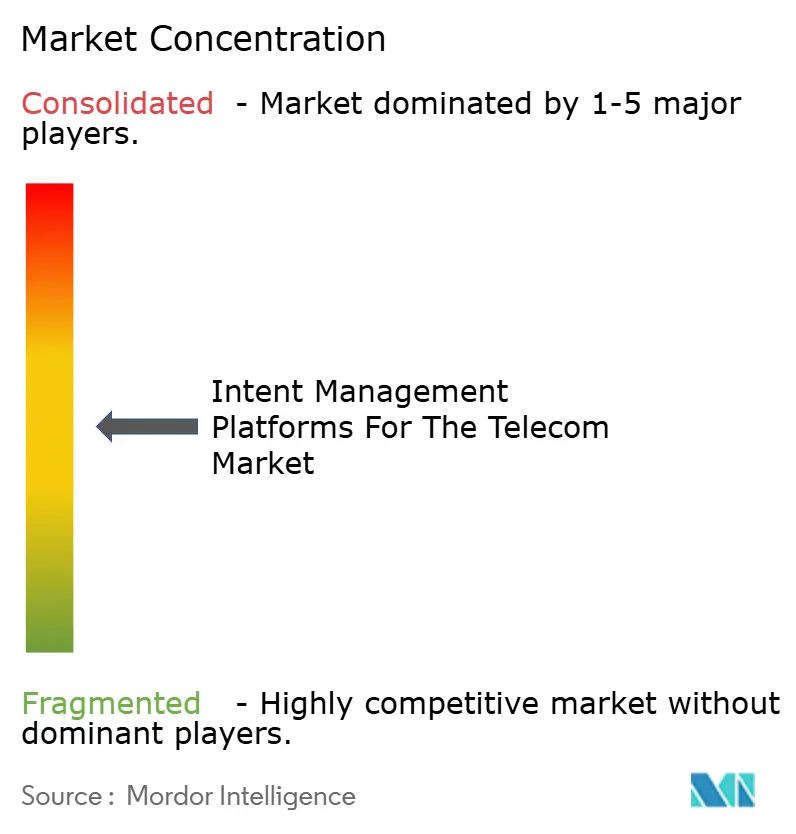
The intent management platforms for the telecom market exhibit moderate to high concentration in the integrated platform layer. Ericsson, Nokia, Cisco, Amdocs, and Netcracker hold significant positions through OSS and BSS integration, established relationships with operators, and managed service contracts. Their installed bases create switching costs for operators considering a core automation software replacement. Competition increasingly centers on a platform’s ability to operate across a broader ecosystem of applications and vendors. This dynamic favors providers that combine policy control, assurance, cloud integration, and open interfaces. Systems integration remains more fragmented, creating opportunities for specialist providers to compete based on delivery expertise.
Nokia and Ericsson are expected to announce a collaboration in March 2026 that will allow Ericsson to join Nokia’s SMO Marketplace and Nokia to join Ericsson’s rApp Ecosystem. The arrangement will enable automation applications from either company to operate across both platforms for communications service providers. Nokia is also expected to expand its Network as Code ecosystem with Google Cloud in March 2026, enabling enterprise AI agents to access network APIs through the Model Context Protocol. In June 2026, Nokia and Google Cloud are expected to announce six Gemini-powered AI agents for Nokia’s autonomous network product suite. These developments indicate that open application ecosystems and AI-enabled assurance are becoming important competitive features in the intent management platforms for the telecom market.
Netcracker introduced an expanded Agentic AI Solution in September 2025, featuring ready-to-deploy telecom AI agents, an open platform, an Agent Design Studio, and an AI Trust and Control layer. The solution provides operators with a vendor-agnostic approach to deploying automation across established BSS and OSS environments. Private network and neutral-host deployments remain less concentrated, as no single provider has established a dominant position. Cross-vendor intent ontology tools also remain an open area, as operators continue to need to connect different data models and policy structures. TM Forum’s intent resources support common terminology; however, each implementation may require specific integration work. Therefore, the competitive structure remains concentrated among core platform vendors, while implementation services and specialized interoperability capabilities remain contested.
Intent Management Platforms For The Telecom Industry Leaders
Cisco Systems, Inc.
Nokia Corporation
IBM Corporation
Amdocs Limited
Huawei Technologies Co., Ltd.
- *Disclaimer: Major Players sorted in no particular order
Intent Management Platforms For The Telecom Market Companies Covered in this Report
- Cisco Systems, Inc.
- Nokia Corporation
- Juniper Networks, Inc.
- Huawei Technologies Co., Ltd.
- Telefonaktiebolaget LM Ericsson
- Hewlett Packard Enterprise Company
- IBM Corporation
- Ciena Corporation
- Amdocs Limited
- Netcracker Technology Corporation
- Blue Planet, a division of Ciena Corporation
- NEC Corporation
- ZTE Corporation
- Samsung Electronics Co., Ltd.
- VMware, Inc.
- Arista Networks, Inc.
- Forward Networks, Inc.
- NetBrain Technologies, Inc.
- Gluware, Inc.
- Itential, LLC
- Anuta Networks, Inc.
- Wipro Limited
- Accenture plc

Recent Industry Developments in Intent Management Platforms For The Telecom Market
- August 2026: HCLTech Pulse Survey of telecom operators found that 49% describe their AI transformation culture as only "moderate," with severe shortages of AI/ML specialists, data engineers, and cloud architects identified as the primary execution constraint on intent platform deployments globally. Hyperscaler competition for talent is compounding the structural disadvantage.
- June 2026: Nokia and Google Cloud announced an expanded partnership that embeds six specialized Gemini-powered AI agents into Nokia's Assurance Center autonomous network suite, with a commercial SaaS launch on Google Cloud Marketplace targeted for September 2026. The integration focuses on closed-loop fault resolution and autonomous RAN energy management for telecom operators.
- June 2026: Cisco unveiled Cisco Cloud Control at Cisco Live US, a unified agentic platform that extends its AgenticOps model to campus, branch, industrial, data center, and service provider environments. Cisco's agentic troubleshooting workflows had already executed over 165,000 times in the preceding 30 days, demonstrating production-scale deployment momentum.
- June 2026: Nokia announced multiple upgrades to its Autonomous Networks portfolio at DTW 2026 in Copenhagen, introducing a new Autonomous Networks Agent Library, updated Autonomous Networks Suite, and AI-driven frameworks for IP, fixed, and optical network management, expanding its multivendor automation addressable market.


Global Intent Management Platforms For The Telecom Market Report Scope
The Intent Management Platforms for Telecom Market Report is Segmented by Component (Platforms and Solutions, and Services), Deployment Model (Cloud, On-Premises, and Hybrid), Platform Capability (Intent Capture and Natural-Language Interpretation, Intent Modeling and Ontology Management, Policy Translation and Configuration Generation, and Other Platform Capabilities), Enterprise Size (Large Telecom Operators, Regional and Challenger Operators, and Private Network and Neutral-Host Operators), and Geography (North America, Asia-Pacific, Europe, South America, and the Middle East and Africa). The Market Forecasts are Provided in Terms of Value (USD).
| Platforms and Solutions |
| Services |
| Cloud |
| On-Premises |
| Hybrid |
| Intent Capture and Natural-Language Interpretation |
| Intent Modeling and Ontology Management |
| Policy Translation and Configuration Generation |
| Other Platform Capability |
| Large Telecom Operators |
| Regional and Challenger Operators |
| Private Network and Neutral-Host Operators |
| North America | United States |
| Canada | |
| Mexico | |
| South America | Brazil |
| Argentina | |
| Rest of South America | |
| Europe | United Kingdom |
| Germany | |
| France | |
| Spain | |
| Rest of Europe | |
| Asia-Pacific | China |
| Japan | |
| India | |
| South Korea | |
| Rest of Asia-Pacific | |
| Middle East | Saudi Arabia |
| United Arab Emirates | |
| Rest of Middle East | |
| Africa | South Africa |
| Egypt | |
| Rest of Africa |
| By Component | Platforms and Solutions | |
| Services | ||
| By Deployment Model | Cloud | |
| On-Premises | ||
| Hybrid | ||
| By Platform Capability | Intent Capture and Natural-Language Interpretation | |
| Intent Modeling and Ontology Management | ||
| Policy Translation and Configuration Generation | ||
| Other Platform Capability | ||
| By Enterprise Size | Large Telecom Operators | |
| Regional and Challenger Operators | ||
| Private Network and Neutral-Host Operators | ||
| By Geography | North America | United States |
| Canada | ||
| Mexico | ||
| South America | Brazil | |
| Argentina | ||
| Rest of South America | ||
| Europe | United Kingdom | |
| Germany | ||
| France | ||
| Spain | ||
| Rest of Europe | ||
| Asia-Pacific | China | |
| Japan | ||
| India | ||
| South Korea | ||
| Rest of Asia-Pacific | ||
| Middle East | Saudi Arabia | |
| United Arab Emirates | ||
| Rest of Middle East | ||
| Africa | South Africa | |
| Egypt | ||
| Rest of Africa | ||


Key Questions Answered in the Report
What is the size of the intent management platforms for the telecom market?
The intent management platforms for the telecom market were USD 489.66 million in 2026 and are expected to reach USD 951.32 million by 2031, at a 14.21% CAGR.
What is driving the adoption of intent management platforms for telecom?
The intent management platforms for the telecom market are being adopted for 5G standalone deployments, network slicing, closed-loop automation, cloud-native infrastructure, and programmable connectivity.
Which component held the largest share in 2025?
Platforms and Solutions held 67.55% of revenue in 2025, reflecting early spending on core policy and automation capabilities.
Which deployment model is expanding most quickly?
Hybrid deployment is projected to expand at a 16.41% CAGR through 2031 as operators manage both legacy and cloud-native systems.
Which region is expected to expand most quickly?
Asia-Pacific is projected to expand at a 16.65% CAGR through 2031, supported by 5G standalone networks and automation programs.
What limits the deployment of intent management platforms?
Deployment in the intent management platforms for the telecom market can be delayed by legacy OSS and BSS integration, skills shortages, non-deterministic AI outputs, and fragmented cross-vendor ontologies.
Page last updated on:





