
Instant Payments Market Size and Share
Market Overview
| Study Period | 2020 - 2031 |
|---|---|
| Market Size (2026) | USD 36.98 Trillion |
| Market Size (2031) | USD 75.13 Trillion |
| Growth Rate (2026 - 2031) | 15.23 % |
| Fastest Growing Market | North America |
| Largest Market | Asia-Pacific |
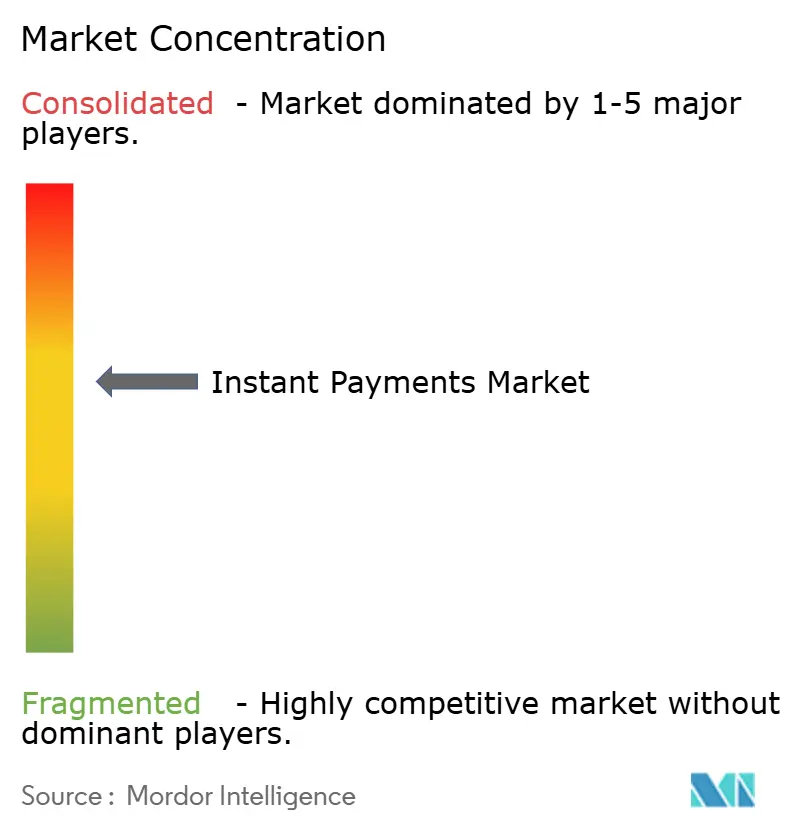
| Market Concentration | Medium |
Major Players *Disclaimer: Major Players sorted in no particular order Image © Mordor Intelligence. Reuse requires attribution under CC BY 4.0. | |
Instant Payments Market Analysis by Mordor Intelligence
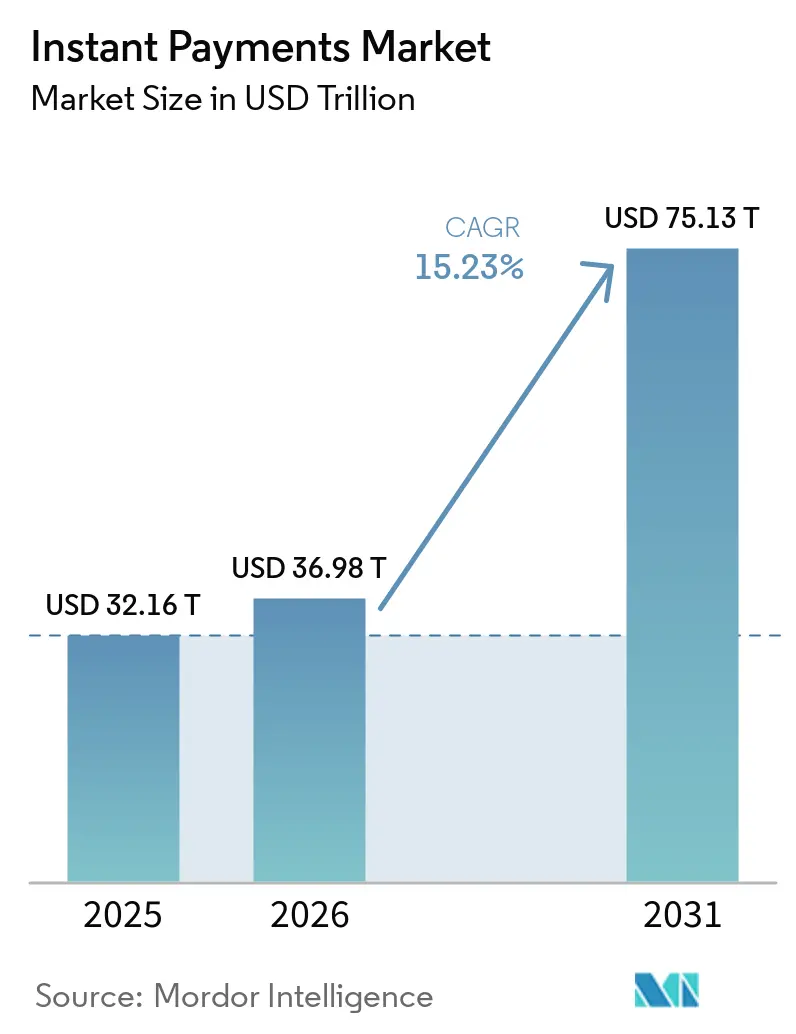
The Instant Payments Market size is expected to increase from USD 32.16 trillion in 2025 to USD 36.98 trillion in 2026 and reach USD 75.13 trillion by 2031, growing at a CAGR of 15.23% over 2026-2031.
Regulatory action is now playing a central role in market expansion, with the European Union enforcing instant credit transfer mandates and fee parity, which has moved instant settlement from an optional service to a required payment capability for a large share of payment service providers. In the United States, network scaling is also evident: FedNow’s total transaction value reached USD 853 billion in 2025, and participation exceeded 1,700 financial institutions by April 2026, indicating that real-time payment adoption is now extending beyond early pilots into broad institutional use. The market is also being shaped by broader migration to ISO 20022 messaging and by cloud-native multi-rail connectivity, as banks seek to support multiple payment rails without maintaining separate compliance and fraud stacks for each network. At the same time, the instant payments market still faces significant operational constraints from APP fraud exposure, legacy batch-processing banking systems, and cross-border interoperability gaps that continue to slow full end-to-end real-time settlement across corridors. These forces are pushing the instant payments market toward a model where compliance readiness, fraud control, data quality, and cross-rail orchestration matter as much as transaction speed.
Key Report Takeaways
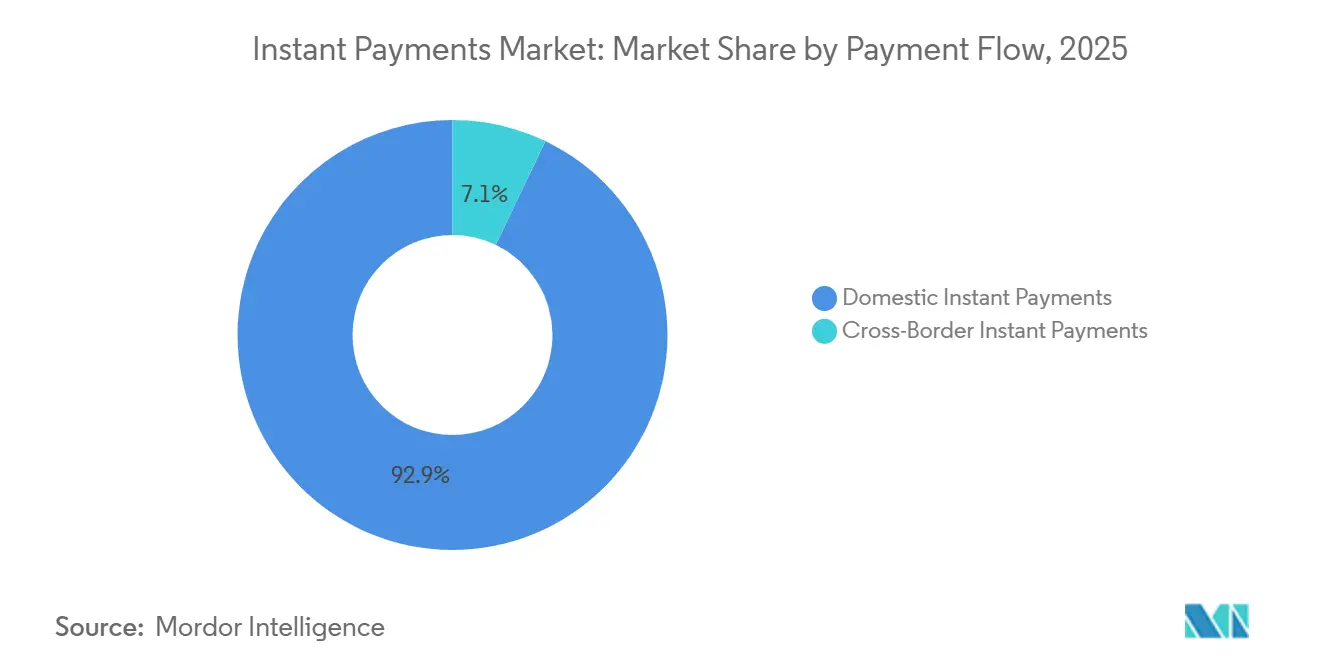
- By payment flow, domestic payments held 92.89% of the instant payments market share in 2025, while cross-border payments are projected to grow at 22.73% CAGR through 2031.
- By end-user segment, consumers and retail users accounted for 46.78% of the instant payments market size in 2025, while large enterprises and corporates are forecast to expand at 19.34% CAGR through 2031.
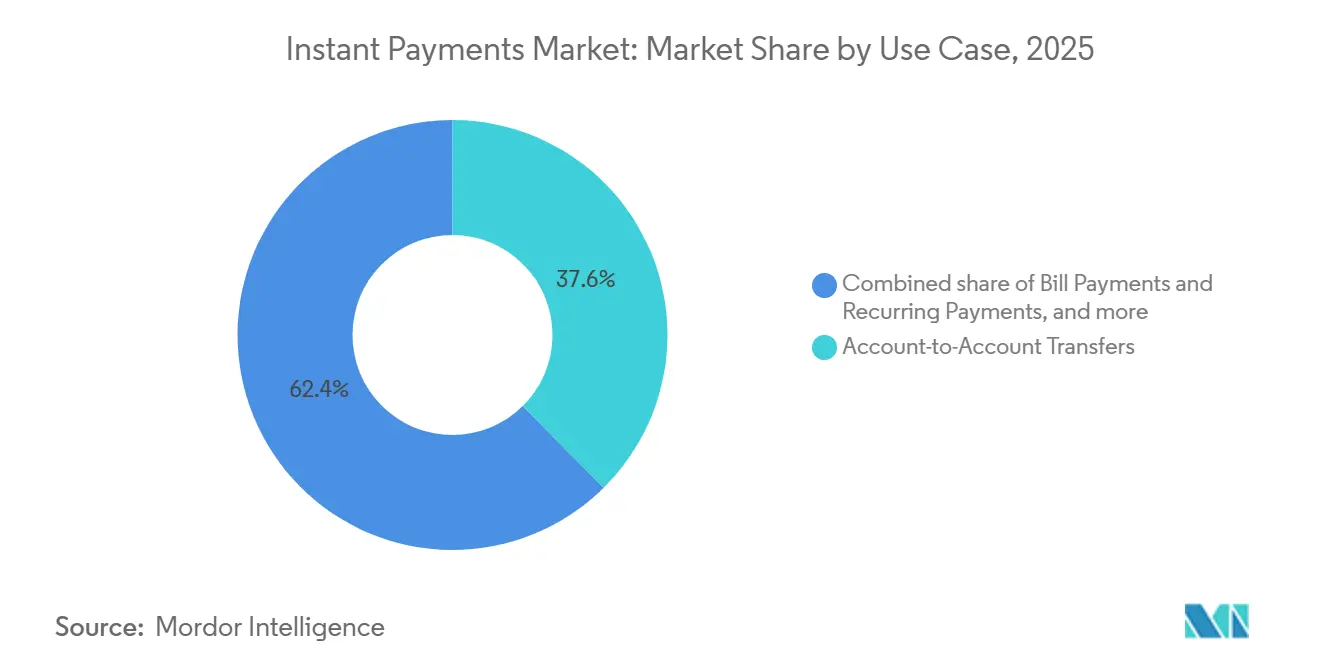
- By use case, account-to-account transfers captured 37.58% of the instant payments market size in 2025, while supplier, vendor, and B2B commercial payments are projected to grow at 20.56% CAGR through 2031.
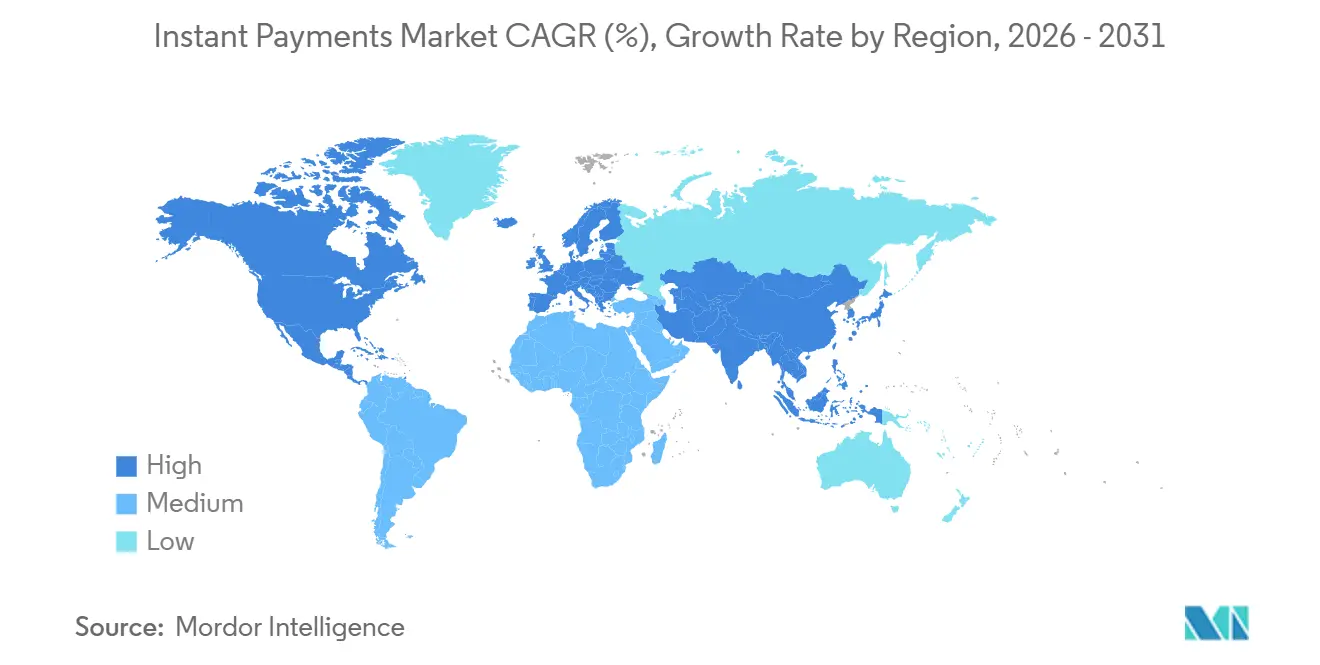
- By geography, Asia-Pacific accounted for 56.63% of the instant payments market share in 2025, while North America is projected to grow at a 21.45% CAGR through 2031.
Note: Market size and forecast figures in this report are generated using Mordor Intelligence’s proprietary estimation framework, updated with the latest available data and insights as of January 2026.
Market Trends and Insights
Drivers Impact Analysis of Instant Payments Market*
| Driver | (~) % Impact on CAGR Forecast | Geographic Relevance | Impact Timeline |
|---|---|---|---|
| Real-Time Settlement Mandates Accelerate Scheme Adoption | +3.8% | Eurozone, United Kingdom, LatAm, South Asia | Short term (≤ 2 years) |
| Retail Demand for Frictionless Checkout and Bill Payments | +2.4% | Global, Asia-Pacific core, North America | Short term (≤ 2 years) |
| Cross-Border Push for Faster Remittances and B2B Trade Payments | +2.8% | Asia-Pacific, Middle East, global corridors | Medium term (2-4 years) |
| Bank Modernization of Core and Payments Infrastructure | +1.9% | North America, Europe | Medium term (2-4 years) |
| ISO 20022 and API Orchestration Reduce Integration Friction | +2.1% | Global, early gains in EU and North America | Short term (≤ 2 years) |
| Embedded Finance Expands Instant Payout Use Cases | +1.6% | North America, Europe, Asia-Pacific | Medium term (2-4 years) |
| Source: Mordor Intelligence | |||
Real-Time Settlement Mandates Accelerate Scheme Adoption
Regulatory mandates have become one of the strongest demand drivers in the instant payments market, driving faster adoption than voluntary pricing or commercial incentives. The European Union required euro-area payment service providers to receive instant payments by January 2025 and to send them by October 2025, while also requiring that fees for instant transfers do not exceed fees for standard credit transfers. The next phase of the rollout reaches non-Euro Area providers in the EEA, with receiving obligations due by January 2027 and sending obligations due by July 2027, which extends the compliance cycle deeper into the region. The October 2025 implementation also advanced verification of payee readiness, which means higher payment speed is being introduced alongside stronger account validation expectations[1]. This regulatory model matters for the instant payments market because it elevates instant settlement from a competitive feature to a baseline service requirement for a wide range of providers.
Retail Demand for Frictionless Checkout and Bill Payments
Consumer behavior is also widening the addressable base of the instant payments market, especially as users expect funds to move at the same pace across payroll, bill payment, wallet funding, and merchant checkout. Demand no longer comes only from peer-to-peer use, because households now expect fast access to wages, claims, refunds, and other time-sensitive receipts. That shift is pulling instant rails into structured financial flows, where timing directly affects recipients' cash availability. In Europe, wallet-led account-to-account payment models are also moving into commerce, as Wero has migrated users from earlier local apps and is extending into e-commerce and point-of-sale environments. This pattern supports the instant payments market by expanding recurring everyday use rather than limiting real-time payments to occasional urgent transfers.
Cross-Border Push for Faster Remittances and B2B Trade Payments
Cross-border activity is becoming a more visible growth layer in the instant payments market as public institutions and network operators push from domestic systems toward linked settlement corridors. In May 2026, the European Central Bank adopted Guideline ECB/2026/11 to integrate the EPC’s One-Leg-Out Instant Credit Transfer scheme into TIPS, creating the legal basis for settling cross-border payments with a euro leg in central bank money within seconds. The BIS also published its February 2026 report on fast payment system interlinking, which highlighted fragmented API standards and uneven settlement arrangements as key barriers and noted that harmonized pre-validation could help reduce payment failures. China’s CIPS further shows how cross-border infrastructure is widening in scale, with 193 direct and 1,573 indirect participants across 124 countries by the end of 2025 and expansion into financial market settlement and integrated cash management in 2026[2]. SWIFT’s consumer payment framework has also attracted commitments from more than 25 banks across major corridors, providing the instant payments market with a broader pathway for cross-border retail and business transfers, with local infrastructure supporting real-time settlement.
ISO 20022 and API Orchestration Reduce Integration Friction
The move to ISO 20022 is reducing operational friction in the instant payments market by standardizing richer payment data across domestic and cross-border environments. The November 2025 close of SWIFT’s MT coexistence period made ISO 20022 the practical messaging baseline for many institutions, while systems such as FedNow, RTP, PIX, UPI, and SEPA Instant were already built natively on the standard[3]. Richer data fields improve party identification, remittance details, reconciliation, and automated exception handling, helping banks and corporate users process payments with fewer manual corrections. The next standards milestone arrives in November 2026, when unstructured postal addresses will be removed from cross-border messages, pushing institutions toward cleaner, more machine-readable payment data. Providers that complete this transition earlier are likely to improve investigation speed and straight-through processing. That strengthens the instant payments market because data readiness increasingly affects operating cost and usability, not just technical compliance.
Restraints Impact Analysis of Instant Payments Market*
| Restraint | (~) % Impact on CAGR Forecast | Geographic Relevance | Impact Timeline |
|---|---|---|---|
| Scam Risk and Authorized Push Payment Fraud Exposure | -1.2% | United Kingdom, Europe, Australia, Asia-Pacific core | Short term (≤ 2 years) |
| Legacy Core Banking Dependencies Slow Rollout | -1.5% | North America, Europe, the Middle East, and Africa | Long term (≥ 4 years) |
| Interoperability Gaps Across Domestic and Cross-Border Schemes | -0.8% | Global, the Middle East, and Africa, cross-border corridors | Long term (≥ 4 years) |
| Merchant Liquidity and Exception-Handling Costs in 24/7 Settlement | -0.6% | Europe, Asia-Pacific | Medium term (2-4 years) |
| Source: Mordor Intelligence | |||
Scam Risk and Authorized Push Payment Fraud Exposure
Fraud remains one of the clearest operating risks for the instant payments market because payment speed leaves little room for post-settlement recovery. In the United Kingdom, the Payment Systems Regulator brought APP scam reimbursement into a mandatory framework from October 7, 2024, with a GBP 85,000 cap and shared liability between sending and receiving providers, which forces both sides of the payment chain to invest in stronger controls. In Europe, the draft Payment Services Regulation published through Council compromise texts in April 2026 proposed mandatory transaction monitoring under Article 83 and direct liability for non-compliance, which points to a similar control direction across the region[4]. Real-time fraud management is therefore moving from a supporting function into a core requirement of payment platform design. This pressure can slow rollout and raise operating costs in the instant payments market, especially for institutions that still rely on separate fraud tools across multiple rails.
Legacy Core Banking Dependencies Slow Rollout
Legacy banking architecture continues to slow down parts of the instant payments market because many institutions still run core systems designed around batch processing windows rather than continuous availability. Even when a bank installs a modern payment hub, upstream and downstream systems, such as fraud engines, reconciliation tools, and notification layers, can reintroduce delays if they are not upgraded at the same pace. This has led many banks to use overlay or sidecar approaches, which can support initial connectivity but often limit scale, resilience, and service depth. A 24/7 settlement model also requires institutions to continuously manage prefunding and liquidity buffers, and ECB implementation work has kept liquidity access and settlement readiness under review as instant payment obligations expand. These structural dependencies do not stop adoption, but they do raise the cost and complexity of widening the instant payments market across smaller and mid-sized banks.
*Our forecasts treat driver/restraint impacts as directional, not additive. The impact forecasts reflect baseline growth, mix effects, and variable interactions.
Instant Payments Market Segment Analysis
By Payment Flow:
Cross-Border Momentum Reshapes a Domestically Concentrated MarketDomestic payments accounted for 92.89% of the instant payments market share in 2025, while cross-border payments are forecast to expand at a 22.73% CAGR from 2026 to 2031. That split shows how deeply national schemes such as UPI, PIX, FedNow, RTP, and SEPA Instant are embedded in home markets. The domestic scale has been built through regulation, broad participation from the banking sector, and familiar use cases such as person-to-person transfers and bill settlement. Cross-border flows still start from a smaller base, but they usually carry higher values because they include remittances, treasury movements, supplier payments, and trade-related transfers. This means the instant payments market can deliver disproportionate economic value even with a limited number of high-value corridors becoming fully real-time.
The legal and operating framework for this shift is now becoming more concrete. The ECB’s May 2026 adoption of Guideline ECB/2026/11 for the integration of One-Leg-Out Instant Credit Transfer into TIPS provides a formal basis for euro-leg cross-border instant settlement in central bank money. India and Singapore had already operationalized UPI-PayNow, and India joined the BIS Project Nexus with Malaysia, the Philippines, Thailand, and Singapore for broader multilateral interlinking. In June 2026, Bank of America announced a cross-border real-time payments solution for corporate and institutional clients via SWIFT and CashPro, signaling that large banks now see cross-border instant settlement as a commercial product rather than a future option. As these linkages deepen, the instant payments market is likely to favor providers that can manage corridor connectivity, data validation, and orchestration across multiple domestic rail networks.
By End-User Segment:
Enterprise Treasury Migration Elevates Market Value per TransactionConsumers and retail users accounted for 46.78% of the instant payments market in 2025, making them the largest end-user segment by value. Their leadership reflects the breadth of consumer use cases, including peer-to-peer transfers, digital wallet funding, merchant payments, and everyday bill settlement. Large enterprises and corporates are the fastest-growing segment, with a projected CAGR of 19.34% from 2026 to 2031. Higher transaction caps on United States real-time payment rails in 2025 widened the practical use of instant payments for corporate payroll, internal treasury movement, and supplier settlement. This shift matters because corporate migration raises average payment value and pushes the instant payments market toward more demanding treasury and reconciliation needs.
The middle of the market is also important. MSMEs sit between high-frequency retail behavior and large-enterprise treasury management, and they benefit from lower acceptance costs, faster settlement, and simpler account-to-account reconciliation. Government disbursements add another layer, because tax refunds, benefits, and emergency transfers gain value when recipients can access funds immediately. The Federal Reserve’s support for agency disbursements through FedNow shows that public-sector payment flows are also entering the real-time perimeter. As a result, the instant payments industry is no longer centered only on consumer convenience, because enterprise and government flows are changing the value mix and operating requirements of the broader instant payments market.
By Use Case:
B2B Commercial Payments Concentrate Instant Rail Value Despite Low Volume ShareAccount-to-account transfers accounted for 37.58% of the instant payments market in 2025, confirming that direct bank-to-bank transfers remain the core use case for real-time payment infrastructure. Supplier, vendor, and B2B commercial payments are the fastest-growing use case, with a projected 20.56% CAGR from 2026 to 2031. This pattern reflects the fact that business payments are fewer in number than retail transfers but usually much larger in value. Merchant and POS transactions are also gaining relevance as account-to-account wallets expand into checkout environments and merchants seek lower-cost acceptance methods. The instant payments market is therefore broadening beyond its original transfer base into commercial settlement, checkout, recurring payments, and disbursements.
Other use cases are also moving in the same direction. Bill and recurring payments gain support from request-to-pay frameworks and from stronger account validation. Salary, wage, and disbursement use cases are expanding as platforms aim to connect treasury visibility, liquidity management, and payouts on a single stack. Adyen’s April 2026 launch of Intelligent Money Movement, with early deployments at Etsy, Expedia Group, and Vinted, is one example of how providers are packaging payment execution with treasury orchestration for large enterprises. Government collections and benefits remain more policy-led, but they still add consistent volume as national payment programs modernize. Within the instant payments industry, this use-case mix is pushing vendors to support not just speed, but also cash positioning, fraud checks, routing logic, and automated reconciliation.
Geography Analysis
APAC Instant Payments Market
Asia-Pacific accounted for 56.63% of the instant payments market in 2025, making it the largest regional center by value. India remains one of the key anchors, with UPI processing close to 15 billion transactions per month in 2025 and extending connectivity through UPI-PayNow and its participation in the BIS Project Nexus. China’s CIPS also continues to scale, with 2024 annual volume reaching CNY 175.49 trillion, equivalent to USD 24.45 trillion, and participation widening to 193 direct and 1,573 indirect institutions across 124 countries by the end of 2025. Southeast Asia is building an additional regional layer through ASEAN payment connectivity, including QR and fast payment interlinking among markets such as Indonesia, Thailand, Malaysia, Vietnam, Singapore, and Japan. Australia and South Korea also strengthen the region’s position because both operate digitally mature payment environments and remain active in broader interoperability discussions.
The Americas Instant Payments Market
North America is projected to grow at a 21.45% CAGR from 2026 to 2031, making it the fastest-growing regional part of the instant payments market. The region’s momentum comes from its dual-rail structure, where RTP and FedNow are both expanding and are shaping different usage patterns across consumer, SME, and institutional flows. FedNow’s high average payment values in 2026 indicate growing relevance for corporate and higher-value transfers, while RTP remains closely associated with established retail and business usage patterns. Mexico adds depth through SPEI, and Canada’s Real-Time Rail modernization program remains an important addition within the forecast period. In South America, Brazil continues to anchor regional activity through PIX, while Colombia’s Bre-B, launched in October 2025 and powered by ACI Worldwide, has processed more than 500 million transactions since go-live, showing how quickly national schemes can scale once infrastructure is in place.
EMEA Instant Payments Market
Europe remains one of the most consequential regions for the instant payments market because regulation is directly reshaping payment economics and the obligations of providers. The EU instant payments framework established receiving and sending mandates, required fee parity, and extended the adoption path to non-eurozone EEA providers through deadlines in 2027. The region is also broadening institution coverage, as Albania, Montenegro, and North Macedonia operationalized SEPA membership in October 2025. In the Middle East, the UAE’s Aani reported 12.5 million users in April 2026 and the ability to process transfers in 3 seconds, while Montran was selected in February 2026 to support Aani’s international remittance gateway. Africa is also becoming more relevant, with 36 active instant payment systems across 31 countries processing 64 billion transactions worth USD 2 trillion in 2024, indicating that the instant payments market is no longer concentrated in the most mature banking regions.
Competitive Landscape
The instant payments market is moderately concentrated across technology and infrastructure providers, with no single vendor controlling all layers of the payments value chain. Payment hub vendors, scheme operators, card networks, embedded finance providers, and core banking vendors compete from different positions within the ecosystem, resulting in a diverse competitive landscape. ACI Worldwide, Fiserv, FIS, Finastra, and Volante Technologies remain visible at the infrastructure and software layer, with cloud-native and multi-rail support emerging as a core product requirement. In April 2026, ACI Worldwide launched ACI Connetic. This single cloud-native platform connects to eight major United States payment networks, directly addressing the operational strain banks face supporting multiple real-time rails. This kind of platform unification matters in the instant payments market because institutions increasingly want a single integration layer rather than separate stacks for each network.
Competitive boundaries are also widening. In June 2026, Mastercard joined a Eurosystem-led TIPS cross-currency pilot with Danmarks Nationalbank and Sveriges Riksbank, which shows how card networks are moving closer to real-time settlement infrastructure. Temenos also expanded its position in January 2026 by deploying ADCB Egypt’s live payments infrastructure on Temenos Payments Hub, combining modernization and ISO 20022 readiness in one program. Stablecoin-linked payout infrastructure is another adjacent theme, with Thunes connecting pay-to-stablecoin-wallet functionality to 11,500 banks via SWIFT in October 2025. These moves show that the instant payments market is evolving through platform extension and settlement innovation rather than through simple share concentration.
White-space opportunities remain strongest in SME treasury orchestration, automated reconciliation, and cross-border connectivity. In the Asia-Pacific region, national operators such as NPCI and CIPS shape domestic economies, narrowing the room for outside vendors in core switching but still leaving space in value-added services and corridor management. In MEA, providers such as Montran can win early positions while national schemes are still being built and expanded. Worldline’s March 2026 extension of its partnership with ABN AMRO also shows that long-standing infrastructure relationships remain important even as the market shifts toward new real-time capabilities. The instant payments market, therefore, remains fragmented, as operators, software providers, banks, networks, and fintech platforms compete to control different parts of the transaction flow.
Instant Payments Industry Leaders
-
ACI Worldwide, Inc.
-
FIS
-
Fiserv, Inc.
-
Visa Inc.
-
Mastercard Incorporated
- *Disclaimer: Major Players sorted in no particular order
Instant Payments Market Companies Covered in this Report
- ACI Worldwide, Inc.
- FIS
- Fiserv, Inc.
- Visa Inc.
- Mastercard Incorporated
- Finastra
- Montran Corporation
- Volante Technologies Inc.
- SWIFT
- Worldline
- Adyen N.V.
- PayPal Holdings, Inc.
- Stripe, Inc.
- Temenos AG
- Nexi S.p.A.
- Bottomline Technologies, Inc.
- Tietoevry Corporation
- FSS
- Jack Henry and Associates, Inc.
- The Clearing House Payments Company L.L.C.
- National Payments Corporation of India
Recent Industry Developments in Instant Payments Market
- June 2026: Bank of America announced a cross-border real-time payments solution for corporate, commercial, and financial institution clients, enabling instant fund transfers via SWIFT or CashPro with real-time tracking and full-principal preservation; P2P and B2C international payment flows serviced by the solution are projected to grow 58% and 131%, respectively, by 2032
- June 2026: Mastercard participated in a Eurosystem-led TIPS cross-currency pilot in collaboration with Danmarks Nationalbank and Sveriges Riksbank, testing instant cross-currency settlement at the infrastructure level across EUR, SEK, and DKK as part of its strategy to build direct connectivity to central bank payment systems
- April 2026: ACI Worldwide launched ACI Connetic for eight major United States payment networks on a single cloud-native platform, providing unified connectivity to Fedwire, CHIPS, SWIFT, RTP, Zelle, and FedNow, with FedACH and EPN expected to follow, enabling banks to eliminate duplicated fraud controls and compliance stacks across parallel rails
- April 2026: ACI Worldwide and Kinexys by J.P. Morgan integrated the Kinexys Liink Confirm application into ACI's Fraud and Financial Crime solution, embedding account and payee verification directly into instant payment workflows to mitigate APP fraud at the moment of payment initiation
Global Instant Payments Market Report Scope
Segmentation Overview
| Domestic Instant Payments |
| Cross-Border Instant Payments |
| Consumers / Retail |
| Micro, Small and Medium Enterprises (MSMEs) |
| Large Enterprises / Corporates |
| Government and Public Sector |
| Account-to-Account Transfers |
| Merchant / Point-of-Sale and E-commerce Payments |
| Bill Payments and Recurring Payments |
| Salary, Wage and Disbursement Payments |
| Supplier / Vendor / B2B Commercial Payments |
| Government Collections, Benefits, Subsidies and Disbursements |
| Other Account-to-Account Payments |
| North America | United States |
| Canada | |
| Mexico | |
| South America | Brazil |
| Argentina | |
| Rest of South America | |
| Europe | United Kingdom |
| Germany | |
| France | |
| Italy | |
| Spain | |
| Rest of Europe | |
| Asia-Pacific | India |
| China | |
| Japan | |
| South Korea | |
| Australia | |
| South East Asia (Singapore, Malaysia, Thailand, Indonesia, Vietnam, and Philippines) | |
| Middle East and Africa | United Arab Emirates |
| Saudi Arabia | |
| South Africa | |
| Nigeria |
| By Payment Flow | Domestic Instant Payments | |
| Cross-Border Instant Payments | ||
| By End-User Segment | Consumers / Retail | |
| Micro, Small and Medium Enterprises (MSMEs) | ||
| Large Enterprises / Corporates | ||
| Government and Public Sector | ||
| By Use Case | Account-to-Account Transfers | |
| Merchant / Point-of-Sale and E-commerce Payments | ||
| Bill Payments and Recurring Payments | ||
| Salary, Wage and Disbursement Payments | ||
| Supplier / Vendor / B2B Commercial Payments | ||
| Government Collections, Benefits, Subsidies and Disbursements | ||
| Other Account-to-Account Payments | ||
| By Geography | North America | United States |
| Canada | ||
| Mexico | ||
| South America | Brazil | |
| Argentina | ||
| Rest of South America | ||
| Europe | United Kingdom | |
| Germany | ||
| France | ||
| Italy | ||
| Spain | ||
| Rest of Europe | ||
| Asia-Pacific | India | |
| China | ||
| Japan | ||
| South Korea | ||
| Australia | ||
| South East Asia (Singapore, Malaysia, Thailand, Indonesia, Vietnam, and Philippines) | ||
| Middle East and Africa | United Arab Emirates | |
| Saudi Arabia | ||
| South Africa | ||
| Nigeria | ||
Key Questions Answered in the Report
What is the value outlook for instant payments through 2031?
The instant payments market size is projected to rise from USD 36.98 trillion in 2026 to USD 75.13 trillion by 2031 at a CAGR of 15.23%.
Which region leads global real-time payment value?
Asia-Pacific led with 56.63% of global value in 2025, supported by scale in India, China, and wider regional connectivity programs.
Which region is growing the fastest through 2031?
North America is forecast to expand at a 21.45% CAGR from 2026 to 2031, supported by the FedNow and RTP dual-rail structure.
What is the largest payment flow category today?
Domestic payments dominated with 92.89% share in 2025 because national instant payment schemes remain far more mature than cross-border corridors.
Which use case is expanding the fastest?
Supplier, vendor, and B2B commercial payments are expected to grow at 20.56% CAGR through 2031, reflecting the move of treasury and settlement activity onto instant rails.
What is the main risk slowing wider adoption?
APP fraud, legacy banking architecture, and cross-border interoperability gaps remain the main limits, because real-time settlement requires stronger fraud controls, cleaner data, and always-on infrastructure.