
Industrial Tires Market Size and Share
Market Overview
| Study Period | 2021 - 2031 |
|---|---|
| Market Size (2026) | USD 31.61 Billion |
| Market Size (2031) | USD 40.65 Billion |
| Growth Rate (2026 - 2031) | 5.16 % |
| Fastest Growing Market | Asia-Pacific |
| Largest Market | Asia-Pacific |
| Market Concentration | Medium |
Major Players *Disclaimer: Major Players sorted in no particular order Image © Mordor Intelligence. Reuse requires attribution under CC BY 4.0. | |
Industrial Tires Market Analysis by Mordor Intelligence
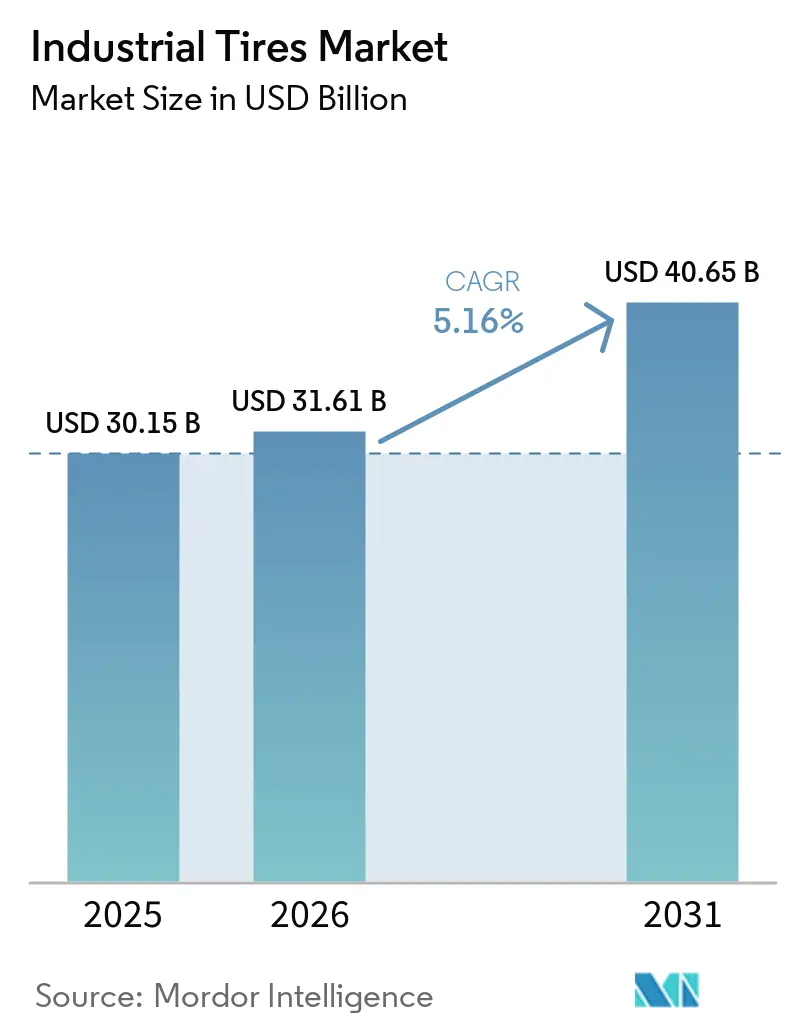
The industrial tires market size was valued at USD 30.15 billion in 2025 and is estimated to grow from USD 31.61 billion in 2026 to reach USD 40.65 billion by 2031, at a CAGR of 5.16% during the forecast period (2026-2031). Infrastructure spending, critical minerals extraction, and e-commerce logistics support demand across the industrial tires market, reducing reliance on any single equipment cycle. These demand sources follow different investment patterns, which limit the likelihood of a simultaneous decline in construction, mining, and warehouse equipment activity. Public construction programs in Asia and the Middle East provide longer visibility for original equipment fitment and replacement tire demand across several vehicle categories. Mining fleet expansion drives demand for larger, high-value tires, while warehouse automation shortens replacement cycles for material-handling equipment operating under intensive-duty conditions. Suppliers are responding by specializing in products, building service networks, adopting digital tire monitoring, and selectively investing in capacity to address premium applications and evolving fleet requirements.
Key Report Takeaways
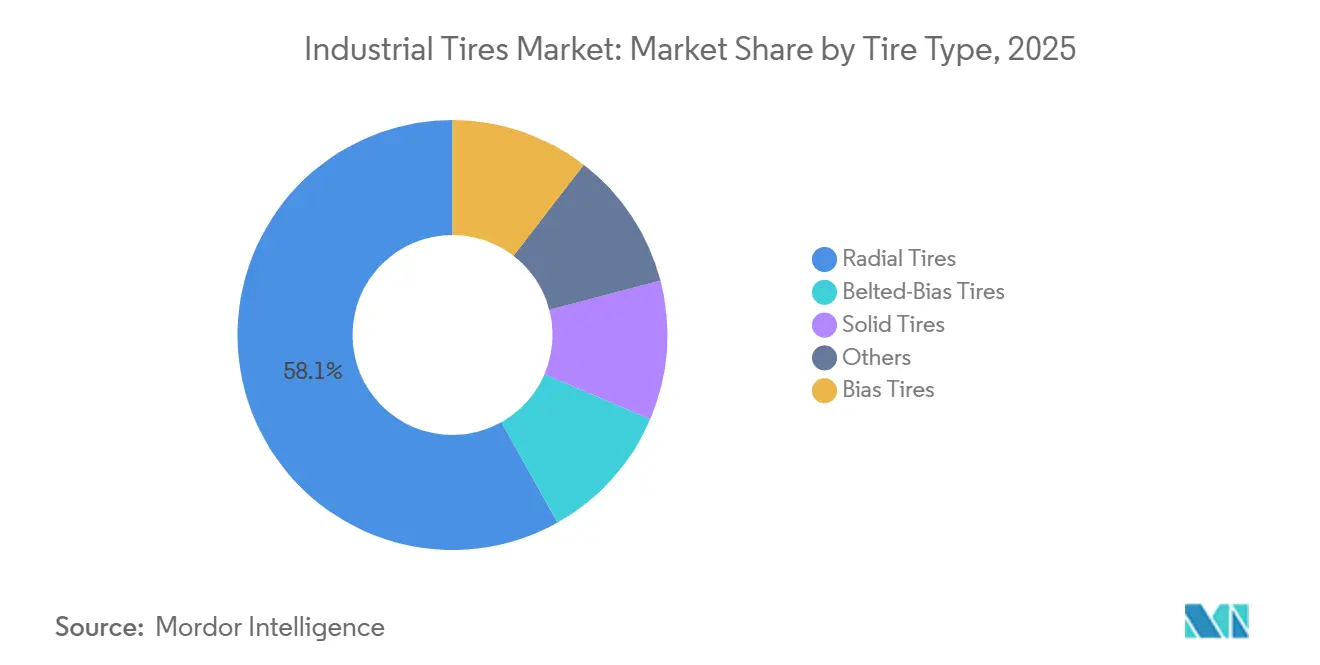
- By tire type, radial tires held 58.13% of global value in 2025 and are forecast to grow at a 5.84% CAGR through 2031.
- By application, construction accounted for 35.22% of the industrial tires market size in 2025, while mining is forecast to expand at a 6.23% CAGR through 2031.
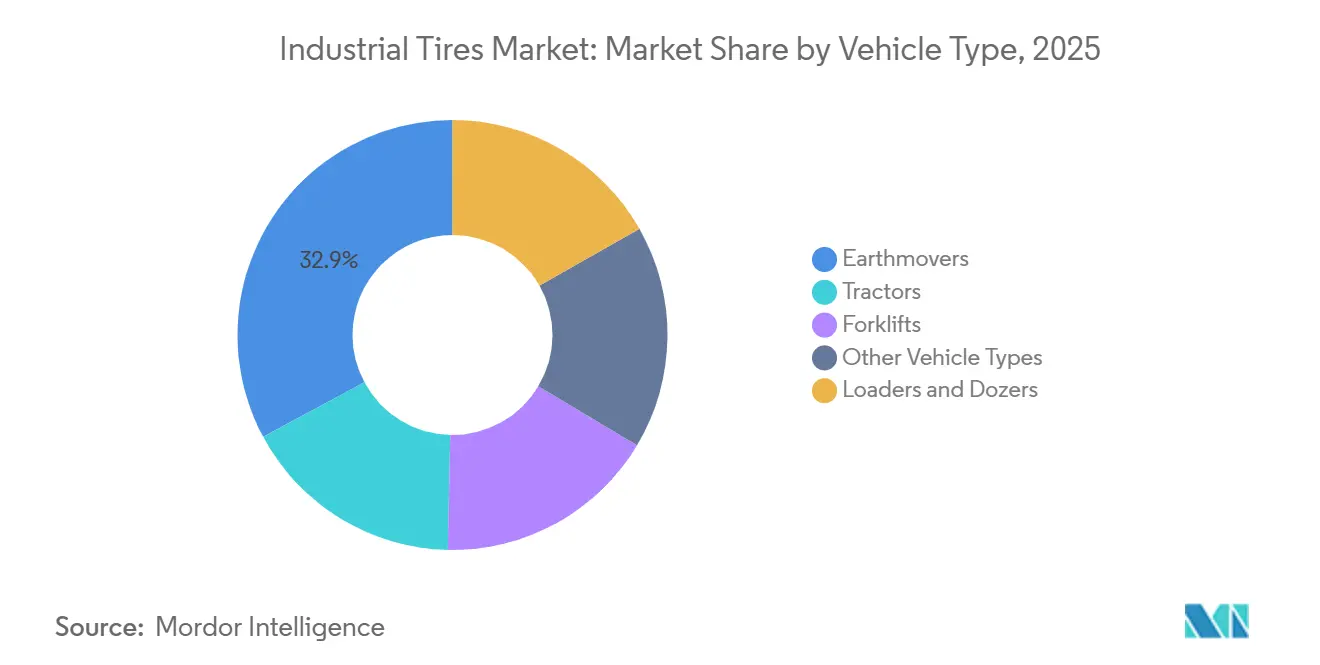
- By vehicle type, earthmovers held 32.85% of global value in 2025, while forklifts are forecast to advance at a 5.72% CAGR through 2031.
- By geography, Asia-Pacific accounted for 38.68% of global value in 2025 and is forecast to grow at a 6.06% CAGR through 2031.
Note: Market size and forecast figures in this report are generated using Mordor Intelligence’s proprietary estimation framework, updated with the latest available data and insights as of January 2026.
Global Industrial Tires Market Trends and Insights
Drivers Impact Analysis*
| Drivers | (~) % Impact on CAGR Forecast | Geographic Relevance | Impact Timeline |
|---|---|---|---|
| Infrastructure and Construction Equipment Investment | +1.30% | Global, concentrated in Asia-Pacific, the Middle East, and South America | Medium term (2-4 years) |
| Mining Fleet Expansion for Critical Minerals | +1.20% | Global, with the strongest pull in Latin America, Australia, and sub-Saharan Africa | Long term (≥ 4 years) |
| Warehouse Automation and Material-Handling Intensification | +0.90% | North America, Europe, and the Asia-Pacific logistics corridors | Short term (≤ 2 years) |
| Agricultural Mechanization in Emerging Economies | +0.70% | Asia-Pacific core, including India and Southeast Asia, with spillover to Latin America | Medium term (2-4 years) |
| Electrification-Driven Tire Redesign for Off-Highway Equipment | +0.50% | Global, with early gains in China, Northern Europe, and North America | Long term (≥ 4 years) |
| Source: Mordor Intelligence | |||
Infrastructure and Construction Equipment Investment
Government-backed infrastructure programs increase equipment utilization and support tire consumption in the industrial tires market across construction, quarrying, and road-building activities. India allocated USD 34.8 billion to the Ministry of Road Transport and Highways for fiscal year 2026-27, an 8% increase from the prior year. The ministry completed 5,313 km of national highways in fiscal year 2025-26, exceeding its target by 15%. Large programs give contractors greater confidence in maintaining active equipment fleets and support demand across original equipment and aftermarket channels. Data-center construction also increases demand for earthmovers and loaders, particularly at remote, land-intensive sites in North America and the Asia-Pacific. This work requires excavation, grading, and aggregate handling before a facility becomes operational, increasing the operating hours of tires used at the site. Quarry activity can therefore sustain off-the-road tire use even when residential and commercial construction remains constrained by financing costs.
Mining Fleet Expansion for Critical Minerals
Demand for copper, lithium, cobalt, and nickel supports a longer investment cycle for mining fleets and the industrial tires market. The International Energy Agency projects that demand for these minerals could double by 2030 under its Stated Policies Scenario and triple under its Net Zero Emissions by 2050 Scenario. Mine development requires investment in haul trucks, loaders, and support equipment before production output can rise. Harder rock and deeper excavation increase tire wear as accessible surface deposits are depleted over time. This raises tire consumption per machine-hour and increases the importance of a dependable supply of replacements at operating sites. BHP maintained capital expenditure guidance of USD 11 billion for each of fiscal years 2026 and 2027, with copper operations central to its program[1]BHP Group, “FY2025 Annual Report and Capital Expenditure Guidance,” BHP, bhp.com. In April 2025, Sailun's Maxam brand secured a 5-year agreement to supply tire solutions for Rio Tinto's 230-ton mining trucks at the Simandou project in Guinea.
Warehouse Automation and Material-Handling Intensification
E-commerce fulfillment operations run forklifts at higher utilization rates than conventional warehouses, supporting replacement demand in the industrial tires market. Fulfillment centers operate continuously and can increase forklift utilization by 35% to 50% compared with traditional warehouses. Greater operating intensity places more pressure on tread, sidewalls, and thermal performance throughout each tire's life. Automated guided vehicles and autonomous mobile robots require tighter tire dimensions and stronger thermal performance than manually operated forklifts. These requirements favor solid and radial tires over low-cost pneumatic products in many indoor applications where downtime can interrupt fulfillment schedules. European distribution centers also apply product requirements linked to EU Registration, Evaluation, Authorization and Restriction of Chemicals (REACH) rules for low-aromatic rubber compounds. Germany presents a concentrated opportunity, as electric forklift adoption and compliance requirements are both concentrated in the same logistics corridors.
Agricultural Mechanization in Emerging Economies
Agricultural mechanization expanded access to tractors in South and Southeast Asia and increased demand for industrial tires. Cooperative farming and government-supported custom hiring centers allow smaller farms to use machinery without adopting the large-farm model seen in North America. These arrangements broaden access to equipment and create recurring maintenance needs for fleets used by multiple farm operators. India's Sub-Mission on Agricultural Mechanization distributed more than 460,000 machines and established over 7,500 custom hiring centers. Vietnam's target of 50% mechanization by 2030, compared with a 2025 base of 28%, points to demand for small- and medium-diameter tractor tires. The Food and Agriculture Organization reported an 18% rise in tractor density across South and Southeast Asia between 2020 and 2024. This pattern creates demand at both value and premium price points, as equipment sizes, farming models, and procurement capacity vary across the region.
Restraints Impact Analysis*
| Restraints | (~) % Impact on CAGR Forecast | Geographic Relevance | Impact Timeline |
|---|---|---|---|
| Volatile Natural Rubber and Reinforcement Material Costs | -0.90% | Global, most acute in India, Southeast Asia, and Africa | Short term (≤ 2 years) |
| High Replacement Cost and Extended Premium-Tier Service Life | -0.50% | North America, Europe, and mature Asia-Pacific markets | Medium term (2-4 years) |
| Low-Cost and Counterfeit Tire Competition | -0.60% | Emerging markets in South and Southeast Asia, sub-Saharan Africa, and Latin America | Medium term (2-4 years) |
| Source: Mordor Intelligence | |||
Volatile Natural Rubber and Reinforcement Material Costs
Natural rubber supply responds slowly to demand because productive trees require long planting and maturation cycles. More than 40% of global rubber plantations consisted of trees older than 30 years, according to the Association of Natural Rubber Producing Countries. Older plantations limit supply responsiveness even when pricing makes additional production economically attractive. The association estimated natural rubber production growth of 0.5% in 2026, below demand growth of 1.3%, producing a 400,000-ton supply deficit. Higher oil prices can also increase synthetic rubber costs and reduce the scope for material substitution. Tire price increases can lag input-cost increases by 6 to 12 months, placing greater pressure on smaller and less integrated producers. These conditions can extend replacement decisions among price-sensitive fleet operators in the industrial tires market.
High Replacement Cost and Extended Premium-Tier Service Life
Longer tire service life reduces replacement frequency and can limit unit demand in the industrial tires market. Bridgestone had deployed its MASTERCORE tire technology at 100 mines globally by mid-2024[2]Bridgestone Corporation, “Bridgestone MASTERCORE Deployed at Approximately 100 Mines Globally,” Bridgestone, press.bridgestone-emea.com. Tire pressure monitoring systems from major suppliers can extend tire life by 10% to 15%. Longer service intervals improve fleet economics but reduce the number of replacement events, thereby stabilizing the installed fleet. Fleet managers facing volatile commodity prices may also defer nonessential replacements beyond recommended intervals. This behavior is more visible in North America and Australia, where procurement decisions emphasize total cost of ownership. Revenue can still grow through higher selling prices, although unit sales may be softer than value growth suggests.
*Our forecasts treat driver/restraint impacts as directional, not additive. The impact forecasts reflect baseline growth, mix effects, and variable interactions.
Segment Analysis
By Tire Type: Radial Construction Leads as Electrification Changes Requirements
Radial tires held 58.13% of the industrial tires market share in 2025 and are forecast to grow at a 5.84% CAGR through 2031. This reflects a long-running shift away from bias-ply construction across mining, construction, and material-handling fleets operating in demanding conditions. Radial designs offer lower fuel consumption, longer carcass life, and better heat dissipation than bias alternatives, which is significant as equipment operating hours and fuel costs remain elevated. The radial category is both the largest and fastest-growing tire type, combining established fleet use with a continuing shift in purchasing preferences.
Bias-ply tires remain relevant where rugged performance at low speeds and under high impact is more important than fuel efficiency, including in some underground mining settings and on heavy loaders operating on rough terrain. Solid tires are gaining use in enclosed warehouses, as eliminating puncture risk can outweigh the ride-comfort trade-off for vehicles operating on predictable indoor surfaces. Belted-bias tires retain a narrower role in agricultural and construction applications where rim sizes limit radial fitment, and operators require greater load-carrying capability. Electric off-highway machines deliver immediate torque from a standstill and increase bead and sidewall stresses, creating distinct design requirements for tire suppliers. In December 2025, Guizhou Tire Co., Ltd. launched its Dianqing electric-drive Off-The-Road (OTR) series, featuring reinforced carcass construction and heat-dissipating tread compounds for high-torque equipment.



By Application: Construction Leads by Value While Mining Drives Premium Demand
Construction accounted for 35.22% of the industrial tires market in 2025, making it the largest application by value. Government infrastructure commitments across Asia, the Middle East, and North America supported equipment activity when private construction slowed due to financing conditions. Wheel loaders, graders, dump trucks, excavators, and compactors generate demand across a wide range of tire sizes and service needs. This breadth of equipment supports stability and revenue resilience across both original equipment and replacement purchases.
Mining is forecast to grow at a 6.23% CAGR through 2031, the highest rate among the listed applications. Mining sites in hard rock or remote areas consume more tires per hour of equipment operation, making the geographic mix of mine development important for the industrial tires market. Expansion in West Africa, South America, and Central Asia can lift mining revenue beyond fleet-unit additions, as tire wear is higher in challenging operating conditions. Material handling is growing alongside logistics infrastructure and favors solid and radial forklift products for indoor use, where uptime is especially important. Agriculture provides steady unit demand as mechanization expands in South and Southeast Asia, although tire values in this segment remain below those in mining and construction. Larger cooperative-farming equipment is gradually raising agricultural value per unit, while smaller operators continue to require accessible products and distribution channels.
By Vehicle Type: Earthmovers Support Value While Forklifts Lead Growth
Earthmovers accounted for 32.85% of the industrial tires market share in 2025, supported by open-pit mining, road construction, and major port and dam projects. The category includes equipment with high tire values, particularly ultra-class mining trucks that require specialized products and dependable field support. Tires for mining trucks with rim diameters exceeding 49 inches can cost more than USD 80,000 per unit. Heavy equipment owners generally replace tires rather than retire capital-intensive machinery, making aftermarket demand a predictable revenue source in the earthmovers segment of the industrial tires market.
Loaders and dozers use similar tire specifications and depend on the same infrastructure and mining cycles, forming a large, closely related revenue block with earthmovers. Forklifts are forecast to grow at a 5.72% CAGR through 2031, supported by warehouse automation, electric forklift adoption, and more intensive material-handling operations. Electric forklifts weigh more due to battery mass and require tires that can handle higher static loads while maintaining lower rolling resistance. These requirements favor premium solid and radial tires over standard pneumatic products, particularly in high-throughput distribution settings. Tractors continue to see steady demand as equipment acquired during the 2020 to 2024 mechanization period reaches its first replacement cycle.
Geography Analysis
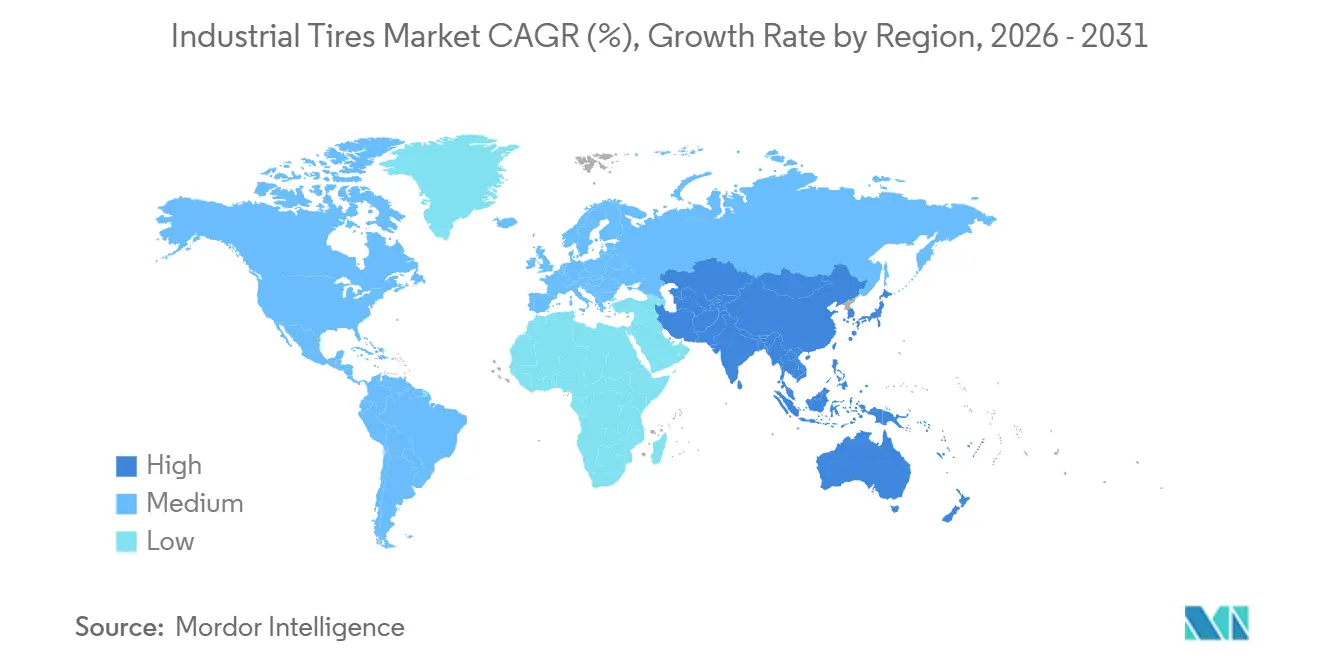
Asia-Pacific accounted for 38.68% of the industrial tires market in 2025 and is forecast to grow at a 6.06% CAGR through 2031. China remains a major producer and consumer of construction equipment, while India and Southeast Asia are increasingly central to regional demand growth. India's USD 34.8 billion road transport budget for fiscal year 2026-27 and its active highway program support demand for construction and earthmover tires. Indonesia, Vietnam, and the Philippines combine infrastructure investment with rising agricultural mechanization, creating demand across several tire applications.
North America's industrial tires market is more heavily dependent on replacement demand and value-focused purchasing. Public infrastructure funding, data-center development, and energy-transition projects support construction tire demand beyond housing activity. The U.S. critical-minerals initiative supports possible fleet expansion for lithium and rare-earth extraction in Nevada, Arizona, and Alaska. Europe's consumption reflects equipment renewal linked to industrial decarbonization and Stage V non-road emissions standards. Germany, France, and the Nordic countries show demand for tire pressure monitoring and predictive maintenance services, supporting premium pricing.
The Middle East and Africa combine construction-led and mining-led demand patterns. Saudi Arabia and the United Arab Emirates drive equipment demand through urban projects and Vision 2030 programs. South Africa, the Democratic Republic of the Congo, Zambia, and Ghana support mining tire demand through metals extraction. In September 2026, Ascenso introduced an all-steel radial OTR range at Electra Mining Africa in South Africa. Argentina's lithium areas and Chile's copper belt add fleet demand, while remote mines require reliable regional tire delivery programs.

Competitive Landscape
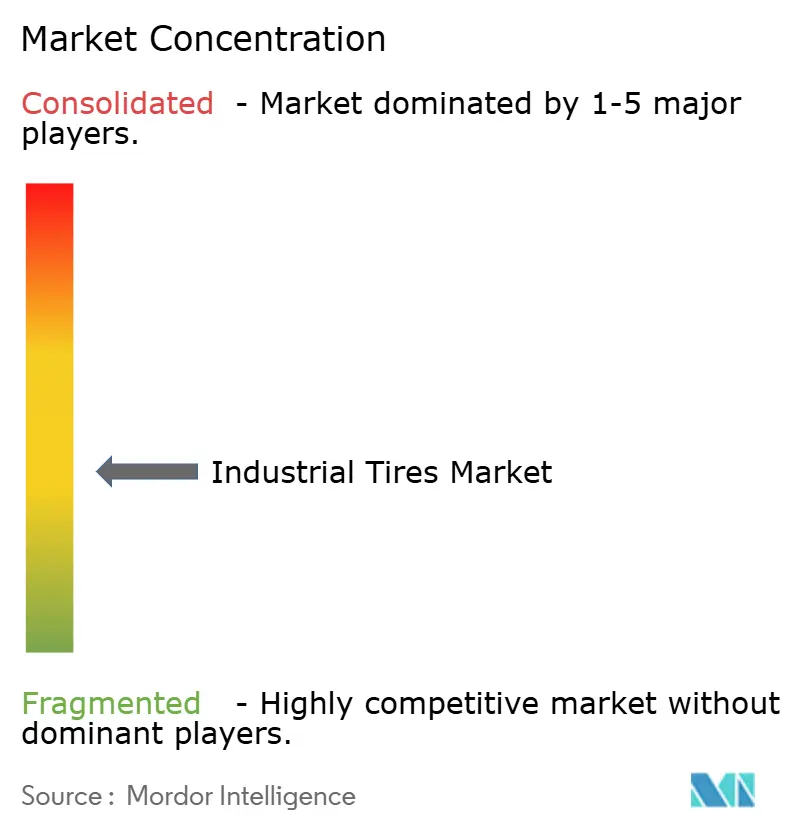
The industrial tires market is moderately fragmented at the premium end, where Bridgestone, Michelin, Continental, BKT, and Yokohama hold strong positions through compound technology, international service networks, and tire management platforms. These suppliers support demanding mining and construction fleets through product development, application advice, and established aftermarket coverage. Yokohama completed its acquisition of Goodyear's OTR tire business for USD 905 million in February 2025. The transaction expanded Yokohama's global OTR position, removed Goodyear as an independent OTR competitor, and reinforced the value of scale in large-fleet service.
Bridgestone invested JPY 25 billion (USD 166 million) in its Kitakyushu plant to enhance quality, improve eco-efficiency, and expand next-generation OTR compound capabilities. The investment favors premium value creation over expansion in lower-margin tire categories. Guizhou Tire's electric-drive OTR launch illustrates how suppliers are adapting carcass and tread construction for high-torque electric equipment. Pirelli signed a partnership with Univrses in April 2026 to develop Cyber Tire technology using AI-based computer vision.
Challenger strategies focus on distribution growth, improved compound expertise, and application specialization in the industrial tires market. Indian and Chinese suppliers are investing in technical capability to narrow the performance gap with established manufacturers, while retaining a position in value-oriented applications. Sailun's low-rolling-resistance Liquid Gold compound is one example of this approach to product development. The premium segment can sustain higher margins where durability, fitment performance, and digital services matter to customers. Value-tier suppliers remain important in price-sensitive construction and agricultural applications, particularly in emerging economies where buyers prioritize acquisition cost. Low-cost and counterfeit products can weaken premium pricing power in these markets, leaving room for both global suppliers and regional competitors with narrower price and application positions.
Industrial Tires Industry Leaders
Bridgestone Corporation
Michelin
The Goodyear Tire & Rubber Company
Continental AG
THE YOKOHAMA RUBBER CO., LTD.
- *Disclaimer: Major Players sorted in no particular order

Recent Industry Developments
- September 2026: Ascenso Tyres, in partnership with Royal Tyres, launched its All-Steel Radial Off-The-Road (OTR) tires in 25-inch to 49-inch sizes at Electra Mining Africa 2026 in South Africa. This marked Ascenso's entry into the ultra-large mining tire segment, reflecting the increasing competition that specialist manufacturers pose to established OTR brands.
- June 2026: Continental introduced two new earthmoving tires, the LD-Master Rock L5 and MPT 91, at Hillhead 2026. The launch was accompanied by an expanded Digital Solutions suite for tire pressure, temperature, and tread-wear monitoring, reinforcing Continental's strategy of combining hardware and digital services for quarry and construction fleets.


Global Industrial Tires Market Report Scope
Industrial tires are heavy-duty tires designed to support extreme loads and withstand harsh conditions in warehouses, factories, and construction sites. These tires are built to perform under demanding conditions, including exposure to rough surfaces, heavy loads, and continuous operational stress.
The industrial tires market is segmented by tire type, application, vehicle type, and geography. By tire type, the market is segmented into radial tires, bias tires, belted-bias tires, solid tires, and others. By application, the market is segmented into construction, mining, material handling, agriculture, and other applications. By vehicle type, the market is segmented into earthmovers, loaders and dozers, tractors, forklifts, and other vehicle types. The report also covers market size and forecasts for industrial tires across 15 countries in major regions. The market sizes and forecasts are provided in terms of value (USD).
| Radial Tires |
| Bias Tires |
| Belted-Bias Tires |
| Solid Tires |
| Others |
| Construction |
| Mining |
| Material Handling |
| Agriculture |
| Other Applications |
| Earthmovers |
| Loaders and Dozers |
| Tractors |
| Forklifts |
| Other Vehicle Types |
| Asia-Pacific | China |
| India | |
| Japan | |
| South Korea | |
| ASEAN Countries | |
| Rest of Asia-Pacific | |
| North America | United States |
| Canada | |
| Mexico | |
| Europe | Germany |
| United Kingdom | |
| France | |
| Italy | |
| NORDIC Countries | |
| Rest of Europe | |
| South America | Brazil |
| Argentina | |
| Rest of South America | |
| Middle East and Africa | Saudi Arabia |
| South Africa | |
| Rest of Middle East and Africa |
| By Tire Type | Radial Tires | |
| Bias Tires | ||
| Belted-Bias Tires | ||
| Solid Tires | ||
| Others | ||
| By Application | Construction | |
| Mining | ||
| Material Handling | ||
| Agriculture | ||
| Other Applications | ||
| By Vehicle Type | Earthmovers | |
| Loaders and Dozers | ||
| Tractors | ||
| Forklifts | ||
| Other Vehicle Types | ||
| By Geography | Asia-Pacific | China |
| India | ||
| Japan | ||
| South Korea | ||
| ASEAN Countries | ||
| Rest of Asia-Pacific | ||
| North America | United States | |
| Canada | ||
| Mexico | ||
| Europe | Germany | |
| United Kingdom | ||
| France | ||
| Italy | ||
| NORDIC Countries | ||
| Rest of Europe | ||
| South America | Brazil | |
| Argentina | ||
| Rest of South America | ||
| Middle East and Africa | Saudi Arabia | |
| South Africa | ||
| Rest of Middle East and Africa | ||


Key Questions Answered in the Report
What is current market size of Industrial Tires Market Market?
The industrial tires market size was valued at USD 30.15 billion in 2025 and is estimated to grow from USD 31.61 billion in 2026 to reach USD 40.65 billion by 2031, at a CAGR of 5.16% during the forecast period (2026-2031).
Which tire type leads industrial tire demand?
Radial tires led with 58.13% share in 2025 and are projected to grow at a 5.84% CAGR through 2031. Their fuel efficiency, carcass life, and heat performance support broad adoption across fleets.
Which application is growing fastest for industrial tires?
Mining is the fastest-growing application, with a projected 6.23% CAGR through 2031, supported by critical minerals extraction. Harder and more remote mining conditions can also increase tire usage per machine-hour.
Why are forklift tires becoming more important?
E-commerce fulfillment, warehouse automation, and electric forklift adoption raise operating intensity and favor durable, solid, and radial tire designs. Indoor fleets also require dependable tire performance to avoid operational interruptions.
Page last updated on:





