
Industrial Seals Market Size and Share
Market Overview
| Study Period | 2021 - 2031 |
|---|---|
| Market Size (2026) | USD 19.34 Billion |
| Market Size (2031) | USD 24.89 Billion |
| Growth Rate (2026 - 2031) | 5.17 % |
| Fastest Growing Market | Asia-Pacific |
| Largest Market | Asia-Pacific |
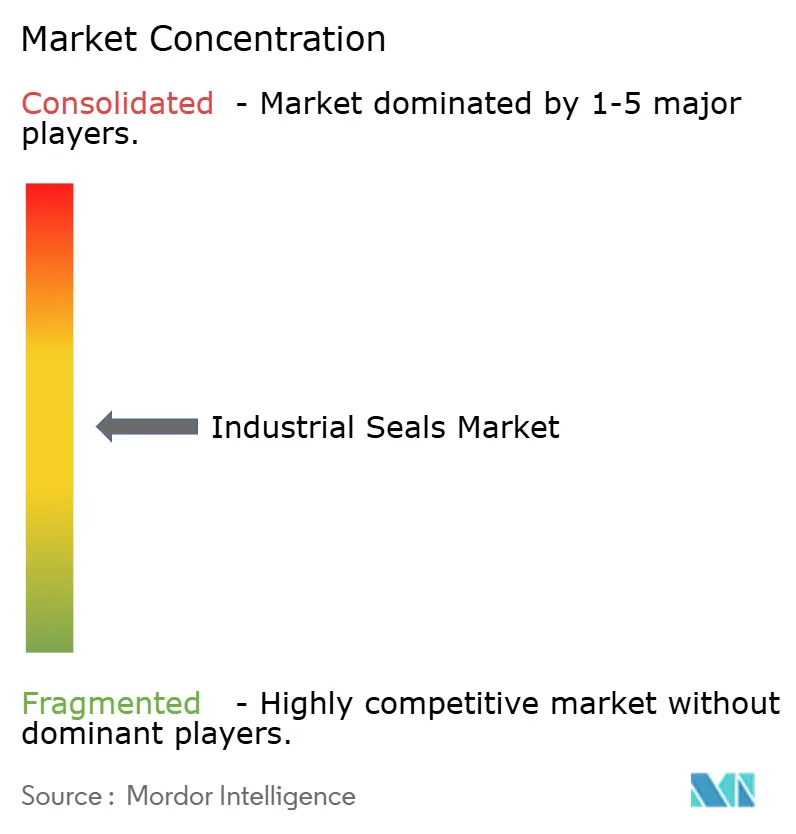
| Market Concentration | Medium |
Major Players *Disclaimer: Major Players sorted in no particular order Image © Mordor Intelligence. Reuse requires attribution under CC BY 4.0. | |
Industrial Seals Market Analysis by Mordor Intelligence
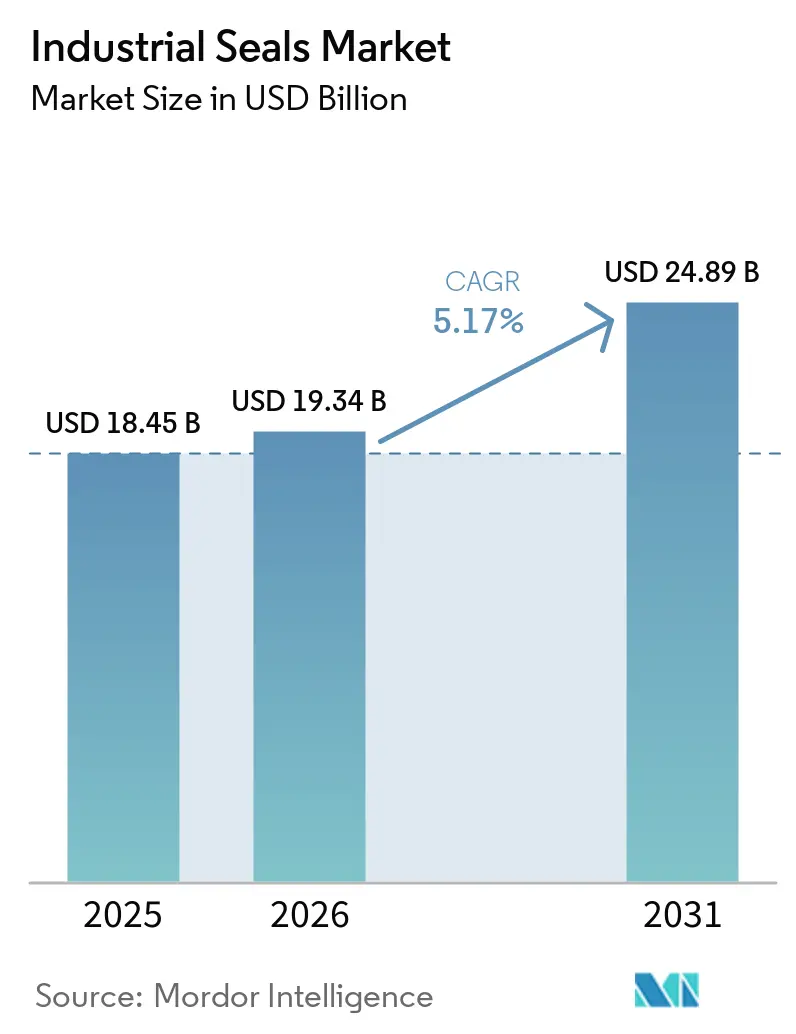
The industrial seals market size was estimated at USD 18.45 billion in 2025 and is estimated to grow from USD 19.34 billion in 2026 to USD 24.89 billion by 2031, at a CAGR of 5.17% during the forecast period (2026-2031). The industrial seals market is supported by automation upgrades in existing plants and evolving seal requirements in electric vehicles, as users seek products that can operate reliably in more closely monitored and specialized equipment across process and discrete manufacturing settings. These changes increase the value of many sealing assemblies, even where replacement quantities remain stable in mature applications, because operators select materials and designs for specific temperature, pressure, chemical, contamination-control, or maintenance conditions rather than purchasing a standard part solely on the basis of size. Suppliers place greater emphasis on engineered materials, qualification records, and condition-monitoring capabilities when competing for high-value applications, and also use service support and available inventory to strengthen customer relationships after the original product sale. This approach can improve aftermarket retention and reduce the ability of smaller suppliers to compete solely on price, particularly when a customer must maintain validated materials, established maintenance practices, dependable access to replacement parts, and continuity across multiple equipment locations. At the same time, alternative equipment designs and uneven access to specialty materials can limit demand for conventional products and add pressure on suppliers without established capabilities in the industrial seals market.
Key Report Takeaways
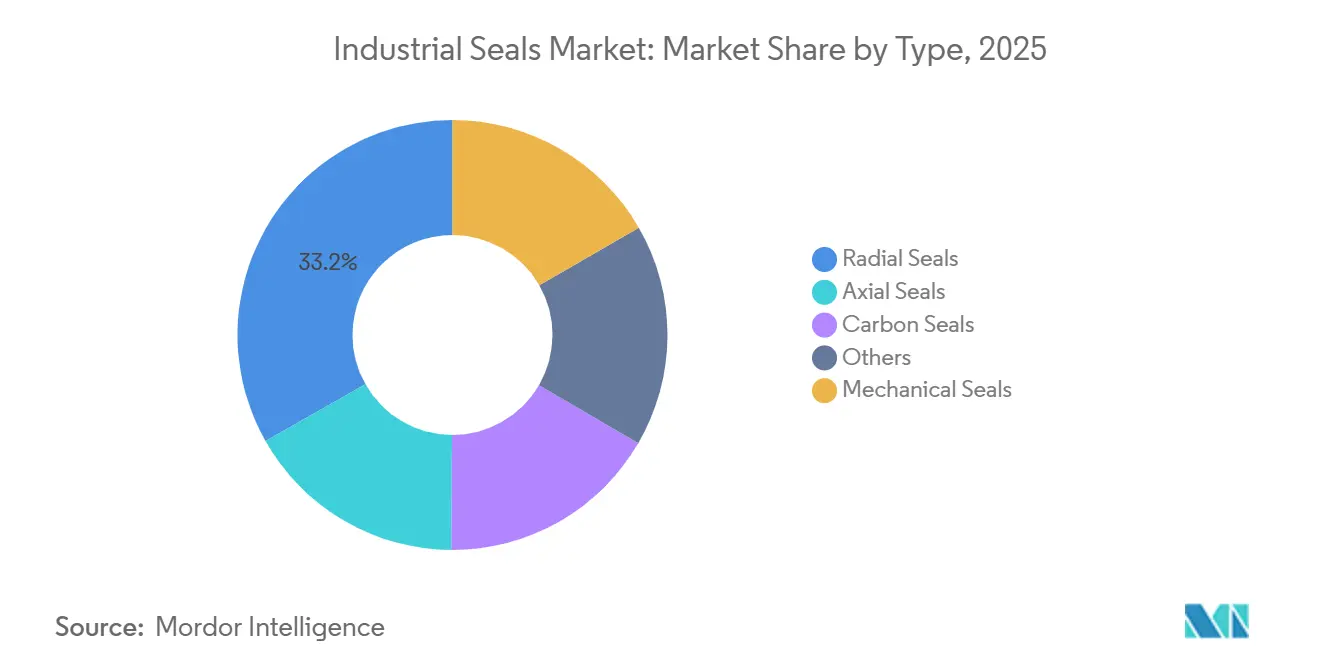
- By type, radial seals held 33.21% of the industrial seals market share in 2025, while mechanical seals are forecast to record the highest CAGR of 6.13% through 2031.
- By material, elastomer seals accounted for 40.34% of the industrial seals market share in 2025, while thermoplastic seals are expected to grow at a 6.26% CAGR through 2031.
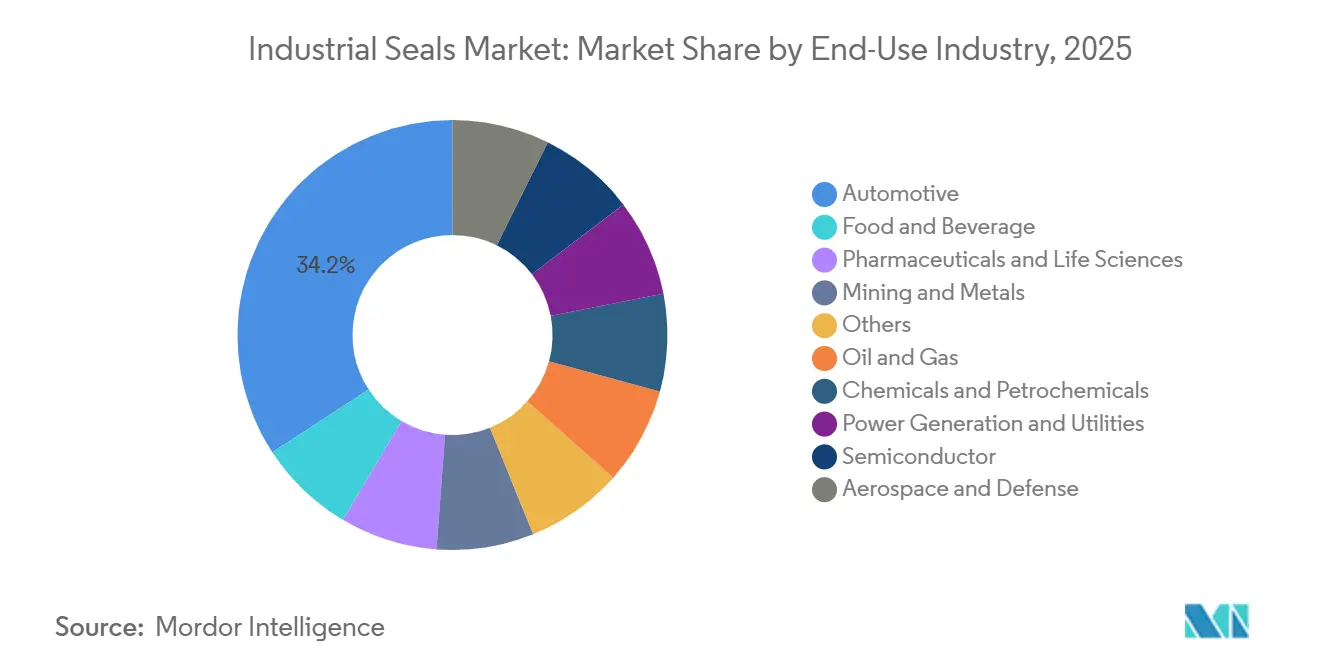
- By end-use industry, automotive accounted for 34.17% of global revenue in 2025, while semiconductor applications are projected to expand at a 6.73% CAGR through 2031.
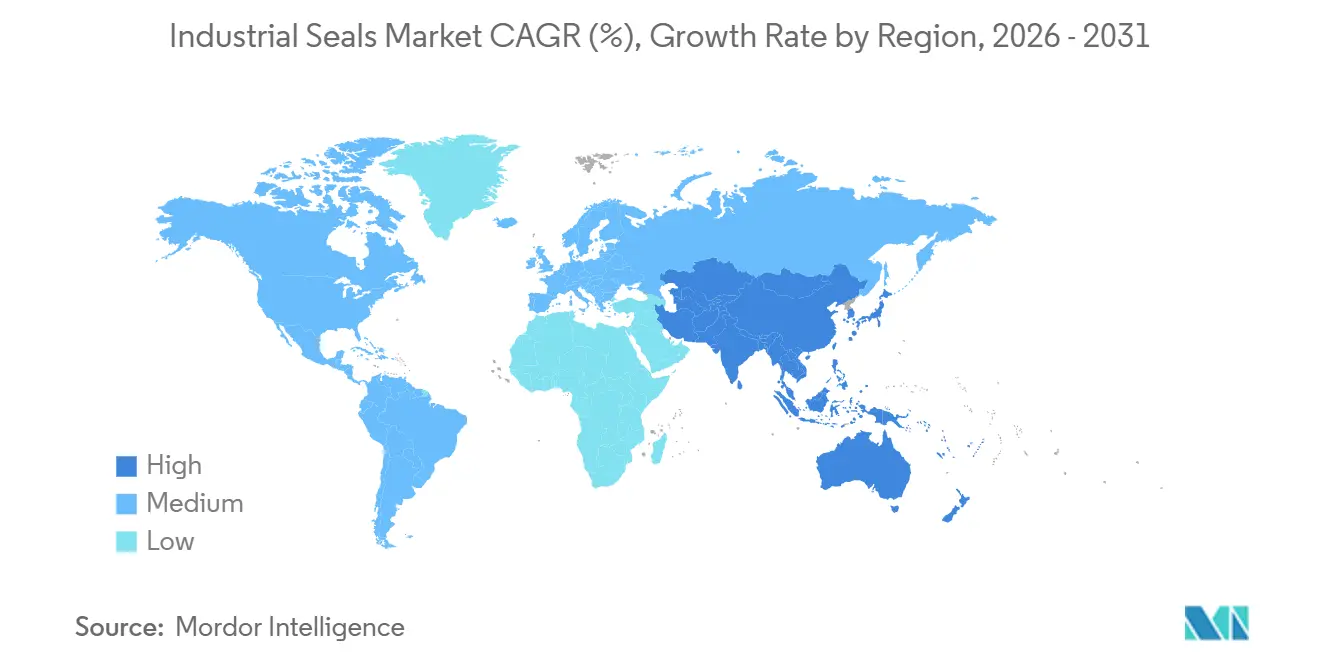
- By geography, Asia-Pacific accounted for 38.43% of global revenue in 2025 and is forecast to grow at a 5.86% CAGR through 2031.
Note: Market size and forecast figures in this report are generated using Mordor Intelligence’s proprietary estimation framework, updated with the latest available data and insights as of January 2026.
Global Industrial Seals Market Trends and Insights
Drivers Impact Analysis*
| Drivers | (~) % Impact on CAGR Forecast | Geographic Relevance | Impact Timeline |
|---|---|---|---|
| Industrial Automation and Brownfield Reliability Upgrades | +1.2% | Global, with higher intensity in Europe and East Asia | Medium term (2-4 years) |
| Electric Vehicle (EV) Battery, Thermal Management, and E-Powertrain Sealing | +1.4% | APAC core, with spillover to Europe and North America | Short term (≤ 2 years) |
| Semiconductor Fab Expansion and Aggressive Process Conditions | +0.9% | APAC core, Taiwan, South Korea, and Japan, with North America activity in Arizona and Texas | Long term (≥ 4 years) |
| Fugitive-Emission and Zero-Leakage Compliance | +0.7% | North America and the EU, with extension to APAC refining clusters | Medium term (2-4 years) |
| Hydrogen, Liquefied Natural Gas (LNG), and Green-Ammonia Infrastructure | +0.6% | Europe, APAC, and MENA | Long term (≥ 4 years) |
| Source: Mordor Intelligence | |||
Industrial Automation and Brownfield Reliability Upgrades
Automation retrofits in older process plants are creating a replacement cycle that conventional capital expenditure plans may not fully capture, particularly where assets were designed around periodic inspections rather than continuous condition monitoring. Reliability programs add sensors, variable-speed drives, and condition-monitoring systems to rotating assets that already have many years of operating history and may include equipment of varying vintages. These programs often require upgraded dynamic sealing components rather than simple like-for-like replacements, because the revised equipment operates under more closely observed conditions and operators seek to reduce unplanned maintenance events. Better instrumentation identifies deterioration that earlier maintenance schedules may not have detected until a failure, a planned shutdown, or a production-quality issue occurs. The Fraunhofer DigiSeal project applies AI and operational knowledge to mechanical-seal maintenance, with the stated aim of extending service life and reducing unexpected failures[1]Fraunhofer Institute for Electronic Microsystems and Solid-State Technologies, “Project DigiSeal Predictive Maintenance Through Informed AI,” Fraunhofer Institute for Electronic Microsystems and Solid-State Technologies, fraunhofer.de. The initial retrofit specification can shift operators toward higher-value parts and later support service arrangements, giving the industrial seals market a more application-led replacement pattern across the installed base.
EV Battery, Thermal Management, and E-Powertrain Sealing
Electric vehicle platforms require seals for battery enclosures, cooling circuits, e-motor shaft interfaces, and power electronics housings, rather than relying solely on the established requirements of internal-combustion powertrains. Each location presents different requirements for thermal movement, dielectric fluids, moisture protection, chemical exposure, and long service life over repeated operating cycles. These needs introduce specialized sealing points that were less relevant in conventional vehicle layouts, even though several conventional oil-seal applications may decline as drivetrains change. The industrial seals market therefore gains new specification opportunities, while internal combustion vehicles continue to drive replacement demand from their large installed base. Material traceability and documented performance favor suppliers with established material libraries, validated production processes, and the ability to support customer qualification work from design through production. Trelleborg Sealing Solutions introduced CellXPro in 2025 as a battery-cell sealing technology designed for chemical resistance and demanding thermal conditions, reflecting the company's product focus in this segment of the industrial seals market.
Semiconductor Fab Expansion, Hydrogen, LNG, and Green-Ammonia Infrastructure
Semiconductor equipment uses seals in high-vacuum, process-gas, and wet-chemistry environments, where standard industrial materials may be unsuitable and where contamination control is central to equipment performance. This equipment operates under conditions involving aggressive chemicals, low contamination tolerance, and tightly controlled processes that place demanding requirements on sealing materials and surface quality. Validated compounds can remain in place for extended periods because a replacement material or design must undergo a separate qualification process before use in a sensitive chamber or process line. This requirement provides qualified suppliers with recurring replacement demand throughout the operating life of process equipment, and underscores the importance of material consistency, documented manufacturing, and reliable availability. Hydrogen, LNG, and green-ammonia equipment add a related need for low-permeation, chemically resistant, and pressure-capable materials that retain performance over time. A peer-reviewed study found that polytetrafluoroethylene (PTFE) and fluorocarbon rubber (FKM) specimens met relevant tensile-property tolerances under controlled hydrogen-exposure conditions, supporting their suitability for hydrogen-transmission service. These demanding applications support a longer-term role for specialty polymers and high-value designs in the industrial seals market, even where related project cycles are longer than standard maintenance cycles.
Fugitive-Emission and Zero-Leakage Compliance
Emission-control requirements are converting many seal upgrades from discretionary purchases into compliance-driven investments at oil, gas, chemical, and refining sites, where operators must document their approach to controlling releases. The U.S. Environmental Protection Agency finalized 40 Code of Federal Regulations (CFR) Part 60 Subpart in 2024, including monitoring and repair requirements for emissions from affected oil and natural gas sources. Pump seals are among the equipment components that operators review as part of broader leak-detection and repair programs, alongside valves, connectors, and other relevant process equipment. Dual-seal and dry-gas-seal arrangements can replace simpler configurations where sites require improved leakage performance and clearer maintenance documentation. European and Asian compliance frameworks reinforce the shift toward premium sealing in process facilities that require documented control of fugitive emissions and reliable operation. This regulatory environment can make demand for part of the industrial seals market less dependent on discretionary expansion and more tied to maintenance deadlines, monitoring requirements, and defined corrective actions.
Restraints Impact Analysis*
| Restraints | (~) % Impact on CAGR Forecast | Geographic Relevance | Impact Timeline |
|---|---|---|---|
| Seal-Less Pumps and Adhesive-Bonded EV Battery Closures | -0.5% | Global, including chemical, pharmaceutical, and EV manufacturing | Short term (≤ 2 years) |
| Specialty Fluoropolymer and Silicon-Carbide Supply Volatility | -0.4% | Global, including semiconductor, EV, and chemical process industries | Short term (≤ 2 years) |
| Long Qualification Cycles for New Compounds and Designs | -0.3% | Global, including oil and gas, semiconductors, and aerospace | Long term (≥ 4 years) |
| Source: Mordor Intelligence | |||
Seal-Less Pumps and Adhesive-Bonded EV Battery Closures
Sealless magnetic-drive pumps can replace conventional mechanical seals in selected hazardous-fluid applications, particularly where equipment design prioritizes containment over access for seal maintenance. Their relevance is greatest in chemical, pharmaceutical, and semiconductor operations where containment, process safety, and emissions control are central design considerations. Flowserve introduced the INNOMAG TB-MAG Dual Drive Pump in March 2025 as a sealless magnetic-drive product with dual hermetic containment. This product demonstrates that established sealing suppliers also participate in equipment designs that eliminate the need for conventional seals in specific pump applications, rather than treating such designs solely as external competition. In electric vehicles, certain cell-to-pack designs use structural adhesives for battery closures and partially replace discrete perimeter-sealing components in selected enclosure configurations. These approaches are not universal, but they can reduce conventional seal content in selected designs while subjecting remaining seals to stricter performance requirements for temperature, chemical exposure, and protection.
Specialty Material Volatility and Long Qualification Cycles
Specialty fluoropolymers and silicon carbide components can face supply disruptions, fluctuating input costs, and limited availability of certain grades approved for high-performance sealing applications. Producers without material integration or long-term supply arrangements may face greater pressure on delivery performance, manufacturing schedules, and margins when those materials become harder to obtain. This concern is most acute in semiconductor, electric vehicle, and chemical-process applications that require advanced materials and cannot easily change specifications after a product has been validated. Long qualification periods create a separate limitation, as replacement compounds and new designs may require extensive validation for oil and gas, semiconductor, and aerospace applications before users can accept them. Qualification protects incumbents once a product is approved, but it also slows new product introductions and limits end users' flexibility during supply disruptions. The result is a more cautious purchasing and design process across the high-performance industrial seals market, with greater importance placed on approved sources and material continuity.
*Our forecasts treat driver/restraint impacts as directional, not additive. The impact forecasts reflect baseline growth, mix effects, and variable interactions.
Segment Analysis
By Type: E-Powertrain and Process Automation Drive Format Divergence
Radial seals held 33.21% of global revenue in 2025, reflecting their use on pump shafts, motor bearings, gearbox outputs, and other rotating interfaces. Their installed base supports repeat replacement demand across automotive manufacturing, process plants, and general industrial machinery, where routine wear and fluid retention remain core maintenance concerns. Oil and gas, power generation, and conventional vehicle production remain important sources of orders, as each operates large populations of rotating assets with established service intervals. Axial seals serve thrust-loading applications, including steering columns and axial compressors, where movement occurs along the shaft and design requirements differ from those of radial arrangements. Carbon seals are used in specialized aerospace and high-speed turbomachinery settings where thermal and centrifugal conditions can be demanding, resulting in a narrower application scope but more exacting requirements.
The other category includes hybrid geometries for e-axles that experience radial and axial loads simultaneously. This group remains smaller but is receiving development attention because electric drive systems can combine several load conditions in compact packages, creating room for customized designs. Mechanical seals are the fastest-growing type, with a forecast CAGR of 6.13% from 2026 to 2031. Semiconductor and hydrogen infrastructure projects support their use in demanding process environments that favor engineered faces, carefully selected materials, and validated manufacturing processes. In 2025, John Crane introduced a coke-resistant non-contacting gas-lubricated seal that reduced energy use by 90%-95% compared with a legacy configuration and limited replacement downtime to one day.



By Material: High-Performance Polymers Capture Disproportionate Value
Elastomer seals accounted for 40.34% of global revenue in 2025. Fluorocarbon rubber (FKM), Ethylene Propylene Diene Monomer (EPDM), and Nitrile Butadiene Rubber (NBR) serve automotive, HVAC, oil and gas, and food-processing applications by providing a balance between cost, flexibility, and performance across a wide range of equipment. Their broad installed base supports repeat demand across many maintenance cycles and equipment categories, including applications that do not require specialty polymers or metal designs. Metal seals are used in high-pressure and high-temperature refinery and aerospace applications where elastomers may not provide sufficient resistance or long-term dimensional stability. Composite seals are relevant when a single material cannot meet the thermal, pressure, and chemical requirements of an application, allowing suppliers to tailor designs for more specialized duties.
Thermoplastic seals are expected to record a 6.26% CAGR from 2026 to 2031. Polytetrafluoroethylene (PTFE) and Polyether Ether Ketone (PEEK) designs address cryogenic hydrogen service, ultra-high-vacuum semiconductor chambers, and aggressive fluid-handling equipment where conventional elastomers may be insufficient. The industrial seals market for thermoplastic products is supported by requirements for low permeation, chemical durability, and stable performance under demanding operating conditions over extended service periods. Controlled hydrogen testing found that PTFE and FKM met the cited tensile-property tolerance under the specified test conditions. Material supply arrangements can increasingly influence competition among premium polymer seal suppliers, as approved materials cannot be changed quickly and users may require continuity throughout qualification and operation.
By End-Use Industry: Semiconductor Momentum Revalues the Segment Mix
Automotive end users accounted for 34.17% of global revenue in 2025. Global vehicle production and higher sealing content in many electric vehicle systems support this position across both original equipment and replacement channels, including platforms that require dedicated seals for battery and thermal management components. Oil and gas, chemicals and petrochemicals, and power generation also generate large orders through planned maintenance, reliability upgrades, and compliance work on existing equipment fleets. Pharmaceuticals and life sciences, food and beverages, and mining require application-specific certifications or performance attributes that influence supplier selection and discourage direct substitution. Aerospace and defense have long qualification cycles that can support durable relationships between users and qualified seal suppliers, even when procurement figures are lower than in automotive applications.
Semiconductor applications are projected to be the fastest-growing end-use category, with a 6.73% CAGR through 2031. Wafer processing equipment requires FFKM and specialty thermoplastic seals for demanding process conditions involving vacuum, reactive gases, wet chemistry, and strict contamination control. Qualification on a process-tool generation can create recurring replacement business over the equipment life, which affects the industrial seals market beyond the first component sale and supports supplier continuity. Mining and metals remain important in Latin America, Australia, and Southern Africa, where abrasion resistance and service life in slurry handling can take priority over chemical compatibility. These varied end-use requirements keep the segment mix tied to both high-volume maintenance activity and smaller, higher-value applications with more exacting specifications.
Geography Analysis
Asia-Pacific accounted for 38.43% of global revenue in 2025 and is forecast to grow at a 5.86% CAGR through 2031. China supports regional demand through chemical processing, domestic semiconductor development, and vehicle production, which together create requirements across both standard and specialty sealing applications. Japan remains important for precision sealing materials and semiconductor-grade fluoropolymers, while South Korea adds demand from its semiconductor manufacturing base and related equipment supply chain. The region combines large end-user production centers with suppliers of advanced materials and process equipment, supporting a varied demand base for the industrial seals market. India is a greenfield location for manufacturing investment, including a Trelleborg Sealing Solutions campus in Bengaluru, announced in April 2026, that will cover PTFE products, mechanical face seals, rotary shaft seals, polyurethane solutions, and research and testing activities.
North America and Europe form the second-largest demand cluster for the industrial seals market. Older industrial assets and compliance-driven replacement programs support demand for premium products in both regions, while the installed base generates demand for aftermarket service, maintenance support, and solutions that help operators manage equipment reliability. In North America, EPA requirements drive attention to lower-leakage configurations in refining and midstream gas operations. Canada and Mexico add demand linked to oil sands, petrochemicals, and nearshore supply strategies, with customers seeking dependable supply for both new projects and existing operations[2]U.S. Environmental Protection Agency, “Small Entity Compliance Guide for Oil and Natural Gas Sector Emission Standards for New, Reconstructed, and Modified Sources,” U.S. Environmental Protection Agency, epa.gov. In Europe, hydrogen infrastructure requires systems capable of handling rapid gas decompression and high-pressure service, while European Industrial Gases Association (EIGA) Document 261 sets out requirements for hydrogen piping at user locations.
South America, the Middle East, and Africa account for smaller revenue pools but often require higher-value systems. Brazil supports demand through sugar-ethanol operations and deepwater oil and gas activity, while Argentina contributes chemical processing and mining demand that may require application-specific equipment support. Saudi Arabian conversion programs and carbon-capture investment create demand for specialized packages, while South African mining requires slurry-resistant mechanical seals in high-wear operating environments. Long logistics routes to offshore and remote sites can favor durable, high-specification parts over the lowest initial-cost option, as unplanned replacement can be difficult, expensive, and disruptive to plant operations. Trelleborg opened a dedicated aerospace facility in Casablanca in June 2026 to manufacture polymer seals and engine components for Boeing and Airbus.

Competitive Landscape
The industrial seals market is moderately fragmented. Key competitors include John Crane, EagleBurgmann, Freudenberg Sealing Technologies, Flowserve Corporation, Trelleborg AB, Parker Hannifin, and AESSEAL, which compete on application engineering, material qualifications, and aftermarket reach. Their market positions are supported by experience across demanding process environments, established relationships with equipment users, and the ability to supply products across multiple industrial locations. Larger suppliers are expanding in Asia-Pacific and MENA, where industrial investment and supply chain diversification are creating opportunities for local capacity, shorter delivery times, and closer customer support. These suppliers are also pursuing adjacent filtration and flow-control activities to broaden customer relationships beyond individual seal sales and support more complete maintenance offerings. In August 2026, Parker Hannifin Corporation completed the acquisition of Filtration Group Corporation for USD 9.25 billion, expanding its filtration and sealing aftermarket platform.
Sensor-integrated seals remain a developing area, as many process plants continue to monitor rotating equipment using external sensors rather than embedded seal systems. Fraunhofer's DigiSeal work demonstrates how predictive maintenance can integrate mechanical seal data with operational knowledge. This approach may increase the importance of service capability, as suppliers would need to support both the physical component and the interpretation of operating data. Hydrogen service represents another materials development area, requiring suppliers to address rapid gas decompression, cryogenic conditions, and low permeation within a single product, which may require specialized compounds and detailed validation. In 2026, Flowserve KSM received a U.S. patent for a silicon-carbide sealing member with dispersed graphite, reflecting continued materials development for demanding applications. Flowserve also completed its acquisition of Trillium Flow Technologies' Valves Division in 2026 for USD 490 million, extending its flow-control position in nuclear power and critical infrastructure.
Regional suppliers in ASEAN, South Korea, and India are becoming more competitive in mid-tier applications by combining shorter lead times and lower costs with improved American Petroleum Institute (API) 682 qualifications. This creates competitive pressure in applications that do not require the most advanced materials or the broadest global service network. Their local presence can be an advantage when customers require responsive delivery and service for routine industrial needs. Global suppliers retain advantages in compound development, precision machining, qualification records, and broad aftermarket support. Digital monitoring platforms can make suppliers more difficult to replace once installed, keeping specialty applications more concentrated than standard replacement products. As a result, competition in the industrial seals market varies considerably by application, customer qualification requirements, and the cost of equipment downtime.
Industrial Seals Industry Leaders
John Crane
Freudenberg Sealing Technologies
Trelleborg AB
SKF
Flowserve Corporation
- *Disclaimer: Major Players sorted in no particular order

Recent Industry Developments
- August 2026: Parker Hannifin Corporation completed the acquisition of Filtration Group Corporation for USD 9.25 billion. The deal expands Parker's filtration and sealing aftermarket platform, extending its reach across aerospace, semiconductor, and industrial markets and reinforcing cross-selling synergies between precision sealing and filtration system maintenance.
- February 2026: Flowserve Corporation entered into a definitive agreement to acquire Trillium Flow Technologies' Valves Division for USD 490 million and subsequently completed the transaction. The acquisition broadened Flowserve's sealing and flow-control offering into nuclear power and critical infrastructure, where regulatory qualification cycles support multi-decade aftermarket revenue visibility.


Global Industrial Seals Market Report Scope
Industrial seals are mechanical devices or materials used to close gaps between stationary and moving parts in machinery. They prevent fluid or gas leaks and block external contaminants such as dust and dirt.
The industrial seals market is segmented by type, material, end-user industry, and geography. By type, the market is segmented into radial seals, mechanical seals, axial seals, carbon seals, and others. By material, the market is segmented into elastomer seals, thermoplastic seals, metal seals, composite seals, and others. By end-user industry, the market is segmented into automotive, oil and gas, chemicals and petrochemicals, power generation and utilities, semiconductor, aerospace and defense, food and beverage, pharmaceuticals and life sciences, mining and metals, and others. The report also covers market size and forecasts for the industrial seals across 15 countries in major regions. The market sizes and forecasts are provided in terms of value (USD).
| Radial Seals |
| Mechanical Seals |
| Axial Seals |
| Carbon Seals |
| Others |
| Elastomer Seals |
| Thermoplastic Seals |
| Metal Seals |
| Composite Seals |
| Others |
| Automotive |
| Oil and Gas |
| Chemicals and Petrochemicals |
| Power Generation and Utilities |
| Semiconductor |
| Aerospace and Defense |
| Food and Beverage |
| Pharmaceuticals and Life Sciences |
| Mining and Metals |
| Others |
| Asia-Pacific | China |
| India | |
| Japan | |
| South Korea | |
| ASEAN Countries | |
| Rest of Asia-Pacific | |
| North America | United States |
| Canada | |
| Mexico | |
| Europe | Germany |
| United Kingdom | |
| France | |
| Italy | |
| NORDIC Countries | |
| Rest of Europe | |
| South America | Brazil |
| Argentina | |
| Rest of South America | |
| Middle East and Africa | Saudi Arabia |
| South Africa | |
| Rest of Middle East and Africa |
| By Type | Radial Seals | |
| Mechanical Seals | ||
| Axial Seals | ||
| Carbon Seals | ||
| Others | ||
| By Material | Elastomer Seals | |
| Thermoplastic Seals | ||
| Metal Seals | ||
| Composite Seals | ||
| Others | ||
| By End-Use Industry | Automotive | |
| Oil and Gas | ||
| Chemicals and Petrochemicals | ||
| Power Generation and Utilities | ||
| Semiconductor | ||
| Aerospace and Defense | ||
| Food and Beverage | ||
| Pharmaceuticals and Life Sciences | ||
| Mining and Metals | ||
| Others | ||
| By Geography | Asia-Pacific | China |
| India | ||
| Japan | ||
| South Korea | ||
| ASEAN Countries | ||
| Rest of Asia-Pacific | ||
| North America | United States | |
| Canada | ||
| Mexico | ||
| Europe | Germany | |
| United Kingdom | ||
| France | ||
| Italy | ||
| NORDIC Countries | ||
| Rest of Europe | ||
| South America | Brazil | |
| Argentina | ||
| Rest of South America | ||
| Middle East and Africa | Saudi Arabia | |
| South Africa | ||
| Rest of Middle East and Africa | ||


Key Questions Answered in the Report
What is current market size of Industrial Seals Market?
The industrial seals market size was estimated at USD 18.45 billion in 2025 and is estimated to grow from USD 19.34 billion in 2026 to USD 24.89 billion by 2031, at a CAGR of 5.17% during the forecast period (2026-2031).
Which product type is expected to grow fastest?
Mechanical seals are projected to grow at a 6.13% CAGR through 2031, supported by semiconductor and hydrogen applications. Within the industrial seals market, these applications favor engineered products where performance, validation, maintenance outcomes, process conditions, and the ability to operate in difficult environments matter more than the cost of a basic replacement component.
Which material category has the highest growth outlook?
Thermoplastic seals are forecast to expand at a 6.26% CAGR through 2031 because polytetrafluoroethylene (PTFE) and polyether ether ketone (PEEK) are well-suited to demanding chemical, vacuum, and hydrogen applications.
Which end-use application has the highest forecast growth?
Semiconductor applications are expected to record a 6.73% CAGR through 2031, reflecting specialized equipment requirements and qualification-led replacement demand.
Page last updated on:





