
Industrial Gaskets Market Size and Share
Market Overview
| Study Period | 2021 - 2031 |
|---|---|
| Market Size (2026) | USD 13.22 Billion |
| Market Size (2031) | USD 17.05 Billion |
| Growth Rate (2026 - 2031) | 5.23 % |
| Fastest Growing Market | Asia-Pacific |
| Largest Market | Asia-Pacific |
| Market Concentration | Low |
Major Players *Disclaimer: Major Players sorted in no particular order Image © Mordor Intelligence. Reuse requires attribution under CC BY 4.0. | |
Industrial Gaskets Market Analysis by Mordor Intelligence
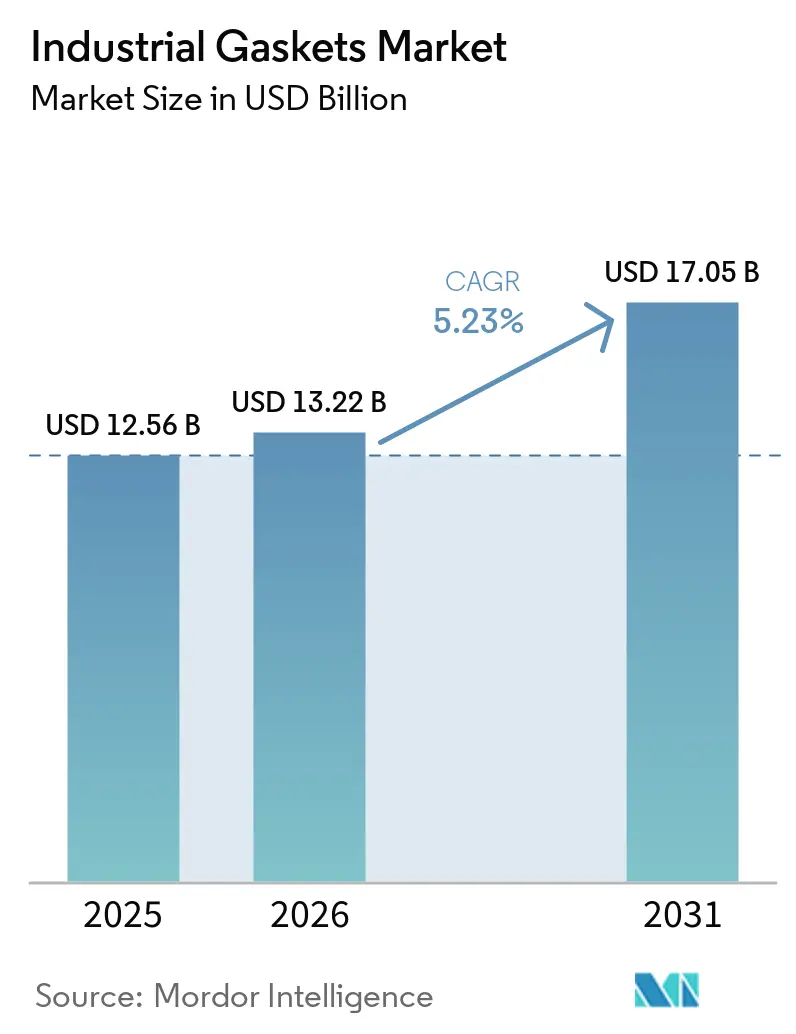
The Industrial Gaskets Market size was valued at USD 12.56 billion in 2025 and is estimated to grow from USD 13.22 billion in 2026 to reach USD 17.05 billion by 2031, at a CAGR of 5.23% during the forecast period (2026-2031). Demand is increasingly shaped by refinery and petrochemical projects, where initial equipment installation creates procurement beyond the routine maintenance cycle. Emission control rules are also moving plant operators toward sealing systems that can meet stricter leak-management expectations. Suppliers are responding by adding certified specialty materials, field services, and monitoring capabilities to their product portfolios. Demand from chemical processing, hydrogen systems, and Liquefied Natural Gas (LNG) infrastructure supports a shift toward higher-value applications. Material availability and reformulation requirements remain important constraints for producers and end users.
Key Report Takeaways
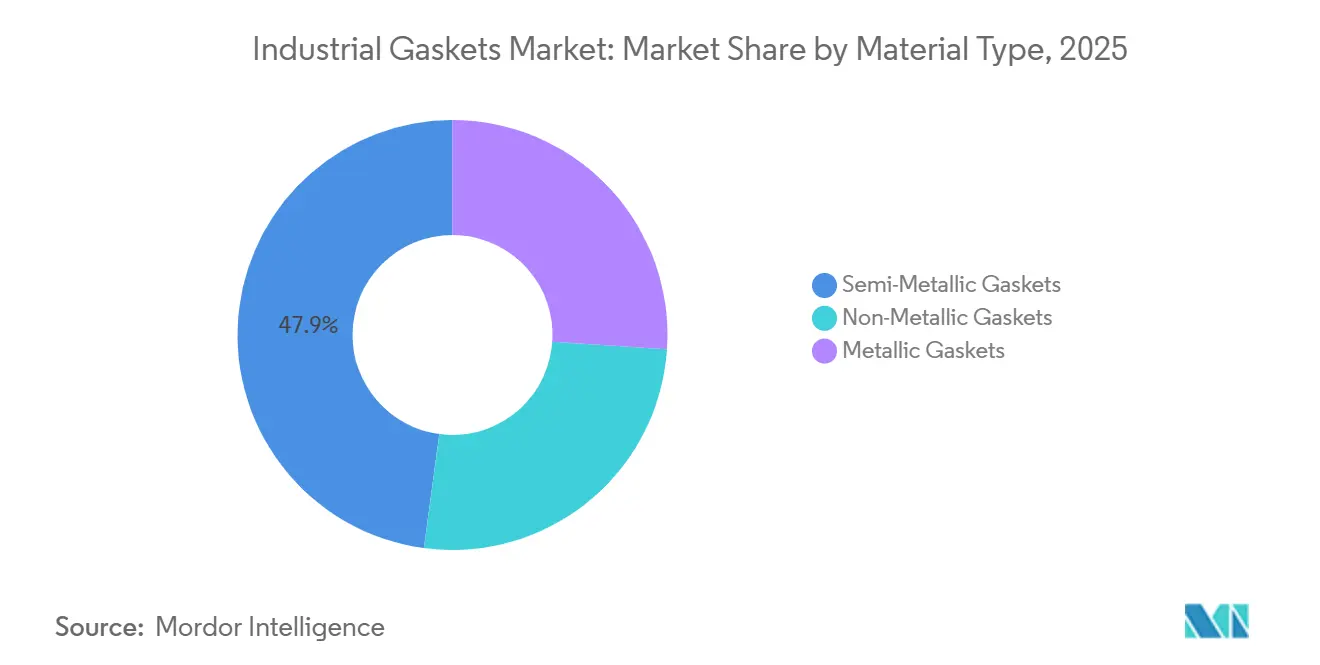
- By material type, semi-metallic gaskets held 47.88% of the industrial gaskets market share in 2025, while non-metallic gaskets are projected to advance at a 5.86% CAGR through 2031.
- By product type, spiral wound gaskets held 38.54% of the industrial gaskets market share in 2025, while corrugated gaskets are projected to advance at a 6.34% CAGR through 2031.
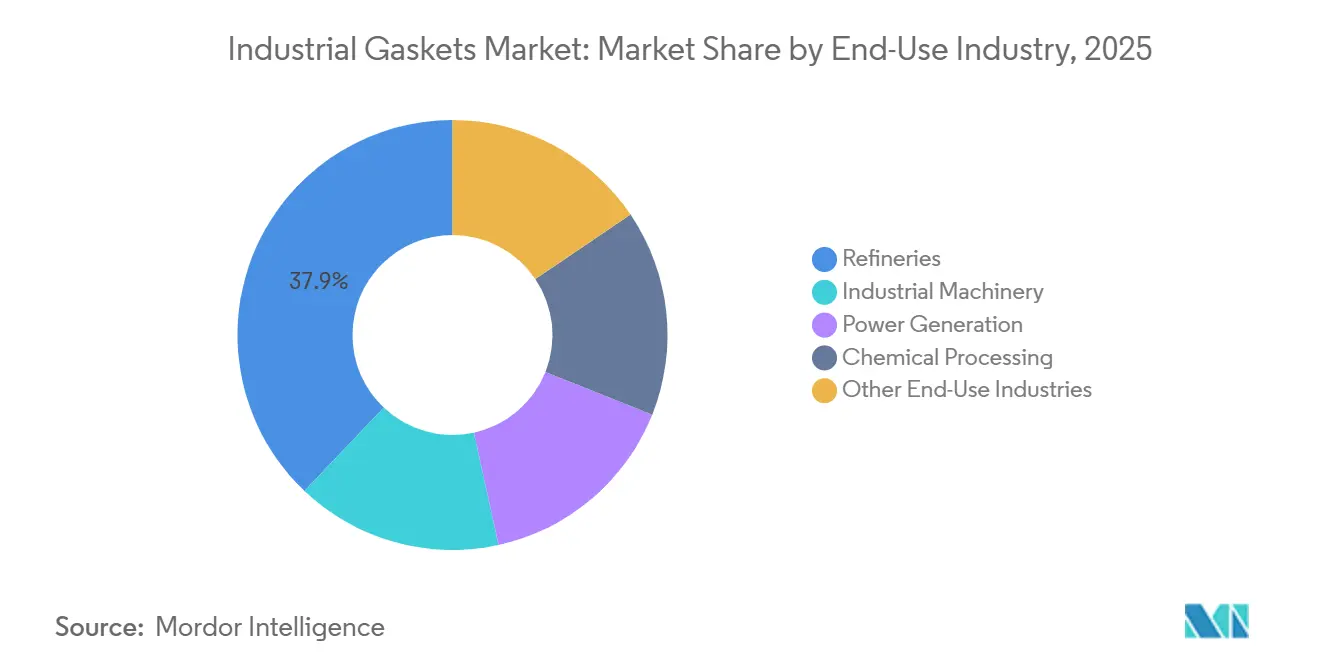
- By end-use industry, refineries held 37.91% of the industrial gaskets market share in 2025, while chemical processing is projected to advance at a 6.77% CAGR through 2031.
- By geography, Asia-Pacific held 42.72% of the industrial gaskets market share in 2025 and is projected to advance at a 5.93% CAGR through 2031.
Note: Market size and forecast figures in this report are generated using Mordor Intelligence’s proprietary estimation framework, updated with the latest available data and insights as of January 2026.
Global Industrial Gaskets Market Trends and Insights
Drivers Impact Analysis*
| Driver | (~) % Impact on CAGR Forecast | Geographic Relevance | Impact Timeline |
|---|---|---|---|
| Industrial Refinery and Petrochemical Capacity Expansion | +1.4% | Asia-Pacific (India, China), Middle East (Saudi Arabia, UAE) | Medium term (2–4 years) |
| Fugitive-Emission Compliance and Low-Leakage Sealing Requirements | +1.1% | North America, Europe, Global (oil & gas operations) | Short term (≤ 2 years) |
| Power-Generation and Grid-Infrastructure Modernization | +0.9% | Asia-Pacific, North America, Europe | Medium term (2–4 years) |
| Replacement Demand From Aging Process Equipment | +0.7% | North America, Europe, with spillover to APAC core | Long term (≥ 4 years) |
| Hydrogen, LNG and Renewable-Energy Sealing Applications | +0.5% | Europe, North America, APAC core, Australia | Long term (≥ 4 years) |
| Source: Mordor Intelligence | |||
Industrial Refinery and Petrochemical Capacity Expansion
Industrial refinery and petrochemical capacity expansion is supporting new demand across the industrial gaskets market because each project requires large numbers of sealed flanged connections. Indian refiners are expanding existing facilities, including projects at Panipat, Gujarat, and Barauni that are scheduled for completion by December 2026. The three projects represent a combined investment of INR 750 billion (approximately USD 8.9 billion) and have added demand for certified sealing components in refinery process units. Tasnee completed its USD 500 million Saudi Ethylene and Polyethylene Company (SEPC) ethylene expansion in Al Jubail in July 2026, which increased olefins capacity by 18% and created installation-stage requirements across the expanded cracking train. These facilities commonly operate at high pressure and in corrosive environments, which favors semi-metallic and metallic grades over basic products. New-build demand also supplements the maintenance and repair base that has historically supported the industrial gaskets market.
Fugitive-Emission Compliance and Low-Leakage Sealing Requirements
Fugitive-emission compliance and low-leakage sealing requirements are encouraging earlier replacement of sealing assemblies at oil and gas facilities. The U.S. Environmental Protection Agency extended implementation deadlines for selected requirements under its oil and natural gas emissions rule through an interim final rule issued in July 2025[1]U.S. Environmental Protection Agency, “2025 Interim Final Rule to Extend Compliance Deadlines,” U.S. Environmental Protection Agency, epa.gov. Monitoring requirements increase the importance of reliable performance at flanged connections and related process equipment. ASME B16.20, American Petroleum Institute 6A, and U.S. Environmental Protection Agency New Source Performance Standards OOOOb and OOOOc shape the performance and monitoring environment for many installations. Teadit described spiral wound gaskets as a sealing option for low-emission service in 2024. Operators can use documented, low-leakage products to support maintenance records, regulatory reviews, and internal emission-management programs.
Power-Generation and Grid-Infrastructure Modernization
Power-generation and grid-infrastructure modernization create demand through both new equipment and maintenance work on existing thermal and nuclear assets. Global renewable power capacity reached 5,149 GW in 2025 after a 692 GW addition during the year, according to the International Renewable Energy Agency. Balancing systems, heat recovery steam generators, steam turbines, boiler feed pumps, and conventional plants require components that operate under high temperature and pressure. These services can exceed 600 °C, which limits the use of standard compressed-fiber materials. Nuclear projects also require long qualification cycles, which can create durable supplier relationships once a gasket specification is accepted. The industrial gaskets market, therefore, benefits from broader energy-system investment even where the new capacity itself is renewable.
Replacement Demand from Aging Process Equipment
Replacement demand from aging process equipment provides a continuing source of revenue for gasket suppliers after construction activity is complete. Many refinery, chemical, and power assets were commissioned between the 1970s and the 1990s and have entered recurring inspection, recertification, and maintenance cycles. Sealing components are commonly changed every 5–10 years, depending on operating conditions and service severity. During these maintenance events, operators can replace older compressed-fiber sheets or rubber products with expanded polytetrafluoroethylene (ePTFE) and flexible graphite alternatives. This upgrade can improve compatibility with current pressure, safety, and emissions requirements. Capacity built across Asia-Pacific from 2000 to 2010 is also moving into major replacement cycles, adding to the region’s project-driven demand.
Restraints Impact Analysis*
| Restraint | (~) % Impact on CAGR Forecast | Geographic Relevance | Impact Timeline |
|---|---|---|---|
| Raw Material Price and Availability Volatility | -0.6% | Global, with acute impact on APAC and North America supply chains | Medium term (2–4 years) |
| PFAS, Asbestos and Material-Substitution Compliance Costs | -0.4% | Europe (EU REACH), North America (EPA/OSHA), Global OEM supply chains | Short term (≤ 2 years) |
| Adhesive Displacement in Electric-Vehicle Battery Enclosures | -0.2% | Asia-Pacific (China EV market), Europe, North America | Long term (≥ 4 years) |
| Source: Mordor Intelligence | |||
Raw Material Price and Availability Volatility
Raw material price and availability volatility put pressure on manufacturing schedules and contract pricing in the industrial gaskets market. Expanded graphite, PTFE compounds, and stainless-steel strips are important inputs for several specialty product categories. Longer lead times can require suppliers to carry more inventory and commit working capital before customer orders are fulfilled. Price movement in ethylene propylene diene monomer (EPDM) and fluoroelastomer (FKM) can also complicate pricing for soft and non-metallic gaskets. Smaller suppliers may find it harder to absorb these swings, which can lead buyers to place greater weight on supply reliability and qualified global sources.
PFAS, Asbestos and Material-Substitution Compliance Costs
Per- and Polyfluoroalkyl Substances (PFAS), asbestos and material-substitution compliance costs create product-development and documentation demands for manufacturers with older material portfolios. U.S. Occupational Safety and Health Administration (OSHA) requirements continue to govern workplace exposure to asbestos, including work involving legacy gasket materials[2]Occupational Safety and Health Administration, “Asbestos,” Occupational Safety and Health Administration, osha.gov. Suppliers must manage disposal procedures and material information where asbestos-containing inventory remains in service. PFAS-related product selection has also become an important engineering consideration for process operators. Qualification of substitute materials through the American Society of Mechanical Engineers, European Norm 13555, or International Organization for Standardization frameworks can add testing time and cost before commercial use.
*Our forecasts treat driver/restraint impacts as directional, not additive. The impact forecasts reflect baseline growth, mix effects, and variable interactions.
Segment Analysis
By Material Type: Semi-Metallic Gaskets Lead While Non-Metallic Gaskets Advance
Semi-metallic gaskets held 47.88% of the industrial gaskets market share in 2025, supported by their use in refinery, petrochemical, and power-generation connections. Spiral wound configurations combine a metal strip and filler material to respond to operating pressure and flange movement. This design supports their use in demanding pipelines and equipment, including systems specified to American Society of Mechanical Engineers B16.5 Class 600 and higher. Metallic products, including ring joint and double-jacketed gaskets, serve smaller but essential applications at wellheads and high-pressure steam systems. American Petroleum Institute and American Society of Mechanical Engineers requirements can restrict the practical use of lower-cost alternatives in those applications.
Non-metallic gaskets are projected to advance at a 5.86% CAGR through 2031. Expanded PTFE and flexible graphite provide chemical resistance and low creep relaxation in chemical processing, water treatment, hydrogen service, and food-grade applications. Flexible graphite has demonstrated stable performance under sustained hydrogen pressure in published research. Suppliers are also working on PFAS-free alternatives for process applications as material-selection requirements evolve. KLINGER has presented Top-Chem as a PFAS-free option for relevant process uses. These technical and compliance needs encourage product differentiation rather than competition based only on basic material cost.



By Product Type: Spiral Wound Gaskets Remain Dominant While Corrugated Gaskets Accelerate
Spiral wound gaskets held 38.54% of the industrial gaskets market share in 2025, reflecting their broad fit across refinery, chemical, and power-generation equipment. Their construction supports reliable service where temperatures, pressures, and flange loads vary during operations. Compliance with American Society of Mechanical Engineers B16.20 supports their position in many process-industry specifications. They are frequently selected when operators upgrade flanged connections for tighter leak-management requirements. Soft gaskets made from compressed fiber sheet, PTFE, and rubber continue to serve utility and general industrial uses with less demanding operating conditions. Ring joint and jacketed designs remain important in high-integrity wellhead and steam-turbine services where technical specifications are especially strict.
Corrugated gaskets are projected to advance at a 6.34% CAGR through 2031. Their metallic core can recover from movement caused by thermal cycling, which is useful in chemical equipment that operates in batch processes. Frequent cycling can stress seals and increase the risk of unplanned maintenance. Condition-monitoring programs can make the durability of a premium gasket more valuable because leaks are identified sooner. Customized products for semiconductor fabrication, food processing, and pharmaceutical equipment add demand in applications with specific operating and certification requirements. These applications can give producers opportunities beyond standard process-industry products.
By End-Use Industry: Refineries Form the Largest Demand Base While Chemical Processing Grows Faster
Refineries held 37.91% of the industrial gaskets market share in 2025. Crude distillation, hydrotreating, and fluid catalytic cracking units contain dense networks of flanged connections that require certified sealing components. Expansion activity at Indian Oil Corporation Limited facilities illustrate how a small number of large projects can create significant procurement needs. The company’s refinery expansion program is scheduled for completion by December 2026 and involves INR 750 billion (approximately USD 8.9 billion) of investment. Power generation requires gaskets for heat recovery steam generators, steam turbines, and nuclear auxiliary equipment. Industrial machinery provides a broad replacement base across manufacturing, mining, and water-treatment systems.
Chemical processing is projected to advance at a 6.77% CAGR through 2031. Capacity additions for specialty chemicals, polymers, agrochemicals, and semiconductor-process chemicals are raising the importance of corrosion-resistant and low-permeation materials. Batch and semi-continuous chemical facilities often experience more thermal cycling than continuously operated refinery units. That operating pattern can shorten gasket service life and raise replacement needs over time. Food and beverage, pharmaceutical, and water-treatment facilities add demand through applications with the Food and Drug Administration, United States Pharmacopeia Class VI, and NSF International (NSF) 61 requirements. These requirements can support more specialized material selection and reduce direct exposure to commodity product competition.
Geography Analysis
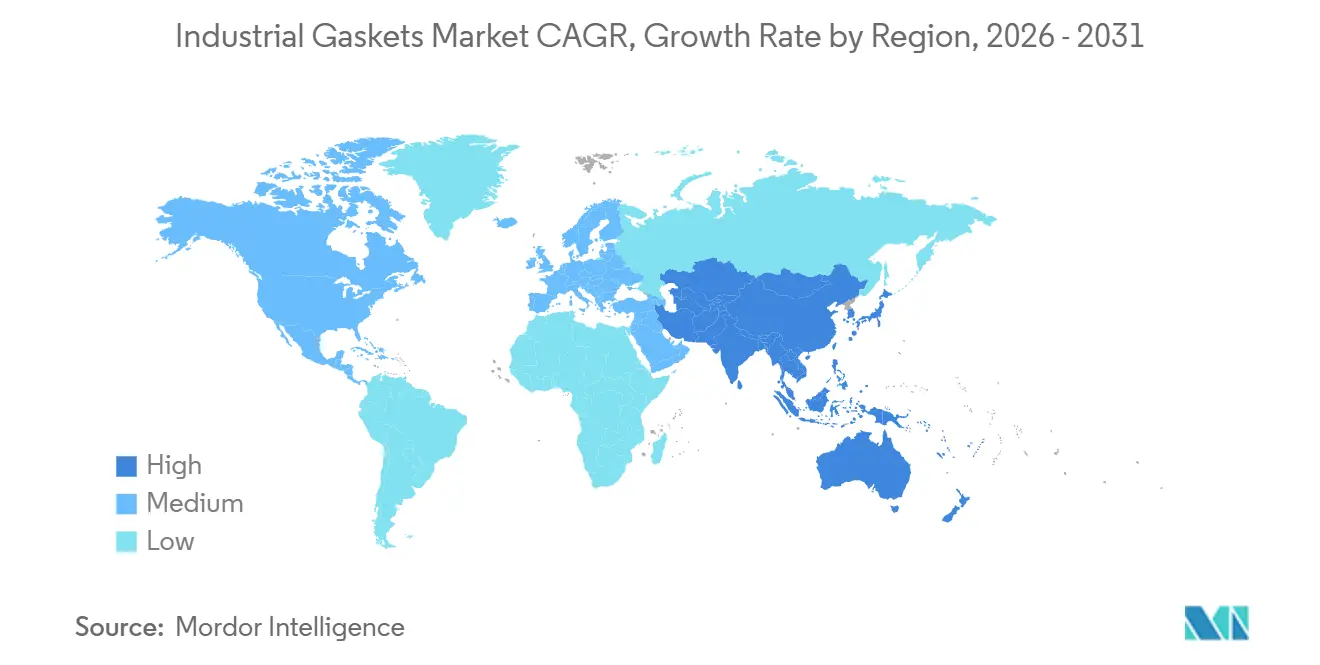
Asia-Pacific held 42.72% of the industrial gaskets market share in 2025 and is projected to advance at a 5.93% CAGR through 2031. India and China support demand through refinery, petrochemical, and industrial expansion. India's refinery capacity is moving from 258 million metric tons per annum toward a 300-310 million metric tons target by 2030. Indian Oil Corporation Limited's three-refinery expansion program is scheduled for completion by December 2026, while Hindustan Petroleum Corporation Limited's 9 million metric tons per annum Barmer Rajasthan facility was commissioned in July 2026. These projects create new requirements for products certified to relevant pipeline and process-equipment standards.
China’s refining and petrochemical projects continue to support demand for semi-metallic sealing materials at integrated sites. Japan and South Korea contribute technical demand from automotive, semiconductor-process equipment, and precision industrial manufacturing. South Korea’s Ulsan and Yeosu petrochemical clusters also support routine maintenance procurement. North America remains an important regional demand center because of refinery maintenance, LNG investment, and nuclear development. Canada contributes to oil-sands and nuclear maintenance demand, while Mexico adds needs from petrochemical complex maintenance.
Europe is shaped by industrial production and evolving materials requirements. Germany supports demand from machinery manufacturing and chemical processing, while the United Kingdom supports refinery and LNG-terminal activity. Nordic applications require specialized products for low-temperature and Arctic conditions. South America has demand linked to Brazilian refinery and offshore assets, while Colombia has recorded a Flexitallic Change gasket installation at a regional refining site. The Middle East supports project-level demand from petrochemical diversification in Saudi Arabia and the United Arab Emirates. Tasnee’s completed ethylene project in Saudi Arabia illustrates this activity. South Africa’s industrial and mining operations provide the most consistent demand base in Africa.

Competitive Landscape
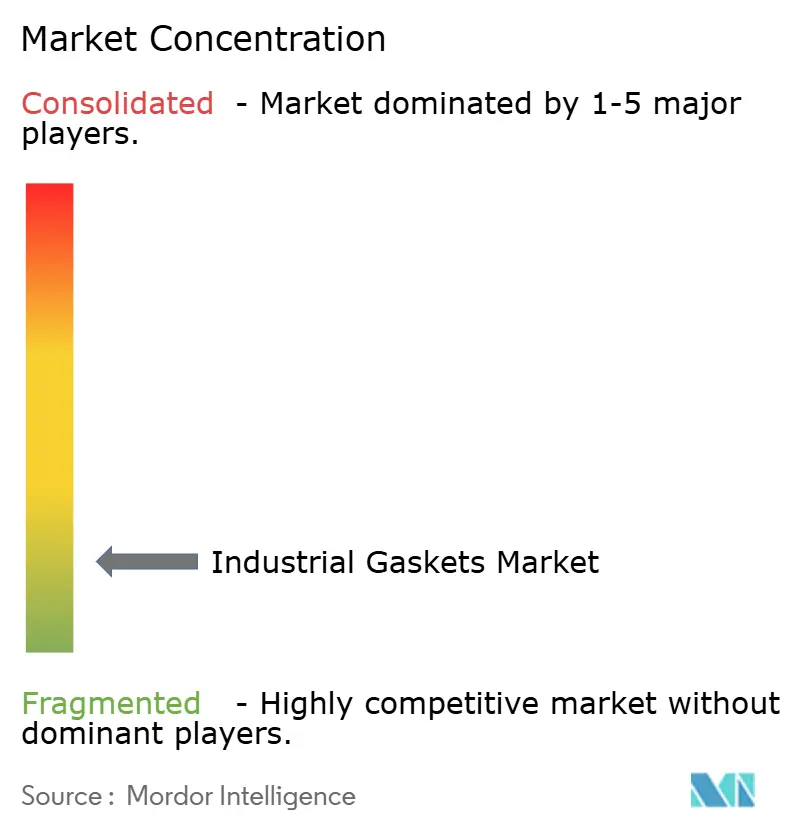
The industrial gaskets market is highly fragmented, with the top five players including Trelleborg AB, Enpro Inc., KLINGER Group, W. L. Gore & Associates, Inc., and Flexitallic Group. Regional manufacturers compete more actively in standard non-metallic and soft gasket categories. Product certification, application knowledge, service reach, and material capability remain important competitive factors. Large suppliers can generally support global customer sites and longer qualification processes more readily than smaller firms.
Michelin completed its acquisition of Flexitallic Group in April 2026, adding its sealing operations to Michelin’s Polymer Composite Solutions business area. The transaction brought USD 220 million in annual sealing revenue and 17 manufacturing sites into the larger group. This move can support investment in manufacturing capacity, digital services, and aftermarket activity. Flowserve signed an agreement in February 2026 to acquire Trillium Flow Technologies’ Valves Division for USD 490 million. The acquisition expands Flowserve’s position in nuclear and conventional power applications, where valves and sealing products are often specified together. Enpro Inc. reported USD 1.14 billion in total sales for 2025 and cited acquisitions that extend its capabilities in biopharma and life sciences.
Suppliers are also pursuing service and material strategies that can strengthen customer relationships. Flexitallic Group launched INTEGRA Technologies UK in February 2026 as a field-service and maintenance operation and introduced its Flexlogics cloud-based joint-management platform. Hydrogen-ready products, PFAS-free material grades, and digital leakage monitoring are areas where suppliers can differentiate their offers. Specialty applications in semiconductors, high-purity chemicals, and energy infrastructure can also offer opportunities for customized products.
Industrial Gaskets Industry Leaders
Trelleborg AB
Enpro Inc.
KLINGER Group
W. L. Gore & Associates, Inc.
Flexitallic Group
- *Disclaimer: Major Players sorted in no particular order

Recent Industry Developments
- August 2026: TIPCO Technologies expanded its gasket manufacturing capacity across the U.S. by installing new gasket-cutting equipment and adding regional production capabilities. The investment strengthens custom gasket production and improves local availability of engineered sealing solutions for industrial customers.
- April 2026: Trelleborg AB broke ground on a new manufacturing facility in Bengaluru, India, representing a greenfield investment that will increase production capacity by 30%. The facility will strengthen local manufacturing of high-performance sealing solutions and support rising demand for industrial gaskets and seals across India's manufacturing and process industries.


Global Industrial Gaskets Market Report Scope
Industrial gaskets are sealing components designed to prevent leakage between mating surfaces in industrial equipment and systems. They maintain pressure integrity and provide reliable sealing under varying temperatures, pressures, and operating conditions.
The Industrial Gaskets Market is segmented by material type, product type, end-use industry, and geography. By material type, the market is segmented into semi-metallic gaskets, non-metallic gaskets, and metallic gaskets. By product type, the market is segmented into spiral wound gaskets, soft gaskets, ring joint gaskets, jacketed gaskets, corrugated gaskets, and other product types. By end-use industry, the market is segmented into refineries, power generation, chemical processing, industrial machinery, and other end-use industries. The report also covers the market size and forecasts for industrial gaskets in 15 countries across major regions. For each segment, the market sizing and forecasts have been done on the basis of value (USD).
| Semi-Metallic Gaskets |
| Non-Metallic Gaskets |
| Metallic Gaskets |
| Spiral Wound Gaskets |
| Soft Gaskets |
| Ring Joint Gaskets |
| Jacketed Gaskets |
| Corrugated Gaskets |
| Other Product Types |
| Refineries |
| Power Generation |
| Chemical Processing |
| Industrial Machinery |
| Other End-Use Industries |
| Asia-Pacific | China |
| India | |
| Japan | |
| South Korea | |
| ASEAN Countries | |
| Rest of Asia-Pacific | |
| North America | United States |
| Canada | |
| Mexico | |
| Europe | Germany |
| United Kingdom | |
| France | |
| Italy | |
| NORDIC Countries | |
| Rest of Europe | |
| South America | Brazil |
| Argentina | |
| Rest of South America | |
| Middle East and Africa | Saudi Arabia |
| South Africa | |
| Rest of Middle East and Africa |
| By Material Type | Semi-Metallic Gaskets | |
| Non-Metallic Gaskets | ||
| Metallic Gaskets | ||
| By Product Type | Spiral Wound Gaskets | |
| Soft Gaskets | ||
| Ring Joint Gaskets | ||
| Jacketed Gaskets | ||
| Corrugated Gaskets | ||
| Other Product Types | ||
| By End-Use Industry | Refineries | |
| Power Generation | ||
| Chemical Processing | ||
| Industrial Machinery | ||
| Other End-Use Industries | ||
| By Geography | Asia-Pacific | China |
| India | ||
| Japan | ||
| South Korea | ||
| ASEAN Countries | ||
| Rest of Asia-Pacific | ||
| North America | United States | |
| Canada | ||
| Mexico | ||
| Europe | Germany | |
| United Kingdom | ||
| France | ||
| Italy | ||
| NORDIC Countries | ||
| Rest of Europe | ||
| South America | Brazil | |
| Argentina | ||
| Rest of South America | ||
| Middle East and Africa | Saudi Arabia | |
| South Africa | ||
| Rest of Middle East and Africa | ||


Key Questions Answered in the Report
What is the size of the industrial gaskets market?
The industrial gaskets market stands at USD 13.22 billion in 2026 and is projected to reach USD 17.05 billion by 2031.
Which material type held the largest share in 2025?
Semi-metallic gaskets held a 47.88% share in 2025, supported by demand from refinery, petrochemical, and power-generation applications.
Which product type is projected to grow the fastest through 2031?
Corrugated gaskets are projected to advance at a 6.34% CAGR through 2031 because they perform well under thermal cycling in chemical equipment.
Which end-use industry is projected to grow the fastest through 2031?
Chemical processing is projected to advance at a 6.77% CAGR through 2031, supported by capacity additions and demanding service conditions.
Page last updated on:


 Your data is secure and never sold or shared.


