Food & Beverage
2nd MayMarket Analysis of Synthetic Food Colorants for a Beverage Leader
5 Min Read
The Indonesia Whey Protein Market is Segmented by Type (Whey Protein Concentrates, Whey Protein Isolates, Hydrolyzed Whey Protein) and Application (Sports & Performance Nutrition, Infant Formula, Functional/Fortified Food, Medical/Clinical Nutrition, Meal Replacement Products, Bakery and Confectionery, Others). The Market Forecasts are Provided in Terms of Value (USD).
Market Overview
| Study Period | 2020 - 2030 |
|---|---|
| Base Year For Estimation | 2024 |
| Forecast Data Period | 2025 - 2030 |
| Market Size (2025) | USD 31.28 Million |
| Market Size (2030) | USD 41.46 Million |
| Growth Rate (2025 - 2030) | 5.80 % CAGR |
| Market Concentration | Medium |
Major Players *Disclaimer: Major Players sorted in no particular order. Image © Mordor Intelligence. Reuse requires attribution under CC BY 4.0. |
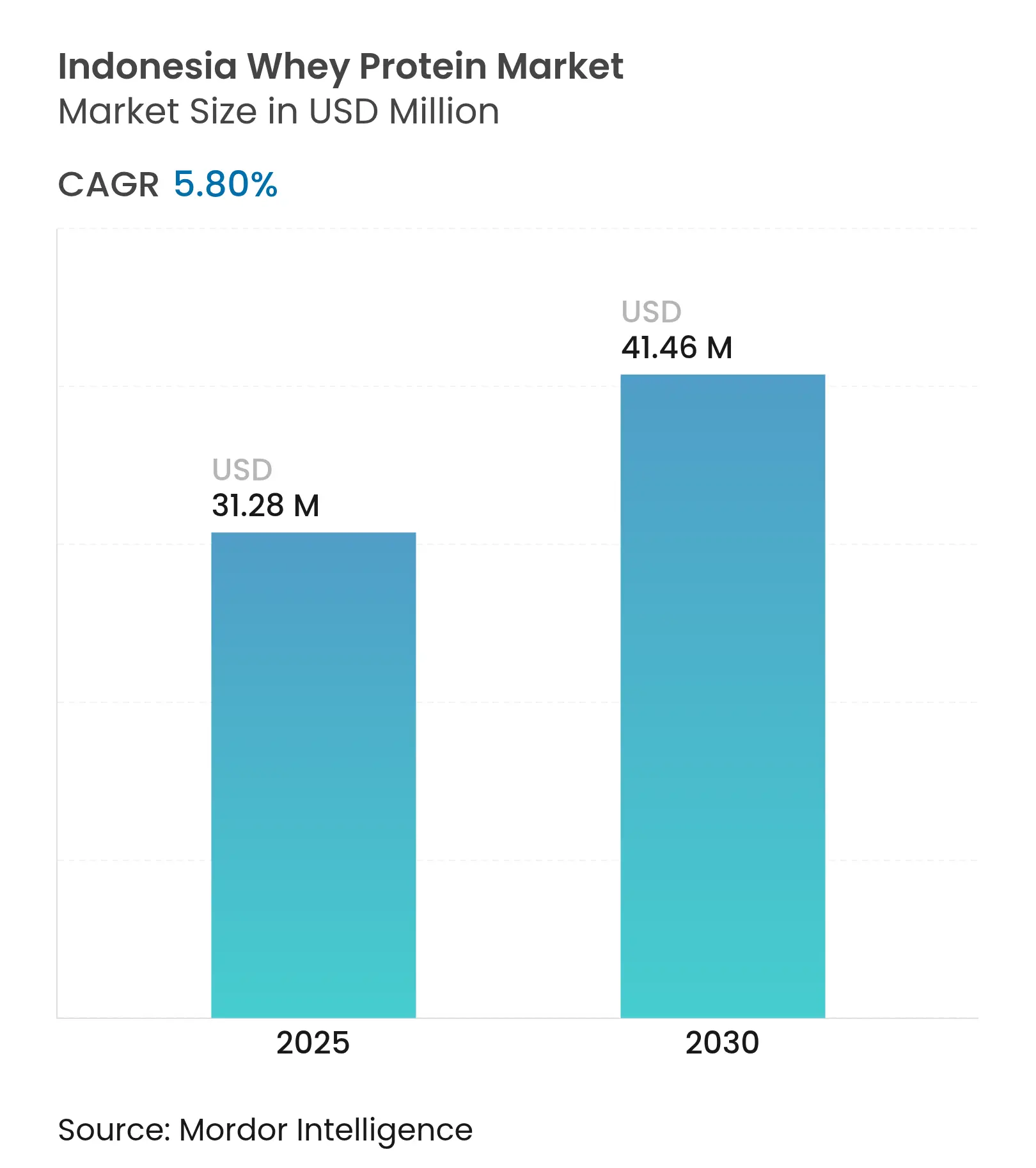

The Indonesia whey protein market size stands at USD 31.28 billion in 2025 and is projected to advance to USD 41.46 billion by 2030, reflecting a 5.8% CAGR. Indonesia whey protein market momentum is anchored in demographic growth, rising disposable incomes, and a nationwide pivot toward preventive health. Government nutrition programs and the country’s large Muslim population elevate demand for halal-certified protein solutions, widening the addressable base for domestic and foreign suppliers. Digital commerce, commanding more than 40% of sales, lowers geographic barriers and accelerates product discovery among first-time buyers. Meanwhile, local dairy processing investments aim to shield manufacturers from currency volatility and import dependence. Collectively, these drivers position the Indonesia whey protein market as a Southeast Asian outperformer over the forecast horizon.
Key Report Takeaways
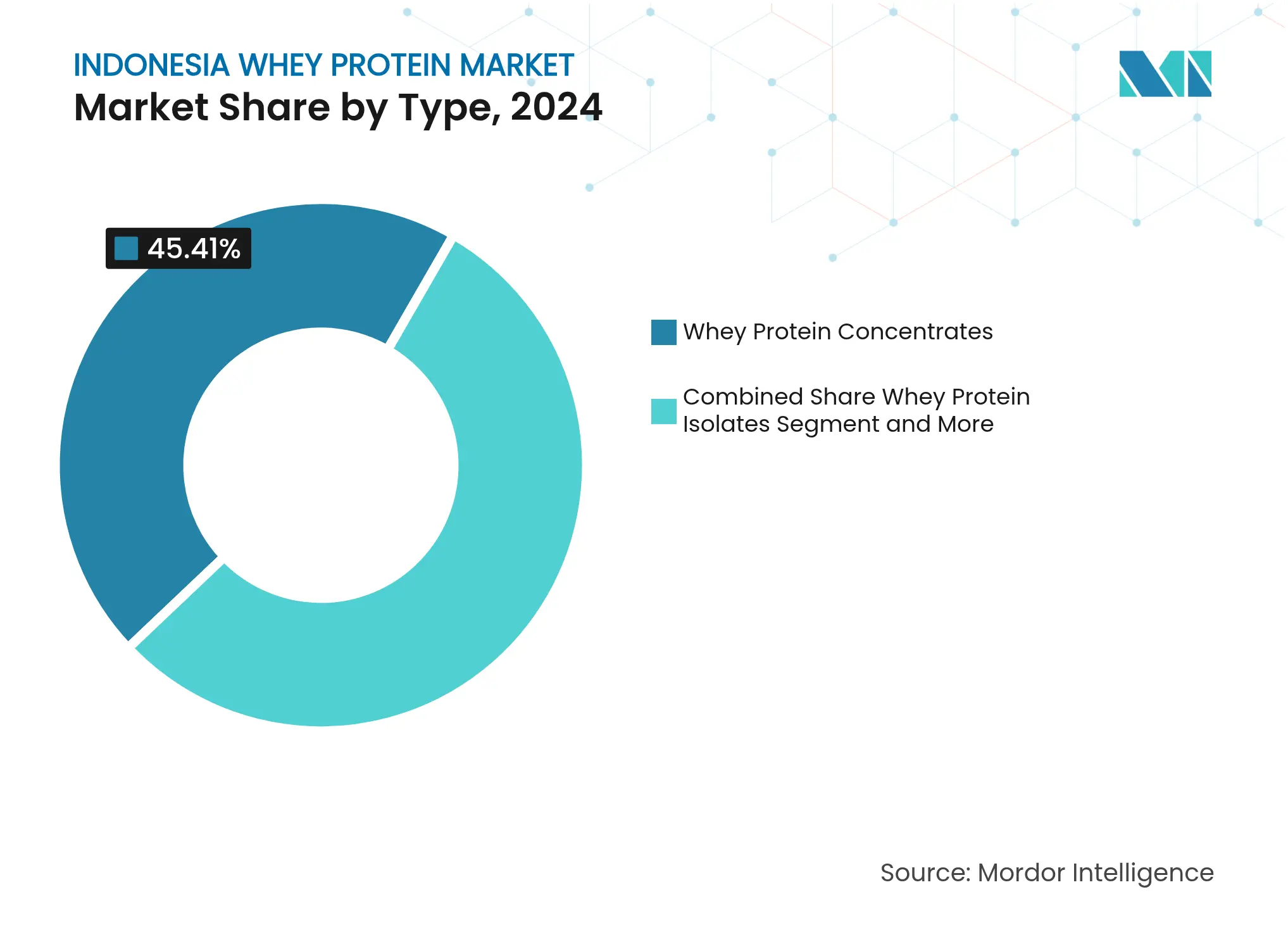
By type, whey protein concentrates captured 45.41% of Indonesia whey protein market share in 2024, while hydrolyzed whey protein is projected to expand at an 11.63% CAGR through 2030.
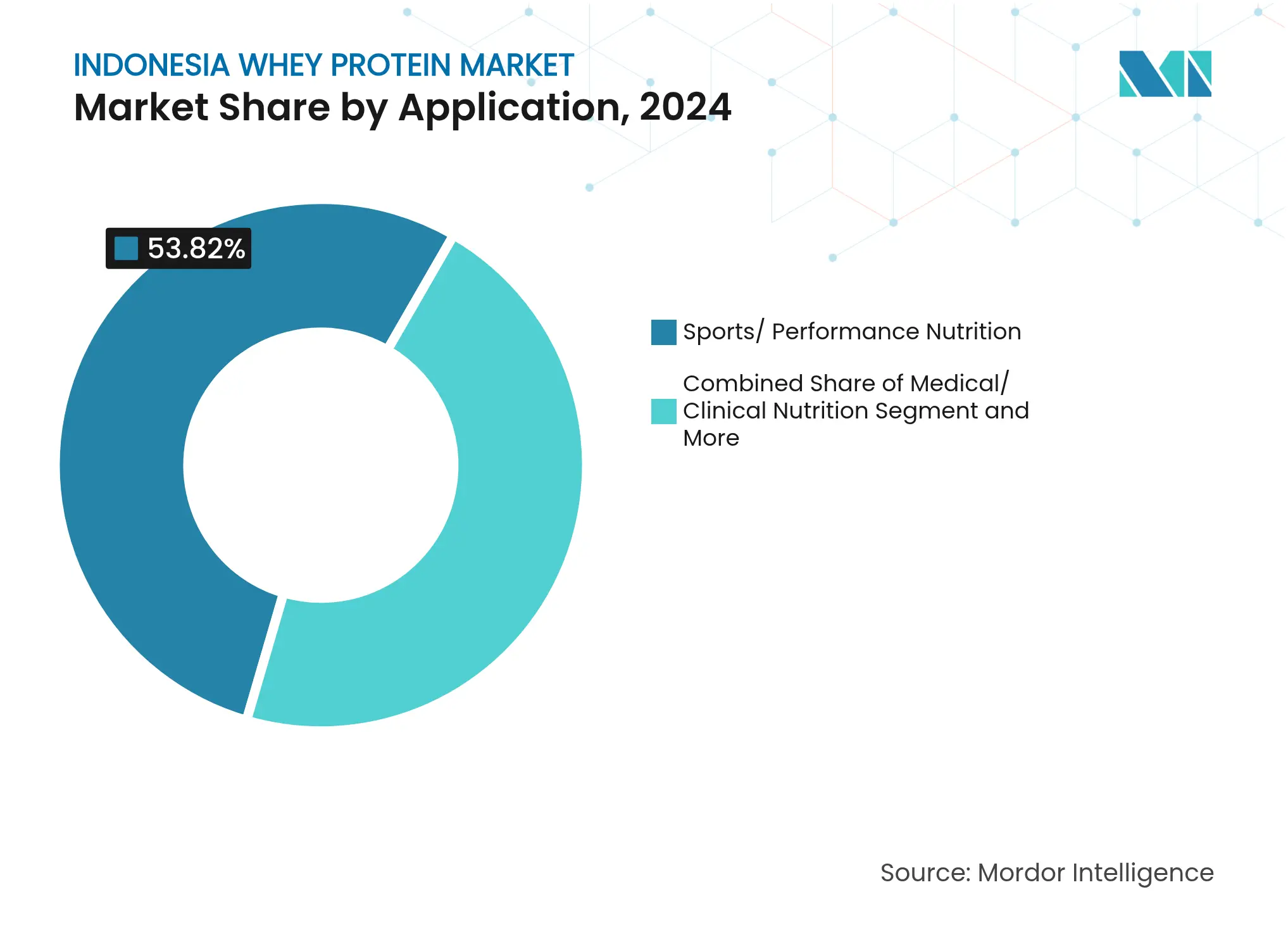
By application, sports & performance nutrition accounted for 53.82% of the Indonesia whey protein market size in 2024, whereas medical & clinical nutrition is forecast to register a 10.69% CAGR to 2030.
Note: Market size and forecast figures in this report are generated using Mordor Intelligence's proprietary estimation framework, updated with the latest available data and insights as of 2026.
Drivers Impact Analysis
| Driver | ( ~ ) % Impact on CAGR Forecast | Geographic Relevance | Impact Timeline |
|---|---|---|---|
Rising gym culture & influencer marketing
|
+1.2%
|
Java and Bali urban centers
|
Medium term (2–4 years)
|
Infant population boom
| +0.8% | National | Long term (≥ 4 years) |
E-commerce nutraceutical expansion
| +1.0% | Nationwide | Short term (≤ 2 years) |
Halal-certified supply chain widening
| +0.7% | National | Medium term (2–4 years) |
Domestic cheese-whey output growth
| +0.5% | Java industrial corridors | Long term (≥ 4 years) |
“Healthy Lifestyle 2030” protein roadmap
| +0.6% | National | Long term (≥ 4 years) |
| Source: Mordor Intelligence | |||
Rising gym culture & influencer marketing in urban centers
Urban fitness memberships have spiked alongside social-media-driven body-performance trends, propelling daily protein supplementation into the mainstream. Indonesia’s fitness economy was valued at USD 36.4 billion in 2022, ranking 19th globally[1]. Kalbe Nutritionals capitalized with the Fitbar Protein Bar launch during the Borobudur Marathon 2024, aligning whey protein with lifestyle branding. Influencer partnerships convert aspirational content into purchase intent among millennials and Gen Z, expanding the Indonesia whey protein market beyond bodybuilding niches. Fitness studios are emerging as last-mile retail points, allowing real-time sampling and expert recommendations. These dynamics reinforce a virtuous cycle of awareness, trial, and repurchase for performance-oriented formulations.
E-commerce nutraceutical platforms’ rapid expansion
Health-supplement e-commerce in Southeast Asia approached USD 10 billion in 2024, with Indonesia contributing the largest share. Tokopedia and Shopee enable same-day delivery to secondary cities, democratizing access to premium whey formats previously confined to Jakarta and Surabaya. Product pages offer detailed amino-acid profiles, fostering trust among ingredients-conscious shoppers. Direct-to-consumer storefronts reduce margin leakage and support personalized promotions based on browsing data. Consequently, the Indonesia whey protein market experiences lower barriers to brand entry and faster innovation cycles.
Infant population boom driving premium formula demand
Indonesia's demographic dividend creates sustained demand for premium infant nutrition, with the infant formula market projected to grow at 3% CAGR through 2029 despite broader Asia-Pacific declines. Government initiatives supporting maternal and child health amplify premium formula adoption, particularly products featuring specialized whey protein formulations. Nestlé Health Science emphasizes whey protein's superior absorption and immune-boosting properties for children, noting it contains four times more amino acids than alternative proteins.[2] Rising disposable incomes enable parents to prioritize nutritional quality over price considerations, creating opportunities for premium whey-based formulations. The segment benefits from Indonesia's cultural emphasis on child development and education, where nutritional investment is viewed as foundational to future success.
Halal-certified whey supply chain broadening reach
Halal certification requirements reshape global whey protein supply chains, creating competitive advantages for compliant suppliers while restricting non-certified alternatives. The Indonesian Ulema Council (MUI) through LPPOM actively promotes halal certification for raw materials across food and beverage industries, directly impacting whey protein sourcing decisions. Indonesia's halal economy, projected to grow from USD 218.8 billion in 2017 to USD 330.5 billion by 2025, creates substantial market opportunities for certified whey suppliers. PT Muscle First successfully leverages halal certification alongside BPOM approval to capture health-conscious Muslim consumers, demonstrating certification's commercial value Detik Health. Halal requirements influence ingredient sourcing, processing methods, and supply chain transparency, creating barriers for non-compliant suppliers while rewarding those investing in certification infrastructure.
Restraints Impact Analysis
| Restraint | % Impact on CAGR Forecast | Geographic Relevance | Impact Timeline |
|---|---|---|---|
Import-price volatility from rupiah fluctuations
|
-0.9%
|
National, import-dependent regions
|
Short term (≤ 2 years)
|
Stringent BPOM labeling & registration timelines
| -0.6% | National regulatory compliance | Medium term (2-4 years) |
Plant-protein switch among Gen Z environmentalists
| -0.4% | Urban centers, educated demographics | Long term (≥ 4 years) |
Cold-chain gaps for RTD whey in Eastern Indonesia
| -0.7% | Eastern Indonesia, remote regions | Medium term (2-4 years) |
| Source: Mordor Intelligence | |||
Import-price volatility from rupiah fluctuations
Currency instability significantly impacts whey protein affordability, as Indonesia imports 80% of its dairy raw materials while domestic production meets only 20% of national demand. Rupiah depreciation directly translates to higher import costs for whey protein concentrates and isolates, forcing manufacturers to balance price competitiveness with margin preservation. The World Bank projects continued commodity price volatility affecting Indonesia's import-dependent sectors, creating strategic imperatives for local production investment. Companies like FrieslandCampina's Frisian Flag invested EUR 257 million in new Cikarang facilities to mitigate import dependency while maintaining cost competitiveness. Exchange rate fluctuations create pricing unpredictability that complicates long-term contracts and consumer price expectations, particularly affecting premium product segments where price sensitivity remains elevated.
Cold-chain gaps for RTD whey in Eastern Indonesia
Infrastructure limitations constrain ready-to-drink whey protein distribution beyond Java's industrial corridors, with current cold storage facilities meeting only 14.15% of Java's needs and significantly less in eastern regions[3]. The Indonesian Cold Chain Association estimates requiring at least 40 million cubic meters of cold storage to meet national demand, representing substantial infrastructure investment needs. Fresh Factory secured IDR 61.8 billion (USD 4.15 million) in funding to enhance cold chain fulfillment services, indicating private sector recognition of infrastructure gaps. Eastern Indonesia's geographic dispersion and limited cold chain infrastructure create distribution cost premiums that limit RTD whey protein market penetration. Government initiatives supporting cold chain development remain insufficient relative to market growth requirements, creating strategic bottlenecks for temperature-sensitive protein products.
By Type: Concentrates Dominate, Hydrolyzed Accelerates
Whey Protein Concentrates maintain market leadership with 45.41% share in 2024, reflecting cost-effectiveness and versatility across multiple applications from sports nutrition to functional foods. The segment's dominance stems from favorable pricing relative to isolates and hydrolyzed variants, making it accessible to price-sensitive Indonesian consumers while delivering adequate protein content for general fitness applications.
Hydrolyzed Whey Protein emerges as the fastest-growing segment at 11.63% CAGR through 2030, driven by premium positioning and superior bioavailability claims. FrieslandCampina's launch of Nutri Whey ProHeat demonstrates technological innovation addressing formulation challenges in ready-to-drink applications, utilizing microparticulation technology to maintain low viscosity under heat exposure. The segment benefits from growing consumer sophistication and willingness to pay premiums for enhanced absorption and faster recovery benefits. Medical and clinical nutrition applications increasingly specify hydrolyzed variants for patients with compromised digestive systems, expanding beyond traditional sports nutrition markets.
Note: Segment shares of all individual segments available upon report purchase
By Application: Sports Nutrition Leads, Medical Segment Surges
Sports & Performance Nutrition commands 53.82% market share in 2024, capitalizing on Indonesia's fitness economy expansion and urban gym culture proliferation. The segment's leadership reflects widespread adoption of protein supplementation among recreational athletes and fitness enthusiasts, supported by social media influence and celebrity endorsements. Kalbe Nutritionals' Fitbar Protein Bar launch at the Borobudur Marathon 2024 exemplifies targeted marketing strategies connecting whey protein with athletic performance and active lifestyles. Distribution through fitness centers creates direct consumer touchpoints, enabling brand education and trial opportunities that drive conversion rates.
Medical & Clinical Nutrition represents the fastest-growing application at 10.69% CAGR through 2030, reflecting Indonesia's healthcare system evolution and aging population demographics. Nestlé Health Science emphasizes whey protein's clinical benefits for children, noting superior amino acid profiles supporting immune system enhancement and physical growth recovery. Hospital partnerships and healthcare professional recommendations drive adoption in clinical settings, particularly for malnutrition recovery and post-surgical healing applications. The segment benefits from government healthcare initiatives and rising medical awareness among middle-class consumers seeking preventive nutrition solutions.
Note: Segment shares of all individual segments available upon report purchase
Indonesia's whey protein market exhibits strong geographic concentration in Java's industrial corridors, where urban centers drive consumption through established fitness culture and higher disposable incomes. Jakarta, Surabaya, and Bandung represent primary consumption hubs, benefiting from developed retail infrastructure and cold chain capabilities essential for temperature-sensitive protein products. The government's free nutritious meal program targeting 82 million school children creates nationwide demand drivers, though implementation concentrates initially in populous Java and Sumatra regions. Regional consumption patterns reflect income disparities, with premium whey protein products achieving higher penetration in metropolitan areas where health consciousness and purchasing power align.
Eastern Indonesia presents significant growth opportunities constrained by infrastructure limitations, particularly cold chain gaps that restrict ready-to-drink whey protein distribution. Current cold storage facilities are creating distribution cost premiums that limit market penetration. The Indonesia-Vietnam dairy farm collaboration in Poso, Central Sulawesi, represents strategic infrastructure development aimed at reducing regional supply dependencies while creating local employment opportunities Indonesia Business Post. Government initiatives supporting cold chain development and rural connectivity improvements will determine eastern regions' market integration timeline and growth potential.

Reports are available across multiple geographies.
Gain in-depth market insights across regions to support informed decisions.
Market Concentration
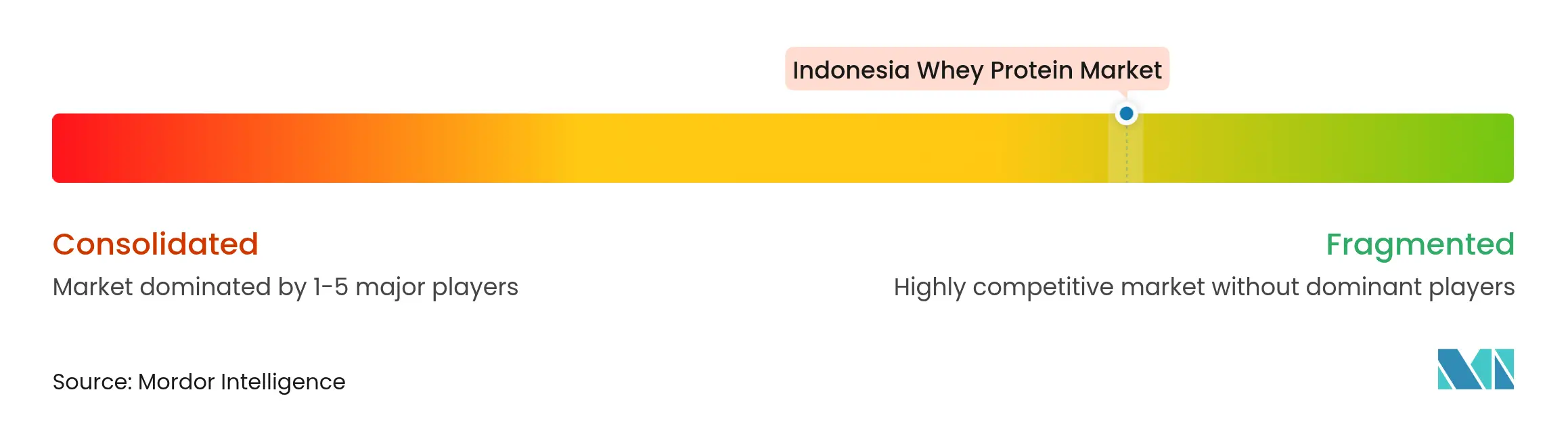
The Indonesia whey protein market is moderately concentrated, scoring 6/10. Kalbe Nutritionals dominates domestic retail channels, leveraging home-field logistics and cultural insight. FrieslandCampina’s EUR 257 million Cikarang hub adds 400,000 kg daily capacity, underscoring its commitment to local production. Glanbia taps global R&D to tailor isolates for Southeast Asian taste profiles, exporting know-how into Indonesian co-packing agreements.
Product innovation centers on heat stability, flavor masking, and low-lactose variants. FrieslandCampina’s Nutri Whey ProHeat targets RTD bottlers seeking shelf-stable proteins in tropical climates. Kalbe’s Fitbar integrates caffeine and vitamins with whey, exemplifying multifunctional snacking. Competitive edges also arise from halal certification and BPOM label agility; compliant firms access national tenders, while laggards face listing delays. Start-ups exploit influencer economies and micro-fulfilment to punch above their scale, diversifying the Indonesia whey protein market.

*Disclaimer: Major Players sorted in no particular order
1. Introduction
2. Research Methodology
3. Executive Summary
4. Market Landscape
5. Market Size & Growth Forecasts (value and Volume)
6. Competitive Landscape
7. Market Opportunities and Future Outlook
Whey protein is one of the primary proteins found in dairy products. A byproduct of the cheese-making process, whey protein provides substantial amounts of the essential amino acids needed to carry out the functions that proteins perform in the body.
The scope of the Indonesia whey protein Mmrket report includes the segmentation of whey protein on the basis of type into whey protein concentrates, whey protein isolates, and hydrolyzed whey proteins. Further, segmentation has been done based on applications such as sports and performance nutrition, infant formula, and functional/fortified food.
For each segment, the market sizing and forecasts have been done based on value (in USD million).
| By Type | Whey Protein Concentrates |
| Whey Protein Isolates | |
| Hydrolyzed Whey Protein | |
| By Application | Sports & Performance Nutrition |
| Infant Formula | |
| Functional / Fortified Food | |
| Medical / Clinical Nutrition | |
| Meal Replacement Products | |
| Bakery and Confectionery | |
| Others |
Market Analysis of Synthetic Food Colorants for a Beverage Leader
5 Min Read
US Market Entry for Taiwanese Machine Tool Manufacturers
5 Min Read
When decisions matter, industry leaders turn to our analysts. Let’s talk.

