
Indonesia Ocean Freight Transport Market Size and Share
Market Overview
| Study Period | 2020 - 2031 |
|---|---|
| Forecast Data Period | 2026 - 2031 |
| Base Year Market Size (2025) | USD 19.61 Billion |
| Market Size (2026) | USD 20.99 Billion |
| Market Size (2031) | USD 28.13 Billion |
| Growth Rate (2026 - 2031) | 6.04 % |
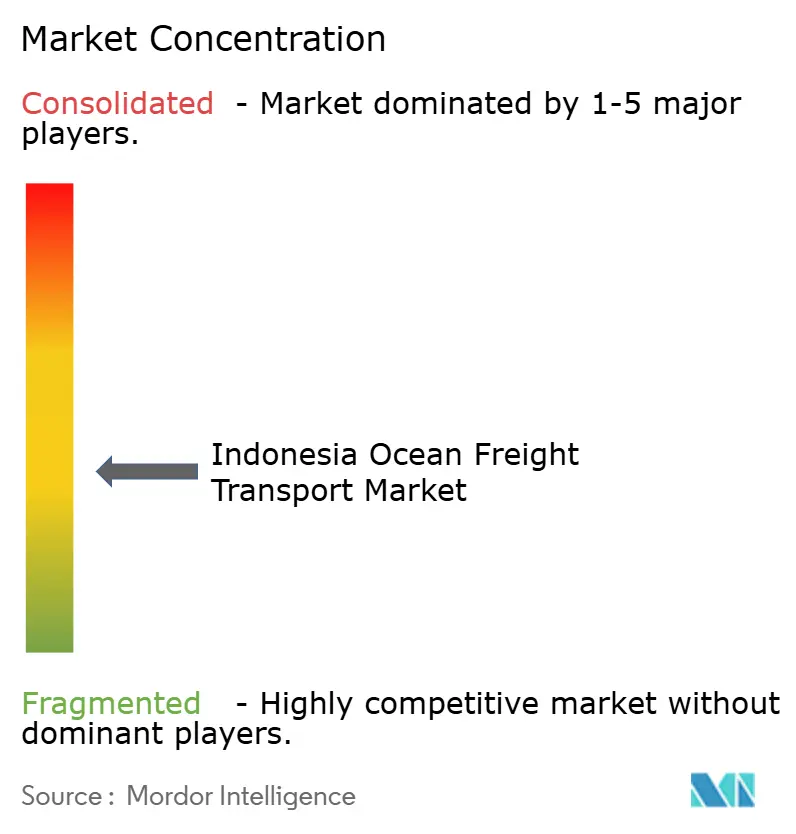
| Market Concentration | Medium |
Major Players *Disclaimer: Major Players sorted in no particular order Image © Mordor Intelligence. Reuse requires attribution under CC BY 4.0. | |
Indonesia Ocean Freight Transport Market Analysis by Mordor Intelligence
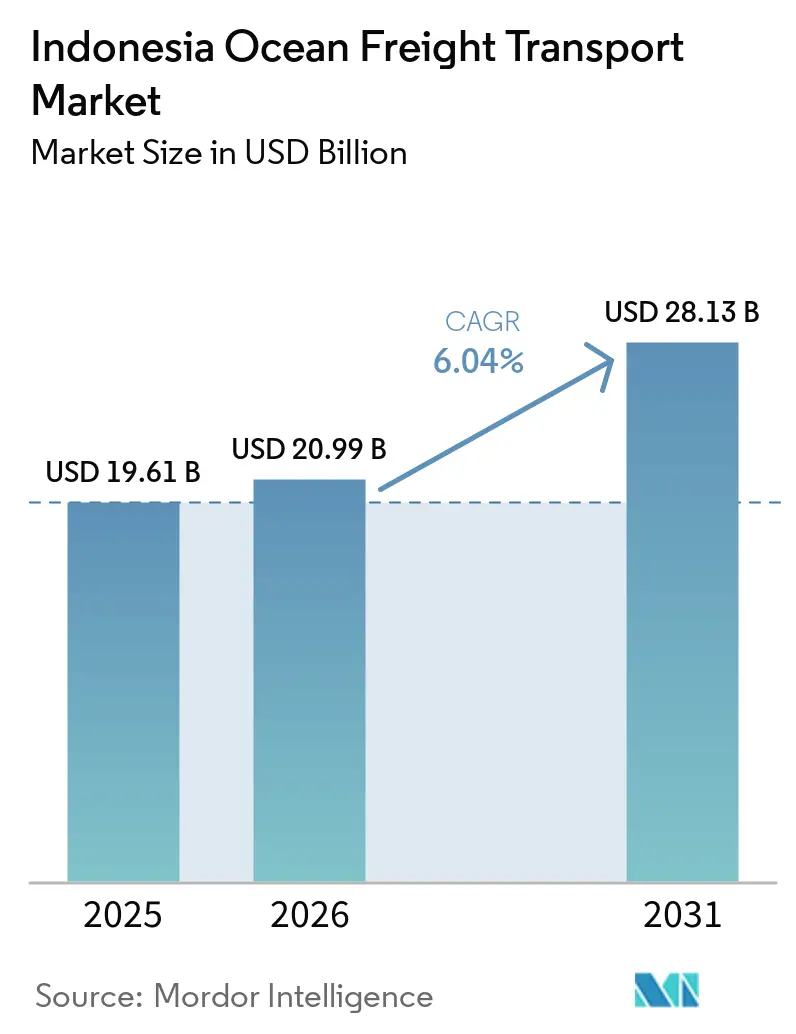
The Indonesia ocean freight transport market size was valued at USD 19.61 billion in 2025, and is estimated to grow from USD 20.99 billion in 2026 to reach USD 28.13 billion by 2031, at a CAGR of 6.04% during the forecast period (2026-2031).
Indonesia’s island geography keeps sea transport essential for freight movements between production centers, ports, and consumption areas. Pelindo-managed terminals processed 6.63 million TEUs in the first half of 2026, up 5.51% year over year, while international container flows rose 9.13%. Imports of raw materials and capital goods represented 78% of Indonesia’s imports, linking container demand closely to manufacturing activity. This cargo profile gives the Indonesia ocean freight transport market a base in industrial supply chains as well as consumer trade. Carrier expansion beyond the main Java gateways is broadening direct access to international services and creating more options for shippers. Higher fuel costs and uneven inland links remain important constraints, where low return volumes make eastern routes difficult to operate without support.
Key Report Takeaways
- By cargo type, non-containerized cargo held 57.86% of the Indonesia ocean freight transport market share in 2025, while containerized cargo recorded the highest projected CAGR at 7.89% through 2031.
- By end-user industry, retail and e-commerce held 24.67% of the Indonesia ocean freight transport market size in 2025, while pharmaceuticals and healthcare recorded the highest projected CAGR at 10.24% through 2031.
- By geography, Java held 43.87% of the Indonesia ocean freight transport market share in 2025, while the Papua Region and Maluku Islands recorded the highest projected CAGR at 8.97% through 2031.
Note: Market size and forecast figures in this report are generated using Mordor Intelligence’s proprietary estimation framework, updated with the latest available data and insights as of January 2026.
Indonesia Ocean Freight Transport Market Trends and Insights
Drivers Impact Analysis*
| Driver | (~) % Impact on CAGR Forecast | Geographic Relevance | Impact Timeline |
|---|---|---|---|
| Growth in Domestic and International Containerized Trade | +1.5% | Global, with concentrated volume gains in Java and Sumatra | Medium term (2-4 years) |
| Port Modernization and Network Expansion | +1.2% | National, with priority investments at Tanjung Priok, Tanjung Perak, Patimban, and Kuala Tanjung | Long term (≥ 4 years) |
| Resource Downstreaming and Bulk-Cargo Export Demand | +0.9% | Kalimantan, Sulawesi, and Papua | Medium term (2-4 years) |
| E-commerce, Retail Replenishment, and Consumer-Goods Imports | +1% | Java corridor, with effects extending to Sumatra and Sulawesi | Short term (≤ 2 years) |
| Eastern Indonesia Route Consolidation and Feeder-Network Formalization | +0.5% | Papua Region, Maluku Islands, and Nusa Tenggara | Long term (≥ 4 years) |
| Digital Cargo Visibility and Data-Driven Container Repositioning | +0.4% | National, with early adoption at Tanjung Priok and Tanjung Perak | Medium term (2-4 years) |
| Source: Mordor Intelligence | |||
Growth in Domestic and International Containerized Trade
International container throughput at Pelindo-managed terminals rose 9.13% in the first half of 2026, and imports increased 11.67%[1]Pelindo Terminal Petikemas, “PMT Layani Pelayaran Perdana CMA CGM ke China Selatan,” Pelindo Terminal Petikemas, pelindotpk.co.id. This increase is driven by capital-goods demand connected to manufacturing rather than consumer restocking. Raw materials and capital goods accounted for 78% of Indonesia’s imports, which supported a direct link between industrial activity and inbound container demand. Manufacturers use imported inputs and equipment in production, so their freight requirements are less dependent on short-term household demand. Indonesia’s exports reached USD 92.15 billion in January through April 2026, up 5.48% year over year. Higher export activity also supports outbound container demand and can improve vessel use on Java-centered routes. More balanced flows help carriers use equipment for both directions and reduce the cost of positioning empty containers. These conditions support the Indonesia ocean freight transport market because the trade base combines domestic supply needs with export movements.
Port Modernization and Network Expansion
Tanjung Priok Terminal 2 Petikemas began operations in August 2026 with a 517.5-meter berth and a 98,700 square-meter yard. This additional capacity raises Jakarta’s ability to handle container flows as import and export traffic grows. It also gives carriers more berth and yard capacity at a gateway that handles a large share of the country’s container trade. Pelindo rehabilitated facilities at 74 locations during 2025-2026, while its PINP program targeted up to 20 new inter-island routes. These actions move the focus from individual terminal upgrades to the movement of cargo through the national port network. Capacity added at Java gateways can increase feeder demand for secondary ports in Sulawesi, Papua, and other eastern areas. Reliable secondary links are necessary when containers arrive through large hub terminals but have final destinations outside Java. This connection supports growth in the Indonesia ocean freight transport market because larger hubs require more regular services with smaller ports.
Resource Downstreaming and Bulk-Cargo Export Demand
Indonesia’s nickel downstreaming policy shifted exports toward processed products, with nickel product exports reaching USD 16.4 billion in 2025, compared with substantially lower values before the implementation of the 2020 raw nickel ore export ban[2]Reuters, “Indonesia to exempt nickel pig iron and some palm oil derivatives from centralized export policy,” Reuters, reuters.com. The shift changed cargo needs from ore movements toward ferronickel, nickel pig iron, and mixed hydroxide precipitate shipments. These products require specialized dry-bulk, liquid-bulk, chemical tanker, and related vessel capacity. Their movement also connects mining areas more closely with processing facilities and export terminals. Coal export volumes declined in January through April 2026 after production quotas were cut by 25%. Some carriers responded by pursuing nickel-related transport work, while PT Habco Trans Maritima secured a 2.1 million metric ton coal contract for April through December 2026. The underlying freight mix is therefore moving toward cargoes that need different vessel types and handling arrangements. The Indonesia ocean freight transport market faces a change in vessel demand rather than a simple reduction in commodity freight.
E-commerce, Retail Replenishment, and Consumer-Goods Imports
E-commerce is increasing booking frequency as retailers move from quarterly consolidations toward monthly or biweekly container bookings. This process can raise container movements even when the weight of goods does not rise by the same amount. Retailers need regular inventory availability across widely separated islands, which makes timely shipping schedules important. Fashion, electronics, and fast-moving consumer goods require timely port-to-distribution-center transfers. The National Logistics Ecosystem framework and ASEAN Single Window integration are intended to reduce dwell time and improve container movement through the logistics chain. Faster cargo handling can improve usable port capacity without requiring a proportional increase in vessel calls. It can also make scheduled services more practical for shippers who place smaller and more frequent orders.
Restraints Impact Analysis*
| Restraint | (~) % Impact on CAGR Forecast | Geographic Relevance | Impact Timeline |
|---|---|---|---|
| Fuel-Price Volatility and Bunker-Cost Exposure | -0.8% | Global, with greater exposure on domestic inter-island routes | Short term (≤ 2 years) |
| Hinterland Connectivity Gaps and High Inter-Island Logistics Costs | -0.7% | Eastern Indonesia and secondary-port catchment areas | Long term (≥ 4 years) |
| Stricter Cabotage and Foreign-Investment Requirements | -0.5% | National, with a concentrated burden on joint-venture shipping entities | Medium term (2-4 years) |
| Empty-Container Imbalances Across Indonesia’s Island Corridors | -0.4% | Domestic inter-island routes, particularly Nusa Tenggara, eastern Sulawesi, and Papua | Long term (≥ 4 years) |
| Source: Mordor Intelligence | |||
Fuel-Price Volatility and Bunker-Cost Exposure
Bunker costs represented 45% to 55% of operating expenses on Indonesia’s short-sea inter-island routes. This exposure is greater than on deep-sea trades and is most difficult for operators with limited ability to raise freight rates. Routes serving smaller islands often have uneven cargo flows, so operators cannot always recover higher fuel costs through a full return load. PT IMC Pelita Logistik identified fuel-price volatility as a principal first-quarter 2026 challenge and used voyage optimization to contain costs. PT TEMAS began operating the LNG-powered MV Digul Mas in August 2026 on the Surabaya-Kendari-Gorontalo route. The vessel provides an example of a lower-volatility fuel approach, although fleet conversion requires capital that smaller operators may not have. International carriers are also working toward IMO Carbon Intensity Indicator compliance through dual-fuel options.
Hinterland Connectivity Gaps and High Inter-Island Logistics Costs
Meratus recorded 880 TEUs outbound and 240 TEUs returning on the Tanjung Perak-Kupang-Ende route between January and August 2025. The 3.7:1 imbalance imposed a 20% to 40% structural cost penalty against Java freight rates. The shortfall in return cargo leaves vessels and containers less productive on routes that already face substantial operating costs. Roads and cargo-collection systems in Papua and Maluku do not yet bring sufficient export loads to secondary ports for regular, unsubsidized liner services. This leaves some routes dependent on the government-supported Tol Laut program and constrains private route development. A Pelindo forum in Makassar in August 2026 brought together SPIL, Tanto Intim Line, Meratus, and SITC to address cargo aggregation and route imbalances. Better roads, dry ports, and multimodal connections are still needed to improve the economics of the Indonesia ocean freight transport market in these areas. These investments would help ports receive steadier loads and make return journeys more commercially viable.
*Our forecasts treat driver/restraint impacts as directional, not additive. The impact forecasts reflect baseline growth, mix effects, and variable interactions.
Segment Analysis
By Cargo Type: Bulk Dominance Persists as Containerization Accelerates
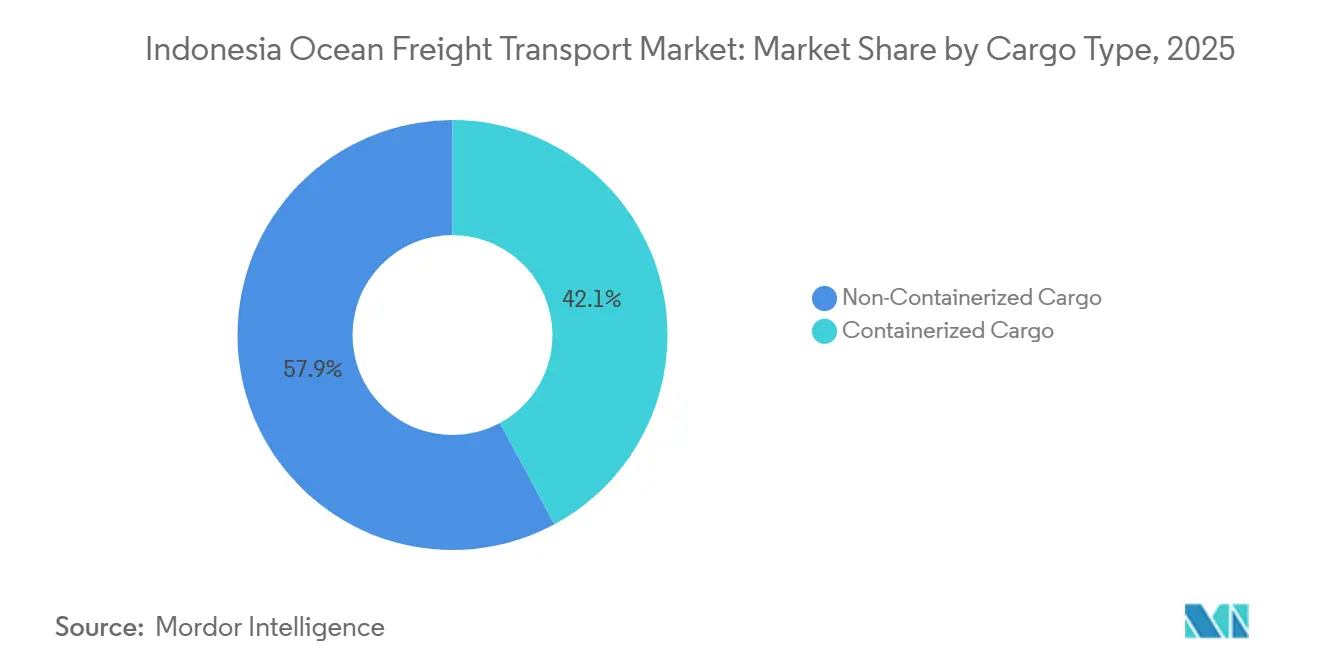
Non-containerized cargo held 57.86% of the Indonesia ocean freight transport market share in 2025, reflecting the continued importance of commodity freight that moves in large volumes rather than through individual unit loads, while containerized cargo is projected to expand at a 7.89% CAGR through 2031, making it the fastest-growing cargo category within the Indonesia ocean freight transport market. Dry bulk handled coal and minerals, liquid bulk moved crude petroleum, LPG, and palm oil, and breakbulk supported cargo that does not fit standard containers. These freight flows are closely tied to Kalimantan, Sulawesi, and Sumatra, where production sites and processing facilities depend on coastal shipping links. The segment remains important because many exports depend on large-volume commodity movements and because cargoes require vessel types matched to their physical characteristics. PT Pertamina International Shipping managed 111 vessels in 2025 and increased LNG shipment frequency 5.5 times year over year. Its fleet activity illustrates the growing role of liquid bulk in the Indonesia ocean freight transport market and the need for regular energy distribution between islands. Breakbulk also supports nickel smelter construction in Morowali and power infrastructure work in eastern Indonesia, where project materials often cannot move in standard container services.
E-commerce replenishment, pharmaceutical distribution, and electronics imports are moving more freight toward scheduled liner services, which support regular delivery patterns for time-sensitive goods. This shift gives shippers more predictable service than spot-chartered general cargo and better aligns port calls with distribution schedules. Reefer containers are gaining importance as pharmaceutical distribution requires more temperature-controlled handling from port arrival through inland delivery. BPOM temperature-logging requirements for biologics are encouraging dedicated reefer use within containerized freight. Operators are also combining container capacity with fuel-cost measures on routes where conventional fuel costs had weakened service economics. TEMAS’s MV Digul Mas on the Surabaya-Kendari-Gorontalo route reflects this approach to serving cargo demand while addressing operating costs. The cargo transition gives the Indonesia ocean freight transport market a stronger container base while retaining a large bulk freight role.



By End-User Industry: Healthcare Freight Disrupts the Consumer-Goods Hierarchy
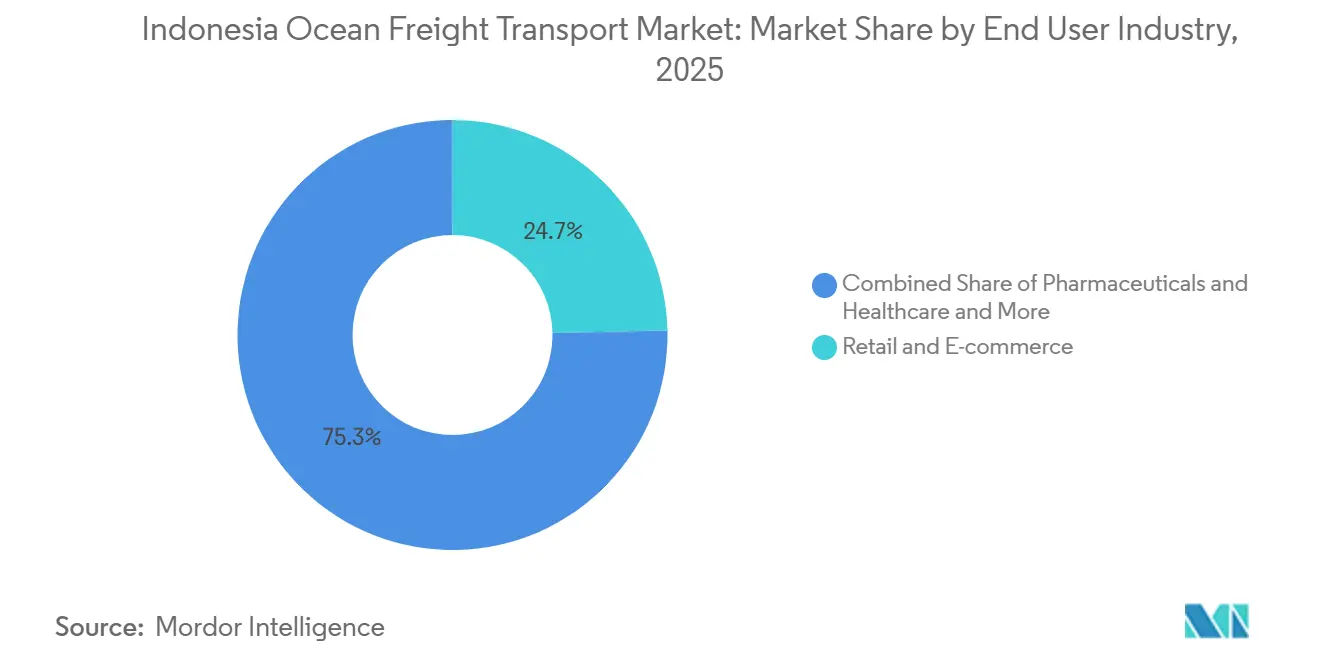
Retail and e-commerce accounted for 24.67% of the Indonesia ocean freight transport market size in 2025, while pharmaceuticals and healthcare are forecast to grow at a 10.24% CAGR through 2031, exceeding the rate identified for the overall Indonesia ocean freight transport market. High-frequency online retail replenishment across the Java-Sumatra urban corridor supported this position, particularly where inventory needed to be available across several islands. Consumer demand requires regular movements of packaged goods into distribution systems that connect ports, warehouses, and retail locations. Electronics and semiconductors, chemicals and petrochemicals, and food and beverage form another large group of freight users with different handling and shipment requirements. Palm oil, packaged foods, and seafood move through both containerized and bulk channels, depending on the product and destination. The range of cargo types means that these end users use different vessels and port services. Retail remains central to the Indonesia ocean freight transport market because it combines import flows with domestic distribution needs across geographically dispersed population centers.
Biologics expansion under the BPJS health insurance program, vaccine distribution to remote areas, and temperature-logging mandates support this growth. These requirements create demand for reefer-equipped feeder vessels in eastern Indonesia, where cold-chain facilities have been limited, and ordinary container services may not meet handling needs. Healthcare demand can therefore support network investment in Papua and Maluku, particularly where reliable distribution links remain incomplete. The Others category includes mining equipment and industrial materials linked to National Strategic Projects. BPOM compliance increases barriers for operators without validated temperature-controlled infrastructure. These conditions direct pharmaceutical freight toward carriers that can meet controlled-handling requirements and maintain the required service quality. The Indonesia ocean freight transport industry also receives project-cargo and breakbulk demand from industrial activity in Kalimantan, Sulawesi, and Papua.
Geography Analysis
Java held 43.87% of the Indonesia ocean freight transport market share in 2025 and remained the country’s main commercial freight center. Tanjung Priok processed 1.817 million TEUs in the first half of 2026, a 7.9% increase from the prior year, which showed continuing demand at the main Jakarta gateway. Tanjung Priok Terminal 2 Petikemas entered service in August 2026 and expanded capacity at the primary Jakarta gateway, giving shipping lines additional room to manage rising volumes and creating scope for more containers to move through Jakarta without relying solely on existing terminal space. Patimban’s scheduled international liner services provide manufacturers in West Java with a direct connection to Shanghai, Ningbo, and Singapore, while also offering an alternative to a single gateway.
Sumatra and Kalimantan form a major commodity export corridor for the Indonesia ocean freight transport market, linking agricultural and bulk cargo areas with domestic and international trade routes. Panjang Port achieved 17.4% throughput growth in the first half of 2026, supported by palm oil and agricultural exports that need reliable port access. CMA CGM’s BBX3 CNC service began calling at Kuala Tanjung in May 2026 and linked North Sumatra directly with Singapore, Port Klang, Da Nang, Nghi Son, and South China, giving the region a scheduled service rather than relying on indirect connections. This first structured international liner connection gives exporters in North Sumatra a direct route to regional markets. Kalimantan is dealing with lower coal output after 2026 production quota cuts, while palm oil and ferroalloy exports provide partial support for cargo activity.
Papua Region and Maluku Islands are forecast to grow at an 8.97% CAGR through 2031 and remain the fastest-growing geography in the Indonesia ocean freight transport market. Freight costs in the region remain 20% to 40% above Java benchmark rates because cargo volumes and inland links remain uneven, which limits the ability of operators to earn comparable returns on individual routes. PELNI assigned 8 subsidized Tol Laut routes in 2025 across Sorong, Fakfak, Kaimana, and Dobo, providing a basic service structure for remote locations. The PELNI-Meratus Hub & Spoke partnership, signed in April 2026, supports more organized cargo distribution on eastern routes and can strengthen aggregation points. Bali and Nusa Tenggara benefit from consumer-goods imports and PELNI’s larger service network, which covered 511 segments and 74 ports in 2025 compared with 482 segments and 72 ports in 2024.
Competitive Landscape
The Indonesia ocean freight transport market is moderately fragmented overall, with international gateway trades more concentrated than domestic cabotage services. MSC, A.P. Moller-Maersk, CMA CGM, COSCO, Hapag-Lloyd, and ONE are extending direct services to secondary Indonesian ports. Their services at Patimban, Kuala Tanjung, and Teluk Lamong reduce the need to depend solely on Singapore transshipment and give cargo owners direct port choices closer to manufacturing and commodity locations. MSC established weekly calls at Patimban through its Seahorse service and launched the Firehorse service connecting Shanghai, Ningbo, Singapore, Surabaya, and Semarang[3]Mediterranean Shipping Company, “MSC Launches Sambar Service, Enhances Pertiwi and Orchid Services,” MSC, msc.com. CMA CGM’s CNC subsidiary began the BBX3 service at Kuala Tanjung in May 2026, while COSCO’s North China-Southeast Asia Express made an inaugural call at Terminal Teluk Lamong. These moves give global carriers closer access to Indonesian exporters and importers.
Domestic operators maintain an important position in inter-island shipping because cabotage rules protect domestic trades. Law No. 66 of 2024 increased the minimum vessel ownership requirement for foreign joint ventures from 5,000 GT to 50,000 GT and capped foreign equity at 49%, increasing the compliance hurdle for foreign participation in domestic shipping. Meratus, SPIL, TEMAS, Samudera Indonesia, and PELNI have established positions in domestic routes, where local networks and experience with island distribution remain important. PT Samudera Indonesia committed USD 300 million in capital expenditure in 2026, including fleet development and a sukuk-financed logistics facility due by the end of 2027. It also formed the Blue Ocean Shipping joint venture with Japan’s Imoto Lines, extending its regional operating position.
Pharmaceutical reefer feeders, LNG bunkering for inter-island operators, and tools that improve freight visibility remain relevant areas of competition. These areas respond to temperature-controlled cargo needs, fuel-cost exposure, and empty-container imbalances that affect operating performance, particularly outside the larger Java gateways. NPCT1 and JICT contracted electric crane and e-RTG systems in 2026, which can make their terminals more attractive for liner services that need modern operating conditions and more efficient container handling. PT TEMAS’s LNG-powered MV Digul Mas is a specific fleet response to fuel-cost exposure. PT Berlian Laju Tanker added the Gas Indonesia pressurized LPG carrier in June 2026, its fourth gas carrier, to expand domestic LPG distribution capacity[4]PT Berlian Laju Tanker, “BLT Adds Gas Indonesia to Its LPG Carrier Fleet,” BLT, blt.co.id.
Indonesia Ocean Freight Transport Industry Leaders
Mediterranean Shipping Company (MSC)
A.P. Moller - Maersk
Meratus
PT Salam Pacific Indonesia Lines (SPIL)
PT Samudera Indonesia Tbk
- *Disclaimer: Major Players sorted in no particular order

Recent Industry Developments
- September 2026: PT Habco Trans Maritima (HATM) raised IDR 320 billion (USD 19.5 million) through a private placement of 640 million new shares to fund vessel acquisition and debt repayment, directly accelerating fleet expansion in the bulk-carrier segment.
- August 2026: PT TEMAS Group commenced commercial operations of MV Digul Mas, Indonesia's first LNG-powered container vessel on the Surabaya-Kendari-Gorontalo route, with CIMC Enric supplying marine LNG tank containers and operating a 5MMSCFD LNG liquefaction plant in Surabaya; TEMAS targets 8 single-fuel LNG container vessels operational by 2027.
- June 2026: PT Berlian Laju Tanker (BLT), via subsidiary PT Sebatik Marin Servis, acquired a second-hand pressurized LPG carrier (Gas Indonesia) from a Chinese owner, BLT's fourth gas carrier, expanding its capacity to serve small ports across Indonesia's domestic LPG distribution network.
- May 2026: CMA CGM, through subsidiary CNC, launched the biweekly BBX3 service from Kuala Tanjung (North Sumatra) to Singapore, Port Klang, Da Nang, Nghi Son, and South China, the port's first direct international liner connection, significantly upgrading North Sumatra's export logistics access.


Indonesia Ocean Freight Transport Market Report Scope
| Containerized Cargo | Dry |
| Reefer | |
| Non-Containerized Cargo | Dry Bulk Cargo |
| Liquid Bulk Cargo | |
| Breakbulk and General Cargo |
| Electronics and Semiconductors |
| Chemicals and Petrochemicals |
| Food and Beverage |
| Pharmaceuticals and Healthcare |
| Retail and E-commerce |
| Others |
| Java (Jakarta and BOD) |
| Sumatra |
| Kalimantan |
| Sulawesi |
| Bali and Nusa Tenggara |
| Papua Region and Maluku Islands |
| By Cargo Type | Containerized Cargo | Dry |
| Reefer | ||
| Non-Containerized Cargo | Dry Bulk Cargo | |
| Liquid Bulk Cargo | ||
| Breakbulk and General Cargo | ||
| By End-User Industry | Electronics and Semiconductors | |
| Chemicals and Petrochemicals | ||
| Food and Beverage | ||
| Pharmaceuticals and Healthcare | ||
| Retail and E-commerce | ||
| Others | ||
| By Region | Java (Jakarta and BOD) | |
| Sumatra | ||
| Kalimantan | ||
| Sulawesi | ||
| Bali and Nusa Tenggara | ||
| Papua Region and Maluku Islands | ||


Key Questions Answered in the Report
What is the forecast value of Indonesia ocean freight transport in 2031?
The Indonesia ocean freight transport market is forecast to reach USD 28.13 billion by 2031. Its value is forecast to rise from USD 20.99 billion in 2026 at a 6.04% CAGR.
Which cargo category leads freight transport in Indonesia?
Non-containerized cargo led with a 57.86% share in 2025. Its position reflects continuing coal, mineral, petroleum, LPG, palm oil, and breakbulk movements between production areas, ports, and export destinations.
What is driving containerized shipping demand in Indonesia?
More frequent e-commerce replenishment, pharmaceutical distribution, electronics imports, and faster logistics processing support container demand. These requirements favor scheduled liner services and more reliable delivery to distribution centers across the islands.
Which end-user sector is growing fastest in Indonesia’s ocean freight transport sector?
Pharmaceuticals and healthcare are forecast to grow at a 10.24% CAGR through 2031. Biologics distribution, remote-area vaccine deliveries, and temperature-control requirements are increasing demand for reefer-equipped freight services.
Which Indonesian region is expected to grow fastest for ocean freight transport?
The Papua Region and the Maluku Islands are forecast to grow at an 8.97% CAGR through 2031. Subsidized Tol Laut routes and the PELNI-Meratus hub-and-spoke arrangement are strengthening cargo connections in remote areas.
What challenges affect inter-island shipping in Indonesia?
Fuel-price exposure, poor hinterland links, high eastern-region costs, cabotage requirements, and empty-container imbalances affect route economics. These challenges are most acute where return cargo volumes remain too low to support regular commercial services.
Page last updated on:





