
Indonesia Healthcare Logistics Market Size and Share
Market Overview
| Study Period | 2020 - 2031 |
|---|---|
| Forecast Data Period | 2026 - 2031 |
| Base Year Market Size (2025) | USD 5.23 Billion |
| Market Size (2026) | USD 5.69 Billion |
| Market Size (2031) | USD 8.57 Billion |
| Growth Rate (2026 - 2031) | 8.56 % |
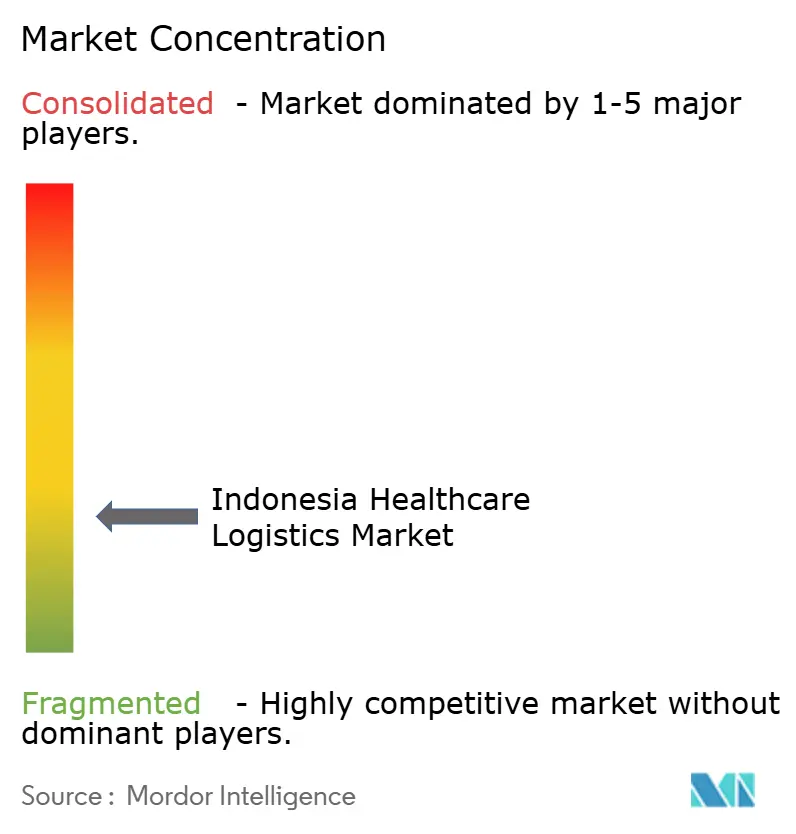
| Market Concentration | Low |
Major Players *Disclaimer: Major Players sorted in no particular order Image © Mordor Intelligence. Reuse requires attribution under CC BY 4.0. | |
Indonesia Healthcare Logistics Market Analysis by Mordor Intelligence
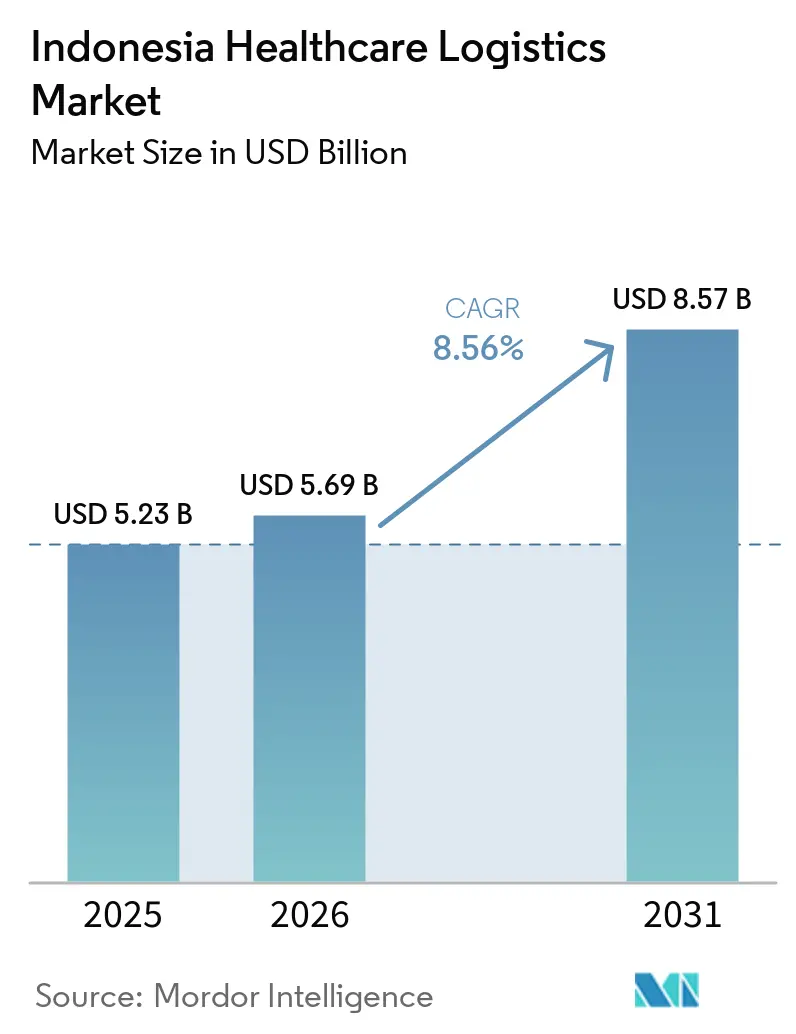
The Indonesia healthcare logistics market size was valued at USD 5.23 billion in 2025 and is estimated to grow from USD 5.69 billion in 2026 to reach USD 8.57 billion by 2031, at a CAGR of 8.56% during the forecast period from 2026 to 2031.
Indonesia’s island geography makes dependable pharmaceutical distribution difficult, especially when a shipment needs to move between road, port, sea, airport, and local delivery networks. Jaminan Kesehatan Nasional, or JKN, covered 98% of the population and reached 280 million members in July 2025, which supported wider use of medicines and healthcare services across the country. The 2026 health budget allocated IDR 244 trillion (USD 15.2 billion) to health, including IDR 69 trillion (USD 4.3 billion) for JKN, which supported demand for regular deliveries to hospitals, clinics, and community health centers. The Indonesia healthcare logistics market is also being shaped by stricter distribution rules, growing use of digital monitoring, and rising needs for controlled-temperature handling. Providers that combine inter-island reach with validated storage, traceability, and reliable backup power are better placed to serve complex healthcare supply chains across the country’s varied transport and infrastructure conditions.
Key Report Takeaways
- By logistics function, transportation held 46.34% of Indonesia healthcare logistics market size in 2025, while value-added services and others are forecast to expand at a 10.34% CAGR through 2031.
- By temperature type, non-temperature-controlled logistics held 56.38% of Indonesia healthcare logistics market share in 2025, while temperature-controlled logistics is projected to register at an 11.93% CAGR through 2031.
- By product type, pharmaceuticals held 58.24% of Indonesia healthcare logistics market size in 2025, while cell and gene therapies are forecast to register a 14.24% CAGR through 2031.
- By destination, domestic logistics held 68.12% of Indonesia healthcare logistics market size in 2025, while international logistics is projected to expand at a 13.86% CAGR through 2031.
- By end user, pharmaceutical manufacturers held 36.94% of Indonesia healthcare logistics market share in 2025, while biopharmaceutical manufacturers are forecast to register at an 11.24% CAGR through 2031.
- By geography, Java, including Jakarta and Bogor-Depok-Bekasi, held 72.36% of Indonesia healthcare logistics market size in 2025, while Sulawesi is projected to register at a 12.78% CAGR through 2031.
Note: Market size and forecast figures in this report are generated using Mordor Intelligence’s proprietary estimation framework, updated with the latest available data and insights as of January 2026.
Indonesia Healthcare Logistics Market Trends and Insights
Drivers Impact Analysis*
| Driver | (~) % Impact on CAGR Forecast | Geographic Relevance | Impact Timeline |
|---|---|---|---|
| Healthcare Access Expanding Pharmaceutical Demand | +2.1% | National, with intensity in Java, Sumatra, and outer-island provinces | Short term (≤ 2 years) |
| Biologics, Vaccines, and Advanced Therapies Increasing Cold-Chain Demand | +1.9% | National, with early concentration in Jakarta, Surabaya, and Makassar | Medium term (2-4 years) |
| Outsourcing Increasing GDP-Compliant Service Adoption | +1.2% | National, with the strongest uptake in Java and Sumatra | Medium term (2-4 years) |
| SATUSEHAT Logistics Improving Healthcare Visibility | +0.9% | National, with pilot intensity in Java and extension to all 38 provinces | Short term (≤ 2 years) |
| Inter-Island Micro-Hubs Expanding Cold-Chain Reach | +0.8% | Outer-island regions, Kalimantan, Sulawesi, Papua, and Maluku | Long term (≥ 4 years) |
| E-Pharmacy Demand Increasing Time-Sensitive Deliveries | +1.1% | National, with early gains in Greater Jakarta, Surabaya, Bandung, and Medan | Short term (≤ 2 years) |
| Source: Mordor Intelligence | |||
Expansion of Healthcare Access Increasing Pharmaceutical Logistics Demand
JKN had near-universal enrollment in 2025, covering 98% of Indonesia’s population, or 280 million members. This coverage links medicine volumes closely to public healthcare access across Indonesia’s provinces, where facilities depend on regular delivery schedules within the Indonesia healthcare logistics market. Each new community health center and hospital requires repeated replenishment of drugs, devices, vaccines, diagnostics, and other healthcare supplies, often through scheduled distribution arrangements that must remain reliable throughout the year. The 2026 health allocation of IDR 244 trillion (USD 13.75 billion), including IDR 69 trillion (USD 3.89 billion) for JKN contributions, provided a public funding base for treatment, medicine supply, and service delivery across the national healthcare system[1]United Nations Development Programme Indonesia, “Transforming Indonesia’s Medical Supply Chain,” United Nations Development Programme, undp.org. JKN’s claim ratio reached 111.8% in February 2026, indicating higher treatment use while raising questions about program finances. For the Indonesia healthcare logistics market, greater use of treatment services means more frequent pharmaceutical movements through national and regional delivery networks.
Biologics, Vaccines, and Advanced Therapies Driving Cold Chain Demand
Vaccines, biosimilars, oncology injectables, and plasma-derived therapies require validated chilled, frozen, or ultra-low-temperature handling. This requirement raises the value of specialized storage, packaging, monitoring, and airfreight services in the Indonesia healthcare logistics market, where cold-chain failures can affect product usability. BPOM Regulation No. 20/2025 strengthened cold-chain oversight for biological products and vaccines, raising operational requirements for providers handling these shipments. Daewoong Pharmaceutical Indonesia received BPOM GMP certification in September 2025 for autologous stem cells, NK cells, and exosomes at its Cikarang facility. Local production of advanced therapies creates demand for dedicated cryogenic transport routes, specialist packaging, trained handling teams, and documented control throughout each movement that conventional general-cargo providers cannot readily offer. The World Bank’s USD 850 million Program-for-Results supporting JKN health access from 2025 to 2029 also supports the movement of specialty medicines through the Indonesian healthcare logistics market.
SATUSEHAT Logistics Integration Improving National Healthcare Visibility
The Ministry of Health and UNDP launched SATUSEHAT Logistics in October 2024 to connect healthcare supply chain data from production through provincial distribution[2]Ministry of Health, Republic of Indonesia, “SATUSEHAT Logistics, Monitoring Vaccine and Drug Distribution,” Ministry of Health, Republic of Indonesia, kemkes.go.id. At launch, the SMILE system tracked more than 800 million vaccine doses and 100 million medicine doses across 10,000 healthcare facilities in 38 provinces. In August 2025, the Ministry of Health and UNDP integrated SSL-SMILE with systems for HIV/AIDS, tuberculosis, and malaria programs. The integration improves visibility for public health shipments from central stock points through provincial and facility-level distribution networks. It makes traceability more important for providers seeking government-linked work. Operators whose systems cannot exchange data with SATUSEHAT may find it harder to meet future contract requirements, as public-sector buyers place greater weight on visible inventory status, distribution records, and compliance documentation. The SATUSEHAT Logistics Roadmap for 2026 to 2029 is under development with WHO support and is expected to set clearer requirements for traceability and compliance.
Rising E-Pharmacy Demand Accelerating Time-Sensitive Healthcare Deliveries
Online pharmacy penetration reached 20% to 25% of total pharmacy sales in 2025. Orders promised within 2 to 4 hours in metropolitan areas require nearby inventory, dependable order processing, and same-city delivery capacity. These needs differ from the bulk distribution model used for regular pharmacy and hospital replenishment. Healthcare platforms are outsourcing fulfillment infrastructure, which creates room for GDP-compliant providers that can manage small-scale, temperature-appropriate storage. This demand supports higher-frequency movements within the Indonesia healthcare logistics market, particularly in Greater Jakarta, Surabaya, Bandung, and Medan, where service expectations differ from conventional wholesale deliveries.
Restraints Impact Analysis*
| Restraint | (~) % Impact on CAGR Forecast | Geographic Relevance | Impact Timeline |
|---|---|---|---|
| Archipelagic Infrastructure Gaps Raising Inter-Island Costs | -1.5% | Outer-island regions, Papua, Maluku, Nusa Tenggara, and parts of Sulawesi and Kalimantan | Long term (≥ 4 years) |
| Compliance Requirements Raising Specialized Costs | -0.9% | National, with most acute pressure on mid-tier and smaller operators | Medium term (2-4 years) |
| Multiple Handoffs Raising Temperature Excursion Risks | -0.8% | Inter-island and last-mile routes, particularly in Eastern Indonesia | Medium term (2-4 years) |
| Uneven Power Reliability Limiting Cold-Chain Continuity | -0.6% | Eastern Indonesia, Papua, Maluku, and parts of Nusa Tenggara | Long term (≥ 4 years) |
| Source: Mordor Intelligence | |||
Archipelagic Infrastructure Gaps Increasing Inter-Island Logistics Costs
Indonesia has more than 17,000 islands, with nearly 7,000 inhabited, and this geography requires multimodal movement for many healthcare shipments. Goods often travel by road to a port, by sea to another island, and then by road or air to the final destination. Every transfer adds time, handling, potential temperature-control risk, and a need for clearer responsibility between parties in the Indonesia healthcare logistics market, particularly when products move through remote routes. A 2024 PLOS Global Public Health study reported that Maluku had 29 seaports and 14 vessels serving 24 inter-island routes, with single trips averaging 15 days[3]PLOS Global Public Health, “Spatial Evaluation of Healthcare Accessibility Across Archipelagic Communities of Maluku Province, Indonesia,” PLOS Global Public Health, journals.plos.org. These transit periods are unsuitable for products with short stability windows, including some cell therapies. Addressing these gaps requires investment in port links, cold-chain warehousing, and buffer-stock systems, which may deter operators that cannot support long payback periods.
Uneven Power Reliability Constraining Cold-Chain Service Continuity
Power interruptions in outer regions can affect the integrity of temperature-sensitive pharmaceuticals during storage at distribution points and healthcare facilities. This issue compounds transport constraints and raises the cost of serving remote areas in the Indonesia healthcare logistics market. A 2025 journal study on archipelagic hospitals found that inadequate power infrastructure and limited access to advanced technology affected pharmaceutical logistics performance in island regions. BPOM Regulation No. 20/2025 requires automatic alarms and quality risk management documentation for cold-chain products. Providers may, therefore, need validated generators, passive packaging, and robust monitoring where grid reliability is weak. These requirements create a barrier for smaller providers while limiting the availability of premium cold-chain services in the most underserved locations, where equipment maintenance and dependable technical support can be difficult to sustain.
*Our forecasts treat driver/restraint impacts as directional, not additive. The impact forecasts reflect baseline growth, mix effects, and variable interactions.
Segment Analysis
By Logistics Function: Transportation Leads While Value-Added Services Expand
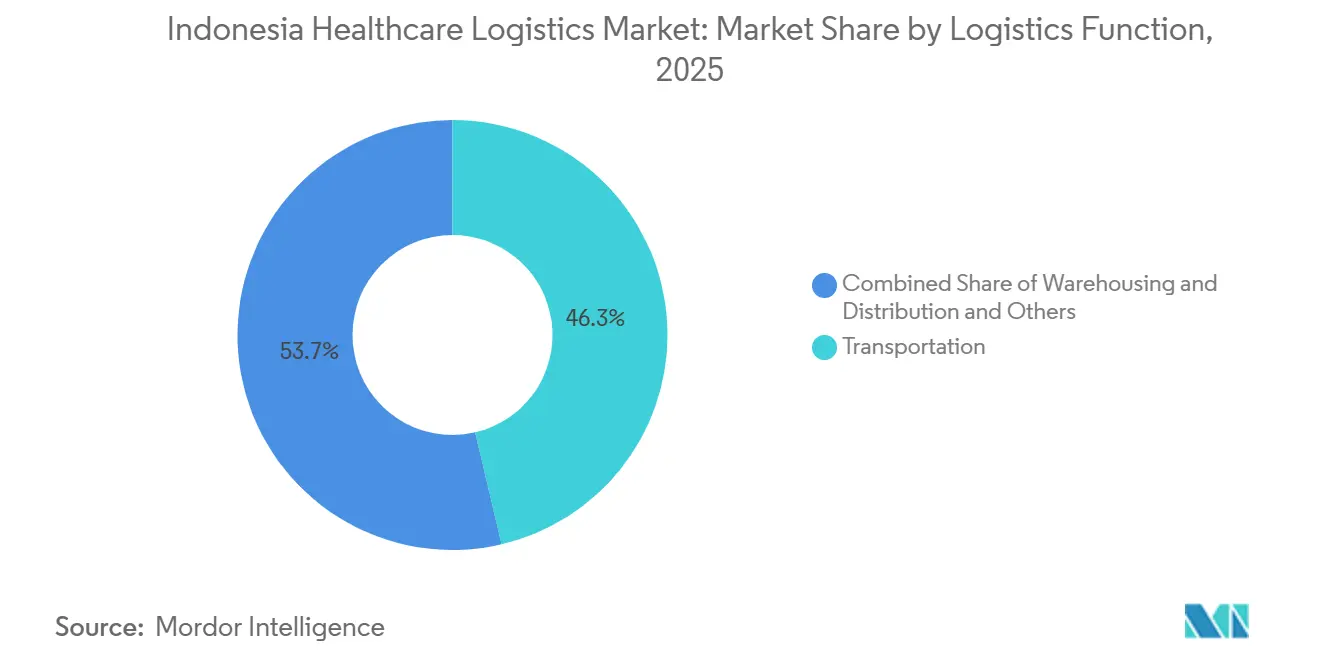
Transportation held 46.34% of Indonesia healthcare logistics market share in 2025, while value-added services and others are forecast to record a 10.34% CAGR through 2031, reflecting the continued importance of physical pharmaceutical movement alongside increasing demand for specialized logistics services. Transportation connects manufacturing sites, distributors, hospitals, clinics, retail pharmacies, and community health centers across varied local transport conditions. Warehousing and distribution provide the storage, consolidation, order preparation, and handoff control required to support these movements. Value-added services include track-and-trace support, repackaging, cold-chain monitoring, and regulatory documentation. CDOB 2025 further increased the importance of providers who integrated these activities into routine logistics operations.
Road transport remains central to intra-island distribution on Java and Sumatra, while sea and inland waterways support bulk freight and connections to outer-island hubs. Air cargo is used for urgent, high-value shipments, including biologics, clinical trial materials, and certain cell and gene therapy products with strict timing requirements. Rail has a limited but developing role in Java for selected urban corridors. Government-linked distribution contracts also require real-time tracking, GDP-compliant storage, inventory management, and multi-temperature handling across subnational delivery points. The Indonesia healthcare logistics market increasingly requires operators to combine physical transportation with information management, compliance, and specialized handling across national, regional, and local distribution networks.



By Temperature Type: Controlled Logistics Gains Strategic Importance
Non-temperature controlled logistics held 56.38% of Indonesia healthcare logistics market size in 2025, while temperature controlled logistics is projected to record an 11.93% CAGR through 2031, reflecting the continued dominance of ambient healthcare products alongside rising demand for specialized cold-chain services. Tablets, capsules, over-the-counter drugs, and ambient-stable medical devices remain major product flows and require secure storage, controlled handling, inventory management, and reliable delivery even without refrigeration. Temperature-controlled logistics support biologics, biosimilars, vaccines, and advanced therapies that require defined temperature ranges throughout storage and transportation. Chilled handling from 0 °C to 5 °C supports insulin and conventional biologics, while deep-frozen and ultra-low-temperature conditions are required for products with more demanding storage requirements. Cell and gene therapies can require liquid-nitrogen conditions from -150 °C to -196 °C, creating specialized requirements for qualified equipment, validated packaging, and trained personnel.
BPOM Regulation No. 20/2025 further increased operational requirements for cold-chain logistics through quality risk management assessments, temperature-excursion procedures, ALCOA++ documentation, and automatic alarm systems. These requirements increase adaptation costs for wholesalers and distributors that lack validated equipment, trained teams, documented processes, alarm systems, temperature records, and consistent deviation-review procedures. The growing use of active temperature-controlled containers also indicates increasing demand for specialized pharmaceutical logistics capabilities, while planned national pharmaceutical infrastructure in Tangerang signals continued investment in cold-chain capacity. The Indonesia healthcare logistics market, therefore, increasingly requires providers to combine temperature-controlled transportation and storage with validated packaging, monitoring systems, documentation, and regulatory compliance.
By Product Type: Pharmaceuticals Lead as Advanced Therapies Develop
Pharmaceuticals held 58.24% of Indonesia healthcare logistics market share in 2025, while cell and gene therapies are forecast to record a 14.24% CAGR through 2031, reflecting the continued scale of conventional pharmaceutical distribution alongside rapid growth in advanced therapies. Prescription medicines, specialty drugs, and over-the-counter products require broad distribution across Indonesia’s 38-province network. Cell and gene therapies, including CAR-T and gene-editing treatments, require specialized logistics involving cryogenic handling, rapid airfreight, controlled handoffs, and close coordination between manufacturers, hospitals, and specialist carriers because of narrow product stability windows. Biopharmaceuticals, including insulin, monoclonal antibodies, and plasma-derived medicines, also increase demand for validated refrigerated distribution. Vaccines continue to represent a major public-sector logistics flow, with SMILE managing more than 800 million doses after SATUSEHAT Logistics was launched.
Medical devices require careful handling as hospitals procure imaging, diagnostic, and other specialized equipment. In contrast, clinical trial materials, blood and plasma components, and diagnostic and laboratory products require traceability, suitable packaging, and documented handoffs. The September 2025 certification of Daewoong’s facilities for autologous stem cells, NK cells, and exosomes further supports the development of domestic advanced-therapy capabilities. The Indonesia healthcare logistics industry, therefore, needs to accommodate increasingly specialized product requirements while maintaining the broad distribution capacity required for conventional pharmaceuticals.
By Destination: Domestic Operations Dominate While International Lanes Rise
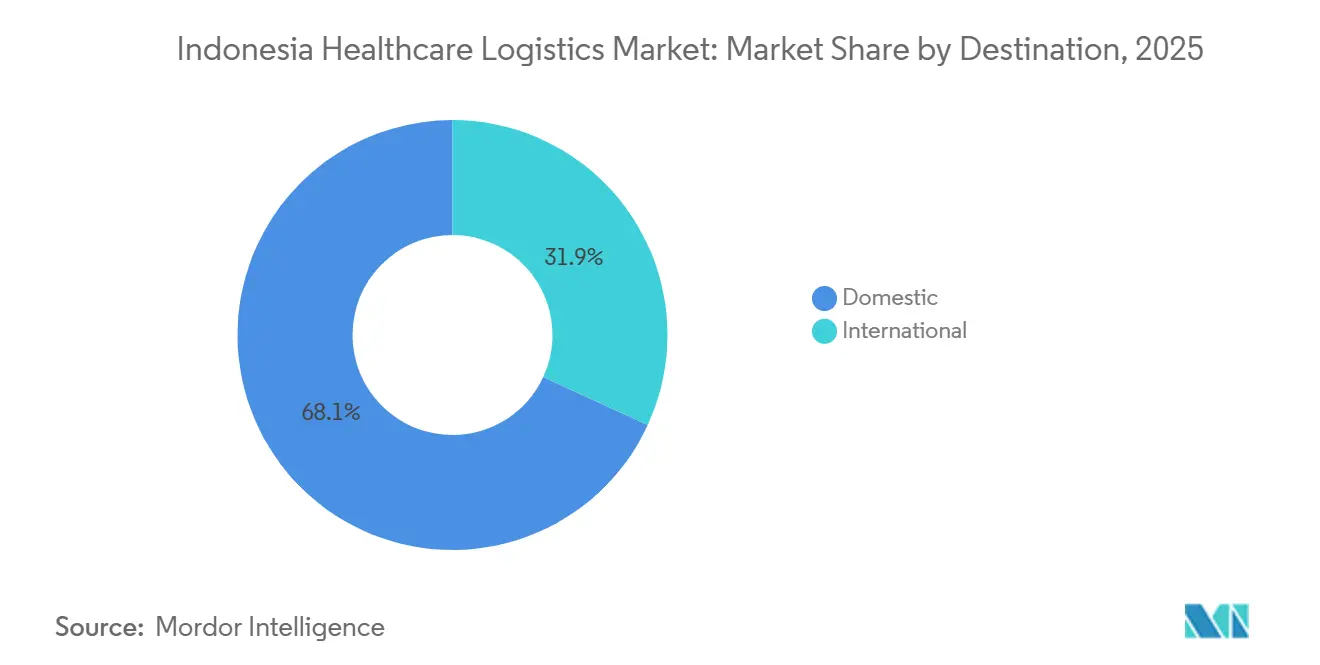
Domestic logistics held 68.12% of Indonesia healthcare logistics market size in 2025, while international logistics is projected to record a 13.86% CAGR through 2031, reflecting the scale of Indonesia’s internal healthcare distribution network alongside increasing cross-border pharmaceutical activity. Domestic logistics supports healthcare distribution across 38 provinces and thousands of inhabited islands, requiring providers to coordinate ambient, refrigerated, frozen, and ultra-low-temperature products across multiple transport modes and delivery conditions. Clinical trial supply chains, pharmaceutical raw-material exports, and imports of specialty biologics support international logistics. The October 2025 export distribution cooperation between PT Kimia Farma Tbk and Soidal Medical Supplies Ltd in Papua New Guinea further illustrated the development of regional pharmaceutical distribution links.
Indonesia’s location between North Asian manufacturing centers and Oceanian markets supported regional pharmaceutical movements, while infrastructure upgrades such as DHL’s December 2025 Surabaya Gateway enhancement strengthened air cargo connectivity for East Java and surrounding markets. Growth in domestic advanced-therapy production and pharmaceutical exports increases the need for specialized airfreight capabilities, including IATA CEIV Pharma-compliant handling. Domestic distribution remains operationally complex because providers must coordinate large numbers of healthcare facilities, varied product conditions, and repeated multimodal handoffs. The Indonesia healthcare logistics market, therefore, requires distinct service models for nationwide distribution and cross-border pharmaceutical lanes.
By End User: Pharmaceutical Manufacturers Lead While Biopharma Adds Premium Demand
Pharmaceutical manufacturers held 36.94% of Indonesia healthcare logistics market share in 2025, while biopharmaceutical manufacturers are projected to record an 11.24% CAGR through 2031, reflecting the continued importance of conventional pharmaceutical flows alongside increasing demand for specialized biopharmaceutical logistics. Pharmaceutical manufacturers generate primary flows from factories to distributors and secondary flows to hospitals, clinics, and retail pharmacies, making them major customers for healthcare logistics providers. Biopharmaceutical manufacturers require validated cold-chain handling, specialized packaging, and real-time monitoring, which can increase logistics requirements and spending per unit compared with conventional pharmaceutical distribution. Hospitals and clinics also provide a recurring institutional procurement base for medicines, medical devices, diagnostics, and temperature-sensitive treatments as healthcare infrastructure expands under the 2023 Health Law.
Kimia Farma’s downstream network included more than 1,000 pharmacies, more than 350 clinics, and more than 60 laboratories as of June 2026. This vertically integrated network generates internal delivery demand while increasing competition for independent logistics providers serving pharmacies, clinics, laboratories, and institutional customers. Healthcare distributors and wholesalers remain an important intermediary tier, with CDOB compliance increasingly supported by digital documentation and monitoring requirements. Providers that can connect with SATUSEHAT while offering storage, fulfillment, temperature control, and shipment visibility can support the evolving requirements of manufacturers and healthcare facilities. The Indonesia healthcare logistics industry is, therefore, becoming increasingly dependent on integrated service quality alongside physical network coverage.
Geography Analysis
Java, including Jakarta and Bogor-Depok-Bekasi, held 72.36% of the Indonesia healthcare logistics market share in 2025, reflecting its role in pharmaceutical manufacturing, warehousing, air cargo, and national distribution. Soekarno-Hatta International Airport is the main entry point for imported biologics, clinical trial materials, and temperature-sensitive specialty medicines. DSV’s GDP-compliant facilities in Cengkareng, Surabaya’s gateway infrastructure, and Enseval’s national branch network reinforce Java’s established distribution base, where import gateways, manufacturers, storage facilities, and national networks are concentrated. The planned National Pharmaceutical Installation in Tangerang is expected to deepen the island’s cold-chain role when construction begins later in 2026. Enseval’s EMOS platform received CDOB PSEF certification in September 2026, showing that Java-based providers are setting a digital compliance standard[4]PT Enseval Putera Megatrading Tbk, “Enseval Strengthens Commitment Through CDOB PSEF,” Enseval, enseval.com. Sumatra is the second-largest pharmaceutical logistics region, with Medan and Palembang serving a population of more than 60 million. Kalimantan is receiving healthcare infrastructure investment related to Nusantara’s development, which is expected to require broader pharmaceutical distribution over the medium term.
Sulawesi is projected to register at a 12.78% CAGR through 2031, supported by hospital commissioning programs, Makassar’s hub role, and clinical trial activity in Tier 2 cities. This growth requires GDP-compliant storage and cold-chain capacity outside Java’s established network, particularly in secondary cities that do not yet have validated storage infrastructure and where providers must develop local capacity before demand becomes large enough to support standard network economics.
Bali and Nusa Tenggara have specialized demand associated with medical tourism and private hospitals serving international patients. Papua Region and the Maluku Islands face the most serious service gaps because fragmented geography, limited air cargo capacity, and unreliable power constrain cold-chain continuity during storage, inter-island transport, and final delivery to remote health facilities. A PLOS Global Public Health study documented Maluku’s restricted port and vessel network. Separate research found that fragmented governance and infrequent transportation contributed to medicine stockout cycles in Maluku. Providers expanding into Papua and Maluku must establish whether health-access mandates can generate enough demand to support their fixed infrastructure costs.
Competitive Landscape
The Indonesia healthcare logistics market is fragmented, with domestic pharmaceutical distributors and global logistics providers serving different but increasingly overlapping needs. PT Anugerah Pharmindo Lestari, PT Enseval Putera Megatrading Tbk, PT Kimia Farma Trading & Distribution, PT Anugrah Argon Medica, and PT Parit Padang Global manage primary distribution through domestic branch networks. DHL Group, DSV A/S, Kuehne+Nagel, CEVA Logistics, and UPS Healthcare compete in cross-border freight, controlled-temperature handling, and GDP-compliant contract logistics. The important competitive gap is the ability to combine deep inter-island reach with validated cold-chain operations beyond Java.
Digitalization is becoming a practical requirement in the Indonesia healthcare logistics market because compliance depends on visible, documented distribution activity. Enseval’s EMOS platform obtained CDOB PSEF certification in September 2026 as Indonesia’s first Distribution PSEF to receive the standard. DHL announced a EUR 500 million (USD 588.15 million) Asia-Pacific investment in life sciences and healthcare logistics in April 2025, supporting GDP-certified hubs, multi-temperature fleets, and end-to-end visibility systems. Kuehne+Nagel’s handling of 14 active Envirotainer containers in Indonesia demonstrates a focus on validated airfreight cold-chain capacity. These moves increase expectations around storage, monitoring, and control at each handoff, from bonded storage and airport handling through final delivery and documented product receipt, and they reinforce the operational gap between basic freight services and specialist healthcare logistics.
CDOB 2025 makes validated systems and documented processes more important in pharmaceutical contracts. Providers that cannot demonstrate compliant cold-chain handling may find it harder to secure business from pharmaceutical companies. Asset-light technology providers can support IoT-enabled monitoring and track-and-trace services without owning every physical asset. FedEx received the Asia-Pacific Biopharma Excellence Award in March 2026 for last-mile implementation, demonstrating its specialized regional healthcare delivery position. Competitive results will rest on meeting compliance requirements while keeping inter-island delivery operations financially viable despite dispersed delivery points, multimodal transfers, limited infrastructure, and the need for specialized equipment.
Indonesia Healthcare Logistics Industry Leaders
PT Anugerah Pharmindo Lestari
PT Enseval Putera Megatrading Tbk
DHL Group
Kuehne+Nagel International AG
DSV A/S
- *Disclaimer: Major Players sorted in no particular order

Recent Industry Developments
- March 2026: PT Enseval Putera Megatrading Tbk and Bayer Consumer Health Indonesia signed a distribution agreement at a ceremony in Singapore, expanding Enseval's principal portfolio and strengthening Bayer's self-care product reach across Indonesia's archipelago.
- November 2025: DHL Group acquired CRYOPDP, a specialty courier focused on clinical trials, biopharma, and cell and gene therapy logistics, strengthening its Pharma Specialized Network with cryogenic handling capabilities. The acquisition directly enhances DHL's ability to serve Indonesia's emerging cell therapy logistics segment as domestic advanced-therapy manufacturing scales.
- October 2025: PT Kimia Farma Tbk and Soidal Medical Supplies Ltd (Papua New Guinea) signed an export distribution cooperation agreement at the Trade Expo Indonesia (ICE BSD), extending Kimia Farma's pharmaceutical product reach into Papua New Guinea's market.
- August 2025: Indonesia Ministry of Health and UNDP launched the integration of the SSL-SMILE electronic health logistics monitoring system with SIHA (HIV/AIDS), SITB (tuberculosis), and SISMAL (malaria) disease program information systems, extending real-time pharmaceutical logistics visibility across three high-burden disease programs in 38 provinces.


Indonesia Healthcare Logistics Market Report Scope
| Transportation | Road |
| Air | |
| Sea and Inland Waterways | |
| Rail | |
| Warehousing & Distribution | |
| Value-added Services and Others |
| Temperature Controlled | Chilled (0-5 °C) |
| Frozen (-18-0 °C) | |
| Ambient | |
| Deep-Frozen / Ultra-Low (less than-20 °C) | |
| Non-Temperature Controlled |
| Pharmaceuticals | Prescription & Speciality Drugs |
| OTC Drugs | |
| Biopharmaceuticals (Biologics and Biosimilars) | |
| Vaccines | |
| Clinical Trial Materials | |
| Cell and Gene Therapies | |
| Medical Devices | |
| Veterinary Medicine | |
| Blood, Plasma & Blood Components | |
| Diagnostic and Laboratory Products | |
| Organs & Human Tissues | |
| Others |
| Domestics |
| International |
| Pharmaceutical Manufacturers |
| Biopharmaceutical Manufacturers |
| Hospitals & Clinics |
| Hospitals and Retail Pharmacies |
| Healthcare Distributors and Wholesalers |
| Others |
| Java (Jakarta and BOD) |
| Sumatra |
| Kalimantan |
| Sulawesi |
| Bali and Nusa Tenggara |
| Papua Region and Maluku Islands |
| By Logistics Function | Transportation | Road |
| Air | ||
| Sea and Inland Waterways | ||
| Rail | ||
| Warehousing & Distribution | ||
| Value-added Services and Others | ||
| By Temperature Type | Temperature Controlled | Chilled (0-5 °C) |
| Frozen (-18-0 °C) | ||
| Ambient | ||
| Deep-Frozen / Ultra-Low (less than-20 °C) | ||
| Non-Temperature Controlled | ||
| By Product Type | Pharmaceuticals | Prescription & Speciality Drugs |
| OTC Drugs | ||
| Biopharmaceuticals (Biologics and Biosimilars) | ||
| Vaccines | ||
| Clinical Trial Materials | ||
| Cell and Gene Therapies | ||
| Medical Devices | ||
| Veterinary Medicine | ||
| Blood, Plasma & Blood Components | ||
| Diagnostic and Laboratory Products | ||
| Organs & Human Tissues | ||
| Others | ||
| By Destination | Domestics | |
| International | ||
| By End User | Pharmaceutical Manufacturers | |
| Biopharmaceutical Manufacturers | ||
| Hospitals & Clinics | ||
| Hospitals and Retail Pharmacies | ||
| Healthcare Distributors and Wholesalers | ||
| Others | ||
| By Region | Java (Jakarta and BOD) | |
| Sumatra | ||
| Kalimantan | ||
| Sulawesi | ||
| Bali and Nusa Tenggara | ||
| Papua Region and Maluku Islands | ||


Key Questions Answered in the Report
What is the forecast for Indonesia healthcare logistics through 2031?
The sector is estimated to register from USD 5.69 billion in 2026 to USD 8.57 billion by 2031, at an 8.56% CAGR.
Which logistics function generated the largest revenue in 2025?
Transportation led with 46.34% of revenue because healthcare products must move across dispersed road, sea, and air networks.
Why is cold-chain capacity becoming more important in Indonesia?
Biologics, vaccines, and advanced therapies need validated temperature control, and temperature-controlled logistics are projected to register at an 11.93% CAGR.
Which product group is expected to grow fastest through 2031?
Cell and gene therapies are expected to register at a 14.24% CAGR, supported by emerging domestic production and specialized treatment requirements.
Which Indonesian region has the largest healthcare logistics base?
Java, including Jakarta and BOD, held 72.36% of revenue in 2025 because it is the main manufacturing, warehousing, and air-cargo center.
What is the main operational challenge for providers serving outer islands?
Inter-island transport, unreliable power, limited cold-chain infrastructure, and repeated handoffs increase cost and temperature-control risk.
Page last updated on:


 Your data is secure and never sold or shared.


