
Indonesia Fourth-party Logistics (4PL) Market Size and Share
Market Overview
| Study Period | 2020 - 2031 |
|---|---|
| Forecast Data Period | 2026 - 2031 |
| Base Year Market Size (2025) | USD 1.97 Billion |
| Market Size (2026) | USD 2.23 Billion |
| Market Size (2031) | USD 3.58 Billion |
| Growth Rate (2026 - 2031) | 9.93 % |
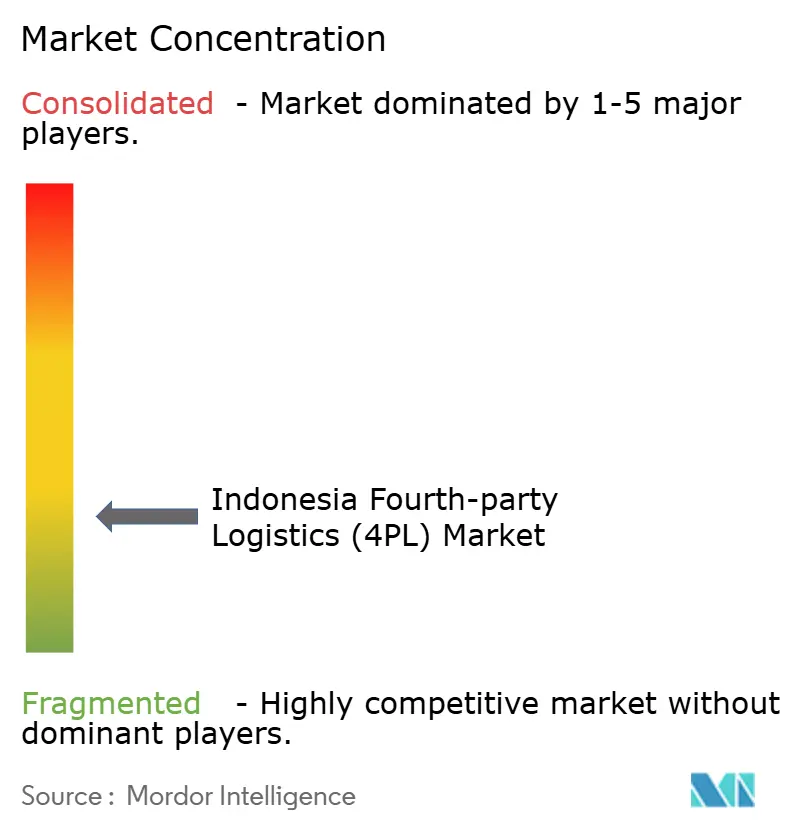
| Market Concentration | Low |
Major Players *Disclaimer: Major Players sorted in no particular order Image © Mordor Intelligence. Reuse requires attribution under CC BY 4.0. | |
Indonesia Fourth-party Logistics (4PL) Market Analysis by Mordor Intelligence
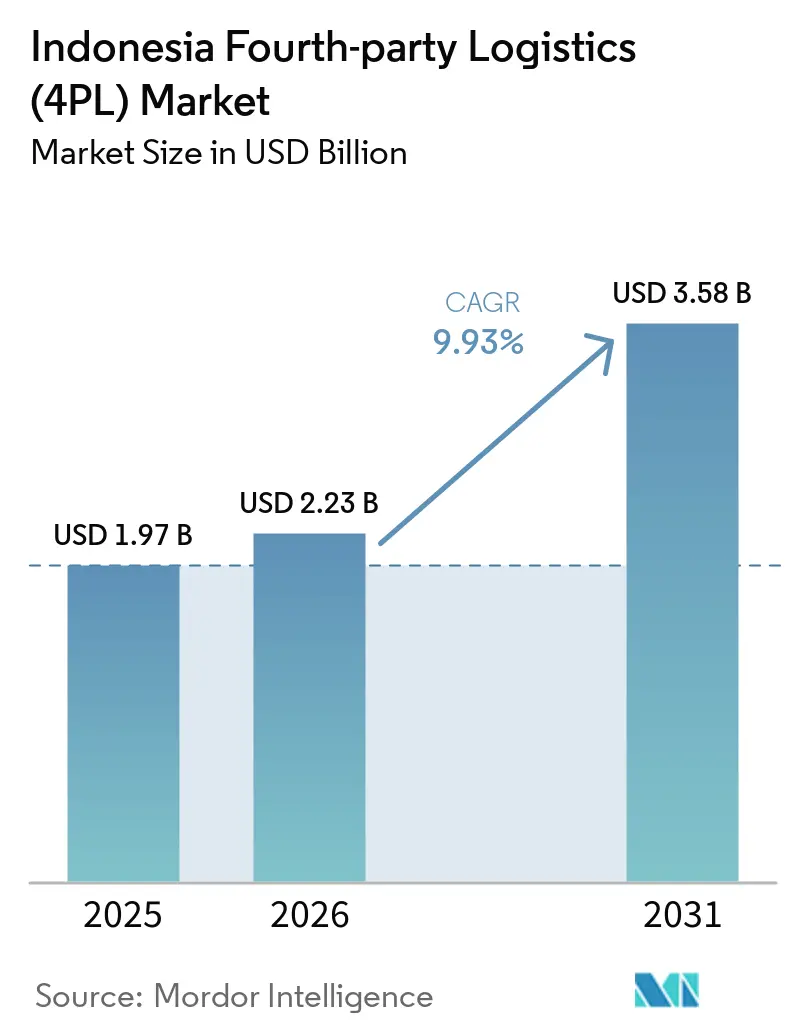
The Indonesia fourth-party logistics (4PL) market size was valued at USD 1.97 billion in 2025 and is estimated to grow from USD 2.23 billion in 2026 to reach USD 3.58 billion by 2031, at a CAGR of 9.93% during the forecast period 2026-2031.
Indonesia’s geography creates coordination needs across more than 17,000 islands, where a single carrier relationship often cannot manage end-to-end movement. Investment realization reached IDR 1,931 trillion (USD 121.4 billion) in 2025, while downstream activities contributed 30% of inflows, supporting demand for coordinated supply chains in mining, petrochemicals, and electric vehicle production. Indonesia’s e-commerce GMV reached USD 71 billion in 2025, and its growth added more frequent multi-carrier fulfillment needs in Java and the outer islands. The Indonesia fourth-party logistics (4PL) market benefits when manufacturers add local suppliers because procurement, inbound transport, and delivery schedules must be managed across more parties. Regulation, data standards, and freight-cost volatility will continue to shape whether the Indonesia fourth-party logistics (4PL) market can scale services beyond the main islands and maintain reliable multi-carrier coordination at scale.
Key Report Takeaways
- By operating model, the lead logistics provider held 42.85% of Indonesia fourth-party logistics (4PL) market size in 2025, while the digital platform 4PL recorded the highest projected CAGR at 16.32% through 2031.
- By end-user industry, retail and e-commerce held 24.64% of Indonesia fourth-party logistics (4PL) market share in 2025, while refrigerated and pharma recorded the highest projected CAGR at 13.89% through 2031.
- By enterprise size, large enterprises held 68.92% of Indonesia fourth-party logistics (4PL) market size in 2025, while small and medium enterprises recorded the highest projected CAGR at 14.32% through 2031.
- By region, Java held 38.68% of Indonesia fourth-party logistics (4PL) market share in 2025, while Sulawesi recorded the highest projected CAGR at 11.98% through 2031.
Note: Market size and forecast figures in this report are generated using Mordor Intelligence’s proprietary estimation framework, updated with the latest available data and insights as of January 2026.
Indonesia Fourth-party Logistics (4PL) Market Trends and Insights
Drivers Impact Analysis*
| Driver | (~) % Impact on CAGR Forecast | Geographic Relevance | Impact Timeline |
|---|---|---|---|
| E-Commerce Complexity Increasing Demand for Integrated 4PL Services | +3.2% | Java, Sumatra, national | Short term (≤ 2 years) |
| Logistics Digitalization Accelerating End-to-End Supply Chain Orchestration | +2.1% | National, with early gains in Jakarta, Surabaya, and Medan | Medium term (2-4 years) |
| Manufacturing Localization Expanding Complex Multi-Industry Logistics Requirements | +1.6% | Sulawesi, Kalimantan, Batam, Central Java, and West Java | Medium term (2-4 years) |
| Real-Time Visibility Demand Driving Control-Tower Adoption | +0.9% | National | Medium term (2-4 years) |
| Healthcare Compliance Increasing Specialized Supply Chain Management Demand | +0.8% | Java, Sulawesi, and Sumatra | Short term (≤ 2 years) |
| Multi-Island Networks Increasing Optimization and Backhaul Coordination Needs | +0.6% | Papua Region, Maluku Islands, and outer islands | Long term (≥ 4 years) |
| Source: Mordor Intelligence | |||
E-Commerce Complexity Increasing Demand for Integrated 4PL Services
Indonesia’s e-commerce GMV reached USD 71 billion in 2025 and grew 14% from the prior year. The country had 800,000 active online sellers in 2025 after a 75% increase, while video commerce recorded 2.6 billion transactions after 90% growth. These volumes require order management, routing, returns handling, and carrier coordination across many individual sellers. The Indonesia fourth-party logistics (4PL) market can serve this need, where merchants use more than 1 carrier and need a common operating layer. Digital platform providers can make these services more accessible to smaller sellers than conventional full-service arrangements.
Logistics Digitalization Accelerating End-to-End Supply Chain Orchestration
The National Logistics Ecosystem covers 55 ports and 12 airports in 2026, according to Indonesia’s customs authority. The program reduces processing time by 73% and logistics costs by 17% at covered locations. These results strengthen the case for shared data and coordinated shipment management. The Indonesia fourth-party logistics (4PL) market can use greater system connectivity to support control-tower services at a lower operating cost. In September 2026, Telkomsel introduced a smart warehouse pilot that improved picking performance by 25% and reduced preparation time from 4 hours to 3 hours.
Manufacturing Localization Expanding Complex Multi-Industry Logistics Requirements
Downstream investment and local manufacturing add supplier, transport, and compliance requirements that extend beyond basic freight execution. Indonesia recorded USD 79 billion in downstream investment and 594,000 new jobs since 2020 through the first quarter of 2025. BYD is committed to using up to 60% local vehicle components from January 2027, creating additional local sourcing relationships. The Indonesia fourth-party logistics (4PL) market is relevant to manufacturers that must align procurement, suppliers, ports, and production sites across separate islands. This is especially important in nickel, electric vehicle components, electronics, automotive parts, and processed foods[1].
Real-Time Visibility Demand Driving Control-Tower Adoption
Inter-island routes require shippers to manage route changes, cargo dwell time, and customs activity across separate transport links. A control tower gives the client one view of these events and supports action when delays arise. PT Samudera Indonesia added hundreds of IoT-equipped land vehicles in June 2026 for real-time tracking and driver-behavior monitoring. XPENG delivered its first locally produced X9 in Indonesia in 2025, showing that new automotive manufacturers were entering with digital supply-chain expectations[2]. The Indonesia fourth-party logistics (4PL) market, therefore, favors providers that combine visibility, predicted arrival times, and exception management across carrier networks.
Restraints Impact Analysis*
| Restraint | (~) % Impact on CAGR Forecast | Geographic Relevance | Impact Timeline |
|---|---|---|---|
| Fragmented Inter-Island Infrastructure Increasing Transshipment Complexity | -1.8% | Papua Region, Maluku Islands, outer Kalimantan, and Nusa Tenggara | Long term (≥ 4 years) |
| Data Interoperability Issues Hindering Integrated 4PL Platforms | -1.1% | National | Medium term (2-4 years) |
| Limited Analytics Talent Constraining Advanced Orchestration Capabilities | -0.7% | National, acute in outer-island regions | Medium term (2-4 years) |
| Strategic Control Concerns Limiting 4PL Outsourcing Adoption | -0.5% | National and domestic conglomerates | Short term (≤ 2 years) |
| Source: Mordor Intelligence | |||
Fragmented Inter-Island Infrastructure Increasing Transshipment Complexity
Indonesia’s logistics costs represented 14.3% of GDP in 2025, compared with an 8% average in developed economies. Feeder shipping frequency, roll-on and roll-off capacity, and shallow ports can raise transit time in Eastern Indonesia. These conditions add cost and uncertainty to a multi-carrier service agreement. The Indonesia fourth-party logistics (4PL) market remains more established in Java and Sumatra because those locations have stronger logistics infrastructure. The same gap can restrict providers from extending a consistent operating model into Papua, Maluku, outer Kalimantan, and Nusa Tenggara.
Data Interoperability Issues Hindering Integrated 4PL Platforms
A fourth-party model depends on reliable exchanges between carrier systems, warehouses, customer enterprise systems, customs, and ports. Smaller trucking companies may not offer digital interfaces, while established operators can use systems that do not readily connect. ALFI stated in July 2026 that integration progress under the National Logistics Ecosystem had stalled since late 2025[3]. Incomplete data can limit the accuracy of a provider’s control-tower reporting and operational decisions. The Indonesian fourth-party logistics (4PL) market also faces higher technology costs, where providers need their own software connections to bridge legacy systems.
*Our forecasts treat driver/restraint impacts as directional, not additive. The impact forecasts reflect baseline growth, mix effects, and variable interactions.
Segment Analysis
By Operating Model: Lead Logistics Providers Lead While Digital Platforms Expand
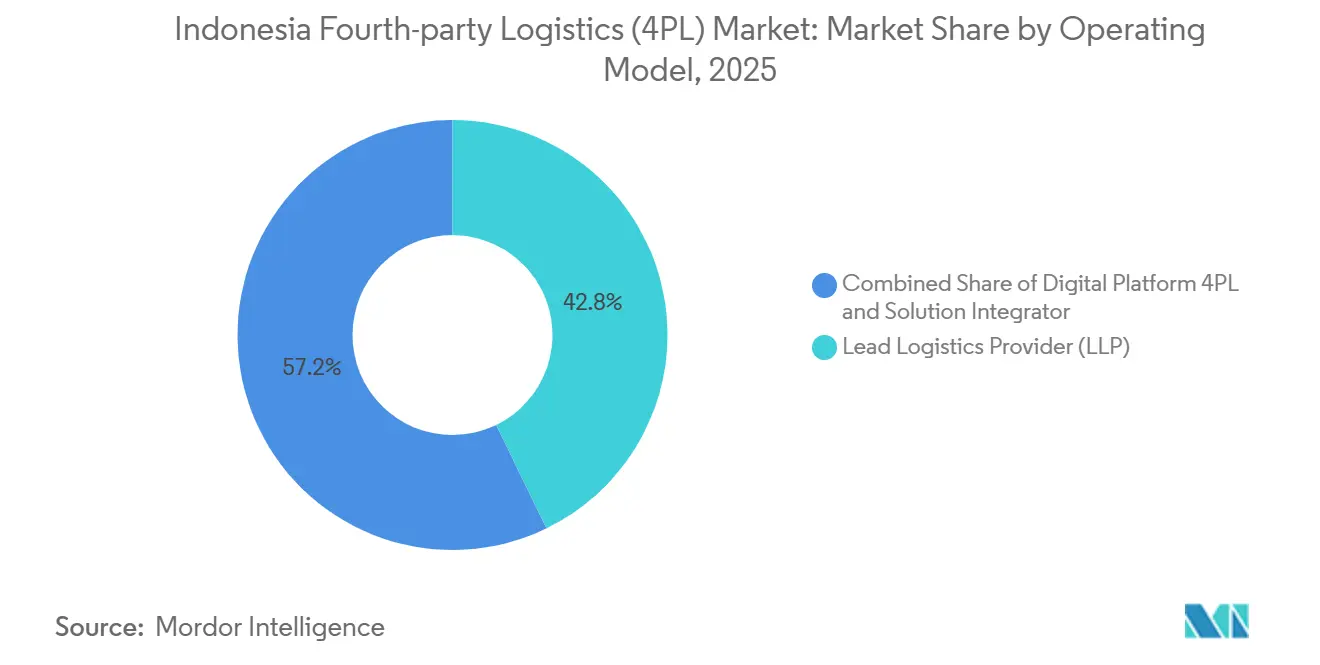
Lead logistics provider (LLP) accounted for 42.85% of the Indonesia fourth-party logistics (4PL) market share in 2025, while digital platform 4PL is forecast to record a 16.32% CAGR from 2026 to 2031. The LLP model appeals to multinational clients seeking one accountable coordinator for complex supply chains, offering defined service levels, compliance support, and a clear escalation structure. Automotive manufacturers, pharmaceutical companies, and industrial groups commonly require this level of coordination across multiple suppliers, carriers, and islands.
Digital platform 4PL is gaining relevance among customers seeking supply chain visibility and coordination without adopting a full-scope outsourcing model. Waresix’s listed subsidiary, PT BSA Logistics Indonesia, reported 42.6% revenue growth in H1 2026, highlighting the expansion of digitally enabled logistics operations. Flexible minimum volumes and connected workflows can also help digital platforms serve mid-market customers. As a result, Indonesia’s 4PL industry accommodates distinct customer requirements through LLP and digital operating models, with each model addressing different levels of supply chain control and outsourcing.

By End-User Industry: Retail and E-Commerce Lead While Refrigerated and Pharma Grow Fastest
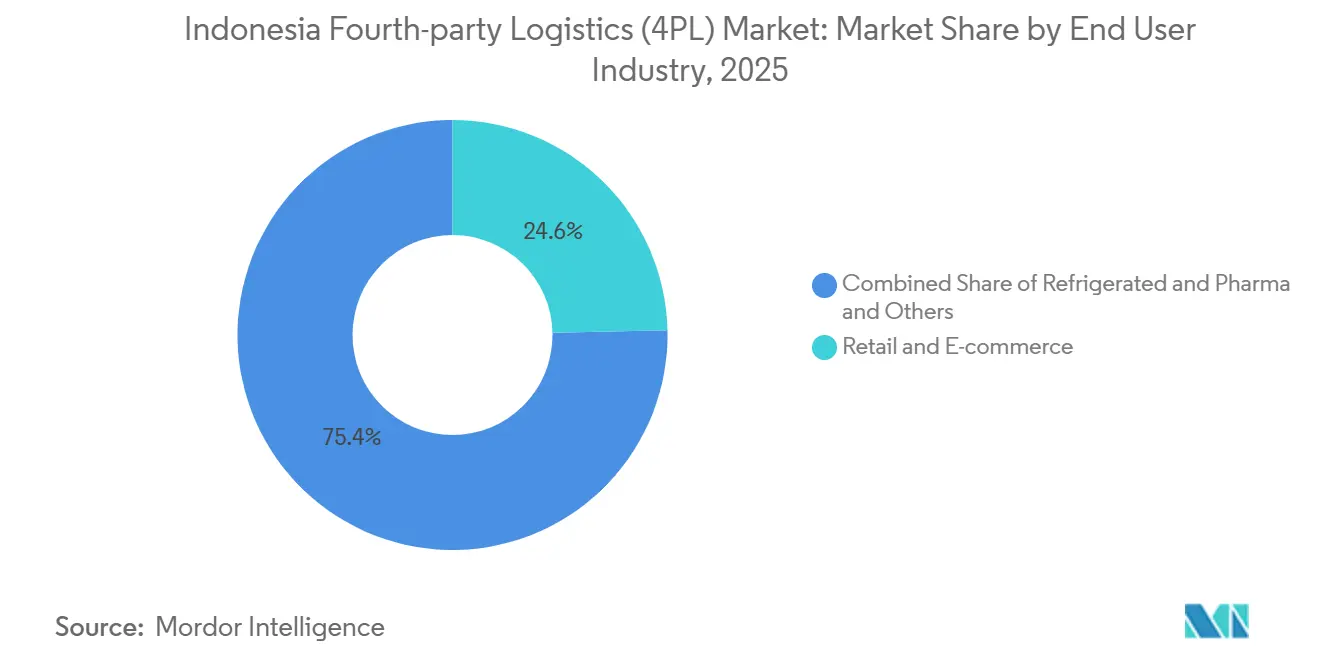
Retail and e-commerce held 24.64% of the Indonesia fourth-party logistics (4PL) market size in 2025, while refrigerated and pharma are projected to record a 13.89% CAGR from 2026 to 2031. Retail and e-commerce generate frequent orders and returns, increasing coordination requirements across fulfillment centers, carriers, and customers. FMCG also contributes substantial demand as consumer goods suppliers manage broad national distribution networks. Automotive and mobility requirements are increasing alongside the development of local supplier networks, while fashion, lifestyle, technology, and electronics add further activity through Java-based distribution and omnichannel fulfillment.
Refrigerated and pharma are gaining importance as pharmaceutical distributors face tighter cold-chain compliance requirements. BPOM Regulation No. 20 of 2025 updated Good Cold Distribution Practice requirements, increasing the need for documented temperature control and monitoring across distribution routes. Industrial manufacturing is also creating additional 4PL requirements as Sulawesi smelter projects generate complex equipment and raw-material logistics needs. PT Vale Indonesia is progressing 3 Sulawesi smelter projects toward completion by 2027, supporting demand for coordinated industrial logistics services.
By Enterprise Size: Large Enterprises Anchor Revenue While SMEs Add Volume
Large enterprises captured 68.92% of the Indonesia fourth-party logistics (4PL) market share in 2025, while small and medium enterprises (SMEs) are forecast to record a 14.32% CAGR from 2026 to 2031. Large enterprises have complex procurement, reporting, and coordination requirements across consumer goods, automotive, and technology supply chains. Their scale supports comprehensive contracts commonly associated with LLP providers, while requirements for clear accountability and reporting sustain demand from major global and established domestic 4PL operators.
SMEs are gaining access to 4PL services as digital platforms lower the operational threshold for companies that previously managed logistics internally. WBSA operates through 9 main branches and 5 major international ports across Indonesia, serving FMCG, manufacturing, retail, and agriculture customers. Digital 4PL models allow smaller businesses to access routing, coordination, and visibility capabilities without the structure of traditional enterprise contracts. This expansion can broaden the customer base and transaction volume of Indonesia’s 4PL industry, while large enterprises continue to generate higher-value contracts.
Geography Analysis
Java held 38.68% of the Indonesia fourth-party logistics (4PL) market share in 2025. Manufacturing sites, major ports, and the largest consumer base make the island the main center of logistics demand. DHL has more than 4,000 employees and 180 facilities in Indonesia. The company expanded its Surabaya Gateway in December 2025 with investment exceeding USD 10 million, alongside an expansion of more than USD 20 million at the Jakarta Gateway. Sumatra is the second-largest island because of palm oil, rubber, coal, and downstream manufacturing logistics.
Sulawesi is forecast to register at a 11.98% CAGR from 2026 to 2031. Nickel downstreaming in Morowali and Konawe requires specialized coordination among mining, processing, marine, road, and project-cargo activities. Vale’s Indonesia Growth Project Pomalaa HPAL facility represents a USD 2 billion investment with GEM and EcoPro. Green nickel exports began directly from Kendari New Port to China in January 2026, using a 16-day voyage. The Indonesia fourth-party logistics (4PL) market has an opportunity to support these corridors as port capacity and logistics connections improve.
Kalimantan has mining, coal, bauxite, biofuel, and palm processing activities that can add complex inbound requirements. At the same time, Bali and Nusa Tenggara rely more on tourism-linked FMCG and cold-chain distribution. Papua and Maluku remain constrained by infrastructure despite natural-resource projects and policy attention. Presidential Regulation No. 41 of 2026 identified port-hinterland connectivity, national logistics ecosystem digitalization, and logistics workforce capacity as core pillars. National logistics ecosystem results at covered nodes offer a basis for wider digital integration and may support expansion as conditions improve.
Competitive Landscape
The Indonesia fourth-party logistics (4PL) market is fragmented, with global providers holding stronger positions in complex multinational assignments that require broad international coverage and defined compliance processes. DSV completed its acquisition of DB Schenker on April 30, 2025, creating the world’s largest freight forwarder by revenue[4]. The Indonesian operations were integrated as PT DSV Transport Indonesia on May 1, 2026. This combination gives DSV greater scale across air, ocean, and contract logistics services.
DHL is expanding healthcare capability in the Asia-Pacific through a EUR 500 million (USD 573 million) investment program, which aligns with compliance-intensive logistics demand. Kuehne+Nagel renewed a 4-year LNG resupply contract in Indonesia in early 2026, extending integrated marine and project logistics work. NX Group merged its 2 Indonesian subsidiaries in March 2026 to form PT NX Lemo Indonesia Logistik. These moves show how international groups are combining scale, vertical knowledge, and a simpler local customer interface. The Indonesia fourth-party logistics (4PL) market is also shaped by domestic providers that compete through faster onboarding and flexible system connections.
Waresix and Janio target smaller and mid-sized users, where major providers may have higher contract thresholds. The outer-island segment remains open because systematic multi-carrier coverage is not yet established at scale. Cold-chain and pharmaceutical services for smaller firms also remain an area where compliance-focused digital offerings are still limited. Rhenus presented sustainability and European trade-compliance support to Indonesian partners in April 2025. The Indonesia fourth-party logistics (4PL) market is likely to reward providers that can connect intermodal management with reliable cold-chain visibility and reporting.
Indonesia Fourth-party Logistics (4PL) Industry Leaders
-
DHL Group
-
DSV A/S
-
PT Samudera Indonesia Tbk
-
PT Puninar Logistics
-
PT Kamadjaja Logistics
- *Disclaimer: Major Players sorted in no particular order
Recent Industry Developments
- August 2026: PT Pelabuhan Indonesia, PT Indo Konstruksi Mineral, and PT Pelindo signed a cooperation agreement at Kendari Port for storage-land use and nickel ore loading and unloading services. The agreement is designed to strengthen the mineral supply chain and Kendari Port’s logistics role in nickel downstreaming.
- March 2026: Kuehne+Nagel renewed its multi-year resupply contract for Indonesia’s largest LNG producer for an additional 4-year term. The contract extends integrated marine and project logistics services managed from its Lamongan Shorebase oil and gas supply base.
- December 2025: DHL Express Indonesia expanded the Surabaya Gateway facility with an investment exceeding USD 10 million. DHL also expanded the Jakarta Gateway with more than USD 20 million, built a dedicated customs gateway in Central Java, and launched a direct Singapore-Semarang flight.
- April 2025: DSV A/S completed the EUR 14.3 billion (USD 16.3 billion)) acquisition of DB Schenker from Deutsche Bahn. The Indonesian entity was fully integrated as PT DSV Transport Indonesia on May 1, 2026, unifying air and ocean freight operations under a single legal entity and customer interface.
Indonesia Fourth-party Logistics (4PL) Market Report Scope
| Lead Logistics Provider (LLP) |
| Solution Integrator |
| Digital Platform 4PL |
| FMCG |
| Retail and E-commerce |
| Fashion and Lifestyle |
| Technology and Electronics |
| Refrigerated and Pharma |
| Automotive and Mobility |
| Industrial Manufacturing |
| Others |
| Small and Medium Enterprises |
| Large Enterprises |
| Java (Jakarta and BOD) |
| Sumatra |
| Kalimantan |
| Sulawesi |
| Bali and Nusa Tenggara |
| Papua Region and Maluku Islands |
| By Operating Model | Lead Logistics Provider (LLP) |
| Solution Integrator | |
| Digital Platform 4PL | |
| By End-User Industry | FMCG |
| Retail and E-commerce | |
| Fashion and Lifestyle | |
| Technology and Electronics | |
| Refrigerated and Pharma | |
| Automotive and Mobility | |
| Industrial Manufacturing | |
| Others | |
| By Enterprise Size | Small and Medium Enterprises |
| Large Enterprises | |
| By Region | Java (Jakarta and BOD) |
| Sumatra | |
| Kalimantan | |
| Sulawesi | |
| Bali and Nusa Tenggara | |
| Papua Region and Maluku Islands |
Key Questions Answered in the Report
What is the projected value of fourth-party logistics services in Indonesia by 2031?
The Indonesia fourth-party logistics (4PL) market is forecast to reach USD 3.58 billion by 2031, rising from USD 2.23 billion in 2026 at a 9.93% CAGR.
Which operating model is expanding most quickly in Indonesia?
Digital platform 4PL is forecast to register at a 16.32% CAGR through 2031, while LLP held the largest 42.85% share in 2025.
Which customer sector has the strongest demand for 4PL services?
Retail and e-commerce led with a 24.64% share in 2025. Refrigerated and pharma are forecast to register the fastest at a 13.89% CAGR through 2031.
Why are digital platforms gaining logistics customers in Indonesia?
They can offer routing, visibility, and multi-carrier coordination with more flexible volumes and a lower operational threshold for smaller firms.
Which region is growing fastest for 4PL activity?
Sulawesi is forecast to expand at a 11.98% CAGR through 2031, supported by nickel downstreaming and related industrial logistics needs.
What limits the broader adoption of coordinated logistics services in Indonesia?
Inter-island infrastructure gaps and incomplete system interoperability can raise costs and reduce the data quality needed for connected logistics management.