
Indonesia Contract Logistics Market Size and Share
Market Overview
| Study Period | 2020 - 2031 |
|---|---|
| Forecast Data Period | 2026 - 2031 |
| Base Year Market Size (2025) | USD 7.26 Billion |
| Market Size (2026) | USD 7.87 Billion |
| Market Size (2031) | USD 12.06 Billion |
| Growth Rate (2026 - 2031) | 8.90 % |
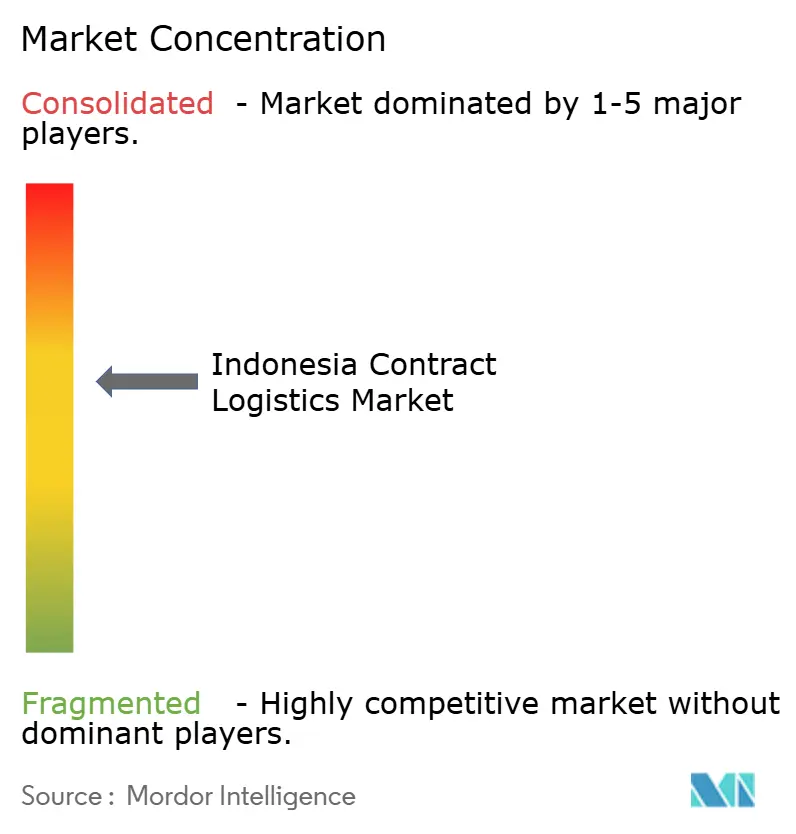
| Market Concentration | Medium |
Major Players *Disclaimer: Major Players sorted in no particular order Image © Mordor Intelligence. Reuse requires attribution under CC BY 4.0. | |
Indonesia Contract Logistics Market Analysis by Mordor Intelligence
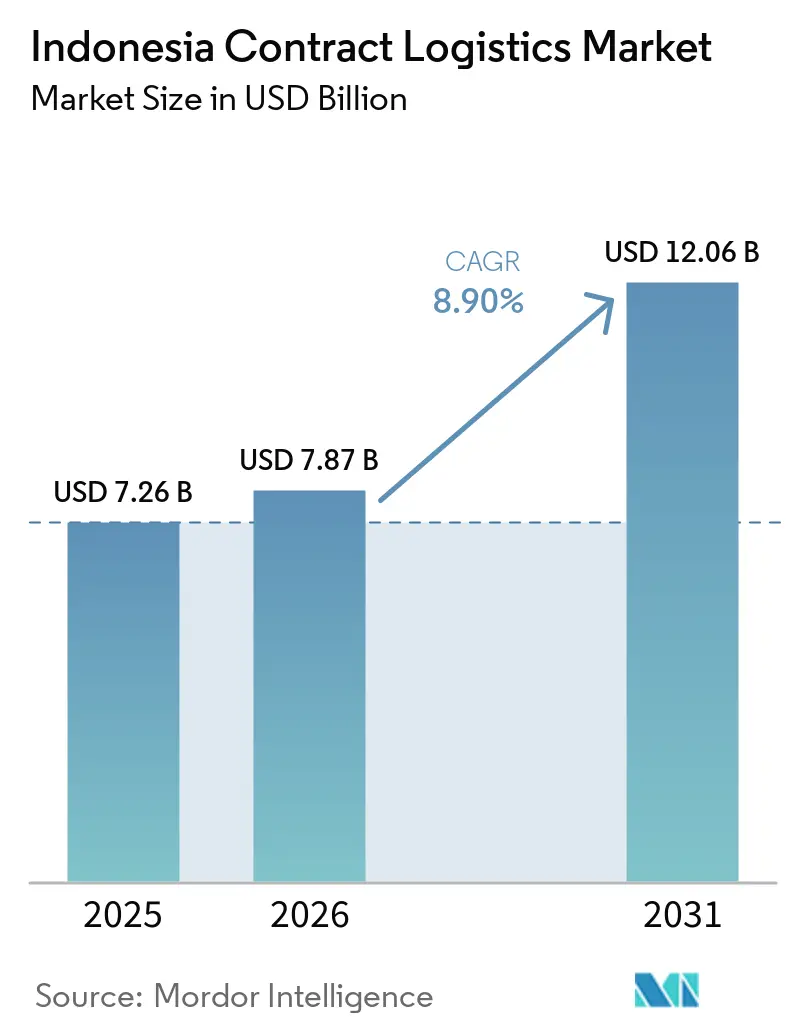
The Indonesia contract logistics market size was valued at USD 7.26 billion in 2025 and is estimated to grow from USD 7.87 billion in 2026 to reach USD 12.06 billion by 2031, at a CAGR of 8.90% during the forecast period (2026-2031).
The Indonesia contract logistics market is moving from individual freight purchases toward longer outsourcing agreements that combine transport, storage, and related services with one provider. Indonesia’s logistics costs represented 14.29% of GDP in the IndoTERM model, which kept pressure on shippers to improve supply chain efficiency. New shipping routes, the Nusantara capital project, toll roads, and rail links are extending logistics demand beyond Java. The Indonesia contract logistics market is, therefore, giving providers more reasons to build facilities and networks outside the traditional Jakarta corridor. Providers are also competing through integrated transport options and supply chain visibility rather than freight rates alone.
Key Report Takeaways
- By service type, transportation held 58.97% of the Indonesia contract logistics market share in 2025, while value-added services recorded the highest projected CAGR at 11.46% through 2031.
- By contract duration, above-3-year agreements held 62.34% of the Indonesia contract logistics market size in 2025, while 1-to-3-year agreements recorded the highest projected CAGR at 10.49% through 2031.
- By end-user industry, manufacturing and automotive held 28.45% of the Indonesia contract logistics market share in 2025, while healthcare and pharmaceuticals recorded the highest projected CAGR at 10.98% through 2031.
- By region, Java, including Jakarta and BOD, held 46.37% of the Indonesia contract logistics market share in 2025, while Sulawesi recorded the highest projected CAGR at 11.56% through 2031.
Note: Market size and forecast figures in this report are generated using Mordor Intelligence’s proprietary estimation framework, updated with the latest available data and insights as of January 2026.
Indonesia Contract Logistics Market Trends and Insights
Drivers Impact Analysis*
| Driver | (~) % Impact on CAGR Forecast | Geographic Relevance | Impact Timeline |
|---|---|---|---|
| E-commerce Fulfillment Outsourcing Accelerating Contract Logistics Demand | +1.8% | Java, with growing relevance in Sumatra, Sulawesi, and Kalimantan | Short term (≤ 2 years) |
| Manufacturing Expansion Increasing Integrated Supply Chain Requirements | +1.5% | Java industrial zones, the Semarang-Solo corridor, and Batam | Medium term (2-4 years) |
| Inter-Island Distribution Development Expanding Contract Logistics Networks | +1.2% | National, with priority in Eastern Indonesia, Kalimantan, and Sulawesi | Long term (≥ 4 years) |
| Cold Chain Growth Driving Specialized Logistics Demand | +1.0% | Java and Sumatra, with emerging demand in Sulawesi and Kalimantan | Medium term (2-4 years) |
| Nusantara Development Shifting Logistics Demand Beyond Java Corridors | +0.9% | East Kalimantan, with secondary relevance in Sulawesi and Makassar | Long term (≥ 4 years) |
| Integrated Visibility Demand Accelerating Control-Tower Service Adoption | +0.7% | Java and Sumatra | Medium term (2-4 years) |
| Source: Mordor Intelligence | |||
E-Commerce Fulfillment Outsourcing Accelerating Contract Logistics Demand
Indonesia’s e-commerce activity sustained double-digit volume growth through 2025, increasing parcel volumes, inventory needs, and reverse-logistics workloads. This activity required brands to manage stock across more locations and serve consumers beyond Greater Jakarta. The Indonesia contract logistics market benefited when brands shifted these tasks to providers with established warehouse and delivery networks. More complex fulfillment contracts combined ambient, refrigerated, and bonded-zone inventory within a single operating location.[1] This arrangement reduced the need to coordinate separate warehouse specialists. It also increased the value of providers that had regional facilities in tier-2 and tier-3 cities.
Manufacturing Expansion Increasing Integrated Supply Chain Requirements
Indonesia’s downstream industrial policy kept more nickel, copper, and bauxite processing within the country before export. Automotive investment added to these requirements, including BYD’s Subang plant and Geely Farizon’s knock-down assembly facility, which became operational in 2026. These facilities required component sequencing, bonded-zone flows, and just-in-time delivery across industrial locations. Toyota Motor Manufacturing Indonesia coordinates more than 240 Tier-1 suppliers and 520 Tier-2 and Tier-3 suppliers in 2026.[2] The supplier base strengthens demand for logistics partners that can manage inbound flows and customs procedures. Textile and garment production moving toward Central Java also created a need for freight links, storage, and export support around Semarang.
Inter-Island Distribution Development Expanding Contract Logistics Networks
Indonesia’s Sea Toll Program expanded from 3 routes in 2015 to 39 active routes serving 115 ports by 2024. Cargo volume on the program reached 24,556 TEUs in 2024. Regular shipping schedules helped logistics providers plan distribution agreements on routes that had previously lacked predictable volumes. PT PELNI began its 2025 fiscal-year Sea Toll operations with the January launch of KM Logistik Nusantara 4. Government planning for a Ro-Ro network also linked Kalimantan, Sulawesi, Maluku, Papua, and Bali-Nusa Tenggara with container hub ports. These links gave the Indonesia contract logistics market a clearer basis for building multi-modal services beyond Java.
Cold Chain Growth Driving Specialized Logistics Demand
Temperature-controlled distribution grew through pharmaceutical demand and food and beverage distribution outside Greater Jakarta. Biologics, vaccines, and specialty injectables required controlled 2 °C-to-8 °C handling across a dispersed island network. The Indonesia contract logistics market favored providers with certified facilities, qualified personnel, and documented chain-of-custody processes for pharmaceutical work. DHL Group announced a EUR 500 million (USD 588.15 million) investment in Life Sciences and Healthcare infrastructure across Asia-Pacific in 2025, with Indonesia identified as a priority country. Multi-temperature sites could handle pharmaceutical cold rooms and ambient food storage under one contract. That capability suited shippers seeking to combine temperature-sensitive and ambient inventory management.
Restraints Impact Analysis*
| Restraint | (~) % Impact on CAGR Forecast | Geographic Relevance | Impact Timeline |
|---|---|---|---|
| Inter-Island Handling Costs Increasing Contract Logistics Expenses | -1.0% | All inter-island routes, especially Eastern Indonesia, Maluku, and Papua | Short term (≤ 2 years) |
| Fragmented Regulations and Infrastructure Gaps Increasing Complexity | -0.8% | Eastern Indonesia, Kalimantan, Papua, and Sulawesi | Medium term (2-4 years) |
| Zero-ODOL Compliance Increasing Fleet Operating Cost Pressures | -0.7% | Java during immediate enforcement and nationally during the 2027 rollout | Short term (≤ 2 years) |
| Limited Backhaul Availability Raising Costs Outside Java | -0.4% | Kalimantan, Sulawesi, Sumatra’s interior, and Eastern Indonesia | Medium term (2-4 years) |
| Source: Mordor Intelligence | |||
Inter-Island Handling Costs Increasing Contract Logistics Expenses
Every inter-island shipment involved sea or air transfer, loading, unloading, and port dwell time. These operating steps did not apply to comparable overland routes in Vietnam, Thailand, or peninsular Malaysia. Costs remained high even after Sea Toll improvements because freight still required collection, consolidation, storage, and handling at ports. Uneven return cargo flows added further pressure because outbound demand from Java exceeded shipments moving back to Java. A 2025 National University of Singapore study identified infrastructure and cargo-handling gaps as ongoing constraints on West Kalimantan’s logistics competitiveness.[3] Fixed-price contracts in outer-island corridors, therefore, carried margin risk when cost movements could not be passed through to clients.
Zero-ODOL Compliance Increasing Fleet Operating Cost Pressures
Indonesia reaffirmed the Zero-ODOL policy as a transport priority in June 2025, with full national enforcement targeted for 2027. In 2026, the policy was in a socialization and pilot-program phase, including priority attention to mining haulage and construction materials. Compliance required fleets to retire or modify overloaded vehicles. A 2026 IndoTERM simulation found that transport operating costs rose 7.73%, while national logistics costs rose 4.58% during the transition period. Dedicated fleets working under fixed prices faced particular pressure where contracts lacked adjustment clauses.[4] NX Logistics Indonesia and KAI Logistik’s rail freight collaboration in 2025 showed how rail and sea alternatives could reduce reliance on overloaded road fleets.
*Our forecasts treat driver/restraint impacts as directional, not additive. The impact forecasts reflect baseline growth, mix effects, and variable interactions.
Segment Analysis
By Service Type: Value-Added Services Reshaping the Revenue Mix
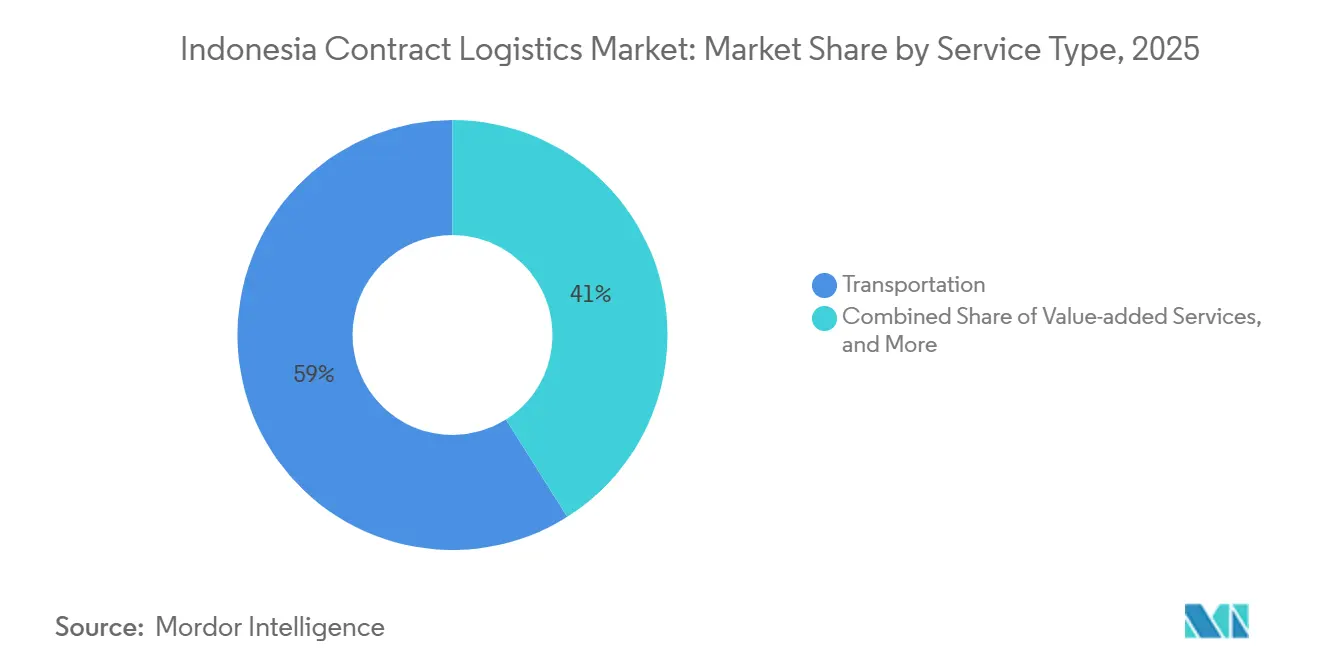
Transportation held 58.97% of the Indonesia contract logistics market share in 2025 and remained the largest service category. Java’s road network and inter-island sea freight supported that position across domestic distribution flows. Road services connected industrial zones, distribution centers, and retail channels on the main islands. Rail provided an alternative on selected Java corridors, while air freight supported time-sensitive cargo moving to eastern Indonesia. NX Logistics Indonesia and KAI Logistik began a rail freight collaboration between Klari, Karawang, and Surabaya in May 2025. Warehousing and distribution formed the middle tier of the service mix as Grade-A stock expanded from Greater Jakarta into Surabaya, Semarang, Medan, and Makassar.
Value-added services are forecast to grow at an 11.46% CAGR from 2026 to 2031, the fastest rate within the service mix. Assembly, labeling, and kitting allowed electronics, automotive, and consumer goods shippers to place production support and fulfillment activities closer together. This reduced handoffs between factories, storage sites, and delivery operations. The Indonesia contract logistics industry gained from longer and more integrated client relationships when these activities sat within a single facility. Bonded-zone authorization also differentiated providers serving export manufacturers. Maersk Logistics Indonesia received approval for a Pusat Logistik Berikat facility in Semarang in early 2026. The facility supported integrated storage and customs management for apparel, footwear, and accessory exporters.

By Contract Duration: Long-Term Agreements Signal Supply Chain Maturity
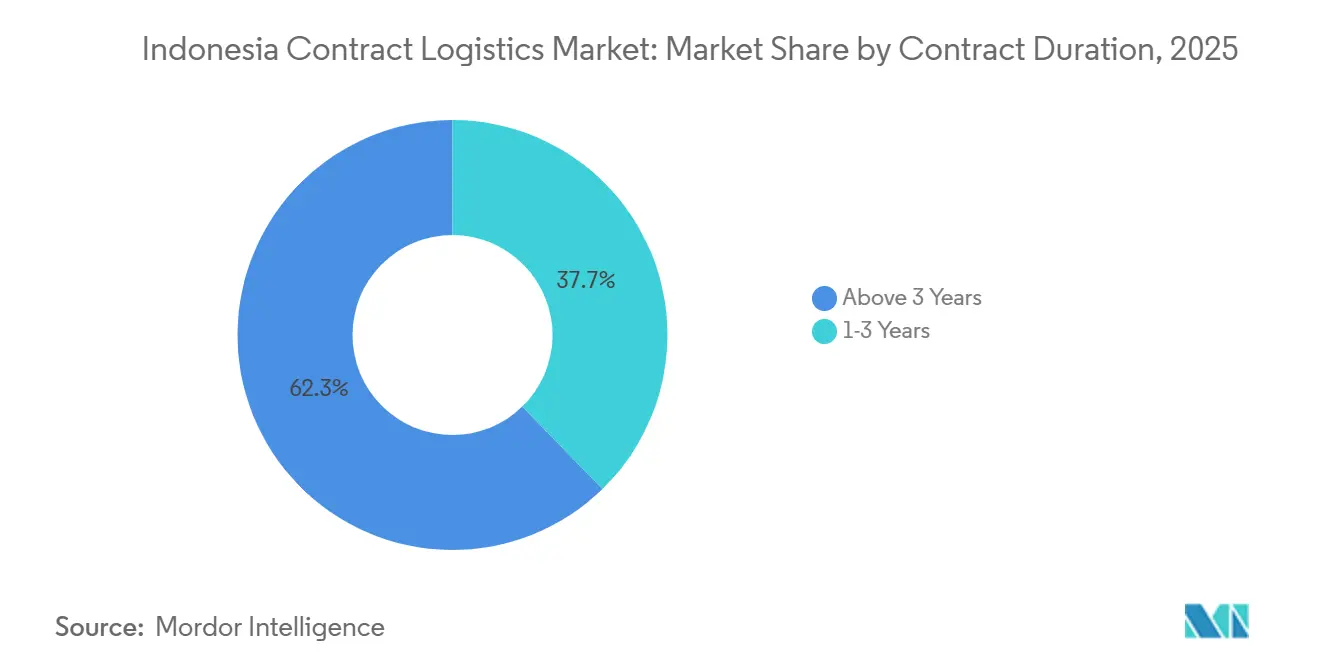
Above-3-year agreements held 62.34% of the Indonesia contract logistics market size in 2025. These agreements were the dominant outsourcing model because changing providers could interrupt complex inter-island operations. Route knowledge, customs familiarity, and local network relationships were not quickly transferred between providers. Manufacturers and retailers also relied on operational continuity to protect production uptime and product availability. Long-term terms gave clients more stable access to capacity and a clearer basis for planning costs. They also matched the longer investment horizon of global manufacturers establishing operations in Indonesia.
The 1-to-3-year segment is forecast to grow at a 10.49% CAGR from 2026 to 2031. New users of outsourced logistics often select shorter initial contracts before committing to longer arrangements. E-commerce and direct-to-consumer brands needed flexibility as volumes and fulfillment models changed. These companies also operated with shorter planning cycles than many established manufacturers. A strong first contract could demonstrate fulfillment accuracy, network reliability, and client-service quality. The Indonesia contract logistics market, therefore, gave providers a chance to convert short engagements into longer client relationships. This progression might increase both the duration and value of an account without changing the core logistics relationship.
By End-User Industry: Healthcare Emerges as the Premium Logistics Segment
Manufacturing and automotive held 28.45% of Indonesia contract logistics market share in 2025. Japanese and Korean supplier networks supported this position, while Chinese EV manufacturers added new supply chain needs. Component imports, in-plant logistics, and finished-vehicle distribution required coordinated handling. Toyota Motor Manufacturing Indonesia worked with more than 240 Tier-1 suppliers and 520 Tier-2 and Tier-3 suppliers in 2026. Food and beverage remained a stable contract base, while retail and e-commerce required more distributed warehousing in smaller cities. Chemicals retained specialized demand because hazardous-material requirements limited the number of eligible providers.
Healthcare and pharmaceuticals are forecast to grow at a 10.98% CAGR from 2026 to 2031. National health insurance, biologics adoption, and hospital expansion outside Java increased demand for compliant pharmaceutical distribution. Providers needed certified cold-chain facilities, trained, qualified personnel, and documented handling procedures. These requirements narrowed the field of providers able to serve pharmaceutical clients. The segment also supported premium contracts and lower client turnover than general freight activities. DHL Group’s 2025 Asia-Pacific investment placed life sciences and healthcare services under the DHL Health Logistics brand. The Indonesia contract logistics market offered a durable opening for providers that built compliant cold-chain capacity early.
Geography Analysis
Java, including Jakarta and BOD, held 46.37% of regional revenue in 2025 and remained Indonesia’s primary logistics hub. Tanjung Priok, warehouse capacity, logistics talent, and customs capability supported its leading role. Greater Jakarta also had the strongest concentration of global 3PL investment. Sumatra complemented Java as the second-largest regional area and included Batam’s electronics logistics cluster. DHL Express operates a 6,000-square-meter facility in Batam and a daily cargo vessel service between Batam and Singapore in 2026. Medan and Palembang supported consumer goods and agribusiness networks, while palm oil processing sustained freight volumes.
Sulawesi is forecast to grow at an 11.56% CAGR through 2031 and is the fastest-growing regional area. Nickel downstreaming, seafood logistics, aquaculture exports, and special economic zone activity supported demand around Makassar. Makassar New Port expansion improved capacity for mineral exports and agricultural distribution. The Makassar-Parepare railway added a rail option within the regional network. Kalimantan expanded through commodity flows in the south and east, as well as Nusantara-related construction demand in East Kalimantan. Indonesia’s Ro-Ro network plan connected Kalimantan, Sulawesi, Maluku, Papua, and Bali-Nusa Tenggara with major container ports. The plan designated regional nodes to concentrate cargo and improve route economics.
Bali and Nusa Tenggara relied on logistics services for tourism supply chains, fresh produce exports, and FMCG distribution. Maritime connections remained the principal limit on delivery speed and cost for island retail destinations. Papua and Maluku were the most infrastructure-limited areas in the Indonesia contract logistics market. Low cargo density, limited backhaul, and port capacity constraints increased operating costs there. The Sea Toll Program covered 115 ports across 39 routes by 2024, including links to Papua and Maluku. Better cargo consolidation at hub ports might improve conditions for dedicated contract logistics activity. Providers that established local distributor and government-linked relationships early might be better placed as infrastructure gaps narrowed.
Competitive Landscape
The Indonesia contract logistics market was moderately concentrated nationally, while regional and inter-island activity remained more fragmented. Global 3PLs competed for multinational manufacturing and retail accounts. Domestic operators retained advantages through inter-island contacts, route familiarity, and customs knowledge. Global providers increased facility commitments, bonded-zone approvals, gateway capacity, and entity changes during 2025 and 2026. These actions indicated a move from agent-based participation toward owned infrastructure. PT Samudera Indonesia Tbk allocated USD 200 million in capital expenditure for 2026 for vessels, chemical tankers, port facilities, and supporting logistics assets. This approach combined shipping, terminals, and logistics operations within one domestic operating model. It also linked fleet expansion with port and logistics infrastructure development. Such integration gave domestic operators a wider operating base across the supply chain.
Providers competed on their ability to combine transport, warehousing, and value-added services under one client relationship. This reduced the number of logistics providers a shipper needed to manage across an archipelago. NX Group completed the absorption merger of PT Nippon Express Indonesia into PT NX Lemo Indonesia Logistik in March 2026. The merger consolidated air and ocean forwarding functions under one customer-contact structure. It also built on the group’s One Indonesia cross-company sales initiative created in 2025. Digital control towers also gained importance for manufacturing clients that required real-time management of supply chain exceptions across islands. They brought operational data and decision processes into a more coordinated client-service model. This capability mattered where delays on one route could affect production or product availability elsewhere.
Supply Chain Indonesia identified digital control towers as a core part of supply chain resilience at the CKB Logistics Forum in June 2026. Cold-chain services outside Java, bonded-zone management in Semarang and Batam, and Kalimantan’s inter-island industrial flows had limited specialized capacity. These areas favored operators with compliant facilities and strong local execution. Kuehne+Nagel’s project logistics and oil and gas supply chain operations in Indonesia showed the value of specialist experience for LNG clients. The Indonesia contract logistics market also rewarded providers that could coordinate people, data, processes, governance, and decision authority across multiple transport modes. The Indonesia contract logistics market required this coordination because clients managed inventory across islands with different transit conditions. Providers with these capabilities could give clients clearer accountability across their transportation and warehousing activities.
Indonesia Contract Logistics Industry Leaders
-
DHL Group
-
DSV A/S
-
Kuehne+Nagel
-
Samudera Group
-
PT Puninar Logistics
- *Disclaimer: Major Players sorted in no particular order
Recent Industry Developments
- June 2026: PT Samudera Indonesia Tbk and Toyota Tsusho Corporation signed a Memorandum of Understanding to jointly develop an integrated logistics hub in Indonesia. The hub will combine transportation and warehousing services, bonded zone facilities, and supply chain solutions. It also incorporated digital technologies to enhance operational visibility and support green logistics practices. The partnership leveraged Samudera's shipping, port, and logistics expertise alongside Toyota Tsusho's industrial capabilities to improve supply chain efficiency and competitiveness.
- March 2026: NX Group (Nippon Express Holdings) completed the absorption merger of PT Nippon Express Indonesia into PT NX Lemo Indonesia Logistik. The merger created a unified entity that consolidated air and ocean freight forwarding functions under a single customer-contact structure. The integration was built on the group’s “One Indonesia” cross-company sales initiative, established in 2025, and provided a one-stop logistics service model for clients based in Indonesia.
- December 2025: DHL Express Indonesia invested more than USD 20 million in the Jakarta Gateway expansion and more than USD 10 million in the Surabaya Gateway, strengthening Indonesia's two busiest air freight hubs. The company also established Indonesia's first customs gateway in Semarang and launched a direct Singapore-to-Semarang air freight route, creating a dedicated logistics corridor for Central Java's textile, garment, and footwear export industries migrating from Jakarta.
- May 2025: PT NX Logistics Indonesia and KAI Logistik, the logistics subsidiary of PT Kereta Api Indonesia, commenced a green logistics collaboration through rail freight by dispatching the inaugural service from Klari, Karawang, to Surabaya. The partnership shifted cargo from road to rail, supporting decarbonization objectives and reducing road congestion along Java’s busiest freight corridor.
Indonesia Contract Logistics Market Report Scope
| Transportation | Road |
| Rail | |
| Air | |
| Sea | |
| Warehousing & Distribution | |
| Value-Added Services (Assembly, Labelling, Kitting) |
| 1-3 Years |
| Above 3 Years |
| Manufacturing and Automotive |
| Food and Beverage |
| Retail and E-commerce |
| Healthcare and Pharmaceuticals |
| Chemicals |
| Other Industries |
| Java (Jakarta and BOD) |
| Sumatra |
| Kalimantan |
| Sulawesi |
| Bali and Nusa Tenggara |
| Papua Region and Maluku Islands |
| By Service Type | Transportation | Road |
| Rail | ||
| Air | ||
| Sea | ||
| Warehousing & Distribution | ||
| Value-Added Services (Assembly, Labelling, Kitting) | ||
| By Contract Duration | 1-3 Years | |
| Above 3 Years | ||
| By End-User Industry | Manufacturing and Automotive | |
| Food and Beverage | ||
| Retail and E-commerce | ||
| Healthcare and Pharmaceuticals | ||
| Chemicals | ||
| Other Industries | ||
| By Region | Java (Jakarta and BOD) | |
| Sumatra | ||
| Kalimantan | ||
| Sulawesi | ||
| Bali and Nusa Tenggara | ||
| Papua Region and Maluku Islands |
Key Questions Answered in the Report
What is the size of the Indonesia contract logistics market?
The Indonesia contract logistics market is valued at USD 7.87 billion in 2026 and is projected to reach USD 12.06 billion by 2031 at an 8.90% CAGR. Its growth reflects greater use of contracts that combine transport, warehousing, and value-added work. This structure allowed clients to manage linked supply chain activities through a single provider relationship.
Which service is growing fastest in Indonesia contract logistics?
Value-added services are forecast to grow at an 11.46% CAGR from 2026 to 2031, ahead of the other service categories. Assembly, labeling, and kitting can place production support and fulfillment functions within the same logistics relationship. This reduced handoffs between logistics activities that were previously managed separately.
Which contract duration is most common in Indonesia?
Agreements above 3 years held 62.34% revenue share in 2025, showing the importance of continuity in inter-island logistics operations. Shippers value providers with established route knowledge, customs familiarity, and local operating relationships. These capabilities were harder to replace quickly across an island-state operating environment.
Which end-user sector is growing fastest?
Healthcare and pharmaceuticals are forecast to grow at a 10.98% CAGR from 2026 to 2031, supported by demand for compliant cold-chain distribution. Certified facilities, trained personnel, and documented procedures narrowed the eligible provider base. Those requirements supported specialized logistics relationships for temperature-sensitive products.
Which region is growing fastest for contract logistics services?
Sulawesi is forecast to grow at an 11.56% CAGR through 2031, supported by downstream nickel activity and wider logistics investment. The region also benefits from seafood, aquaculture, special economic zone activity, and the Makassar-Parepare railway. These activities added demand across industrial, agricultural, and export-related cargo flows.
What are the main operational constraints for logistics providers in Indonesia?
Inter-island handling costs, weak backhaul availability, infrastructure gaps, and Zero-ODOL compliance costs remain key constraints. These factors can make fixed-price contracts harder to manage outside Java and on routes with low return cargo volumes. Providers could face a choice between absorbing higher costs or applying variable surcharges under their client agreements, particularly on remote corridors with uneven freight demand.