
Market Overview
| Study Period | 2020 - 2031 |
|---|---|
| Forecast Data Period | 2026 - 2031 |
| Historical Data Period | 2020 - 2024 |
| Growth Rate | 3.18 % |
| Market Concentration | Medium |
Major Players *Disclaimer: Major Players sorted in no particular order Image © Mordor Intelligence. Reuse requires attribution under CC BY 4.0. | |
India Smart Grid Network Market Analysis by Mordor Intelligence
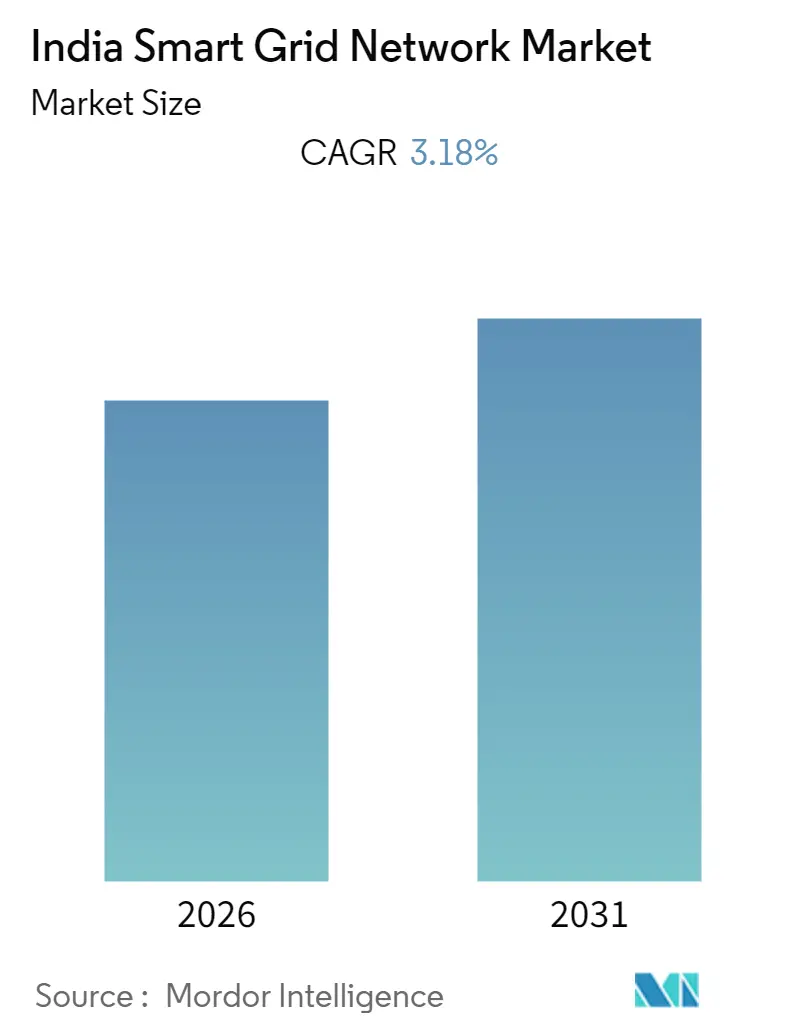
The India Smart Grid Network Market size is expected to register a CAGR of 3.18% during the forecast period.
The Indian smart grid network market was adversely affected by COVID-19 due to disruptions in the supply chain. However, the market rebounded in 2021.
- In terms of market growth, smart grid technologies like smart meters, EV chargers, and other smart grid infrastructure technologies are expected to drive the market in the coming years. This is because more money is being spent on and put into smart grid technologies like these. Moreover, in India, the trend to add more renewable energy sources and smart grids will play an important role in integrating these into transmission and distribution grids.
- However, the huge investment that is required for setting up and modernizing power generation, transmission, and distribution networks and weak private sector investments may restrain the smart grid network market in India during the forecast period.
- India is starting to see smart grid technology as a strategic investment in its infrastructure that will help it maintain long-term economic growth and reach its goals for reducing carbon emissions. This, in turn, is expected to give companies in the smart grid network market a lot of chances to make money in the near future.
Note: Market size and forecast figures in this report are generated using Mordor Intelligence’s proprietary estimation framework, updated with the latest available data and insights as of 2026.
India Smart Grid Network Market Trends and Insights
Advanced Metering Infrastructure (AMI) is Expected to Witness Significant Growth
- Advanced metering infrastructure (AMI), or smart metering, is an integrated system of smart meters, communication networks, and data management systems that enable two-way communication between utilities and customers.
- The metering industry has taken rapid strides in the past few years by transitioning from automated meter reading (AMR) to smart metering using bi-directional communication, thereby enabling greater benefits to electricity distribution companies (DISCOMs), customers, and society.
- The Indian government is pushing for advanced metering infrastructure to reduce electricity waste and the labor costs associated with recording meter values. To promote smart meters, the government has started the "Smart Meter National Programme," which is expected to be the umbrella program for expanding smart meters in every electrified household in the country.
- With the USD 157.5 million it got from the German bank KfW, Madhya Pradesh was going to expand and update its electricity network in February 2022 by putting in place smart meters and smart grid technologies.
- Therefore, in light of the increasing efforts to modernize the electricity grid and reduce T&D losses, the Indian government is investing in advanced metering infrastructure. This is expected to drive the AMI market during the forecast period.


Increasing Investments are Driving the Market Demand
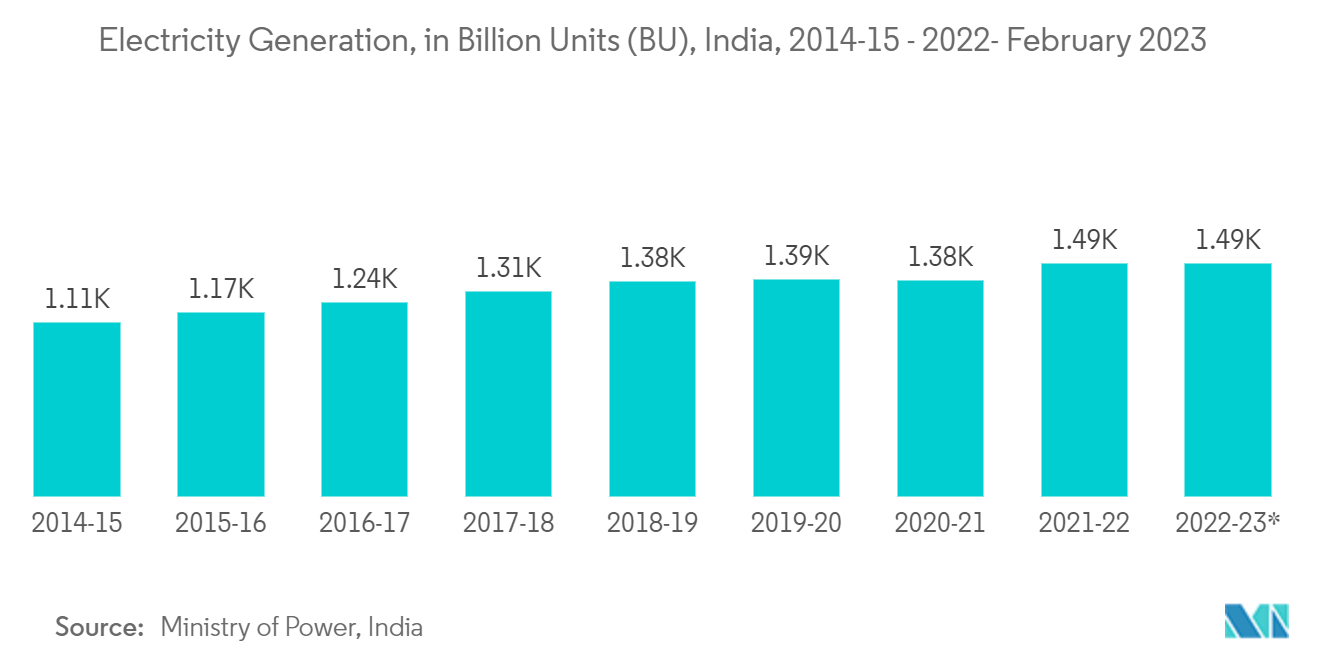
- Smart grid technologies are a key part of meeting the growing power needs because of the growing need for electricity and the use of renewable energy to save energy and use it more efficiently.
- The country has made major strides in improving smart access to power among rural and urban communities through various government-led schemes focused on "Power for All."
- To further meet the goal of modernization and optimization of the electricity grid, the Indian government, under the Smart City Mission, allocated USD 783 million for the financial year 2021-22. Smart energy systems and grids have the capability to manage the energy supply of buildings in cities, which boosts the deployment of smart grid technologies across the country.
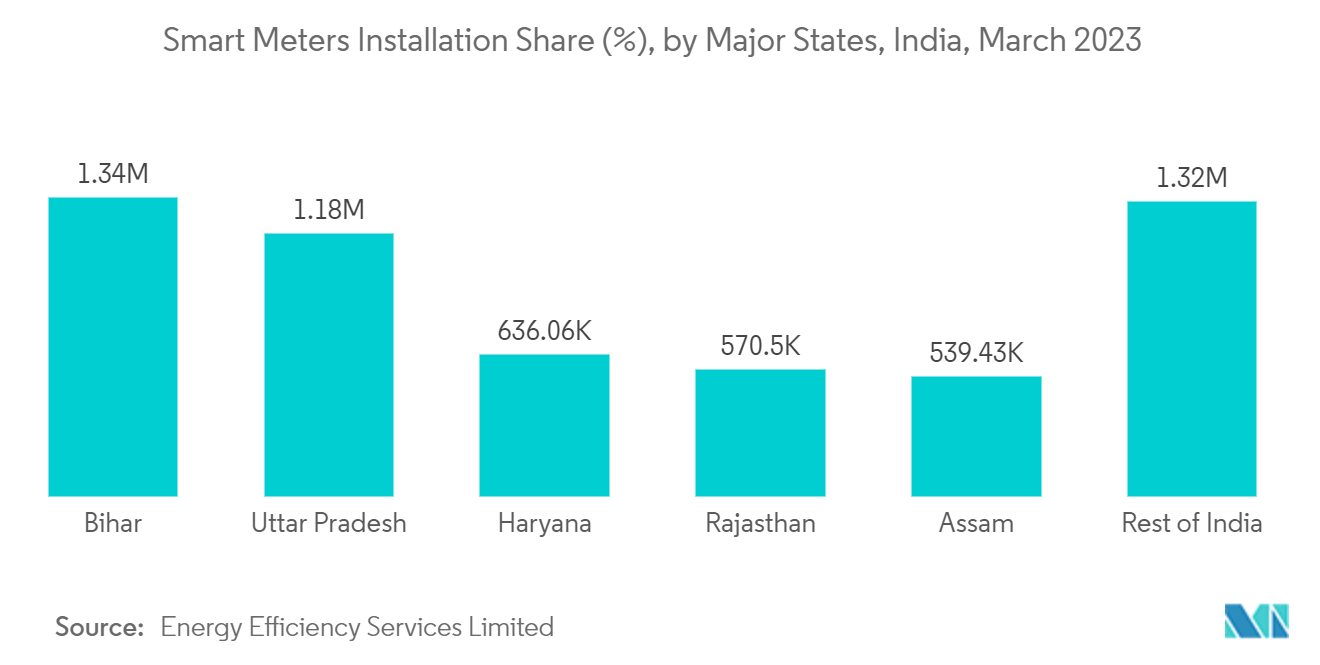
- Furthermore, in October 2022, state-owned Energy Efficiency Services Ltd. (EESL) announced the completion of the installation of 30 lakh smart meters across India under the government's Smart Meter National Programme. The company further aims to install a total of over 47,000 smart meters by December 2023.
- The increased investments by the Indian government, private players implementing initiatives pertaining to environmental protection, and growth in the adoption of smart grid technologies are likely to boost the smart grid network market in India.
Regulatory Landscape
India's smart grid network deployment is being shaped by central technical regulations and national programs administered through the Ministry of Power, the Central Electricity Authority (CEA), and the National Smart Grid Mission (NSGM). In April 2026, the CEA notified the CEA (Installation and Operation of Meters) Amendment Regulations, 2026, which mandate smart meters for consumers in areas with communication network coverage, strengthening the compliance push behind AMI rollouts.
On the grid-integration side, the CEA issued the Draft CEA (Technical Standards for Connectivity to the Grid) Regulations, 2026 (July 2026), moving toward a technology-neutral connectivity and stability framework. Alongside NSGM's role in coordination and technical support for state-level project implementation, these actions reinforce a standards-driven pathway for interoperability across metering, communications, and grid automation in renewable-rich operating conditions.
Value Chain Analysis
The smart grid network value chain in India spans hardware (smart meters, feeder and distribution transformer meters, sensors, communication modules), field implementation and system integration, and utility IT/OT layers such as head-end systems, meter data management, SCADA, analytics, and billing and customer platforms. On the buyer side, DISCOMs and grid operators, including Power Grid Corporation of India Limited in transmission, drive procurement and rollout through government-led schemes and program-management structures supported by NSGM.
RDSS is the primary funding and execution vehicle for distribution modernization, with large sanctioned volumes across consumer, DT, and feeder metering (as of March 31, 2025, 19.79 crore consumer meters, 5.253 million DT communicable meters, and 2.11 lakh communicable feeder meters sanctioned). Installations have scaled materially, with smart meter installations crossing 40 million as of August 2025 and reaching 5.28 crore as of December 31, 2025 under various schemes. A key integration bottleneck is linking previously siloed meter, SCADA, and billing systems, and the Ministry of Power's India Energy Stack initiative (launched March 2026) addresses this by providing a digital public infrastructure layer for standardized data exchange and coordinated operations.
Competitive Landscape
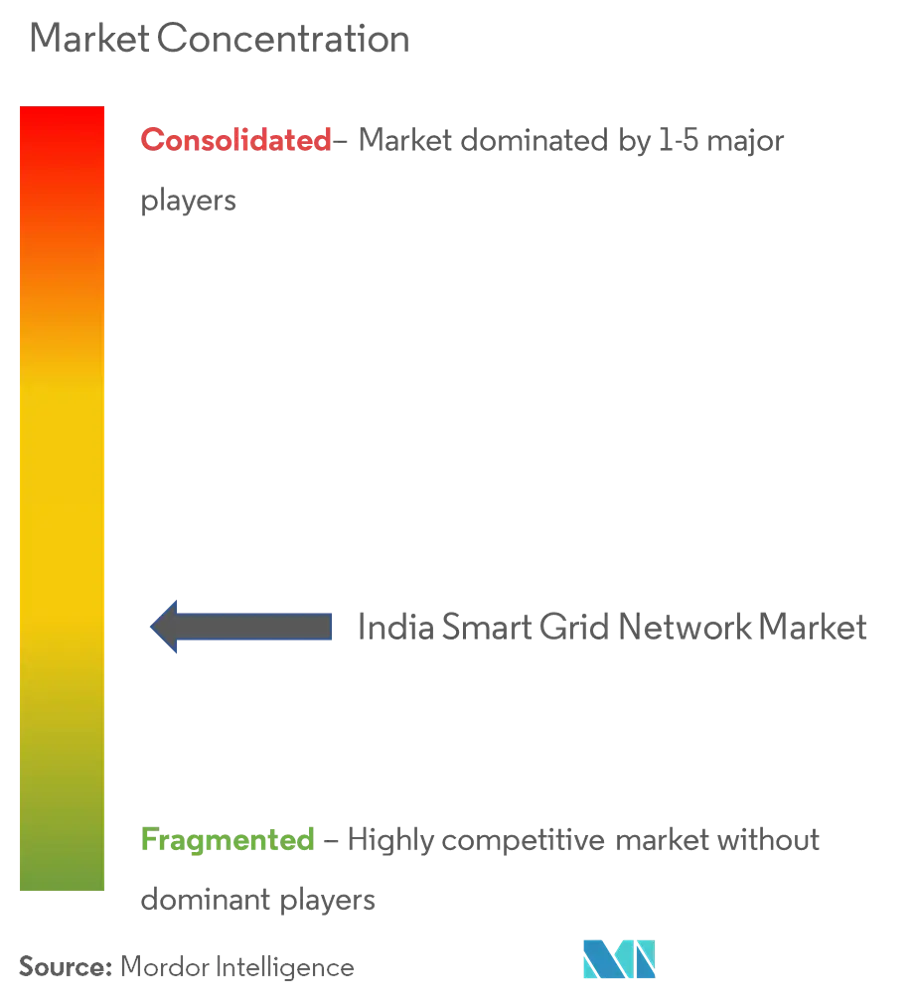
The Indian smart grid network market is moderately fragmented. Some key players in this market (not in particular order) are ABB Ltd, Seimens AG, Schneider Electric SE, General Electric Company, and Cisco Systems Inc.
India Smart Grid Network Industry Leaders
Seimens AG
Schneider Electric SE
Cisco Systems Inc.
ABB Ltd
General Electric Company
- *Disclaimer: Major Players sorted in no particular order

Market Opportunities and Future Outlook
A primary opportunity remains the execution gap between sanctioned and installed smart metering under RDSS, which directly expands demand for AMI devices, communications, HES/MDM platforms, and systems integration services. As of June 2026, 53.28 million smart consumer meters were installed against a sanctioned target of 195.83 million under RDSS, leaving substantial scope for DISCOM-led procurement, financing, and rollout partnerships, alongside supporting upgrades such as GIS-based asset mapping and integration with billing and outage workflows.
On the transmission and grid-operations side, utility investments in real-time monitoring and control systems are translating into addressable demand for SCADA upgrades, synchrophasor-based situational awareness, and digital asset management. In June 2026, Power Grid Corporation of India Limited approved a Rs 485.04 crore upgrade of SCADA systems for National and Regional Transmission Asset Management Centres, and in May 2026 it was assigned to implement Phase II of the Unified Real Time Dynamic State Measurement System (URTDSM) project under the Regulated Tariff Mechanism. Together, these programs underpin vendor demand across communication networks, OT cybersecurity, analytics, and grid-edge integration required for renewable-rich system operations.
Recent Industry Developments
- February 2026: Siemens Energy India approved an investment of Rs 2,060 crore for a new power transformer factory with 30,000 MVA capacity. The added domestic manufacturing base supports faster execution of transmission and grid-strengthening programs and reinforces local supply availability for network upgrades.
- December 2025: GE Vernova was awarded a contract by Adani Energy Solutions Ltd. to deliver a 2.5 GW HVDC transmission corridor in India. The project adds momentum to HVDC buildout and expands demand for high-voltage equipment, controls, and associated grid-integration capabilities relevant to smart grid network modernization.
- August 2024: ABB India won a Rs 173.55 crore order from Siemens Gamesa Renewable Power to supply wind turbine converters and electrical cabinets. The order reflects accelerating deployment of power-electronics-heavy assets, which increases requirements for grid monitoring, control, and stability solutions across transmission and distribution networks.


Research Methodology Framework and Report Scope
Market Definition and Coverage
For this methodology, the India smart grid network market covers revenues tied to smart grid networking upgrades used by utilities to monitor, communicate, and control electricity networks in India. This includes digital grid communication and key smart grid network application areas.
Scope exclusions: It excludes standalone power generation assets and traditional grid expansion work that does not add smart communication, monitoring, or automation capability.
Segmentation Overview
- Transmission
- Advanced Metering Infrastructure (AMI)
- Communication Technology
- Other Technology Application Areas
Data Sources, Market Sizing, and Validation
Desk Research
Desk research was used to set the market boundary and build an initial view of the demand drivers behind grid networking spends in India. We relied on public datasets and official publications such as Ministry of Power updates, Central Electricity Authority (CEA) statistics, Central Electricity Regulatory Commission (CERC) regulations and orders, and India Smart Grid Forum materials. These sources helped confirm program priorities and timing for utilities.
To translate these signals into market variables, we reviewed utility tenders and award notes, project announcements, and product documentation. We also used annual reports and investor presentations from relevant solution providers and EPC participants to anchor pricing direction. Patent databases and a paid subscription for company financials and news were used selectively to validate activity levels, pricing movement, and the pace of deployments. This list is illustrative, and we also consulted other public sources for data collection, cross-checks, and clarification.
Primary Interviews and Surveys
Primary work focused on interviews and structured surveys with utility teams, system integrators, technology distributors, and domain specialists who track grid modernization programs across India. These discussions were used to close gaps that desk research leaves open, especially on what is being procured now versus planned, how communication choices are changing (wired versus wireless), and what typical pricing looks like by project type.
Coverage was balanced across India, and feedback was re-checked across respondent groups so assumptions on adoption pace and project slippage could be adjusted before final sizing.
Distribution of primary research fieldwork respondents
| Company type | Respondent position |
|---|---|
| Top tier: 30% | CXOs: 16% |
| Mid tier: 53% | Functional/Unit leaders: 38% |
| Smaller Players: 17% | Managers: 46% |
Market-Sizing & Forecasting
Sizing was built using a top-down model where India grid modernization spend pools were reconstructed from policy-led programs, utility investment plans, and the project pipeline. We then filtered those pools to the portion that maps directly to smart grid networking use.
To keep totals grounded, we corroborated the outputs with selective bottom-up checks, including sample project bill-of-material logic, typical system pricing from channel feedback, and a roll-up of visible tender values where disclosures were clear.
Key inputs used in the model included (as examples) AMI rollout pace, transmission and distribution automation project starts, communication technology mix (wired versus wireless), typical project size by utility category, and observed pricing movement for networking and integration work. Where bottom-up visibility was patchy, gaps were handled using scenario ranges informed by interview feedback on conversion rates from announced projects to awarded contracts.
For forecasting, we used scenario analysis supported by time-series smoothing on the historical build pattern. The outlook was then tuned using expert views on program funding continuity, procurement cycles, and execution constraints. Assumptions were kept simple and traceable so updates could be made quickly when tender pipelines or policy timelines shift.
Data Validation & Update Cycle
Validation was done through multiple checks to ensure no single-source bias drove the final number. Model outputs were compared with independent signals such as public tender volumes, utility capex direction, and implied unit economics from sample deployments, and then outliers were reviewed before sign-off.
If a major variance appeared, analysts re-contacted participants to confirm whether the change came from timing shifts, scope differences, or pricing changes. The model was adjusted only after the reason was clear.
Reports are refreshed annually, with interim updates for material events such as policy revisions, large award cycles, or sharp currency moves. Before delivery, we run a fresh review pass to ensure clients receive the most current view available.
Mordor Intelligence's India Smart Grid Network Market Market Size Compared Against Other Published Estimates
Published estimates for India smart grid often do not align because the term can be interpreted differently. Some studies also combine infrastructure, software, services, and adjacent grid spends into one total. Differences also show up depending on whether a publisher uses an installed-base lens or focuses on project award values in a single year.
The table shows a wide spread mainly because some sources bundle broader smart grid infrastructure and end-use solutions, while under Mordor Intelligence's model the scope is limited to smart grid network revenues aligned to technology application areas such as transmission, AMI, communication technology, and other smart grid network applications. This avoids counting unrelated grid capex. Additional variation comes from how pricing is trended forward, whether currency conversion uses an average-year rate or a point-in-time rate, and how often assumptions are refreshed after large utility tenders.
Benchmark comparison
| Source | Market Size | Gaps in Research Methodology |
|---|---|---|
| Mordor Intelligence | USD 0.00 B (2024) | |
| Industry Publication A | USD 2.90 B (2024) | Uses a broader India smart grid definition that can include hardware, software, and services across end users, which inflates the total beyond networking and utility grid application revenues. |
| Advisory Firm B | USD 0.58 B (2024) | Tracks smart grid infrastructure as a narrower bucket centered on AMI and distribution automation, which can undercount transmission-side networking and other smart grid network applications. |
From the comparison, the key takeaway is that scope boundaries and what gets counted as networking versus wider smart grid programs drive most of the difference. By keeping inputs tied to utility program activity and validating pricing and adoption assumptions through repeated checks, the final number stays easier to trace back to clear demand indicators and repeatable steps.


Key Questions Answered in the Report
What is the current India Smart Grid Network Market size?
The India Smart Grid Network Market is projected to register a CAGR of 3.18% during the forecast period (2026-2031)
Who are the key players in India Smart Grid Network Market?
Seimens AG, Schneider Electric SE, Cisco Systems Inc., ABB Ltd and General Electric Company are the major companies operating in the India Smart Grid Network Market.
What years does this India Smart Grid Network Market cover?
The report covers the India Smart Grid Network Market historical market size for years: 2019, 2020, 2021, 2022, 2023 and 2024. The report also forecasts the India Smart Grid Network Market size for years: 2026, 2027, 2028, 2029, 2030 and 2031.
Page last updated on:


 Your data is secure and never sold or shared.


