
India Religious Tourism Market Size and Share
Market Overview
| Study Period | 2026 - 2031 |
|---|---|
| Forecast Data Period | 2026 - 2031 |
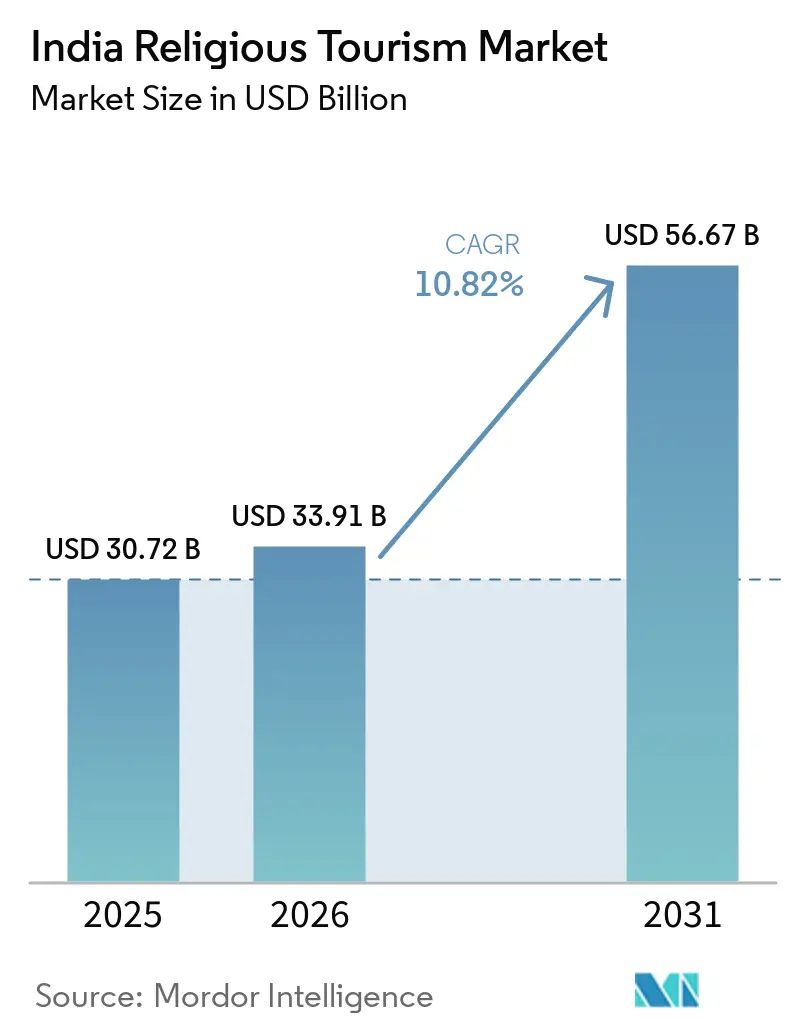
| Base Year Market Size (2025) | USD 30.72 Billion |
| Market Size (2026) | USD 33.91 Billion |
| Market Size (2031) | USD 56.67 Billion |
| Growth Rate (2026 - 2031) | 10.82 % |
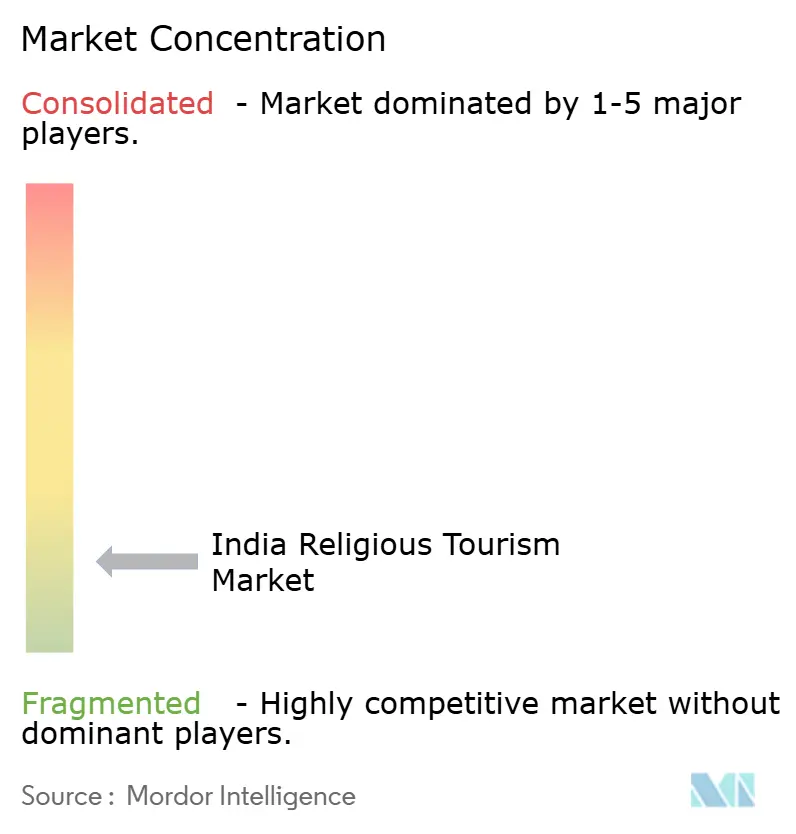
| Market Concentration | Low |
Major Players *Disclaimer: Major Players sorted in no particular order Image © Mordor Intelligence. Reuse requires attribution under CC BY 4.0. | |
India Religious Tourism Market Analysis by Mordor Intelligence
The India Religious Tourism Market size is projected to expand from USD 30.72 billion in 2025 and USD 33.91 billion in 2026 to USD 56.67 billion by 2031, registering a CAGR of 10.82% between 2026 to 2031.
The India religious tourism market is being supported by rising repeat pilgrimage behavior, broader circuit travel, and steady public investment in access infrastructure across temple towns and pilgrimage corridors. Demand is also becoming more organized as online discovery, packaged travel, curated stays, and queue management tools bring more structure to a travel category that was long dominated by informal local arrangements. The market is gaining additional support from stronger road, rail, and air links under central and state programs, which are widening the range of destinations that can be sold as viable commercial circuits. The India religious tourism market is also moving toward higher monetization per trip as accommodation, guided services, premium darshan formats, and destination extensions gain acceptance across both domestic and international traveler groups. Competitive positioning is now shaped less by basic access to destinations and more by who can combine transport, stay, ritual convenience, and digital engagement into a more reliable pilgrim experience.[1]
Key Report Takeaways
- By religion type, Hindu pilgrimage accounted for 78.62% of revenue in 2025, while Buddhist pilgrimage tourism is projected to record the fastest growth at a 11.44% CAGR through 2031.
- By traveler type, domestic pilgrims accounted for 96.21% of total traveler volume in 2025, while international pilgrims are projected to expand at the fastest pace with a 13.31% CAGR through 2031.
- By booking channel, direct bookings held a 58.73% share in 2025, while online travel platforms are forecast to grow the fastest at a 14.18% CAGR through 2031.
- By expenditure type, transportation accounted for 32.51% of spending in 2025, while accommodation is projected to grow at the fastest rate, with a 11.83% CAGR through 2031.
- By geography, North India held 38.67% share in 2025, while East India is projected to grow the fastest at 11.25% CAGR through 2031.
Note: Market size and forecast figures in this report are generated using Mordor Intelligence’s proprietary estimation framework, updated with the latest available data and insights as of January 2026.
India Religious Tourism Market Trends and Insights
Drivers Impact Analysis*
| Drivers | (~) % Impact on CAGR Forecast | Geographic Relevance | Impact Timeline |
|---|---|---|---|
| Rising Domestic Pilgrimage Frequency | +3.2% | Pan-India, highest in North and South India | Short term (≤ 2 years) |
| Government Backing Through Pilgrimage Infrastructure Schemes | +2.0% | Pan-India, concentrated in Uttar Pradesh, Bihar, the Northeast states, and Maharashtra | Medium term (2-4 years) |
| Digital Booking Adoption and Mobile-First Pilgrimage Planning | +1.6% | Pan-India, strongest in metro and tier-1 feeder cities | Short term (≤ 2 years) |
| Premiumization of Pilgrimage Stays and Curated Circuit Travel | +1.0% | North India and South India, emerging in East India | Medium term (2-4 years) |
| Under-Served Secondary Pilgrimage Circuits | +0.7% | Central India, East India, and Northeast India | Long term (≥ 4 years) |
| AI-Enabled Crowd Management and Queue Optimization | +0.5% | South India and North India | Medium term (2-4 years) |
| Source: Mordor Intelligence | |||
Rising Domestic Pilgrimage Frequency Unlocks Repeat-Visitor Economics
The Indian religious tourism market is benefiting from a clear shift in domestic travel behavior, with pilgrimage increasingly treated as a repeat activity rather than a one-time event. The Char Dham Yatra recorded 51.06 lakh pilgrims in 2025, up from 48.01 lakh in 2024, which shows that high-volume circuits are still adding scale even after already operating at large numbers. This change matters because repeat travel supports more predictable demand for hotels, transport operators, bundled circuits, and local service providers across the India religious tourism market. MakeMyTrip reported a 19% increase in accommodation bookings across 56 pilgrimage destinations in FY24-25, with 34 of those destinations posting double-digit growth, suggesting that organized demand is broadening beyond a few flagship shrines. Group travel is also shaping the revenue pool, with 47% of pilgrimage trips booked in groups, compared with 38.9% in leisure travel, keeping tour organizers and transport aggregators central to the category. The result is a demand base that is larger, more frequent, and easier to package than in the past, which supports stronger monetization across the India religious tourism market.
Government Backing Through Pilgrimage Infrastructure Schemes Rewires Accessibility
Public investment remains one of the clearest structural supports for the India religious tourism market because it lowers access barriers that private operators cannot solve on their own. The Ministry of Tourism stated in February 2026 that 54 projects across 28 states had been sanctioned under PRASHAD, with a total outlay of INR 1,726.74 crore (USD 0.18 billion), indicating the breadth of central support already in execution. The Union Budget 2026-27 also raised the PRASHAD allocation to INR 245 crore. It proposed an Urban Challenge Fund of INR 10,000 crore (USD 1.04 billion) to finance urban redevelopment and innovative city infrastructure, while also naming 15 sacred and archaeological sites for experiential development. These moves improve the commercial case for new routes, new hotel supply, and more structured package design because roads, urban services, and visitor facilities become less of a bottleneck. The India religious tourism market is therefore expanding not only through demand growth but also through a state-backed rise in destination readiness. This is especially relevant for smaller pilgrimage towns that need formal infrastructure before they can support sustained private participation at scale.[2]
Digital Booking Adoption and Mobile-First Pilgrimage Planning Bifurcates the Stack
Digital planning is reshaping how the Indian religious tourism market converts interest into bookings, especially in categories where travelers now want both convenience and destination-specific assurance. "MakeMyTrip launched its "Loved by Devotees" feature in February 2025 with more than 450 hotels and homestays across 26 spiritual destinations, and it paired that launch with more than 600 pilgrim holiday packages. That kind of curation matters because pilgrims often prioritize temple proximity, vegetarian food, accessibility, and family-friendliness over broader preferences in leisure travel. The booking stack is also splitting into two layers, with mainstream platforms handling transport and stay, while faith-focused apps and operators handle ritual services, prasad, and temple-linked experiences. AppsForBharat raised INR 175 crore in July 2025 to expand AI-led personalization, logistics, and temple-town presence, indicating that digital demand in the Indian religious tourism market is now deep enough to support specialized platforms. As mobile discovery grows, operators with strong local curation and strong service reliability are likely to capture more value than those offering only generic inventory aggregation.
Premiumization of Pilgrimage Stays and Curated Circuit Travel Redefines Ticket Sizes
The India religious tourism market is seeing a clear rise in spending per trip as more pilgrims move toward better rooms, curated journeys, and smoother on-ground arrangements. MakeMyTrip data for FY24-25 showed that bookings for rooms priced above INR 7,000 (USD 77.9) per night rose more than 20%, with the INR 7,000 (USD 77.9) to INR 10,000 (USD 111.2) range up 24% and rooms above INR 10,000 (USD 111.2) up 23%. Thomas Cook India and SOTC Travel expanded their spiritual portfolio to 11 curated circuits in August 2025, adding aerial darshan, VIP access, and pandit-accompanied rituals, signaling that higher-value product design is moving into the mainstream. This trend is important because it shifts revenue growth away from pure footfall expansion and toward higher yield per booking. The India religious tourism market is therefore becoming more attractive to operators that can package convenience, trust, and comfort into a single paid product. It also supports a broader supplier base, including premium transport, better-located hotels, curated local guides, and specialized family travel arrangements. Over time, this should make premium pilgrimage travel a stable category rather than a short seasonal spike.
Restraints Impact Analysis*
| Restsaints | (~) % Impact on CAGR Forecast | Geographic Relevance | Impact Timeline |
|---|---|---|---|
| Seasonal Congestion and Peak-Window Capacity Stress | -0.8% | North India, including Char Dham and Varanasi, and South India, including Tirupati and Sabarimala | Short term (≤ 2 years) |
| Last-Mile Connectivity Gaps at Remote Shrines | -0.5% | Northeast India, Himalayan circuits, and secondary Central India sites | Long term (≥ 4 years) |
| Accommodation Shortages in High-Footfall Pilgrimage Hubs | -0.7% | North India, including Ayodhya and Varanasi, and South India, including Tirupati and Ujjain | Medium term (2-4 years) |
| Fragmented Local Regulations and Temple-Board Coordination Complexity | -0.4% | Pan-India, most acute in multi-state circuits | Long term (≥ 4 years) |
| Source: Mordor Intelligence | |||
Seasonal Congestion and Peak-Window Capacity Stress Erode Service Reliability
Seasonal concentration remains one of the clearest operating constraints on the Indian religious tourism market, as demand is highly compressed around pilgrimage windows, festivals, and auspicious dates. The SDC Foundation's Char Dham analysis showed that 72% of annual footfall in 2025 arrived within the first 60 days of the season, a level of compression that strains transport, lodging, sanitation, and safety systems simultaneously. Ujjain's Mahakaleshwar temple also experienced peak-day pressure, with daily visitors reaching 2.5 to 3 lakh during busy periods and accommodation prices rising sharply. This kind of concentration reduces service predictability for the India religious tourism market because packaged operators must sell fixed itineraries into destinations where usable capacity can swing sharply within days. Price spikes during those windows also distort the affordability of what is otherwise a mass domestic travel category. Unless more demand is spread across broader time bands and more destinations, peak stress will continue to hold back experience quality and operational efficiency.
Last-Mile Connectivity Gaps at Remote Shrines Keep Secondary Demand Under-Monetized
Last-mile connectivity remains a slow-moving drag on the Indian religious tourism market because many remote shrines still depend on patchy roads, difficult terrain, or weak feeder transport links. This issue is most visible in Himalayan routes, eco-sensitive northeastern terrain, and smaller sites that are not yet integrated into a formal travel circuit. Central schemes are improving core access, but the commercial traveler experience still depends on the quality of the final stretch between the transport hub and the shrine itself. Weak last-mile access reduces the practical capacity of the Indian religious tourism market by lengthening travel times, increasing fatigue, and limiting the appeal of multi-stop itineraries for families and elderly pilgrims. It also increases the cost of destination management for operators who must arrange local transfers, on-the-ground assistance, and contingency support. Until the final leg becomes more reliable, several secondary circuits will remain more visible on paper than fully commercial in practice.
*Our forecasts treat driver/restraint impacts as directional, not additive. The impact forecasts reflect baseline growth, mix effects, and variable interactions.
Segment Analysis
By Religion Type: Hindu Dominance Remains Intact While Buddhist Travel Posts the Fastest Growth
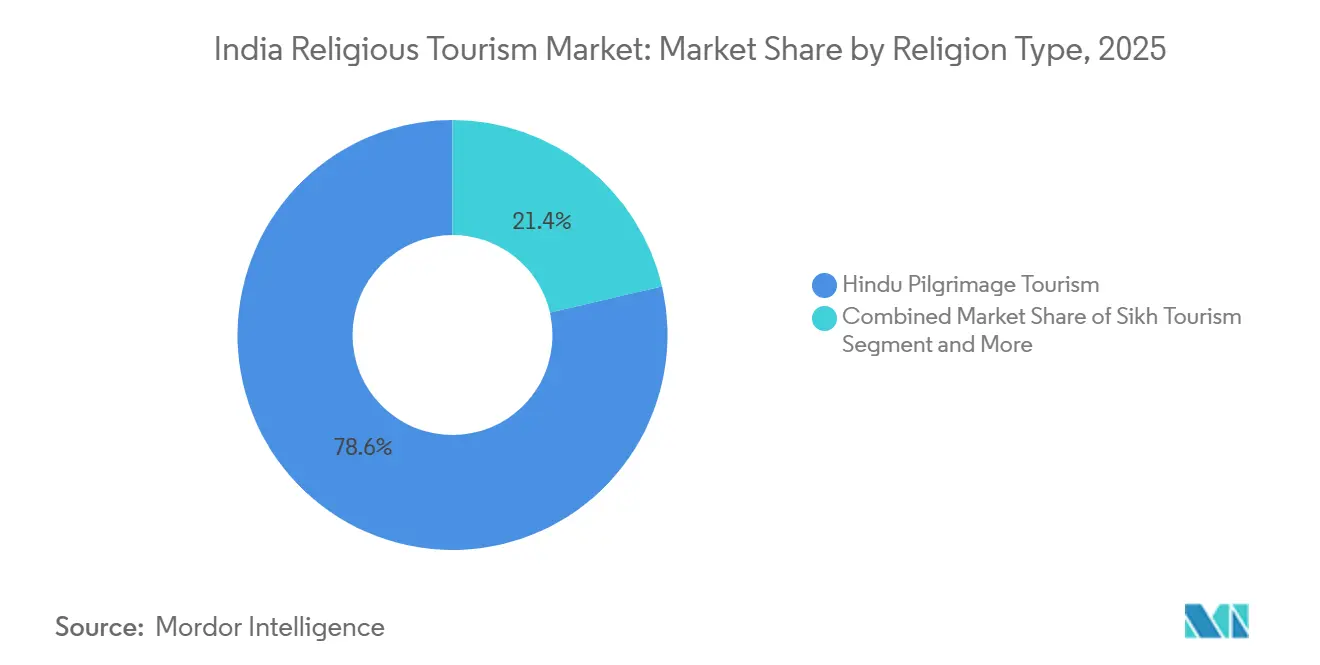
Hindu pilgrimage tourism accounted for 78.62% of India's religious tourism market share in 2025, reflecting the depth of India’s domestic pilgrim base and the long-established network of temple-led travel circuits. This part of the India religious tourism industry benefits from dense shrine concentration, regular festival calendars, and stronger infrastructure visibility in cities such as Varanasi, Ayodhya, Prayagraj, and Ujjain. That scale also creates a reinforcing effect, because high footfall attracts better transport options, more local suppliers, and wider packaged-travel participation. Sikh, Jain, Islamic, and Christian heritage travel continue to hold stable relevance within specific regional corridors, even though they remain much smaller than Hindu travel in absolute terms. EaseMyTrip’s Bathinda cluster mandate under Punjab’s Mukh Mantri Tirth Yatra Yojana shows that organized pilgrimage operations are also emerging in non-Hindu circuits when states actively structure and support them.
Buddhist pilgrimage tourism is projected to expand at 11.44% CAGR from 2026 to 2031, making it the fastest-growing religion-based segment in the report. This sub-segment is benefiting from India’s diplomatic outreach to Buddhist countries, the renewed focus on the Bodh Gaya-linked circuit, and the budget-backed push into northeastern Buddhist destinations. The India religious tourism market for Buddhist pilgrimage is growing, as the segment attracts longer-haul visitors, stronger interest in guided heritage interpretation, and a better fit with premium accommodation and curated itineraries. Growth in Buddhist travel also has strategic importance because it supports inbound demand from East and Southeast Asia rather than relying only on domestic volume. Within the broader Indian religious tourism industry, this segment is likely to remain smaller than the Hindu pilgrimage in terms of scale. Still, it offers a stronger revenue profile per traveler and a clearer path to international expansion.

By Traveler Type: Domestic Volume Anchors the Base While International Pilgrims Lift Yield
Domestic pilgrims accounted for 96.21% of traveler volume in 2025, making this segment the primary volume base for the India religious tourism market. The segment remains dominant because pilgrimage travel in India is frequent, family-oriented, and closely linked to regional faith calendars that sustain year-round movement across multiple states. Domestic travelers also support the broadest demand pool across all price points, from low-cost self-organized trips to escorted premium journeys that include better rooms and managed access. Their importance is rising rather than declining because repeat visits are increasing, and more temple towns are becoming easier to reach through public infrastructure investment. Even as booking formats evolve, domestic volume continues to determine occupancy, transport loads, and seasonal pressure across the India religious tourism market.
International pilgrims are projected to grow at a 13.31% CAGR through 2031, making them the fastest-growing traveler segment in the report. This segment is smaller in volume, but it matters because it improves revenue quality through longer stays, stronger hotel spend, and greater reliance on formal itineraries and professional handling. The India religious tourism market for international pilgrims is growing, driven by stronger positioning of the Buddhist circuit, diaspora demand, and more specialized digital and packaged products designed for travelers seeking greater service certainty. AppsForBharat disclosed that nearly 20% of demand for Sri Mandir comes from the Indian diaspora in countries such as the United States, the United Kingdom, the United Arab Emirates, Canada, and Australia, underscoring how overseas engagement is already monetizable through adjacent spiritual services. As international share grows, the segment should influence product design well beyond its current volume, because premium circuits, interpretation services, and better-located hotel supply tend to follow higher-yield travelers first.
By Booking Channel: Direct Booking Still Leads While Online Platforms Gain Fastest
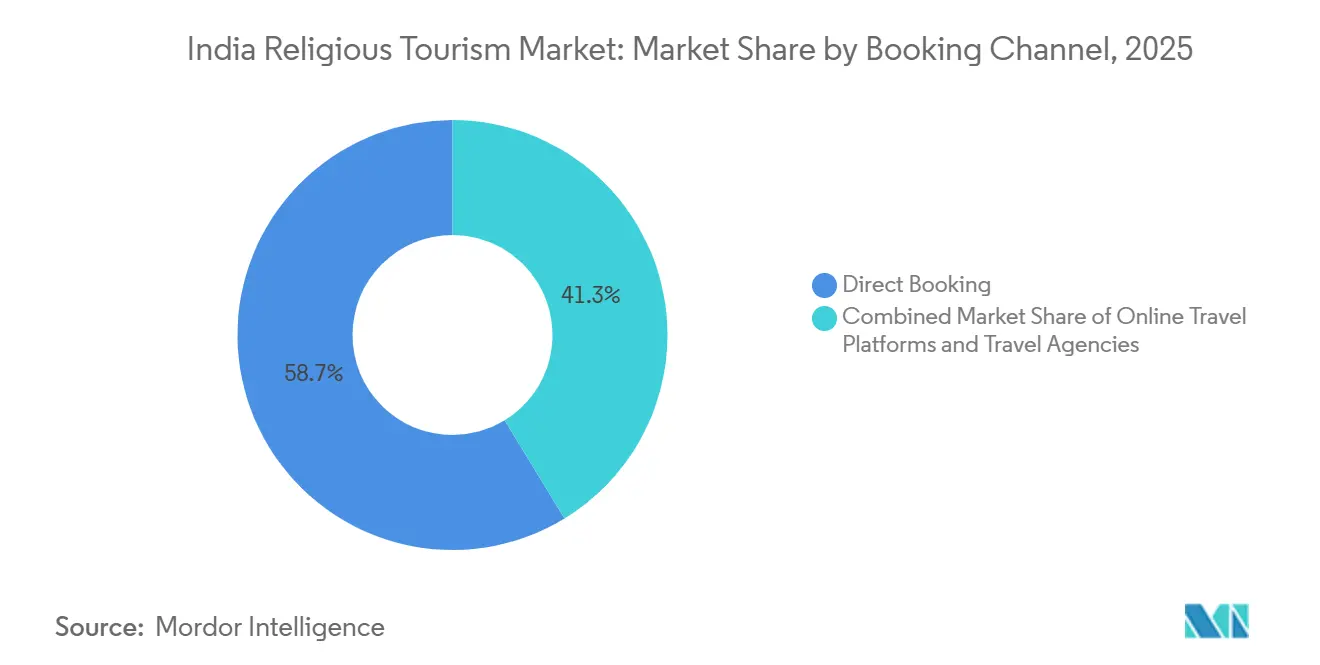
Direct bookings accounted for 58.73% in 2025, indicating that the Indian religious tourism market still has a strong tradition of self-organized travel. Many pilgrims continue to arrange transport, stay, and darshan plans through local familiarity, direct hotel contact, temple-linked networks, or repeat travel habits built over the years. This pattern remains especially strong among domestic repeat travelers and families visiting well-known shrines where the route, stay options, and local routines are already familiar. Travel agencies and tour operators still play an important role, but their value is highest when journeys involve multiple destinations, elderly travelers, tighter schedules, or premium access requirements. The leading share of direct booking, therefore, reflects habit and familiarity rather than the absence of organized alternatives in the India religious tourism market.
Online platforms are projected to grow at 14.18% CAGR from 2026 to 2031, making them the fastest-growing booking channel in the report. The India religious tourism market for online platforms is expanding because digital channels address discovery, trust, comparison, and packaged convenience simultaneously, especially for travelers entering new temple towns or newer circuits. MakeMyTrip’s curated spiritual lodging feature and package rollout show how mainstream platforms are adapting to pilgrimage-specific needs rather than trying to serve the category with standard leisure templates. Specialist digital players are widening that change by focusing on ritual services, live participation, prasad, and community-led trust, which gives them a role that generic OTAs cannot easily match. The result is a booking landscape where direct remains large, but the fastest shift in organized conversion is clearly moving through digital channels.
By Expenditure Type: Transportation Leads Spend While Accommodation Grows Fastest
Transportation accounted for 32.51% of expenditure in 2025, which makes it the largest spending category in the India religious tourism market. This outcome is consistent with how pilgrimage travel in India often spans long distances, involves multiple stops, and uses rail, road, and air depending on the circuit. It also reflects the importance of bundled circuit design, because movement between shrines is often the most visible cost and the most difficult element for travelers to coordinate on their own. IRCTC’s Bharat Gaurav train products illustrate this logic by bundling travel, lodging, meals, and sightseeing into a single offer, reducing planning friction for pilgrims. In a market where circuit geometry is complex, transportation remains the basic spending anchor that enables all other services.
Accommodation is projected to grow at 11.83% CAGR through 2031, making it the fastest-growing expenditure segment in the report. The Indian religious tourism accommodation market is growing due to room scarcity, higher traveler expectations, and more premium package formats, which are driving up stay spending. This segment is also one of the clearest monetization opportunities in the Indian religious tourism market, as higher room rates, longer stays, and better service bundling can all boost trip value without requiring a corresponding rise in footfall. Over the forecast period, accommodation should continue to shift from a supporting function to a main driver of revenue uplift, especially in temple towns that combine high footfall with limited quality inventory.
Geography Analysis
North India accounted for 38.67% of the Indian religious tourism market share in 2025, making it the largest regional segment in the report. Its lead comes from the density and national prominence of destinations such as Varanasi, Ayodhya, Prayagraj, Vaishno Devi, and the Char Dham circuit. Uttar Pradesh remains central to this scale because it combines major Hindu pilgrimage demand with heavy public investment in access routes and destination upgrades. Ayodhya and Varanasi also show how religious travel can quickly translate into wider local spending once a destination receives national attention and improved visitor infrastructure. North India, therefore, remains the operational center of the Indian religious tourism market in both scale and visibility.
South India ranks as the second-largest regional market and is supported by the steady pull of Tirupati, Sabarimala, Tamil Nadu temple corridors, and major Karnataka pilgrimage routes. The region is important because it combines high devotional traffic with relatively advanced use of digital queue systems, organized darshan management, and branded circuit travel. Tirumala’s AI-enabled command center has already shown that technology can materially improve throughput, waiting time, and queue quality at one of the country’s busiest shrines. West India remains relevant through Gujarat’s Somnath, Dwarka, and Palitana routes and through Maharashtra’s large pilgrimage centers such as Shirdi, Nashik, and Pandharpur. The western region also matters for future event-led demand, as preparations for major religious gatherings can create lasting infrastructure and hospitality benefits beyond the event window.
East India is projected to grow at a 11.25% CAGR through 2031, making it the fastest-growing geography in the report. Its momentum comes largely from Bihar’s Buddhist circuit, where Bodh Gaya, Rajgir, and Nalanda are gaining importance in both domestic and inbound pilgrimage planning. This growth matters because East India adds a stronger international dimension to the India religious tourism market through Buddhist heritage travel and the potential for longer itineraries. The Northeast is also moving from a peripheral status toward a more defined growth role, helped by the Union Budget 2026-27 Buddhist circuit scheme covering six northeastern states. Central India is gaining visibility through Ujjain and related event-driven capacity investments, indicating that future regional growth in the Indian religious tourism market will not be limited to today’s best-known temple towns.[3]
Competitive Landscape
The India religious tourism market remains fragmented, with no single commercial operator holding dominant revenue control across transport, accommodation, booking, and ritual-linked services. This structure exists because the category spans several business models, including public rail operators, digital travel platforms, faith-tech specialists, temple-linked systems, and hotel chains. IRCTC remains one of the most visible organized players because Bharat Gaurav products convert rail access into structured pilgrimage circuits that private competitors cannot easily replicate at the same scale. That advantage is important in the Indian religious tourism market because rail still accounts for a large share of long-distance pilgrim mobility. At the same time, IRCTC does not control the broader commercial stack, leaving room for hotels, OTAs, faith-tech apps, and local operators to capture value from adjacent services.
Private competition is sharpening in the Indian religious tourism market, where digital demand, premium packaging, and specialized customer service matter most. Thomas Cook India and SOTC strengthened their position in August 2025 by expanding to 11 curated pilgrimage circuits and adding differentiated service elements, such as aerial darshan, VIP access, and ritual accompaniment. AppsForBharat is building a different kind of moat through Sri Mandir, where ritual services, prasad logistics, and diaspora engagement create a vertical layer that mainstream travel aggregators do not address well. OYO’s 2025 plan to add 500 hotels across major pilgrimage hubs points to another competitive response: going after the underserved mid-tier stay segment at scale. These moves show that competition is no longer only about reach, but also about who can offer the cleanest combination of trust, convenience, and destination-specific relevance.
The Indian religious tourism market still offers meaningful white space despite rising consolidation among the better-known players. One opportunity lies in secondary circuits where destination potential is improving faster than branded commercial supply. Another lies in the mid-price accommodation band, where the gap between basic dharamshala capacity and premium hotel inventory remains too wide in many temple towns. Technology-led governance also creates an indirect competitive advantage, as destinations with better queue systems, surveillance, and planning are easier for operators to sell with confidence. The next phase of competition in the India religious tourism market is therefore likely to favor companies that can navigate local complexities while still delivering a consistent pilgrim experience.
India Religious Tourism Industry Leaders
-
Indian Railway Catering and Tourism Corporation Ltd
-
MakeMyTrip (India) Private Limited
-
Thomas Cook (India) Limited
-
Yatra Online Limited
-
Easy Trip Planners Limited
- *Disclaimer: Major Players sorted in no particular order
Recent Industry Developments
- June 2026: IRCTC launched the Pashupatinath Nepal Darshan Yatra from Indore, marking the first Bharat Gaurav Tourist Train to travel outside India. The 9-night, 10-day program covers Kathmandu, Pokhara, Chitwan National Park, and Manakamana Temple at package prices ranging from INR 62,710 to INR 90,400 (USD 750 to USD 1,080), extending organized pilgrimage travel into an international circuit.
- April 2026: Thomas Cook India and SOTC Travel expanded their spiritual tourism portfolio to 11 curated pilgrimage circuits and announced a brand partnership with Padma Shri Anuradha Paudwal for the Darshans product line. The expanded offering included aerial darshan, VIP access, and pandit-accompanied rituals, targeting the growing demand for premium, structured religious travel experiences.
- February 2026: Union Budget 2026-27 raised the PRASHAD scheme allocation to INR 240 crore (USD 26.7 million) from a revised INR 132 crore (USD 14.69 million) in FY26 and announced a dedicated Buddhist circuit development scheme across six northeastern states. The budget also proposed an Urban Challenge Fund of INR 10,000 crore (USD 1.11 billion) to finance urban redevelopment and innovative city infrastructure, while also naming 15 sacred and archaeological sites for experiential development.
- February 2026: The Ministry of Tourism confirmed 54 PRASHAD projects across 28 states with a sanctioned outlay of INR 1,726.74 crore, including work linked to pilgrimage interpretation centers and destination infrastructure in multiple states.
- February 2026: The Ministry of Tourism confirmed 54 PRASHAD projects across 28 states with a sanctioned outlay of INR 1,726.74 crore (0.19 billion), including work linked to pilgrimage interpretation centers and destination infrastructure in multiple states.
India Religious Tourism Market Report Scope
| Direct Booking |
| Travel Agencies & Tour Operators |
| Online Travel Platforms |
| Domestic Tourists |
| International Tourists |
| Accommodation |
| Transportation |
| Food & Beverage |
| Religious Offerings & Donations |
| Other Ancillary Services |
| Hindu Tourism |
| Sikh Tourism |
| Buddhist Tourism |
| Jain Tourism |
| Islamic Heritage Tourism |
| Christian Heritage Tourism |
| North India |
| South India |
| West India |
| East India |
| Northeast India |
| Central India |
| By Booking Channel | Direct Booking |
| Travel Agencies & Tour Operators | |
| Online Travel Platforms | |
| By Traveler Type | Domestic Tourists |
| International Tourists | |
| By Expenditure Type | Accommodation |
| Transportation | |
| Food & Beverage | |
| Religious Offerings & Donations | |
| Other Ancillary Services | |
| By Religion Type | Hindu Tourism |
| Sikh Tourism | |
| Buddhist Tourism | |
| Jain Tourism | |
| Islamic Heritage Tourism | |
| Christian Heritage Tourism | |
| By Geography | North India |
| South India | |
| West India | |
| East India | |
| Northeast India | |
| Central India |
Key Questions Answered in the Report
What is the current outlook for India religious tourism demand through 2031?
The report estimates the India religious tourism market size at USD 30.72 billion in 2025, USD 33.91 billion in 2026, and USD 56.67 billion by 2031, with 10.82% CAGR over 2026-2031.
Which religious travel segment is growing the fastest in India?
Buddhist pilgrimage tourism is projected to grow the fastest by religion type at 11.44% CAGR through 2031, supported by stronger circuit development and inbound interest.
Why does North India lead the country in religious travel revenue?
North India held 38.67% share in 2025 because it combines major pilgrimage centers such as Varanasi, Ayodhya, Prayagraj, and Char Dham with strong public infrastructure support.
Which booking channel is changing pilgrim travel the most?
Online platforms are expected to grow the fastest at 14.18% CAGR because they improve discovery, package comparison, and stay selection for temple towns and circuit travel.
What is the biggest operating challenge for temple town travel businesses?
Seasonal congestion and accommodation shortages remain major challenges because demand is highly concentrated in peak windows, which raises prices and reduces service reliability.
Where are the best commercial opportunities beyond the biggest shrines?
Secondary circuits, mid-tier accommodation, and digitally managed pilgrimage services offer the clearest opportunities as the category becomes more organized across more destinations.