
Market Overview
| Study Period | 2021 - 2031 |
|---|---|
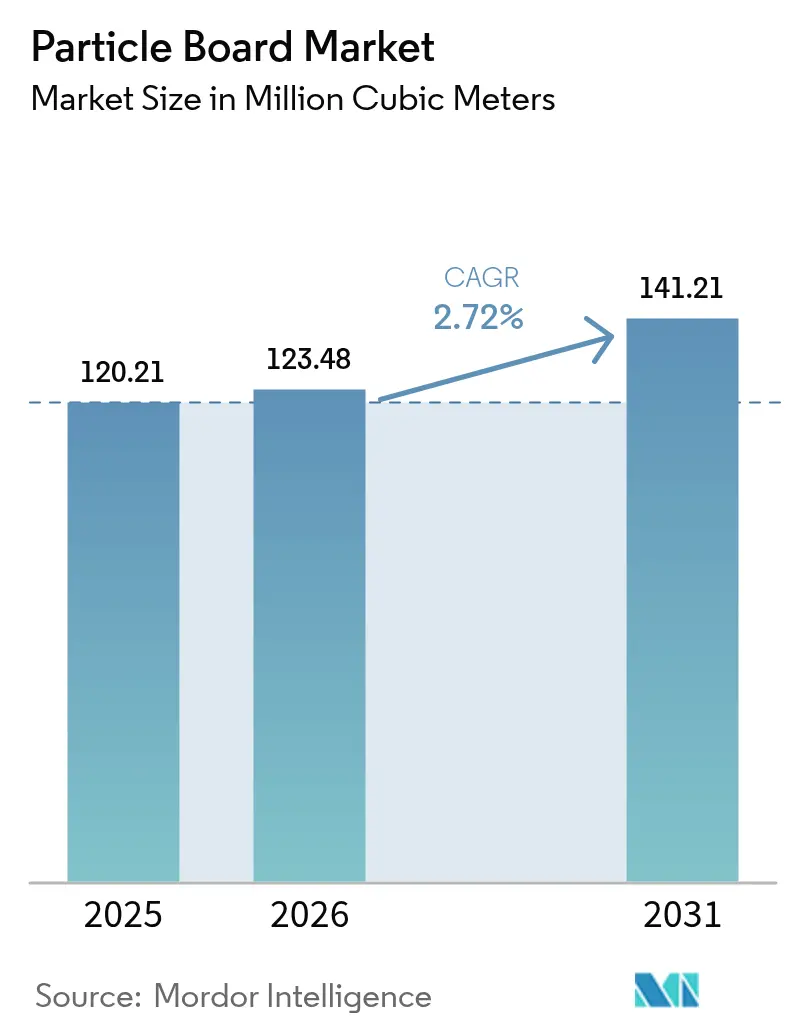
| Market Volume (2026) | 123.48 Million cubic meters |
| Market Volume (2031) | 141.21 Million cubic meters |
| Growth Rate (2026 - 2031) | 2.72 % |
| Fastest Growing Market | Middle East and Africa |
| Largest Market | Asia Pacific |
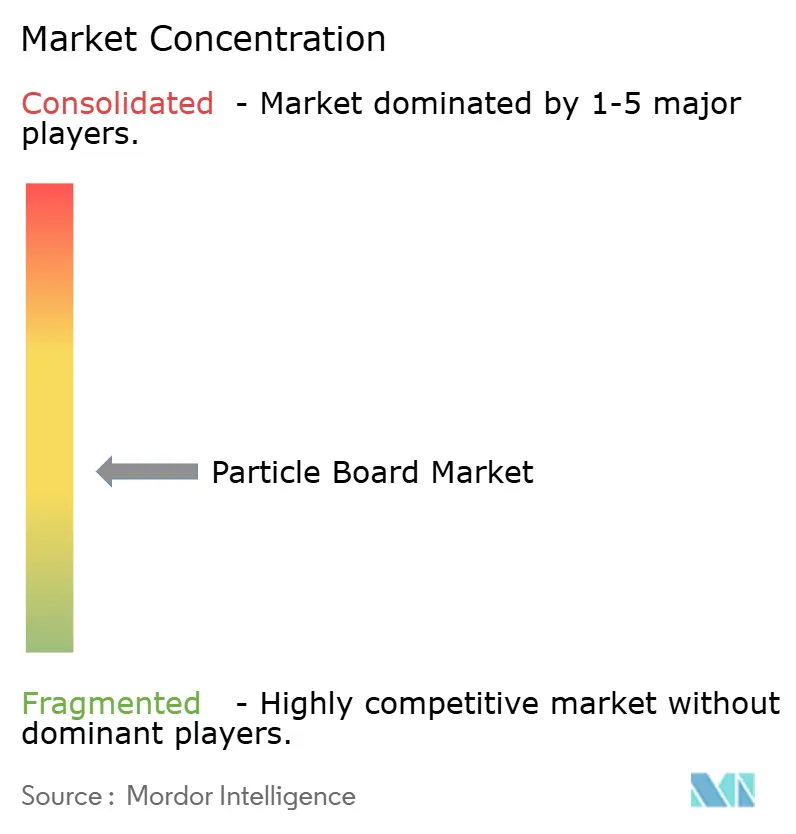
| Market Concentration | Medium |
Major Players *Disclaimer: Major Players sorted in no particular order Image © Mordor Intelligence. Reuse requires attribution under CC BY 4.0. | |
Particle Board Market Analysis by Mordor Intelligence
The Particle Board Market size is expected to increase from 120.21 million cubic meters in 2025 to 123.48 million cubic meters in 2026 and reach 141.21 million cubic meters by 2031, growing at a CAGR of 2.72% over 2026-2031. Capacity additions in China, together with persistent raw-material cost pressure and evolving trade regulations, are shaping a maturing supply base. Wood residue continued to dominate input streams, yet sugar-derived bagasse is capturing incremental share as decarbonization policies shift agricultural by-products into engineered panels. Ready-to-assemble furniture and modular kitchen demand from global retailers sustain core consumption, while low-formaldehyde standards in Europe and North America reward mills that invest in methylene diphenyl diisocyanate adhesive systems. Competitive intensity remains moderate because freight costs limit long-haul trade, and no producer controls more than 8% of global installed capacity, creating space for regional specialists to differentiate through moisture-resistant and non-wood grades.
Key Report Takeaways
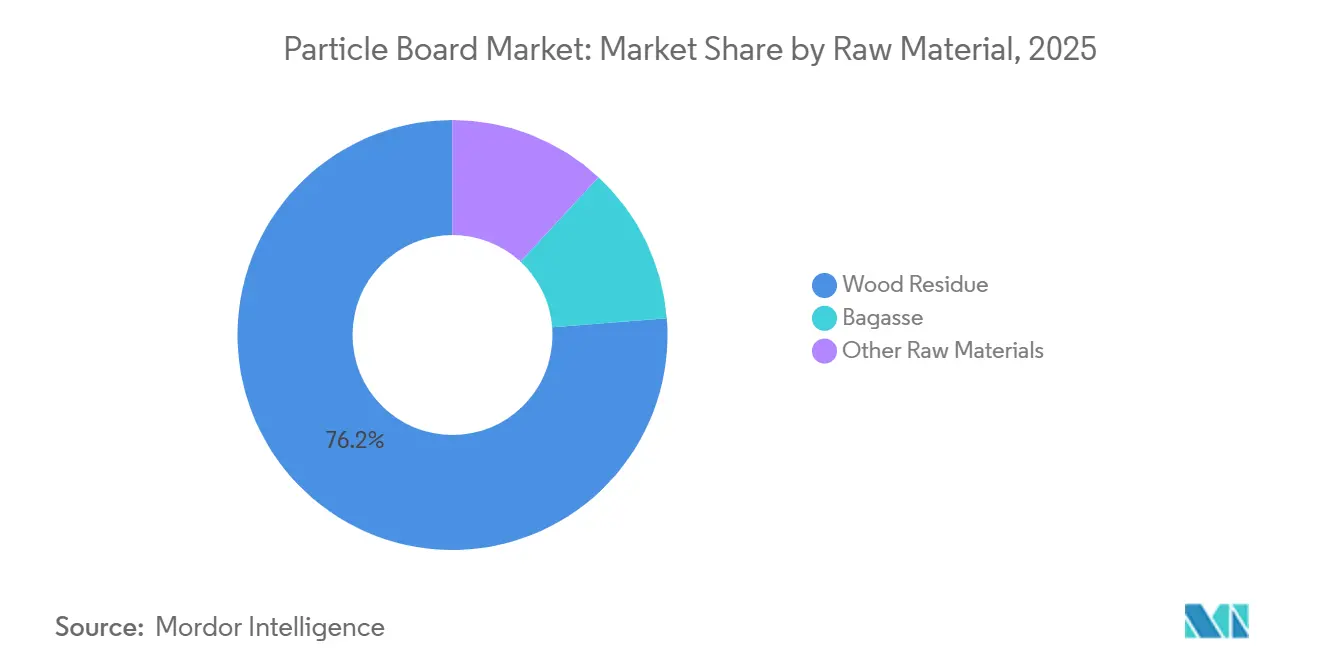
- By the raw material, wood residue captured 76.25% of the particle board market share in 2025, whereas bagasse is projected to advance at a 3.42% CAGR through 2031.
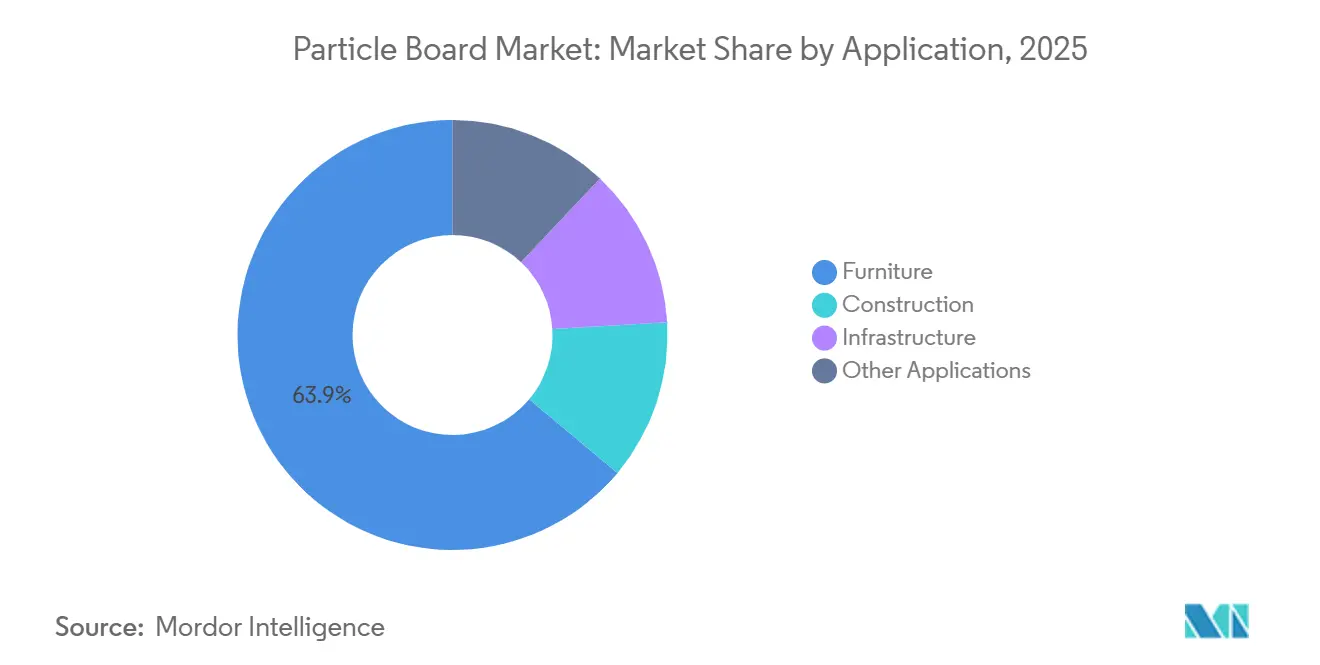
- By application, furniture led with 63.91% revenue share in 2025, while other applications are forecast to expand at a 3.66% CAGR to 2031.
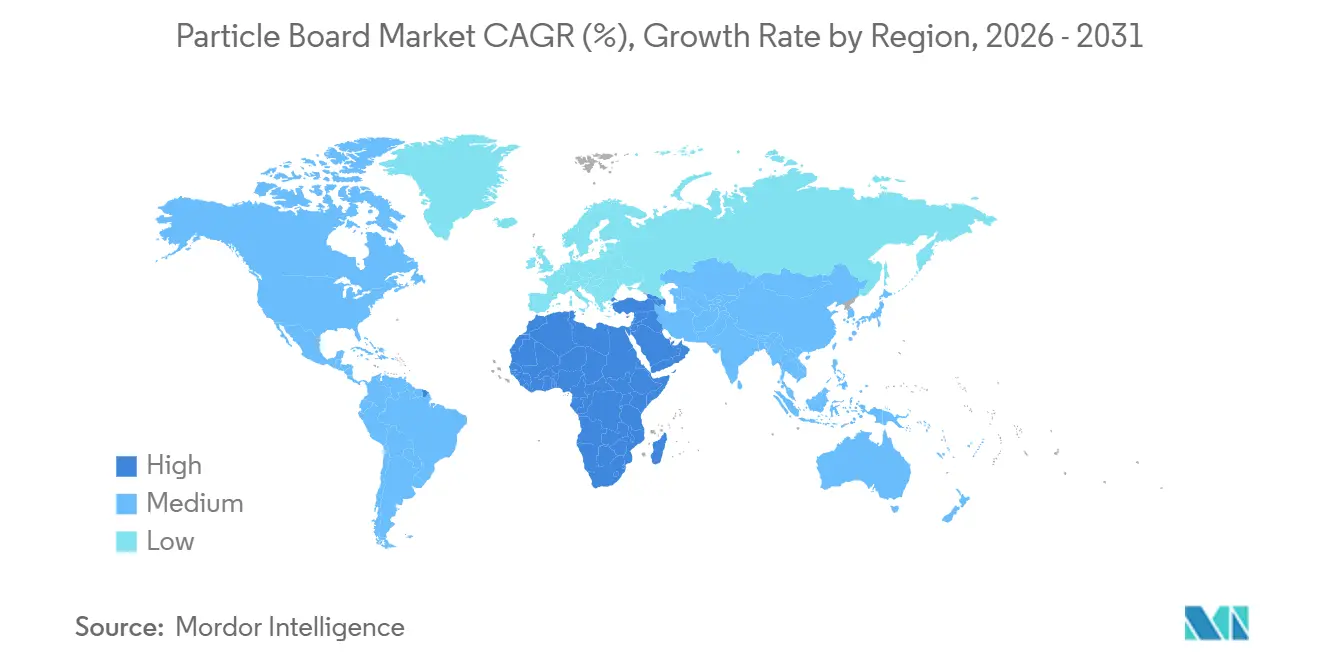
- By geography, Asia-Pacific held 45.44% of the 2025 volume; the Middle-East and Africa recorded the fastest growth trajectory at 3.71% CAGR to 2031.
Note: Market size and forecast figures in this report are generated using Mordor Intelligence’s proprietary estimation framework, updated with the latest available data and insights as of 2026.
Market Trends and Insights
Drivers Impact Analysis of Particle Board Market*
| Drivers | (~) % Impact on CAGR Forecast | Geographic Relevance | Impact Timeline |
|---|---|---|---|
| Rapid urbanization in tier-2/3 Asian cities spurring affordable housing interiors | +0.8% | Asia-Pacific core (India, China, ASEAN), spill-over to South Asia | Medium term (2–4 years) |
| Cost advantage vs. MDF and plywood in non-load-bearing uses | +0.6% | Global, with highest uptake in price-sensitive markets (India, Southeast Asia, Middle East and Africa) | Short term (≤2 years) |
| Stringent low-formaldehyde rules boosting EU/NA import demand | +0.5% | North America and EU, indirect impact on certified Asian exporters | Long term (≥4 years) |
| Sugar-industry decarbonization freeing up bagasse feedstock | +0.3% | Brazil, India, Thailand, China (sugarcane-producing regions) | Long term (≥4 years) |
| AI-driven continuous-press optimization lifting yields and cut-offs | +0.4% | Global, led by Europe and North America, accelerating in China | Medium term (2–4 years) |
| Source: Mordor Intelligence | |||
Rapid Urbanization in Tier-2/3 Asian Cities Spurring Affordable Housing Interiors
As second- and third-tier cities in India, China, and Southeast Asia witness a surge in migration, the demand for budget-friendly interior panels, tailored for apartments, is on the rise. India's Pradhan Mantri Awas Yojana is steering the affordable housing narrative, emphasizing particle board cabinetry and wardrobes[1]Ministry of Housing and Urban Affairs, “Pradhan Mantri Awas Yojana,” Government of India, pmaymis.gov.in. China's urbanization rate is expected to grow further, and provincial capitals are trailing coastal areas in furniture penetration. Vietnamese furniture exports, bolstered by manufacturers shifting from China and capitalizing on EU-Vietnam FTA tariff benefits, saw a significant year-on-year surge. This proximity not only slashes delivered costs compared to MDF but also fuels a cycle of local installations, hastening adoption in nearby urban areas.
Cost Advantage vs. MDF and Plywood in Non-Load-Bearing Uses
Particle board boasts a cost advantage over MDF and plywood, particularly in applications like carcass, shelving, and concealed surfaces. While MDF consumes more electricity for production, particle board's lower energy consumption translates to significant savings. In Vietnam, wage inflation has surged annually, prompting a shift in material choices for drawer bottoms and backs. Although plywood continues to dominate in high-load furniture applications, the introduction of larger-diameter screws, metal inserts, and adhesive-reinforced joints is gradually diminishing plywood's stronghold. This shift is particularly pronounced in markets with volatile currencies, where the price of imported plywood can fluctuate more rapidly than domestic panel costs.
Stringent Low-Formaldehyde Rules Boosting EU/NA Import Demand
In 2025, U.S. consumption outstripped domestic output, a gap that only accredited mills or importers can bridge. Meanwhile, in 2024, German buyers shelled out premiums for E0 panels. Capital-rich Asian manufacturers pivoted to melamine-urea-formaldehyde or MDI systems to stay competitive, while smaller mills opted for domestic markets with more lenient regulations. California's CARB Phase 2, the EPA's TSCA Title VI, and Europe's E0 voluntary regimes have set emission caps between 0.05 and 0.09 ppm, effectively dividing the supply base into certified and non-certified segments.
Sugar-Industry Decarbonization Freeing Up Bagasse Feedstock
In Brazil and India, efficient biomass cogeneration is unlocking millions of tons of bagasse each year. In 2024, Brazilian sugar operations produced bagasse, with a portion deemed surplus and directed towards engineered panels. Similarly, Indian mills, bolstered by an additional cogeneration capacity since 2020, found themselves with an oversupply. This surplus enabled panel producers to source feedstock at a significantly lower cost compared to their wood-residue counterparts. While bagasse panels incur additional resin costs, factoring in discounts on raw materials leads to notable net savings per cubic meter.
Restraints Impact Analysis of Particle Board Market*
| Restraints | (~) % Impact on CAGR Forecast | Geographic Relevance | Impact Timeline |
|---|---|---|---|
| Volatile resin and methanol prices squeezing producer margins | -0.5% | Global, most acute in Europe and North America where energy costs are highest | Short term (≤2 years) |
| EU Deforestation Regulation raising compliance costs for Asian mills | -0.3% | Asia-Pacific exporters (China, Indonesia, Vietnam, Malaysia) targeting EU markets | Medium term (2–4 years) |
| Moisture-related swelling limiting exterior applications | -0.2% | Global, particularly in humid climates (Southeast Asia, coastal regions, tropical markets) | Long term (≥4 years) |
| Source: Mordor Intelligence | |||
Volatile Resin and Methanol Prices Squeezing Producer Margins
In mid-2024, Europe witnessed a surge in methanol spot quotes before retracting. This volatility pushed urea-formaldehyde prices higher and squeezed EBITDA margins at merchant mills. However, integrated firms like Georgia-Pacific managed to absorb the impact, thanks to their captive chemistry streams. With feedstock concentrated in China, the Middle East, and the U.S. Gulf, geopolitical risks loom large, hinting at an inherently unstable resin economic landscape.
EU Deforestation Regulation Raising Compliance Costs for Asian Mills
Starting December 2024, the EUDR mandates that all wood products entering Europe must verify their origin. This requirement could impose additional costs on mills lacking digital traceability platforms[2]European Commission, “Regulation on Deforestation-Free Products,” europa.eu. While Indonesian and Vietnamese exporters grapple with challenges due to a fragmented residue supply, the 25 largest producers in China are leveraging blockchain ledgers, not only to manage the new requirements but also to seize market share from those struggling.
*Our forecasts treat driver/restraint impacts as directional, not additive. The impact forecasts reflect baseline growth, mix effects, and variable interactions.
Particle Board Market Segment Analysis
By Raw Material:
Wood Residue Dominates, Bagasse Gains TractionWood residue delivered 76.25% of 2025 feedstock, confirming its entrenched logistical and process advantages. While the particle board market size for wood residue-based production is set to grow in tandem with the overall panel output, it will gradually yield a portion of its market share to bagasse, projected to grow at a 3.42% CAGR through 2031. Despite this growth, bagasse's global market penetration is expected to stay limited. This limitation arises as seasonal supply challenges compel mills to invest in covered storage and modify resin chemistry.
In India and Brazil, bagasse's adoption is driven by cost savings, with delivered prices significantly lower than wood residue on a dry-weight basis. In Germany and the Netherlands, recycled wood commands a notable share of the particle board market, bolstered by landfill-diversion mandates.



By Application:
Furniture Anchors Demand, Infrastructure Niches ExpandFurniture absorbed 63.91% of the 2025 volume, validating the historic linkage between ready-to-assemble formats and the particle board market. While construction made up a significant share, "other applications" are projected to grow at a 3.66% CAGR during the forecast period. In 2024, railway interiors purchased a substantial amount of fire-retardant panels, with projections suggesting this could double by 2028.
Reinforcing feedstock recycling, circular initiatives are making waves; for instance, global circular hubs are reclaiming panels, leading to a reduction in raw-material costs. On the other hand, while automotive trunk liners present a limited opportunity due to the weight of particle boards conflicting with lightweighting goals, there's potential. With density optimization, additional demand could be realized by 2030.
Geography Analysis
APAC Particle Board Market
Asia-Pacific represented 45.44% of 2025 consumption. China, boasting substantial installed capacity, faces a slowdown in local uptake due to weaknesses in its property sector. Meanwhile, India utilized resources in 2024, catering to both domestic furniture needs and export contracts. ASEAN nations are attracting production shifts from China, bolstered by trade agreements, whereas Japan grapples with dwindling demand due to its aging demographics.
MEA Particle Board Market
Middle-East and Africa is the fastest-growing region at 3.71% CAGR to 2031. This growth is fueled by Saudi Vision 2030's investment in affordable housing fit-outs. Additionally, South Africa's residential growth in 2024 lends further credence to the region's expansion.
The Americas and Europe Particle Board Market
North America represented a notable portion of global volume in 2025. While U.S. housing starts bolstered cabinet demand, a significant supply gap looms, largely due to stringent CARB and EPA regulations. Europe, on the other hand, contributed a considerable share to the global volume, with production hubs in Germany, Poland, and Romania. However, early 2024 saw output curbed in these regions, primarily due to fluctuations in natural gas prices. South America accounted for a smaller share of the global market, with Brazilian mills actively seeking tariff protections against competitively priced imports from China.

Regulatory Landscape
Formaldehyde-emission compliance remains the key regulatory lever shaping particle board trade and product specifications across major consuming regions. In the United States, the EPA regulates formaldehyde emissions for composite wood products under TSCA Title VI, including a 0.09 ppm limit for particleboard, while California enforcement under CARB Phase 2 continues to influence mill certification and importer due diligence. In February 2026, the EPA proposed updates to its TSCA Title VI framework (40 CFR 770.99) to incorporate updated voluntary consensus standards and a new small-scale chamber test method (ISO 12460-2:2024(en)), tightening the technical basis used for demonstrating compliance.
In Europe, requirements for wood-based articles and furniture placed on the EEA market are becoming more stringent and more time-bound. Commission Regulation (EU) 2023/1464 entered into force in August 2026, setting formaldehyde emission limits of 0.062 mg/m3 for wood-based articles and furniture and 0.080 mg/m3 for other articles, which raises the compliance bar for exporters that already meet US TSCA or CARB thresholds. In parallel, the EU Deforestation Regulation (EUDR) adds origin-traceability obligations from December 2024 for wood products entering the EU, increasing documentation and digital traceability requirements for particleboard supply chains that source from fragmented residue channels.
Value Chain Analysis
The particle board value chain begins with feedstock aggregation and preprocessing, centered on wood residues (sawdust, shavings, chips, and fines), with sugarcane bagasse increasingly used in select regions. Resin and additives form the second critical input stream, with urea-formaldehyde common in interior grades and higher-performance binders (including MDI systems where used) supporting differentiated products aligned with low-emission specifications. Manufacturing is capital- and energy-intensive, following a linear flow of screening and classification, drying, adhesive blending, mat forming, hot pressing, trimming, sanding, and optional lamination or surface finishing, with quality systems and emissions-testing protocols built into TSCA Title VI/CARB and EU REACH-related formaldehyde requirements.
Downstream, distribution is constrained by particle board's low value-to-weight ratio, making freight costs a structural limiter on long-haul trade and tying mill economics to proximity to sawmills, wood-processing clusters, and dense furniture and interior-fit-out demand centers. Buyers include ready-to-assemble furniture producers, cabinet and modular kitchen manufacturers, and construction and interior contractors. Product differentiation increasingly focuses on moisture-resistant and fire-retardant panels, along with laminated formats. On the supply side, China illustrates the scale-driven manufacturing layer, where sector consolidation and line commissioning activity lifted operational capacity to 64.15 million cubic meters by end-2024 (with 48 new production lines commissioned in 2024). This reinforces competitive pressure on commodity grades and increases the importance of compliance-ready supply and higher-value finishing capabilities.
Competitive Landscape
The particle board market is moderately fragmented. Scale players are deploying continuous-press automation and captive resin plants to secure cost leadership. Chinese mills installing blockchain traceability systems are positioned to seize share in EUDR-compliant channels. While certification regimes like FSC and ISO 14001 have become essential for entry into European and North American markets, many mills in Asia have yet to achieve these qualifications.
Particle Board Industry Leaders
Kronoplus Limited
ARAUCO
EGGER
West Fraser Timber Co.
Kastamonu Entegre
- *Disclaimer: Major Players sorted in no particular order
Particle Board Market Companies Covered in this Report
- ARAUCO
- Associate Decor
- Boise Cascade Company
- Century Prowud
- Century Plyboards (India) Ltd
- EGGER
- Georgia-Pacific
- Kastamonu Entegre
- Krifour Industries Pvt. Ltd.
- Kronoplus Limited
- Roseburg Forest Products
- Siam Riso Wood Products Co., Ltd.
- Sonae Arauco
- SWISS KRONO Group
- Timber Products Company
- West Fraser Timber Co.

Market Opportunities and Future Outlook
Low-emission and compliance-ready particle board remains a clear whitespace area across import-dependent channels, particularly where TSCA Title VI/CARB certifications and tighter EU formaldehyde limits gate access to higher-value furniture and interior applications. The August 2026 EU formaldehyde restriction under Commission Regulation (EU) 2023/1464, together with the ongoing TSCA Title VI regime in the United States, keeps demand tied to mills that can supply low-emission boards and traceable fiber, which in turn supports adoption of alternative binder systems and upgraded testing methods. Investment activity in 2026 also shows producers prioritizing modern continuous-press lines and circular input streams, with Uniboard starting a new particleboard line in Val-d'Or, Quebec in February 2026 (550,000 m3 annual capacity; USD 350 million investment) and Unilin announcing in June 2026 plans to invest over EUR 100 million to modernize its Oostrozebeke, Belgium site, including a new continuous press to maintain 575,000 m3 capacity.
Capacity and modernization projects in Europe also point to opportunity in upgraded surface finishing, recycled wood utilization, and energy-integrated operations that reduce unit costs while improving environmental positioning. Kronospan began construction in February 2026 of a 600,000 m3 annual-capacity particleboard plant in San Vito al Tagliamento, Italy (EUR 300 million), and elka-Holzwerke announced in June 2026 a high double-digit million euro modernization at Morbach, Germany with a new Dieffenbacher production line and a 20 MW energy plant. In parallel, the feedstock mix shift toward bagasse in sugarcane regions creates a cost-anchored niche for non-wood grades where surplus agricultural residues are available, while compliance with EUDR traceability and EU REACH formaldehyde thresholds helps exporters differentiate through documented origin and emissions performance at scale.
Recent Industry Developments in Particle Board Market
- June 2026: Unilin announced a plan to invest over EUR 100 million to modernize its Oostrozebeke, Belgium particleboard facility, including a new continuous press while maintaining 575,000 m3 of capacity. The upgrade is intended to support higher productivity and specification flexibility in a market shaped by low-emission and higher-value laminated panel demand. The update also points to continued reinvestment in mature European assets rather than pure greenfield expansion.
- July 2025: Century Plyboards (India) Ltd commissioned a particle board manufacturing facility in Therovy Kandigai near Chennai, Tamil Nadu. The site adds scale to domestic engineered wood supply, aligning with growth in ready-to-assemble furniture and modular interiors in India. It also strengthens the companys ability to serve both local demand and export-oriented customers that require consistent panel quality.
- November 2024: EGGER announced an investment of EUR 200 million in its Markt Bibart, Germany particleboard plant to process recycled wood and produce laminated particleboard, including a Timberpak collection site to secure recycled feedstock. The project advances recycled-wood integration and supports higher-margin laminated products, addressing circularity and supply-security needs. It also underpins competitiveness in Europe where material traceability and emissions compliance increasingly influence procurement decisions.


Particle Board Market Report Scope and Research Methodology
Market Definition and Coverage
For this study, the particle board market covers manufactured particle boards made by pressing wood particles or similar lignocellulosic residues with binders, and sold into downstream uses as a wood-based panel material.
The scope excludes MDF, plywood, OSB, and veneer sheets. It also excludes downstream furniture or construction value added beyond the particle board output volume sold to those sectors.
Segments Covered in This Report
- By Raw Material
- Wood Residue
- Bagasse
- Other Raw Materials
- By Application
- Furniture
- Construction
- Infrastructure
- Other Applications
- By Geography
- Asia-Pacific
- China
- India
- Japan
- South Korea
- ASEAN Countries
- Rest of Asia-Pacific
- North America
- United States
- Canada
- Mexico
- Europe
- Germany
- United Kingdom
- France
- Italy
- Russia
- NORDIC Countries
- Rest of Europe
- South America
- Brazil
- Argentina
- Rest of South America
- Middle-East and Africa
- Saudi Arabia
- South Africa
- Rest of Middle-East and Africa
- Asia-Pacific
Data Sources, Market Sizing, and Validation
Desk Research
Desk research starts by identifying supply and demand signals that can be tracked in a repeatable way for wood-based panels. We rely on public sources such as the FAO forestry database, UN Comtrade customs statistics, the USITC DataWeb for trade and tariff context, Eurostat industrial production series, and UNECE forest products publications for regional production and consumption patterns.
Next, we cross-check direction and scale using company annual reports, investor presentations, sustainability disclosures, and reputable industry press that discusses capacity additions, mill curtailments, and resin and wood fiber availability. Where needed, paid subscriptions for company financials and intelligence, shipment-level import and export logs, and patent databases are used to confirm corporate footprints, trade splits, and technology shifts that can affect product mix. This list of desk research sources is indicative, and additional sources were also used for data collection, validation, and clarification.
Primary Interviews and Surveys
Primary work is used to pressure-test what desk sources cannot fully show, especially operating rates, product mix shifts, and pricing behavior across grades and applications. We speak with manufacturers, distributors, resin and wood raw material participants, and large buyers serving furniture and construction, then validate differences across APAC, EMEA, and the Americas so regional swings are not averaged out too early.
Distribution of primary research fieldwork respondents
| Company type | Respondent position | Region |
|---|---|---|
| Top tier: 32% | CXOs: 12% | APAC: 45% |
| Mid tier: 49% | Functional/Unit leaders: 35% | EMEA: 34% |
| Smaller Players: 19% | Managers: 53% | Americas: 21% |
Market-Sizing & Forecasting
The core model uses a top-down reconstruction that starts from wood-based panels production and trade statistics, then narrows to an addressable particle board volume pool by region. That regional pool is adjusted with application-level demand signals.
To keep the estimate grounded, we corroborate totals with selective bottom-up approximations such as sampled capacity by key countries, utilization ranges gathered from interviews, and a check on implied shipments by major distribution channels.
Model inputs include particle board production volumes, import and export balances, housing starts and remodeling activity as a proxy for panel demand, furniture output trends, and changes in wood residue availability and resin cost pressure that can influence operating rates. Forecasting uses scenario analysis supported by time-series smoothing, with base, conservative, and high cases linked to consensus expectations from primary respondents on construction cycles, capacity additions, and trade friction. When bottom-up checks do not fully cover a segment, we use proxy indicators like regional panel capacity changes and trade unit value movements to avoid overfilling missing country data with flat assumptions.
Data Validation & Update Cycle
Validation is done through multiple passes that compare modeled totals against independent signals, including trade flow consistency, regional production shares, and implied demand from construction and furniture indicators. Large variances are flagged, investigated, and then corrected through a second look at assumptions such as utilization, conversion factors, and the timing of capacity changes.
Before sign-off, the work is reviewed by another analyst to check the calculation logic, inputs, and year mapping end to end. The report is refreshed annually, and interim updates are triggered when material events occur, for example major mill start-ups, shutdowns, or sharp raw material disruptions. Immediately before delivery, a final check is completed so the client receives the most current view available.
Mordor Intelligence's Particle Board Market Estimate Compared With Other Published Estimates
Published market sizes for particle board can differ widely because some sources express the market in USD values, while others track physical output, and the two are not interchangeable without careful treatment of prices and scope. Variances also come from whether estimates cover particle board only, or blend multiple wood-based panels, and from how trade flows, capacity utilization, and application demand are combined.
By tracking production and trade volumes first and converting only after scope checks, Mordor Intelligence keeps the estimate aligned to cubic meter demand and avoids mixing adjacent panels or downstream furniture value, which is where many gaps typically start.
Benchmark comparison
| Source | Market Size | Gaps in Research Methodology |
|---|---|---|
| Mordor Intelligence | USD 120.21 M (2025) | |
| Industry Data Publisher A | USD 46.80 B (2024) | Uses a value measure based on producer and importer revenues, which can also reflect broader pricing and revenue coverage that is not directly comparable to a volume-defined market, and may mix product boundaries beyond particle board depending on classification. |
| Global Advisory B | USD 4.79 B (2023) | Presented as an incremental growth outlook over a short horizon, with limited clarity on whether the scope is only particle board or includes closely related wood-based panels, and with differing currency timing and ASP assumptions that can shift totals. |
The comparison mainly highlights unit and scope differences rather than a single right or wrong number. One set is volume-led, while the others are value-led with different revenue boundaries. When the market is kept tied to transparent production and trade signals first, and then mapped to pricing where needed, the resulting estimate is easier to reproduce and to update with new capacity and demand information.


Key Questions Answered in the Report
How fast will global demand for particle board grow through 2031?
Volume is forecast to increase from 123.48 million cubic meters in 2026 to 141.21 million cubic meters by 2031, reflecting a 2.72% CAGR.
Which region is expected to expand the quickest?
The Middle East and Africa segment should register the fastest 3.71% CAGR due to Saudi infrastructure spending and South African housing growth.
What share of the particle board market comes from furniture uses?
Furniture commanded 63.91% of 2025 volume, maintaining its role as the primary demand engine.
Why is bagasse gaining relevance as a feedstock?
Surplus bagasse from decarbonizing sugar mills costs roughly half as much as wood residue and is growing at a 3.42% CAGR despite storage and resin-adjustment hurdles.
Page last updated on:


 Your data is secure and never sold or shared.


