
India OTT Market Size and Share
Market Overview
| Study Period | 2020 - 2031 |
|---|---|
| Forecast Data Period | 2026 - 2031 |
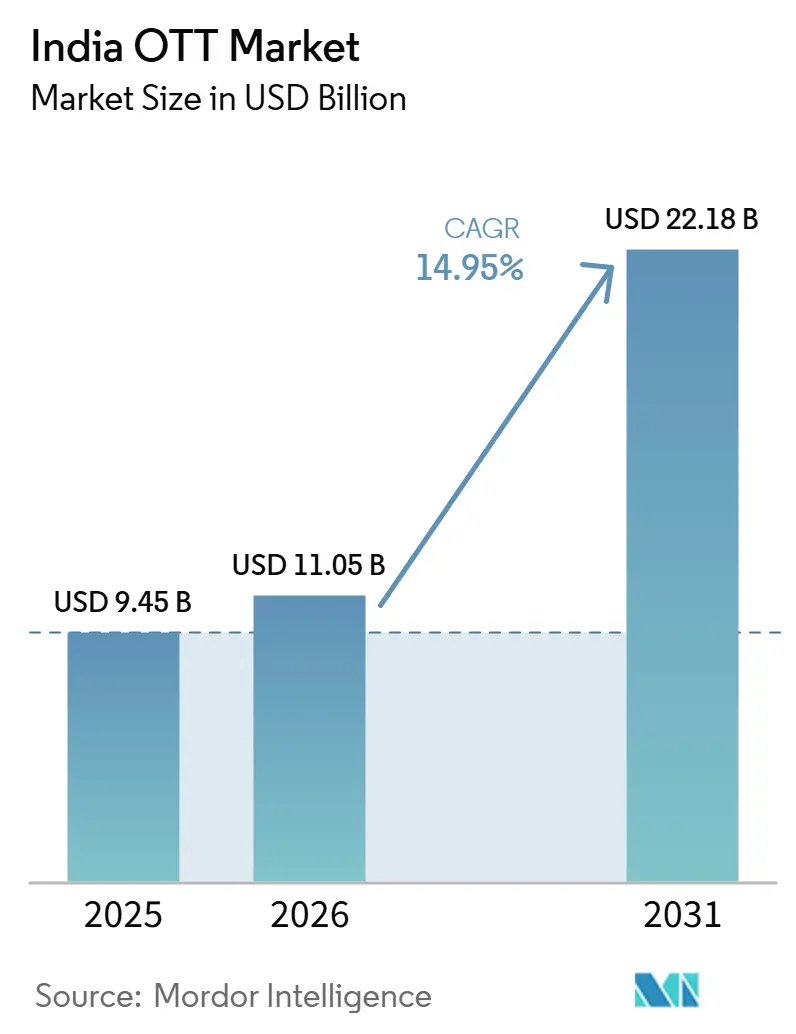
| Base Year Market Size (2025) | USD 9.45 Billion |
| Market Size (2026) | USD 11.05 Billion |
| Market Size (2031) | USD 22.18 Billion |
| Growth Rate (2026 - 2031) | 14.95 % |
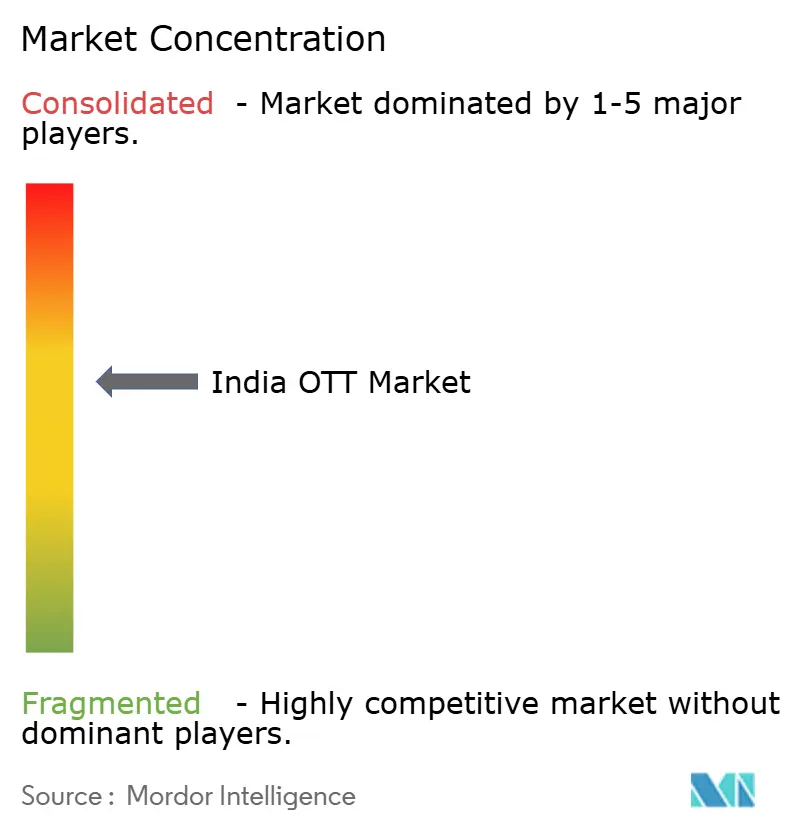
| Market Concentration | Medium |
Major Players *Disclaimer: Major Players sorted in no particular order Image © Mordor Intelligence. Reuse requires attribution under CC BY 4.0. | |
India OTT Market Analysis by Mordor Intelligence
The India OTT market size was valued at USD 9.45 billion in 2025 and is estimated to grow from USD 11.05 billion in 2026 to reach USD 22.18 billion by 2031, at a CAGR of 14.95% during the forecast period (2026-2031). India has already built a large monthly viewing base, so the central commercial issue is converting viewing time into sustainable subscription and advertising income. Growth is expected to come from higher value per user, broader connected TV use, and revenue plans that combine advertising with subscriptions. Sports, regional programming, and broadband bundles are likely to remain important tools for retaining users and reducing acquisition costs. The India OTT market also faces pressure from low willingness to pay, informal access to content, and high spending on sports rights and original productions. These conditions favor platforms that can use distribution partnerships and focused content portfolios without relying only on rapid subscriber additions.
Key Report Takeaways
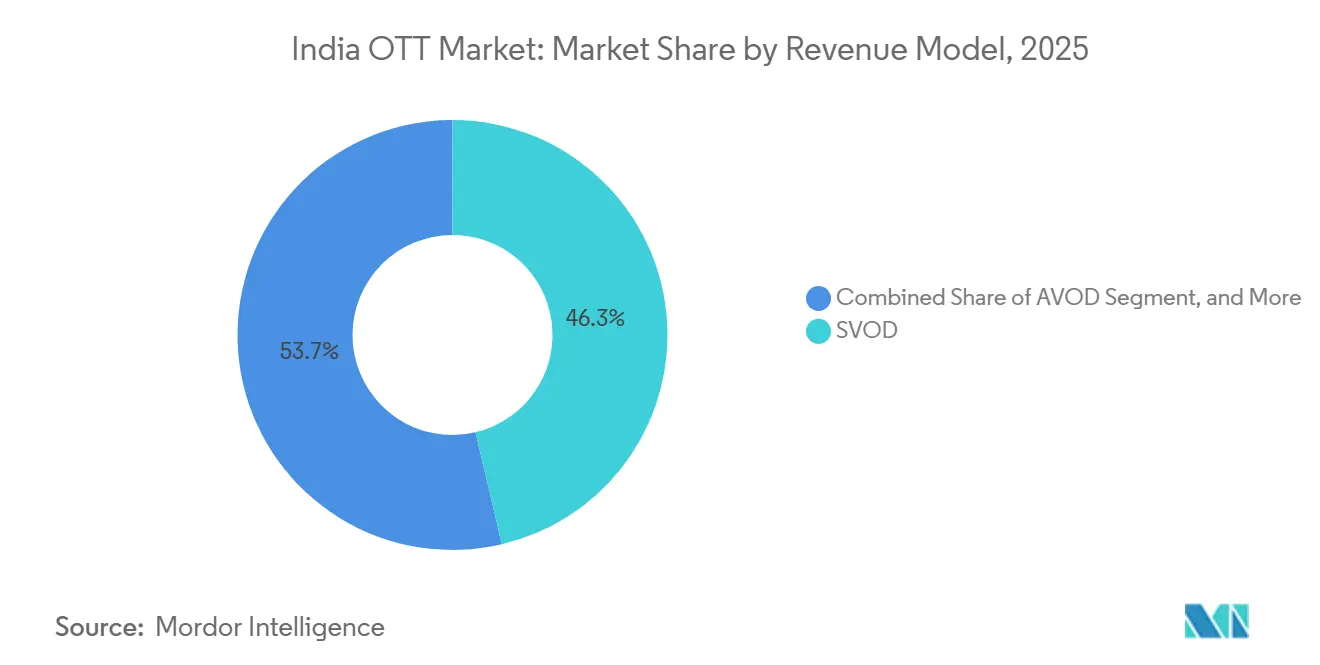
- By revenue model, SVOD accounted for 46.31% of the India OTT market streaming revenue in 2025, while AVOD is projected to expand at a 15.38% CAGR through 2031.
- By device type, smartphones and tablets accounted for 73.84% of streaming revenue in 2025, while smart TVs are projected to grow at a 15.51% CAGR through 2031.
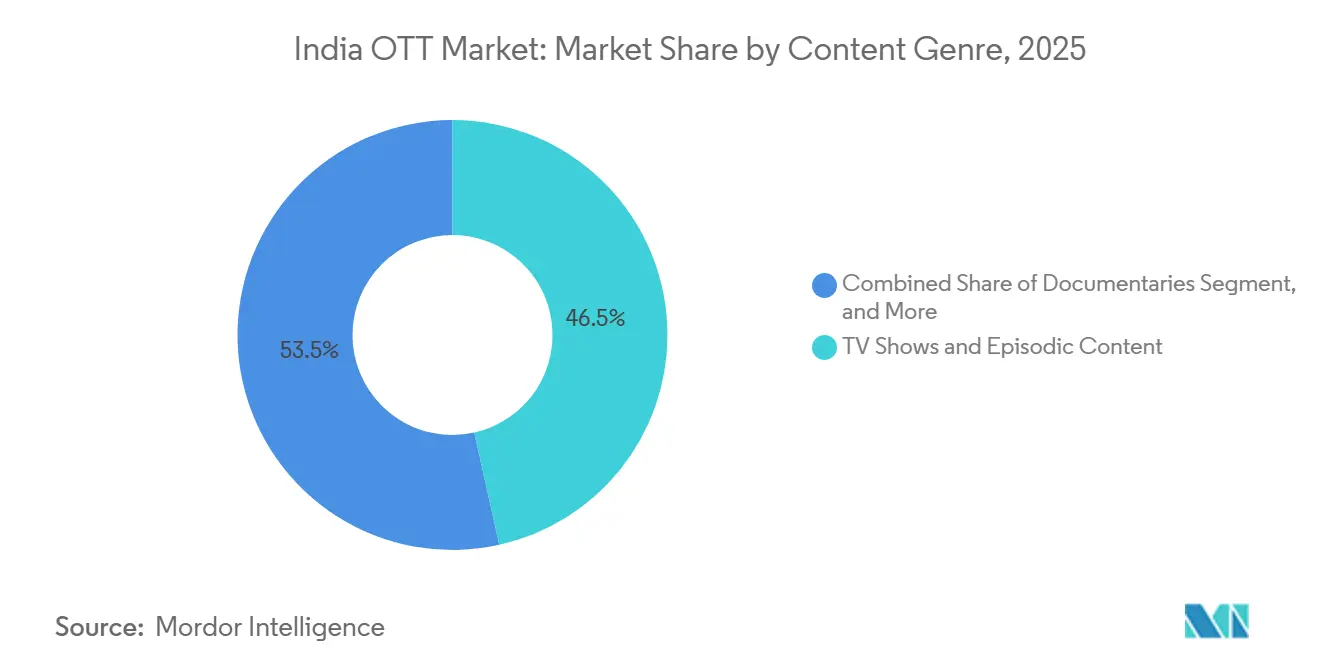
- By content genre, TV shows and episodic content accounted for 46.51% of streaming revenue in the India over-the-top (OTT) market in 2025, while documentaries are projected to expand at a 15.27% CAGR through 2031.
Note: Market size and forecast figures in this report are generated using Mordor Intelligence’s proprietary estimation framework, updated with the latest available data and insights as of January 2026.
India OTT Market Trends and Insights
Drivers Impact Analysis*
| Driver | (~) % Impact on CAGR Forecast | Geographic Relevance | Impact Timeline |
|---|---|---|---|
| Rising Connected TV Adoption in Urban Households | +3.5% | National, with early impact in South India and metro centers in Maharashtra and Karnataka | Short term (≤ 2 years) |
| Sports Rights and Live Event Monetization | +3.0% | National, with Tier 2 city demand during IPL and ICC events | Short term (≤ 2 years) |
| Hybrid Monetization Becomes the Default Revenue Stack | +2.5% | National | Medium term (2-4 years) |
| Regional Language Content Expands Audience Reach Beyond Metro Cities | +2.0% | South India, expanding to East India | Medium term (2-4 years) |
| Programmatic CTV Advertising Improves Ad Yield and Targeting | +1.8% | National, with strongest effect in South India and Tier 1 metropolitan centers | Medium term (2-4 years) |
| Bundling With Telco and Broadband Plans Lowers Acquisition Friction | +1.5% | National, most pronounced in Tier 2 and Tier 3 cities | Short term (≤ 2 years) |
| Source: Mordor Intelligence | |||
Rising Connected TV Adoption in Urban Households
India's connected TV audience reached 166 million monthly viewers aged 15 and above in the first quarter of 2026, increasing 23% year over year. The same research found that 36% of connected TV viewers used only that screen for video, placing 59 million viewers beyond the reach of conventional linear television campaigns. The 2026 FICCI-EY report stated that India had 68 million connected TV households in 2025, including 40 million weekly active households, and projected more than 90 million households by 2028.[1]“Stories, Scale and Impact: Unlocking India's Media and Entertainment Economy,” FICCI, ey.com The report also recorded a 42% increase in connected TV advertising revenue to INR 9,900 crore (USD 117.9 million) in 2025 and projected INR 16,400 crore (USD 195.2 million) by 2028. Connected TV, therefore, gives the India OTT market access to longer viewing sessions and a household setting that can support premium advertising formats. Kantar also found that 60% of connected TV viewers belonged to NCCS A households, which supports the case for premium subscriptions and higher-value advertising inventory.
Sports Rights and Live Event Monetization
Live sports remain a dependable way for platforms to attract viewers and keep them active through an event season. IPL 2025 reached 1.19 billion viewers across television and digital services, including 652 million digital viewers, while peak digital concurrency reached 55.2 million and total watch time reached 840 billion minutes. JioStar disclosed a USD 500 million commitment to sports production, marketing, and technology, underscoring that rights acquisition is tied to a broader effort to build long-term fan relationships. This approach can help the India OTT market turn occasional sports viewers into users of entertainment and ad-supported offerings between events. It also raises financial risk for platforms that pursue premium rights without enough advertising scale or paying users. JioStar India's provisions for expected losses on onerous sports contracts rose to INR 25,760 crore (USD 306.7 million) in FY25 from INR 12,319 crore (USD 146.7 million) in the prior year. The result is a market where large sports investments can deepen engagement but can also widen the advantage of platforms with stronger balance sheets.
Hybrid Monetization Becomes the Default Revenue Stack
The India OTT market is moving toward plans that combine free access supported by advertising with several paid tiers. Digital subscription revenue in India rose 60% to INR 163 billion (USD 1.94 billion) in 2025, with 216 million paid subscriptions across 143 million households. The report stated that 71% of those subscriptions were bundled through telecom operators, e-commerce platforms, or aggregators. Bundles lower the upfront decision for consumers and give platforms a channel to reach households that may not subscribe directly. Ad-supported tiers can also offer a lower entry price without removing premium plans for users who value wider catalogs or fewer advertisements. Platforms that connect advertising exposure and paid account behavior can improve audience targeting and retention over time. This structure is better suited to varied household budgets than a choice between a free and a paid plan.
Regional Language Content Expands Audience Reach Beyond Metro Cities
Regional language programming remains a major route to reach viewers outside the largest Hindi-speaking markets. Zee5 stated that almost 50% of its total viewership came from non-Hindi content, and that South India accounted for up to 45% of platform watch time. The India OTT market can leverage local-language libraries to better resonate with households with diverse cultural preferences and viewing habits. Such programming also helps platforms address regional audiences without depending on the same national originals. Lower production costs can improve the economics of selected regional titles, but success still depends on distribution, catalog depth, and consistent release schedules. The Economic Times reported that demand from the South Indian audience has encouraged major services to expand their local production pipelines. This makes regional content a retention tool as well as a means of expanding the addressable audience.
Restraints Impact Analysis*
| Restraint | (~) % Impact on CAGR Forecast | Geographic Relevance | Impact Timeline |
|---|---|---|---|
| Subscription Fatigue Among Price-Sensitive Users | -2.2% | National, more pronounced in Tier 2 and Tier 3 cities | Short term (≤ 2 years) |
| Content Piracy and Account Sharing Pressure Monetization | -1.8% | National | Short term (≤ 2 years) |
| High Content Costs for Premium Sports and Originals | -1.5% | National | Medium term (2-4 years) |
| Fragmented Payments and Renewal Drop-Off in Mass-Market Segments | -0.9% | National, with sharper impact in non-metro markets | Medium term (2-4 years) |
| Source: Mordor Intelligence | |||
Subscription Fatigue Among Price-Sensitive Users
Subscription fatigue limits services' ability to translate large audiences into recurring revenue. Ormax Media’s 2025 OTT Audience Report indicated that audience growth slowed to below 10% in 2025 after exceeding 13% in earlier years, with service fragmentation and churn contributing to the slowdown. Monthly pricing may appear manageable for a single platform, but it becomes difficult when households maintain several subscriptions. The India OTT market must therefore carefully manage plan selection and payment renewals, particularly in price-sensitive households. Bundling can reduce consumers' immediate costs, but it may also weaken the direct relationship between a platform and its subscribers. Services with distinctive programming and clear plan differences are better placed to avoid being treated as easily replaceable.
Content Piracy and Account Sharing Pressure Monetization
Piracy and password sharing reduce the share of viewing that can be converted into subscription or advertising revenue. The available evidence described content appearing on messaging services soon after streaming premieres, while enforcement remained difficult across a fragmented online environment. Shared passwords can also make reported viewer counts a weak indicator of the number of paying households. The 2026 FICCI-EY report recorded an 18% fall in OTT content spending to INR 21.8 billion (USD 259.5 million) in 2025 from INR 26.7 billion (USD 317.9 million) in 2024. Reduced spending can weaken the content distinction that helps a platform encourage paid renewal. The India OTT market consequently faces a cycle in which informal access reduces revenue, lower revenue constrains programming investment, and weaker programming makes paid access harder to defend.
*Our forecasts treat driver/restraint impacts as directional, not additive. The impact forecasts reflect baseline growth, mix effects, and variable interactions.
Segment Analysis
By Revenue Model: Advertising-Supported Services Narrow the Gap With Subscription Video
SVOD accounted for 46.31% of streaming revenue in 2025 and remained the largest revenue model. JioHotstar, Amazon Prime Video, and Netflix use multiple pricing tiers to offer paid access across a broad range of household budgets. These plans allow services to preserve premium options while keeping lower-price entry points available. TVOD addresses more event-driven viewing, especially when a title has a limited exclusive period before broader licensing. Zee Entertainment's digital business leadership described windowing periods of 2-3 weeks as a way to manage content costs before licensing to another platform. Hybrid subscription and advertising offerings recognize that many users do not fit neatly into fully paid or fully free categories. The India OTT industry is therefore using flexible access paths to support a more gradual move from casual viewing to paid services.
AVOD is projected to be the fastest-growing revenue model at a 15.38% CAGR from 2026 to 2031. The expansion follows growth in connected TV advertising and the broader use of programmatic buying. The 2026 FICCI-EY report noted the strong increase in connected TV advertising revenue during 2025. Advertisers in consumer goods, automotive, and financial services can use connected TV to reach households on a larger screen with measurable digital delivery. AVOD also provides a practical option for viewers who want video access but are reluctant to add another monthly subscription. Revenue results will depend on the quality of advertising inventory, household targeting, and a platform's ability to maintain a satisfactory viewing experience. This model provides the India over-the-top (OTT) market with a growth path less dependent on immediate subscription conversion.



By Device Type: Mobile Retains Reach While Smart TVs Support Higher-Value Viewing
Smartphones and tablets held 73.84% of the India OTT market share in 2025. Mobile devices remain the main access point because data availability, lower-cost handsets, and bundled plans have supported a mobile-first viewing pattern. Jio and Airtel have offered multi-platform OTT packs priced from INR 200 to INR 279 (USD 2.09 to 2.92) per month, which makes smartphones the simplest access point for many households. Laptops and desktops serve a smaller group of urban professionals and viewers of international and long-form content. Their role may decline as lower-priced smart television options become more available. Mobile remains important because it provides reach across locations, rather than only inside the home. The India OTT industry will still need to improve the mobile experience even as large-screen viewing grows.
Smart TVs are projected to be the fastest-growing device type at a 15.51% CAGR from 2026 to 2031. The connected TV audience expanded from 69.7 million in 2024 to 129.2 million in 2025, according to the available Ormax Media evidence. The Economic Times reported in May 2026 that southern states were driving connected TV adoption through broadband density and a preference for larger-screen viewing. Larger displays encourage family viewing and can improve the appeal of premium advertising formats. Interest in QLED panels and larger screens also indicates that some households are upgrading the quality of their viewing setup. That shift can increase session length and improve the value of advertisements delivered in a living-room environment. Smart TV growth gives the India OTT market an additional route to improve average revenue per viewer.
By Content Genre: Episodic Programming Leads While Documentaries Gain Attention
TV shows and episodic content accounted for 46.51% of the India OTT market size in 2025. Recurring formats help platforms establish regular viewing habits and maintain audience interest between major film releases. The available evidence identified crime thrillers as a leading original-content subgenre in 2025. It also reported that JioHotstar's Special Ops S2 reached 29.6 million viewers during 2025. Movies and films continue to be an important conversion tool because audiences often follow titles from theatrical release into streaming windows. Zee5 leadership stated that film availability accounted for 50%-60% of new subscriber growth, underscoring the ongoing role of movies in subscription decisions. Reality formats, sports clips, and unscripted programs add variety to the India OTT market.
Documentaries are projected to be the fastest-growing genre at a 15.27% CAGR from 2026 to 2031. True crime can draw viewers who normally prefer either fictional drama or factual programming. Ormax Media stated that 40% of documentaries released on major Indian streaming platforms since 2019 were in the true-crime genre.[2]“Bundy to Burari: Adapting True Crime Documentaries to the Indian Context,” Ormax Media, ormaxmedia.com Warner Bros. Discovery released Nithari, Truth, Lies, and Murder in November 2025, following a Supreme Court verdict that drew public attention back to the case. This showed how a factual release can gain attention when it is relevant to a current public discussion. The available evidence also indicated that fiction series represented 71% of OTT originals in 2025, leaving non-fiction with a smaller production base. Documentary producers and platforms with suitable rights relationships can use this gap to broaden their catalogs without relying only on scripted series.
Geography Analysis
South India is a major growth geography in the Indian OTT market, with 143 million OTT users across Tamil Nadu, Telangana, Andhra Pradesh, Kerala, and Karnataka. That figure nearly matched North India's 151 million users despite the South having a smaller share of the national population. The available evidence stated that southern audiences consumed 50% more content than the national average, and led smart TV penetration. JioHotstar planned to increase its South-originated programming slate to 1,500 hours, while Prime Video India had 26 South-origin titles in development or production. Zee5 reported that South India contributed up to 45% of its total watch time. This combination of audience intensity, broadband access, and language diversity makes the region important for content planning and the adoption of premium screens.
North India remains the largest geography by subscriber count and includes major centers for Hindi-language demand. Hindi represented nearly 45% of national OTT viewing time in the available evidence. Delhi, Uttar Pradesh, and Madhya Pradesh support this demand through their large urban and regional viewer bases. West India, especially Maharashtra and Gujarat, is also becoming more significant for regional content and connected TV services. The 2026 EY India media and entertainment report identified Maharashtra and Karnataka as markets with strong broadband penetration and substantial regional content investment. Reliance Jio's July 2026 Freedom Offer combined 15 months of 100 Mbps broadband with 12 OTT subscriptions, adding a direct route to broader connected household access. East India has a smaller subscriber base, but Bengali, Odia, and Assamese programming give it a distinct role in local-language expansion.
Tier 2 and Tier 3 cities are important to the India over-the-top (OTT) market because they offer room for subscriber and advertising growth across regions. Zee5 leadership stated that more than 70% of its new subscribers came from non-metro cities. Regional platforms, including Chaupal and SunNXT, address audiences that larger national services have not always served with sufficient local programming. Kantar found that 1 in 3 connected TV users in India lived in rural areas in the first quarter of 2026.[3]“Connected TV Adds 166 Million Monthly Viewers in India as Adoption Surges: Kantar,” CNBC TV18, cnbctv18.com These users may respond well to bundled access because it removes the need to choose and pay for each service separately. Local-language catalogs can also support loyalty by reflecting daily language and regional culture. Lower content costs and telecom distribution improve the commercial case, even when individual willingness to pay remains limited.
Competitive Landscape
The India OTT market is moderately concentrated among leading platforms and fragmented among smaller services. More than 50 active services compete for viewer attention, while high spending on content, sports rights, and technology creates substantial barriers to the highest-value audiences. The available JustWatch figures showed Amazon Prime Video and Netflix at 22% SVOD share each in the second quarter of 2026. JioHotstar and Apple TV+ each accounted for 18%, while Zee5 accounted for 9%. JioHotstar had 451 million monthly active users but lost 7 percentage points of SVOD share year over year, according to the available evidence. The difference between broad reach and premium subscription share shows that distribution scale alone does not ensure stronger monetization. Platforms are responding through sports rights, regional programming, and telecom bundles that lower customer-acquisition costs.
Jio Studios acquired a 50.1% stake in Sikhya Entertainment for INR 150 crore (USD 17.9 million) in February 2026, adding an established production partner to its pipeline. Zee Entertainment secured exclusive Bundesliga rights in India for 5 years beginning with the 2026-27 season and held rights to 39 FIFA competitions through 2034.[4]“Bundesliga and Zee Entertainment Enter a Multi-Year Media Partnership for India,” Sportzpower, sportzpower.com Prime Video India and CJ ENM signed a multiyear distribution agreement covering more than 100 Korean titles in Hindi, Tamil, and Telugu. These moves show a preference for content assets that can support defined audience groups rather than a single uniform catalog. They also underscore the importance of careful content selection, as large commitments can be difficult to recover in a price-sensitive environment. Smaller services need clearer regional positions, efficient production, or specialized catalogs to compete without matching the largest budgets. The India OTT market is likely to reward platforms that balance audience acquisition with disciplined spending.
Premium non-fiction and lower-cost production methods remain areas of interest for mid-tier services. The available data showed that 71% of 2025 OTT originals were fiction series, leaving documentaries and unscripted formats with a smaller share of output. This offers room for services that can acquire or produce factual content with recognizable themes. Content spending declined in 2025, making production efficiency more important across the competitive field. Netflix India's net profit increased 63% to INR 85 crore (USD 10.1 million) in FY25, while revenue from operations rose 32% to INR 3,769 crore (USD 44.9 million). This performance indicates that a defined, higher-value customer base can support pricing discipline.
India OTT Industry Leaders
JioStar Private Limited
Netflix, Inc.
Amazon.com, Inc.
The Walt Disney Company
Zee Entertainment Enterprises Limited
- *Disclaimer: Major Players sorted in no particular order

Recent Industry Developments
- July 2026: Netflix India reported that Indian titles generated 688 million views on the platform during the first half of 2026, its strongest first half for Indian content to date, with India ranking third globally for total film viewing and first among non-English film sources. The milestone reinforced Netflix's use of India-originated content as an international revenue driver.
- July 2026: Reliance Jio launched its Freedom Offer for JioFiber and AirFiber subscribers, bundling 15 months of 100 Mbps broadband with subscriptions to 12 OTT platforms including JioHotstar, ZEE5, SonyLIV, Sun NXT, and Hoichoi. The offer extended multi-platform OTT access to broadband-eligible Tier 2 and Tier 3 households through a single upfront payment.
- June 2026: Netflix India announced plans to release 4 titles per week across more than 20 genres in the second half of 2026. The plan increased content throughput as the platform moved beyond prestige programming toward a broader release schedule.
- May 2026: Amazon consolidated MX Player into Prime Video India, creating a single interface for free and paid content. The change brought its advertising-supported and subscription offerings under one product surface.


India OTT Market Report Scope
The India OTT (Over-the-Top) Market comprises digital platforms and service providers that deliver video and other entertainment content directly to consumers through internet-enabled devices, bypassing traditional broadcast and cable distribution networks. The market includes streaming services that offer on-demand access to movies, television shows, original programming, documentaries, and other digital content through subscription, advertising-supported, transactional, and hybrid monetization models.
The India OTT Market Report is Segmented by Revenue Model (SVOD, AVOD, TVOD, and Hybrid Subscription and Ads), by Device Type (Smartphones and Tablets, Smart TVs, Laptops and Desktops, and Other Device Types), by Content Genre (Movies and Films, TV Shows and Episodic Content, Documentaries, and Other Content Genres). The Market Forecasts are Provided in Terms of Value (USD).
| SVOD |
| AVOD |
| TVOD |
| Hybrid Subscription and Ads |
| Smartphones and Tablets |
| Smart TVs |
| Laptops and Desktops |
| Other Device Types |
| Movies and Films |
| TV Shows and Episodic Content |
| Documentaries |
| Other Content Genres |
| By Revenue Model | SVOD |
| AVOD | |
| TVOD | |
| Hybrid Subscription and Ads | |
| By Device Type | Smartphones and Tablets |
| Smart TVs | |
| Laptops and Desktops | |
| Other Device Types | |
| By Content Genre | Movies and Films |
| TV Shows and Episodic Content | |
| Documentaries | |
| Other Content Genres |


Key Questions Answered in the Report
What is the size of the India OTT market?
The India OTT market was valued at USD 9.45 billion in 2025 and is estimated at USD 11.05 billion in 2026. It is projected to reach USD 22.18 billion by 2031 at a 14.95% CAGR.
Which revenue model leads streaming services in India?
SVOD led with a 46.31% share in 2025. AVOD is projected to grow faster at a 15.38% CAGR through 2031.
Why are smart TVs important for streaming platforms in India?
Smart TVs are projected to grow at a 15.51% CAGR through 2031. They offer a larger-screen setting that can support premium advertising and longer viewing sessions.
Which content formats are driving viewer engagement in India?
TV shows and episodic content led with a 46.51% share in 2025. Documentaries are projected to be the fastest-growing genre at a 15.27% CAGR.
How do telecom bundles affect OTT adoption in India?
Bundles lower the immediate cost and reduce payment friction. In 2025, 71% of paid digital subscriptions were bundled through telecom operators, e-commerce platforms, or aggregators.
Which regions offer the strongest streaming growth potential in India?
South India is important because of its 143 million OTT users, high content consumption, and connected TV adoption. Tier 2 and Tier 3 cities also offer growth through regional programming and bundled access.
Page last updated on:


 Your data is secure and never sold or shared.


