
India Online Tutoring Services Market Size and Share
Market Overview
| Study Period | 2021 - 2031 |
|---|---|
| Forecast Data Period | 2026 - 2031 |
| Base Year Market Size (2025) | USD 3.19 Billion |
| Market Size (2026) | USD 3.32 Billion |
| Market Size (2031) | USD 4.61 Billion |
| Growth Rate (2026 - 2031) | 6.81 % |
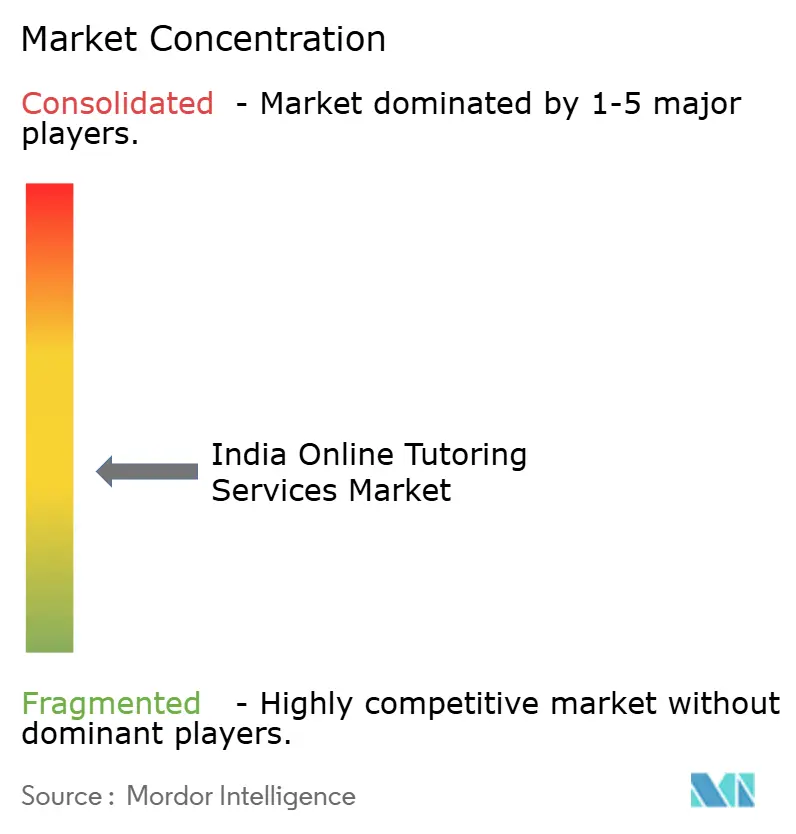
| Market Concentration | Medium |
Major Players *Disclaimer: Major Players sorted in no particular order Image © Mordor Intelligence. Reuse requires attribution under CC BY 4.0. | |
India Online Tutoring Services Market Analysis by Mordor Intelligence
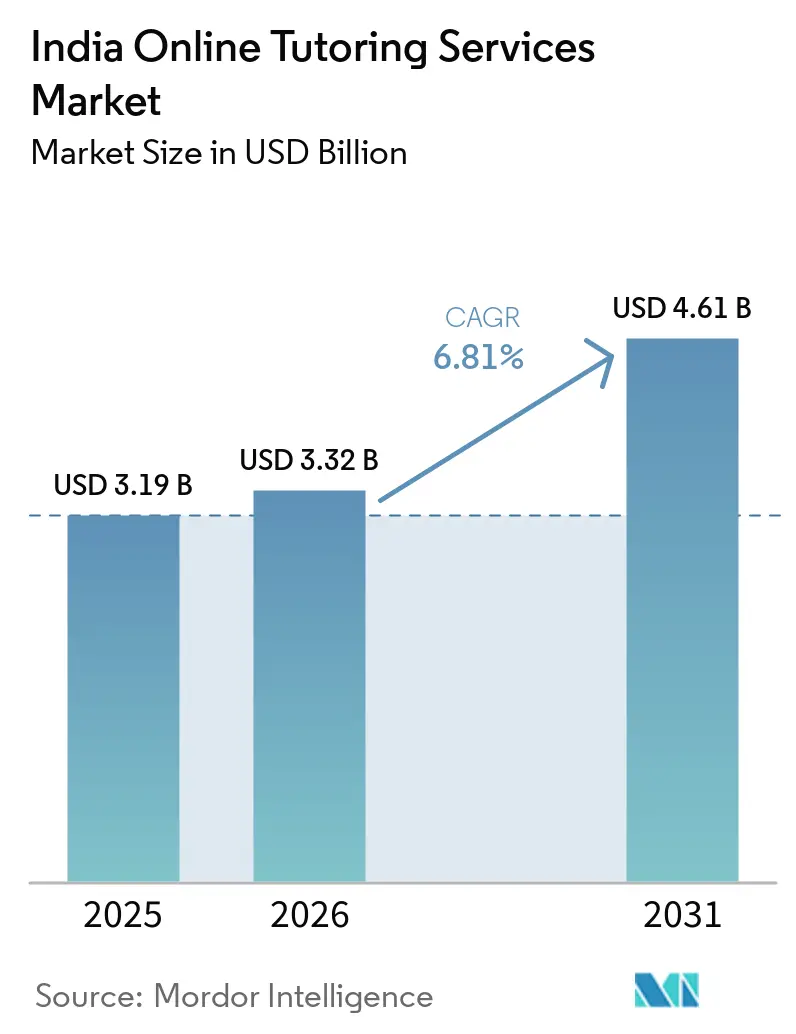
The India Online Tutoring Services Market was valued at USD 3.19 billion in 2025 and estimated to grow from USD 3.32 billion in 2026 to reach USD 4.61 billion by 2031, at a CAGR of 6.81% during the forecast period (2026-2031). The market is shifting from marketing-driven growth to models emphasizing learner outcomes, repeat usage, and disciplined spending. Competitive exams remain a key driver, with significant demand for paid preparation in medical, engineering, and civil services categories. Government-backed digital learning initiatives have increased familiarity with online tutoring, encouraging broader adoption of paid platforms. The commercial model is evolving, with hybrid delivery, subscription pricing, and AI-driven learner support enhancing retention and cost management. This positions the market on a selective growth path, where scale, profitability, trust, and execution quality are increasingly prioritized over earlier expansion-focused strategies[1].
Key Report Takeaways
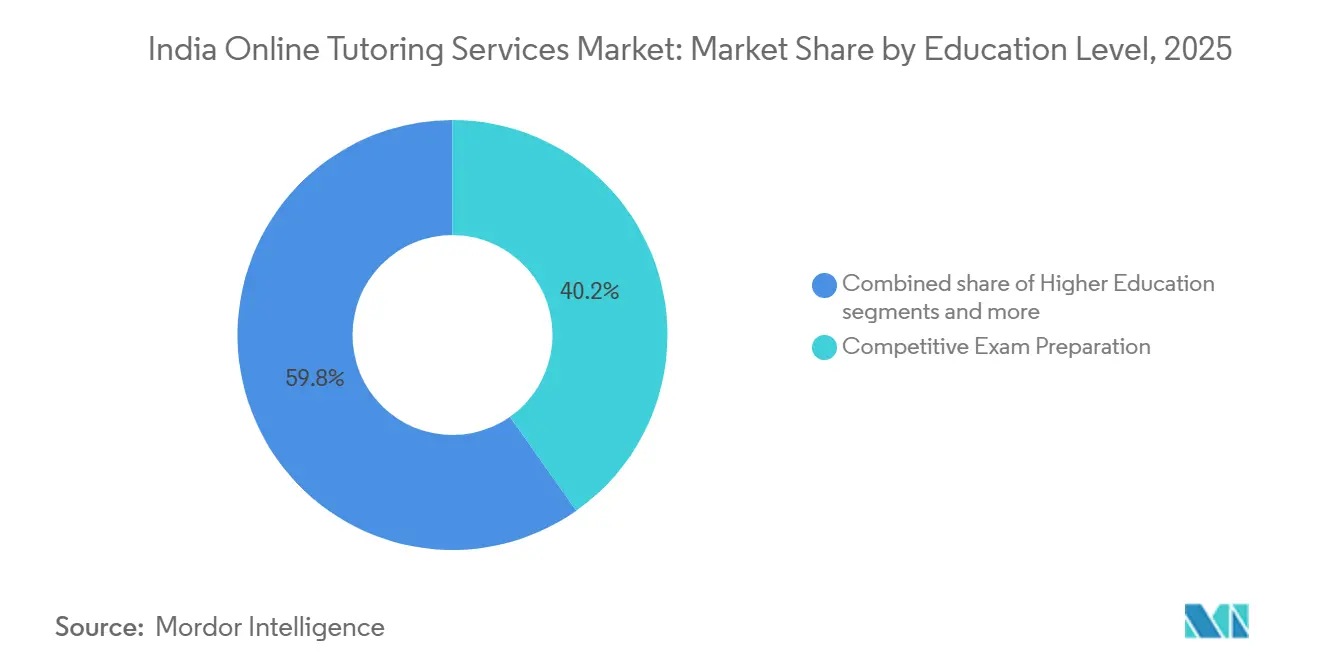
- By education level, Competitive Exam Preparation commanded a 40.24% share of the India Online Tutoring Services Market in 2025, while Professional and Skill Development is projected to grow at the highest CAGR of 7.45% by 2031.
- By end user, Individual Learners accounted for 88.12% of the India Online Tutoring Services Market revenue in 2025, while Schools and Educational Institutions are projected to grow at the highest CAGR of 7.98% by 2031.
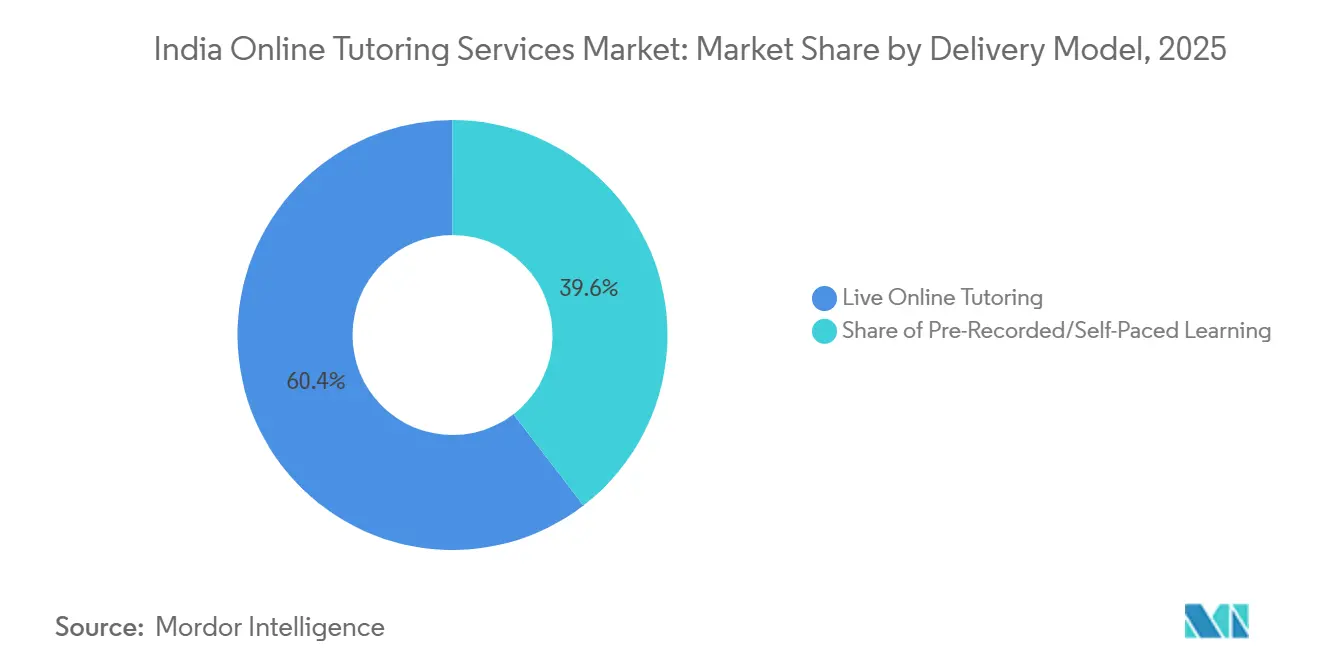
- By delivery model, Live Online Tutoring captured a 60.43% share of the India Online Tutoring Services Market revenue in 2025, while Pre-Recorded and Self-Paced Learning is projected to grow at the highest CAGR of 8.12% by 2031.
- By pricing model, Course-Based Packages held a 45.92% share of the India Online Tutoring Services Market revenue in 2025, while Subscription-Based Pricing is projected to grow at the highest CAGR of 8.35% by 2031.
- By geography, North India led with a 32.81% share of the India Online Tutoring Services Market in 2025, while South India is projected to grow at the highest CAGR of 7.96% by 2031.
Note: Market size and forecast figures in this report are generated using Mordor Intelligence’s proprietary estimation framework, updated with the latest available data and insights as of January 2026.
India Online Tutoring Services Market Trends and Insights
Drivers Impact Analysis*
| Driver | (~) % Impact on CAGR Forecast | Geographic Relevance | Impact Timeline |
|---|---|---|---|
| Rising Demand for JEE, NEET, and UPSC-Linked Test Preparation | +1.2% | North India, South India, pan-India metro belts | Short term (≤ 2 years) |
| Hybrid Online-Offline Coaching Models | +0.7% | North India, South India, Tier-2 expansion zones | Medium term (2-4 years) |
| Teacher Quality and Outcome Consistency as Differentiators | +0.5% | Pan-India, with premium concentration in metro markets | Medium term (2-4 years) |
| Vernacular Content Expansion into Tier-2 and Tier-3 Cities | +0.6% | East India, central India, South India vernacular markets | Medium term (2-4 years) |
| Mobile-First Delivery and Low-Cost Data Adoption | +0.5% | Tier-2, Tier-3, semi-urban, rural-adjacent markets | Short term (≤ 2 years) |
| AI-Based Personalization and Adaptive Learning | +0.7% | Pan-India, with early gains in metro and Tier-1 learner cohorts | Long term (≥ 4 years) |
| Source: Mordor Intelligence | |||
Rising Demand for JEE, NEET, and UPSC-Linked Test Preparation
India's exam-preparation system is a key driver of demand for online tutoring services. The large learner base for structured digital preparation solutions is evident from the significant number of candidates for competitive exams. Government-supported initiatives like SATHEE have increased familiarity with online study formats among JEE and NEET aspirants across regions. This growing acceptance reduces resistance to digital coaching and encourages more students to adopt guided online learning. Demand in this segment is less discretionary than general tutoring, as exam results directly influence college admissions, career opportunities, and social mobility.
Hybrid Online-Offline Coaching Models
Hybrid delivery has become a practical model for building trust and driving conversions in the Indian online tutoring services market by combining digital scalability with a local physical presence. PhysicsWallah reported operating an increasing number of tech-enabled offline centers, with significant growth over the past few years. The company has also allocated IPO proceeds to expand its offline network further. This trend underscores the continued importance of local reassurance in online tutoring, particularly in high-value exam-preparation segments where parents seek visible support structures. The hybrid model also aids conversions in Tier-2 cities, where families are more inclined to enroll after engaging with faculty, counselors, or support staff in person. In the Indian online tutoring services market, hybrid growth reflects the critical role of trust in education-related spending.
Teacher Quality and Outcome Consistency as Differentiators
Teacher quality is a critical factor in the India online tutoring services market, as learners in exam-focused categories prioritize rank improvement, doubt resolution, and teaching clarity over brand recognition. Real-time interaction remains significant, with live online tutoring expected to dominate the market, reflecting the continued preference for teacher-led formats over static content. AI tools are enhancing teacher effectiveness rather than replacing them, as seen in Microsoft Research's collaboration with PhysicsWallah on AI-driven tutoring support and doubt-solving systems. Leading platforms are focusing on separating routine support from high-value instruction while keeping teacher quality central to the learner experience. Consistent outcomes and credible faculty support are essential for driving retention, referrals, and market pricing advantages.
Vernacular Content Expansion into Tier-2 and Tier-3 Cities
Vernacular expansion is critical for growth in the India online tutoring services market, as many new internet users prefer Indian languages over English. PhysicsWallah has expanded its content to 11 languages and built a significant vernacular learner base through numerous language-specific YouTube channels, reaching millions of students. Regional language content has become essential, particularly for state board and exam preparation, where instruction in a learner's preferred language improves comprehension and trust. This approach also allows platforms to serve dispersed students without requiring extensive physical infrastructure in every city. As a result, the market is expanding more effectively in Tier-2 and Tier-3 locations, where content relevance is as important as affordability[2].
Restraints Impact Analysis*
| Restraint | (~) % Impact on CAGR Forecast | Geographic Relevance | Impact Timeline |
|---|---|---|---|
| Rural Device Access and Digital Literacy Gaps | -0.7% | East India, Northeast, rural Tier-3 and Tier-4 markets | Medium term (2-4 years) |
| High Customer Acquisition Costs | -0.6% | Pan-India, with the sharpest pressure in K-12 and metro test-prep segments | Short term (≤ 2 years) |
| Low Trust in Unregulated Certifications | -0.3% | Pan-India, especially in professional and skill development segments | Long term (≥ 4 years) |
| Fragmented Monetization and Weak Unit Economics | -0.4% | Pan-India, especially among mid-tier and early-stage platforms | Medium term (2-4 years) |
| Source: Mordor Intelligence | |||
Rural Device Access and Digital Literacy Gaps
The India online tutoring services market faces access challenges in rural areas despite improvements in device ownership. Smartphone availability in rural households remains lower than in urban areas, reflecting uneven distribution across the country. Rural tele-density data indicates that many users still lack reliable digital access, limiting the adoption of online tutoring platforms. This disparity makes it difficult to replicate metro-focused product designs in smaller towns and rural regions. To address these challenges, the market needs low-bandwidth lesson formats, user-friendly interfaces, and improved onboarding processes to effectively engage rural users[3].
High Customer Acquisition Costs
High customer acquisition costs pose a significant challenge in the India online tutoring services market, as paid user growth can quickly become expensive in competitive categories. Acquisition costs for K-12 students have been high in some segments, and marketing expenses have consumed a substantial portion of revenue during peak expansion periods. This issue has eased for some established brands with strong organic user acquisition channels but continues to affect platforms heavily reliant on digital advertising to attract short-term exam-focused learners. Insights from PhysicsWallah demonstrate the benefits of a content-driven discovery model, which reduces reliance on advertising compared to competitors. Scale advantages in this market are concentrated among players with established educator brands, extensive content libraries, or hybrid distribution networks.
*Our forecasts treat driver/restraint impacts as directional, not additive. The impact forecasts reflect baseline growth, mix effects, and variable interactions.
Segment Analysis
By Education Level: Competitive Exam Dominance Masks a Skills-Led Rebalancing
Competitive exam preparation contributed 40.24% of revenue in 2025, making it the largest education-level segment in the India online tutoring services market. This reflects a strong willingness to pay in exam categories where outcomes directly influence higher education and employment opportunities. Demand is highest in engineering, medical, and civil service preparation, where students need structured content, disciplined testing, and ongoing doubt resolution. Government initiatives like SATHEE have encouraged digital preparation habits, with many students later opting for paid platforms for advanced coaching. Exam-linked preparation remains the primary revenue driver across learner groups in the industry.
Professional and skill development is expected to grow at a 7.45% CAGR through 2031, making it the fastest-growing education-level segment in the India online tutoring services market. This growth is driven by working professionals and older learners seeking upskills in coding, communication, finance, and career-oriented skills beyond traditional schooling. While smaller than exam preparation, this segment diversifies revenue as learners are not tied to academic calendars. Adjacent skill-oriented formats have shown profitability, supporting the viability of outcome-focused skilling models aligned with employability or communication improvement. As the market matures, this segment provides platforms an opportunity to expand revenue streams beyond the exam cycle while retaining an education-focused core.

By End User: Institutional Adoption Lags but is Accelerating
Individual learners contributed 88.12% of revenue in 2025, reflecting the India online tutoring services market's reliance on family-funded, student-driven purchases. Tutoring is primarily bought as a supplementary service outside formal education, with enrollment decisions influenced by exam schedules, parental confidence, and teacher quality. This structure has enabled rapid growth for consumer-focused brands but has also led to challenges like cyclical churn and high acquisition costs. While the market remains consumer-heavy, diversifying the end-user base could improve revenue stability.
Schools and educational institutions are projected to grow at a 7.98% CAGR through 2031, emerging as the fastest-growing end-user group in the India online tutoring services market. This growth is driven by policy support for digital learning tools and institutional interest in tutoring models that complement traditional teaching. The institutional channel reduces reliance on individual consumer acquisition and fosters stable usage across classrooms or school systems. It also positions platforms as enablers of technology and tutoring rather than substitutes for academic frameworks. Although smaller than direct consumer demand, this segment is gaining importance for long-term operational stability[4].
By Delivery Model: Live Tutoring's Lead Is Structurally Sound but Challenged at the Margins
Live online tutoring held a 60.43% market share in 2025, maintaining its position as the largest delivery model in the India online tutoring services market. This segment remains strong due to the credibility of real-time teaching, especially for exam preparation, progress tracking, and doubt resolution. Students and parents value visible faculty interaction, making live formats less likely to be replaced by static content. AI-based doubt support has been integrated into this model, enhancing the economics of live teaching without removing teacher involvement. Live delivery remains central to the market, even as other formats grow.
Pre-recorded and self-paced learning is expected to grow at a compound annual growth rate (CAGR) of 8.12% through 2031, making it the fastest-growing delivery model in the India online tutoring services market. This growth reflects its flexibility, as many learners combine recorded modules with live sessions for practice or to resolve doubts. Mobile-first usage also supports this growth, as lighter-content formats suit areas with inconsistent connectivity. For instance, PhysicsWallah’s course structure, which integrates recorded lectures, live sessions, and AI-supported doubt tools, highlights the blending of formats. The growth of self-paced learning strengthens the overall product mix without diminishing the trust associated with live tutoring.
By Pricing Model: Course Bundles Anchor Revenue as Subscriptions Gain Traction
Course-based packages held a 45.92% market share in 2025, making them the largest pricing format in the India online tutoring services market. This reflects the structured nature of exam preparation, which typically follows a defined course with a start date, study path, and target exam outcome. The format allows providers to plan faculty, manage cohorts, and schedule content efficiently. With fixed exam calendars, learners often prefer a single packaged purchase aligned with the preparation period over flexible access models. Course-based bundles remain a key revenue driver in high-stakes exam categories.
Subscription-based pricing is expected to grow at a compound annual growth rate (CAGR) of 8.35% through 2031, making it the fastest-growing pricing format in the India online tutoring services market. Testbook’s consolidation of multiple pass plans into a unified "Pass One" membership demonstrates efforts to simplify subscription models, improve clarity, and enhance renewal rates. This format reduces the friction of repeated purchases and encourages learners to stay within the same ecosystem across exam categories. It also provides more stable recurring revenue compared to one-time course purchases, especially when the product catalog supports continued access. Subscription growth is driven by retention-focused monetization strategies rather than discounting.
Geography Analysis
North India accounted for 32.81% of revenue in 2025, driven by a high concentration of aspirants for UPSC, SSC, banking, engineering, and medical exams in states like Uttar Pradesh, Bihar, Rajasthan, Delhi, and Haryana. The region benefits from a strong tutoring ecosystem, with many companies, faculty networks, and operational teams concentrated in the NCR corridor. Expansion by platforms such as PhysicsWallah into cities like Muzaffarpur and Dhanbad highlights opportunities in semi-urban areas. Exam demand, platform presence, and learner familiarity reinforce North India’s position as the largest regional base.
South India is projected to grow at a 7.96% CAGR through 2031, supported by high exam intensity, digital adoption, and parental investment in education in states like Tamil Nadu, Telangana, Karnataka, and Andhra Pradesh. Platforms offering instruction in Telugu, Tamil, and Kannada align better with state board requirements. Expansion strategies and vernacular support highlight the region’s potential for scale and localized offerings, making it a key area for regional monetization.
East and West India hold smaller market shares but offer unique demand profiles. East India shows potential in the medical and civil services, as well as in regional language tutoring, though digital access remains uneven. West India, particularly Maharashtra and Gujarat, supports K-12 tutoring, test preparation, and professional skilling. Digital inclusion efforts and telecom expansion are gradually increasing accessibility, diversifying the demand base with distinct language, exam, and learning needs.
Competitive Landscape
The India online tutoring services market is fragmented, with multiple brands operating across exam preparation, school support, and skill development. No single player dominates, reflecting diverse demand driven by language, exam types, learner demographics, and pricing models. PhysicsWallah has gained prominence through content-driven acquisition, hybrid center expansion, and AI-enabled tutoring investments. Fundraising and operational disclosures highlight its offline growth and reduced losses. While competitive, execution depth varies among players.
The market is shifting focus from scale to operational discipline and product depth. PhysicsWallah’s expansion of its offline centers, the launch of Aryabhata 2.0, and its collaboration with Microsoft Research on AI tools exemplify this trend. Testbook’s pricing consolidation into Pass One simplifies its commercial structure. These strategies emphasize retention, clarity in monetization, and learner outcomes over raw user acquisition.
Consolidation and specialization pressures are increasing. The proposed upGrad-Unacademy transaction combines test preparation and lifelong learning into a single platform. Smaller and mid-tier players face challenges in marketing efficiency, faculty branding, and technology investment without organic distribution or differentiated content. Opportunities exist in institutional support, regional language tutoring, and AI-assisted learning for first-generation users. The market is evolving from user acquisition to efficient retention and scalable delivery quality.
India Online Tutoring Services Industry Leaders
-
Vedantu Innovations Pvt. Ltd.
-
PhysicsWallah Limited
-
Testbook Edu Solutions Pvt. Ltd.
-
Extramarks Education India Pvt. Ltd.
-
CueLearn Pvt. Ltd.
- *Disclaimer: Major Players sorted in no particular order
Recent Industry Developments
- June 2026: Testbook launched Phase 2 of the Testbook Premier League (TPL) on June 4, 2026, for government exam aspirants. The initiative involves daily challenges and mock tests, allowing users to earn points and compete for rewards, including an INR 50,000 (USD 556.49) laptop.
- May 2026: PhysicsWallah launched Aryabhata 2.0, a STEM reasoning model with 3.6 billion active parameters, achieving 88.95% Pass@1 accuracy on competitive exam benchmarks. Published on HuggingFace, this open-source initiative aims to build ecosystem credibility alongside the planned commercial AI tutor launch.
- May 2026: UpGrad has filed with the Competition Commission of India for approval to acquire Unacademy in an all-stock deal worth Rs 2,055 crore, a 90% drop from Unacademy's 2021 valuation of USD 3.4 billion. The merger aims to create a combined entity with annualized revenues exceeding INR 24,000 million (USD 271.1 million) across K-12, test prep, and upskilling.
- March 2026: Unacademy and upGrad signed a term sheet for a 100% all-stock acquisition with a disclosed break fee. Unacademy had over USD 100 million in cash reserves after restructuring its offline centers into franchise partnerships and focusing on core online test-prep products.
India Online Tutoring Services Market Report Scope
| K-12 Education |
| Higher Education |
| Competitive Exam Preparation |
| Professional & Skill Development |
| Individual Learners |
| Schools & Educational Institutions |
| Live Online Tutoring |
| Pre-Recorded/Self-Paced Learning |
| Subscription-Based |
| Pay-Per-Session |
| Course-Based Packages |
| North India |
| South India |
| East India |
| West India |
| By Education Level | K-12 Education |
| Higher Education | |
| Competitive Exam Preparation | |
| Professional & Skill Development | |
| By End User | Individual Learners |
| Schools & Educational Institutions | |
| By Delivery Model | Live Online Tutoring |
| Pre-Recorded/Self-Paced Learning | |
| By Pricing Model | Subscription-Based |
| Pay-Per-Session | |
| Course-Based Packages | |
| By Geography | North India |
| South India | |
| East India | |
| West India |
Key Questions Answered in the Report
What is the projected value of online tutoring services in India by 2031?
The India online tutoring services market is projected to reach USD 4.61 billion by 2031, rising from USD 3.32 billion in 2026 at a CAGR of 6.81%.
Which segment currently contributes the most revenue?
Competitive exam preparation leads by education level with 40.24% share in 2025, reflecting strong demand tied to JEE, NEET, UPSC, and similar high-stakes exams.
Which delivery format is expanding the fastest?
Pre-recorded and self-paced learning is the fastest-growing delivery model with an 8.12% CAGR through 2031, although live tutoring still holds the largest 2025 share at 60.43%.
Why does North India lead while South India grows faster?
North India leads with 32.81% share because of dense exam-prep demand and platform concentration, while South India is growing faster at 7.96% CAGR due to strong digital adoption, regional language alignment, and high education spending.
What is the biggest challenge for tutoring platforms in India?
Customer acquisition costs remain a major challenge because many platforms still depend on expensive marketing, while profitability increasingly depends on retention, subscriptions, and stronger organic discovery.
How are AI tools changing tutoring platforms in India?
AI helps platforms improve doubt resolution, personalization, and faculty productivity, with PhysicsWallah’s AI stack and Aryabhata 2.0 showing how curriculum-specific tools are becoming part of mainstream delivery.