
Private Tutoring Market Size and Share
Market Overview
| Study Period | 2022 - 2032 |
|---|---|
| Market Size (2027) | USD 153.59 Billion |
| Market Size (2032) | USD 216.53 Billion |
| Growth Rate (2027 - 2032) | 7.11 % |
| Fastest Growing Market | Asia-Pacific |
| Largest Market | Asia-Pacific |
| Market Concentration | Low |
Major Players *Disclaimer: Major Players sorted in no particular order Image © Mordor Intelligence. Reuse requires attribution under CC BY 4.0. | |
Private Tutoring Market Analysis by Mordor Intelligence
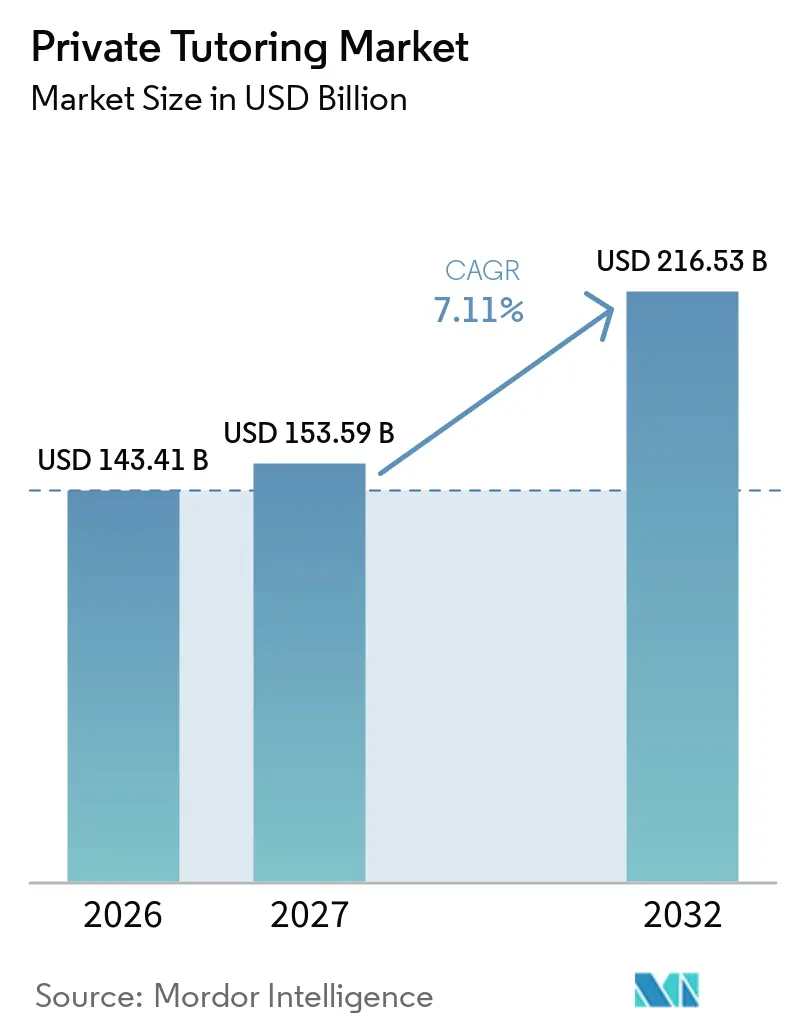
The global private tutoring market was valued at USD 143.41 billion in 2026 and is estimated to grow from USD 153.59 billion in 2027 to reach USD 216.53 billion by 2032, at a CAGR of 7.11% during the forecast period (2027-2032). The global private tutoring market is driven by intense academic competition, persistent gaps in school capacity, and household demand for measurable learning outcomes. Its fragmented structure enables local tutors, tutoring centers, digital marketplaces, and technology-led providers to serve varied budgets and learning needs. Digital delivery reduces the cost of serving learners across locations, while human-led instruction remains important for accountability, feedback, and complex explanations. Improving school connectivity in emerging markets expands the reach of digital education tools beyond major cities, while coaching center regulations in several countries require providers to focus more closely on learner welfare and operating practices. The market faces affordability constraints, uneven service quality, data protection concerns, and country-specific regulations that can reshape provider business models.
Key Report Takeaways
- By delivery mode, Online Tutoring accounted for 36.82% of the global private tutoring market share in 2026, while Hybrid Tutoring is projected to grow at an 8.72% CAGR through 2032.
- By end user, K-12 Students accounted for 51.73% of the global private tutoring market share in 2026, while Working Professionals are projected to grow at an 8.73% CAGR through 2032.
- By tutoring style, One-to-One Tutoring accounted for 61.73% of the global private tutoring market share in 2026, while Group Tutoring is projected to grow at an 8.94% CAGR through 2032.
- By course type, Curriculum-Based Learning accounted for 54.92% of the global private tutoring market share in 2026, while Test Preparation is projected to grow at a 9.13% CAGR through 2032.
- By geography, Asia-Pacific accounted for 35.61% of the global private tutoring market share in 2026 and is projected to grow at an 8.62% CAGR through 2032.
Note: Market numbers in this report are based on Mordor Intelligence's proprietary estimation framework, which combines nine months of actuals with Q4 projections for base year 2026.
Market Trends and Insights
Drivers Impact Analysis of Private Tutoring Market*
| Driver | (~) % Impact on CAGR Forecast | Geographic Relevance | Impact Timeline |
|---|---|---|---|
| Rising Academic Competition and High-Stakes Admissions | +1.8% | Global, concentrated in Asia-Pacific (China, India, South Korea, Japan), North America | Medium term (2–4 years) |
| Growing Demand for Personalized Learning and Learning-Gap Remediation | +1.4% | Global, with early gains in North America, Western Europe, and Asia-Pacific urban centers | Medium term (2–4 years) |
| Expansion of Online, Hybrid, and On-Demand Tutoring | +1.2% | Global; highest penetration in North America, Asia-Pacific, and Middle East and North Africa with mobile-first adoption | Short term (≤ 2 years) |
| Increasing Adoption of AI-Assisted Assessment and Tutor Matching | +0.8% | North America, Asia-Pacific; spill-over to Europe and South America | Short to medium term |
| Outcome-Based Tutoring Partnerships with Schools and Public Programs | +0.5% | North America, Western Europe, Australia | Medium term (2–4 years) |
| Cross-Border Demand for Language, International-Curriculum, and Professional Certification Support | +0.4% | Global, with core demand in South America, the Middle East and Africa, Southeast Asia, and Eastern Europe | Long-term (≥ 4 years) |
| Source: Mordor Intelligence | |||
Rising Academic Competition and High-Stakes Admissions
Competitive admissions systems support demand in the global private tutoring market as families seek instruction to strengthen academic readiness and examination performance. A 2025 United States study associated statewide mandatory college entrance examination policies with a 16% increase in private tutoring prevalence, particularly in high-income and highly educated communities. The SAT Class of 2025 exceeded 2 million test takers, with 97% taking the test digitally, highlighting the relevance of digital test-preparation formats[1]. In South Korea, private education expenditure totaled KRW 27.5 trillion (USD 19.08 billion) in 2025, while participating students spent an average of KRW 604,000 (USD 419.13) monthly. In emerging Asia-Pacific markets, demand for competitive examination preparation and curriculum support remains strong, even as governments tighten coaching center regulations.
Growing Demand for Personalized Learning and Learning-Gap Remediation
The global private tutoring market benefits as families seek targeted support beyond general academic reinforcement. A 2025 Preply and LeanLab Education study found that 96% of surveyed learners considered human tutoring and real conversations essential for progress, while one in three learners who took at least 24 lessons advanced by a full CEFR level within 12 weeks [2]. Parents of children with identified learning needs represent an important demand base because schools may not consistently provide tailored support. The study also found higher tutoring interest among special education families, increasing the importance of diagnostic assessments and tutoring. Human tutors can adapt pacing, explain errors, and sustain engagement beyond what standardized content alone may achieve. In large and diverse education systems, personalized tutoring addresses differences in language, curriculum, teacher access, and readiness for competitive examinations across regions and cities.
Expansion of Online, Hybrid, and On-Demand Tutoring
Online and hybrid delivery models expand access to the global private tutoring market by reducing travel time and connecting learners with tutors beyond their immediate locations. In India, school computer availability rose from 38.5% in 2019-20 to 57.2% in 2023-24, while internet availability increased from 22.3% to 53.9%, supporting tutoring platforms in Tier-2 and Tier-3 locations. China’s Smart Education platform had more than 164 million registered users and integrated 51 services across eight major categories as of April 2025, demonstrating the scale of digital learning infrastructure. AI improves tutor matching, session planning, and practice delivery but does not replace human support for complex reasoning and interpretive work. Hybrid models combine live instruction with digital practice and learning records. Providers can improve responsiveness by ensuring tutor availability across subjects, languages, and time zones without relying solely on physical center networks.
Cross-Border Demand for Language, International-Curriculum, and Professional Certification Support
Public programs, school partnerships, language learning, and professional certification requirements are creating additional demand avenues for the global private tutoring market. In its 2026 funding announcement, Preply identified consumer learning and corporate language training as investment areas. The platform serves learners in 180 countries and offers more than 90 languages. Cross-border learning is relevant for students seeking international curricula, English-language support, or recognized credentials. Learners in large emerging markets present an opportunity, as international curricula, professional qualifications, and English-language requirements coexist with strong domestic examination demand. However, curriculum-specific content, tutor capabilities, and compliance processes can limit replication across countries. Providers that distinguish between school-aligned instruction, international curriculum support, and adult professional learning are better positioned to manage this complexity.
Restraints Impact Analysis of Private Tutoring Market*
| Restraint | (~) % Impact on CAGR Forecast | Geographic Relevance | Impact Timeline |
|---|---|---|---|
| High Cost of Premium Human-Led Tutoring | −0.8% | Global, most acute in developed markets (North America, Western Europe, and Singapore, Australia) | Short to medium term |
| Uneven Tutor Quality and Outcome Consistency | −0.6% | Global, most severe in emerging markets and informal provision segments | Medium term (2–4 years) |
| Child-Safety, Data-Privacy, and Trust Risks in Informal and Digital Provision | −0.4% | Global; regulatory influence most active in the European Union (GDPR), UAE, South Korea, and India | Medium term (2–4 years) |
| Policy Shocks and Curriculum Misalignment Across National Education Systems | −0.5% | Asia-Pacific (China, India, South Korea); regulatory influence of Double Reduction (China), and NEP 2020 (India) | Long term (≥ 4 years) |
| Source: Mordor Intelligence | |||
High Cost of Premium Human-Led Tutoring
Human-led tutoring can create affordability barriers for households unable to sustain regular sessions. South Korea’s 2025 private education expenditure survey found that high school students participating in private education spent an average of KRW 793,000 (USD 550.28) monthly, highlighting the financial commitment associated with supplementary education[3]. In India, tutoring expenses may also challenge households requiring support across multiple subjects or extended examination preparation, although this comparison requires direct affordability evidence. Uncertainty about tutor qualifications, teaching quality, and learning outcomes can further complicate provider selection. Tutoring platforms and centers can help address these concerns through transparent tutor profiles, learner feedback, diagnostic assessments, and parent communication, although these measures may increase operating costs.
Policy Shocks and Curriculum Misalignment Across National Education Systems
Private tutoring providers face child-safety, data-privacy, regulatory, and curriculum-related risks, especially when delivering services online or across borders. A 2025 academic study found that only 49 of 205 countries and self-governing jurisdictions reported regulations for tutorial enterprises in UNESCO’s 2021 survey, highlighting gaps in sector-specific oversight. India’s 2024 coaching center guidelines cover registration, fee transparency, tutor qualifications, student well-being, and grievance redressal, but implementation depends on state and union territory frameworks. A 2025 German Federal Court of Justice ruling confirmed that some online coaching arrangements may require approval under distance-learning legislation, depending on their structure. Differences between CBSE, IB, and GCSE curricula also increase content-development and quality-control requirements. These factors favor providers with documented safeguarding procedures, transparent data practices, tutor oversight, and curriculum alignment.
*Our forecasts treat driver/restraint impacts as directional, not additive. The impact forecasts reflect baseline growth, mix effects, and variable interactions.
Student & Learner Behavior Analysis
Preply’s 2026 Progress Report, based on 5,050 working professionals across nine countries, found that 88% used AI for learning, 63% felt they were learning without making meaningful progress, and 75% trusted a combination of AI and human expertise for long-term progress. While learners value convenience, they still require feedback and practical application. Providers can address these needs through tutor-led sessions, adaptive practice, and outcome tracking.
The OECD’s PISA 2025 findings provide a school-age perspective. Across the Organisation for Economic Co-operation and Development (OECD) countries, 77% of students reported seeking help when they struggled, while 49% frequently checked their understanding through self-questioning. Additionally, 60% received at least one form of supplementary science instruction, including recorded lessons, online platforms, or tutoring. These trends create opportunities for targeted academic support; however, unequal access for disadvantaged learners remains a challenge.
Education Performance Intelligence
Global student performance remains under pressure, creating opportunities for targeted academic support. The OECD released PISA 2025 results in September 2026, covering more than 760,000 students across 91 countries and economies. From 2015 to 2025, average OECD reading scores declined by 28 points and mathematics scores by 22 points, equivalent to approximately 1.5 years and slightly more than one year of learning, respectively. TIMSS 2023 found that 91% of fourth-grade students achieved at least the low international mathematics benchmark, highlighting the gap between foundational competence and advanced proficiency.
These learning gaps strengthen demand in the global private tutoring market for diagnostic-led remediation, examination preparation, and personalized instruction. Providers can differentiate through measurable learning gains and improved critical-reading and mathematics problem-solving skills rather than additional lesson hours. However, affordability and unequal access remain barriers, creating opportunities for flexible pricing and targeted support.
Private Tutoring Market Segment Analysis
By Delivery Mode:
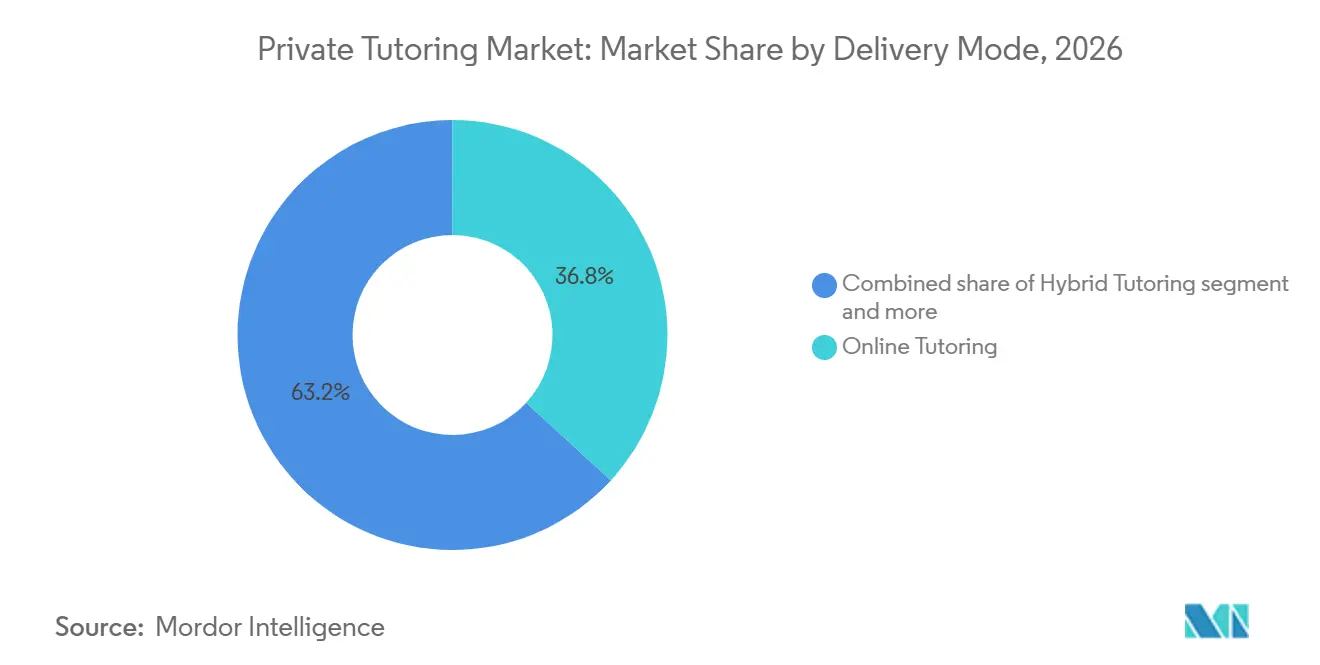
Hybrid Models Redefine the Online-Physical BoundaryOnline tutoring held 36.82% of the global private tutoring market share in 2026, making it the largest delivery format. This reflects the convenience of remote sessions, reduced travel, and access to tutors beyond a learner’s local area. Hybrid tutoring is forecast to grow at a CAGR of 8.72% through 2032, combining digital flexibility with periodic in-person interaction. In-person tutoring remains relevant for one-to-one instruction, in countries with established tutoring centers, and for younger learners or students who need structured supervision.
Hybrid delivery supports shared learning records across in-person and online sessions. Tutors can identify learning gaps in person and assign digital practice aligned with learner progress. Improved school connectivity in emerging markets supports this approach, including in smaller cities where specialist centers are difficult to access. Online providers must maintain safeguards, responsive support, and consistent tutor quality. Providers serving German learners must consider the 2025 distance-learning decisions when designing asynchronous coaching formats. Effective models use each channel for the learning activities it supports best.

By End User:
K-12 Dominance Coexists with Emerging Professional DemandK-12 students accounted for 51.73% of the global private tutoring market size in 2026, driven by demand for supplementary academic support, curriculum reinforcement, and entrance examination preparation. The working professionals segment is forecast to grow at a CAGR of 8.73% through 2032, supported by demand for certifications, career mobility, professional licensing preparation, and language learning. Higher education students use tutoring for subject support, admissions tests, and academic writing. The Others category includes early childhood education, adult literacy, and lifelong learning.
Preply announced in January 2026 that its platform supports individual learners and organizations through more than 100,000 tutors across 180 countries. This model is relevant in emerging markets, where learners and employers seek language skills, professional examination preparation, and international education pathways. K-12 providers must comply with national requirements for coaching center operations and learner welfare. Providers serving school learners and working professionals should differentiate product design, tutor capabilities, and safeguarding standards by age group. Adult learning demand can reduce dependence on school enrollment cycles, examination seasons, and individual student cohorts.
By Tutoring Style:
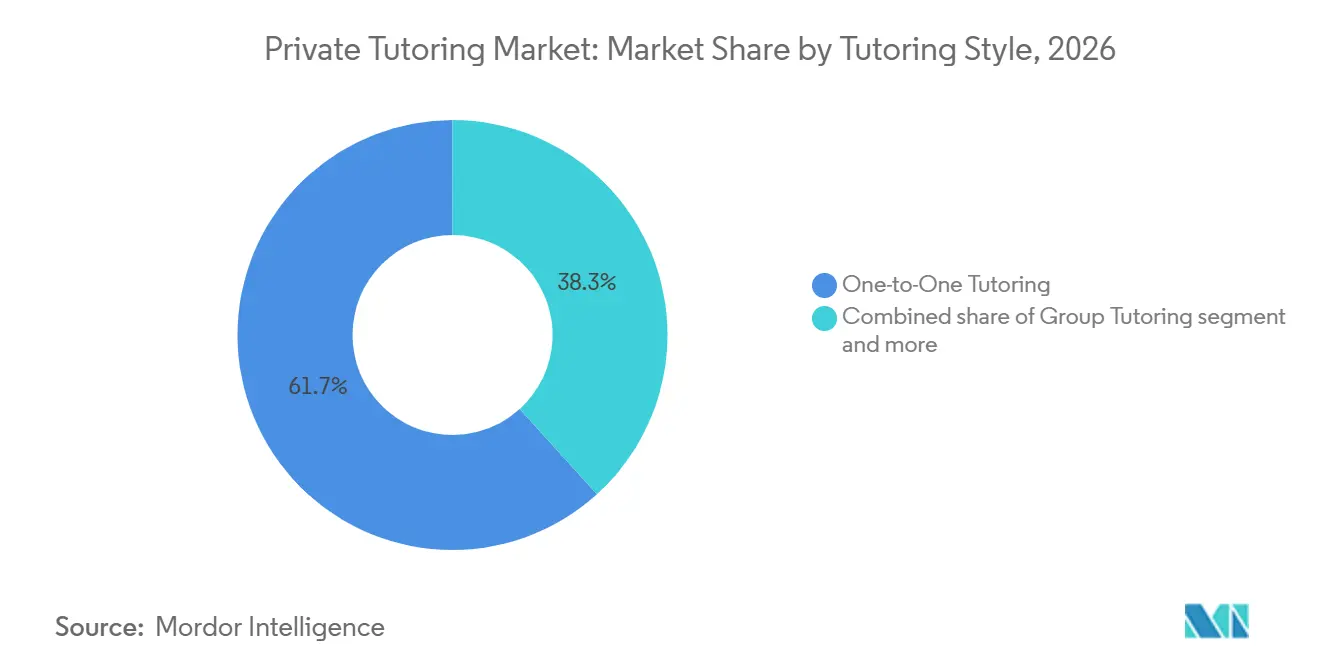
One-to-One Retains Dominance as Group Formats Scale RapidlyOne-to-one tutoring accounted for 61.73% of revenue in 2026, driven by demand for individualized pacing, direct feedback, and learner-specific content. Group tutoring is forecast to grow at a CAGR of 8.94% through 2032 because it reduces costs per learner while retaining live instruction. One-to-one sessions remain important for learners with specific gaps, greater accountability needs, or high-stakes examination preparation. Group formats support peer interaction and lower the cost of regular sessions. Large cohorts remain relevant in South Asia and East Asia, where cost per session is a key decision factor.
A 2025 study of PISA 2022 data across six East Asian jurisdictions found that internet- and computer-based tutoring was more accessible across socioeconomic groups than traditional one-to-one tutoring. It also found that traditional one-to-one tutoring depended heavily on socioeconomic status, reinforcing affordability challenges in the global private tutoring market. In price-sensitive markets, well-designed group models can expand access to specialized instruction beyond higher-income segments. Quality depends on matching learners by level, enabling active participation, and equipping tutors to address individual gaps. Providers need clear cohort designs to deliver lower costs and credible academic support.
By Course Type:
Test Preparation Accelerates on Expanding Examination EcosystemsCurriculum-Based Learning held 54.92% of the global private tutoring market in 2026, supported by its role in daily school performance and subject reinforcement. Test Preparation is forecast to grow at a CAGR of 9.13% through 2032, making it the fastest-growing course type. High-stakes examinations drive spending when scores affect admission, licensing, or career progression. More than 2 million students in the SAT Class of 2025 took the test, and 97% used digital delivery, maintaining demand for test-format familiarity. Curriculum-based tutoring helps learners keep pace with school coursework.
Princeton Review launched resources in 2026 for nine new digital AP exam formats and the enhanced ACT format, demonstrating how test changes create preparation needs. Providers need to align content with evolving examination patterns and make responsible claims about outcomes. They must also distinguish exam preparation from enrichment, language acquisition, and project-based STEM learning. Where academic tutoring faces restrictions, enrichment and vocational programs may gain importance. Professional credentials expand the addressable audience beyond school students. Recurring curriculum needs and time-bound test preparation support the global private tutoring market.
Geography Analysis
APAC Private Tutoring Market
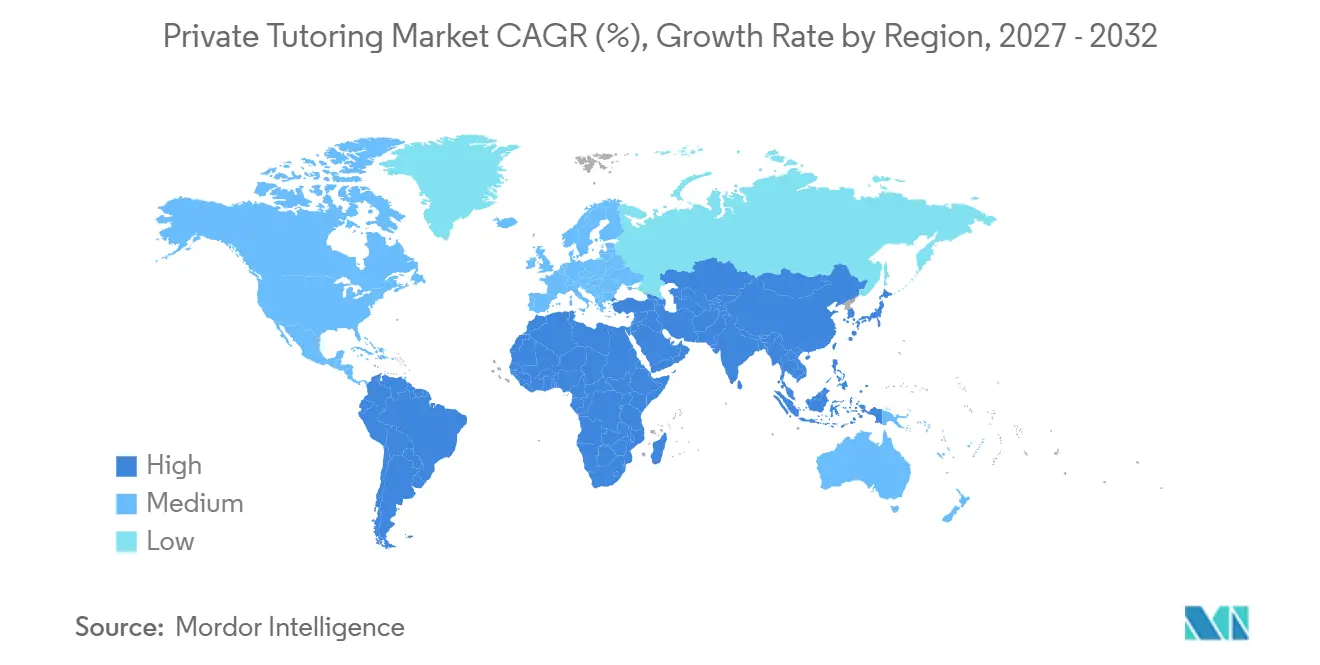
Asia-Pacific accounted for 35.61% of the global private tutoring market in 2026 and is forecast to grow at an 8.62% CAGR through 2032. The region combines academic competition, large learner populations, and expanding digital access. South Korea’s 2025 official survey recorded KRW 27.5 trillion (USD 19.08 billion) in private tutoring expenditure, while participating students spent KRW 604,000 (USD 419.13) monthly. In India, greater school access to computers and internet facilities supports platform reach beyond major cities. Demand includes English-language tutoring, curriculum support, entrance preparation, and professional learning. By April 2025, China’s Smart Education platform had over 164 million registered users, 61.3 billion cumulative page views, and access from more than 220 countries and regions[4].
APAC, North America and EMEA Private Tutoring Market
Private providers must complement this content availability with quality tutoring and personalized support. 51Talk reported FY2025 gross billings of USD 127.6 million and 170,300 active students. Across emerging Asia-Pacific markets, organized platforms can expand through local languages, transparent pricing, and reliable tutor standards. North America maintains demand for test preparation and school support, while digital SAT testing shapes preparation. Europe emphasizes cross-border digital-service compliance; Germany’s 2025 court decisions increased requirements for online tutoring. The Middle East and Africa offer developing opportunities for curriculum-aligned and English-language tutoring. Providers must balance digital scale with local regulations, curricula, and safeguards for younger learners.
Education Infrastructure & Development Intelligence
Digital learning infrastructure is expanding unevenly across countries, creating opportunities for online, hybrid, and center-based tutoring providers. UNESCO Institute for Statistics data show that 100% of primary schools in the United States, Australia, South Korea, and Singapore had internet access for teaching purposes, compared with 38.3% in Brazil and 31.9% in Kenya. High connectivity supports online and hybrid tutoring in these markets, while less-connected countries require mobile-first platforms, community learning centers, and offline-compatible content.
National programs are also improving school connectivity. In India, the share of schools with internet access rose from 22.3% in 2019–20 to 53.9% in 2023–24, while computer availability increased from 38.5% to 57.2%, according to the Economic Survey 2024–25. The OECD Digital Education Outlook 2023 examines how countries are building national digital education infrastructure. Providers can build school partnerships and blended learning networks that adapt to local infrastructure rather than relying solely on live online lessons.
Competitive Landscape
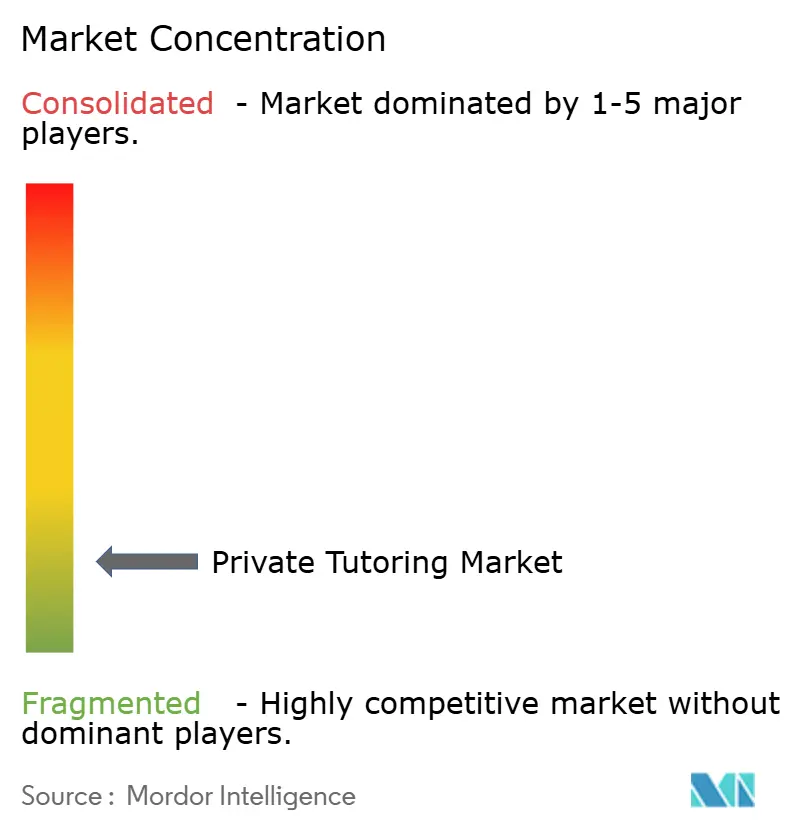
The global private tutoring market remains fragmented. Key players include Kaplan, Inc., Sylvan Learning, Wyzant, Inc., Kumon Institute of Education Co., Ltd., and Nerdy, Inc. (Varsity Tutors). Local tutor relationships, national curricula, examination formats, and independent operators limit concentration. Digital marketplaces operate across countries, but many tutors and centers rely on local networks. The market includes language platforms, test-preparation providers, school-support companies, coaching centers, and hybrid education services. Competition centers on tutor quality, convenience, outcomes, pricing, content relevance, trust, and regulatory compliance. Preply raised USD 150 million in a January 2026 Series D round at a USD 1.2 billion valuation. It reported more than 100,000 tutors serving learners in 180 countries and over 90 languages, and plans to invest in AI, data capabilities, and global growth. Vedantu raised USD 11 million in a September 2025 convertible equity round to fund AI personalization, adaptive content, and category expansion. These investments emphasize personalized learning over recorded content alone. In emerging markets, local curriculum expertise, tutor oversight, and reliable support remain essential. Inspirit Capital acquired Kaplan Languages Group from Kaplan in April 2026, creating a corporate and institutional language education specialist. Unleashed Brands acquired Sylvan Learning from Franchise Group in February 2024. These transactions provide access to tutoring brands, learner communities, content, and distribution channels, but local demand and tutor networks continue to limit rapid consolidation.
Private Tutoring Industry Leaders
-
Kaplan, Inc.
-
Sylvan Learning
-
Wyzant, Inc.
-
Kumon Institute of Education Co., Ltd.
-
Nerdy, Inc. (Varsity Tutors)
- *Disclaimer: Major Players sorted in no particular order
Private Tutoring Market Companies Covered in this Report
- Kaplan, Inc.
- Sylvan Learning
- Wyzant, Inc.
- Kumon Institute of Education Co., Ltd.
- Nerdy, Inc.
- Huntington Learning Center
- Daekyo Co., Ltd.
- Mathnasium
- Tutor Doctor
- Preply, Inc.
- Superprof
- GoStudent
- New Oriental Education & Technology Group Inc.
- Vedantu Innovations Pvt. Ltd.
- VIPKid
- Revolution Prep
- Tutorful
- Cambly, Inc.
- italki
- Aakash Educational Services Limited
Recent Industry Developments in Private Tutoring Market
- September 2026: Kumon Institute of Education launched its learning program in Mongolia through a five-year licensing agreement, introducing tablet-based KUMON CONNECT to approximately 700 students across five schools.
- April 2026: Inspirit Capital acquired Kaplan Languages Group from Kaplan. The divestiture enabled Kaplan to focus on its core test-preparation and academic products while establishing a standalone provider of corporate and institutional language education.
- January 2026: Preply raised USD 150 million in a Series D funding round, valuing the company at USD 1.2 billion. The company plans to use the funding to strengthen its AI and data capabilities and support global growth.
- September 2025: Vedantu raised USD 11 million through a convertible equity round from existing investors, including ABC World Asia, Accel India, and Omidyar Network. The company allocated the funds to technology and AI investments, adaptive content for personalized learning, and category expansion through organic and inorganic growth opportunities.
Global Private Tutoring Market Report Scope
The Global Private Tutoring Market report analyzes supplemental educational services across delivery modes, learner groups, tutoring styles, and course types. The study examines key growth drivers, including academic competition, personalized learning needs, digital delivery, AI-assisted assessment, and institutional partnerships, alongside restraints related to affordability, tutor quality, child safety, data privacy, and curriculum alignment. It evaluates education infrastructure, private-sector investment, student-teacher ratios, institutional density, student enrolment, and education spending to assess market development and learner demand. The report provides market size and growth forecasts, regional and country-level assessments, competitive positioning, market concentration, market share analysis, strategic developments, and profiles of key tutoring providers. It also identifies opportunities in AI-enabled tutoring with human oversight and affordable online services for underserved learners. Market estimates and forecasts are presented in value (USD) across all covered segments.
Segmentation Overview
Key Questions Answered in the Report
What is the size of the global private tutoring market?
The global private tutoring market was valued at USD 143.41 billion in 2026 and is projected to reach USD 216.53 billion by 2032, growing at a 7.11% CAGR from 2027 to 2032.
Which delivery model is growing fastest in the global private tutoring market?
Hybrid Tutoring is forecast to grow at an 8.72% CAGR through 2032 because it combines online flexibility with live human support.
Which learners account for the largest share of global private tutoring demand?
K-12 Students held 51.73% of demand in 2026, supported by curriculum reinforcement, supplementary learning, and entrance preparation.
Why is test preparation expanding in the global private tutoring market?
Test Preparation is forecast to grow at a 9.13% CAGR through 2032 as academic and professional examinations require focused and current preparation.
Why is India important for global private tutoring providers?
India has rising school digital access, with 57.2% of schools having computers and 53.9% having internet facilities in 2023-24, widening the potential reach of online and hybrid services.
Which end-user segment is growing fastest in the global private tutoring market?
Working Professionals are forecast to grow at 8.73% CAGR through 2032, the fastest among all end-user segments, as demand for professional certification, language skills, and career-transition support expands the private tutoring market well beyond its traditional school-age base.