
United States Online Tutoring Services Market Size and Share
Market Overview
| Study Period | 2022 - 2031 |
|---|---|
| Forecast Data Period | 2026 - 2031 |
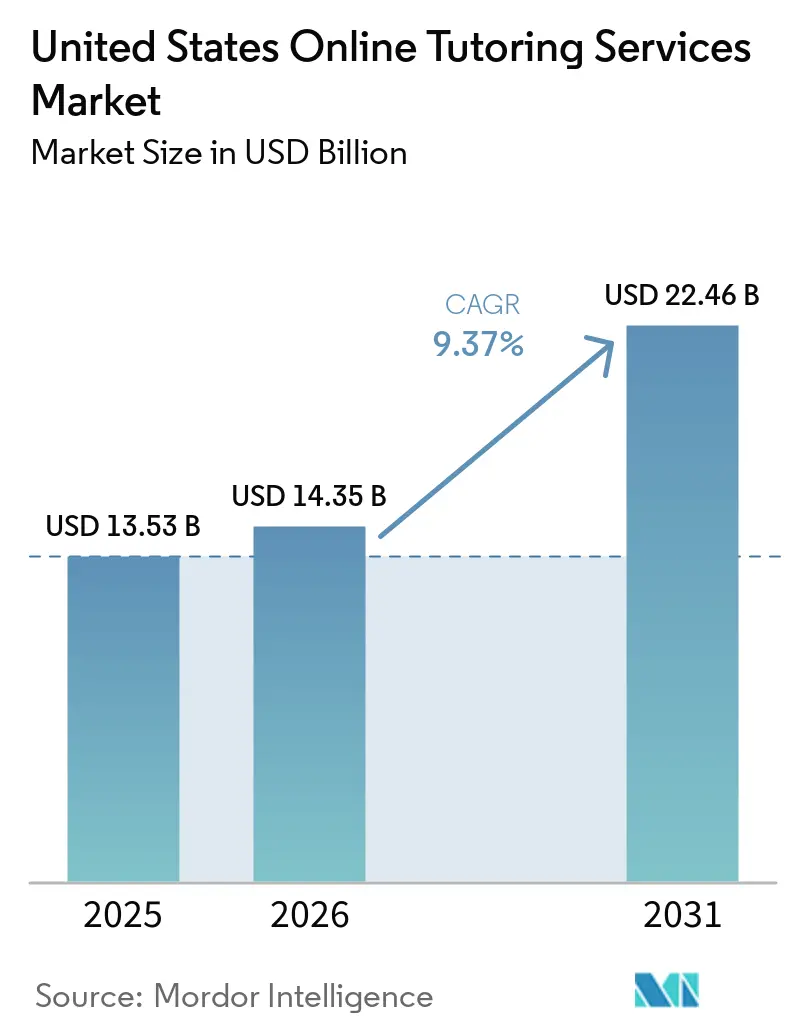
| Base Year Market Size (2025) | USD 13.53 Billion |
| Market Size (2026) | USD 14.35 Billion |
| Market Size (2031) | USD 22.46 Billion |
| Growth Rate (2026 - 2031) | 9.37 % |
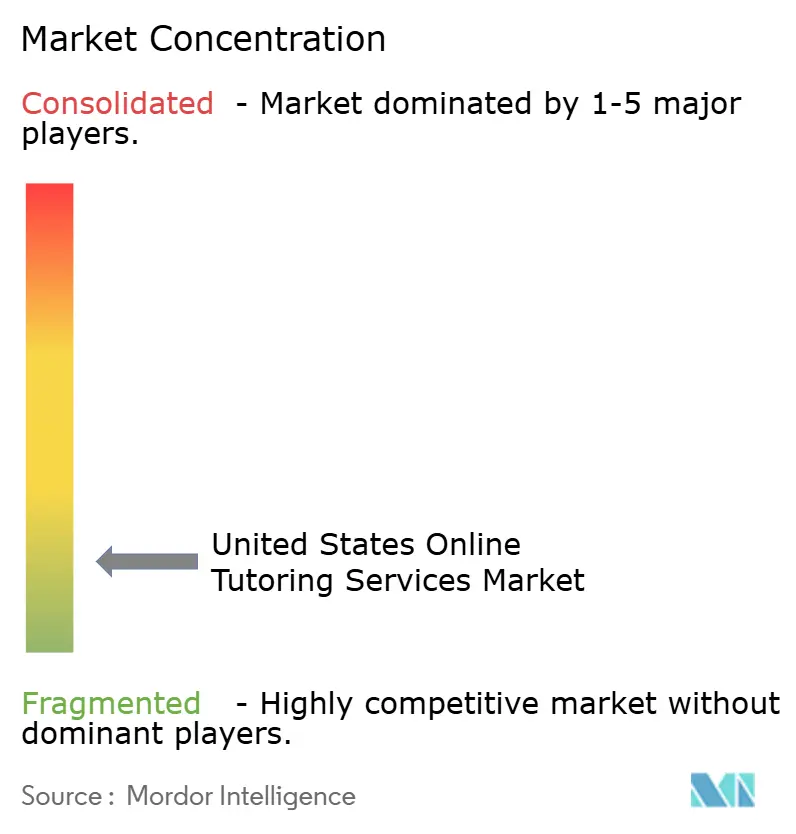
| Market Concentration | Low |
Major Players *Disclaimer: Major Players sorted in no particular order Image © Mordor Intelligence. Reuse requires attribution under CC BY 4.0. | |
United States Online Tutoring Services Market Analysis by Mordor Intelligence
The United States Online Tutoring Services Market size is projected to be USD 13.53 billion in 2025, USD 14.35 billion in 2026, and reach USD 22.46 billion by 2031, growing at a CAGR of 9.37% from 2026 to 2031.
The United States online tutoring market is being supported by steady demand from households, school systems, and employers that continue to use supplemental learning outside the traditional classroom. The market is also benefiting from the normalization of remote learning habits and from stronger use of digital learning tools across K-12, higher education, and adult learning settings. A meaningful policy shift is now underway as state appropriations in places such as Florida, Louisiana, and New York begin to replace expiring federal support, which gives the United States online tutoring market a firmer institutional base than it had during the stimulus period. AI-led tutoring workflows, digital test preparation, and workforce reskilling demand are also widening the addressable customer base, even as budget cuts in some districts and price pressure from informal tutors continue to shape competition.[1]
Key Report Takeaways
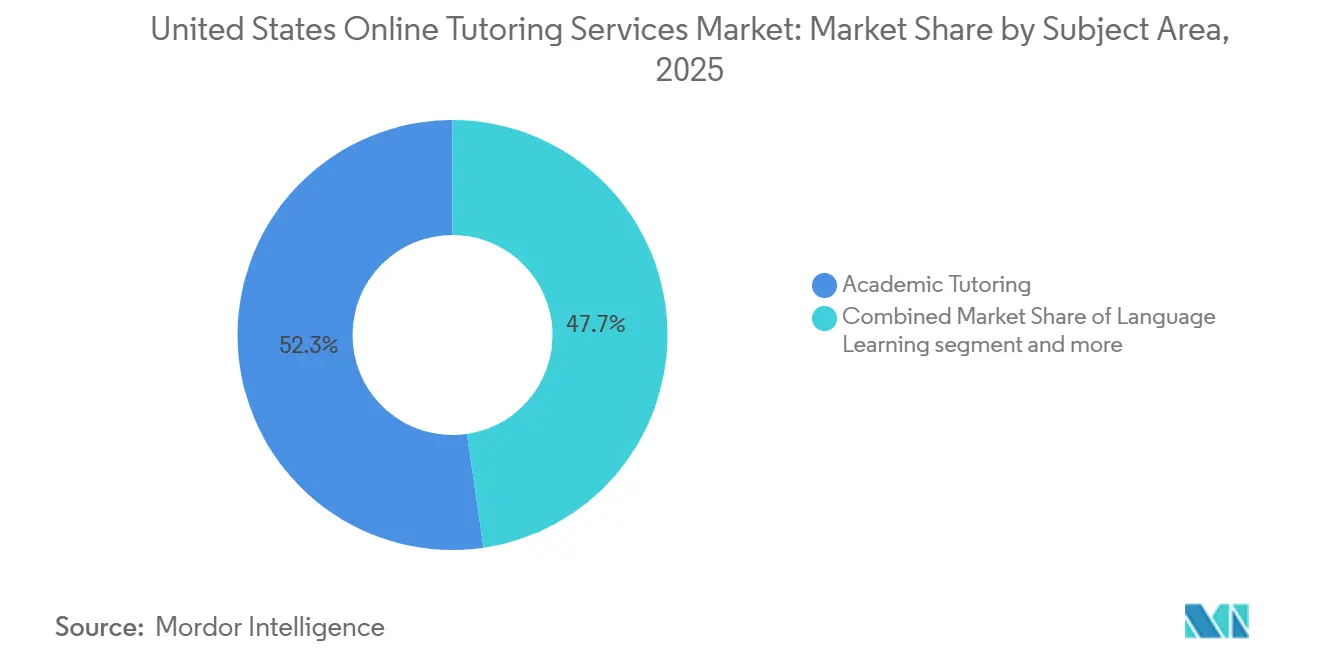
- By subject area, Academic Tutoring accounted for 52.3% of revenue in 2025, while Professional and Skill-Based Tutoring is projected to grow at a 11.4% CAGR through 2031.
- By tutoring type, Structured or Scheduled Tutoring held 61.7% of revenue in 2025, while On-Demand Tutoring is projected to grow at a 12.3% CAGR through 2031.
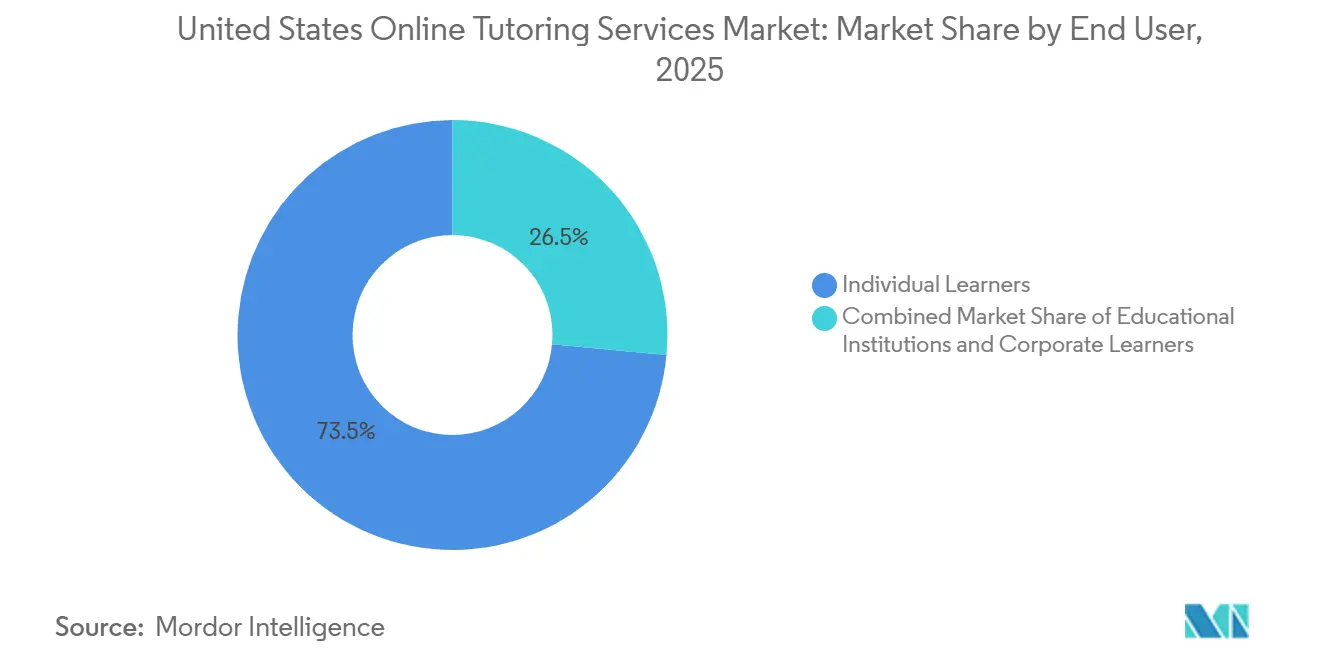
- By end user, Individual Learners held 73.5% of revenue in 2025, while Corporate Learners are projected to grow at a 12.5% CAGR through 2031.
- By education level, K-12 Education accounted for 58.6% of revenue in 2025, while Adult and Continuing Education is projected to grow at a 11.9% CAGR through 2031.
- By geography, the South held 36.3% of revenue in 2025, while the West is projected to grow at a 10.6% CAGR through 2031.
Note: Market size and forecast figures in this report are generated using Mordor Intelligence’s proprietary estimation framework, updated with the latest available data and insights as of January 2026.
United States Online Tutoring Services Market Trends and Insights
Drivers Impact Analysis*
| Drivers | (~) % Impact on CAGR Forecast | Geographic Relevance | Impact Timeline |
|---|---|---|---|
| Flexibility of Online Tutoring | +2.0% | National, with concentration in the South and West | Short term (≤ 2 years) |
| AI-Powered Personalization and Analytics | +2.1% | National, with early gains in the West and Northeast | Medium term (2-4 years) |
| Rising Demand for Test Preparation Support | +1.5% | Northeast, South, and West | Short term (≤ 2 years) |
| Workforce Upskilling and Professional Certification Demand | +1.6% | National, especially the West and Northeast | Medium term (2-4 years) |
| School District and Institutional Supplemental Learning Spending | +0.9% | South, Northeast, and Midwest | Medium term (2-4 years) |
| LMS Integration and Institutional Workflow Standardization | +0.8% | National, especially higher education, and corporate learning | Long term (≥ 4 years) |
| Source: Mordor Intelligence | |||
Flexibility of Online Tutoring: Structural Demand Across Learner Cohorts
Flexibility remains one of the clearest demand drivers for the United States' online tutoring market, as learners now expect support that fits school schedules, work hours, and family routines. The user-supplied draft noted that asynchronous and on-demand models are drawing spending from K-12 families, college students, and working adults, which broadens demand across age groups and use cases. A 2025 workforce survey by upGrad Enterprise found that 58% of U.S. professionals preferred self-paced modules and 55% favored role-tailored programs, which supports the shift toward flexible digital formats. Public-school adoption also moved in the same direction, with the share using on-demand online tutoring rising from 8% in 2024 to 11% by June 2025, and the largest schools showing the highest uptake. That pattern matters because it shows that flexibility is not only a household preference, but also a feature that institutions are increasingly willing to buy in the United States online tutoring market.
AI-Powered Personalization and Analytics: Shifting the Productivity Frontier for Tutors
AI has moved from an added feature to a core operating layer in the United States online tutoring market, especially for providers serving schools and structured high-dosage programs. Varsity Tutors launched its Live+AI platform nationwide in April 2025 and said the platform supported up to 2x gains in targeted skill areas while reducing teacher administrative work by 7 to 10 hours per week. The platform's core design includes AI-generated session insights, real-time analytics, video playback, and automated progress reporting, which shows how analytics is becoming part of the value proposition rather than a back-office tool. This raises the performance gap between platforms that can document learning outcomes and those that still compete solely on availability, an important change in the United States online tutoring market. Regulatory expectations around student data privacy also raise the bar for AI deployment in school-facing contracts, which favors providers with stronger compliance capabilities.
Rising Demand for Test Preparation Support: A Persistent Structural Driver
Test preparation continues to support the United States' online tutoring market, even as some higher education institutions have adopted test-optional admissions policies. The College Board reported that more than 2 million students in the class of 2025 took the SAT, the first time participation rose above that level since 2020. It also said that 97% of the cohort used the fully digital version, which shifts preparation toward platform-led and device-native tutoring formats. The draft also linked this trend to professional and credentialing exams such as the PMP, CPA, MCAT, and LSAT, indicating that the same tutoring infrastructure can serve both academic and career-oriented learners. Brainfuse's May 2025 partnership with GED Testing Service shows how providers are extending test preparation into adult credentialing and workforce re-entry pathways, which adds another stable demand layer.[2]
Workforce Upskilling and Professional Certification Demand: Redefining the Total Addressable Market
Workforce learning has become one of the strongest expansion channels for the United States online tutoring market, especially as employers respond to AI-related job changes and faster skill obsolescence. An edX survey found that 65% of U.S. adults were considering upskilling or reskilling because of economic conditions, and 53% said they needed to begin within 6 months to maintain employment. The Association for Talent Development reported that 11% of organizational learning expenditures went to tuition reimbursement, which shows that employer-funded external education maintains stable budget support. Chegg’s repositioning toward enterprise skilling, along with partnerships involving Woolf University, DHL, and Gi Group, shows how providers are moving beyond student subscription models and into employer-funded learning relationships. This matters for the United States online tutoring market because corporate contracts typically bring larger deal sizes, longer terms, and lower churn than consumer-only tutoring sales.
Restraints Impact Analysis*
| Restraints | (~) % Impact on CAGR Forecast | Geographic Relevance | Impact Timeline |
|---|---|---|---|
| Limited Human Connection in Virtual Learning | -0.5% | National, more pronounced in rural areas, and K-12 | Short term (≤ 2 years) |
| Price Pressure from Unorganized Private Tutors | -0.4% | National, the highest in suburban and urban centers | Medium term (2-4 years) |
| Quality Variability and Tutor Credential Trust Gap | -0.3% | National, more acute in K-12 and test preparation | Medium term (2-4 years) |
| Test-Optional Policies Reducing Some Exam Prep Demand | -0.2% | Northeast, with spillover to the Midwest and West | Long term (≥ 4 years) |
| Source: Mordor Intelligence | |||
Limited Human Connection in Virtual Learning: A Structural Drag on Retention
Human connection remains a meaningful limit on the United States online tutoring market because many learners still see live interaction as central to progress and confidence. A 2025 efficiency study cited in Preply’s January 2026 funding announcement found that 96% of learners viewed human tutors and real conversations as essential, and 97% said human interaction improved their confidence. This issue is especially important in K-12 tutoring, where parents often judge value through engagement quality as much as through test scores or assignment completion. The supplied draft also noted that premium providers are adopting a human-led, AI-enabled model, in which AI handles tracking and content generation. At the same time, tutors focus on instruction and motivation. That response helps retention, but it is harder to scale at low cost, which keeps pressure on margins across the United States online tutoring market.
Price Pressure from Unorganized Private Tutors: Compressing Margins at the Consumer End
Price pressure from independent tutors remains a real constraint on the United States' online tutoring market, as many families can still access referrals outside formal platforms. The draft noted that informal tutors often charge USD 30 to USD 60 per hour, with minimal overhead, making it difficult for platforms to justify higher prices for standard academic subjects. SHRM reported in 2025 that 50% of U.S. workers cited limited time as the top barrier to formal learning, which helps explain why flexible, familiar independent tutors can still meet demand even without platform infrastructure. Platforms have responded with subscriptions, stronger matching systems, and quality assurance layers, but these advantages take time to prove when a buyer already trusts a referral from a local network. That means price competition is likely to remain strongest in suburban and urban areas where word-of-mouth tutor discovery is active and switching costs are low.
*Our forecasts treat driver/restraint impacts as directional, not additive. The impact forecasts reflect baseline growth, mix effects, and variable interactions.
Segment Analysis
By Subject Area: Academic Tutoring Dominates, Professional Skills Accelerate
Academic Tutoring held 52.3% of the United States online tutoring market share in 2025, making it the largest subject-area segment across school support, college readiness, and core curriculum reinforcement. The segment remains large because mathematics, science, writing, and other foundational subjects generate recurring demand throughout the school year and around exam cycles. That steady pattern gives providers a more predictable revenue base than niche learning categories with narrower enrollment windows. The draft also noted that other subject areas, such as music and specialized test preparation, occupy smaller but higher-value pockets where learners are often more willing to pay. These features explain why Academic Tutoring remains the anchor segment even as new growth themes gain more attention in the United States online tutoring market.
Professional and Skill-Based Tutoring is projected to grow at an 11.4% CAGR through 2031, making it the fastest-growing subject-area segment in the United States online tutoring market. That acceleration is being driven by employer-sponsored upskilling, certification needs, and by adult learners combining academic goals with job-linked credentials. Language learning also remains an attractive premium category, and Preply's January 2026 Series D at a USD 1.2 billion valuation shows that live, tutor-led language instruction still commands strong investor confidence when paired with AI support tools. The digital SAT shift also raises the technical bar for academic test-prep platforms, which helps providers that can combine subject expertise with device-native delivery. Together, these shifts show that the United States' online tutoring industry is expanding from a school-centric base into a broader skills-and-credentials model.

By Tutoring Type: Structured Formats Hold Scale, On-Demand Commands the Growth Story
Structured or Scheduled Tutoring accounted for 61.7% of revenue in 2025, indicating that formal delivery still accounts for the greatest share of the United States online tutoring market. That position reflects the needs of schools, universities, and corporate learning teams, which generally prefer scheduled sessions tied to attendance records, progress tracking, and accountability requirements. The draft also pointed out that compliance-led procurement tends to favor formats that can document what happened in each session and how a learner progressed over time. This makes structured delivery more resilient in institutional channels, even as household demand shifts toward flexible access. In practical terms, structured tutoring remains the backbone of providers serving school districts and other contracted buyers.
On-Demand Tutoring is projected to grow at a 12.3% CAGR through 2031, giving it the strongest growth story in this segment of the United States online tutoring market. The format benefits from flexible study patterns among working adults and from the rise in public schools' adoption of on-demand online tutoring between 2024 and 2025. The draft further argued that AI is starting to merge the 2 formats by adding summaries, dashboards, and structured follow-up to sessions that begin as on-demand interactions. Varsity Tutors' October 2025 product update reflects this move toward hybrid delivery, blending convenience with institutional reporting. That hybrid path could become a key operating model for the United States' online tutoring industry, as it enables providers to serve both consumer and institutional channels on the same platform.
By End User: Individual Learners Anchor Revenue, Corporate Learners Drive Incremental Growth
Individual Learners accounted for 73.5% of revenue in 2025, making them the primary demand base for the United States online tutoring market. This segment includes K-12 students, college learners, and self-directed adults, and it is often shaped by tutor-student rapport more than by platform branding. The draft argued that this weakens platform-level network effects because many users remain loyal to the tutor they trust rather than to the software environment where sessions take place. Educational institutions still matter because district and university contracts can smooth seasonality, improve visibility, and support multi-year engagement. Education Week’s reporting on long-run district tutoring programs supports that point and shows why contracted institutional demand remains strategically valuable.
Corporate Learners are projected to grow at a 12.5% CAGR through 2031, making them the fastest-growing end-user group in the United States online tutoring market. Chegg’s enterprise-skilling repositioning and the completion of the Coursera-Udemy combination both point to stronger employer willingness to pay for structured digital learning support. This shift matters because employer buyers expect different proof points than family buyers, including clearer ROI, stronger content governance, and easier integration with workforce systems. Providers that began in K-12 or test preparation, therefore, need new sales, credentialing, and service layers to compete effectively in this channel. That transition cost is one reason growth is concentrating among platforms that can serve both education and employment-linked use cases in the United States online tutoring market.
By Education Level: K-12 Provides a Stable Floor, Adult Education Opens the Ceiling
K-12 Education accounted for 58.6% of revenue in 2025, giving it the largest share of the United States online tutoring market by education level. The scale of this segment is closely tied to the size of the student base and to the continued use of tutoring as an intervention tool for academic recovery and performance improvement. The draft also noted that high-dosage tutoring adoption among midsize schools rose from 37% to 47% between 2022 and 2025, which shows a stronger institutional commitment than a temporary emergency response. This helps explain why K-12 remains the most dependable volume segment even while the fastest growth is coming from older learners. It also supports the United States online tutoring market because state budgets and school procurement can sustain demand beyond household spending cycles.
Adult and Continuing Education is projected to grow at an 11.9% CAGR through 2031, making it the fastest-growing education-level segment in the United States online tutoring market. The segment is supported by workforce re-entry, technical reskilling, and a broader need for professional certification support among adults not tied to traditional academic calendars. ATD reported that nearly two-thirds of surveyed organizations expected to increase AI practical skills training within the next 6 months, providing a clear demand signal for adult-focused tutoring platforms with deep technical content. Studiosity’s expansion into the United States in October 2025 also showed that higher Education and adjacent adult study support remain underdeveloped opportunities for international providers. A federal tax credit provision that designates tutoring as an allowable household education expenditure could further widen participation among adults who were previously priced out of premium services.
Geography Analysis
The South held a 36.3% share of the United States online tutoring market in 2025, making it the largest regional contributor to current revenue. The region benefits from a large school-age population, strong household education spending in several states, and visible state-level tutoring appropriations. Florida’s USD 20 million tutoring commitment and Louisiana’s USD 30 million K-5 allocation show that southern demand is being reinforced by public budgets rather than only by private household spending. That shift matters because it gives the United States online tutoring market a more durable public-sector footing in a region that already has broad learner demand. It also favors providers that have state relationships, measurable outcomes, and the reporting discipline needed for school-linked programs.
The West is projected to grow at a 10.6% CAGR through 2031, which gives it the fastest regional outlook in the United States online tutoring market. The draft linked this to employer upskilling budgets in technology-heavy corridors, greater demand for AI- and data-related tutoring, and a learner base more comfortable with digital-first delivery. This regional profile aligns well with corporate learning growth, flexible formats, and AI-enabled tutoring tools, all of which are becoming more central to future revenue expansion. The West is therefore well-positioned to benefit from the overlap among academic support, career development, and digital platform adoption. That makes it an important region for providers that want to expand beyond K-12 and meet the demand for adult and enterprise learning.
The Northeast remains attractive because it combines high household incomes with strong demand for college-preparatory services, which supports premium pricing for test prep, admissions coaching, and subject tutoring. The Midwest is smaller in share, but it is gaining support from state-level tutoring initiatives that can create multi-year district procurement opportunities. Across all regions, compliance with student data privacy expectations acts as a market filter, often favoring established institutional vendors over informal operators. The South’s 36.3% share of the United States online tutoring market shows current breadth, while the West’s faster expansion indicates where newer digital and workforce use cases are concentrating. Those 2 regional patterns together capture the present scale and future momentum of the United States online tutoring market.[3]
Competitive Landscape
The United States online tutoring market remains fragmented, and the supplied draft stated that no single platform captured more than a mid-single-digit share of a USD 14.4 billion market in 2026. This structure reflects a mix of direct-to-consumer marketplaces, school-focused tutoring platforms, test-preparation specialists, language-learning providers, and enterprise skilling operators. It also reflects the fact that tutor-led loyalty often sits with the instructor rather than with the platform, which reduces the winner-take-most effects seen in some other digital service categories. As a result, companies are competing on depth of service, proof of outcomes, and the ability to integrate AI into daily workflows rather than on scale alone. In the United States, the online tutoring market keeps the field open for specialized providers even as a few larger brands strengthen their position.
Product strategy is increasingly centered on AI, but the strongest moves are coming from companies that combine AI tools with verified content, live instruction, or institutional reporting. Varsity Tutors used this approach in April 2025 with the national launch of Live+AI for schools, and it expanded the same platform in October 2025 with added analytics, reporting, and playback tools for teachers and administrators. Chegg made a different move in May 2026 by expanding into AI model training and treating its proprietary question-and-answer base as a monetizable asset, rather than relying solely on traditional student subscriptions. Preply’s January 2026 funding round also showed that investors still see value in human-led tutoring models when AI is used to improve efficiency rather than replace instructors. These moves suggest that leadership in the United States online tutoring market will depend less on generic access to AI and more on how well firms connect AI to outcomes, trust, and distribution.
Mergers, acquisitions, and platform combinations are also reshaping competitive direction, especially in skills-focused and institutional segments. Coursera completed its combination with Udemy in May 2026, creating a platform with 290 million learners and 18,000 enterprise customers, thereby strengthening competition in employer-linked learning and certification pathways. Intrax acquired StudyPoint in April 2026, which expanded its presence in one-on-one K-12 tutoring and SAT or ACT preparation across 23 U.S. metropolitan areas. Studiosity’s October 2025 entry into the United States added another institution-facing player focused on writing feedback and study support for higher education. Taken together, these moves show that the United States online tutoring market remains fragmented, but the strongest companies are expanding through AI capabilities, enterprise reach, and adjacent service depth rather than through price competition alone.
United States Online Tutoring Services Industry Leaders
-
Chegg, Inc.
-
Varsity Tutors, LLC
-
Tutor.com, Inc.
-
Khan Academy, Inc.
-
Wyzant, Inc.
- *Disclaimer: Major Players sorted in no particular order
Recent Industry Developments
- February 2026: Chegg announced a strategic partnership with Woolf, a globally accredited collegiate higher-education institution, to launch Skill-First Degrees. This collaboration integrates Chegg Skills' industry-aligned workforce training programs into Woolf's rigorous academic framework. Through this initiative, students can apply their career-building, job-relevant coursework directly toward fully accredited undergraduate and postgraduate degrees that comply with European Higher Education Area (EHEA) standards and are recognized across more than 60 countries.
- October 2025: Studiosity officially entered the United States market, establishing a U.S. Academic Advisory Board composed of distinguished higher education leaders and targeting on-demand writing feedback and study support contracts. The company, trusted by over 200 universities in Canada, the United Kingdom, Australia, and New Zealand, identified United States higher education as its primary growth opportunity.
- July 2025: Instructure and OpenAI announced a global partnership embedding AI learning experiences within the Canvas LMS, launching LLM-Enabled Assignments, allowing educators to create custom AI tutoring experiences directly inside course environments used by millions of students. This integration accelerates the adoption of LMS-embedded tutoring among institutional buyers at the precise moment district AI procurement standards are being formalized.
- June 2025: Studyverse launched an AI tutoring infrastructure platform for tutoring firms, following documented MCAT outcomes averaging an 11.2-point score improvement and 2.9 hours of daily student engagement among retakers. The B2B model targets tutoring organizations seeking 24/7 AI-assisted instruction without building proprietary systems.
United States Online Tutoring Services Market Report Scope
| Academic Tutoring |
| Language Learning |
| Professional & Skill-Based Tutoring |
| Other Subject Areas |
| On-Demand Tutoring |
| Structured/Scheduled Tutoring |
| Individual Learners |
| Educational Institutions |
| Corporate Learners |
| K-12 Education |
| Higher Education |
| Adult & Continuing Education |
| Northeast |
| Midwest |
| South |
| West |
| By Subject Area | Academic Tutoring |
| Language Learning | |
| Professional & Skill-Based Tutoring | |
| Other Subject Areas | |
| By Tutoring Type | On-Demand Tutoring |
| Structured/Scheduled Tutoring | |
| By End User | Individual Learners |
| Educational Institutions | |
| Corporate Learners | |
| By Education Level | K-12 Education |
| Higher Education | |
| Adult & Continuing Education | |
| By Region | Northeast |
| Midwest | |
| South | |
| West |
Key Questions Answered in the Report
What is the size of the United States online tutoring market in 2026?
The United States online tutoring market stands at USD 14.4 billion in 2026 and is forecast to reach USD 22.5 billion by 2031 at a 9.4% CAGR.
Which segment leads by subject area in the United States online tutoring space?
Academic Tutoring led with 52.3% of revenue in 2025 because it serves core school subjects, college readiness, and recurring curriculum support.
Which tutoring format is growing the fastest in the United States?
On-Demand Tutoring is projected to grow at a 12.3% CAGR through 2031, supported by learner demand for schedule flexibility and rising school adoption.
Why are corporate learners becoming important for tutoring platforms?
Corporate Learners are projected to grow at a 12.5% CAGR through 2031 as employers spend more on reskilling, certifications, and structured digital learning support.
Which region contributes the most revenue today, and which region grows the fastest?
The South held 36.3% of revenue in 2025, while the West is expected to grow the fastest at a 10.6% CAGR through 2031.
What is driving adult and continuing education demand in online tutoring?
Adult and Continuing Education is projected to grow at an 11.9% CAGR through 2031 because of reskilling needs, certification preparation, and workforce re-entry demand.