
Academic Tutoring and Customized Learning Programs Market Size and Share
Market Overview
| Study Period | 2021 - 2031 |
|---|---|
| Market Size (2026) | USD 193.74 Billion |
| Market Size (2031) | USD 280.61 Billion |
| Growth Rate (2026 - 2031) | 7.69 % |
| Fastest Growing Market | Middle East and Africa |
| Largest Market | Asia-Pacific |
| Market Concentration | Medium |
Major Players *Disclaimer: Major Players sorted in no particular order Image © Mordor Intelligence. Reuse requires attribution under CC BY 4.0. | |
Academic Tutoring and Customized Learning Programs Market Analysis by Mordor Intelligence
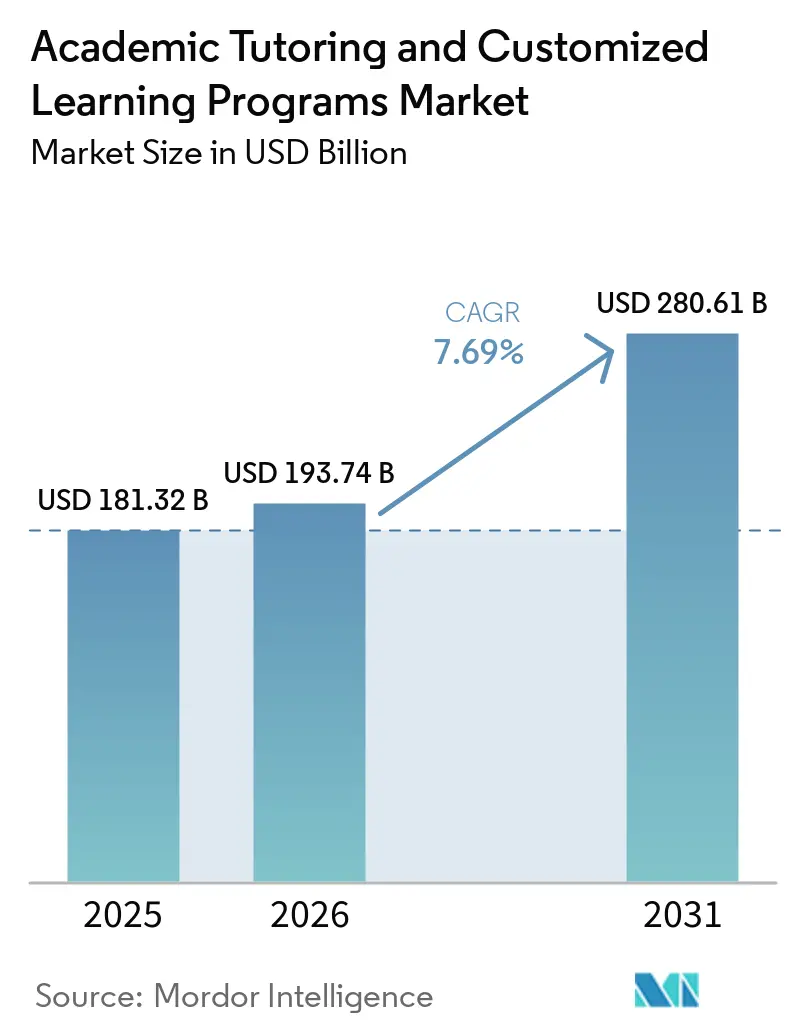
The Academic Tutoring and Customized Learning Programs market was valued at USD 181.32 billion in 2025 and estimated to grow from USD 193.74 billion in 2026 to reach USD 280.61 billion by 2031, at a CAGR of 7.69% during the forecast period (2026-2031). Growth is driven by hybrid delivery models, on-demand access, and AI-based assessment tools, which enhance accessibility and scalability across age groups. Government remediation efforts support school-linked demand, though reduced emergency funding has caused regional fluctuations[1]. Institutions increasingly rely on external tutoring partners to deliver flexibly, achieve measurable learning outcomes, and improve reporting. Test preparation now emphasizes measurable results, while adult customized learning presents new revenue opportunities in regions with low participation in structured learning. The Asia-Pacific region, led by China, India, Japan, and South Korea, influences pricing, platform models, and competitive benchmarks in North America and Europe. Specialized providers focusing on niche subjects, adult learners, and outcome-driven services continue to find opportunities within the market.
Key Report Takeaways
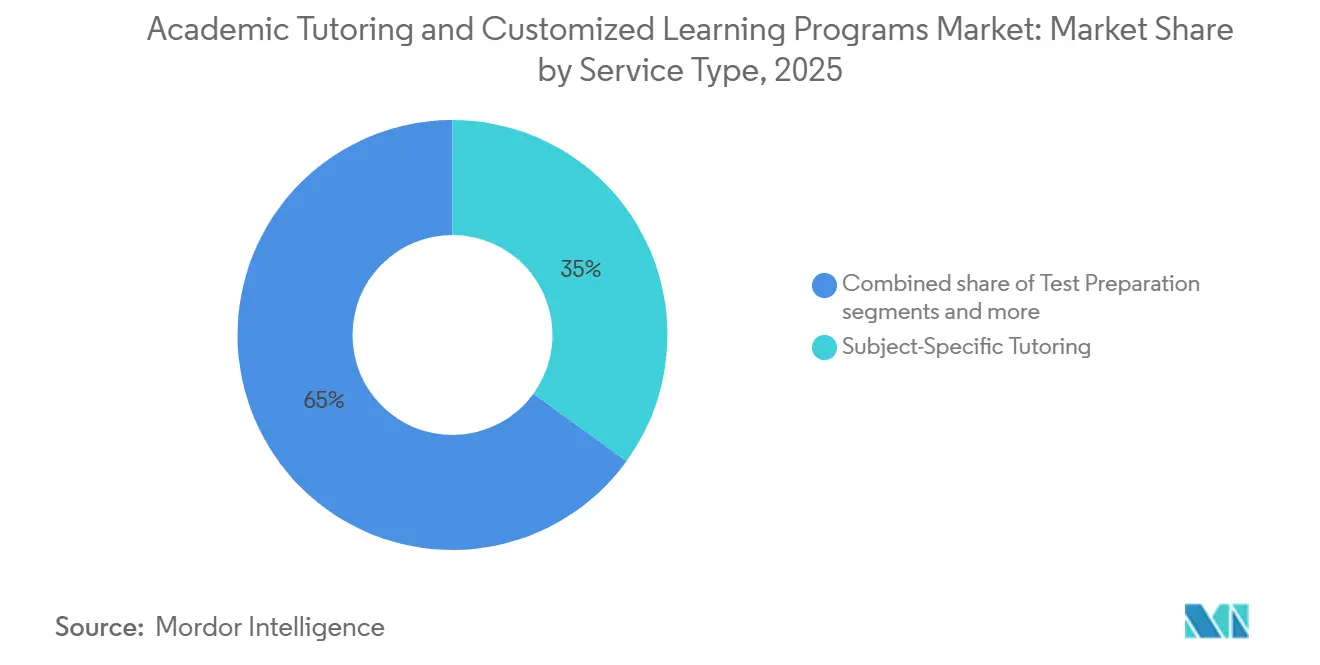
- By service type, subject-specific tutoring accounted for 35.0% of revenue in the Academic Tutoring and Customized Learning Programs market in 2025, while skill development and enrichment programs are projected to expand at a 11.62% CAGR through 2031.
- By delivery mode, in-person tutoring accounted for 41.1% of revenue in the Academic Tutoring and Customized Learning Programs market in 2025, while on-demand tutoring is projected to expand at a 13.85% CAGR through 2031.
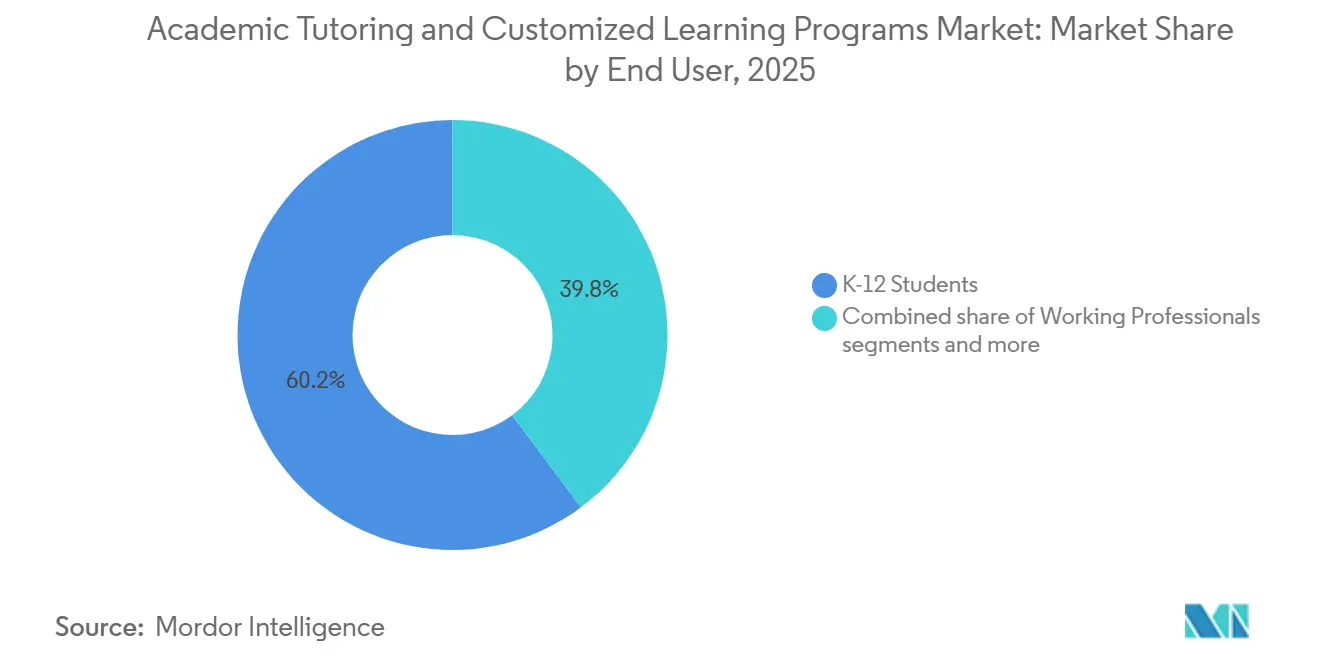
- By end user, K-12 students accounted for 60.2% of revenue in the Academic Tutoring and Customized Learning Programs market in 2025, while working professionals are projected to expand at a 11.50% CAGR through 2031.
- By business model, pay-per-session tutoring accounted for 33.7% of revenue in the Academic Tutoring and Customized Learning Programs market in 2025, while subscription-based programs are projected to expand at a 12.90% CAGR through 2031.
- By geography, Asia-Pacific accounted for 42.0% of revenue in the Academic Tutoring and Customized Learning Programs market in 2025, while the Middle East and Africa are projected to expand at a 10.80% CAGR through 2031.
Note: Market size and forecast figures in this report are generated using Mordor Intelligence’s proprietary estimation framework, updated with the latest available data and insights as of January 2026.
Global Academic Tutoring and Customized Learning Programs Market Trends and Insights
Drivers Impact Analysis*
| Driver | (~) % Impact on CAGR Forecast | Geographic Relevance | Impact Timeline |
|---|---|---|---|
| Rising Demand for Personalized Learning Outcomes | +2.0% | Global | Medium term (2-4 years) |
| Growth of Hybrid and On-Demand Tutoring Models | +1.5% | Asia-Pacific core, spill-over to North America and the European Union | Short term (≤ 2 years) |
| Academic Recovery and Learning Gap Remediation | +1.0% | North America and the European Union | Short term (≤ 2 years) |
| Integration of AI-Based Assessment and Tutor Matching Technologies | +1.4% | Global | Medium term (2-4 years) |
| Expansion of Test Preparation and Exam-Linked Tutoring | +0.8% | Asia-Pacific and Middle East and Africa | Medium term (2-4 years) |
| Institutional Outsourcing of Supplementary Learning Support | +0.6% | North America and the European Union | Long term (≥ 4 years) |
| Source: Mordor Intelligence | |||
Rising Demand for Personalized Learning Outcomes
Personalized tutoring is increasingly expected as delivery methods improve, and families seek tailored instruction to meet individual performance needs. Official Data reported that many lower secondary teachers incorporated AI tools into their professional practices in 2024, signaling that technology-assisted personalization is now part of regular teaching workflows. Evidence also showed that AI-supported math tutors in the United States enhanced student success rates, particularly among those taught by less effective instructors, demonstrating the potential of technology to address quality disparities among tutors. This trend is reshaping the academic tutoring and customized learning programs market, shifting family preferences from relying solely on tutor reputation to prioritizing platform reliability, learner analytics, and measurable progress tracking. Official data show that participation in private tutoring is widespread in certain markets, suggesting saturation in urban areas. Future growth opportunities are likely to focus on semi-urban and rural regions, which remain underserved and present untapped potential for expansion[2].
Growth of Hybrid and On-Demand Tutoring Models
Hybrid delivery is transforming the academic tutoring and customized learning programs market by integrating live instruction with app-based access and digital scheduling. Varsity Tutors launched its Live + AI platform nationwide, reporting significant skill improvements among students in high-dosage programs and reduced teacher administrative workloads. On-demand tutoring is expected to grow rapidly, driven by the need for immediate support during exams, assignment deadlines, and focused learning periods. New Oriental's intelligent learning system demonstrated strong adoption, with active users across multiple cities, showcasing how providers are enhancing service networks with digital solutions instead of separating online and offline channels. Hybrid delivery has become essential for retention, cost efficiency, and trust-building in this competitive market.
Academic Recovery and Learning Gap Remediation
Tutoring remains a critical tool for addressing learning gaps, driving growth in the academic tutoring and customized learning programs market. Many United States schools offer tutoring, but only a fraction meet high-dosage standards, which require consistent tutors, small groups, and frequent sessions. This gap highlights opportunities for providers offering trained tutors, structured schedules, and reliable reporting systems to meet public accountability needs. Federal priorities now emphasize high-impact tutoring, with discretionary grant criteria reflecting this focus. State-level initiatives also support this trend, such as California's commitment to literacy and mathematics coaching and to expanded learning opportunities, including high-impact tutoring[3]. Louisiana's improvement on the National Report Card between 2019 and 2025 further demonstrates the effectiveness of high-dosage tutoring, reinforcing its role as a policy model. These developments underscore the growing importance of outcome-based procurement in the academic tutoring and customized learning programs market.
Integration of AI-Based Assessment and Tutor Matching Technologies
AI is transforming the academic tutoring and personalized learning market, shaping product design and pricing strategies. Official Data highlights a significant difference between guided and unguided AI usage. Students using general-purpose AI for math practice experienced improved practice results but showed a decline in exam performance when AI access was removed. This trend benefits platforms that position AI as a pedagogical tool, focusing on long-term learning rather than short-term task completion. Pearson recently introduced 'Communication Coach' within Microsoft 365 and launched 'Foundations of AI' for educators. These initiatives demonstrate how established education companies are integrating AI to enhance credibility and streamline workflows. A state contract for an AI-powered reading tutor reflects the growing public-sector adoption of AI tutoring solutions. However, privacy compliance and student data controls are expected to favor larger, well-prepared operators in the market.
Restraints Impact Analysis*
| Restraint | (~) % Impact on CAGR Forecast | Geographic Relevance | Impact Timeline |
|---|---|---|---|
| High Service Delivery Cost for Premium Tutoring | -1.4% | Global, most acute in North America and European Union | Short term (≤ 2 years) |
| Uneven Tutor Quality and Outcome Consistency | -0.9% | Emerging markets, South Asia, Middle East and Africa | Medium term (2-4 years) |
| Student Engagement Fatigue in Long Duration Programs | -0.7% | Global | Medium term (2-4 years) |
| Data Privacy and Child Safety Compliance Burden | -0.5% | European Union and North America | Long term (≥ 4 years) |
| Source: Mordor Intelligence | |||
High Service Delivery Cost for Premium Tutoring
Personalized tutoring faces accessibility challenges due to the high cost of human-led instruction and the difficulty of scaling without increasing prices or reducing tutor pay. Official Data has noted that private supplementary tutoring can worsen inequality, as participation depends on both academic needs and a household's financial ability and time availability. Longer programs that require repeated sessions before results are evident add to the financial burden, limiting renewals and reducing the potential market. Preply recently reported significant growth, including an expanded tutor base, additional language offerings, and funding to enhance human-led, AI-supported learning. This reflects the marketplace’s efforts to lower costs while retaining tutors in the model. However, the academic tutoring and customized learning programs market continues to face margin pressure. Families often compare the costs of specialized tutoring with those of more affordable subscription-based and AI-assisted alternatives, which affects the adoption of higher-cost options[4].
Uneven Tutor Quality and Outcome Consistency
The academic tutoring and customized learning programs market faces a persistent challenge: tutor quality variability. Learning outcomes remain highly dependent on a tutor's skills, training, and alignment with curricula. Official Data has noted that untrained tutors often fail to align instruction with school curricula or address individual learning needs, making tutoring hours an unreliable learning effectiveness. This issue is more pronounced in fragmented gig-style tutoring ecosystems, where onboarding is minimal, classroom alignment is weak, and outcome tracking is often absent. Varsity Tutors reported serving numerous school districts through partnerships, highlighting the growing preference among institutional buyers for vendors that offer documented results and structured delivery rather than large tutor pools. This trend has created a two-tier market structure. Platforms with verified outcomes gain trust and stability, while unverified aggregators face intense price competition.
*Our forecasts treat driver/restraint impacts as directional, not additive. The impact forecasts reflect baseline growth, mix effects, and variable interactions.
Segment Analysis
By Service Type: Enrichment Demand Diversifies Beyond Core Remediation
Subject-specific tutoring accounted for 35.0% of the academic tutoring and customized learning programs market in 2025, making it the largest revenue-generating service category. Its demand remains strong due to alignment with school curricula, exam preparation, and parental expectations for measurable academic improvement. Test preparation and homework support are significant components, particularly in systems with visible learning gaps where families prioritize immediate academic performance. Language learning supports both school-age learners and adults. In January 2026, Preply reported over 100,000 bookable tutors across 180 countries and added more than 40 languages since its previous funding round. Special education and learning disability support remain important as families and institutions increasingly seek tutoring tailored to individualized learning plans.
Skill development and enrichment programs are projected to grow at an 11.62% CAGR through 2031, making them the fastest-growing segment in the academic tutoring and customized learning programs market. This reflects a shift in tutoring usage, expanding beyond remediation and exam recovery to include coding, STEM, competitive mathematics, and leadership training. Official Data research links future labor demand to higher-order skills and lifelong learning, driving early investment in enrichment rather than focusing solely on academic weaknesses. Established tutoring providers face pressure to expand offerings beyond traditional subject repair and test coaching. Providers that clearly define curriculum quality, assessment standards, and learner progression are better positioned to maintain pricing as enrichment becomes a larger part of the market.

By Delivery Mode: Offline Resilience Coexists With Digital Acceleration
In-person tutoring held 41.1% of the academic tutoring and customized learning programs market share in 2025, maintaining offline delivery's dominance despite digital adoption. Parents preferred face-to-face instruction for high-stakes academics, prioritizing trust over convenience and linking learning support to discipline and routine. New Oriental’s financial reports consistently highlight an expansive network of physical schools and learning centers across dozens of Chinese cities, emphasizing the importance of physical infrastructure in large tutoring ecosystems. While online tutoring expanded access and scheduling flexibility, families valued local presence, supervision, and instructional seriousness. Hybrid delivery emerged as a practical solution, combining physical credibility with digital scalability.
On-demand tutoring is projected to grow at a 13.85% CAGR through 2031, making it the fastest-growing segment in the delivery mix. Its episodic use cases, such as pre-exam revision, urgent assignment help, and flexible support for working adults, drive its appeal. In October 2025, Varsity Tutors introduced "Live + AI" for schools, integrating human tutors, real-time AI insights, and 24/7 support to improve learning outcomes and reduce teacher workloads. New Oriental’s intelligent learning system reported approximately 367,000 active paid users across 60 cities in Q3 FY2026, demonstrating the scalability of digital delivery within broader service ecosystems. Speed of tutor matching and platform responsiveness are becoming as critical as tutor reputation in this segment of the academic tutoring and customized learning programs market.
By End User: K-12 Dominance Masks a Strategic Shift Toward Adult Learners
K-12 students accounted for 60.2% of the market share for academic tutoring and customized learning programs in 2025, maintaining their position as the dominant end-user group. This reflects compulsory schooling, strong parental involvement, and entrenched tutoring cultures in many Asian education systems. Homework help, subject tutoring, and test preparation are key drivers for this group, directly tied to grades, exams, and school progression. Higher education students represent the next significant demand segment, driven by graduate admissions tests, English-language exams, internship readiness, and professional credential preparation. Parents and homeschooling households are forming a growing niche, using tutoring providers as structured curriculum partners rather than as occasional support.
Working professionals are projected to grow at an 11.50% CAGR through 2031, making them the fastest-growing end-user group in the market. Official Data 2025 reported adult learning participation ranging from 58% in Nordic economies to 13% in some OECD countries, highlighting a significant opportunity for structured adult learning and upskilling. In October 2025, Chegg announced its focus on B2B skilling and, in May 2026, partnered with Cornerstone OnDemand to expand enterprise distribution for Chegg Skills. Pearson reported 8% growth in Enterprise Learning & Skills in Q1 2026 and a 21% increase in Virtual Learning during the 2025-2026 academic year. These developments indicate a shift in the market from child-focused services to a broader lifelong learning model, attracting both corporate and household customers.
By Business Model: Subscription Economics Drive Platform Investment Cycles
Pay-per-session tutoring held 33.7% of revenue in 2025, maintaining its position as the largest business model in the academic tutoring and customized learning programs market. Families prefer this model during tight budgets, seasonal tutoring needs, or when assessing tutor quality before committing further. Package-based plans offer cost-effective pricing compared to single sessions while retaining more flexibility than full subscriptions. Institutional contracts are gaining importance as districts, schools, and employers increasingly rely on external vendors for scalable supplementary support. This mix of business models highlights the continued relevance of transactional spending, even as recurring revenue models attract more provider investment.
Subscription-based programs are projected to grow at a 12.90% CAGR through 2031, making them the fastest-growing business model in the academic tutoring and customized learning programs market. Providers favor subscriptions for their recurring billing, which improves revenue visibility and enhances learner lifetime value when progress is evident, and users remain engaged. Chegg’s Q1 2026 report noted that its skilling business is distributed through Cornerstone and anticipated double-digit growth for the year, reflecting a shift toward longer-term learning relationships rather than one-off tutoring sessions. However, subscription models face churn when learners perceive little progress. Providers are addressing this by focusing on progress dashboards, milestone designs, and AI-driven gap diagnoses. Increased scrutiny of autorenewals and cancellations means platforms that combine strong outcomes with transparent terms are better positioned for growth in the academic tutoring and customized learning programs market.
Geography Analysis
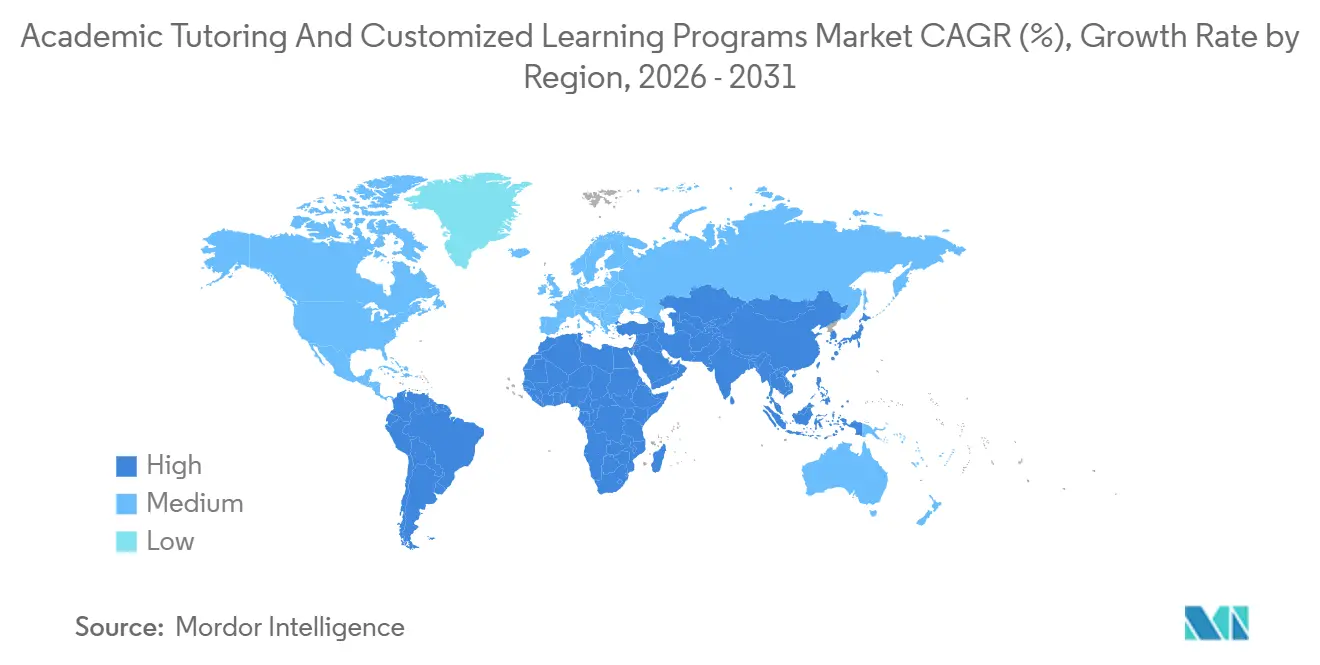
Asia-Pacific held 42.0% of the academic tutoring and customized learning programs market in 2025, making it the largest regional bloc. China and India drive this growth, with China reporting 1.1 billion internet users by late 2024 and India recording 969.1 million internet subscribers by March 2025. TAL's FY2026 net revenue rose to USD 3,008.9 million from USD 2,250.2 million in FY2025, while operational income shifted to USD 276.0 million from a USD 3.2 million loss, reflecting a recovery in China's tutoring sector. Japan and South Korea maintain high tutoring intensity, while Southeast Asia sees growth due to mobile access, younger populations, and affordable online formats in Indonesia, Vietnam, and the Philippines.
North America and Europe rank as the second and third-largest regional blocs, supported by policy-driven demand, digital learning adoption, and institutional procurement. Federal priorities in the United States include high-impact tutoring, with Massachusetts allocating USD 25 million for early literacy tutoring across 272 schools. Pearson's Virtual Learning segment grew 21% in the 2025-2026 academic year, indicating strong demand for scalable digital models. Europe remains commercially viable but faces higher data governance costs, favoring providers with strong compliance systems and local credibility.
The Middle East and Africa are projected to grow at a 10.8% CAGR through 2031, driven by Saudi Arabia's Vision 2030 and the UAE's demand for tutoring in British, American, and IB curricula. Emerging markets like Nigeria, South Africa, and Kenya benefit from mobile-first access, while South America, though smaller, is strategically relevant. Preply announced plans for South American expansion in January 2026, following a USD 150 million fundraising round. Challenges include improving tutor quality and local content development alongside expanding internet access.
Competitive Landscape
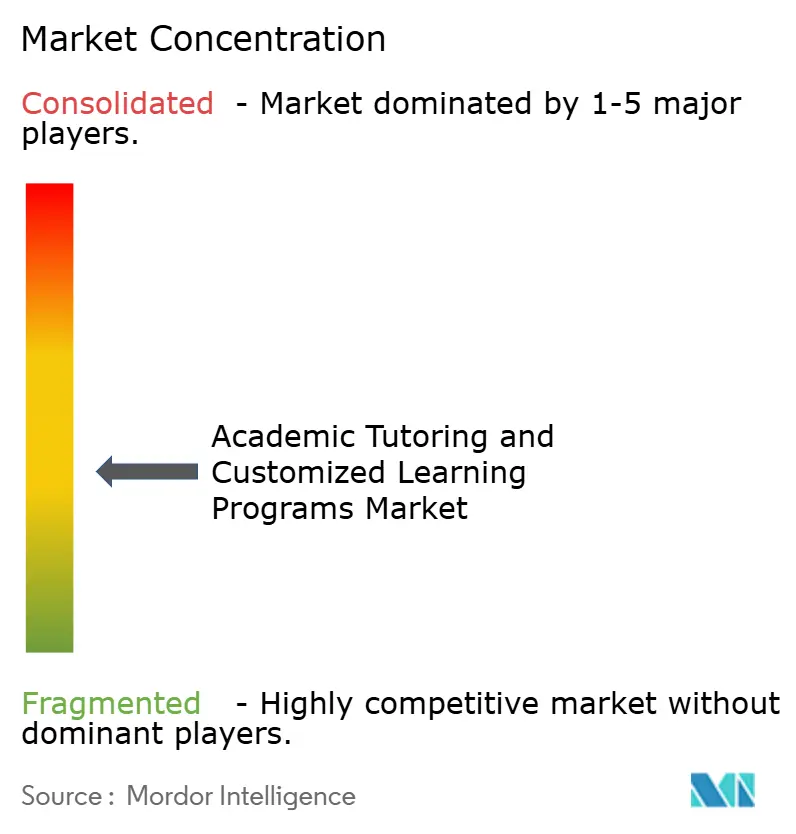
The academic tutoring and customized learning programs market is moderately concentrated, with several regional and global operators. Companies such as Pearson, Chegg, New Oriental, TAL Education, Preply, and Varsity Tutors employ a range of models, including enterprise learning platforms, tutor marketplaces, and center-led networks. Pearson is enhancing its B2B offerings through Communication Coach in Microsoft 365 and an expanded AI portfolio, appealing to institutions and employers. TAL has improved its operating income due to revenue recovery, strengthening its position in China and enabling further investments. The market remains competitive as technology, compliance, and capital demands increase.
Competitive advantage now depends on measurable outcomes rather than tutor availability. Buyers seek evidence that tutoring leads to learning improvements. Varsity Tutors integrated human tutoring with AI support and reinforced this approach through a White House AI education pledge involving school districts. Chegg is focusing on enterprise channels through its partnership with Cornerstone and a broader B2B strategy. New Oriental leverages its network of schools and learning centers in China while developing intelligent learning systems. Providers lacking resources for product development, data management, and quality control may struggle to meet market demands.
Opportunities exist in enterprise academic support, AI-driven STEM tutoring, adult reskilling, and rural markets where scaling in-person models is difficult, and localized solutions are essential. Preply’s recent fundraising highlights investor confidence in marketplace models combining tutor networks with personalized tools and regional growth. Inspirit Capital’s acquisition of Kaplan Languages Group reflects the appeal of specialized language assets with growth potential. Future competition will likely focus on trust, measurable outcomes, and local relevance rather than advertising. Niche entrants targeting specific subjects, age groups, or regional curricula with disciplined delivery approaches may find opportunities in this evolving market.
Academic Tutoring and Customized Learning Programs Industry Leaders
-
BYJU'S
-
Pearson Plc
-
Chegg, Inc.
-
New Oriental Education and Technology Group Inc.
-
Tal Education Group
- *Disclaimer: Major Players sorted in no particular order
Recent Industry Developments
- May 2026: Inspirit Capital acquired KLG Kaplan Languages Group from Kaplan, including Kaplan International Languages, Alpadia Language Schools, and ESL Education. The group operates 20+ schools in 8 countries and manages 200+ partner destinations. Kaplan shifted focus to online university and test preparation, while Inspirit Capital plans a new brand identity for KLG.
- May 2026: Chegg reported a Q1 2026 GAAP net income of USD 0.2 million, with Chegg Skilling revenues rising 9% year-on-year to USD 17.6 million. The company partnered with Cornerstone OnDemand to establish an enterprise channel and reaffirmed double-digit skilling revenue growth guidance for 2026.
- April 2026: TAL Education Group reported fiscal year 2026 net revenues of USD 3,008.9 million, a 33.7% year-on-year increase, with operating income of USD 276.0 million, reversing a prior-year loss of USD 3.2 million. Non-GAAP net income rose 283.8% to USD 573.8 million, driven by a recovery in learning centers and non-academic tutoring.
- April 2026: Pearson issued a GBP 350 million (USD 472.20 million) 10-year bond and repurchased GBP 219 million (USD 295.46 million) of its GBP 350 million (USD 472.20 million) share buyback program by March 31, 2026. Q1 2026 results showed 21% growth in Virtual Learning and 8% growth in Enterprise Learning & Skills.
Global Academic Tutoring and Customized Learning Programs Market Report Scope
| Test Preparation |
| Subject-Specific Tutoring |
| Language Learning Support |
| Special Education and Learning Disability Support |
| Homework Help and Assignment Support |
| Skill Development and Enrichment Programs |
| Online Tutoring |
| In-Person Tutoring |
| Hybrid Tutoring |
| On-Demand Tutoring |
| K-12 Students |
| Higher Education Students |
| Working Professionals |
| Parents and Homeschooling Users |
| Subscription-Based Programs |
| Pay-Per-Session Tutoring |
| Package-Based Learning Plans |
| Institutional Contracts |
| North America | United States |
| Canada | |
| Mexico | |
| South America | Brazil |
| Peru | |
| Chile | |
| Argentina | |
| Rest of South America | |
| Europe | United Kingdom |
| Germany | |
| France | |
| Spain | |
| Italy | |
| BENELUX (Belgium, Netherlands, and Luxembourg) | |
| NORDICS (Denmark, Finland, Iceland, Norway, and Sweden) | |
| Rest of Europe | |
| Asia-Pacific | India |
| China | |
| Japan | |
| Australia | |
| South Korea | |
| South East Asia (Singapore, Malaysia, Thailand, Indonesia, Vietnam, and Philippines) | |
| Rest of Asia-Pacific | |
| Middle East And Africa | United Arab Emirates |
| Saudi Arabia | |
| South Africa | |
| Nigeria | |
| Rest of Middle East And Africa |
| By Service Type | Test Preparation | |
| Subject-Specific Tutoring | ||
| Language Learning Support | ||
| Special Education and Learning Disability Support | ||
| Homework Help and Assignment Support | ||
| Skill Development and Enrichment Programs | ||
| By Delivery Mode | Online Tutoring | |
| In-Person Tutoring | ||
| Hybrid Tutoring | ||
| On-Demand Tutoring | ||
| By End User | K-12 Students | |
| Higher Education Students | ||
| Working Professionals | ||
| Parents and Homeschooling Users | ||
| By Business Model | Subscription-Based Programs | |
| Pay-Per-Session Tutoring | ||
| Package-Based Learning Plans | ||
| Institutional Contracts | ||
| By Geography | North America | United States |
| Canada | ||
| Mexico | ||
| South America | Brazil | |
| Peru | ||
| Chile | ||
| Argentina | ||
| Rest of South America | ||
| Europe | United Kingdom | |
| Germany | ||
| France | ||
| Spain | ||
| Italy | ||
| BENELUX (Belgium, Netherlands, and Luxembourg) | ||
| NORDICS (Denmark, Finland, Iceland, Norway, and Sweden) | ||
| Rest of Europe | ||
| Asia-Pacific | India | |
| China | ||
| Japan | ||
| Australia | ||
| South Korea | ||
| South East Asia (Singapore, Malaysia, Thailand, Indonesia, Vietnam, and Philippines) | ||
| Rest of Asia-Pacific | ||
| Middle East And Africa | United Arab Emirates | |
| Saudi Arabia | ||
| South Africa | ||
| Nigeria | ||
| Rest of Middle East And Africa | ||
Key Questions Answered in the Report
How large is the academic tutoring and customized learning programs market in 2026?
The academic tutoring and customized learning programs market stands at USD 193.74 billion in 2026 and is forecast to reach USD 280.61 billion by 2031 at a 7.69% CAGR.
Which service category leads revenue generation?
Subject-specific tutoring leads the revenue mix with a 35.0% share in 2025, supported by curriculum alignment and exam-linked demand.
Which delivery format is growing the fastest?
On-demand tutoring is the fastest-growing delivery format, with a projected 13.85% CAGR through 2031, helped by urgent exam and assignment use cases.
Why do K-12 learners still dominate spending?
K-12 students accounted for 60.2% of revenue in 2025 because tutoring remains closely tied to grades, exams, parental involvement, and school progression.
Which region is expanding the fastest?
Middle East and Africa is forecast to grow the fastest at 10.80% CAGR through 2031, supported by young populations, education investment, and digital access growth.
What is changing competition among providers?
Competition is increasingly shaped by outcome tracking, AI-guided delivery, compliance readiness, and the ability to serve schools and employers through scalable models.