
Market Overview
| Study Period | 2020 - 2031 |
|---|---|
| Forecast Data Period | 2026 - 2031 |
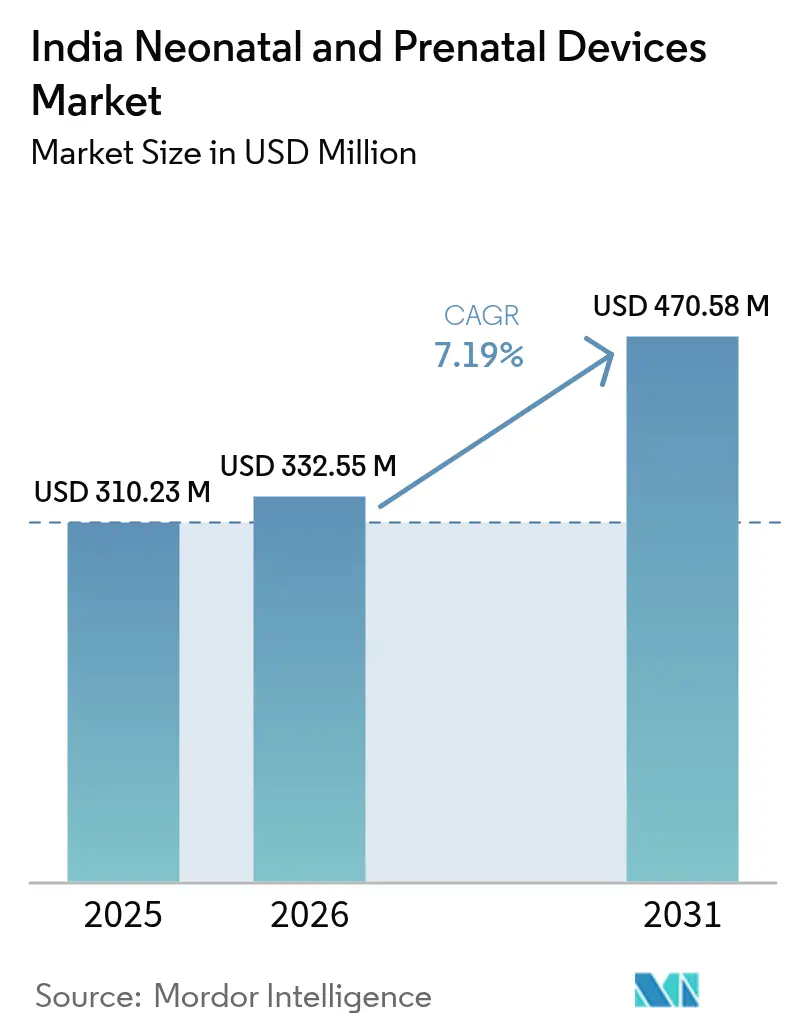
| Base Year Market Size (2025) | USD 310.23 Million |
| Market Size (2026) | USD 332.55 Million |
| Market Size (2031) | USD 470.58 Million |
| Growth Rate (2026 - 2031) | 7.19 % |
| Market Concentration | Medium |
Major Players *Disclaimer: Major Players sorted in no particular order Image © Mordor Intelligence. Reuse requires attribution under CC BY 4.0. | |
India Neonatal And Prenatal Devices Market Analysis by Mordor Intelligence
The India neonatal and prenatal devices market size was valued at USD 310.23 million in 2025 and estimated to grow from USD 332.55 million in 2026 to reach USD 470.58 million by 2031, at a CAGR of 7.19% during the forecast period (2026-2031). Strong public-sector funding, rapid NICU expansion in secondary cities, and accelerating adoption of AI-enabled monitoring systems are widening clinical coverage while pushing average selling prices upward. Hospitals continue to anchor demand, yet specialty clinics and home-based monitoring solutions are gaining share as healthcare delivery models diversify [1]. Domestic manufacturing incentives are lowering landed costs for selected devices and trimming import dependence, while stricter quality regulations are encouraging product upgrades. Taken together, these forces are expanding the addressable base of clinicians and patients who can access advanced monitoring therapies.
Key Report Takeaways
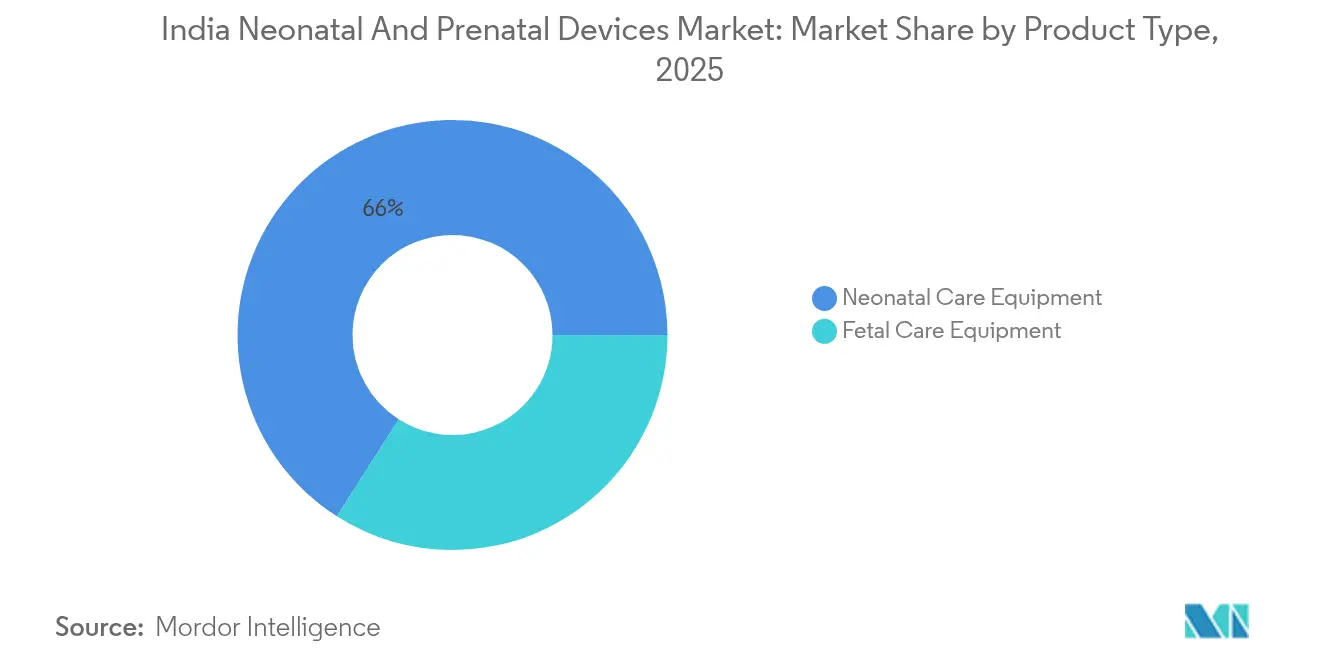
- By product type, neonatal care equipment led with 65.96% revenue share in 2025, while fetal care equipment is projected to advance at an 8.03% CAGR through 2031.
- By end user, hospitals held 49.20% share in 2025, and neonatal and pediatric specialty clinics are forecast to grow at an 8.08% CAGR during 2026-2031.
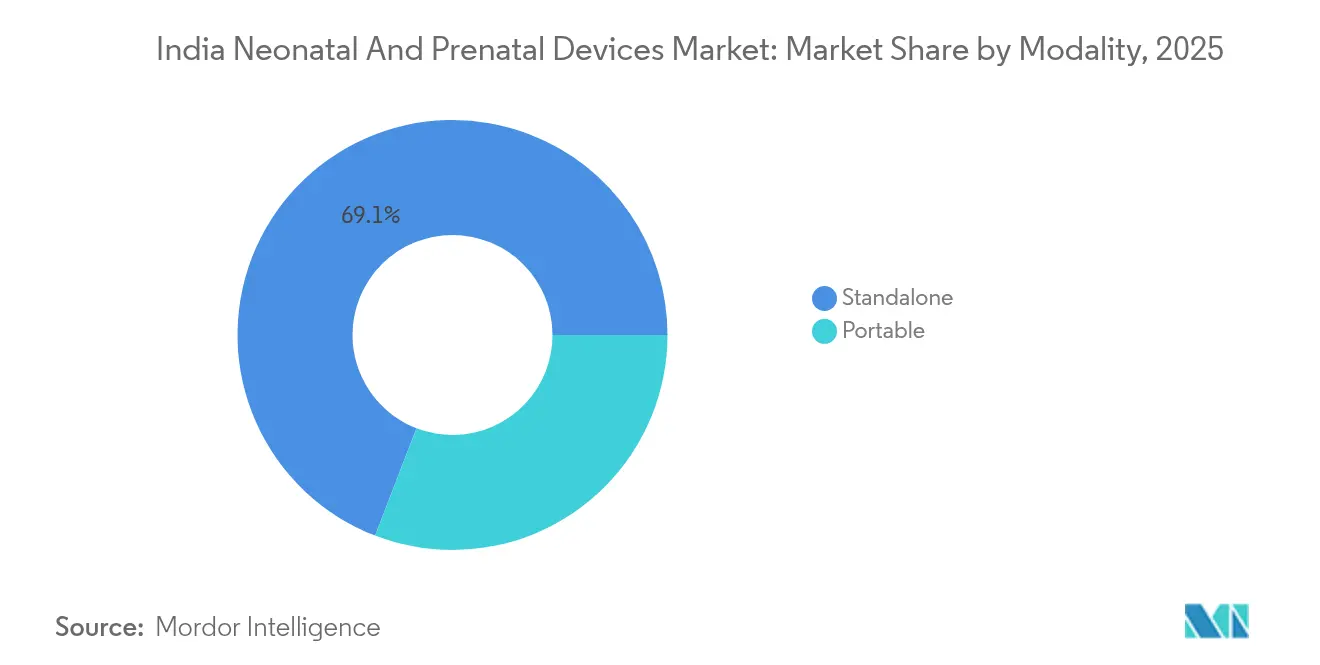
- By modality, standalone systems accounted for 69.14% share in 2025, whereas portable solutions are set to rise at an 8.18% CAGR to 2031.
Note: Market size and forecast figures in this report are generated using Mordor Intelligence’s proprietary estimation framework, updated with the latest available data and insights as of 2026.
India Neonatal And Prenatal Devices Market Trends and Insights
Drivers Impact Analysis*
| Driver | (~) % Impact on CAGR Forecast | Geographic Relevance | Impact Timeline |
|---|---|---|---|
| Rapid NICU-bed expansion in Tier 2/3 cities | +1.8% | Tier 2/3 cities, rural catchment areas | Medium term (2-4 years) |
| Shift toward portable and home-based monitoring | +1.2% | Global, with early gains in metro cities | Long term (≥ 4 years) |
| Production-Linked Incentive (PLI) scheme boosts local supply | +1.5% | National manufacturing hubs | Medium term (2-4 years) |
| AI-enabled predictive analytics embedded in devices | +0.9% | Tier 1 cities, premium healthcare segments | Long term (≥ 4 years) |
| Import-substitution push amid high import dependence | +1.1% | National, with focus on manufacturing zones | Medium term (2-4 years) |
| Rise in high-risk pregnancies & late maternal age | +0.7% | Urban centers, educated demographics | Short term (≤ 2 years) |
| Source: Mordor Intelligence | |||
Rapid NICU-bed expansion in Tier 2 and 3 cities drives equipment demand
District hospitals operated 2,847 functional NICUs in 2024, marking a 34% rise since 2020 [2]. The Ayushman Bharat Health Infrastructure Mission is channeling USD 7.8 billion toward maternal and child health upgrades, prompting private hospital chains to add neonatal units in secondary cities. Higher disposable income and stronger insurance penetration support this wave of construction. Rising bed capacity lifts orders for incubators, phototherapy lamps, and multi-parameter monitors, with procurement teams favoring models that lower total cost of ownership. Vendors that can bundle training, maintenance, and remote support hold a pricing edge.
PLI scheme catalyzes domestic manufacturing capabilities
The medical-device PLI scheme earmarks USD 60 million for firms that expand Indian production of high-end neonatal and fetal equipment. Twenty-one manufacturers have qualified for rebates worth 5-7% of incremental sales [3]. BPL Medical Technologies invested USD 12 million to extend its incubator line, and Phoenix Medical Systems lifted plant throughput by 40%. Faster product approvals and duty concessions are compressing payback periods, narrowing price gaps with imported devices, and improving after-sales response times.
AI-enabled predictive analytics transforms neonatal monitoring
Artificial-intelligence dashboards can flag sepsis or respiratory distress six to twelve hours sooner than standard alarms. The Edison platform from GE Healthcare cut false alerts by 23% and boosted early sepsis detection by 18% across 150 Indian NICUs. Mindray ventilators now self-titrate oxygen delivery, reducing clinician workload in settings where each neonatologist may oversee eighteen to twenty beds. Uptake is strongest in Tier 1 hospitals that can absorb premium pricing; however, domestic manufacturing scale-up is set to push median selling prices lower, enabling wider diffusion by 2028.
Import-substitution momentum builds amid supply-chain vulnerabilities
Imports still cover 85% of advanced neonatal hardware. A new Quality Control Order mandates BIS certification for twenty-three device classes, and domestic players that meet the norm earn accelerated Central Drugs Standard Control Organisation clearance. Skanray Technologies lifted its share in portable ultrasound systems to 15% after leveraging the regulatory shift. Faster domestic approvals—now eight months rather than eighteen for repeat applicants—shorten commercialization cycles and encourage local innovation.
Restraints Impact Analysis*
| Restraint | (~) % Impact on CAGR Forecast | Geographic Relevance | Impact Timeline |
|---|---|---|---|
| High cap-ex & maintenance cost for advanced systems | -1.4% | Tier 2/3 cities, public hospitals | Short term (≤ 2 years) |
| Shortage of trained neonatologists & biomedical engineers | -1.1% | National, acute in rural areas | Long term (≥ 4 years) |
| Fragmented procurement across public hospitals | -0.8% | State-level public healthcare systems | Medium term (2-4 years) |
| Data-privacy gaps for connected devices | -0.6% | Urban centers with digital infrastructure | Medium term (2-4 years) |
| Source: Mordor Intelligence | |||
High capital expenditure constrains adoption of advanced systems
Outfitting a ten-bed NICU demands USD 1.2 million to USD 2 million, and annual maintenance averages 8-12% of equipment value. Budget limitations steer many small hospitals toward stripped-down monitors that meet minimal clinical needs. Lowest-price bid rules in government tenders often elevate upfront savings over lifecycle economics, resulting in frequent repairs and higher downtime. Finance leasing and pay-per-use models are emerging but remain under-penetrated.
Workforce shortage limits equipment utilization and market expansion
India fields only 1,200 certified neonatologists compared with a recommended 1:10,000 live-birth ratio. Less than 5,000 biomedical engineers are available to service a device universe spread across 70,000 facilities. Limited operator expertise discourages hospitals from procuring sophisticated ventilators or AI-driven monitors. Expanded fellowship seats and tele-mentoring programs offer relief, yet meaningful capacity gains will surface only after 2028.
*Our forecasts treat driver/restraint impacts as directional, not additive. The impact forecasts reflect baseline growth, mix effects, and variable interactions.
Segment Analysis
By Product Type: Neonatal Equipment Dominance Faces Fetal Care Innovation
Neonatal care devices captured 65.96% of the India neonatal and prenatal devices market share in 2025. Government policy requires every district hospital to house at least six NICU beds, which secures recurring demand for incubators, phototherapy units, and ventilators. Phoenix Medical Systems supplies 25% of domestic incubators with designs that withstand voltage fluctuations and dusty environments. Hospitals also favor integrated monitoring platforms that combine pulse oximetry, ECG, and temperature tracking to optimize bedside space.
Fetal care equipment is projected to record an 8.03% CAGR through 2031, the fastest among all product groups. Rising maternal age and elective prenatal screening are normalizing electronic fetal monitor use in private clinics. AI-embedded cardiotocography units from GE Healthcare can identify distress patterns thirty minutes earlier than standard monitors, which helps obstetricians lower emergency intervention rates. Portable Doppler probes and handheld ultrasound scanners are also gaining favor for outreach camps and home visits. As technology costs fall, the India neonatal and prenatal devices market size for fetal devices is expected to expand beyond metro clusters toward peri-urban areas.

By End User: Hospital Dominance Challenged by Specialty Clinic Growth
Hospitals accounted for 49.20% of the India neonatal and prenatal devices market in 2025. Public facilities handle 65% of institutional births, creating a baseline demand for standard-spec monitors that comply with procurement guidelines. Large private chains are now segmenting their maternity wings into level-II and level-III NICUs to command premium tariffs. These networks prize devices with remote diagnostics because centralized engineering teams manage multiple campuses.
Neonatal and pediatric specialty clinics are forecast to grow at an 8.08% CAGR during 2026-2031. Urban parents value personalized care and shorter wait times that such clinics offer. Stand-alone neonatal centers in Bengaluru and Chennai manage complex cases referred from satellite towns, pushing up demand for high-frequency ventilators and servo-controlled warmers. Maternity and birthing centers, advancing at 7.56% CAGR, prefer compact equipment footprints. Home-care teams are beginning to rent portable monitors for post-discharge follow-up, hinting at a nascent yet promising service sub-segment.
By Modality: Portable Solutions Gain Momentum Despite Standalone Prevalence
Standalone systems commanded 69.14% of revenue in 2025 as hospital architects still design NICUs around fixed workstations. Integrated servers, larger screens, and built-in data gateways deliver uninterrupted tracking required for critical care. Device makers bundle these consoles with multiyear service pacts that guarantee parts availability and scheduled calibration.
Portable equipment is projected to log an 8.18% CAGR through 2031. Handheld ultrasound devices and battery-powered monitors enable physicians to reach patients in remote clinics or emergency wards without reconfiguring infrastructure. During the COVID-19 pandemic, field hospitals and isolation wards accelerated portable adoption, a trend that has persisted because administrators appreciate redeployment flexibility. As price gaps shrink, the India neonatal and prenatal devices market size for portable devices will broaden to primary health centers, mobile medical units, and even home-care settings.
Geography Analysis
Southern and western states together controlled 57.55% of the India neonatal and prenatal devices market in 2025. Tamil Nadu led with 16.05% share, supported by 450 NICUs across public and private sectors and a dense medical device manufacturing corridor. Karnataka followed at 14.70% share, buoyed by Bengaluru’s cluster of healthcare start-ups and multi-hospital chains that standardize procurement. Maharashtra contributed 12.95% share, with Mumbai and Pune anchoring demand from tertiary centers and acting as distribution nodes for western India.
Northern India, comprising Delhi NCR and Uttar Pradesh, generated 28.25% share in 2025. Uttar Pradesh posted 8.55% share; ongoing Ayushman Bharat investments are elevating equipment density, although specialist shortages persist. Neonatal monitors with simplified interfaces are selling well because clinicians can train nursing staff rapidly. Delhi NCR hospitals demonstrate early adoption of AI-ready monitors, creating reference sites for vendors who later scale to adjoining states. Eastern states, led by West Bengal and Odisha, captured 14.20% share. Budgetary ceilings restrict high-end purchases, but tender wins by Apollo Hospitals and similar operators are raising the bar for device specifications. Portable ultrasound units that run on extended batteries fit outreach camps in hilly terrain. Government projects funded by multilateral agencies are also upgrading district hospitals, adding steady but modest order volumes.
Regulatory Landscape
India regulates neonatal and prenatal devices primarily through the Central Drugs Standard Control Organisation (CDSCO) under the Medical Devices Rules, 2017, using a risk-based classification (Class A to D) and licensing for manufacture and import. Compliance is further shaped by mandated standards and certifications (including BIS requirements for notified device categories), which affects product registration timelines, documentation, and post-market obligations for hospital and clinic deployments.
In April 2026, the Ministry of Health and Family Welfare published the draft Medical Devices (Amendment) Rules, 2026 (G.S.R. 270(E)), proposing standardized testing fees at government laboratories and additional labeling requirements tied to licensed sterilization facilities. In June 2026, the Department of Pharmaceuticals launched two sub-schemes under the Scheme for Strengthening of Medical Device Industry (SMDI), including a Marginal Investment Scheme for reducing import dependence and a Medical Device Clinical Studies Support Scheme. July 2026 deadlines were set for applications and for industry inputs related to the Global Tender Enquiry (GTE) Exemption List of Medical Devices (354 devices), creating a near-term policy anchor for localization and evidence generation.
Value Chain Analysis
The India neonatal and prenatal devices value chain spans component and sub-assembly suppliers (sensors, electronics, plastics, optics), device OEMs (global and domestic), authorized distributors and system integrators, and hospital engineering teams that install, validate, and maintain equipment in NICUs and maternity settings. Public-sector demand flows through National Health Mission-linked procurement structures aligned to the Facility Based Newborn Care (FBNC) framework (NBCC, NBSU, and SNCU), which drives standardization of device configurations and tender-ready documentation.
Downstream, purchasing and specification discipline is shaped by the National Health Systems Resource Centre (NHSRC), which publishes standardized technical specifications for SNCU and NICU equipment, including transport incubators, neonatal ventilators, radiant warmers, and phototherapy units. Regulatory clearance and standards compliance (CDSCO licensing under the Medical Devices Rules, 2017, and BIS certification where applicable) are gating steps before commercial distribution, while after-sales service, calibration, spares availability, and user training differentiate vendors since utilization depends on clinical staffing and biomedical engineering capacity at the facility level.
Competitive Landscape
The top five suppliers hold a significant share, signaling a moderately concentrated arena. GE Healthcare, Philips Healthcare, and Medtronic anchor the premium tier with broad portfolios and long-term service contracts. Domestic challengers have leveraged the PLI scheme to sharpen pricing and shorten delivery cycles. Local firms design power-backed modules and dust-resistant casings that match Indian site realities, and they court secondary-city hospitals through in-language training.
Competition increasingly hinges on solution breadth rather than standalone features. Vendors now pitch bundled NICU packages that fold in bedside monitors, warmers, and ventilators, plus staff training and cloud analytics. Contracts often span seven to ten years, locking in consumables and maintenance revenue. White-space remains in Tier 3 cities and rural districts where affordability barriers persist. Creative leasing and subscription models that spread costs across operational budgets can unlock fresh volumes.
International firms are responding with localization strategies. GE Healthcare is building a Chennai plant that can supply Edison-ready monitors for India and Southeast Asia. Philips co-developed wireless neonatal sensors with Apollo Hospitals to cut caregiver workload. Medtronic secured CDSCO clearance for a cloud-linked fetal monitor that supports remote consultations in areas with scarce obstetricians. Such moves illustrate how the India neonatal and prenatal devices industry is shifting from import dependency toward a hybrid model where global and local players co-create products.
India Neonatal And Prenatal Devices Industry Leaders
-
Atom Medical Corporation
-
Dragerwerk AG & Co. KGaA
-
GE Healthcare
-
Koninklijke Philips NV
-
Medtronic plc
- *Disclaimer: Major Players sorted in no particular order

Market Opportunities and Future Outlook
A clear opportunity sits at the intersection of public procurement standardization and domestic manufacturing. NHSRC technical specifications for SNCU and NICU equipment provide a defined, repeatable target for product design and tender participation, while Make-in-India procurement preferences and the medical-device PLI scheme support localization economics for OEMs and key suppliers. The 2026 launch of Department of Pharmaceuticals sub-schemes under SMDI adds another lever, combining capital support aimed at reducing import dependence with a clinical studies support track that can help manufacturers build India-relevant evidence for neonatal and prenatal devices.
A second opportunity is operational. As hospitals expand NICU capacity in secondary cities, buyers are prioritizing solutions that reduce total cost of ownership and improve uptime, creating room for bundled offerings that combine devices with training, preventive maintenance, and remote diagnostics. In parallel, connected monitoring and analytics adoption creates a pathway for vendors with interoperable platforms that can move data from bedside devices to hospital information systems. This aligns with the market shift toward digital NICU workflows and supports differentiated offerings for multi-site hospital chains and specialty clinics.
Recent Industry Developments
- June 2026: The Department of Pharmaceuticals launched two sub-schemes under the Scheme for Strengthening of Medical Device Industry (SMDI), including a Marginal Investment Scheme for reducing import dependence and a Medical Device Clinical Studies Support Scheme. These programs broaden the toolkit for manufacturers to localize components and fund clinical evidence generation, improving tender readiness and adoption of neonatal and prenatal devices in India.
- April 2026: The Ministry of Health and Family Welfare published the draft Medical Devices (Amendment) Rules, 2026 (G.S.R. 270(E)), signaling standardized testing fees at government laboratories and additional labeling requirements tied to licensed sterilization facilities. This policy anchor supports localization and evidence generation in the neonatal and prenatal devices segment.
- January 2025: GE Healthcare announced a USD 50 million facility in Chennai to manufacture neonatal monitors for domestic and Southeast Asian markets. The investment supports localization of supply for monitoring platforms and can shorten lead times and service responsiveness for Indian hospital buyers.
Research Methodology Framework and Report Scope
Market Definition and Coverage
This market covers medical devices used in India for monitoring, diagnosing, and supporting fetal health during pregnancy and newborn care after birth, across clinical and remote-care settings, as long as the device is used for prenatal or neonatal care.
Scope exclusions: Services, consumables, general hospital infrastructure, and pharmaceuticals are excluded unless they are sold as part of a device-led system.
Segmentation Overview
- By Product Type
- Fetal Care Equipment
- Fetal Ultrasound Systems
- Fetal Dopplers
- Electronic Fetal Monitors (CTG)
- Fetal MRI & Pulse-Oximeters
- Neonatal Care Equipment
- Incubators
- Infant Warmers & Convertible Warmers
- Phototherapy Systems
- Neonatal Ventilators & CPAP
- Multi-parameter Monitors & Pulse-Oximeters
- Resuscitators & Syringe/Feeding Pumps
- Fetal Care Equipment
- By End User
- Hospitals
- Neonatal & Pediatric Specialty Clinics
- Maternity & Birthing Centers
- Home-care or Remote Monitoring Settings
- By Modality
- Portable
- Standalone
Data Sources, Market Sizing, and Validation
Desk Research
Desk research was used to set the boundaries of what counts as neonatal and prenatal devices, and to build a clean demand and supply context before modeling started. We reviewed public health system releases on maternal and child health programs, published statistics on births and neonatal outcomes, and import-export disclosures for medical equipment categories that map to fetal monitoring and NICU equipment.
To avoid relying on a single signal, we also used a mix of sources such as Ministry of Health and Family Welfare updates, national sample survey style publications where available, peer-reviewed clinical literature on NICU practices, customs trade statistics, and medical device regulator guidance. This was followed by investor presentations and annual reports from relevant device suppliers and distributors. For cross-checking company scale and product footprint, paid subscriptions for company financials and intelligence and a patent database were used in a limited way. These desk sources are illustrative, and many other public documents and datasets were also referenced for data collection, clarification, and validation.
Primary Interviews and Surveys
Primary work was used to pressure-test utilization and pricing assumptions that desk sources rarely quantify well for India. We spoke with hospital NICU administrators, obstetric and neonatology clinicians, procurement and biomedical teams, device distributors, and service partners across major metros and fast-growing Tier 2 clusters. Survey feedback was then used to confirm what is being purchased, how often devices are replaced, and where portable versus standalone systems are preferred.
Distribution of primary research fieldwork respondents
| Company type | Respondent position |
|---|---|
| Top tier: 33% | CXOs: 14% |
| Mid tier: 51% | Functional/Unit leaders: 33% |
| Smaller Players: 16% | Managers: 53% |
Market-Sizing & Forecasting
Sizing was built using a top-down approach where the demand pool was reconstructed from maternity and newborn care activity, and then translated into device needs using practical adoption and replacement assumptions. In this market, the model was anchored on indicators such as live births, preterm birth share and NICU admission intensity, the installed base of incubators and warmers in facilities, penetration of CTG and fetal ultrasound in antenatal care, and replacement cycles tied to uptime and serviceability.
Those totals were corroborated with selective bottom-up checks, including sampled facility counts by level of care, typical device mix per NICU bed, and a price band build using observed procurement quotes and distributor feedback. These checks were then used to refine the national total when gaps appeared. For forecasting, scenario analysis was applied because policy funding, private hospital expansion, and affordability can shift demand meaningfully. The input paths were validated through expert expectations on procurement timing, technology shifts toward portable monitoring, and service contract attachment. Where direct visibility was weaker for smaller clinics and remote monitoring settings, penetration rates were filled using ranges from interviews and then constrained using import trends and hospital expansion signals.
Data Validation & Update Cycle
Outputs were cross-checked against independent signals such as trade flows for key equipment groups, facility expansion announcements, and observed procurement patterns shared in interviews. When the model produced sharp year-on-year swings, the drivers were re-opened, and assumptions were revisited. Respondents were re-contacted if the variance could not be explained by policy or pricing changes.
Before sign-off, the estimates go through multi-step analyst reviews that focus on scope consistency, unit economics realism, and coherence across product types and end users. The report is refreshed annually, and interim updates are made if a material event shifts demand, pricing, or availability. Right before delivery, a final pass is completed so clients receive the most current view that can be traced back to clear inputs.
Mordor Intelligence's India Neonatal and Prenatal Devices Market Size Compared Against Other Published Estimates
Published numbers for this market can differ because firms do not always count the same device set, and they also pick different base years and time windows. Differences also come from how each model translates clinical activity into equipment demand, and how pricing is treated across portable and standalone systems.
Birth volumes, NICU capacity build-out, and equipment mix per level of care are used as evidence checks to keep Mordor Intelligence's estimate tied to the same counted device categories across fetal care equipment and neonatal care equipment, instead of blending in adjacent hospital tools. In practice, gaps usually show up when an estimate folds neonatal monitoring into a broader monitoring market, assumes faster ASP inflation without matching it to procurement behavior, or uses a less frequent refresh that misses policy-led buying cycles and import-cost moves.
Benchmark comparison
| Source | Market Size | Gaps in Research Methodology |
|---|---|---|
| Mordor Intelligence | USD 310.23 M (2025) | |
| Global Consultancy A | USD 655.00 M (2023) | Uses an earlier base year and a broader counted basket that separates out neonatal monitoring as its own block, which can double-count overlaps with multi-parameter monitoring already embedded in NICU equipment bundles. |
| Industry Publisher B | USD 272.40 M (2024) | Covers fetal and neonatal care equipment with a narrower product list that is weighted toward imaging and fetal monitoring, which can understate neonatal intensive-care devices such as incubators, warmers, and respiratory support systems. |
Looking across the figures, the spread mainly traces back to what is included in the device basket and how the base year is set, followed by different pricing and adoption assumptions. By keeping the scope consistent across fetal and neonatal equipment and then checking it against real-world utilization signals, the model stays repeatable and easier to reconcile with on-ground procurement behavior.
Key Questions Answered in the Report
What is the current value of the India neonatal and prenatal devices market?
The market is valued at USD 332.55 million in 2026 and is forecast to reach USD 470.58 million by 2031.
Which product segment leads sales today?
Neonatal care equipment leads with 65.96% revenue share in 2025.
Which end-user group is expanding fastest?
Neonatal and pediatric specialty clinics are projected to grow at an 8.08% CAGR through 2031.
How fast are portable devices growing?
Portable equipment revenue is forecast to rise at an 8.18% CAGR between 2026 and 2031.
How concentrated is supplier power?
The top five vendors hold around 45% market share, indicating moderate concentration.
What incentive program supports local manufacturing?
The Production-Linked Incentive scheme grants 5-7% sales rebates on qualifying medical devices, encouraging domestic production.