
Market Overview
| Study Period | 2020 - 2031 |
|---|---|
| Market Size (2026) | USD 10.47 Billion |
| Market Size (2031) | USD 14.5 Billion |
| Growth Rate (2026 - 2031) | 6.74 % |
| Fastest Growing Market | Asia Pacific |
| Largest Market | North America |
| Market Concentration | Medium |
Major Players *Disclaimer: Major Players sorted in no particular order Image © Mordor Intelligence. Reuse requires attribution under CC BY 4.0. | |
Fetal And Neonatal Monitoring Market Analysis by Mordor Intelligence
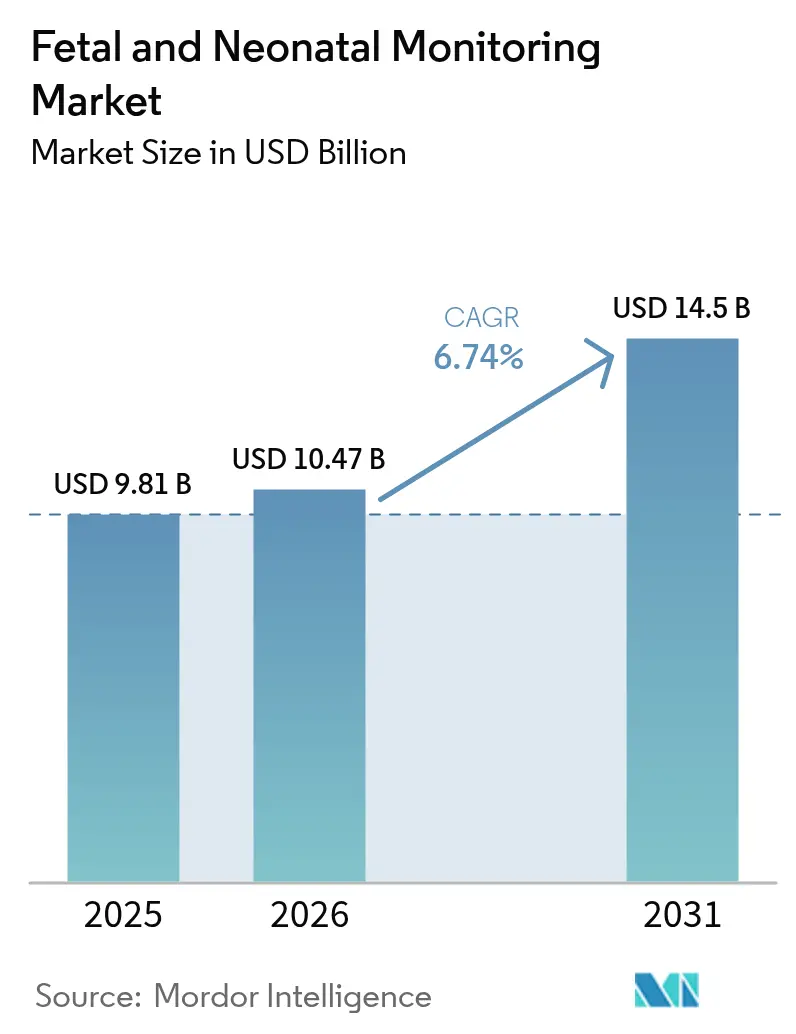
The Fetal And Neonatal Monitoring Market size is projected to be USD 9.81 billion in 2025, USD 10.47 billion in 2026, and reach USD 14.5 billion by 2031, growing at a CAGR of 6.74% from 2026 to 2031.
Demand escalates as pre-term deliveries climb, private hospitals in emerging economies add Level III and Level IV neonatal intensive-care beds, and artificial-intelligence modules are embedded in cardiotocography (CTG) and multiparameter platforms. Portable, battery-powered monitors are gaining traction in maternity-care deserts, helped by permanent U.S. reimbursement codes for remote patient monitoring. Meanwhile, the FDA’s cybersecurity rule, enforced from October 2024, marginally increases compliance costs yet catalyzes vendor consolidation, tilting share toward companies able to sustain ISO 27001 programs. Across regions, China’s three-child policy and India’s LaQshya quality mandate together underpin device procurement pipelines that run through 2031.
Key Report Takeaways
- By product category, fetal monitoring devices accounted for 61.45% of the fetal and neonatal monitoring market share in 2025, whereas neonatal monitoring devices are forecast to advance at a 7.43% CAGR through 2031.
- By method, non-invasive techniques dominated with 69.98% revenue in 2025; non-invasive techniques also regestered fastest growth with 7.65% CAGR through 2031.
- By portability, portable systems—though starting from a smaller base—are projected to grow at 8.23% a year, supported by maturing home-care reimbursement and FDA-cleared wireless patches.
- By end user, hospitals retained 53.12% spending in 2025, but standalone neonatal care centers are growing at 7.23% as payers steer extreme-prematurity cases into specialized, lower-cost facilities.
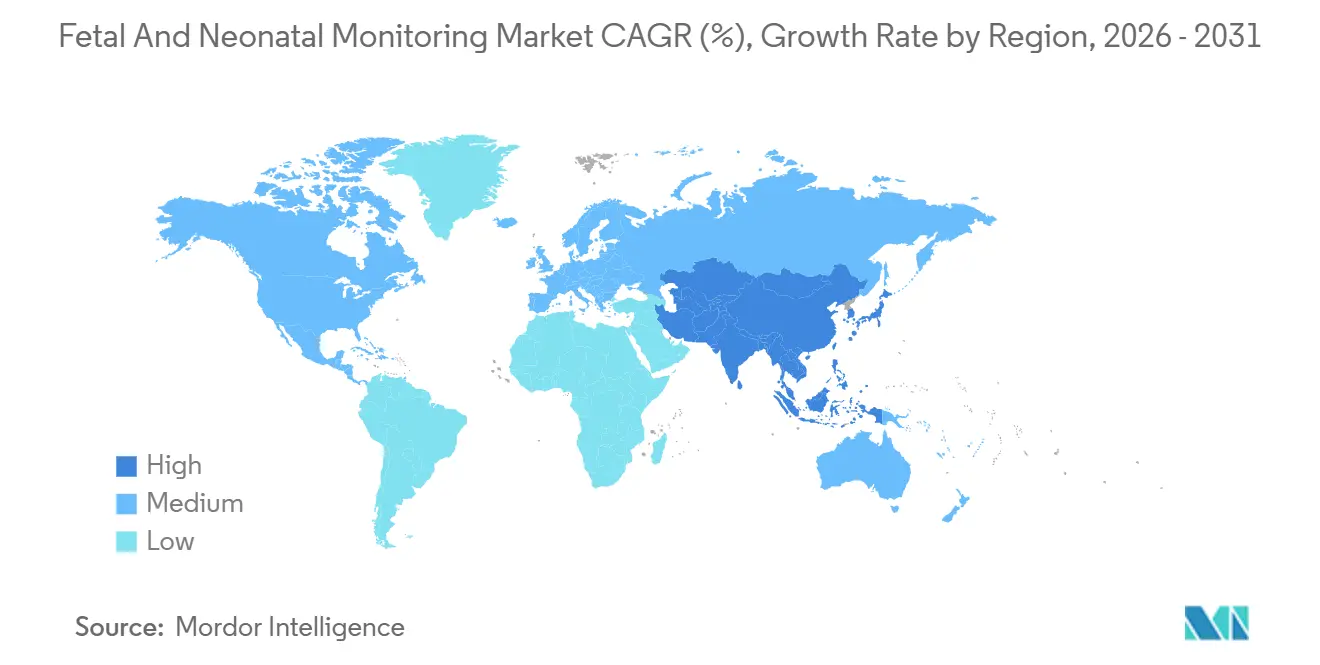
- By geography, North America led with 45.3% of 2025 revenue; Asia-Pacific is on track to post an 8.11% CAGR, buoyed by China’s maternal-health subsidies and India’s NICU build-outs.
Note: Market size and forecast figures in this report are generated using Mordor Intelligence’s proprietary estimation framework, updated with the latest available data and insights as of 2026.
Market Trends and Insights
Drivers Impact Analysis of Fetal And Neonatal Monitoring Market*
| Driver | (~) % Impact on CAGR Forecast | Geographic Relevance | Impact Timeline |
|---|---|---|---|
| Rising Pre-Term & Low-Birth-Weight Deliveries | +1.2% | Global, with highest incidence in Sub-Saharan Africa and South Asia | Medium term (2-4 years) |
| Government Maternity-Care Initiatives in Emerging Economies | +1.5% | APAC core (India, China, Indonesia), spill-over to MEA | Long term (≥ 4 years) |
| Expanding NICU Capacity Across Private Hospital Chains | +1.3% | APAC (India, China), Middle East GCC, select Latin America metros | Medium term (2-4 years) |
| Increasing Adoption of Advanced CTG & Ultrasound Systems | +0.9% | North America, Europe, urban APAC | Short term (≤ 2 years) |
| Integration of Maternal-Fetal Big-Data Platforms with Hospital Command Centers | +0.8% | North America, Western Europe, Australia | Medium term (2-4 years) |
| Insurance-Reimbursement Shifts Favoring Remote Fetal Telemetry | +1.0% | United States (CMS coverage), select European payers | Short term (≤ 2 years) |
| Source: Mordor Intelligence | |||
Rising Pre-Term & Low-Birth-Weight Deliveries
The U.S. pre-term rate climbed to 10.41% in 2024 [1]. Hospitals respond by deploying continuous electronic fetal monitoring in labor suites and stocking Level III NICUs with multiparameter devices that track heart rate, oxygen saturation, and transcutaneous carbon dioxide. Demand is also shifting to wireless Doppler patches for high-risk pregnancies managed at home, a segment enabled by permanent U.S. telehealth codes. Portable monitors compliant with ISO 80601-2-85 remain essential in rural Africa and South Asia, where mains power is unreliable. Collectively, these dynamics lift unit volumes faster than population growth, sustaining the fetal and neonatal monitoring market even in low-birth-rate economies.
Government Maternity-Care Initiatives in Emerging Economies
Between 2020 and 2025, India’s Janani Suraksha Yojana distributed cash incentives to 30 million mothers, channeling deliveries toward accredited facilities equipped with fetal monitors. China’s provinces have earmarked more than CNY 2 billion (USD 280 million) in 2024 for NICU upgrades under the three-child policy [2]. Ethiopia, after equipping 500 health centers with handheld Dopplers, recorded an 18% stillbirth reduction in two years. These policies converge on low-cost, non-invasive devices, accelerating external Doppler and handheld ultrasound sales. Faster regulatory acceptance, with many ministries accepting FDA or CE clearances without in-country trials, condenses vendor entry times to under nine months, widening geographic reach for the fetal and neonatal monitoring market.
Expanding NICU Capacity Across Private Hospital Chains
Rainbow Children’s, Motherhood Hospitals and Aster DM collectively added 1,200 NICU beds in India during 2024, each ordering Mindray BeneVision monitors and Dräger Babylog ventilators. Similar expansions are under way in China and the Gulf Cooperation Council, creating a replacement cycle for analog monitors installed a decade ago. Stand-alone neonatal centers already account for 12% of new NICU beds and should reach 15% by 2028, reshaping procurement toward modular, cloud-connectable platforms. As capacity scales, service contracts bundled with software upgrades become a decisive revenue stream for vendors, reinforcing recurring value in the fetal and neonatal monitoring market.
Increasing Adoption of Advanced CTG & Ultrasound Systems
The FDA cleared the Dawes-Redman computerized CTG algorithm in March 2025, making automated interpretation mainstream and cutting observer variability by 30% [3]. Philips’ Avalon CL adds AI modules that push smartphone alerts, while handheld ultrasound probes priced under USD 5,000 proliferate in rural clinics. Regulatory pathways remain efficient, most devices stay in Class II—so innovation cycles shorten. Consequently, next-generation CTG and low-cost ultrasound together add fresh avenues for revenue diversification within the fetal and neonatal monitoring market.
Restraints Impact Analysis of Fetal And Neonatal Monitoring Market*
| Restraint | ( ~ ) % Impact on CAGR Forecast | Geographic Relevance | Impact Timeline |
|---|---|---|---|
| Limited Device Accessibility in Rural LMIC Facilities | -0.7% | Sub-Saharan Africa, rural South Asia, Andean Latin America | Long term (≥ 4 years) |
| Lengthy 510(k)/CE Approval Timelines | -0.5% | United States, European Union | Medium term (2-4 years) |
| Rising Cyber-Security Insurance Premiums | -0.4% | North America, Western Europe | Short term (≤ 2 years) |
| Consumer Data-Privacy Concerns | -0.3% | EU, United States, Japan, South Korea | Medium term (2-4 years) |
| Source: Mordor Intelligence | |||
Limited Device Accessibility in Rural LMIC Facilities
A 2024 World Bank audit revealed that 43% of primary health centers in Kenya, Tanzania and Uganda face daily power outages over four hours, hampering mains-powered CTG deployment. Consumable spoilage rates exceed 15% in tropical climates, inflating per-use costs. As a result, handheld Dopplers priced below USD 300 dominate, yet lack continuous waveforms needed for quality audits. Stillbirth rates remain stubbornly high—21 per 1,000 in sub-Saharan Africa—highlighting that hardware alone cannot offset workforce and infrastructure gaps. These factors collectively subtract 0.7 percentage points from the long-term CAGR of the fetal and neonatal monitoring market.
Lengthy 510(k)/CE Approval Timelines
Median U.S. 510(k) clearance for fetal monitors stretched to 12 months in 2024, and AI-rich devices required up to 18 months as the FDA sought additional validation data. Europe’s Medical Device Regulation adds six-to-nine-month delays amid notified-body bottlenecks. Start-ups bear the brunt, often needing multi-site trials that cost USD 5+ million. Resultant capital drag slows innovation diffusion, trimming 0.5 percentage points from fetal and neonatal monitoring market growth over the medium term.
*Our forecasts treat driver/restraint impacts as directional, not additive. The impact forecasts reflect baseline growth, mix effects, and variable interactions.
Fetal And Neonatal Monitoring Market Segment Analysis
By Product:
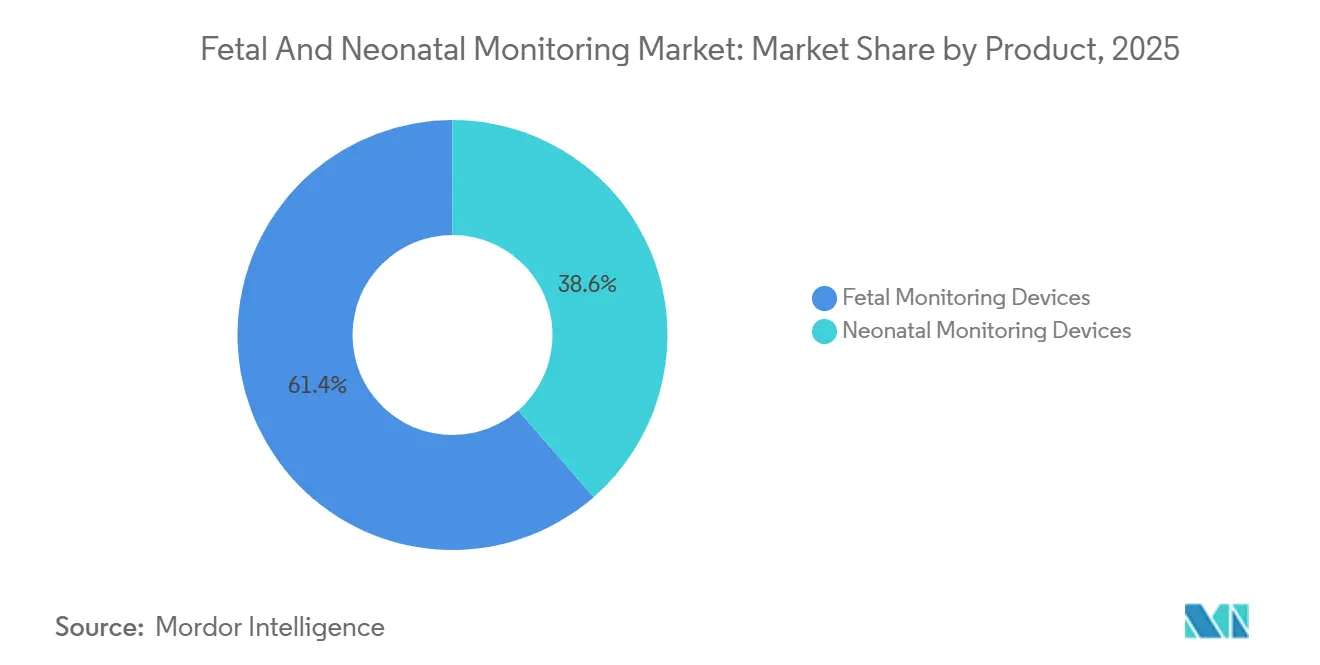
Neonatal Devices Narrow the GapNeonatal monitors are closing on fetal systems, expanding 7.43% annually against the broader fetal and neonatal monitoring market CAGR of 6.74%. Fetal CTG and external Doppler devices still anchor 61.45% of revenue, but AI-enabled software subscriptions, such as PeriGen Cerebro, blur hardware boundaries. Multiparameter neonatal platforms, exemplified by Mindray BeneVision and Dräger Infinity Delta, now bundle capnography, pulse oximetry, and invasive blood pressure in one chassis, driving upgrade cycles. Masimo’s 2024 acquisition of Stork extends neonatal surveillance beyond discharge, hinting at post-acute use cases that add fresh volume to the fetal and neonatal monitoring market size.
Demand migrates toward integrated modules because single-function monitors crowd limited NICU head-wall slots. Capnograph volumes rose notably in 2024 as lung-protective strategies targeted extremely low-birth-weight infants. AI layers that predict sepsis risk are next, with patent filings for machine-learning signal processing now 38% of total fetal-monitoring patent applications. Collectively, these shifts set a taller performance bar, tightening competition among incumbents while leaving niche space for cloud-native entrants.
By Method:
Non-Invasive Dominance with Niche Invasive ApplicationsNon-invasive techniques command 69.98% of 2025 revenue and are also expected to register the fastest growth in the forecast period, with a CAGR of 7.65%. Transcutaneous CO₂ monitors slash neonatal heel sticks by 30%, improving nursing efficiency. Meanwhile, the ICE 80601 standard aligns alarm protocols across devices, streamlining clinician workflows. Conversely, invasive tools—fetal scalp electrodes, intrauterine pressure catheters—retain use in obese patients or when signal quality degrades. Goldtrace’s 2025 wireless scalp electrode mitigates cable clutter, but adoption remains selective, anchoring a low-volume, high-margin niche.
Training requirements are higher for invasive placements, and malpractice insurers in the United States often mandate credentialing, dampening uptake. Still, the devices’ diagnostic precision in complex labor ensures continued procurement, safeguarding a small but critical adjacency inside the larger fetal and neonatal monitoring market.
By Portability:
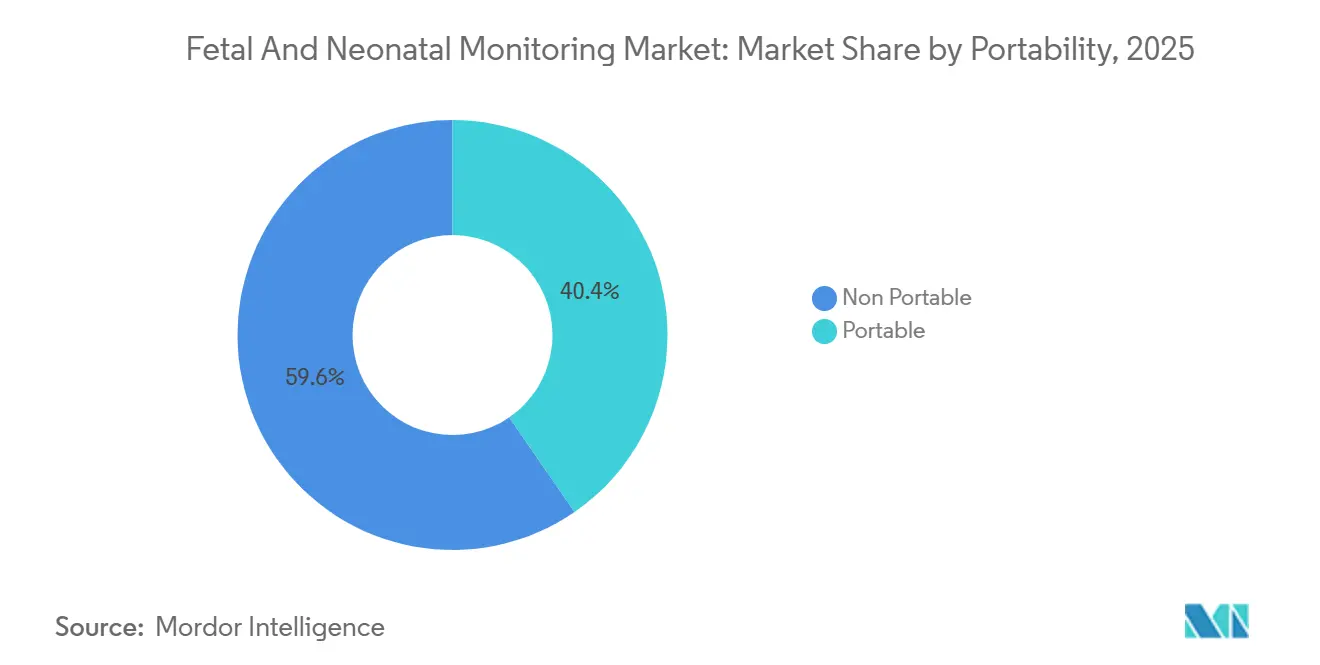
Portable Monitors Capture Home and Ambulatory NichesPortable monitors, weighing under 2 kg and offering eight-to-twelve-hour battery life, are on pace for an 8.23% CAGR. The CMS decision that codified remote-patient-monitoring codes 99453, 99457, and 99458 fuels U.S. demand for devices such as GE Novii+ and Nuvo INVU. In sub-Saharan Africa, handheld Dopplers dominate antenatal check-ups, sustaining baseline volume. Conversely, non-portable systems still hold 59.65% of revenue in 2025 because fixed CTG consoles and bedside NICU monitors integrate with enterprise electronic health records, a feature valued in high-acuity settings.
Vendor economics diverge: portable hardware sells for USD 200-800 but depends on consumable streams and subscription analytics; fixed units cost USD 15,000-40,000 and lock in multiyear service revenue equal to 20-25% of hardware value. Both models coexist, expanding the fetal and neonatal monitoring market size across care settings.
By End User:
Neonatal Care Centers Emerge as Growth LocusHospitals remain the core buyer, yet stand-alone neonatal centers grow fastest at 7.23% because insurers pursue bundled payments and lower per-diem charges. Rainbow Children’s opened six such centers in 2024, each specifying Mindray BeneVision monitors and Dräger Babylog ventilators. These facilities target a 25% unit-cost edge versus tertiary hospitals, validating specialized, high-volume models of care that elongate the demand curve for the fetal and neonatal monitoring market.
Home-care settings, which accounted for a notable share of 2025 spending, receive oxygen thanks to permanent U.S. and selective European reimbursement. Yet, only 5% of the 2.2 million women living in maternity-care deserts adopted home fetal monitors in 2024 because of connectivity gaps and privacy worries. Over time, satellite connectivity and cheaper SIMs should lift penetration, adding another growth lever.
Geography Analysis
North America Fetal and Neonatal Monitoring Market
North America contributed 45.3% of global revenue in 2025, led by 3,000 U.S. hospitals with networked CTG and 800 Level III/IV NICUs. Permanent remote-monitoring codes amplify sales of wearable fetal patches, while the FDA’s cybersecurity mandate, activated in 2024, raises entry barriers for low-cost importers. Canada’s provincial health services replace decade-old consoles on standard five-year cycles, whereas Mexico lags because public budgets favor basic obstetric kits over digital networks.
APAC Fetal and Neonatal Monitoring Market
Asia-Pacific is the fastest-growing theatre at 8.11% per year. China cut maternal mortality to 15.1 per 100,000 births in 2023 after pouring CNY 2+ billion into county-level maternal-child hospitals. Mindray shipped 18,000 neonatal monitors in 2024, up 22% year-on-year. India’s LaQshya program funnels INR 3,200 crore (USD 385 million) into labor-room upgrades across 5,000 facilities, supporting broad diffusion of portable Dopplers. Japan bucks the low-birth trend by spending heavily on AI-enabled monitors to offset staffing gaps, while Australia and South Korea grow at mid-single-digit levels tied to routine replacement.
EMEA and South America Fetal and Neonatal Monitoring Market
Europe contributed significant share of 2025 revenue, but MDR-related CE delays and GDPR encryption rules dampen cloud-based deployments. Germany, France and the U.K. still account for majority of regional sales thanks to dense hospital networks. The Middle East and Africa combine for notable share; Gulf states invest in maternal-child megahospitals, but sub-Saharan Africa struggles with power outages that curtail digital uptake. South America faces currency swings that cap capital-equipment budgets.
Regulatory Landscape
Fetal and neonatal monitoring devices generally move through established medical-device pathways, but newer requirements put greater emphasis on software, cybersecurity, and post-market surveillance for connected systems. In the United States, many fetal monitoring systems are regulated as Class II devices under 21 CFR Part 884 (product code HGM) using the 510(k) pathway, while consensus standards such as IEC 80601-2-49 (2024 edition) are increasingly referenced for safety and performance of multifunction patient monitors in perinatal use.
In Europe, EU MDR classification and notified-body capacity remain key gating factors for both bedside monitors and centralized perinatal monitoring software. The Medical Device Coordination Group has also continued to refine expectations around post-market surveillance (for example, MDCG 2025-10). EUDAMED readiness is an operational compliance milestone, with modules scheduled for deployment by May 28, 2026, which is pushing manufacturers and importers to tighten device registration, certificate tracking, and market-surveillance processes across perinatal monitoring portfolios.
Competitive Landscape
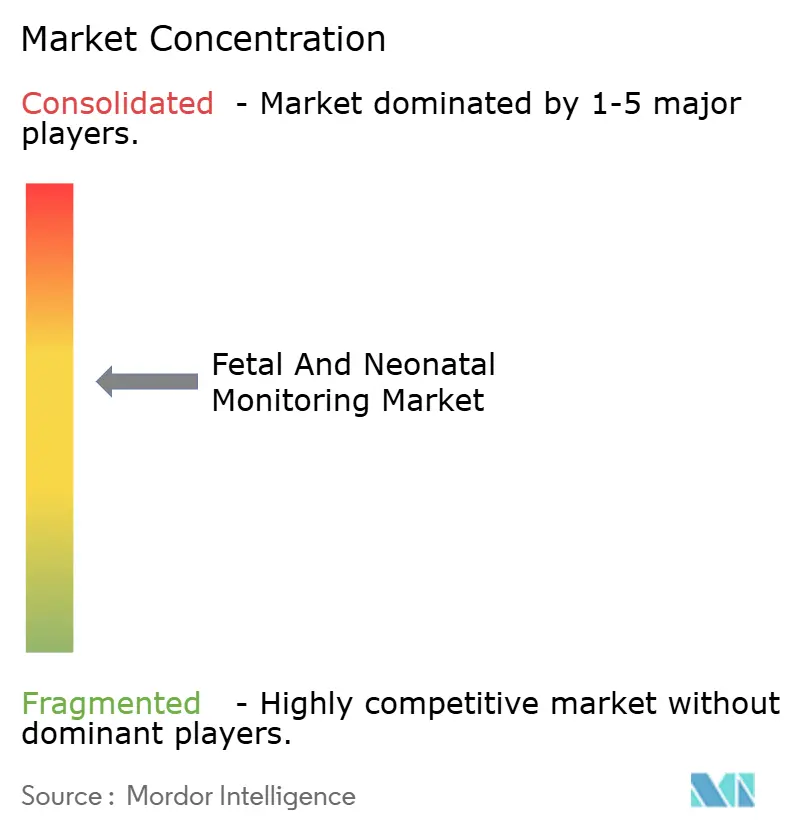
The fetal and neonatal monitoring market is moderately concentrated: the top five suppliers, GE Healthcare, Koninklijke Philips, Siemens Healthineers, Medtronic, and Becton, Dickinson and Company, collectively held the majority of revenue share in 2025. They defend turf through installed-base service contracts, interoperability modules, and vendor-financing programs that stretch hardware refresh cycles to seven-plus years. Region-specific challengers such as Mindray and Phoenix Medical capture notable share at home by pairing lower prices with local support.
Product differentiation tilts toward software. PeriGen Cerebro, installed in more than 500 U.S. hospitals, analyzes two million labor records to predict cesarean and hemorrhage risk. Masimo’s acquisition of Stork injects rainbow-sensor technology into home neonatal monitoring. Cybersecurity costs concentrate power; smaller Asian vendors lacking ISO 27001 credentials absorb margin hits of 3-5 percentage points, prompting mergers or exits.
White-space opportunities include portable multiparameter monitors for birthing centers and AI-driven analytics that flag fetal distress 20-30 minutes earlier than Doppler alone. Post-discharge neonatal monitoring could be worth USD 300 million by 2030, a niche Masimo now targets. Collectively, these niches add upside to the long-run trajectory of the fetal and neonatal monitoring market.
Fetal And Neonatal Monitoring Industry Leaders
-
GE Healthcare
-
Medtronic Plc
-
Becton, Dickinson and Company
-
Siemens Healthineers
-
Koninklijke Philips N.V.
- *Disclaimer: Major Players sorted in no particular order
Fetal And Neonatal Monitoring Market Companies Covered in this Report
- Analogic
- Arjo AB
- Atom Medical
- Beckton Dickinson
- Cardinal Health
- The Cooper Companies
- Dragerwerk
- EDAN Instruments Inc.
- Fisher & Paykel Healthcare
- FUJIFILM
- GE Healthcare
- Getinge
- Huntleigh Healthcare Ltd.
- International Biomedical
- Koninklijke Philips
- Masimo
- Medtronic
- Mindray Bio-Medical Electronics
- Natus Medical
- Nihon Kohden
- Phoenix Medical Systems Pvt Ltd.
- Siemens Healthineers
- Spacelabs Healthcare
- Vyaire Medical
Market Opportunities and Future Outlook
Wireless and wearable perinatal monitoring, along with AI-enabled interpretation, are widening the addressable workflow beyond conventional labor-and-delivery CTG consoles, especially where mobility and staffing constraints limit continuous observation. A recent signal is Sibel Healths FDA 510(k) clearance (K253021) for ANNE Maternal in 2026, which uses epidermal wearable sensors to capture maternal vital signs alongside fetal heart rate and uterine contractions, aligning with demand for portable systems and remote monitoring-enabled care pathways.
AI-enabled software layers are also creating adjacent opportunities in fetal imaging and neonatal neuro-monitoring that sit alongside core monitoring hardware. In 2026, Sonio received FDA 510(k) clearance (K261519) for Sonio Suspect, a computer-assisted diagnostic software supporting lesion detection in fetal ultrasound, while BrightHeart reported an EU CE mark for its B-Right AI platform for prenatal ultrasound screening. On the neonatal side, published proof-of-concept work in 2026 on non-invasive sensor patches (for continuous monitoring of parameters such as temperature and electrolytes through skin fluids) and validated automated EEG analysis pipelines points to whitespace for continuous, low-burden monitoring that can reduce invasive sampling, and supports new software-plus-sensor adoption paths across NICUs and post-acute settings.
Recent Industry Developments in Fetal And Neonatal Monitoring Market
- June 2026: GE HealthCare launched CareIntellect for Perinatal, a cloud-based SaaS application that integrates maternal and fetal vital statistics. The release supports centralized surveillance and analytics across labor and delivery workflows, reinforcing the shift from stand-alone consoles toward connected perinatal platforms.
- June 2026: Medtronic received FDA 510(k) clearance for the Nellcor pulse oximetry system with the Nell-EQ intelligent processor. The clearance strengthens Medtronics neonatal monitoring stack by upgrading signal-processing performance in a core NICU vital-sign parameter.
- May 2025: GE HealthCare and Raydiant Oximetry began joint R&D on fetal oxygen-saturation monitoring to improve fetal distress detection. The collaboration targets a long-standing clinical gap in fetal monitoring, with potential to differentiate next-generation fetal monitoring platforms beyond conventional heart-rate and contraction signals.
Fetal And Neonatal Monitoring Market Report Scope and Research Methodology
Market Definition and Coverage
For this study, the market includes the revenue generated from fetal monitoring and neonatal monitoring devices and systems used to track vital signals before birth and in newborn care settings across all major regions.
Scope exclusions: We exclude general adult patient monitors that are not used for fetal or neonatal monitoring, and also exclude standalone consumables when they are not priced as part of the monitoring system value.
Segments Covered in This Report
- By Product
- Fetal Monitoring Devices
- External Doppler HR Monitors
- Cardiotocography (CTG) Systems
- Uterine Contraction Monitors
- Fetal Pulse Oximeters
- Wireless/Wearable Fetal Patches
- AI-Enabled Predictive Platforms
- Other Fetal Monitoring Devices
- Neonatal Monitoring Devices
- Cardiac Monitors
- Capnographs
- Blood-Pressure Monitors
- Pulse Oximeters
- Integrated Multiparameter Monitors
- Respiratory Monitors
- Other Neonatal Monitoring Devices
- Fetal Monitoring Devices
- By Method
- Invasive
- Non-Invasive
- By Poribility
- Portable
- Non Portable
- By End User
- Hospitals
- Neonatal Care Centres
- Home-Care Settings
- Other End Users
- By Geography
- North America
- United States
- Canada
- Mexico
- Europe
- Germany
- United Kingdom
- France
- Italy
- Spain
- Rest of Europe
- Asia-Pacific
- China
- India
- Japan
- South Korea
- Australia
- Rest of Asia-Pacific
- Middle East and Africa
- GCC
- South Africa
- Rest of Middle East and Africa
- South America
- Brazil
- Argentina
- Rest of South America
- North America
Data Sources, Market Sizing, and Validation
Desk Research
Desk research was used to build the demand context and to keep the assumptions consistent around births, care access, and facility readiness for monitoring. We leaned on public health and statistics sources such as the World Health Organization, the World Bank, UNICEF, and national health agencies for birth volumes, neonatal outcomes, and maternal care coverage.
To translate care activity into equipment demand, we also reviewed publications and references from bodies such as the US Centers for Disease Control and Prevention, peer-reviewed clinical journals, and medical device regulatory databases for product categories and typical use conditions. This was complemented with annual reports, investor presentations, and reputable press coverage to capture product mix direction and pricing cues, and then company financials and intelligence databases plus patent databases were used selectively to cross-check revenue exposure and innovation intensity. The sources listed here are illustrative only, and other public and paid references were used to collect, validate, and clarify data points during the work.
Primary Interviews and Surveys
Primary work focused on validating what gets purchased, how often systems are replaced, and which care settings are actually driving utilization, since these factors are not fully visible in public data. We spoke with a mix of manufacturers, distributors, hospital and neonatal care center stakeholders, and clinical users across APAC, EMEA, and the Americas to close gaps on adoption timing, procurement patterns, and average selling price movements.
These inputs were then used to check desk research assumptions, adjust penetration and replacement rates by setting, and confirm the realism of the forecast variables before finalizing the model.
Distribution of primary research fieldwork respondents
| Company type | Respondent position | Region |
|---|---|---|
| Top tier: 33% | CXOs: 19% | APAC: 46% |
| Mid tier: 48% | Functional/Unit leaders: 40% | EMEA: 32% |
| Smaller Players: 19% | Managers: 41% | Americas: 22% |
Market-Sizing & Forecasting
Sizing was built using a top-down approach that reconstructs the annual monitoring demand pool from live births, share of institutional deliveries, NICU and labor ward coverage, and the expected monitoring intensity per setting. Once that demand pool was set, we converted it into value using a practical split between new installations and replacements, followed by average selling price ranges that reflect product mix and technology shifts.
To keep the totals realistic, we corroborated outputs with selective bottom-up approximations, including sampled supplier revenue exposure checks, channel feedback on shipment direction, and a basic units-times-ASP validation for key device groups. When a country-level input was missing, we used proxy indicators (for example, delivery volumes and facility density) and then rechecked the implied per-birth spend using interview feedback so the gaps did not distort regional rollups.
Forecasts were produced using scenario analysis, where birth trends, hospital investment cycles, and adoption of portable and wireless monitoring were varied within expert-validated ranges. The final trajectory was accepted only after both short-term swings and the longer replacement cycle effects were visible and explainable in the model.
Data Validation & Update Cycle
Validation was done through repeated consistency checks across regions and care settings, so the implied devices-per-facility and spend-per-birth did not drift outside realistic bounds. We compared outputs against independent signals like procedure volumes, facility capacity additions, and procurement behavior discussed in interviews, then flagged anomalies for rework before internal review sign-off.
Reports are refreshed annually, and interim updates are triggered when material events occur, such as major regulatory changes, reimbursement shifts, or sudden supply chain constraints affecting pricing and availability. Before delivery, an analyst performs a fresh pass on key assumptions and recent news flow so clients receive an updated view aligned to the latest available information.
Mordor Intelligence's Global Fetal and Neonatal Monitoring Market Market Size Measured Against Other Published Estimates
Published market sizes for fetal and neonatal monitoring often do not match because the underlying counting rules are not the same, even when the titles look identical. Differences usually come from what is included in the device basket, how neonatal monitoring is separated from broader NICU equipment, and how pricing and replacement timing are treated.
Some estimates fold fetal and neonatal monitoring into a wider care-equipment spend, and others narrow the scope to a few device types with limited settings. In Mordor Intelligence calculations, value is counted only for fetal and neonatal monitoring devices and systems, and the demand pool is anchored to births, facility coverage, and replacement cadence checks that were revalidated through primary discussions.
Benchmark comparison
| Source | Market Size | Gaps in Research Methodology |
|---|---|---|
| Mordor Intelligence | USD 10.47 B (2026) | |
| Industry Publisher A | USD 5.70 B (2024) | The scope appears to be limited to selected monitoring device types and may apply a narrower end-user lens, which can reduce the counted revenue versus a full fetal plus neonatal monitoring system view. |
| Industry Publisher B | USD 11.60 B (2026) | The estimate likely uses a broader product basket and more aggressive ASP progression over time, which can lift the 2026 value if adjacent NICU care equipment or bundled platform revenues are counted under monitoring. |
Taken together, the spread is mainly explained by what each source counts as monitoring revenue and how it treats pricing and replacement timing across care settings. By keeping inclusions explicit and tying the total back to observable demand drivers, the resulting number stays traceable to repeatable inputs that can be checked and updated as new signals emerge.
Key Questions Answered in the Report
How fast will the fetal and neonatal monitoring market grow through 2031?
Revenue is projected to rise from USD 10.47 billion in 2026 to USD 14.50 billion by 2031, reflecting a 6.74% CAGR
Which product segment is expanding quickest?
Neonatal monitoring devices are forecast to grow 7.43% annually, narrowing the gap with fetal devices.
Why is Asia-Pacific the fastest-growing region?
China’s three-child policy, India’s LaQshya program and private NICU investments give Asia-Pacific an expected 8.11% CAGR.
What role does AI play in new monitors?
Algorithms such as Dawes-Redman and PeriGen Cerebro automate CTG interpretation and predict complications, lowering clinician workload and intervention time.
What are key barriers to rural deployment?
Power outages, consumable logistics and limited staff training slow adoption in low-income countries despite low-cost handheld Dopplers.