
Baby Cleaning Products Market Size and Share
Market Overview
| Study Period | 2019 - 2030 |
|---|---|
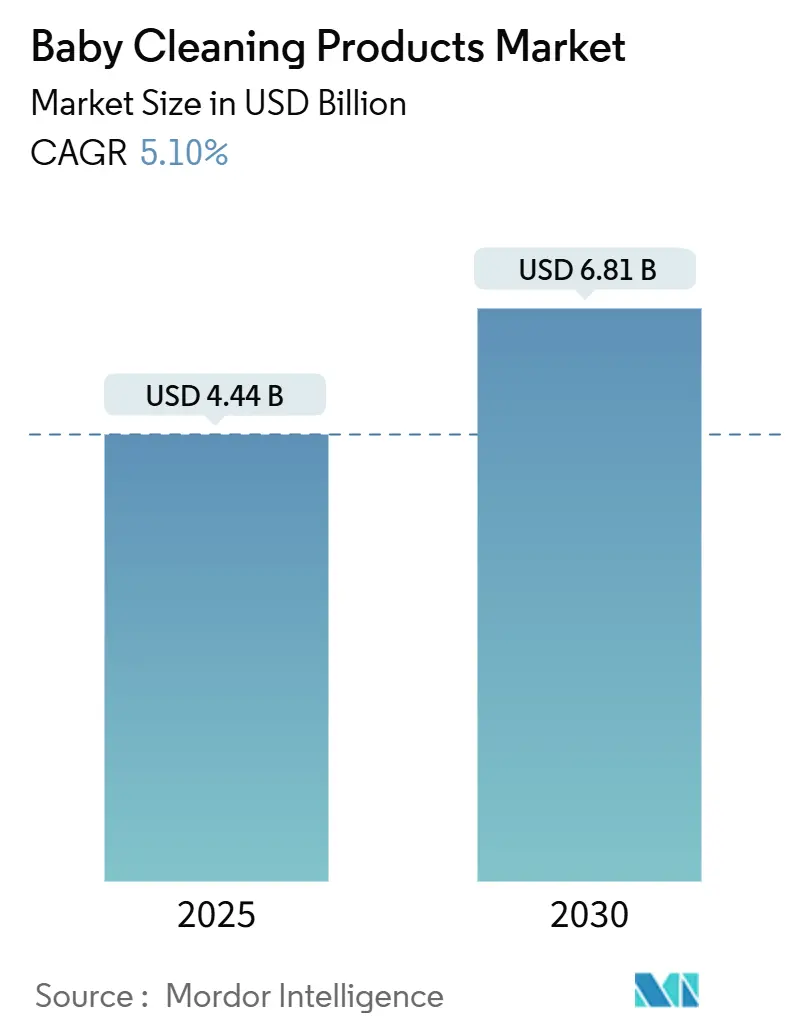
| Market Size (2025) | USD 4.44 Billion |
| Market Size (2030) | USD 6.81 Billion |
| Growth Rate (2025 - 2030) | 5.10 % |
| Fastest Growing Market | Asia Pacific |
| Largest Market | North America |
| Market Concentration | Medium |
Major Players *Disclaimer: Major Players sorted in no particular order Image © Mordor Intelligence. Reuse requires attribution under CC BY 4.0. | |
Baby Cleaning Products Market Analysis by Mordor Intelligence
The baby cleaning products market size stands at USD 4.44 billion in 2025 and is forecast to climb to USD 6.81 billion by 2030, reflecting a 5.1% CAGR. Robust demand for hypoallergenic wipes, detergents, and surface cleaners offsets lower birth rates in mature economies. Rising awareness of infant dermatitis, eco-friendly packaging mandates, and premium positioning around plant-based formulas spur revenue growth. Competitive intensity centers on patent-backed innovations in absorbent substrates and enzymatic detergents, while retailers promote refillable packs to cut waste. Digital channels reinforce brand discovery and subscription replenishment, giving niche entrants faster scale and pressuring incumbents to refresh direct-to-consumer plays.
Key Report Takeaways
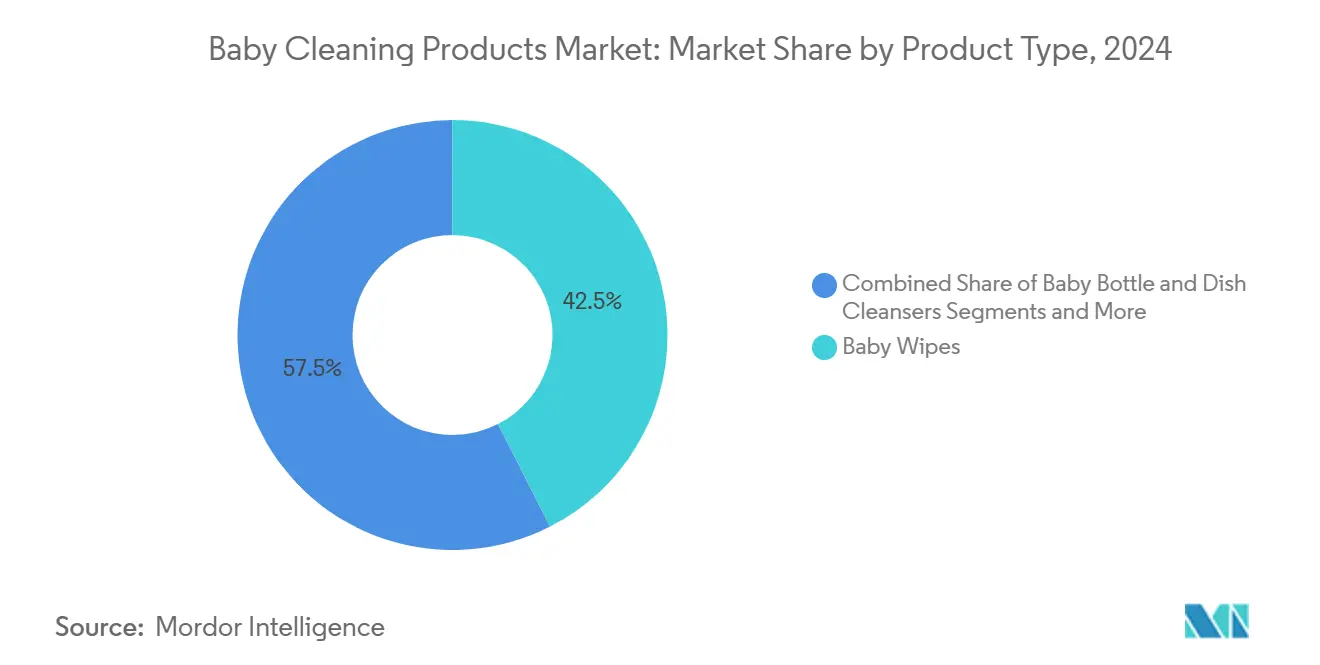
- By product type, baby wipes led with 42.5% revenue share in 2024; fruit and vegetable wash is forecast to expand at a 9.8% CAGR through 2030.
- By form, wipes held 55.1% of sales in 2024; spray and foam formats are advancing at a 10.6% CAGR to 2030.
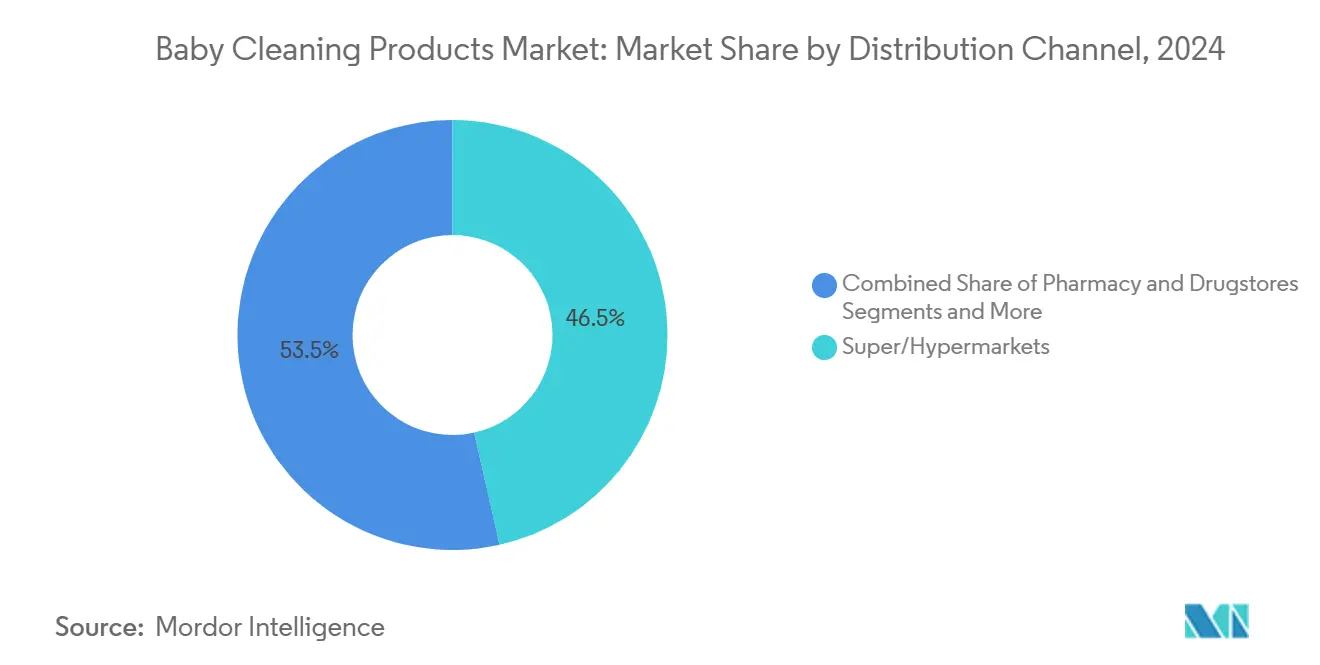
- By distribution channel, super and hypermarkets controlled a 46.5% share in 2024; online retail is projected to grow at a 12.9% CAGR through 2030.
- By geography, North America accounted for 32.8% revenue in 2024; Asia Pacific is set to register the fastest 7.5% CAGR to 2030.
Note: Market size and forecast figures in this report are generated using Mordor Intelligence’s proprietary estimation framework, updated with the latest available data and insights as of January 2026.
Market Trends and Insights
Drivers Impact Analysis of Baby Cleaning Products Market*
| Driver | (~) % Impact on CAGR Forecast | Geographic Relevance | Impact Timeline |
|---|---|---|---|
| Rising demand for eco-friendly biodegradable wipes | +1.20% | Global with EU and UK leading | Medium term (2–4 years) |
| Increasing incidence of infant dermatitis driving hypoallergenic formulations | +0.80% | Global, strongest in developed markets | Long term (≥ 4 years) |
| Rapid e-commerce penetration enabling niche baby cleaning brands | +0.90% | North America and Asia Pacific | Short term (≤ 2 years) |
| Premiumization and willingness to pay for natural ingredients | +0.70% | North America, Europe, developed APAC | Medium term (2–4 years) |
| Innovations in enzymatic plant-based detergents reducing wash cycles | +0.50% | Global | Long term (≥ 4 years) |
| Government subsidies or tax breaks on infant hygiene products | +0.40% | Emerging APAC, Latin America, MEA | Medium term (2–4 years) |
| Source: Mordor Intelligence | |||
Rising Demand for Eco-Friendly Biodegradable Wipes
Regulators in the United Kingdom banned plastic-containing wet wipes that account for 11 billion units annually, catalyzing a market pivot to plant-based substrates.[1] Major retailers pre-emptively delisted plastic options, underscoring supply-chain readiness for cellulose alternatives. Only 12% of manufacturers currently offer fully plastic-free wipes, so capacity constraints support premium pricing while encouraging merger activity among firms with biopolymer expertise. Standardized biodegradability testing from the Department for Environment, Food and Rural Affairs accelerates harmonization, and brands with proven R&D pipelines shorten innovation cycles ahead of the April 2026 enforcement deadline.
Increasing Incidence of Infant Dermatitis Driving Hypoallergenic Formulations
Healthcare surveys reveal 28% of infants experience atopic dermatitis, and 29% endure chronic dry skin.[2] Formulators now replace phenoxyethanol with multifunctional systems such as ethylhexylglycerin for gentler preservation. Kenvue reported that a mild cleanser plus colloidal oat lotion regimen improved skin-barrier integrity at the 15th World Congress of Pediatric Dermatology. Dermatologist endorsements justify price premiums and strengthen shopper loyalty, especially among millennial parents who view infant skincare through an adult beauty lens.
Rapid E-Commerce Penetration Enabling Niche Baby Cleaning Brands
Online retail posts the highest 12.9% CAGR as caregivers gravitate to subscription replenishment and ingredient-filter search tools. Southeast Asian players showcase a hybrid “online-to-offline” tactic—selling first on marketplaces to gauge demand, then using pop-up exhibitions for cost-efficient regional expansion. Direct-to-consumer storefronts capture first-party data that feed product iteration, while social-commerce live streams simplify real-time Q&A on sensitivities such as fragrance-free claims.
Premiumization And Willingness to Pay for Natural Ingredients in Developed Markets
Millennial and Gen Z parents have shifted the baby cleaning products market dynamics by favoring plant-based detergents, dermatologically tested wipes, and recyclable pumps. Procter & Gamble’s Dreft purtouch detergent contains 65% biobased content and is produced at zero-waste wind-powered facilities. Premium lines also integrate minimalist aesthetics that match home décor, elevating gifting appeal at baby showers and registry platforms.
Restraints Impact Analysis of Baby Cleaning Products Market*
| Restraint | (~) % Impact on CAGR Forecast | Geographic Relevance | Impact Timeline |
|---|---|---|---|
| Regulatory scrutiny over microplastics and preservatives in wipes | -0.60% | EU and North America | Short term (≤ 2 years) |
| Supply-chain volatility for plant-based raw materials | -0.40% | Global | Medium term (2–4 years) |
| High price sensitivity among mass-market consumers in developing nations | -0.50% | Emerging APAC, Africa, Latin America | Long term (≥ 4 years) |
| Waste-management pressure leading to single-use-wipes ban proposals | -0.30% | EU and UK | Medium term (2–4 years) |
| Source: Mordor Intelligence | |||
Regulatory Scrutiny Over Microplastics and Preservatives in Wipes
Although the U.S. FDA currently finds insufficient evidence to restrict microplastics in cosmetics, European authorities are preparing tighter limits modeled on the Microbead-Free Waters Act precedent.[3]Reformulating away from phenoxyethanol and tocopherol allergens raises cost and testing time, particularly for small brands without dedicated toxicologists.
Supply-Chain Volatility for Plant-Based Raw Materials
Weather-linked yield swings in cotton, bamboo, and coconut derivatives inflate input prices. Hipp Organic recently missed deliveries on 51 SKUs when a logistics bottleneck halted plant-derived ingredient flow from Germany, highlighting fragility in specialized feedstocks.
*Our forecasts treat driver/restraint impacts as directional, not additive. The impact forecasts reflect baseline growth, mix effects, and variable interactions.
Baby Cleaning Products Market Segment Analysis
By Product Type:
Wipes Maintain Leadership While Niche Cleaners AccelerateWipes generated 42.5% of the baby cleaning products market size in 2024 amid entrenched convenience habits. Fruit and vegetable washes, though niche, post a 9.8% CAGR, reflecting parental vigilance over pesticide residues. Premium hypoallergenic laundry detergents capitalize on enzymatic breakthroughs that clean at cold settings, lowering household energy bills. Innovations in superabsorbent polymers patented by leading diaper manufacturers spill over into wipe substrates, boosting fluid management. Brands diversify into toy and high-chair disinfectants that align with post-pandemic hygiene routines. The wipes segment, despite volume deceleration in saturated geographies, adds value through biodegradable fibers and dermatologically tested lotions, sustaining pricing power. Start-ups leverage food-grade preservatives and transparent supply stories to win shelf space at natural retailers. Health-care professionals increasingly recommend category-specific products, driving cross-selling opportunities across the brand portfolio.
The product mix broadens as caregivers seek task-specific solutions, such as pacifier wipes infused with xylitol to discourage bacterial growth. Surface sprays with botanical antimicrobials serve open-play zones, reinforcing daily multi-pack purchases. Patent filings reveal growth in fragrance-free, pH-balanced compositions that preserve microbiome integrity, a claim resonating with millennial parents. Established firms pilot subscription bundles combining wipes, detergent, and bottle cleanser, raising lifetime customer value. Competitive gaps persist in concentrates and tabletized formats that minimize plastic, inviting challenger entries.

By Form:
Spray and foam Gain Momentum Over Traditional LiquidsSpray and foam options now grow at 10.6% CAGR, a sign that parents appreciate targeted application and lower wastage. Wipes still contribute the largest 55.1% revenue slice but encounter substitution where sprays offer superior per-use economics. Concentrated liquids and dissolvable sheets appeal to eco-conscious consumers mindful of shipping emissions. Powder sticks enter travel kits, replacing leak-prone bottles and complying with airline liquid limits. Bar cleaners wrapped in compostable paper reclaim niche relevance among zero-waste advocates. Patent literature points to aerosol-free pump technologies that deliver fine mist without pressurized propellants, aligning with regulations on volatile organic compounds. Market education efforts underscore dosing accuracy and reduced residue to address skepticism surrounding novel formats.
Foam cleansers for stroller fabrics illustrate form-factor innovation that tackles odor without machine washing, reinforcing convenience value. R&D teams explore bio-based surfactants that generate stable micro-bubbles at low alkalinity, protecting sensitive skin. Retailers allocate end-caps to feature refill pouches that cut packaging by 70%, nudging shoppers to trial. Multichannel storytelling through social video tutorials accelerates understanding of newer forms, and user-generated testimonials validate efficacy claims.
By Distribution Channel:
Digital Platforms Reshape Shopper JourneysSuper and hypermarkets hold 46.5% of the baby cleaning products market share thanks to one-stop shopping convenience, yet e-commerce adds the most significant incremental dollars via 12.9% CAGR. Marketplaces feature ingredient tag filters letting shoppers exclude parabens or ethanolamines, while algorithmic bundling elevates average order value. Drugstores sustain trust for first-time parents seeking pharmacist guidance on hypoallergenic goods. Specialty baby boutiques will be repositioned as experiential hubs, hosting demo classes that convert to higher ticket purchases. Department stores pilot curated “clean nursery” corners to recapture younger demographics who migrated online.
Subscription models on brand-owned sites smooth consumption forecasting and streamline pack design around optimal shipping dimensions. Social-commerce in China and Southeast Asia leverages livestream hosts to explain derm testing results in local dialects, boosting rural penetration. Omnichannel-ready brands synchronize in-store QR codes to mobile coupons, bridging physical touchpoints with digital loyalty tracking. Transparent delivery carbon scores appear on checkout pages, incentivizing consolidated cart behavior.
Geography Analysis
North America Baby Cleaning Products Market
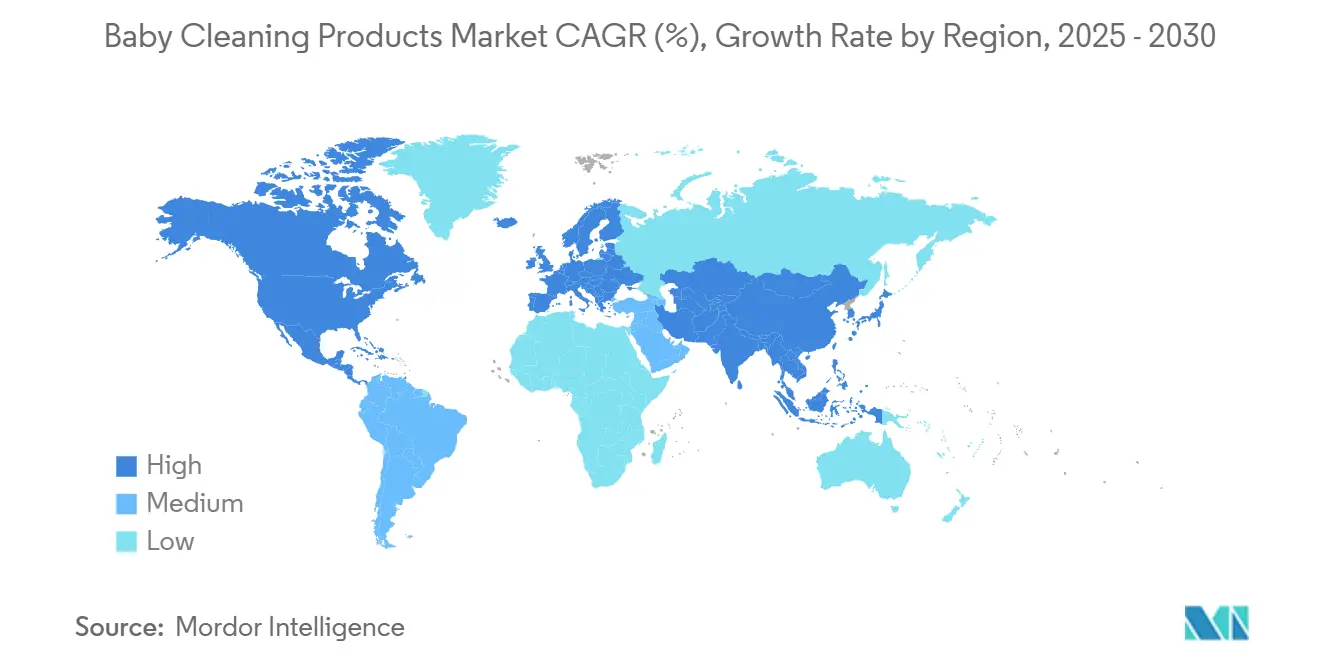
North America retained 32.8% of 2024 revenue as premium plant-based wipes and dermatologist-recommended detergents remained staples in household budgets. U.S. retailers introduced refill stations for liquid cleaners, spurring repeat foot traffic. Canada favors organic certifications, while Mexico’s growing middle class increasingly seeks fragrance-free laundry liquids for infants. Retail price inflation moderates category expansion: however, loyalty programs soften trade-down risks.
APAC Baby Cleaning Products Market
Asia Pacific is projected to drive a 7.5% CAGR through 2030, fueled by rising disposable incomes and digital commerce adoption. China’s cross-border e-commerce channels import fragrance-free U.S. brands, catering to parents wary of domestic quality lapses. India’s urban centers witness hospital partnerships distributing sample kits that convert new mothers into ongoing customers. In Indonesia, diaper penetration remains under 50%, leaving headroom for ancillary wipes and cleaners. Australian and Japanese shoppers prioritize reef-safe surfactants, shaping regional formulation norms.
Europe Baby Cleaning Products Market
Europe shows mixed momentum. The United Kingdom’s plastic-wipe ban signals continental policy direction and forces tooling upgrades in German and Italian factories. France sees robust uptake of refill-pouch detergents under retailer private labels. Nordic markets, already advanced in waste-sorting compliance, experiment with cradle-to-cradle certified packaging. Eastern Europe experiences slower value growth due to currency pressures, yet government grants for local biopolymer start-ups could realign cost structures over the medium term.
Competitive Landscape
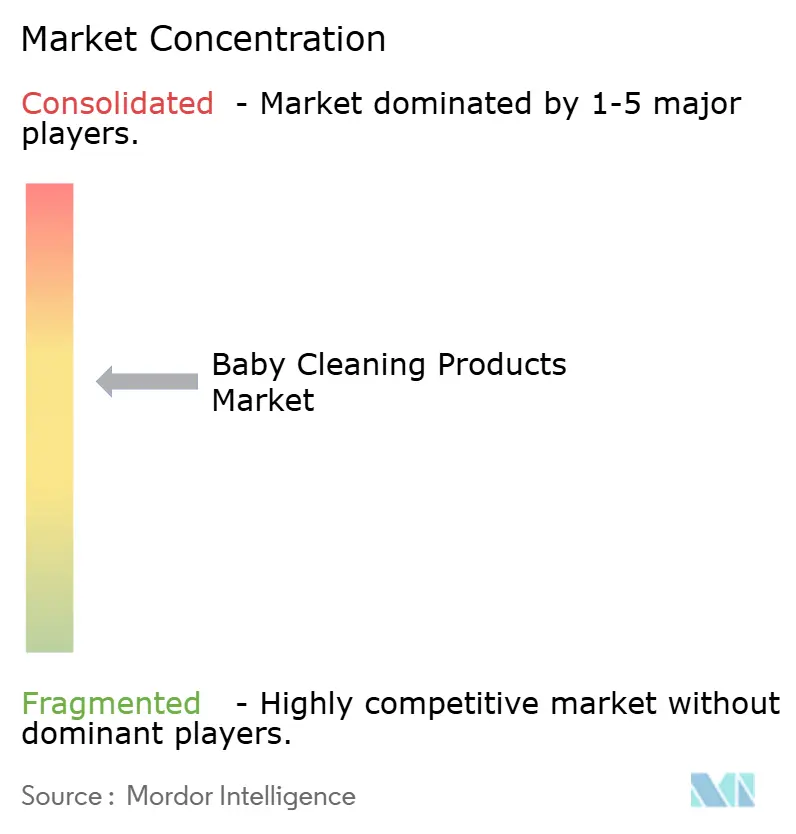
The top five players collectively hold an estimated 54% of category sales, indicating moderate concentration. Kimberly-Clark, Procter & Gamble, and Johnson & Johnson rely on long-standing trust and a multichannel footprint. Kimberly-Clark expanded its Huggies franchise into diaper-rash-protective wipes that claim 99% pure water and botanical extracts. Procter & Gamble’s patent pipeline includes hot-melt adhesives that tolerate high humidity, improving diaper tab integrity. Kenvue leverages cross-brand dermatology expertise to introduce tiered cleansing systems tied to clinical studies. SC Johnson’s 2024 acquisition of Babyganics demonstrates that inorganic growth plays targeting green-label loyalists.
Mid-size challengers differentiate through single-origin ingredient sourcing and transparent carbon accounting. Australian brand Ecoriginals touts bamboo fiber provenance, while India’s Mamaearth scales export reach via Amazon storefronts. Private labels rise in Western Europe, riding retailer mandates to hit eco-score thresholds that mirror national plastic tax schemes. Licensing deals with children’s entertainment franchises add emotional appeal and command price premiums despite functional parity.
R&D focus pivots to enzyme cocktails that remove baby food stains at cold settings, granting an “energy saver” claim that resonates in regions with high utility tariffs. Investment in vertically integrated pulp lines secures supply of Forest Stewardship Council-certified fibers, guarding margins against feedstock swings. Patented air-filtering covers for infant carriers create adjacency entry points for cleaning product brands eager to bundle hygiene accessories. As ESG reporting tightens, large corporations disclose cradle-to-gate emissions, elevating procurement barriers for smaller suppliers lacking traceability systems.
Baby Cleaning Products Industry Leaders
-
Procter & Gamble
-
Kenvue Inc.
-
Kimberly-Clark Corporation
-
Unilever plc
-
Pigeon Corporation
- *Disclaimer: Major Players sorted in no particular order
Baby Cleaning Products Market Companies Covered in this Report
- Kenvue Inc.
- Procter & Gamble
- Kimberly-Clark Worldwide
- Unilever plc
- The Honest Company Inc.
- Babyganics (SC Johnson)
- Earth Mama Organics
- Seventh Generation Inc.
- Pigeon Corporation
- Dapple Baby (MaddieBrit)
- Chicco (Artsana S.p.A.)
- NUK (Newell Brands)
- Dr. Brown's (Handi-Craft)
- Milton (Acraf S.p.A.)
- Munchkin Inc.
- Biokleen (Weiman)
- Mustela (Laboratoires Expanscience)
- Sebapharma GmbH & Co. KG
- Farlin Corporation
- Unicharm
Recent Industry Developments in Baby Cleaning Products Market
- April 2025: ITC bought a 73.5% stake in Mother Sparsh for INR 126 crore (USD 14.5 million), adding a digital-first Ayurvedic label posting more than INR 110 crore (USD 12.6 million) in annual sales to its personal-care stable.
- April 2025: Hiro Technologies introduced the first fungi-powered “MycoDigestible” diaper, using mycelium to accelerate biodegradation and cut landfill impact.
- April 2025: HealthyBaby broadened its EWG-Verified line with Gentle Nose & Face Wipes made from organic botanicals and plastic-free fibers, while Procter & Gamble’s Dreft launched “purtouch,” a 65% plant-based hypoallergenic detergent manufactured using 100% wind energy.
Global Baby Cleaning Products Market Report Scope
| Baby Wipes |
| Baby Laundry Detergents |
| Baby Bottle & Dish Cleansers |
| Surface & Toy Cleaners |
| Fruit & Vegetable Wash |
| Liquid & Gel |
| Wipes |
| Powder & Tablet |
| Spray & Foam |
| Bar Soap |
| Supermarkets & Hypermarkets |
| Pharmacy & Drugstores |
| Baby Specialty Stores |
| Online Retail / E-commerce |
| Convenience & Department Stores |
| North America | United States |
| Canada | |
| Mexico | |
| Europe | Germany |
| United Kingdom | |
| France | |
| Italy | |
| Spain | |
| Rest of Europe | |
| Asia Pacific | China |
| Japan | |
| India | |
| South Korea | |
| Australia | |
| Rest of Asia Pacific | |
| Middle East & Africa | GCC |
| South Africa | |
| Rest of Middle East & Africa | |
| South America | Brazil |
| Argentina | |
| Rest of South America |
| By Product Type | Baby Wipes | |
| Baby Laundry Detergents | ||
| Baby Bottle & Dish Cleansers | ||
| Surface & Toy Cleaners | ||
| Fruit & Vegetable Wash | ||
| By Form | Liquid & Gel | |
| Wipes | ||
| Powder & Tablet | ||
| Spray & Foam | ||
| Bar Soap | ||
| By Distribution Channel | Supermarkets & Hypermarkets | |
| Pharmacy & Drugstores | ||
| Baby Specialty Stores | ||
| Online Retail / E-commerce | ||
| Convenience & Department Stores | ||
| By Geography | North America | United States |
| Canada | ||
| Mexico | ||
| Europe | Germany | |
| United Kingdom | ||
| France | ||
| Italy | ||
| Spain | ||
| Rest of Europe | ||
| Asia Pacific | China | |
| Japan | ||
| India | ||
| South Korea | ||
| Australia | ||
| Rest of Asia Pacific | ||
| Middle East & Africa | GCC | |
| South Africa | ||
| Rest of Middle East & Africa | ||
| South America | Brazil | |
| Argentina | ||
| Rest of South America | ||
Key Questions Answered in the Report
What is the projected value of the baby cleaning products market in 2030?
The market is expected to reach USD 6.8 billion by 2030.
Which product form is growing fastest in baby cleaning products?
Spray and foam cleaners lead with a 10.6% CAGR through 2030.
Why are biodegradable wipes gaining traction?
Regulatory bans on plastic-containing wipes and retailer delistings drive demand for plant-based alternatives.
Which region will post the highest growth through 2030?
Asia Pacific is forecast to expand at a 7.5% CAGR due to rising middle-class spending and e-commerce expansion.
How does e-commerce influence brand competition?
Online channels enable niche entrants to bypass traditional retail, leverage data analytics, and scale via subscription models.
What technological trend supports premium detergents?
Enzymatic plant-based formulations clean effectively at cold temperatures, reducing energy use and appealing to eco-conscious parents.