
India Mechanical, Electrical, and Plumbing (MEP) Services Market Size and Share
Market Overview
| Study Period | 2020 - 2031 |
|---|---|
| Forecast Data Period | 2026 - 2031 |
| Base Year Market Size (2025) | USD 10.97 Billion |
| Market Size (2026) | USD 12.12 Billion |
| Market Size (2031) | USD 19.91 Billion |
| Growth Rate (2026 - 2031) | 10.44 % |
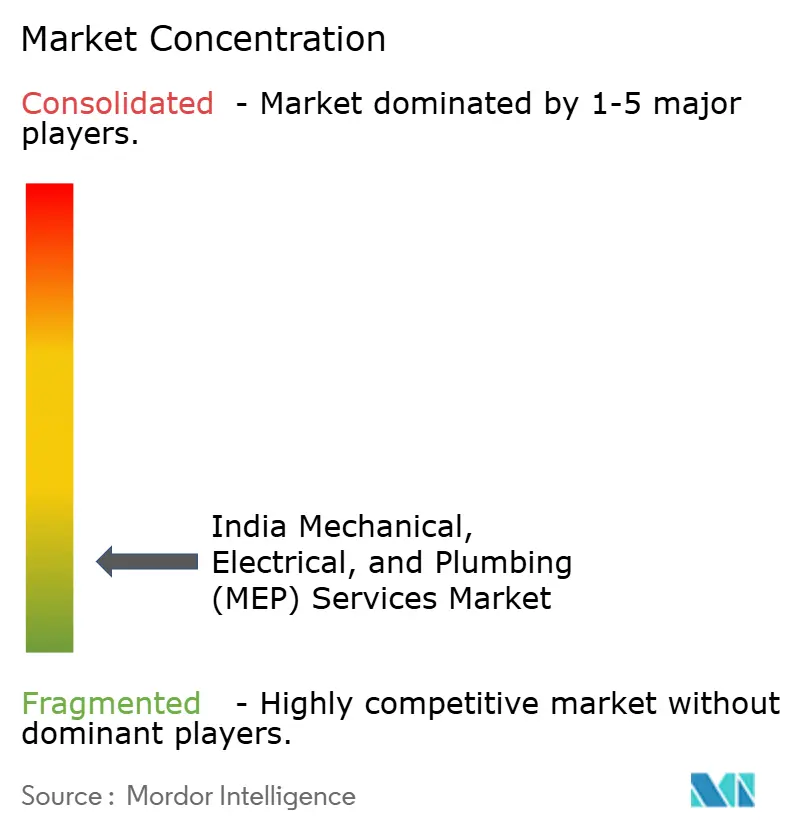
| Market Concentration | Low |
Major Players *Disclaimer: Major Players sorted in no particular order Image © Mordor Intelligence. Reuse requires attribution under CC BY 4.0. | |
India Mechanical, Electrical, and Plumbing (MEP) Services Market Analysis by Mordor Intelligence
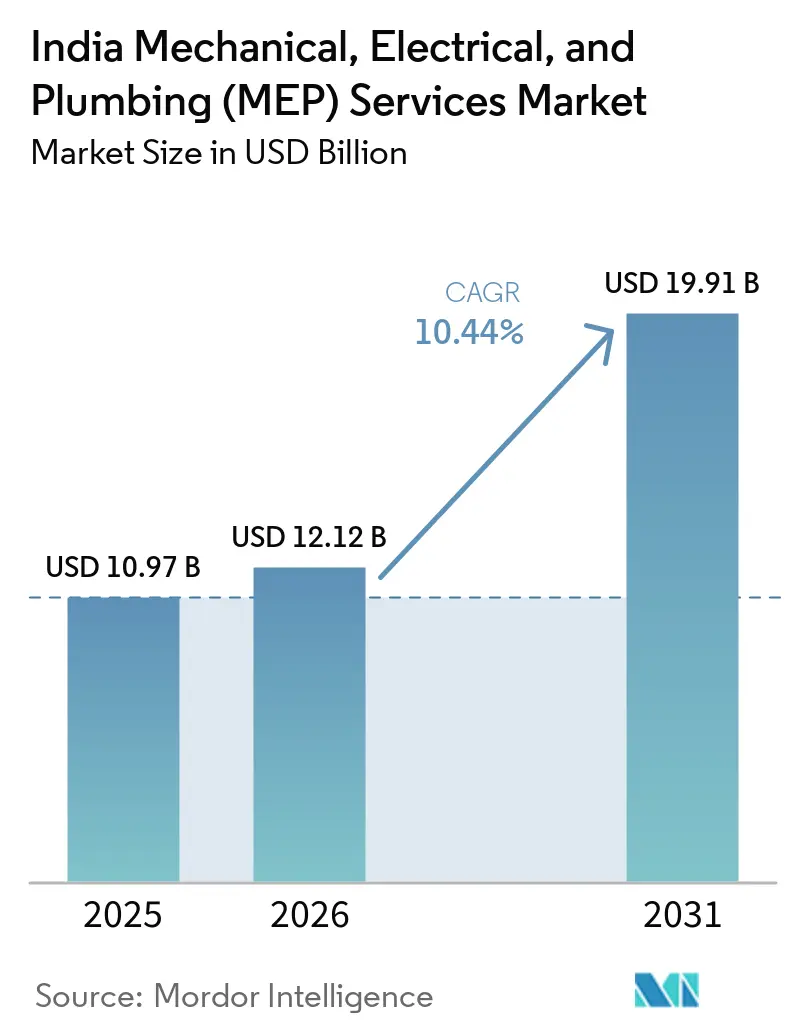
The India Mechanical, Electrical, And Plumbing Services Market size was valued at USD 10.97 billion in 2025 and is estimated to grow from USD 12.12 billion in 2026 to reach USD 19.91 billion by 2031, at a CAGR of 10.44% during the forecast period (2026-2031).
Demand is moving toward projects that require coordinated mechanical, electrical, and plumbing design rather than separate installation packages. Data centers, airports, metro systems, commercial campuses, and high-specification industrial facilities are raising the technical content of each contract. Energy rules are also making performance, commissioning, and documentation more important across large buildings. Contractors with design, procurement, and on-site delivery capability are better placed to manage complex scopes. The India MEP services market, therefore, rewards firms that can combine technical coordination with dependable execution.
Key Report Takeaways
- By type, mechanical services held 40.1% of the India MEP services market share in 2025, while integrated MEP services are forecast to grow at an 11.55% CAGR through 2031.
- By service type, design and engineering held 36.2% of the India MEP services market share in 2025, while managed and performance-based services are forecast to grow at an 11.79% CAGR through 2031.
- By end-user industry, commercial users held 41.6% of the India MEP services market size in 2025, while infrastructure is forecast to grow at an 11.92% CAGR through 2031.
- By city, Mumbai Metropolitan Region held 19.9% of the India MEP services market share in 2025, while Hyderabad is forecast to grow at a 12.22% CAGR through 2031.
Note: Market size and forecast figures in this report are generated using Mordor Intelligence’s proprietary estimation framework, updated with the latest available data and insights as of January 2026.
India Mechanical, Electrical, and Plumbing (MEP) Services Market Trends and Insights
Drivers Impact Analysis*
| Drivers | (~) % Impact on CAGR Forecast | Geographic Relevance | Impact Timeline |
|---|---|---|---|
| Data Center and High-Tech Facility Expansion | +2.3% | Hyderabad, Mumbai, Chennai, Noida, Pune, Bengaluru | Short term (≤ 2 years) |
| National Infrastructure and Urban Development Pipeline | +2.2% | National, with early gains in the Mumbai Metropolitan Region, Delhi NCR, and Bengaluru | Medium term (2-4 years) |
| Energy Efficiency and Green Building Requirements | +1.8% | National, with compliance activity concentrated in Tier-1 cities | Medium term (2-4 years) |
| Outsourcing of Technical Facility Operations | +1.4% | Bengaluru, Hyderabad, Pune, and Delhi NCR | Medium term (2-4 years) |
| BIM-Led Prefabrication for Constrained Metropolitan Sites | +0.9% | Mumbai Metropolitan Region, Delhi NCR, and Bengaluru | Long term (≥ 4 years) |
| Water-Neutral Plumbing and Circular Water Management | +0.6% | Maharashtra, Tamil Nadu, Karnataka, and IGBC-rated projects nationally | Long term (≥ 4 years) |
| Source: Mordor Intelligence | |||
Data Center and High-Tech Facility Expansion Anchoring Mission-Critical MEP Demand
Data center construction is expanding the need for cooling, electrical distribution, backup power, fire protection, and water systems that must work as one operating environment. TCS stated in September 2026 that HyperVault had secured land in Telangana for a large-scale artificial intelligence data center campus, creating a substantial future requirement for integrated building systems[1]. These facilities require precise cooling and resilient electrical systems because interruption risks are much higher than in standard commercial buildings. The India MEP services market gains from this change because project owners need contractors that can coordinate multiple technical systems before construction begins. Process facilities, including semiconductor-related sites, add a similar need for controlled environments and specialized heating, ventilation, and air-conditioning systems. Tata Projects reported the delivery of the Micron semiconductor facility at Sanand in its 2025-26 annual report[2]. These projects favor firms that can manage detailed design, installation, testing, and final commissioning without transferring responsibility between many subcontractors.
National Infrastructure and Urban Development Pipeline Sustaining Broad-Based MEP Demand
Large infrastructure programs support demand for electrical, mechanical, plumbing, life-safety, and building-control work across several project categories. Airports and metro systems require integrated systems because public safety, passenger comfort, and uninterrupted operations depend on coordinated delivery. Tata Projects reported the completion of Noida International Airport Phase 1 and work connected with Pune Metro Line 3 in its 2025-26 annual report. The India MEP services market benefits when owners award a combined scope that includes design coordination and field execution. This approach can reduce gaps between mechanical, electrical, plumbing, and fire-protection work during construction. It also places greater weight on contractors who understand public infrastructure standards and complex project schedules. The opportunity is broad, but it remains most valuable for suppliers that can carry technical responsibility across the full project cycle.
Energy Efficiency and Green Building Requirements Reshaping MEP Specification Standards
Energy requirements are increasing the technical specifications used in large residential and commercial developments. Eco-Niwas Samhita 2024 brings building envelope and equipment requirements into a single residential energy code, including requirements for lighting, air conditioners, elevators, and pumps[3]. The draft amendment issued by the Ministry of Power in July 2026 proposes mandatory Bureau of Energy Efficiency star ratings for new buildings above 20,000 square meters before completion. These requirements place more attention on equipment selection, verification, testing, and records created during commissioning. The India MEP services market can therefore gain value from the part of the contract that confirms building systems meet the required standard. GRIHA Version 6 also describes a large, registered project base and links green-building practice to energy and resource performance. Contractors with documented energy-management and commissioning capabilities can compete on compliance quality instead of relying only on installation pricing.
Outsourcing Technical Facility Operations Driving Managed MEP Models
Corporate campuses and high-availability facilities increasingly require operating support after construction is complete. This need is to help clients consider contracts that cover equipment uptime, energy performance, maintenance planning, and compliance activity over several years. Managed and performance-based services are the fastest-growing service type in the India MEP services market, with an 11.79% CAGR forecast through 2031. Building management systems and connected monitoring can give owners clearer visibility into equipment performance and maintenance needs. These tools also allow service providers to use the design and commissioning information created during construction in later operations. The commercial case is stronger where cooling, power reliability, and operating continuity affect the client’s core activity. This shift supports recurring service work, but providers must show that their field teams can meet performance commitments consistently.
Restraints Impact Analysis*
| Restraints | (~) % Impact on CAGR Forecast | Geographic Relevance | Impact Timeline |
|---|---|---|---|
| Shortage Of Skilled MEP And Commissioning Technicians | -1.8% | National, with the greatest pressure in Tier-1 cities | Short term (≤ 2 years) |
| Imported Equipment Lead Times And Component Price Volatility | -1.6% | National, with a greater effect in Tier-2 cities with weaker supply chains | Short term (≤ 2 years) |
| Fragmented Contracting And Contractor Cash-Flow Pressure | -1.2% | National, concentrated in government-client project corridors | Medium term (2-4 years) |
| Inconsistent Municipal Approvals And Retrofit Constraints | -0.9% | NMMC, CIDCO, and secondary ULBs, with improving conditions in GHMC and BDA | Medium term (2-4 years) |
| Source: Mordor Intelligence | |||
Skilled MEP Workforce Scarcity Constraining Execution Capacity
The delivery of complex MEP work depends on trained engineers, technicians, commissioning staff, and supervisors who can coordinate several building systems. The workforce challenge is most visible when multiple data centers, infrastructure, and commercial projects are being delivered in the same city. The National Building Information Modeling policy direction also increases demand for engineers who can use digital coordination methods alongside site teams. A shortage in either field execution or digital coordination can delay handover and increase the risk of rework. The India MEP services market is therefore likely to favor contractors that invest in internal training, standardized methods, and experienced project managers. Off-site assembly can help reduce work at congested sites, but it still requires skilled teams to design modules and complete final installation. Smaller contractors may find it difficult to build both digital and field capabilities at the same time.
Imported Equipment Lead Times and Component Price Volatility Pressuring Project Economics
Specialized electrical and cooling equipment can create procurement pressure when delivery schedules are tight. This issue matters most for facilities that need high-capacity electrical distribution, backup systems, precision cooling, or advanced controls. Fixed-price contracts can become harder to manage when materials or long-lead equipment must be ordered before the full site schedule is certain. The India MEP services market also faces more risk when smaller contractors do not have the working capital to reserve equipment early. Large contractors may have an advantage because they can plan procurement across multiple projects and work more directly with manufacturers. Project owners can limit some of this risk by aligning equipment decisions with design completion and realistic construction milestones. Clear technical specifications and early procurement planning remain important to avoid avoidable schedule disruption.
*Our forecasts treat driver/restraint impacts as directional, not additive. The impact forecasts reflect baseline growth, mix effects, and variable interactions.
Segment Analysis
By Type: Mechanical Services Leads, While Integrated Delivery Gains Ground
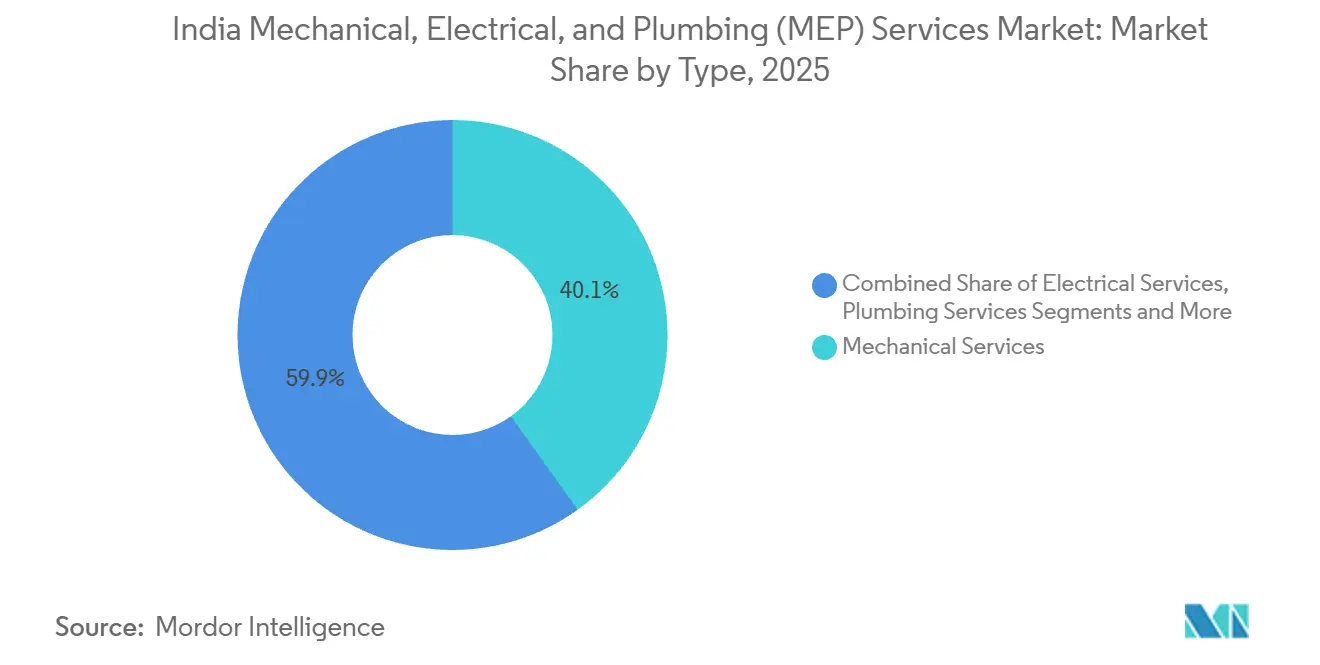
Mechanical services held 40.1% of the India MEP services market share in 2025. Heating, ventilation, and air-conditioning work remains central to commercial buildings, hospitals, infrastructure assets, and facilities requiring continuous cooling. Data center construction raises the importance of precision cooling and closely coordinated mechanical design. Electrical services form the next major area of demand because projects need high-voltage and low-voltage distribution, backup power, controls, and building-system integration. Plumbing services are often procured through several packages, although water efficiency and reuse requirements are creating a stronger case for integrated planning. Maharashtra’s 2025 wastewater reuse policy for 424 urban local bodies gives new importance to plumbing layouts that support reuse and dual-water systems. The mix means the India MEP services industry must retain deep discipline-specific expertise even as clients seek one accountable contractor.
Integrated MEP services are forecast to grow at an 11.55% CAGR from 2026 to 2031. Clients use an integrated package where the main risk comes from the interface between several disciplines rather than from a single equipment category. Airports, hospital campuses, data centers, and phased commercial projects fit this model because design changes in one system can affect all others. Sterling and Wilson entered a June 2026 memorandum of understanding with Shinsung E&G for cleanroom and dry-room heating, ventilation, and air-conditioning projects in semiconductor, battery, and display facilities. The move shows why process facilities require delivery models that bring specialized system knowledge into a wider MEP scope. Energy-code compliance also favors close coordination between cooling, lighting, pumping, and solar systems. The India MEP services market will continue to use specialist packages, but integrated delivery has a clear role where technical coordination determines project outcomes.

By Service Type: Design And Engineering Holds the Largest Position
Design and engineering accounted for 36.2% of the India MEP services market share in 2025. Early design choices affect equipment size, layout, power demand, cooling performance, water use, and future maintenance access. This stage has a strong effect on capital discipline because changes discovered late in construction can be costly and disruptive. Installation, testing, and commissioning remain essential because even well-designed systems must be installed and verified under site conditions. Maintenance, repair, and retrofit work can gain importance as owners update older buildings to meet newer energy and operating expectations. The India MEP services industry is also being shaped by the need for clearer records from design through handover. This record is useful to owners because it supports later maintenance decisions and system modifications.
Managed and performance-based services are forecast to grow at an 11.79% CAGR from 2026 to 2031. These contracts extend the contractor’s role from construction delivery into equipment operation and performance assurance. A completed digital model can support this transition when it captures the final condition of equipment and systems. Managed contracts may be especially relevant for campuses and commercial facilities that operate for long hours and need predictable maintenance. Energy requirements can increase the value of this service because owners need evidence that installed systems are operating as specified. The India MEP services market size for these services can grow when owners value guaranteed uptime and measurable energy outcomes over isolated repair visits. Providers will need technical depth and responsive field coverage to make these contracts credible.
By End-User Industry: Commercial Leads, Infrastructure Grows Fastest
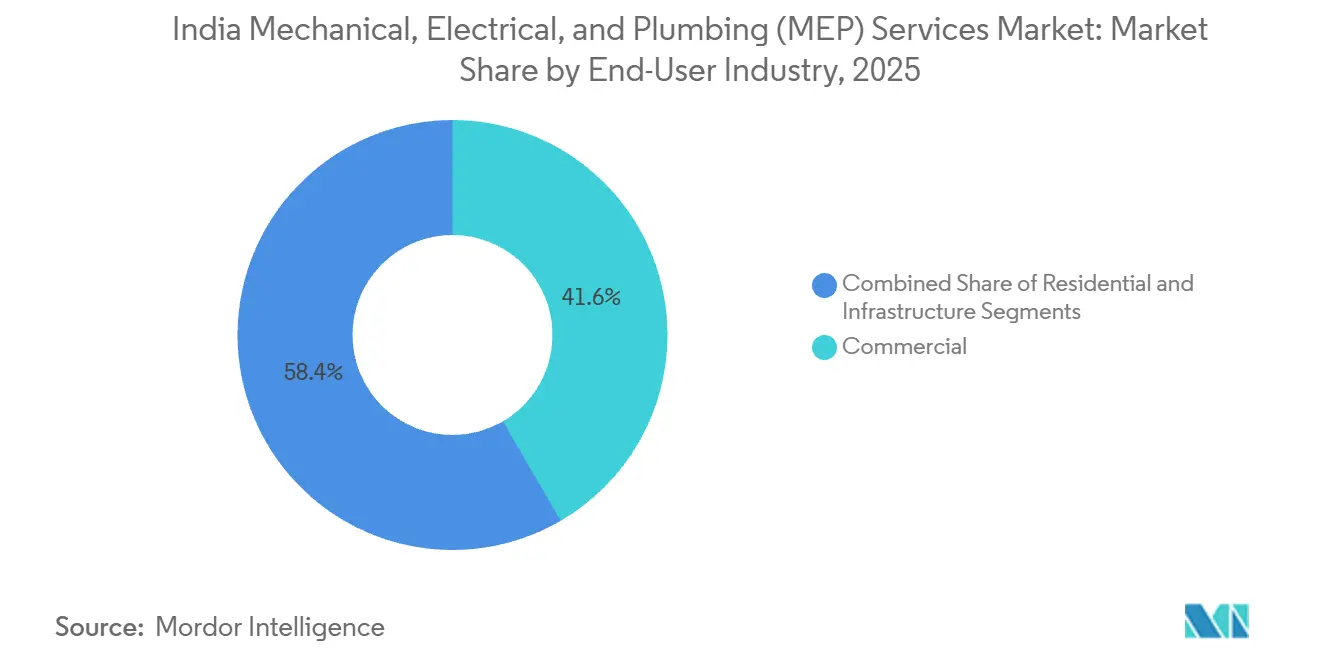
Commercial end users held 41.6% of the India MEP services market share in 2025. Grade-A offices, retail locations, hotels, and corporate campuses need systems that provide comfort, safety, reliable power, and efficient operation. Premium properties also seek stronger environmental credentials to meet tenant expectations and reduce operating costs. Global capability center campuses can have greater cooling and power needs than conventional offices because of longer operating hours and denser technology use. Residential activity contributes significant installation volume, but the value per project can be lower than in complex commercial developments. Eco-Niwas Samhita 2024 applies to residential buildings above the stated connected-load threshold and raises attention to equipment performance. This can gradually increase specification quality in the residential part of the India MEP services market.
Infrastructure is forecast to grow at an 11.92% CAGR from 2026 to 2031. Airports, metro stations, government facilities, and digital infrastructure need coordinated electrical, mechanical, plumbing, fire, and life-safety systems. Tata Projects reported airport and metro project delivery in FY2026, demonstrating the integrated character of these assignments. The scale of these projects makes construction planning and commissioning just as important as equipment installation. Advanced computing facilities may create another class of infrastructure work because they need stable power, thermal control, and close monitoring. The India MEP services market benefits when infrastructure owners use technical specifications that recognize the interdependence of all building systems. Contractors that can coordinate these systems from design through commissioning are likely to be more relevant to large public and private infrastructure programs.
Geography Analysis
Mumbai Metropolitan Region accounted for 19.9% of the India MEP services market size in 2025. Its large base of offices, premium housing, transit projects, and airport development supports work across several MEP disciplines. Dense development conditions raise the need for careful design coordination, site planning, and modular assembly. Contractors that can complete mechanical, electrical, plumbing, fire, and controls work under a coordinated plan can be more competitive in this environment. The regional project mix also supports demand for energy-efficient systems because operating costs and compliance requirements matter to large property owners.
Hyderabad is the fastest-growing city segment, with a forecast 12.22% CAGR through 2031. The city’s expanding data center activity creates demand for systems with high cooling capacity, reliable electrical distribution, backup arrangements, and continuous monitoring. TCS’s September 2026 announcement of a large-scale artificial intelligence data center campus in Telangana supports the view that Hyderabad will remain important for mission-critical project activity. The city also has technology and commercial developments that create a wider base of demand. Growth will depend on contractors being able to secure trained personnel and equipment on schedules that match the pace of construction.
Delhi NCR and Bengaluru provide broad demand across commercial facilities, public projects, technology campuses, manufacturing, and aviation-linked development. Pune is supported by automotive and pharmaceutical facility upgrades, while Chennai’s connectivity supports data center and commercial investment. Kolkata and other cities contribute through housing and public infrastructure activities. The India MEP services market share remains concentrated in the largest urban centers because they contain the widest mix of complex assets. However, cities outside the main metros can offer room for contractors that bring consistent technical quality and project discipline. The geographic opportunity is therefore not limited to the highest-growth city, but implementation capability will shape which firms convert regional demand into completed work.
Competitive Landscape
The India MEP services market is fragmented among subcontractors, while larger integrated contractors are more visible on complex assignments. Larsen and Toubro, Tata Projects, Sterling and Wilson, Blue Star, and Voltas, through Universal MEP Projects and Engineering Services, compete across data centers, airports, metro systems, and large commercial developments. Blue Star has stated that data center MEP work is an important area of its growth plans, which shows the growing strategic value of this category. Larger firms can compete on engineering depth, procurement planning, working-capital capacity, and multi-site delivery. Smaller contractors can remain relevant where they have strong local execution or specialized capability. The competitive balance changes when a project requires a single party to take responsibility for many interconnected systems.
Company moves are increasingly focused on process facilities and technology infrastructure. Sterling and Wilson’s June 2026 memorandum of understanding with Shinsung E&G supports joint work on cleanroom and dry-room heating, ventilation, and air-conditioning applications. Tata Projects reported strategic memoranda of understanding with Honeywell, Microsoft, Google, and Torrent Power in FY2026, alongside major project delivery activity. These moves show that leading contractors are developing relationships that can support design-and-build work in technology and industrial settings. Facility-management providers also compete for longer-duration technical service contracts after building handover. The distinction between construction delivery and technical operations is becoming less clear, as owners want one provider to support system performance over time.
The competitive opportunity in Tier-2 cities comes from projects that need consistent design coordination, energy-code compliance, and predictable site delivery. National contractors may prioritize the largest assignments, while local firms may have narrow technical coverage. This creates a role for firms that can deliver BIM-coordinated work without the cost structure of the largest players. Compliance capability is also becoming a practical differentiator because owners need systems that can be commissioned and documented against energy requirements. Contractors that develop formal energy-management and green-building support can strengthen their position with institutional clients. The India MEP services market remains open to specialists, but they need clear technical strengths to compete with integrated firms.
India Mechanical, Electrical, and Plumbing (MEP) Services Industry Leaders
-
Sterling and Wilson Private Limited
-
Blue Star Limited
-
Voltas Limited
-
Larsen & Toubro Limited
-
Tata Projects Limited
- *Disclaimer: Major Players sorted in no particular order
Recent Industry Developments
- September 2026: TCS subsidiary HyperVault secured land in Hyderabad for a large-scale artificial intelligence data center campus. The company described the project as a major data infrastructure investment in Telangana.
- June 2026: Sterling and Wilson signed a memorandum of understanding with Shinsung E&G of South Korea for joint bidding and execution of cleanroom and dry-room heating, ventilation, and air-conditioning projects for semiconductor, battery, and display facilities in India.
- April 2026: Tata Projects disclosed FY2025-26 project delivery that included Noida International Airport Phase 1 and the Micron Semiconductor ATMP facility in Sanand, as well as strategic memoranda of understanding with Honeywell, Microsoft, Google, and Torrent Power.
India Mechanical, Electrical, and Plumbing (MEP) Services Market Report Scope
| Mechanical Services |
| Electrical Services |
| Plumbing Services |
| Integrated MEP Services |
| Design and Engineering |
| Installation, Testing, and Commissioning |
| Maintenance, Repair, and Retrofit |
| Managed / Performance-Based Services |
| Residential |
| Commercial |
| Infrastructure |
| Mumbai Metropolitan Region |
| Delhi NCR |
| Pune |
| Bengaluru |
| Hyderabad |
| Chennai |
| Kolkata |
| Rest of India |
| By Type | Mechanical Services |
| Electrical Services | |
| Plumbing Services | |
| Integrated MEP Services | |
| By Service Type | Design and Engineering |
| Installation, Testing, and Commissioning | |
| Maintenance, Repair, and Retrofit | |
| Managed / Performance-Based Services | |
| By End-User Industry | Residential |
| Commercial | |
| Infrastructure | |
| By City | Mumbai Metropolitan Region |
| Delhi NCR | |
| Pune | |
| Bengaluru | |
| Hyderabad | |
| Chennai | |
| Kolkata | |
| Rest of India |
Key Questions Answered in the Report
What is the projected growth rate for India MEP services?
The India MEP services market is forecast to grow at a 10.44% CAGR from 2026 to 2031, reaching USD 19.91 billion by 2031.
Which MEP service type has the largest share in India?
Design and engineering were the largest service type, with 36.2% share in 2025.
Which MEP type is growing fastest in India?
Integrated MEP services are the fastest-growing type, with a projected CAGR of 11.55% through 2031.
Which end-user segment is expanding fastest for MEP services?
Infrastructure is forecast to grow at an 11.92% CAGR through 2031, supported by complex transport, public, and digital facilities.
Which city is forecast to grow fastest for MEP services?
Hyderabad is forecast to grow at 12.22% CAGR through 2031, supported by data center and technology-related construction.
Why are energy rules important for MEP contractors in India?
Energy requirements increase the importance of equipment selection, testing, commissioning, and documented building performance.