
Market Overview
| Study Period | 2020 - 2031 |
|---|---|
| Forecast Data Period | 2026 - 2031 |
| Base Year Market Size (2025) | USD 74.48 Million |
| Market Size (2026) | USD 82.2 Million |
| Market Size (2031) | USD 134.68 Million |
| Growth Rate (2026 - 2031) | 10.37 % |
| Market Concentration | Medium |
Major Players *Disclaimer: Major Players sorted in no particular order Image © Mordor Intelligence. Reuse requires attribution under CC BY 4.0. | |
India Mammography Market Analysis by Mordor Intelligence
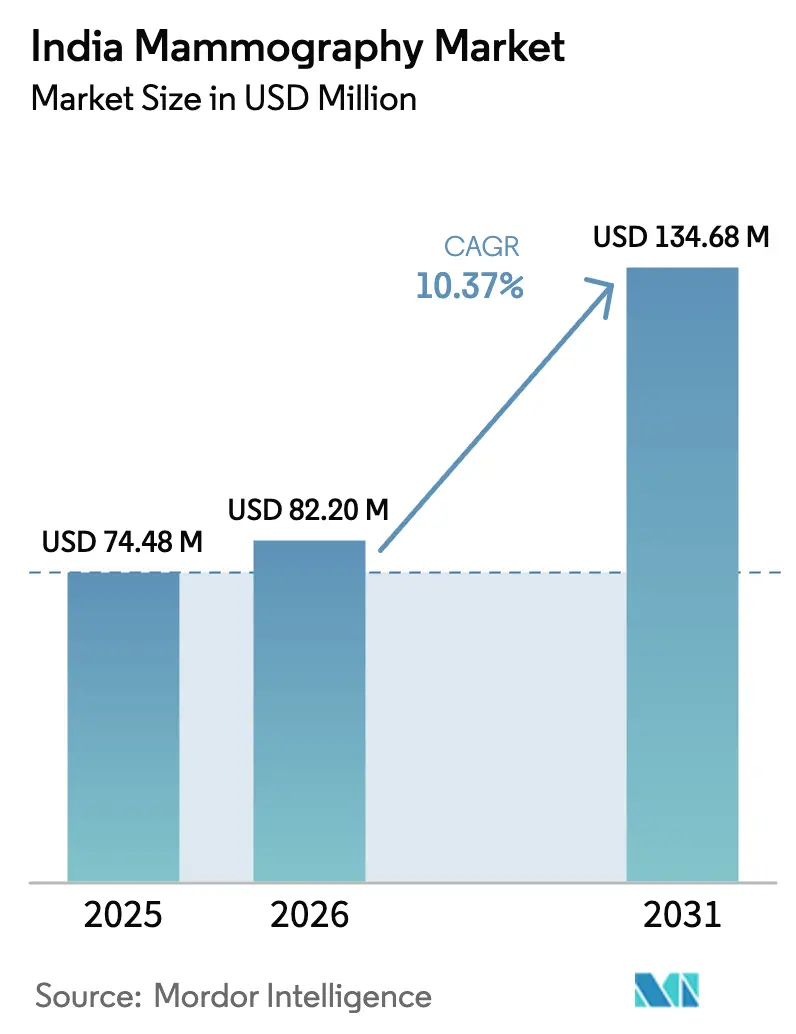
The India mammography market size is expected to grow from USD 74.48 million in 2025 to USD 82.2 million in 2026 and is forecast to reach USD 134.68 million by 2031 at 10.37% CAGR over 2026-2031. The growth reflects government-funded population screening, hospital upgrades to 3-D systems, and private diagnostic expansion into tier-2 and tier-3 cities. Breast cancer’s 32% share of all female malignancies has moved early detection from an urban concern to a national priority. Domestic manufacturing commitments by Wipro GE Healthcare and Siemens Healthineers are lowering device costs and accelerating technology adoption. Meanwhile, AI-assisted triage solutions address radiologist shortages and improve throughput, further catalyzing the India mammography market.
Key Report Takeaways
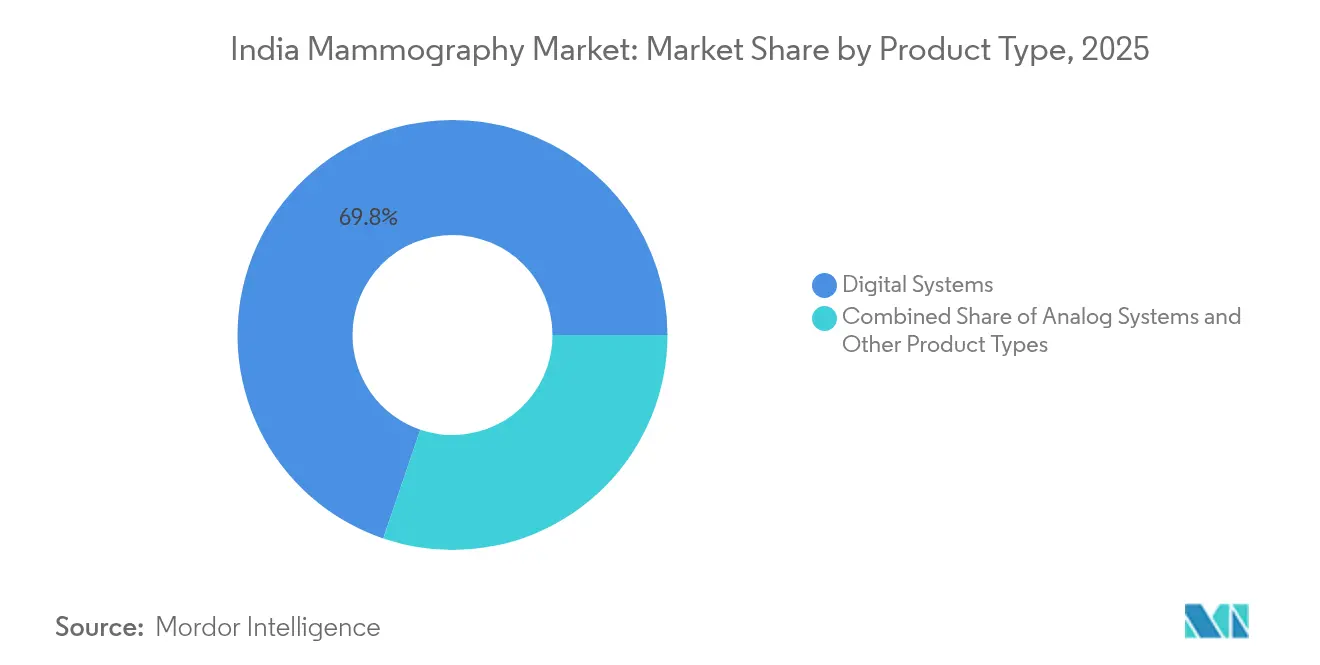
- Digital Systems captured 69.78% of the India mammography market share in 2025, whereas Other Product Types are projected to expand at an 11.22% CAGR through 2031.
- Hospitals accounted for 64.45% of the India mammography market size in 2025, and Specialty Clinics are advancing at an 11.63% CAGR to 2031.
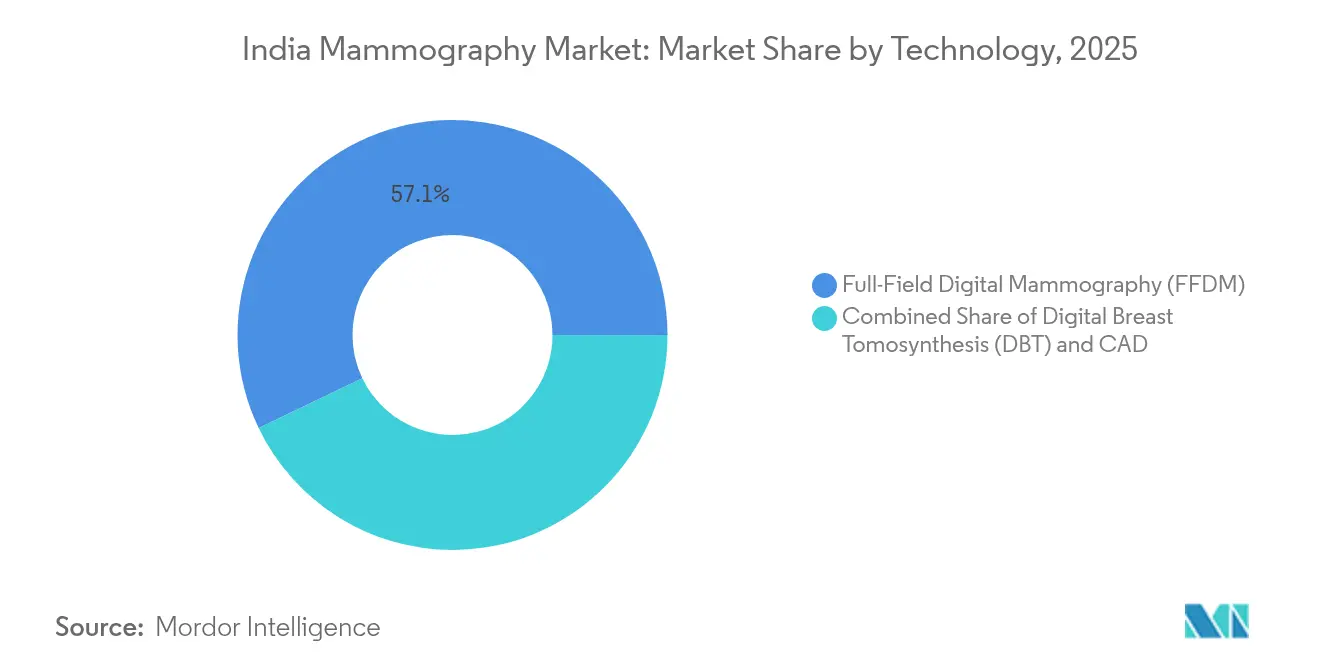
- Full-Field Digital Mammography held 57.12% of the India mammography market share in 2025, while Digital Breast Tomosynthesis is set to grow at an 11.78% CAGR over the forecast period.
Note: Market size and forecast figures in this report are generated using Mordor Intelligence’s proprietary estimation framework, updated with the latest available data and insights as of 2026.
India Mammography Market Trends and Insights
Drivers Impact Analysis*
| Driver | (~) % Impact on CAGR Forecast | Geographic Relevance | Impact Timeline |
|---|---|---|---|
| Growing Burden Of Breast Cancer In Urban & Semi-Urban India | +2.8% | Urban metros and tier-2 cities, with spillover to semi-urban areas | Medium term (2-4 years) |
| Government-Funded Population-Based Screening Roll-Outs | +2.1% | National, with early gains in states with established NPCDCS infrastructure | Long term (≥ 4 years) |
| Expansion Of Large Private Diagnostic Chains Into Tier-2/Tier-3 Cities | +1.9% | Tier-2 and tier-3 cities across major states | Short term (≤ 2 years) |
| Rapid Hospital Adoption Of 3-D/DBT Upgrades As Cap-Ex Costs Fall | +1.7% | Urban hospitals and specialty centers nationwide | Medium term (2-4 years) |
| AI-Enabled Triage Solutions Easing Radiologist Shortage | +1.2% | Major metropolitan areas with advanced healthcare infrastructure | Medium term (2-4 years) |
| Corporate Wellness Programs Boosting Opportunistic Screening | +0.8% | Corporate hubs in major cities and industrial centers | Short term (≤ 2 years) |
| Source: Mordor Intelligence | |||
Growing Breast-Cancer Burden in Urban & Semi-Urban India
Breast-cancer diagnoses in India are projected to climb from 806,218 in 2025, driven by delayed childbearing and lifestyle changes. Higher awareness campaigns, especially in metros, are prompting earlier self-referral. Economic modeling places the breast-cancer cost burden at USD 13.95 billion by 2030. These pressures drive sustained procurement of digital systems and mobile units, strengthening the India mammography market.
Government-Funded Population-Based Screening Roll-Outs
The NPCDCS now covers more than 400 districts and has screened over 34.39 crore individuals for common cancers. More than 1,72,148 Ayushman Arogya Mandirs perform routine clinical breast examinations, generating predictable equipment demand across public facilities. Duty exemptions on select oncology drugs and the National Cancer Grid’s standardized protocols further reinforce volume certainty [1]. The program’s expansion into rural health sub-centers anchors the long-term trajectory of the India mammography market.
Expansion of Private Diagnostic Chains into Tier-2/Tier-3 Cities
Organized diagnostic players, holding 16–20% of the broader diagnostics revenue, are growing 8–9% annually. Dr. Lal PathLabs, Metropolis, and Neuberg set up satellite labs and imaging hubs, often bundling mobile mammography vans to widen catchment areas. Tele-radiology link-ups allow sub-10-minute turnaround of scans, mitigating radiologist scarcity. These moves funnel equipment sales toward compact digital units, deepening the India mammography market footprint in emerging towns.
Rapid Hospital Adoption of 3-D/DBT Upgrades
Capital outlays for Digital Breast Tomosynthesis have fallen 18–22% since 2023 as Wipro GE and Fujifilm ramp up local assembly. Apollo Hospitals and PGI Chandigarh publicly inaugurated 3-D suites in 2024, citing lower recall rates and improved dense-breast imaging. Vendor-neutral prior-image comparison and zero-click workflow features boost technologist productivity, sustaining hospital demand for premium upgrades. These trends accelerate the move toward 3-D dominance within the India mammography market.
Restraints Impact Analysis*
| Restraint | (~) % Impact on CAGR Forecast | Geographic Relevance | Impact Timeline |
|---|---|---|---|
| Uneven Reimbursement & Low Private Insurance Penetration | -1.8% | National, with acute impact in rural and semi-urban areas | Long term (≥ 4 years) |
| Radiation-Exposure Concerns Among Pre-Menopausal Women | -1.2% | Urban educated populations and health-conscious demographics | Medium term (2-4 years) |
| Scarcity Of Mammography Technicians In Tier-3 Towns | -1.0% | Tier-3 cities and rural healthcare facilities | Long term (≥ 4 years) |
| Import-Duty & GST Structure Inflating Device ASPs | -0.9% | National, affecting all market segments uniformly | Short term (≤ 2 years) |
| Source: Mordor Intelligence | |||
Uneven Reimbursement & Low Private Insurance Penetration
Only 41.2% of households have any insurance cover, and a mere 3.3% rely on private plans, stifling preventive screening uptake. State-level disparities are stark; Rajasthan reports 87.9% coverage while some island territories sit below 2%. Out-of-pocket mammography spending remains high because underwriting rules often treat screening as elective. Despite IRDAI guidance allowing coverage, real-world claims for mammograms stay low [2]. These gaps defer elective imaging and weigh on the India mammography market.
Radiation-Exposure Concerns Among Pre-Menopausal Women
Modeling estimates 86 induced cancers per 100,000 women screened, a statistic publicized in patient forums. Clinical protocols now recommend starting screening at age 30, intensifying exposure worries among younger cohorts. Dense-breast imaging and overdiagnosis debates circulate widely on social media, prompting some women to postpone scans. Hospitals counter by emphasizing low-dose DBT and AI-based triage, yet lingering perceptions still temper growth momentum in the India mammography market.
*Our forecasts treat driver/restraint impacts as directional, not additive. The impact forecasts reflect baseline growth, mix effects, and variable interactions.
Segment Analysis
By Product Type: Digital Dominance Drives Market Evolution
Digital Systems generated 69.78% of the India mammography market share in 2025 and underpin the nationwide shift toward image-rich, radiation-efficient diagnostics. Their cloud connectivity aligns with tele-radiology workflows, enabling remote reads from metro hubs. The India mammography market size for Digital Systems is expected to scale rapidly as state oncology programs mandate DICOM-compliant storage. Analog units are being phased out, often traded in for mobile vans targeting single-day screening camps. Other Product Types—biopsy-guided suites and van-mounted devices—show an 11.22% CAGR, buoyed by rural outreach under the National Health Mission.
Growing preference for base-hospital DBT plus satellite mobile units has widened vendor portfolios. Fujifilm alone has installed more than 50,000 medical devices across India, including FFDM scanners optimized for low-resource settings. Quality-assurance guidelines issued by the Breast Imaging Society of India push for uniform calibration and dose monitoring IJBI.IN. These standards reinforce digital predominance and help maintain consistent imaging quality across the India mammography market.

By End User: Specialty Clinics Narrow the Gap
Hospitals commanded 64.45% of the India mammography market size in 2025 on the back of multispecialty oncology centers and capacity expansions financed through public-private partnerships. Academic institutions anchor clinical trials and often serve as early adopters for AI-enabled diagnostics. Specialty Clinics, however, exhibit the fastest 11.63% CAGR as private chains bundle breast imaging with wellness panels and tele-consults. Their compact center format suits tier-3 cities where floor space is at a premium.
Workflow-enhancement devices such as GE HealthCare’s Pristina Via reduce technologist click counts, an attractive feature for clinics facing an 18% vacancy rate among radiographers. Mobile units parked at industrial sites under CSR initiatives further expand the addressable population. The combined institutional and entrepreneurial demand stabilizes unit shipments and ensures that the India mammography market remains resilient to macroeconomic fluctuations.
By Technology: DBT Innovation Reshapes Diagnostic Capability
FFDM retained 57.12% of the India mammography market share in 2025, yet growth momentum clearly tilts toward Digital Breast Tomosynthesis, forecast at an 11.78% CAGR. DBT’s layered imaging reduces tissue overlap, improving lesion detection in dense breasts and curbing recall anxiety. Computer-Aided Detection algorithms, both embedded and cloud-based, complement DBT and FFDM workflows, offering automated lesion flags within seconds.
A study in Odisha reported 98.7% sensitivity and 87.9% diagnostic accuracy for BI-RADS-guided readings on modern systems. The IAEA’s quality-assurance protocol underscores digital systems’ superiority and supports grant funding for DBT in government hospitals. Regulatory clarity under the Medical Devices Rules, 2017 fast-tracks import licenses for AI-enabled upgrades . Together these factors accelerate the transition toward 3-D, reinforcing the innovation profile of the India mammography market.
Geography Analysis
Metropolitan clusters such as Delhi-NCR, Mumbai-Pune, and Bengaluru host the densest installed base, driven by higher disposable incomes and awareness. Breast-cancer survival reaches 74.9% in Mizoram and 72.7% in Ahmedabad but falls below 42% in Pasighat, exposing stark regional care gaps. Northern and western corridors benefit from oncology hubs and medical-device parks that localize manufacturing, trimming logistics costs.
Southern states, notably Tamil Nadu and Karnataka, leverage strong public-health budgets and CSR-led screening drives. Punjab logged a 7% jump in breast-cancer incidence from 2021–2024, yet screening participation languishes at 0.3%. This gap is spurring mobile-van deployments under programs like Deen Dayal Chalit Aspatal, operating since 2007.
Tier-2/3 cities now anchor the fastest install growth as chain clinics cluster around state-highway spines. Uttar Pradesh, Bihar, and Madhya Pradesh, accounting for nearly half of national cancer cases, form the next frontier for the India mammography market. Indigenous device parks in Himachal Pradesh and Uttar Pradesh promise to shorten supply cycles, driving double-digit shipment growth into interior districts.
Regulatory Landscape
Mammography X-ray systems are regulated in India under the Medical Devices Rules (MDR), 2017, and are generally treated as Class C imaging devices. This places them within the Central Drugs Standard Control Organization (CDSCO) framework through the Central Licensing Authority for manufacturing licenses and related permissions. In June 2026, the Union health ministry proposed amendments to MDR 2017 to streamline and expedite licensing, including a reduction in the approval timeline for Class C and D device licenses from 105 days to 90 days, which changes time-to-market for mammography system manufacturers and importers.
Device promotion and healthcare engagement are also being tightened through the Uniform Code for Marketing Practices in Medical Devices (UCMPMD) 2024, which clarifies expectations for industry conduct. Alongside MDR requirements, suppliers selling into government facilities must align bids and product positioning with domestic preference mechanisms such as the Global Tender Enquiry (GTE) exemption list used to restrict imports for selected categories, reinforcing local assembly and domestically supported supply chains for imaging platforms.
Value Chain Analysis
The India mammography value chain is anchored by global and domestic OEMs that supply gantries, X-ray tubes, flat-panel detectors, generators, software, and AI-enabled workflow modules, followed by importers or local assemblers and national distributors that serve hospital and diagnostic-chain procurement teams. Despite growing local capabilities, India still relies heavily on overseas supply for diagnostic imaging hardware, with an estimated ~80% of diagnostic medical imaging equipment imported. This increases exposure to duties, logistics lead times, and service-part availability across installed bases.
Downstream, independent dealers and channel partners extend coverage into tier-2 and tier-3 cities, while third-party service providers and OEM service arms support installation, preventive maintenance, calibration, and uptime contracts that directly influence screening throughput. The chain also reflects a concentrated set of multinational suppliers, notably Siemens Healthineers, GE HealthCare, Hologic, and Fujifilm, which increasingly use local assembly to manage total landed costs. Capability-building initiatives such as skill labs and institutional collaborations further expand the trained technologist and radiographer pool needed to run FFDM and DBT systems across India.
Competitive Landscape
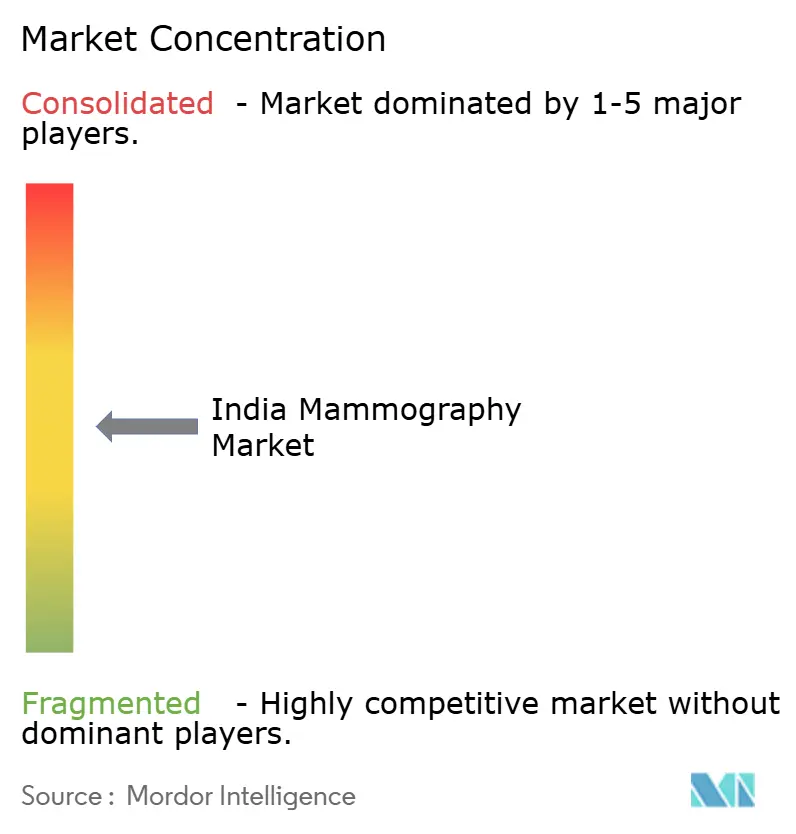
The India mammography market is moderately concentrated round a triad of multinationals—Wipro GE Healthcare, Siemens Healthineers, and Hologic—each localizing production to sidestep import duties that can reach 45%. Domestic brands such as BPL Medical Technologies leverage distribution alliances to fill rural demand with cost-optimized units. Competitive positioning centers on AI integration, dose-management features, and patient-comfort design.
Strategic alliances frame recent momentum: GE HealthCare and RadNet signed a multi-year collaboration to embed SmartTechnology AI into workflow stacks. Siemens Healthineers’ Bengaluru site now ships MAMMOMAT units throughout South Asia, slashing lead times. Hologic continues to dominate premium DBT, citing 250 million patients touched by its women’s-health portfolio in FY 2023.
White-space innovators are scaling AI triage: Vara secured USD 8.9 million to deploy cloud-based detection in NM Medical’s network. Thermalytix and Niramai offer thermal-imaging adjuncts aimed at low-resource clinics. The resultant blend of global R&D with local frugality creates a dynamic ecosystem, sustaining healthy rivalry while steadily raising the technology baseline across the India mammography market.
India Mammography Industry Leaders
-
Siemens AG
-
Planmed OY
-
Hologic Inc.
-
Fujifilm Holdings Corporation
-
GE Healthcare
- *Disclaimer: Major Players sorted in no particular order
Market Opportunities and Future Outlook
A major opportunity is localization of mammography system subassemblies and adjacent components, supported by central programs aimed at strengthening medical-device manufacturing. The Department of Pharmaceuticals has launched the Scheme for Strengthening of Medical Device Industry (SMDI) with subsidies up to INR 10 crore for component and device manufacturing, and up to INR 5 crore for clinical studies. This can reduce barriers for domestic suppliers of imaging-critical parts such as detectors, generators, and related electronics used in mammography platforms.
Procurement mechanics and industrial policy also create whitespace for suppliers that can meet domestic preference criteria. The government has identified 8-10 high-value medical devices and key inputs for accelerated domestic production, including X-ray tubes, imaging detectors, and generators, while the Global Tender Enquiry (GTE) exemption list (354 medical devices) restricts imports for selected categories where domestic capability is being prioritized. Market pull is visible in AI-enabled screening deployments and collaborations, including Fujifilm India installing an AI-powered digital mammography system at NM Medical in Mumbai (June 2026) and GE HealthCare expanding its collaboration with DeepHealth (April 2026), supporting integrated offerings that bundle hardware, AI tools, and service models for throughput needs in high-volume urban centers and expansion networks in tier-2 and tier-3 cities.
Recent Industry Developments
- June 2026: Fujifilm India installed the first AI-powered AMULET SOPHINITY digital mammography system at NM Medical in Mumbai. The AI-enabled imaging deployment in a high-volume urban center expands technology reach and demonstrates local presence of advanced diagnostics in India.
- April 2026: GE HealthCare announced expanded global collaboration with DeepHealth to distribute AI-powered breast cancer screening tools for GE HealthCare mammography systems. This expands AI-assisted screening across GE platforms and strengthens AI workflow capabilities in India pipeline.
- February 2026: Fujifilm India unveiled the FFDM Sophinity mammography system with AI-driven breast density assessment and tomosynthesis at IRIA 2026. Broadens technologically advanced options available to Indian radiology networks.
Research Methodology Framework and Report Scope
Market Definition and Coverage
For this methodology, the India mammography market covers revenues generated from mammography systems sold for breast imaging in India, covering both public and private care settings where screening and diagnostic imaging is performed.
Scope exclusions: We exclude breast ultrasound, breast MRI, biopsy consumables, contrast agents, radiologist reading fees, and broader oncology treatment spending because these sit outside mammography equipment revenues.
Segmentation Overview
- By Product Type
- Digital Systems
- Analog Systems
- Other Product Types (Biopsy-guided, Mobile units)
- By End User
- Hospitals
- Specialty Clinics
- Others
- By Technology
- Full-Field Digital Mammography (FFDM)
- Digital Breast Tomosynthesis (DBT)
- Computer-Aided Detection (CAD)
Data Sources, Market Sizing, and Validation
Desk Research
Desk research was used to anchor the demand context and keep the assumptions realistic for India. We reviewed public health and cancer burden signals from sources such as ICMR and the National Cancer Registry Programme, and we also used WHO references on screening and early detection. On the policy and system capacity side, we checked Government of India releases, including documents from the Ministry of Health and Family Welfare and items published through the Press Information Bureau.
To connect demand with procurement activity, we cross-checked customs and trade data series published by the Directorate General of Commercial Intelligence and Statistics. We also reviewed published guidance and adoption cues from professional bodies and peer-reviewed clinical literature. For product mix and pricing direction, we reviewed company filings, investor presentations, and reputable press. Where needed, we used a paid subscription covering company financials and an import-export shipment level database to validate supplier presence and shipment intensity. The sources listed here are illustrative, and we relied on additional public documents and datasets for cross-checks and clarification.
Primary Interviews and Surveys
Primary work focused on interviews and structured surveys with hospital imaging heads, diagnostic center operators, procurement teams, and radiology decision-makers who influence equipment upgrades and utilization in India. We also spoke with service-side experts who track installation cycles, tender behavior, and shifts toward 3-D systems, which helped us confirm what is actually being purchased and put into use. These conversations were used to test desk assumptions, correct weaker data points, and align the final model with on-ground pricing and replacement patterns.
Distribution of primary research fieldwork respondents
| Company type | Respondent position |
|---|---|
| Top tier: 35% | CXOs: 14% |
| Mid tier: 49% | Functional/Unit leaders: 29% |
| Smaller Players: 16% | Managers: 57% |
Market-Sizing & Forecasting
Sizing started with a top-down build that reconstructs the India demand pool from imaging capacity and adoption signals, and then translates that into annual equipment revenue. We mapped likely purchasing volume across hospitals, specialty clinics, and diagnostic centers, and then applied average selling price bands that reflect product-type differences across digital systems, analog systems, breast tomosynthesis, and other products.
Key inputs that we tracked include breast cancer incidence and screening push signals, installed base replacement cycles, uptake of 3-D versus conventional systems, tender activity and public procurement timing, and import intensity as a proxy for supply flow. To avoid over-counting, gaps in public data were handled using conservative utilization and replacement ranges, and those ranges were adjusted after interviews confirmed typical upgrade triggers and pricing movement.
For forecasting, we used scenario analysis supported by short trend extrapolation. The main drivers were screening program momentum, private diagnostic expansion into non-metro cities, and pricing direction as local manufacturing and competition change. We also used bottom-up approximations as a check, including sampled ASPs times expected unit shipments for selected channels, and corrected totals when the roll-ups deviated from realistic procurement capacity.
Data Validation & Update Cycle
Validation was done through multiple passes, where our model outputs were compared with independent signals such as public procurement news flow, trade data direction, and installed base narratives gathered in interviews. Outliers, including sudden price jumps or volume swings by product type, were flagged and reviewed by another analyst before numbers were finalized.
We also re-contacted respondents when a major mismatch appeared between what the model implied and what buying teams reported, especially around tomosynthesis adoption pace and replacement timing. The report is refreshed annually, and interim updates are made when material events occur, such as policy changes or large tender announcements. Before delivery, we run a fresh check to ensure the market size reflects the most recent data points and confirmed assumptions.
Mordor Intelligence's India Mammography Market Size Versus Other Published Estimates
Published market values for India mammography can differ because the scope and pricing basis are not consistent. Some writers also mix equipment with services and related breast imaging modalities. Timing adds another layer, because procurement can be lumpy, so a year that includes a few large tenders may look unusually strong.
The biggest gap drivers we see are whether 3-D systems are counted as a separate product class or merged into digital, whether unit pricing is based on list pricing versus realized tender pricing, and whether the estimate includes only device sales or also adds software and maintenance. Differences also come from how quickly adoption is assumed to move beyond large metros, and from how often the estimate is refreshed with new import and tender signals. This is why the model uses equipment-only revenues by product type and updates key assumptions from interviews close to publication, which is the approach applied by Mordor Intelligence.
Benchmark comparison
| Source | Market Size | Gaps in Research Methodology |
|---|---|---|
| Mordor Intelligence | USD 74.48 M (2025) | |
| Industry Data Publisher A | USD 73.50 M (2024) | Uses a fiscal-year framing and an earlier base year, and the value is sensitive to how tender timing is mapped into the period, which can shift one-off system purchases across years. |
| Healthcare Media Brief B | USD 60.00 M (2023) | Often reflects a narrower equipment-only view focused on the installed base context, and it may not fully capture newer 3-D upgrade value or average selling price changes in recent procurement cycles. |
Overall, the spread is mainly explained by year alignment and what is bundled into the total, rather than a disagreement that demand exists. By keeping pricing tied to observed procurement behavior and separating product types that have different ASP levels, our estimate stays traceable to clear variables and repeatable checks.
Key Questions Answered in the Report
How big is the India Mammography Market?
The India Mammography Market size is expected to reach USD 82.2 million in 2026 and grow at a CAGR of 10.37% to reach USD 134.68 million by 2031.
Which product segment leads sales volume?
Digital Systems hold 69.78% of all units sold in 2025.
Who are the key players in India Mammography Market?
Siemens AG, Planmed OY, Hologic Inc., Fujifilm Holdings Corporation and GE Healthcare are the major companies operating in the India Mammography Market.
Why are Specialty Clinics the fastest-growing end users?
Private diagnostic chains are expanding into tier-2/3 cities, boosting clinic demand at an 11.63% CAGR.