
Market Overview
| Study Period | 2020 - 2031 |
|---|---|
| Forecast Data Period | 2026 - 2031 |
| Base Year Market Size (2025) | USD 278.12 Million |
| Market Size (2026) | USD 297.87 Million |
| Market Size (2031) | USD 419.79 Million |
| Growth Rate (2026 - 2031) | 7.10 % |
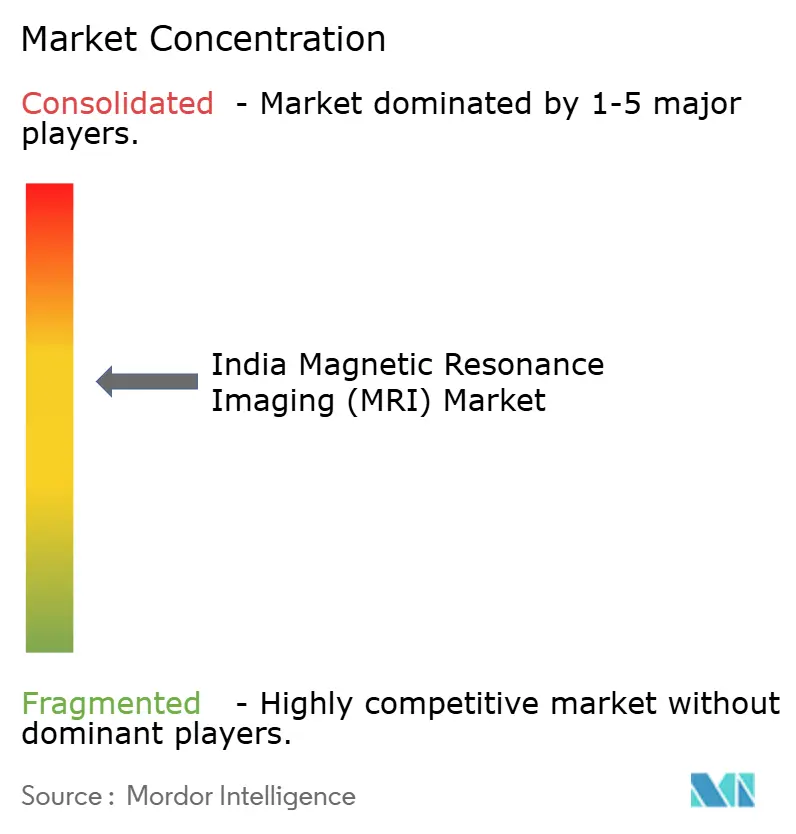
| Market Concentration | Medium |
Major Players
*Disclaimer: Major Players sorted in no particular order Image © Mordor Intelligence. Reuse requires attribution under CC BY 4.0. |
|
India Magnetic Resonance Imaging (MRI) Market Analysis by Mordor Intelligence
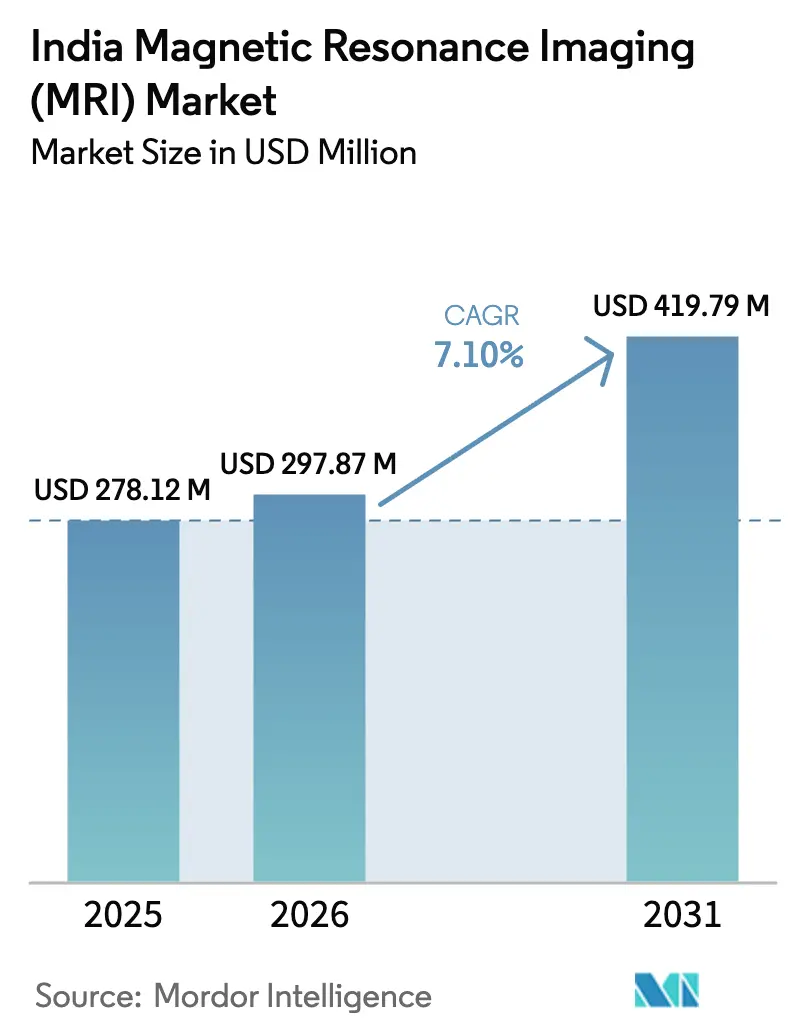
India Magnetic Resonance Imaging (MRI) market size in 2026 is estimated at USD 297.87 million, growing from 2025 value of USD 278.12 million with 2031 projections showing USD 419.79 million, growing at 7.10% CAGR over 2026-2031. The India MRI market is expanding because non-communicable diseases (NCDs) now account for nearly 66% of the country’s total disease burden, and clinicians rely on high-resolution MRI scans to detect tumors, neurological lesions, and complex musculoskeletal injuries at earlier stages. Private diagnostic-center chains continue to roll out new facilities across tier-2 and tier-3 cities, amplifying India MRI market adoption outside the traditional metro strongholds. Public-hospital upgrades under Ayushman Bharat funnel additional capital toward advanced imaging suites, while Production Linked Incentive (PLI) schemes make locally manufactured scanners a cost-effective alternative for value-conscious buyers, further stimulating India MRI market demand. The convergence of AI-enabled workflow automation, helium-lean magnet architectures, and patient-comfort innovations supports sustainable profitability for providers, keeping the India MRI market’s growth trajectory intact through 2030.
Key Report Takeaways
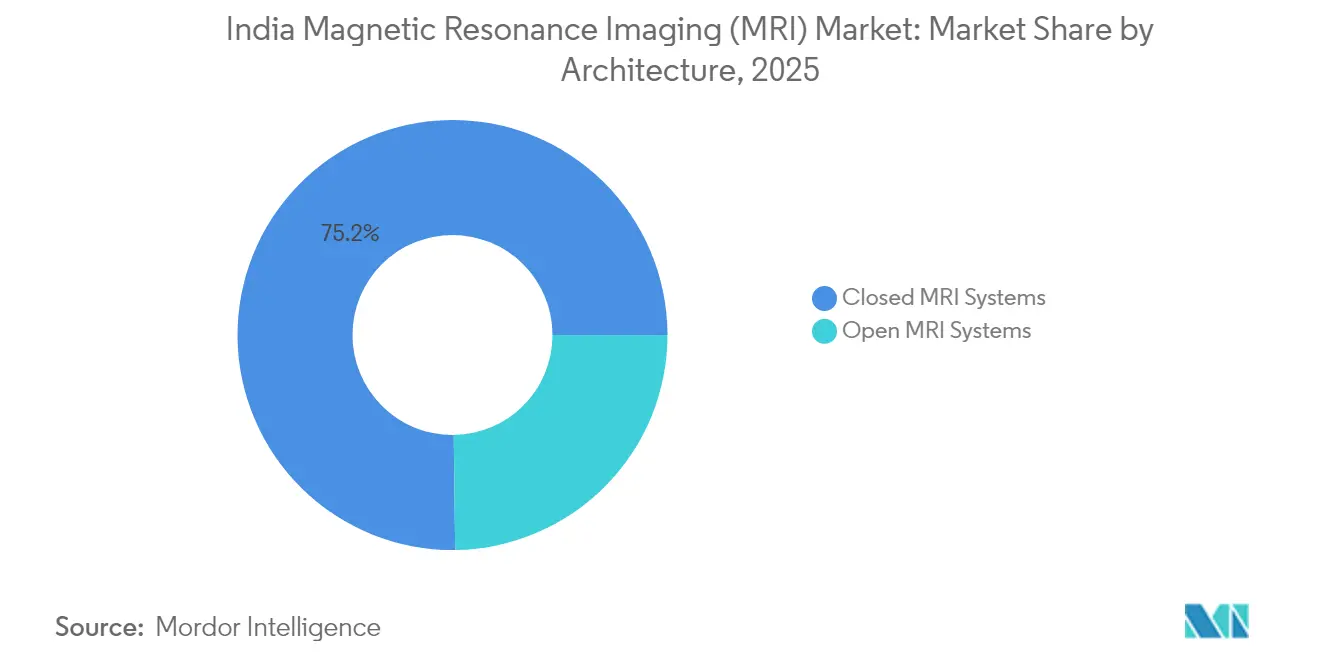
- By architecture, closed MRI systems led with 75.20% revenue share in 2025, while open systems are forecast to expand at an 8.05% CAGR through 2031, highlighting their status as the fastest-growing segment within the India Magnetic Resonance Imaging (MRI) Market.
- By field strength, 1.5 T high-field systems commanded 55.72% share of the India Magnetic Resonance Imaging (MRI) Market size in 2025, and very-high field (≥3 T) systems are advancing at a 7.72% CAGR between 2026-2031.
- By application, neurology captured 42.00% of India Magnetic Resonance Imaging (MRI) Market share in 2025, while oncology is projected to grow at an 8.08% CAGR through 2031.
- By end user, hospitals accounted for a 47.68% share of the India Magnetic Resonance Imaging (MRI) Market size in 2025, whereas specialized clinics & imaging centers are rising at an 8.65% CAGR between 2026-2031.
Note: Market size and forecast figures in this report are generated using Mordor Intelligence’s proprietary estimation framework, updated with the latest available data and insights as of 2026.
Market Trends and Insights
Drivers Impact Analysis of India Magnetic Resonance Imaging (MRI) Market*
| Driver | (~) % Impact on CAGR Forecast | Geographic Relevance | Impact Timeline |
|---|---|---|---|
| Rising NCD burden | +1.8% | Urban and peri-urban clusters nationwide | Medium term (2–4 years) |
| Expansion of private diagnostic-center chains & medical tourism | +1.5% | Tier-2 and tier-3 cities; tourism corridors | Short term (≤ 2 years) |
| Public-hospital imaging upgrades under Ayushman Bharat | +1.2% | Rural districts and aspirational blocks | Long term (≥ 4 years) |
| AI-enabled high-field imaging boosts throughput & quality | +1.0% | Metro health hubs, expanding to secondary cities | Medium term (2–4 years) |
| Make-in-India MRI manufacturing lowers cap-ex | +0.9% | Bengaluru, Chennai, Pune and Noida industrial clusters | Long term (≥ 4 years) |
| Ban on refurbished imports shifts demand to new units | +0.7% | Nationwide | Short term (≤ 2 years) |
| Source: Mordor Intelligence | |||
Rising NCD Burden Accelerates Diagnostic Imaging Demand
India’s escalating NCD prevalence raises the clinical urgency for high-resolution soft-tissue imaging. Cancer incidence is expected to climb from 529.40 per 100,000 in 2022 to 549.17 per 100,000 by 2031, underpinning structural demand for MRI-based oncology diagnostics. Stroke, epilepsy, and neuro-degenerative conditions also continue to rise, so neurologists increasingly prescribe MRI scans for finer lesion mapping, boosting daily scanner utilization, particularly in secondary cities where care gaps remain acute. Government screening programs for breast and cervical cancer routinely direct patients toward MRI for confirmatory scans, embedding the modality into standard care pathways. Health-insurance payouts under Ayushman Bharat further raise affordability for low-income households, sustaining patient-volume growth in the India MRI market. Consequently, providers view MRI capacity expansion as a prerequisite for clinical relevance as disease patterns evolve.
Expansion of Private Diagnostic-Center Chains & Medical Tourism
Organized diagnostic networks such as Dr. Lal PathLabs, Neuberg, and Metropolis collectively operate over 1,500 imaging hubs, and the number could double by 2028 as asset-light franchise models reduce capital intensity. These groups channel fresh scanner installations into smaller cities where competition is limited, thus diffusing India MRI market penetration beyond metro clusters. In parallel, medical-tourism arrivals rose to 463,725 visas in 2024 as foreign patients sought cost-advantaged cancer, spine, and cardiac care bundled with MRI diagnostics.[1] Hospitals in Delhi, Chennai, and Kochi advertise fixed-price oncology packages that include pre- and post-surgical 3 T MRI scans, reinforcing MRI as a revenue anchor. Such inbound traffic incentivizes providers to install premium-spec systems with AI-accelerated throughput to maintain service levels. The dual tailwind of domestic and foreign demand keeps scanner-purchase pipelines healthy for OEMs and local assemblers.
Public-Hospital Imaging Upgrades Under Ayushman Bharat
The central government budgeted INR 90,659 crore (USD 11.3 billion) for the Ministry of Health & Family Welfare in FY 2024–25, with a notable slice earmarked for diagnostic-equipment modernization. More than 8,700 public health facilities completed upgrades in FY 2023–24, many of which involved installing new 1.5 T magnets to fulfill Ayushman Bharat referral commitments. Five greenfield All India Institute of Medical Sciences (AIIMS) campuses that opened in 2024 each added at least two 3 T scanners, creating training hubs for advanced neuroradiology. State governments mirror this momentum: Tamil Nadu’s health-infrastructure program funded 26 scanners in district hospitals, anchoring localized MRI services that previously required referrals to metro centers. Because public hospitals still conduct roughly 35% of all scans nationwide, the ripple effect on India MRI market volumes is decisive and long lasting.
AI-Enabled High-Field Imaging Boosts Throughput & Quality
AI-embedded reconstruction engines shrink average scan times from 30 minutes to under 10 minutes for routine neuro and MSK protocols, thereby tripling per-scanner daily throughput in busy outpatient settings. Siemens Healthineers’ MAGNETOM Flow and Philips’ SmartSpeed Precise platforms integrate zero-click protocol selection, relieving technologists of repetitive control-panel tasks and mitigating operator shortages. Diagnostic chains leverage these efficiency gains to drive same-center revenue without adding floorspace, strengthening the investment case for premium-priced systems in the India MRI market. AI-based denoising also lets providers down-field to 1.5 T systems for certain tasks, easing helium and power burdens while preserving image fidelity—an attractive proposition for facilities coping with utility-cost spikes. As radiologist burnout mounts, AI-assisted precohorting and lesion-flagging deliver interpretive consistency, thereby elevating clinical acceptance and boosting competitive advantage for facilities that adopt next-gen scanners early.
Restraints Impact Analysis of India Magnetic Resonance Imaging (MRI) Market*
| Restraint | (~) % Impact on CAGR Forecast | Geographic Relevance | Impact Timeline |
|---|---|---|---|
| High scanner cost & low reimbursement tariffs | -1.4% | All states, acute in low-income districts | Medium term (2–4 years) |
| Shortage of trained radiologists/technologists | -1.1% | Tier-2 and tier-3 cities | Long term (≥ 4 years) |
| Helium supply volatility elevates opex | -0.8% | Nationwide | Short term (≤ 2 years) |
| CDSCO approval lags for >3 T systems | -0.6% | Nationwide | Medium term (2–4 years) |
| Source: Mordor Intelligence | |||
High Scanner Cost & Low Reimbursement Tariffs
Imported 1.5 T or 3 T scanners cost INR 6–9 crore (USD 730,000–1.1 million at FY 2024 exchange rates), a steep hurdle for small hospitals serving low-to-middle-income populations. Government reimbursement under Ayushman Bharat averages INR 3,000 (USD 36) per scan, barely covering electricity, helium, and maintenance. Consequently, many district-level facilities limit MRI utilization to complex cases, undercutting economies of scale and elongating ROI timelines beyond seven years. Although domestic manufacturing promises lower prices, early units still face validation delays, prolonging the affordability gap. Without tariff recalibration or bundled-payment alternatives, bottom-line pressure could temper India MRI market uptake in cost-constrained geographies.
Shortage of Trained Radiologists/Technologists
India has roughly 15,000 practicing radiologists for a population exceeding 1.4 billion, equating to one specialist per 93,000 people, far below OECD norms.[2] The 612 medical colleges graduate only about 1,200 radiologists annually, and most migrate to metros, leaving smaller cities underserved. Limited technologist training centers exacerbate bottlenecks; many institutions operate with a single technician running double shifts, raising burnout and quality-control risks. AI can automate select tasks, yet final interpretation still demands skilled oversight. Unless fellowship seats expand and tele-radiology networks scale nationally, the talent deficit could impede scanner-utilization rates and dilute India MRI market growth.
*Our forecasts treat driver/restraint impacts as directional, not additive. The impact forecasts reflect baseline growth, mix effects, and variable interactions.
India Magnetic Resonance Imaging (MRI) Market Segment Analysis
By Architecture:
Closed Systems Maintain Dominance Amid Open MRI InnovationClosed systems generated 75.20% of 2025 revenue in the India Magnetic Resonance Imaging market, reflecting provider preference for higher signal-to-noise ratios essential for neuro-oncology and vascular imaging. The sealed bore design also supports gradient strengths above 45 mT/m, enabling advanced diffusion and functional protocols that smaller clinics use to attract complex referrals. High utilization levels keep per-scan costs competitive, reinforcing closed scanners as the workhorse of the India Magnetic Resonance Imaging market. Patient comfort, however, remains a pain point; claustrophobia-induced cancellations can reach 8% in urban centers, prompting providers to explore supplemental open-system capacity.
Open systems, though holding only 24.80% of 2025 value, are projected to grow at 8.05% CAGR through 2031, outpacing the overall India Magnetic Resonance Imaging market. Better patient tolerance, bariatric-friendly table loads, and pediatric volumes drive adoption, especially within suburban diagnostic chains. AI-powered image-reconstruction software narrows the historical resolution gap, letting providers conduct routine spine and MSK studies with acceptable quality. Local OEMs leverage modular coil designs to shorten installation footprints, positioning open scanners as pragmatic expansion units where real estate costs are high. As reimbursement parity between open and closed scans spreads beyond Karnataka and Maharashtra, incremental installations may accelerate, diversifying vendor portfolios and reducing the dominance of sealed-bore architectures.

By Field Strength:
High-Field 1.5 T Dominance Faces Ultra-High Field Challenge1.5 T scanners captured 55.72% of the India Magnetic Resonance Imaging market size in 2025, balancing diagnostic versatility with infrastructure friendliness; they require only 600 sq ft of shielded space and standard 45 kVA power. Public hospitals favor 1.5 T for broad-spectrum applications—from trauma triage to liver volumetry—maximizing reimbursement throughput. Domestic manufacture could trim acquisition costs by 35–40%, preserving 1.5 T’s market lead through 2031. Yet academic centers seek finer gradient fidelity for research; thus, 3 T and higher systems, although currently 14% of installed base, are forecast to grow faster than the India Magnetic Resonance Imaging market at 7.72% CAGR.
Ultra-high field (7 T) remains niche because of CDSCO clearance lags and INR 40 crore (USD 4.8 million) price tags. Still, premier institutes in Delhi, Bengaluru, and Hyderabad are provisioning space for future 7 T suites, encouraged by early neuroscience grants from the Department of Biotechnology. Low-field systems (<1.5 T) maintain marginal presence in point-of-care stroke and neonatal ICUs; Hyperfine’s 0.064 T portable unit gained marketing authorization in 2024 and can fit into ambulance bays, hinting at decentralized imaging opportunities. Taken together, field-strength segmentation underscores stratified purchasing behavior within the India Magnetic Resonance Imaging market: value-driven district hospitals gravitate toward 1.5 T, while flagship centers stretch into the ultra-high field frontier to differentiate academic output.
By Application:
Neurology Leadership Challenged by Oncology GrowthNeurology retained 42.00% share of India Magnetic Resonance Imaging market revenue in 2025, propelled by higher case volumes of stroke, multiple sclerosis, and epilepsy, which all demand soft-tissue contrast unachievable with CT. Epilepsy pre-surgical mapping, for instance, drives routine 3 T functional MRI referrals in tertiary centers. Post-COVID neurological sequelae also boost outpatient MRI bookings, raising per-scanner workloads in urban regions. The segment’s leadership derives from entrenched clinical guidelines and rising awareness among neurologists practicing beyond metros.
Oncology, holding 18.90% value in 2025, now expands at 8.08% CAGR, nearly 1 percentage-point faster than the overall India Magnetic Resonance Imaging market. Multiparametric MRI underpins prostate and breast-cancer screening algorithms that state insurance schemes increasingly reimburse. Hospitals leverage AI-assisted lesion-grading tools to reduce reporting variance, enticing oncologists to order MRI over PET-CT for pre-operative staging in select cancers. Musculoskeletal, cardiology, and abdominal applications collectively make up the remainder, each advancing in mid-single digits as sports-medicine clinics, interventional cardiology programs, and gastroenterology departments adopt MRI for functional assessments that avoid ionizing radiation.

By End User:
Hospital Dominance Faces Specialized Center CompetitionGeneral and specialty hospitals generated 47.68% of 2025 revenue in the India Magnetic Resonance Imaging market, benefitting from integrated care pathways that funnel in-patients and emergency cases directly to in-house scanners. Network expansions by Apollo, Fortis, and Max add 2,000 new beds and at least 30 magnets through 2027, anchoring hospital share near the 50% threshold. Government hospitals, including five new AIIMS campuses, bolster public-sector demand with procurement budgets protected from currency swings.
Specialized clinics and imaging centers contributed 35.85% in 2025 but will climb fastest at 8.65% CAGR, capitalizing on outpatient convenience, shorter wait times, and aggressive marketing of health-check packages. Franchise models allow asset-light growth; combined with vendor financing, smaller centers can deploy mid-field scanners in cities of 300,000–800,000 people. Research and academic institutes, though fewer, invest in ultra-high field capabilities for translational projects, sustaining a pipeline for advanced applications that filter downstream into clinical practice. These dynamics reinforce a multi-tiered delivery model that broadens India Magnetic Resonance Imaging market penetration while sharpening competition for specialized talent and maintenance contracts.
Geography Analysis
India Magnetic Resonance Imaging market adoption remains uneven across regions. The north—including Delhi, Uttar Pradesh, and Haryana—commands roughly one-third of installed scanners thanks to a dense private-hospital network and medical-tourism inflows. Western states such as Maharashtra and Gujarat follow closely because of robust corporate health-insurance coverage among formal-sector employees. Southern hubs—Karnataka, Tamil Nadu, and Telangana—benefit from domestic manufacturing ecosystems that simplify spare-parts logistics and technician availability. Eastern states still lag; West Bengal’s per-capita scanner density is 40% below the national mean, while neighboring Odisha and Bihar depend heavily on centralized government hospitals for access. Government capital-grant programs aim to reduce this disparity, allocating funds for three new district imaging centers per underserved state in FY 2025–26, which should widen geographic reach for the India Magnetic Resonance Imaging market.
Urban areas dominate revenue, accounting for 70% of 2025 scans. Metro centers house multi-national hospital chains that run high-field and ultra-high field systems, catering to complex neurology and oncology cases. As land prices soar, these providers increasingly prefer compact 3 T units with 70 cm bore diameters and helium-free designs to lower operating costs. Suburban clusters evolve into overflow zones where mid-field scanners absorb elective imaging volume. Tier-2 cities such as Jaipur, Coimbatore, and Lucknow witness double-digit scanner growth as organized diagnostic chains establish satellite facilities, democratizing MRI access and reinforcing India Magnetic Resonance Imaging market momentum outside metro cores.
Rural utilization remains sparse. Only 14% of primary health-care blocks reported local MRI availability in 2024. Mobile 1.5 T vans funded under public-private partnerships now operate in Himachal Pradesh and Rajasthan, offering on-site scans two days weekly and forwarding images to tele-radiology hubs in Bengaluru. While these pilots cover fewer than 50 vans nationwide, early clinical audits report 92% patient-satisfaction rates. If scaled, such models could unlock latent demand among the 65% of Indians living in non-urban locales, materially altering the spatial dynamics of the India Magnetic Resonance Imaging market.
Regulatory Landscape
MRI systems in India fall under the Drugs and Cosmetics Act, 1940 and the Medical Devices Rules (MDR), 2017, with the Central Drugs Standard Control Organization (CDSCO) acting as the Central Licensing Authority for import and manufacturing permissions for high-risk devices. Regulation of medical devices such as MRI as drugs became effective on April 1, 2021, tightening documentation and conformity requirements for OEMs and local assemblers.
Compliance expectations center on quality and standards conformance. MRI manufacturers are required to meet the Quality Management System requirements under the Fifth Schedule of MDR 2017, and per Rule 7, conform to applicable Bureau of Indian Standards (BIS) specifications, or ISO/IEC standards where BIS standards are not available. This shapes supplier qualification and audit-readiness across the installed-base service ecosystem.
Value Chain Analysis
The India MRI value chain starts with sourcing components and subsystems, including magnets, gradients, RF coils, cryogen handling, shielding, and power infrastructure. OEM manufacturing and assembly follow, then CDSCO licensing and registration for import and manufacture, before downstream distribution to hospitals and diagnostic imaging centers. Installation readiness (site planning, RF shielding, HVAC and power conditioning) and commissioning services add further value, while recurring revenues concentrate in multi-year service contracts, uptime management, software upgrades, coils, and consumables tied to patient throughput.
India has historically depended heavily on imports for imaging equipment, but the supply chain is shifting as domestic manufacturing capacity is built under the Production Linked Incentive (PLI) scheme for medical devices. Large OEMs such as Siemens, GE, Philips, United Imaging, and Fujifilm remain central across product, applications, and service footprints. At the same time, local manufacturing initiatives under PLI and India-based R&D (including AI workflow features) are increasing locally value-added hardware and software, shortening lead times and improving service-part availability for tier-2 and tier-3 deployments.
Competitive Landscape
The India Magnetic Resonance Imaging market hosts a mix of multinational heavyweights and emergent domestic innovators. Siemens Healthineers, Philips, and Wipro GE Healthcare jointly control a significant revenue share, leveraging extensive service networks and brand trust. Siemens invested EUR 60 million in its Kemnath production site to support Indian sub-assembly inflows, minimizing lead times for 1.5 T orders. Philips enlarged its Pune healthcare R&D campus to develop AI algorithms tailored to ethnic-specific imaging phenotypes, giving the firm localized software differentiation. Wipro GE pledged USD 960 million through 2028 to scale magnet and gradient-coil manufacturing in Bengaluru, aligning with PLI incentives.[3]
Domestic entrants rely on cost agility. Voxelgrids’ 1.2 T Made-in-India system lists at INR 2.8 crore (USD 340,000), undercutting imported rivals by 40%. Paras Defence works with SAMEER on 1.5 T prototypes that use indigenous cryocoolers to cut helium dependency by 60%. Although still small in volume, such players garner attention from midsize hospitals constrained by cap-ex budgets. The ban on refurbished imports further tilts procurement toward these local options, reshaping competitive parameters in the India Magnetic Resonance Imaging market.
Strategic collaborations intensify. Hyperfine appointed Radiosurgery India as distributor for its portable Swoop MRI, a move that targets neuro-ICU applications in 20 premium hospitals. GE partnered with the Tata Trusts cancer-care initiative to deploy 3 T scanners across new oncology hubs, locking in multi-year service contracts. Meanwhile, Promaxo secured funding from Zynext Ventures to explore decentralized urology MRI pods, hinting at segment-specific device proliferation. Overall, vendor rivalry now hinges on after-sales uptime, AI-software add-ons, and flexible financing—not just static magnet specifications—keeping pressure on all players to innovate continuously.
India Magnetic Resonance Imaging (MRI) Industry Leaders
-
Siemens AG
-
Canon Medial Systems
-
GE Healthcare
-
Fujifilm Holdings Corporation
-
Koninklijke Philips N.V.
- *Disclaimer: Major Players sorted in no particular order
India Magnetic Resonance Imaging (MRI) Market Companies Covered in this Report
- Wipro GE Healthcare Pvt Ltd
- Siemens Healthineers
- Philips India Ltd
- Hitachi
- Canon
- Fujifilm Holdings Corp
- United Imaging Healthcare
- Esaote
- Voxelgrids Innovations Pvt Ltd
- Hyperfine Inc
- Neusoft Medical Systems
- IMRIS Inc
- Medtronic plc (iMRI)
- Allengers
- Time Medical Systems
- Shenzhen Anke High-Tech
- Aspect Imaging
- Aurora Imaging Technology
- Bharat Electronics Ltd (MRI R&D)
- Agfa HealthCare (NOVA MRI PACS)
Read Analysis of India Magnetic Resonance Imaging (MRI) Companies
Market Opportunities and Future Outlook
Domestic manufacturing and localization create an opportunity to reduce acquisition and lifecycle costs for providers that are constrained by capex and low reimbursement. The Production Linked Incentive (PLI) scheme for medical devices is a concrete enabler, with approved applicants including Siemens Healthcare Private Limited and Allengers Medical Systems Limited initiating domestic manufacturing for MRI and CT systems. The Department of Pharmaceuticals also reported 19 commissioned projects covering 46 types of medical devices (including MRI machines) as of early 2025. This environment supports more competitive configurations for high-volume 1.5 T deployments in district and mid-sized private hospitals, while also strengthening parts availability and service responsiveness.
Operating-cost and access constraints point to whitespace around helium-lean architectures, AI-enabled throughput tools, and distributed models of care delivery. Providers face helium supply volatility and workforce shortages, and OEM activity around sealed, low-helium magnet technology and AI workflow acceleration indicates a pathway to higher utilization per scanner and improved feasibility in non-metro settings. Public-system modernization under Ayushman Bharat, along with upgraded facilities and new AIIMS campuses, reinforces continued procurement-led demand, while portable and point-of-care MRI authorizations create a separate lane for neuro-ICU and emergency use cases where fixed-suite infrastructure is a barrier.
Recent Industry Developments in India Magnetic Resonance Imaging (MRI) Market
- July 2026: Philips Bengaluru innovation campus confirmed as its largest global innovation hub, developing AI-enabled MRI technology to improve resolution and reduce scan times by up to three times. The development expands Philips' AI-driven MRI capabilities in India and globally. It reinforces Philips' global R&D footprint and innovation leadership.
- June 2026: Deployment of new-generation low-helium and sealed magnet MRI technology in India, designed to operate without regular helium refills. The capacity addition strengthens reliability and sustainability for Indian healthcare facilities, reducing helium dependency and operating costs. It aligns with sustainability and reliability goals for Indian healthcare facilities.
- April 2026: Pune facility manufactures MRI components for global markets; India serves as a global hub for more than 85% of Philips' healthcare AI solutions. The localization anchors India as a critical supply and AI development center for Philips, expanding local manufacturing and AI software footprint.
India Magnetic Resonance Imaging (MRI) Market Report Scope and Research Methodology
Market Definition and Coverage
For this report, the market is defined as revenues generated from the sale of MRI systems in India, counted at the manufacturer or authorized channel level and captured in current US dollars.
Scope exclusions: We exclude MRI scan procedure revenues, facility operations, and unrelated imaging modalities such as CT, X-ray, and ultrasound.
Segments Covered in This Report
-
By Architecture
- Closed MRI Systems
- Open MRI Systems
-
By Field Strength
- Low-field (Less than 0.3 T)
- Mid-field (0.3–1.5 T)
- High-field (3 T)
- Ultra-high field (Above 3 T)
-
By Application
- Neurology
- Musculoskeletal
- Cardiovascular
- Abdominal & Pelvic
- Breast Imaging
- Oncology (Whole Body)
-
By End User
- Public Hospitals
- Private Hospitals
- Diagnostic Imaging Centers
- Ambulatory Surgical Centers
Data Sources, Market Sizing, and Validation
Desk Research
Desk research starts by mapping the installed base and the demand environment for MRI in India, so the model is anchored to real healthcare capacity and utilization. We reviewed public sources such as the Ministry of Health and Family Welfare (MoHFW), the National Health Authority (NHA), the Press Information Bureau (PIB), and official import trade statistics that show device inflow patterns.
Next, we layered in technical and clinical context from sources such as peer reviewed radiology journals, standards and safety publications, and association portals for radiology and imaging professionals, along with reputable press coverage on new hospital builds and diagnostics expansion. Company filings, investor presentations, and a paid subscription for company financials and news were then used to validate revenue direction and the timing of major product cycles. This list is illustrative, and many other public documents and datasets were also used to collect, cross check, and clarify inputs.
Primary Interviews and Surveys
Primary work focused on reconciling what is shipped versus what gets installed and paid for in a given year, since timing gaps can distort annual value. We spoke with a mix of MRI OEM side experts, distributors, hospital procurement and radiology department leaders, and independent service engineers to validate pricing, replacement cycles, and demand trends across major Indian metros and select tier 2 cities.
Distribution of primary research fieldwork respondents
| Company type | Respondent position |
|---|---|
| Top tier: 30% | CXOs: 17% |
| Mid tier: 52% | Functional/Unit leaders: 41% |
| Smaller Players: 18% | Managers: 42% |
Market-Sizing & Forecasting
Sizing starts with a top-down build that reconstructs India MRI system revenues using shipment and import patterns, typical channel markups, and the split between new installations and replacements, followed by adjustments for public and private procurement timing. To keep the totals realistic, we then corroborate them with selective bottom-up checks, such as sampled average selling price ranges by field strength and a limited roll up of supplier and channel feedback across key states.
A few market fingerprints were treated as core inputs because they are repeatable and explain most of the variance year to year. These include MRI installed base expansion, replacement cycle length, average selling price movement by 1.5T versus 3T adoption, tender driven price pressure in public hospitals, and delivery to installation lead times that shift revenue recognition. Where bottom-up signals were missing, gaps were handled using conservative ranges agreed in interviews, and then tested through sensitivity checks before finalizing the point estimate.
Forecasting uses scenario analysis supported by a simple multivariate regression lens, where system demand is linked to indicators such as new hospital capacity additions, diagnostics center expansion, and expected patient throughput growth. Expert inputs were used to sanity check the forward path for ASP erosion or stabilization, which is then applied consistently across the forecast window.
Data Validation & Update Cycle
Validation is done through multiple passes, where model outputs are compared against independent signals such as import value trends, known tender awards, and visible changes in installed base expansion. If a variance is outside the expected band, we re-check assumptions, revisit the source trail, and re-contact selected interviewees to clarify what changed.
Before sign-off, the work is reviewed by another analyst to ensure arithmetic consistency, scope discipline, and that the assumptions can be explained simply and traced back to sources. Reports are refreshed annually, and interim updates are made when material events occur, such as policy changes, large tender cycles, or supply constraints. Right before delivery, we do a fresh review so clients receive the most current view available.
Mordor Intelligence's India Magnetic Resonance Imaging Mri Market Size Measured Against Other Published Estimates
Published figures for India MRI can look far apart, and it usually comes down to what is being counted and when it is being counted. In practice, estimates split between equipment sales versus procedure revenues, and they also vary on whether refurbished systems and long installation lead times are treated as part of the same year.
Some external sources discuss an overall MRI market number that may blend equipment revenues with service activity or may not clarify how revenue timing is handled. For Mordor Intelligence, only MRI system equipment revenues in India are counted, and revenue is aligned to realistic shipment to installation and payment timing checks shared by channel and hospital respondents.
Benchmark comparison
| Source | Market Size | Gaps in Research Methodology |
|---|---|---|
| Mordor Intelligence | USD 278.12 M (2025) | |
| Trade Journal A | USD 230.00 M (2024) | The published value is provided in INR for 2024 and the scope language is mixed, so conversion timing and whether it includes services or only equipment is not clear. It also does not state how refurbished systems and installation lead times are treated, which can shift one year totals. |
| Industry Publisher B | USD 300.00 M (2025) | The figure is presented as an equipment market value but the base year is not clearly stated on the page, which can cause year mismatch. In addition, assumptions on ASP levels and the split of 1.5T versus 3T systems are not transparent, which can lift totals if higher spec systems are over-weighted. |
Across the three numbers, the biggest drivers are scope clarity and how annual revenue timing is recognized, followed by currency timing and ASP assumptions. By keeping the model tied to equipment only, and by cross checking shipments, installs, and pricing ranges with field inputs, the estimate stays traceable to practical variables that can be reviewed and updated consistently.
Key Questions Answered in the Report
What is the projected value of the India Magnetic Resonance Imaging market in 2031?
The India Magnetic Resonance Imaging Market size is expected to reach USD 419.79 million by 2031.
Which architecture leads current adoption in India?
Closed MRI systems captured 75.20% revenue share in 2025.
Why are 1.5 T scanners still dominant?
They balance diagnostic versatility with lower infrastructure costs, giving them 55.72% share in 2025.
Which application is growing fastest?
Oncology scans are forecast to expand at an 8.08% CAGR through 2031.