
Mexico Industrial Press Machines Market Size and Share
Market Overview
| Study Period | 2020 - 2031 |
|---|---|
| Forecast Data Period | 2026 - 2031 |
| Base Year Market Size (2025) | USD 0.51 Billion |
| Market Size (2026) | USD 0.52 Billion |
| Market Size (2031) | USD 0.66 Billion |
| Growth Rate (2026 - 2031) | 4.88 % |
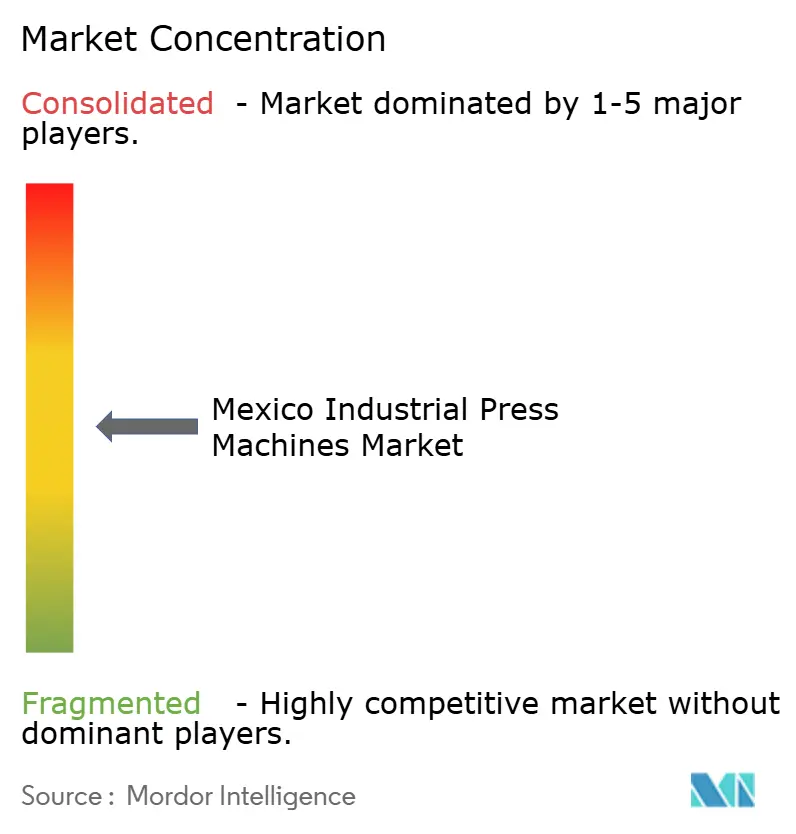
| Market Concentration | Medium |
Major Players *Disclaimer: Major Players sorted in no particular order Image © Mordor Intelligence. Reuse requires attribution under CC BY 4.0. | |
Mexico Industrial Press Machines Market Analysis by Mordor Intelligence
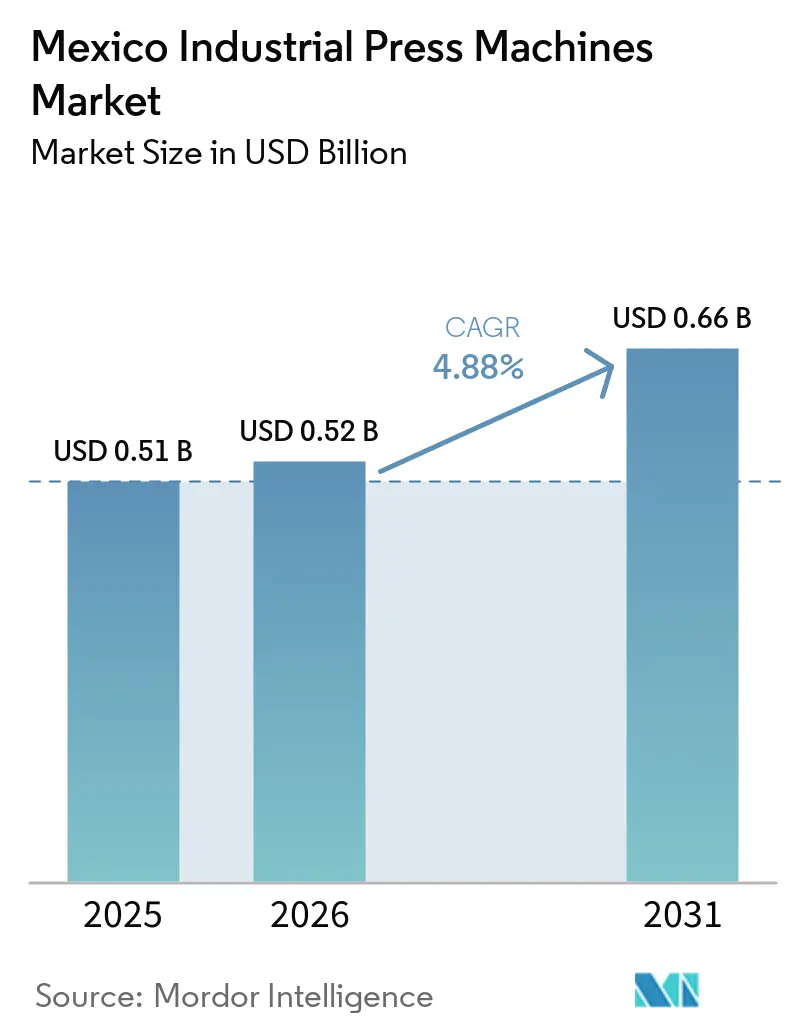
The Mexico Industrial Press Machines Market size is projected to be USD 0.51 billion in 2025, USD 0.52 billion in 2026, and reach USD 0.66 billion by 2031, growing at a CAGR of 4.88% from 2026 to 2031.
Nearshoring is driving demand for forming, stamping, and joining equipment as automotive and component production moves closer to North American customers. Electric vehicle production and battery localization are widening demand beyond traditional body-panel stamping to include precision press-fitting, busbar production, and structural joining. Plan México combines tax relief and financing programs that support machinery purchases, although smaller suppliers can still face difficult funding conditions. The Mexico industrial press machine market also faces import exposure, energy-cost uncertainty, and shortages of technicians who can install, program, and maintain advanced lines. These conditions favor suppliers that combine equipment sales with local service, retrofit capability, and financing support for purchasers that cannot absorb delayed returns, particularly across established automotive clusters and newer aerospace and electronics manufacturing locations in Mexico.
Key Report Takeaways
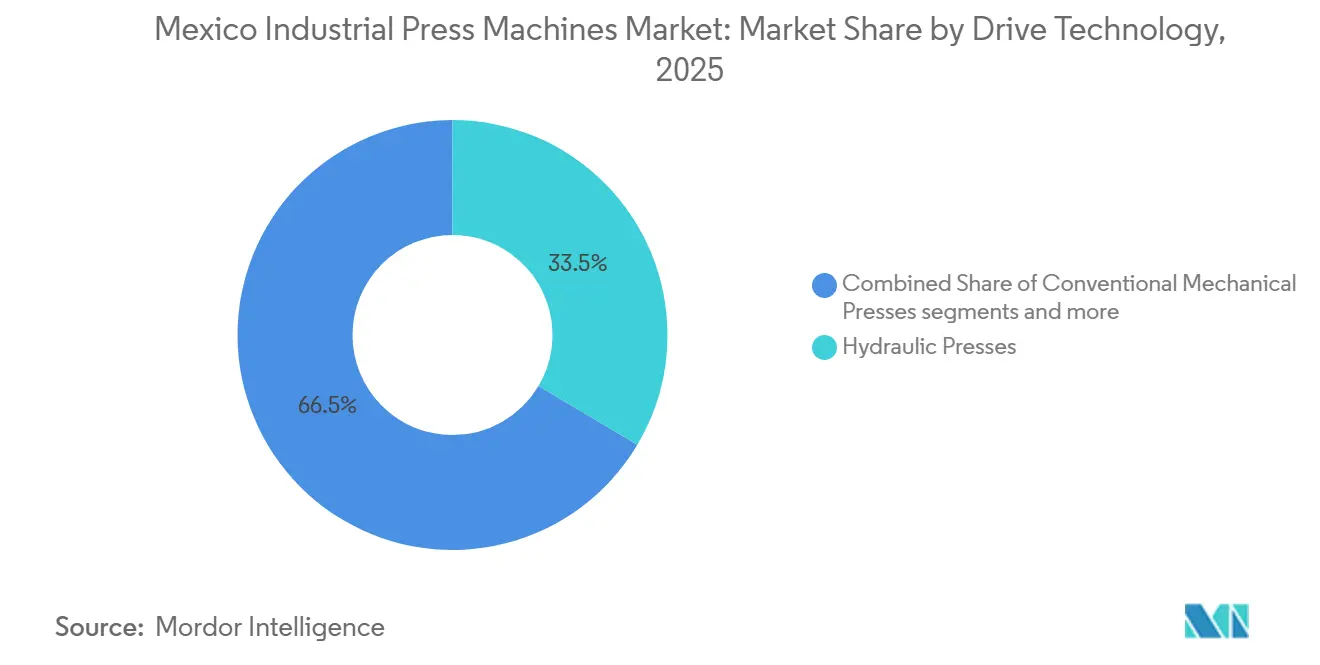
- By drive/actuation technology, hydraulic presses held 33.5% of the Mexico industrial press machines market share in 2025, while servo-mechanical presses are forecast to grow at an 8.3% CAGR through 2031.
- By press force/capacity, the 101-to-500-ton range held 33.7% of the Mexico industrial press machines market share in 2025, while above-2,000 ton presses are projected to expand at a 5.6% CAGR through 2031.
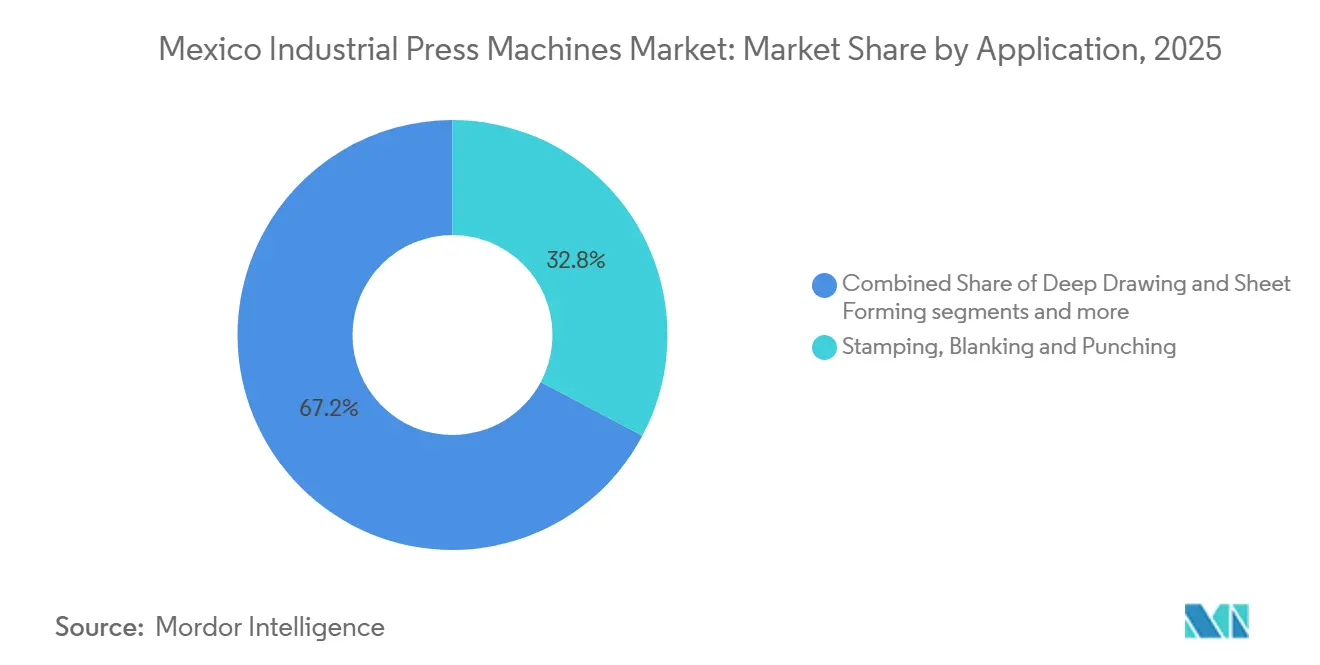
- By application/process, stamping, blanking, and punching accounted for 32.8% of the Mexico industrial press machines market size in 2025, while assembly, press-fitting, and joining are advancing at a 6.0% CAGR through 2031.
- By end-use industry, automotive and transportation accounted for 38.4% of the Mexico industrial press machines market size in 2025, while aerospace and defense are forecast to grow at a 6.3% CAGR through 2031.
Note: Market size and forecast figures in this report are generated using Mordor Intelligence’s proprietary estimation framework, updated with the latest available data and insights as of January 2026.
Mexico Industrial Press Machines Market Trends and Insights
Drivers Impact Analysis*
| Driver | (~) % Impact on CAGR Forecast | Geographic Relevance | Impact Timeline |
|---|---|---|---|
| Nearshoring and Automotive Capacity Additions | +1.5% | Nuevo León, Coahuila, Chihuahua, Guanajuato, and San Luis Potosí | Short term (≤ 2 years) |
| Electric Vehicle and Battery Component Localization | +1.1% | Nuevo León, San Luis Potosí, and Querétaro | Medium term (2-4 years) |
| Automation and Industry 4.0 Adoption | +0.8% | National, with early gains in Nuevo León, Querétaro, and Puebla | Medium term (2-4 years) |
| Replacement of Aging Press Equipment | +0.5% | National, concentrated in the northern auto belt and Bajío corridor | Short term (≤ 2 years) |
| Servo Press Adoption for High-Strength and Lightweight Materials | +0.4% | Nuevo León, Guanajuato, and San Luis Potosí | Medium term (2-4 years) |
| Local Service and Retrofit Economics Under Import Dependence | +0.2% | National, with early gains in Querétaro and Puebla service hubs | Long term (≥ 4 years) |
| Source: Mordor Intelligence | |||
Nearshoring and North American Automotive Capacity Additions
Nearshoring and regional supply-chain strategies are moving automotive and component manufacturing capacity into Mexico. Nuevo León attracted USD 1.45 billion across 18 automotive projects in 2025, and 4 projects were linked to electromobility. Coahuila added USD 386.84 million across 19 automotive projects, with activity in aluminum processing, auto parts, and electromobility components. These additions require progressive and transfer presses for new Tier 1 stamping capacity in the northern corridor. The 2,274 hectares of industrial park space under construction in 2025 indicate that equipment purchasing will continue as plants move from construction to fit-out. The Mexico industrial press machine market benefits when suppliers favor local agents that can shorten delivery, installation, and service time.
Electric Vehicle and Battery Component Localization
Electric vehicle production is changing requirements for stamping, joining, and press-fitting equipment in Mexico. Kia began producing the EV3 compact electric SUV at its Pesquería facility on August 4, 2026, supported by a USD 649 million investment that is phased through 2028. The project requires multi-material body structures and EV-specific structural joining, which increases the need for dedicated press lines. BMW began building high-voltage battery assembly capacity in San Luis Potosí as part of its EUR 800 million, or USD 870 million, investment program. Battery-module production needs equipment for lamination stacking, busbar stamping, and cell-compression forming. The Mexico industrial press machines market, therefore, gains demand from both vehicle assemblers and the Tier 1 and Tier 2 suppliers that support new EV platforms.
Automation and Industry 4.0 Adoption
Factory automation is increasing the value of new press installations across automotive, appliance, and electronics plants. Plan México financing through NAFIN and Bancomext had mobilized MXN 120 billion, or USD 6.9 billion, for small and medium-sized enterprises by February 2026. The program includes fixed-asset modernization support that can help smaller manufacturers finance automation upgrades. Automated lines combine robotic material handling, sensor-based tonnage monitoring, and closed-loop servo control. These configurations are displacing standalone legacy machines in high-volume applications. The Mexico industrial press machine market is consequently shifting toward higher-value systems even where unit demand rises more gradually.
Replacement of Aging Press Equipment
A substantial part of Mexico’s installed press base dates to the maquiladora expansion of the 1990s through the early 2000s. Many conventional mechanical and hydraulic units had moved beyond recommended refurbishment intervals by 2025. Suppliers cannot easily defer replacement when downtime threatens just-in-time automotive production. Schuler Inc. Mexico operates service centers in Puebla, Querétaro, and Ramos Arizpe, while AIDA Engineering de México has operated from Querétaro since 2008. Their replacement, relocation, and service offerings address a purchasing cycle that differs from greenfield investment. Retrofitting a large hydraulic press with modern servo-hydraulic controls can cost 30% to 50% of a new system while delivering performance close to that of an original equipment manufacturer machine.
Restraints Impact Analysis*
| Restraint | (~) % Impact on CAGR Forecast | Geographic Relevance | Impact Timeline |
|---|---|---|---|
| Import Dependence, Lead-Time, Foreign-Exchange, and Tariff Exposure | -0.8% | National, with the strongest exposure in northern states and the Bajío corridor | Short term (≤ 2 years) |
| High Upfront Capital Costs and Financing Needs | -0.6% | National, especially Tier 2 and Tier 3 firms in Guanajuato, Puebla, and Coahuila | Medium term (2-4 years) |
| Volatile Energy Costs and Industrial Power Supply Reliability | -0.4% | National, with the highest exposure in northern states reliant on CFE grid supply | Medium term (2-4 years) |
| Shortage of Skilled Press-Maintenance and Systems-Integration Personnel | -0.3% | Nuevo León, Querétaro, and the Bajío corridor | Long term (≥ 4 years) |
| Source: Mordor Intelligence | |||
Import Dependence, Lead-Time, Foreign-Exchange, and Tariff Exposure
Mexico imports much of its industrial press equipment from Germany, Japan, and other Asian manufacturing locations. Buyers face tariffs outside preferential-origin rules, foreign-exchange exposure on euro and yen contracts, and delivery times of 18 to 30 weeks for customized large-tonnage machines. The IMMEX program permits export-oriented manufacturers to import machinery without general import duties temporarily. This support does not fully resolve value-added tax obligations and does not cover domestically focused producers in the same way. A 2024 decree established temporary tariffs of 5% to 50% on 544 tariff-line items, including selected capital-goods categories. The Mexico industrial press machine market can therefore see longer capital-investment cycles among small and medium-sized buyers outside IMMEX.
High Upfront Capital Cost and Financing Requirements
New large-tonnage systems require significant capital before a manufacturer can realize operational or tax benefits. A mid-range 300-ton servo press can cost USD 500,000, while a multi-station transfer-press line can exceed USD 5 million. NAFIN offers fixed-rate Plan México financing at rates of up to 14.5% per year. Those rates increase the effective cost of new equipment for domestic small and medium-sized suppliers. The January 22, 2025, Presidential Decree provides immediate deductions of 35% to 91% for qualifying new fixed-asset investments. The timing between an equipment payment and tax relief can still limit upgrade activity when firms lack short-term liquidity.
*Our forecasts treat driver/restraint impacts as directional, not additive. The impact forecasts reflect baseline growth, mix effects, and variable interactions.
Segment Analysis
By Drive/Actuation Technology: Hydraulic Presses Lead While Servo-Mechanical Accelerates
Hydraulic presses held 33.5% of demand in 2025, supported by their use in deep drawing, forging, and heavy forming. Their versatility suits the varied requirements of Mexico’s automotive and industrial supplier base. Servo-mechanical presses are forecast to record an 8.3% CAGR from 2026 to 2031. Manufacturers use servo systems when advanced high-strength steel and aluminum require programmable slide motion and energy recovery. Conventional mechanical presses retain a large installed base in high-volume single-stroke stamping, while pneumatic presses serve lighter assembly and pilot-production work.
The Mexican industrial press machine industry is adopting servo systems where tolerance requirements and material changes justify the cost. Programmable stroke profiles can extend tooling life by 20% to 40% compared with fixed-motion mechanical systems. This is particularly relevant to high-mix EV component production, where die replacement is expensive. BMW’s San Luis Potosí investment includes body-shop expansion and advanced automation, setting a procurement pattern that local suppliers can follow. Hybrid and energy-efficient drives are attracting interest from operators concerned about electricity costs.

By Press Force/Capacity: Mid-Range Tonnage Anchors Volume, Ultra-Large Capacity Leads Growth
The 101 to 500 ton range held a 33.7% share in 2025 and is appropriate for progressive-die stamping of structural brackets, door inners, and sub-frame components. The above-2,000 ton category is projected to grow at a 5.6% CAGR from 2026 to 2031. Large systems support body-panel investment associated with EV platform retooling at assembly plants. Kia’s Pesquería investment demonstrates demand for equipment that can form large aluminum body structures and floor assemblies. The Mexico industrial press machine market continues to rely on the mid-range segment for its core volume.
The 501 to 1,000 ton and 1,001 to 2,000 ton ranges support forging and deep drawing for driveline and powertrain parts. Demand in these ranges is comparatively steady while internal-combustion vehicle output continues through the forecast period. Up-to-100-ton machines serve press-fitting, assembly, and light-gauge stamping for electronics and appliances. Baja California and Querétaro support this lighter equipment demand through electronics manufacturing activity. Buyers in the 101 to 500 ton class are increasingly choosing servo-drive options as lower component costs and tighter EV customer tolerances improve the upgrade case.
By Application/Process: Stamping Dominates, Assembly Presses Record the Highest Growth
Stamping, blanking, and punching accounted for 32.8% of the Mexico industrial press machines market in 2025. The process remains central to sheet-metal fabrication for automotive body, chassis, and powertrain components. Assembly, press-fitting, and joining are projected to rise at a 6.0% CAGR through 2031. Growth reflects demand for battery-module presses, busbar stamping lines, and structural press-bonding stations. Battery investment in Pesquería has increased demand for press-fit battery-module assembly equipment that is relatively new to Mexico’s tooling base.
Deep drawing and sheet forming serve appliance housings and fuel-system components. Forging supports driveline and heavy-equipment applications in states with established forging capacity. Compression molding and powder compaction serve smaller aerospace-composite and medical-precision applications. Straightening and general forming provide a base of demand for agricultural and construction-equipment suppliers in the Bajío corridor. Busbar and EV-connector production illustrates the move toward process-specific configurations as EV supply chains raise quality and cycle-time expectations.
By End-Use Industry: Automotive Leads, Aerospace Records the Fastest Growth
Automotive and transportation accounted for 38.4% of revenue in 2025. Dense Tier 1 and Tier 2 supplier networks around assembly plants in Nuevo León, Puebla, and Guanajuato support this leading position. Aerospace and defense is forecast to grow at a 6.3% CAGR between 2026 and 2031. The aerospace base in Querétaro, Baja California, and Sonora needs tight-tolerance hydraulic and servo-hydraulic presses for aluminum airframe and structural parts. Mexico had 5,868 robot installations in 2023, with automotive accounting for 70%, which reflects the established connection between automotive production and automation.
Electrical and electronics producers need light-gauge stamping and precision punching equipment in Baja California and Nuevo León. Medical and precision manufacturing uses hydraulic and servo presses for implant components near Monterrey and Guadalajara. Construction and heavy equipment provide a baseline of equipment demand that follows infrastructure investment. Aerospace, medical, and energy applications favor high-mix and lower-volume production with more specialized specifications. The Mexican industrial press machine industry is therefore seeing its revenue mix move toward higher-specification equipment across several end uses.
Geography Analysis
Nuevo León, the largest demand hub in Mexico’s northern manufacturing belt, attracted USD 3.03 billion in foreign direct investment during the second quarter of 2025, a 31.6% increase from a year earlier. The state also recorded USD 1.45 billion in automotive investment across 18 projects during 2025. Monterrey is the operating base for service and distribution across the north. Schuler Inc. Ramos Arizpe service center, AIDA Engineering de México’s Querétaro base, and independent integrators support manufacturers in the corridor.
Coahuila attracted USD 386.84 million in automotive investment across 19 projects in 2025. The projects were concentrated in aluminum forming, electrical components, and electromobility. The Bajío corridor of Guanajuato, Querétaro, and San Luis Potosí is the second principal center for the Mexico industrial press machine market. San Luis Potosí has drawn aluminum-forming, wiring-harness, and electrical-systems projects. Guanajuato supports a sizable progressive-die stamping base.
Querétaro combines aerospace manufacturing with automotive suppliers, supporting demand for higher-specification hydraulic and servo-hydraulic systems. Puebla-Tlaxcala remains an important cluster for stamping and body-panel forming because of Volkswagen’s Puebla plant and its surrounding supplier base. Baja California has Mexico’s electronics manufacturing concentration and therefore needs more light-gauge punching and precision-forming equipment. Estado de México contributes to appliance and general-manufacturing demand that grows more slowly than demand in the north and Bajío. The 2,274 hectares of industrial park space under construction in 2025 point to press purchases that will emerge through 2026 and 2027 as facilities enter installation phases.
Competitive Landscape
The Mexico industrial press machine market exhibits a medium level of market concentration. Schuler Inc., AIDA Engineering, Komatsu Industries, and TRUMPF hold leading individual positions in new-equipment sales. RAM2 Prensas Hidráulicas, Hydromex Maquinaria, MATRO, and KLUMEX serve retrofit and light-duty needs that are less attractive to global brands. Competition in the mid-tier focuses on total cost of ownership rather than equipment price alone. Import dependence makes local service coverage important to buyers evaluating delivery, commissioning, spare parts, and emergency repair.
In March 2025, Schuler Inc. completed a global rebranding as an integrated forming-and-handling technology provider. This move widened its competitive reach beyond conventional press supply into handling and related automation. Bystronic completed its acquisition of Coherent Corp.’s Tools for Materials Processing division in February 2026. It announced an agreement to acquire Isochronic AG in August 2026, adding high-speed robotic sorting systems and software for sheet-metal processing. These moves join laser, handling, and automation requirements around sheet-metal operations.
Service opportunities remain in spare-parts supply and emergency repair for older equipment outside major automotive corridors. Integrated press, die, and automation packages can address Tier 2 and Tier 3 suppliers without in-house engineering resources. Monitoring systems that can be retrofitted to machines built between 2000 and 2015 are another relevant service opportunity. Smaller local firms can be well-positioned in these areas because their Mexico-focused operating models support upgrades required by NOM-004-STPS-1999 machinery-protection standards and ISO 13849 control-system requirements.
Mexico Industrial Press Machines Industry Leaders
-
TRUMPF SE + Co. KG
-
AMADA CO., LTD.
-
AIDA ENGINEERING, LTD.
-
Schuler Inc.
-
Komatsu Industries Mexico S.A. de C.V.
- *Disclaimer: Major Players sorted in no particular order
Recent Industry Developments
- August 2026: Kia commenced production of the all-electric EV3 compact SUV at its Pesquería, Nuevo León facility on August 4, 2026, supported by a USD 649 million investment phased through 2028. The launch reconfigures press and joining requirements across the Tier 1 supplier base and establishes Mexico as Kia's only EV3 production hub outside South Korea, creating sustained downstream press-procurement demand.
- August 2026: Bystronic announced an agreement to acquire Isochronic AG, a Swiss automation specialist in high-speed robotic sorting systems and software for sheet-metal processing. The acquisition deepens Bystronic's automation integration capabilities in press-adjacent workflows and strengthens its Mexico market positioning as press lines increasingly incorporate automated material handling.
- February 2026: Bystronic completed the acquisition of Coherent Corp.'s Tools for Materials Processing division, adding micro-material processing and semiconductor-laser applications to its portfolio, expanding its addressable market into aerospace and medical precision manufacturing segments active in Mexico.
Mexico Industrial Press Machines Market Report Scope
The Mexico Industrial Press Machines Market is Segmented by Drive Technology (Conventional Mechanical Presses, Hydraulic Presses, Pneumatic Presses, and More), by Press Force (Up To 100 Tons, 101–500 Tons, 501–1, 000 Tons, and More), by Application (Forging, Powder Compaction, and More), by End-Use Industry (Aerospace and Defense, Electrical and Electronics, and More). The Market Forecasts are Provided in Terms of Value (USD).
| Conventional Mechanical Presses |
| Servo-Mechanical Presses |
| Hydraulic Presses |
| Pneumatic Presses |
| Other and Hybrid Presses |
| Up to 100 Tons |
| 101-500 Tons |
| 501-1,000 Tons |
| 1,001-2,000 Tons |
| Above 2,000 Tons |
| Stamping, Blanking and Punching |
| Deep Drawing and Sheet Forming |
| Forging |
| Straightening and General Forming |
| Compression Molding |
| Powder Compaction |
| Assembly, Press-Fitting, and Joining |
| Other Press Applications |
| Automotive and Transportation |
| Aerospace and Defense |
| Industrial Machinery and Equipment |
| Electrical and Electronics |
| Appliances and Consumer Durables |
| Construction and Heavy Equipment |
| Energy and Power Equipment |
| Metal Products and General Manufacturing |
| Medical and Precision Manufacturing |
| Other End-Use Industries |
| By Drive / Actuation Technology | Conventional Mechanical Presses |
| Servo-Mechanical Presses | |
| Hydraulic Presses | |
| Pneumatic Presses | |
| Other and Hybrid Presses | |
| By Press Force / Capacity | Up to 100 Tons |
| 101-500 Tons | |
| 501-1,000 Tons | |
| 1,001-2,000 Tons | |
| Above 2,000 Tons | |
| By Application / Process | Stamping, Blanking and Punching |
| Deep Drawing and Sheet Forming | |
| Forging | |
| Straightening and General Forming | |
| Compression Molding | |
| Powder Compaction | |
| Assembly, Press-Fitting, and Joining | |
| Other Press Applications | |
| By End-Use Industry | Automotive and Transportation |
| Aerospace and Defense | |
| Industrial Machinery and Equipment | |
| Electrical and Electronics | |
| Appliances and Consumer Durables | |
| Construction and Heavy Equipment | |
| Energy and Power Equipment | |
| Metal Products and General Manufacturing | |
| Medical and Precision Manufacturing | |
| Other End-Use Industries |
Key Questions Answered in the Report
What is the projected growth rate for industrial press machines in Mexico?
The Mexico industrial press machine market is forecast to grow at a 4.88% CAGR from 2026 to 2031 and reach USD 0.66 billion by 2031, nearshoring, EV localization, and factory automation support this expansion.
Which press technology is growing the fastest in Mexico?
Servo-mechanical presses are projected to grow at an 8.3% CAGR through 2031. Programmable slide motion, energy recovery, and tighter tolerance requirements make them relevant for advanced steel and aluminum parts.
Which end-use sector accounts for the greatest demand?
Automotive and transportation led with 38.4% of revenue in 2025. Its large supplier base supports demand for body, chassis, powertrain, and emerging battery-component applications.
Why are EV investments important for press equipment demand?
EV and battery projects need equipment for multi-material body structures, busbars, lamination stacking, and battery-module assembly. The Mexico industrial press machine market gains demand from vehicle assemblers and from their Tier 1 and Tier 2 suppliers.
Which Mexican regions have the strongest equipment demand?
Nuevo León, Coahuila, Guanajuato, Querétaro, and San Luis Potosí lead demand because of automotive, aerospace, and electronics activity. Northern manufacturing centers and the Bajío corridor support the Mexico industrial press machine market.
What constrains equipment purchases by smaller suppliers?
High upfront costs, financing rates, import exposure, tariffs, and delivery times can delay capital purchases by small and medium-sized firms. IMMEX support is most relevant to export-oriented facilities, leaving domestically focused producers with greater exposure.