
India Data Center Storage Market Size and Share
Market Overview
| Study Period | 2020 - 2032 |
|---|---|
| Forecast Data Period | 2026 - 2032 |
| Base Year Market Size (2025) | USD 2.90 Billion |
| Market Size (2026) | USD 3.51 Billion |
| Market Size (2032) | USD 11.05 Billion |
| Growth Rate (2026 - 2032) | 21.12 % |
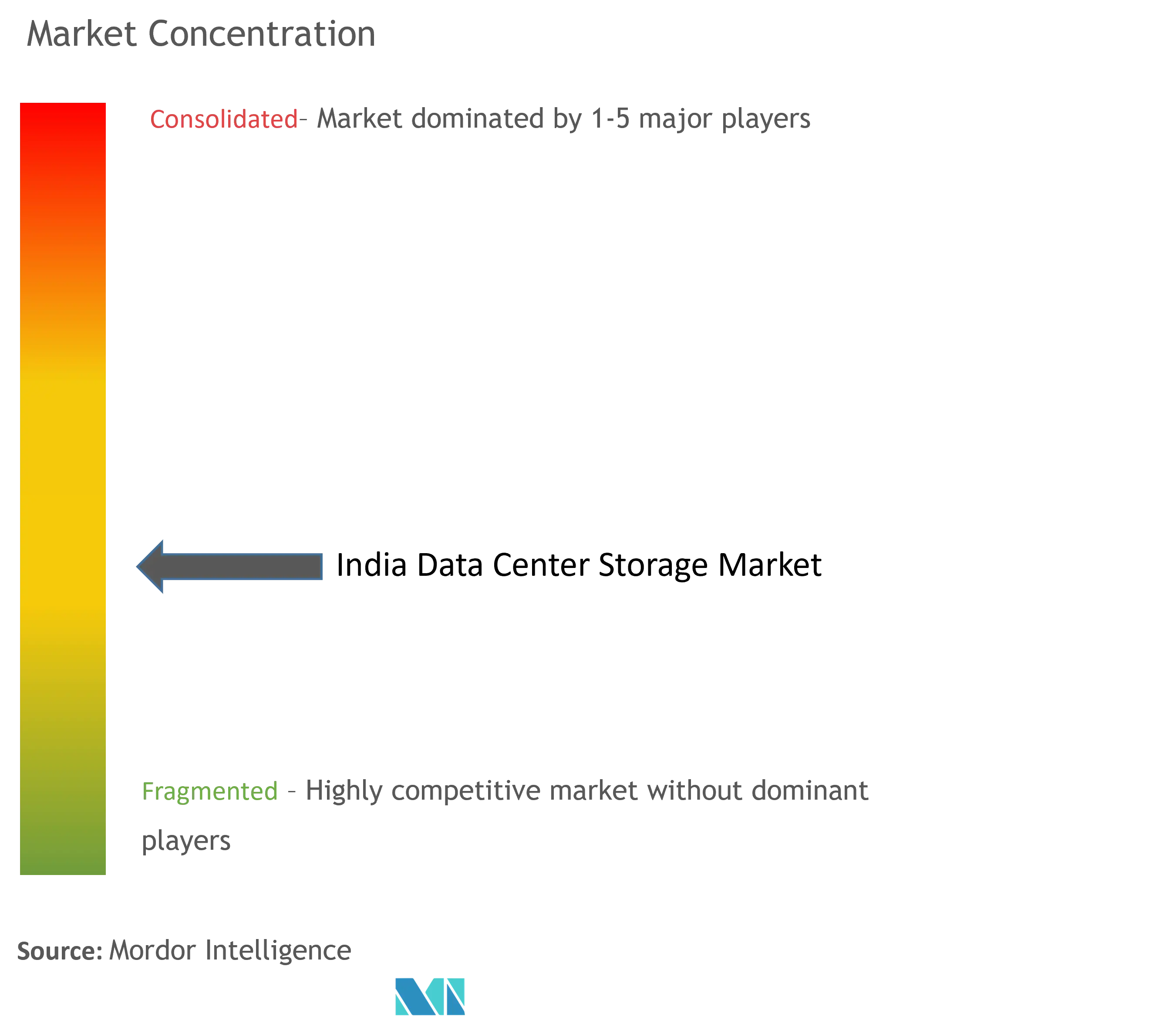
| Market Concentration | Medium |
Major Players *Disclaimer: Major Players sorted in no particular order Image © Mordor Intelligence. Reuse requires attribution under CC BY 4.0. | |
India Data Center Storage Market Analysis by Mordor Intelligence
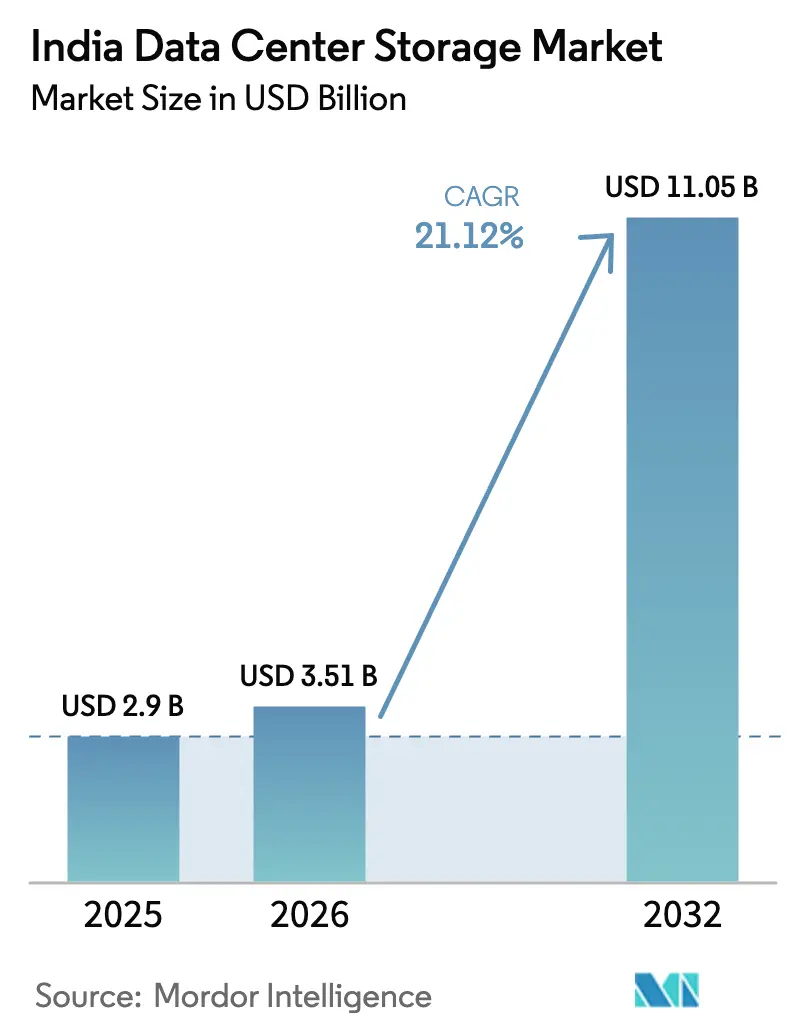
India data center storage market size in 2026 is estimated at USD 3.51 billion, growing from 2025 value of USD 2.90 billion with 2032 projections showing USD 11.05 billion, growing at 21.12% CAGR over 2026-2032. Momentum stems from surging cloud adoption, sovereign data mandates, and the rapid shift of critical enterprise workloads toward localized infrastructure. AI-ready flash platforms, rising sovereign cloud projects, and capacity additions from both domestic and multinational hyperscalers are widening addressable demand pools for the India data center storage market. Sector growth also benefits from declining $/GB for flash, greater availability of renewable energy for high-density campuses, and tier-2 city incentives that are de-risking greenfield builds. Supply-chain strategies that emphasize local assembly and flexible consumption models are helping vendors offset NAND price volatility, thereby sustaining investment appetite throughout the India data center storage market.
Key Report Takeaways
- By storage technology, Storage Area Networks led with 45.40% of the India data center storage market share in 2025; Network Attached Storage is projected to grow at a 18.97% CAGR through 2032.
- By storage type, all-flash arrays accounted for a 38.10% share of the India data center storage market size in 2025 and are advancing at a 17.05% CAGR to 2032.
- By data center type, colocation providers held 43.40% of the India data center storage market share in 2025, while hyperscale and self-built deployments are expanding at a 15.28% CAGR through 2032.
- By end-user industry, IT and telecommunications captured 41.60% of the India data center storage market share in 2025; media and entertainment is progressing at an 17.68% CAGR to 2032.
Note: Market size and forecast figures in this report are generated using Mordor Intelligence’s proprietary estimation framework, updated with the latest available data and insights as of 2026.
India Data Center Storage Market Trends and Insights
Drivers Impact Analysis*
| Driver | (~) % Impact on CAGR Forecast | Geographic Relevance | Impact Timeline |
|---|---|---|---|
| Expansion of IT infrastructure | +3.20% | National, concentrated in Mumbai, Bengaluru, Chennai | Medium term (2-4 years) |
| Increased investments in hyperscale data centers | +4.10% | Mumbai, Chennai, Hyderabad with tier-2 expansion | Long term (≥ 4 years) |
| Government data-localization mandates | +2.80% | National, particularly BFSI and government sectors | Short term (≤ 2 years) |
| AI/ML workload proliferation driving high-performance arrays | +3.50% | Major metros with spillover to edge locations | Medium term (2-4 years) |
| Rise of edge data centers in tier-2/3 cities | +2.10% | Tier-2/3 cities including Jaipur, Nagpur, Chandigarh | Long term (≥ 4 years) |
| Growth of fintech and digital payments ecosystem | +1.90% | National with concentration in financial hubs | Medium term (2-4 years) |
| Source: Mordor Intelligence | |||
Expansion of IT Infrastructure
Enterprise modernization continues to double national capacity, rising from 1,255 MW to an expected 2,070 MW by end-2025. Data center capex programs tied to the Digital India initiative inject over USD 100 billion through 2027, pulling forward demand for next-generation arrays that underpin hybrid-cloud rollouts. Federal projects such as the National Informatics Centre’s USD 600 million Guwahati build add regional nodes that stimulate vendor ecosystems serving northeastern states. Storage architects are retiring direct-attached deployments in favor of software-defined stacks that interoperate across public, private, and edge clouds, reinforcing revenue visibility for the India data center storage market. Secondary hubs such as Nagpur and Raipur gain relevance because land and power pricing widen TCO advantages over saturated metros, further decentralizing opportunities.
Increased Investments in Hyperscale Data Centers
Landmark capital outlays are reshaping the India data center storage market. Reliance Industries’ planned USD 30 billion Jamnagar campus targets a record 3 GW IT load and is optimized for AI training clusters that need massively parallel flash arrays. In parallel, the USD 30 billion Project MGX consortium—anchored by Microsoft, BlackRock, and Temasek—selects Mumbai among fourteen Asia sites, underscoring sustained hyperscale momentum.
Google’s USD 6 billion Visakhapatnam facility cements the sovereign-cloud narrative, further locking in localized storage demand. Such megaprojects tilt procurement toward NVMe-oF, erasure coding, and advanced tiering that help hyperscalers curb latency and power draw. The ripple effect compels incumbent vendors in the India data center storage market to pivot toward open APIs and consumption-based contracting.
Government Data-Localization Mandates
Reserve Bank of India regulations require payment data to reside exclusively onshore, triggering immediate capacity upgrades across financial clouds [1]Reserve Bank of India, “Storage of Payment System Data,” rbi.org.in. The Digital Personal Data Protection Act of 2023 extends these obligations to most multinationals, accelerating sovereign platform builds and the adoption of granular audit capabilities. Domestic firms such as Jio Haptik completed SAR audits to validate compliance, illustrating how certifications influence vendor short-lists. Prospects of AI model localization requirements are poised to add further layers of storage residency, locking in multi-year investment pipelines within the India data center storage market.
AI/ML Workload Proliferation Driving High-Performance Arrays
A Pure Storage survey shows 52% of Indian enterprises already deploy AI, and 41% have doubled storage consumption, prompting 74% to budget for innovative arrays [2].Chris Mellor, “Pure Storage passes USD 3 billion revenue,” blocksandfiles.com Training large language models demands sustained >1 M IOPS, pushing buyers toward NVMe-based all-flash and parallel file systems. Vendors’ responses include Western Digital’s Ultrastar DC SN861 SSD at 16 TB and KIOXIA’s 122.88 TB PCIe 5.0 drive, which reduce rack footprints and energy per inference. BFSI and tech firms lean toward all-flash to maintain sub-millisecond latency SLA, whereas public health agencies prefer hybrid builds that satisfy compliance yet moderate capex. This segmentation expands SKU diversity across the India data center storage market.
Restraints Impact Analysis*
| Restraint | (~) % Impact on CAGR Forecast | Geographic Relevance | Impact Timeline |
|---|---|---|---|
| High initial investment cost | -2.30% | National, particularly affecting SME adoption | Short term (≤ 2 years) |
| Unreliable power supply in secondary cities | -1.80% | Tier-2/3 cities with grid infrastructure challenges | Medium term (2-4 years) |
| Import-dependent component price volatility | -1.50% | National, affecting all storage vendors | Short term (≤ 2 years) |
| Shortage of skilled storage professionals | -1.20% | National with acute impact in emerging markets | Long term (≥ 4 years) |
| Source: Mordor Intelligence | |||
High Initial Investment Cost
Average build costs hover at USD 5.4 million per MW, with storage absorbing 15-20% of budgets, impeding cash-constrained adopters [3]Jingyue Hsiao, “NAND flash prices surge,” semicone.com. All-flash arrays, while performance-superior, command higher ASPs than hybrid peers, delaying refresh cycles within small enterprises. Premium colocation rents in Mumbai and Bengaluru compound TCO concerns, making opex-based storage-as-a-service models more enticing. Vendors such as Hitachi Vantara and Dell are scaling pay-per-use offerings that flex in capacity and performance, partially offsetting this restraint within the India data center storage market.
Import-Dependent Component Price Volatility
NAND flash spot prices spiked over 10% in March 2025 after producer output cuts, instantly lifting BOM costs across SSD portfolios. India’s semiconductor market, estimated at USD 38 billion in 2023, remains import heavy despite incentive schemes slated through 2030. Currency swings and geopolitical uncertainties magnify pricing swings, compelling distributors to adopt dynamic quotation engines that may limit price-sensitive deployments. Successful execution of the Electronics Component Manufacturing Scheme 2025 could temper volatility, but timelines extend beyond the immediate horizon of the India data center storage market.
*Our forecasts treat driver/restraint impacts as directional, not additive. The impact forecasts reflect baseline growth, mix effects, and variable interactions.
Segment Analysis
By Storage Technology: SAN Leadership Meets NAS Acceleration
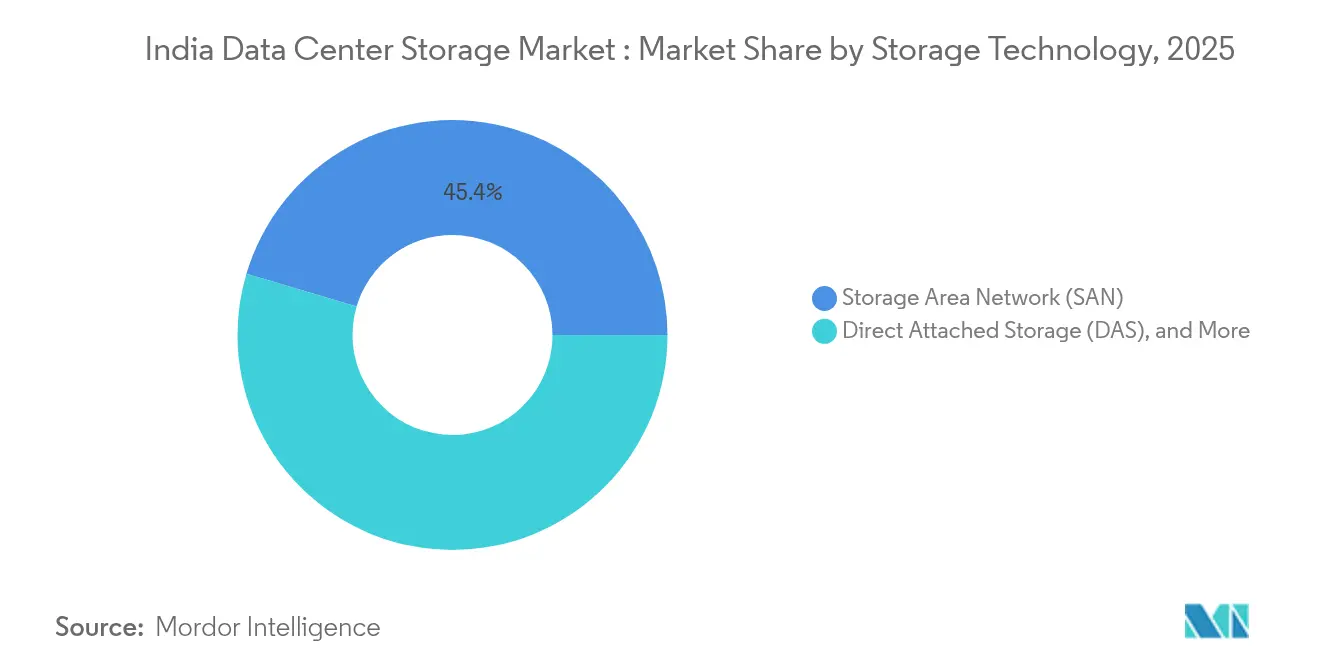
Storage Area Networks continued to dominate the India data center storage market in 2025 with a 45.40% share, driven by BFSI and telecom platforms that mandate block-level throughput for mission-critical databases. Although capital intensive, SAN fabrics deliver consistent latency and robust zoning required for high-transaction workloads. State Bank of India’s YONO expansion underscores SAN relevance by anchoring 64 million mobile users on low-latency Oracle RAC clusters. The India data center storage market size for SAN-based deployments is projected to rise steadily as tier-1 banks consolidate databases. At the same time, Network Attached Storage posts a 18.97% CAGR through 2032, fueled by streaming, design collaboration, and analytics workloads in media production houses around Mumbai and Hyderabad.
Migration from cumbersome file servers to clustered NAS advances data democratization and simplifies scale-out growth. Vendors such as QNAP and NetApp now bundle multiprotocol access, enabling customers to toggle between SAN and NAS modalities within unified arrays. Direct-attached configurations retain niche roles at edge nodes where simplicity trumps scalability, while software-defined storage is carving early footholds among tech startups attracted to commodity hardware economics. Overall, blended protocol strategies are expected to elevate flexibility across the India data center storage market as compliance rules favor architectures providing audit trails and immutable snapshots.



By Storage Type: Flash Gains Center Stage
All-flash arrays already captured 38.10% of the India data center storage market share in 2025 and are projected to compound at 17.05% annually, reflecting maturing price-performance economics. Large AI training clusters require petabyte-scale flash pools to minimize GPU idle time, an imperative that conventional HDD tiers cannot satisfy. The India data center storage market size for flash systems is poised to grow as organizations execute latency-critical fintech and OTT workloads.
Traditional spinning media endures within archival tiers, where cost per TB remains decisive. Hybrid arrays marry SSD front-ends with HDD back-ends, offering transitional economics for cautious CIOs. Industry alliances such as Samsung-Acro aim to widen SSD accessibility and localize supply to cushion NAND price swings. As PCIe 5.0 and zoned-namespace SSDs mainstream, unit energy per I/O is set to decline, reinforcing flash momentum within the India data center storage market.
By Data Center Type: Colocation Predominance, Hyperscale Steep Climb
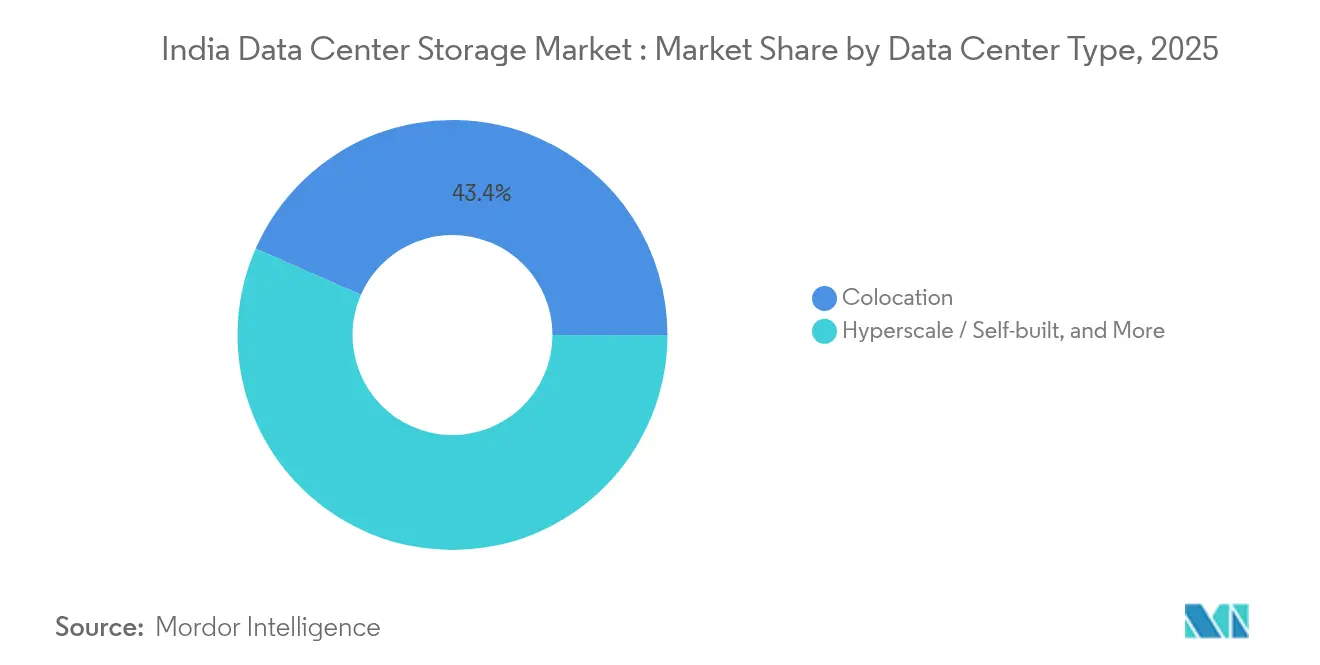
Colocation captured 43.40% of the India data center storage market share during 2025, enabled by carrier-neutral interconnect and compliance certifications that shorten enterprise migration cycles. Monetization models based on cross-connect density and shared chillers keep opex predictable for SaaS, gaming, and ERP vendors. Meanwhile, hyperscale and self-built campuses are sprinting at a 15.28% CAGR, driven by sovereign cloud commitments from Amazon, Google, and domestic internet majors. The India data center storage market size attached to hyperscalers could surpass colocations in the out-years as workloads consolidate onto mega-campuses.
Edge and modular footprints are emerging in Jaipur, Nagpur, and Guwahati to slash first-mile latency for regional fintech and ed-tech apps, creating micro-storage nodes often under 50 racks. STT GDC’s 6 MW Jaipur project is illustrative, inserting smaller yet high-density pods to reduce hop counts for IoT gateways. Storage vendors targeting these deployments emphasize ruggedized enclosures and autonomous management stacks tuned for limited staff sites.
By End-User Industry: IT-Telco Mainstay, Media-Entertainment Breakout
IT and telecommunications commanded 41.60% of the India data center storage market share in 2025, reflecting core dependency on rapid packet processing, subscriber analytics, and 5G core virtualization. Operators funnel capex toward NVMe grids that sustain network-slicing control planes and subscriber data management. The India data center storage market size anchored in telco clouds keeps expanding as 5G densification multiplies data per cell site.
Media and entertainment advances at an 17.68% CAGR, a function of booming OTT subscriptions and localized dubbing workflows that inflate transcode footprints. High-bit-rate 4K and volumetric video assets are pushing studios toward petabyte flash caches connected by 100 GbE. BFSI modernization, catalyzed by digital onboarding and real-time fraud detection, drives appetite for encrypted SAN volumes compliant with RBI directives. Government departments extend e-services across states and pilot sovereign clouds that require tamper-proof audit logs, injecting new RFPs into the India data center storage market. Healthcare, edu-tech, and manufacturing verticals form the next demand wave, seeking sector-tuned compliance features such as HL7 tagging and shop-floor time-series retention.
Geography Analysis
Mumbai retained leadership in 2025 with 53.20% of installed capacity, underpinned by submarine cable gateways and dense capital markets traffic. Chennai follows as the fastest supply-adding hub, projected to contribute 24.10% of new racks through 2032 on the back of pro-investment policies and renewable-powered campuses. Delhi-NCR and Bengaluru round out the core cluster, together hosting multitenant facilities favored by SaaS exporters and federal agencies. This quartet accounts for roughly 89.20% of current compute footprints, a concentration that crystallizes vendor sales efforts inside the India data center storage market.
A discernible pivot toward tier-2 cities is underway as operators chase land savings and edge latency gains. Jaipur, Nagpur, Chandigarh, and Raipur now offer multi-megawatt plots, tax holidays, and expedited clearances, making them credible alternatives for secondary nodes. State level policies—Maharashtra’s NAINA science data initiative and Tamil Nadu’s Green Data Centre Park framework—showcase a policy arms race that pledges USD 40 billion in cumulative incentives. Power mapping by the Ministry of Power anticipates 3.2 GW of data center electricity load by FY28, funneling renewable procurement into site-selection calculus. Expansion beyond metros diversifies seismic and flood risk exposure but raises logistical concerns such as dual-grid redundancy and fiber backhaul availability. Vendors responding to the India data center storage market therefore invest in regional distribution warehouses and partner academies to groom local talent. As clusters mature, storage demand patterns will increasingly mirror edge population densities, turning capacity forecasting into a geo-spatial exercise rather than solely a metro-centric model.
Regulatory Landscape
India data center storage procurement is shaped by data protection and sector localization requirements that keep regulated data onshore and require logging that can be audited. The Digital Personal Data Protection Act, 2023 and the Digital Personal Data Protection Rules, 2025 (notified 13 November 2025) set compliance obligations that increase demand for encryption, access governance, and tamper-evident audit trails; the Data Protection Board of India can impose penalties up to INR 250 crore per contravention. Under the DPDP Rules, full compliance is required by 13 May 2027, which raises the priority of retention and evidence-ready storage practices, including operational log retention, for regulated enterprises and service providers.
Sector regulators also maintain localization and oversight requirements alongside the DPDP framework, including the Reserve Bank of India, SEBI, and IRDAI. Infrastructure-side governance is reinforced through MeitY security guidance for State Data Centres, which stresses logical and physical security zoning and periodic third-party audits, shaping how storage is segmented (production versus backup, privileged access, and monitoring) within public sector environments and regulated colocation operations.
Value Chain Analysis
The India data center storage value chain covers semiconductor memory and HDD component sourcing, system design and OEM integration (arrays, controllers, backplanes), India distribution and channel partners, and deployment into colocation, hyperscale/self-built, and enterprise/edge facilities. Because key components are import-dependent, vendors and partners increasingly rely on local stocking, bundling, and consumption models to manage BOM volatility and procurement cycles, while hyperscale programs continue to specify NVMe-based architectures, disaggregated designs, and software-defined layers that can be operated at scale.
Downstream, implementation and lifecycle services (migration, data protection, cybersecurity hardening, and managed operations) carry more weight as compliance moves beyond capacity into controls, monitoring, and evidence retention. MeitY State Data Centre security guidance anchors operational expectations such as zone-based logical security for critical rooms and racks and periodic third-party audits (at least once every six months), which supports demand for secure configuration baselines, immutable snapshots, and integrated logging across primary, backup, and archive tiers. State-level single-window clearance and industrial park mechanisms, such as TS-iPASS in Telangana and SIPCOT in Tamil Nadu, also influence site selection and project execution, affecting where storage ecosystems, field service coverage, and spares logistics concentrate.
Competitive Landscape
The India data center storage market is moderately concentrated yet fluid, as hyperscalers dilute incumbent dominance. Strategic moves reflect a race to AI optimization. Western Digital rolled out the AI Data Cycle framework, integrating workload classifiers into firmware to cut provisioning times. Samsung appointed Acro Engineering as national distributor to localize SSD channels and hedge against import shocks. Domestic conglomerates are also active: Reliance’s partnership with NVIDIA includes GPU and storage procurement bundles for the Jamnagar megacenter. White-space opportunities concentrate around edge appliances, sovereign cloud orchestrators, and finite-element simulation storage where latency determinism trumps raw capacity.
Local assembly gains strategic importance as component volatility persists. Both Micron and Foxconn evaluate Indian packaging plants, a shift that could reshape BOM economics for arrays sold into the India data center storage market. Vendors differentiate through service tiers offering capacity on demand, carbon accounting dashboards, and quantum-ready namespace designs, positioning themselves for the impending quantum compute rollout in Andhra Pradesh. Over the medium term, ecosystem alliances and regional manufacturing footprints will be pivotal differentiators.
India Data Center Storage Industry Leaders
Dell Inc.
Hewlett Packard Enterprise
NetApp Inc.
Hitachi Vantara LLC
Kingston Technology Company Inc.
- *Disclaimer: Major Players sorted in no particular order

Market Opportunities and Future Outlook
A clear whitespace is compliance-aligned storage modernization for regulated and public sector workloads as the DPDP Rules approach the 13 May 2027 full-compliance milestone and as sector requirements from RBI, SEBI, and IRDAI continue to require onshore handling. This creates opportunities for platforms that package encryption, granular access controls, immutable backups, and long-lived logging into deployable reference architectures for banks, insurers, payment firms, and government agencies, including builds tied to sovereign cloud initiatives such as the TCS and C-DAC partnership.
Investment signals also open room for hyperscaler-adjacent and colocation-led storage deployments. The Union Budget 2026-27 provisions cited in the evidence pack, including a tax holiday until 2047 for eligible foreign cloud service providers using India-based data center infrastructure and a 15% safe harbour margin on costs for resident data centers providing services to related foreign cloud companies, support more structured captive and related-party delivery models that pull through enterprise-grade arrays and data protection stacks. Alongside ongoing capacity additions, such as Google confirming a USD 6 billion, 1 GW Visakhapatnam data center and the tier-2, policy-led expansion cited in the report context, including activity around Jaipur and Guwahati, demand is building for ruggedized, remotely managed storage nodes and standardized deployment kits that simplify operations across distributed campuses.
Recent Industry Developments
- May 2026: Dell Technologies introduced Dell PowerStore Elite, an intelligent storage platform capable of up to 3x performance increases and 6:1 data reduction, with availability starting in July 2026. Directly affects enterprise storage performance/efficiency in India data centers. Strengthens Dell’s position in India’s AI-ready storage segment and disaggregated architecture adoption.
- May 2026: Hewlett Packard Enterprise announced the launch of HPE Private Cloud AI in India to support generative and agentic AI applications, integrating NVIDIA AI computing with HPE GreenLake platform, compute, and storage. Directly supports sovereign AI infrastructure and storage integration in India. Expands HPE’s cloud-on-prem capabilities for AI workloads in the Indian market.
- March 2026: Dell Technologies announced advancements to its AI Data Platform with NVIDIA, including the introduction of Dell Exascale Storage and the Dell Lightning File System to provide high-throughput storage for multimodal AI workloads. Enhances AI-focused storage capabilities and throughput in Indian data centers. Propels Dell’s AI-centric storage portfolio and accelerates enterprise AI deployment in India.


Research Methodology Framework and Report Scope
Market Definition and Coverage
For this methodology, the India data center storage market covers storage hardware and related storage software deployed inside data centers in India. The spending is counted as storage systems used to store, protect, and serve data for enterprise and cloud workloads.
Scope exclusions: Excludes general enterprise storage that is not deployed in data centers, and it also excludes data center construction, power, cooling, and networking spend.
Segmentation Overview
- By Storage Technology
- Network Attached Storage (NAS)
- Storage Area Network (SAN)
- Direct Attached Storage (DAS)
- Other Technologies
- By Storage Type
- Traditional Storage
- All-Flash Storage
- Hybrid Storage
- By Data Center Type
- Colocation
- Hyperscale / Self-built
- Enterprise / Edge / Modular
- By End-User Industry
- IT and Telecommunication
- BFSI
- Government
- Media and Entertainment
- Other End Users
Data Sources, Market Sizing, and Validation
Desk Research
Desk research helped us build the starting demand picture for storage inside India data centers, and it also helped prevent over-counting adjacent IT spend. We referred to public datasets and standards, including MeitY policy notes and data-governance updates, Telecom Regulatory Authority of India releases for traffic and broadband indicators, Reserve Bank of India statistics for digital payments and system load proxies, and government open data portals for macro and industry series.
To convert that context into sizing inputs, we also reviewed company annual reports and investor presentations, credible press coverage of new data center capacity announcements, and association publications on data center development in India. In addition, paid subscriptions for company financials and intelligence, patent databases, and shipment-level import and export tracking were used in a selective way to sanity-check supplier exposure, product-mix shifts, and pricing direction. These desk sources are illustrative, and we also reviewed many other public documents and datasets for data collection, validation, and clarification.
Primary Interviews and Surveys
Primary work was used to pressure-test the desk assumptions and bring in the practical realities of buying and deploying storage in Indian data centers. We spoke with a mix of data center operators, cloud and managed service providers, systems integrators, and storage-focused channel participants, and then cross-checked the feedback across major metros and fast-growing secondary hubs.
Through these discussions, we confirmed pricing behavior, typical refresh cycles, flash versus HDD mix, and procurement triggers, including compliance and resilience needs. This made the final model reflect how decisions are actually made.
Distribution of primary research fieldwork respondents
| Company type | Respondent position |
|---|---|
| Top tier: 33% | CXOs: 20% |
| Mid tier: 46% | Functional/Unit leaders: 33% |
| Smaller Players: 21% | Managers: 47% |
Market-Sizing & Forecasting
Sizing starts from a top-down build where India data center capacity additions and utilization are translated into storage demand, and then filtered through storage intensity by workload type. Along the way, we used practical inputs such as installed and announced rack and power capacity, growth in cloud adoption and data creation, the flash adoption curve versus HDD, and average usable capacity per deployed system after redundancy and data protection needs are applied.
We then checked the totals with selective bottom-up approximations, including sampled price per GB trends and channel feedback on deal sizes. This helped adjust for mix shifts and procurement timing. Where direct bottom-up signals were thin, for example private data center builds that disclose limited detail, we handled gaps by applying adoption ratios drawn from comparable facilities, and then re-tested those assumptions through follow-up calls.
For forecasting, scenario analysis was used since storage demand in India data centers can swing with hyperscale leasing cycles, regulation-driven localization moves, and near-term price changes in storage media. The base case was kept consistent with what industry respondents described as the most likely procurement pace, and we stress-tested it with conservative and aggressive uptake paths for flash and AI-ready deployments.
Data Validation & Update Cycle
Model outputs were validated through triangulation across independent signals, including capacity announcements, macro digital growth indicators, and observed product-mix movement shared by interviewees. We flagged outliers when the implied storage per MW or the direction of pricing movement looked inconsistent with the broader evidence, then revisited assumptions until the variance was explainable.
Before sign-off, multiple analyst reviews focus on unit consistency, year-to-year continuity, and the reasonableness of growth drivers. Reports are refreshed annually, and interim updates are done when material events occur, such as large capacity commissioning, policy changes that alter data location requirements, or sharp pricing shifts. Right before delivery, a final pass is completed so clients receive the latest updated view.
Mordor Intelligence's India Data Center Storage Market Size Compared With Other Published Estimates
Published market values for India data center storage can differ because each publisher decides what counts as data center storage, how they treat cloud versus enterprise deployments, and how they convert capacity growth into spend. Timing also matters, since pricing for storage media and systems can move quickly, and the base year chosen can shift the whole curve.
The biggest gaps usually come from scope and pricing logic, where some estimates fold in broader data storage, including end user enterprise storage outside data centers, or include services and adjacent infrastructure spend. Another common difference is the growth path that gets assumed for flash penetration and refresh cycles. An aggressive mix shift can inflate near-term value even if capacity is still being absorbed. The table highlights that spread, and the key limiter here is that only storage deployed inside India data centers is counted. Pricing and mix are refreshed against recent channel checks before finalizing the estimate, which is the approach used by Mordor Intelligence.
Benchmark comparison
| Source | Market Size | Gaps in Research Methodology |
|---|---|---|
| Mordor Intelligence | USD 2.90 B (2025) | |
| Industry Publisher A | USD 4.19 B (2025) | Uses a wider definition that appears to include non-data-center enterprise storage and a broader set of storage mediums, which lifts the spend base beyond data center deployments. |
| Research Provider B | USD 2.40 B (2024) | Anchors the number on an earlier base year and likely applies more conservative pricing and refresh assumptions, which reduces the implied spend even if capacity growth is acknowledged. |
Looking across the three figures, most of the difference comes down to what is included as storage spend and how quickly pricing and mix are updated. By keeping the scope tied to data center deployments inside India and by re-checking key inputs like flash share and refresh timing, the final number stays traceable to clear variables and repeatable steps, which makes it easier for decision-makers to use consistently.


Key Questions Answered in the Report
What is the projected value of India’s data center storage segment by 2032?
It is forecast to reach USD 11.05 billion by 2032, expanding at a 21.12% CAGR from 2026.
How quickly are data-localization rules shaping storage demand in India?
Reserve Bank of India mandates and the Digital Personal Data Protection Act are already adding roughly +2.8% to the sector’s CAGR by forcing on-premise storage for regulated data.
Which storage technology currently holds the largest share in India?
Storage Area Networks led with 45.40% share in 2025 because BFSI and telecom workloads favor block-level throughput and low-latency zoning.
Why are hyperscale investments important to India’s future capacity?
Projects such as Reliance’s planned 3 GW Jamnagar campus and Google’s Visakhapatnam build need ultra-dense flash arrays and NVMe-over-Fabrics, driving large incremental demand for high-performance storage.
What challenge do component price swings pose to storage providers?
NAND flash spot prices jumped more than 10% in 2025, lifting bill-of-materials costs and forcing vendors to adopt dynamic pricing that can slow purchases among cost-sensitive buyers.
How does the Digital Personal Data Protection Act affect enterprise storage strategy?
The Act keeps personal data inside national borders, so multinationals must deploy compliant onshore arrays with fine-grained access controls and audit logs to meet residency and governance rules.
Page last updated on:
- Data Center Server Market Servers across the global market, covering tier, facility size and facility type.
- Artificial Intelligence (AI) Data Center Market AI facilities worldwide, split by facility type, component and tier.
- Data Center Construction Market Construction across the global market, covering tier, facility size and facility type.
- Spain Data Center Rack Market Racks demand across Spain, covering rack size, rack height and rack type.
- United States Data Center Server Market Servers demand across the US, covering data-center tier, form factor and application / workload.
- South Korea Hyperscale Data Center Market South Korea hyperscale sites, split by facility type, component and tier.





