
Market Overview
| Study Period | 2020 - 2031 |
|---|---|
| Forecast Data Period | 2026 - 2031 |
| Base Year Market Size (2025) | USD 1.48 Billion |
| Market Size (2026) | USD 1.58 Billion |
| Market Size (2031) | USD 2.18 Billion |
| Growth Rate (2026 - 2031) | 6.70 % |
| Market Concentration | Medium |
Major Players *Disclaimer: Major Players sorted in no particular order Image © Mordor Intelligence. Reuse requires attribution under CC BY 4.0. | |
India Crane Market Analysis by Mordor Intelligence
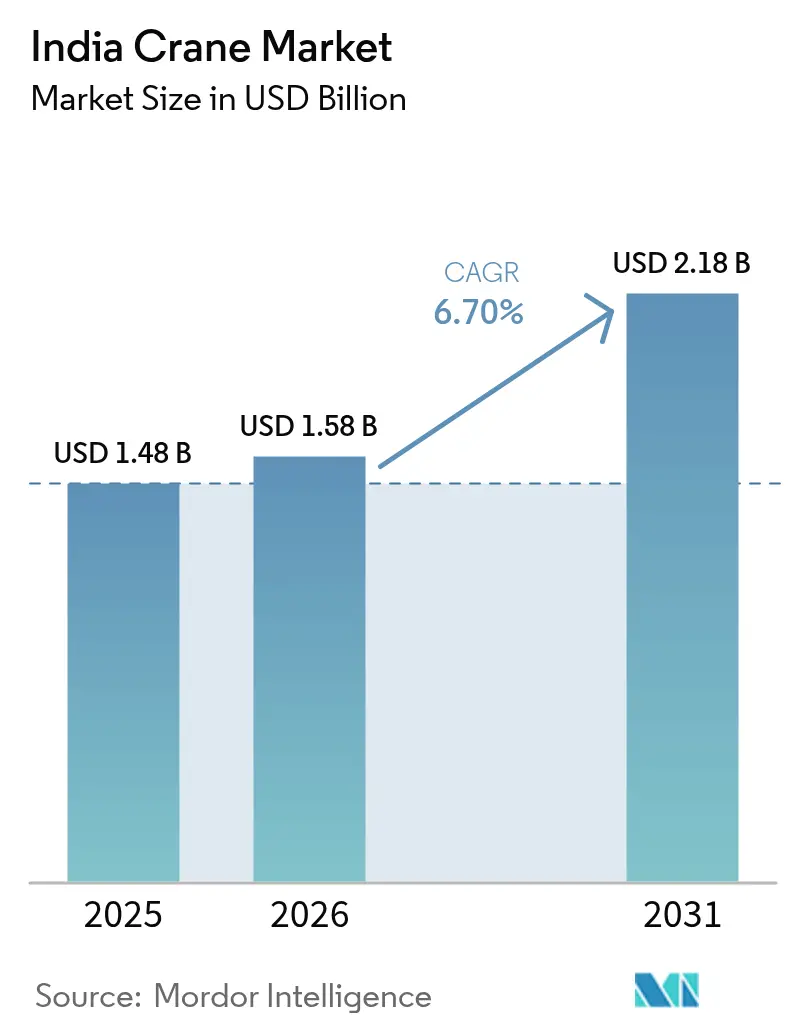
The India crane market size was valued at USD 1.48 billion in 2025 and estimated to grow from USD 1.58 billion in 2026 to reach USD 2.18 billion by 2031, at a CAGR of 6.70% during the forecast period (2026-2031). Rapid infrastructure modernization, the USD 1.4 trillion National Infrastructure Pipeline (NIP), and strong growth in renewable-energy installations anchor demand for mobile, crawler, and tower cranes across capacity classes[1]“Crane Market Sees Demand Surge on NIP Projects,”, Construction World Editorial Team, constructionworld.in. Contractor preference for mechanized lifting over labor-intensive methods accelerates fleet replacement with higher-capacity, telematics-enabled units. Public–private partnerships in metro-rail and regional rapid-transit corridors compress construction timelines, favoring rental-first procurement. Renewable-energy build-out, especially wind projects calling for 800-ton crawler cranes, deepens application diversity, while electric-power trains begin challenging diesel dominance as environmental standards tighten. Competitive intensity rises as Action Construction Equipment (ACE) defends its domestic stronghold against cost-competitive Chinese OEMs that localize production to manage rupee volatility and compliance with the Bureau of Indian Standards Scheme X.
Key Report Takeaways
- By machine type, mobile cranes led with 62.55% of the India crane market share in 2025; crawler cranes recorded the fastest CAGR at 8.62% through 2031.
- By application, construction accounted for a 57.05% share of the India crane market size in 2025, while energy and utilities advanced at a 10.22% CAGR to 2031.
- By lifting capacity, 20-100 ton units held 45.74% of the India crane market size in 2025; above-300-ton units expanded at a 9.05% CAGR through 2031.
- By boom type, telescopic designs commanded 53.92% revenue share in 2025; lattice boom variants progressed at a 9.50% CAGR to 2031.
- By power source, diesel models captured 82.45% revenue in 2025; fully electric cranes climbed at a 10.18% CAGR over the same horizon.
Note: Market size and forecast figures in this report are generated using Mordor Intelligence’s proprietary estimation framework, updated with the latest available data and insights as of 2026.
India Crane Market Trends and Insights
Drivers Impact Analysis*
| Driver | (~) % Impact on CAGR Forecast | Geographic Relevance | Impact Timeline |
|---|---|---|---|
| NIP Investments | +1.2% | National; tier-1 and tier-2 cities | Long term (≥ 4 years) |
| Smart Cities Housing | +1.0% | 100 Smart Cities | Medium term (2-4 years) |
| Renewable Heavy-lift Demand | +1.1% | Gujarat; Rajasthan; Tamil Nadu; Karnataka; Maharashtra | Long term (≥ 4 years) |
| PPP Metro and RRTS | +0.8% | Delhi NCR; Mumbai; Bangalore; Chennai; Hyderabad | Medium term (2-4 years) |
| Rental-first EPC | +0.7% | Nationwide industrial corridors | Short term (≤ 2 years) |
| Telematics and Autonomy | +0.5% | Metro cities; industrial clusters; large projects | Long term (≥ 4 years) |
| Source: Mordor Intelligence | |||
Surge in National Infrastructure Pipeline (NIP) Investments
The USD 1.4 trillion NIP funds highway, port, airport, and urban-transport projects, lifting annual crane demand by prioritizing mechanized construction over manual labor. Road works under Bharatmala and port upgrades via Sagarmala contribute 30-40% of all construction-equipment volumes. Contractors rely on rentals to ensure on-time availability, which underpins Sanghvi Movers’ double-digit fleet additions.
Housing-Led Urban Revitalization Under Smart Cities Mission
The Smart Cities Mission funnels over USD 20 billion into 8,000 active projects, generating dense urban core lifting needs suited to tower cranes and compact mobiles [2]“Smart City Projects Push Demand for IoT-Ready Cranes,”, NBM&CW Editors, nbmcw.com. With over 65% tower-crane share, ACE plans 25-ton flattop launches to address high-rise clusters. Sustainability mandates push electric and hybrid cranes that cut emissions and noise. Project management platforms demand IoT-ready lifting solutions, turning telematics from optional to essential.
24×7 Renewable-Energy Build-Out Driving Heavy-Lift Demand
India’s 500 GW non-fossil target boosts demand for 600- to 800-ton crawler cranes that erect 3 MW wind turbines with 168-meter boom systems. SANY’s SCC8000A handover in Gujarat evidences the shift toward super-heavy classes. Solar parks create high-volume mobile crane needs in remote terrains. Environmental clearances incentivize electric-drive cranes in ecologically sensitive zones.
Automation Push: Telematics and Autonomous Cranes Pilots
SANY’s E-Vision suite and Caterpillar IoT platforms provide real-time health diagnostics that shift maintenance from reactive to predictive. Cableless controls from AUTEC pave the way for semi-autonomous cranes that mitigate operator shortages. BIS standards are moving toward mandatory telematics for safety oversight, embedding connectivity in future purchase decision.
Restraints Impact Analysis*
| Restraint | (~) % Impact on CAGR Forecast | Geographic Relevance | Impact Timeline |
|---|---|---|---|
| Operator Shortage | -0.8% | Nationwide; tier-2 and tier-3 cities | Short term (≤ 2 years) |
| Working-capital Strain | -0.6% | Regional MSME rental operators | Short term (≤ 2 years) |
| Rupee Volatility | -0.5% | Import-dependent OEMs nationwide | Short term (≤ 2 years) |
| Fragmented Safety Regs | -0.4% | State-level variations | Medium term (2-4 years) |
| Source: Mordor Intelligence | |||
Shortage of Certified Crane Operators and Riggers
A shortfall in certified personnel limits fleet utilization as equipment sophistication outruns skill supply. The Infrastructure Equipment Skill Council offers 6- to 12-month courses, yet demand outstrips throughput. OEM-run academies train operators, but advanced wind-lift or metro-rigging expertise remains scarce, keeping labor a growth bottleneck[3]“Skill Shortage Hinders Crane Operations,”, NBMCW Editors, nbmcw.com.
High Working-Capital Cycle for Small Rental Fleets
Construction receivables often stretch 90-180 days, straining MSME fleet owners who must service loans while equipment sits idle[4]“Credit Risks Rise for Equipment Rentals,”, Autocar Professional Analysts, autocarprofessional.com. Illegal exports of pledged machinery heighten lender risk, tightening credit. Smaller players, therefore, stick to mid-capacity cranes with quicker payback, ceding super-heavy segments to large operators.
*Our forecasts treat driver/restraint impacts as directional, not additive. The impact forecasts reflect baseline growth, mix effects, and variable interactions.
Segment Analysis
By Machine Type: Mobile Cranes Lead Infrastructure Surge
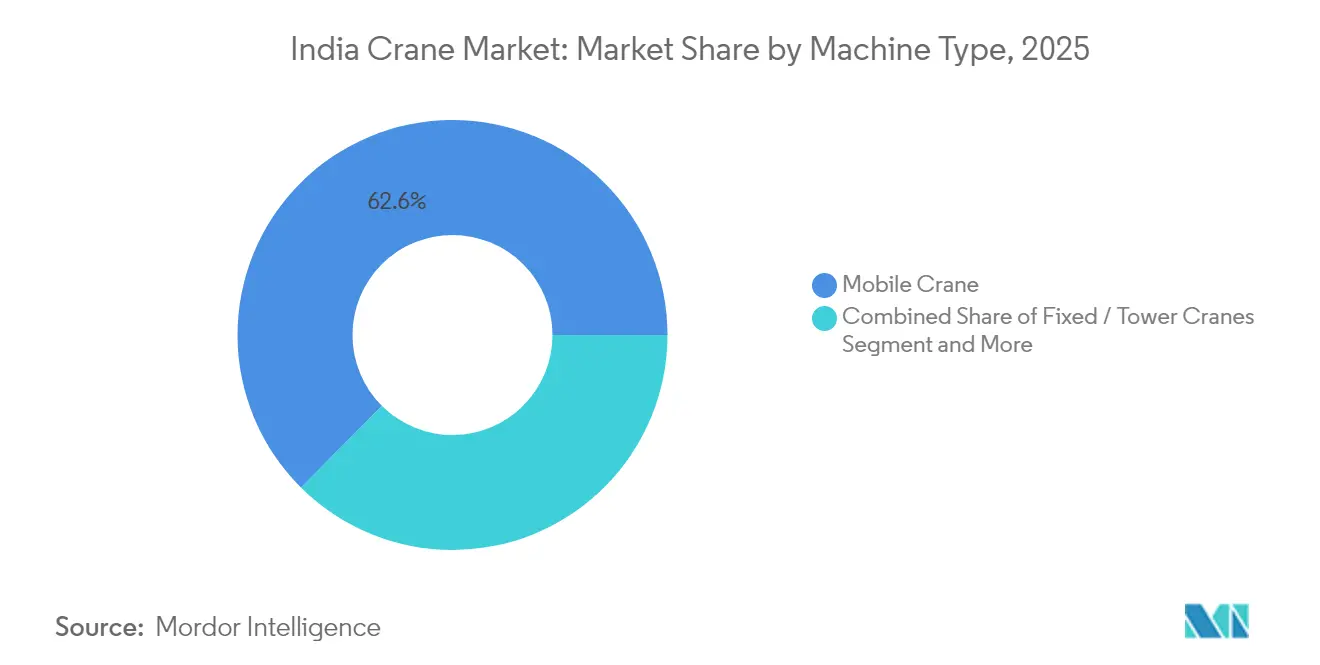
The mobile-crane segment captured 62.55% of the India crane market size in 2025, thanks to fast deployment across road, port, and industrial sites. Its dominance persists as contractors demand versatile lifting that keeps pace with compressed project schedules. Fixed and Tower-crane demand, expanding at an 8.20% CAGR, mirrors growth in needing stable heavy-lift solutions. Fixed tower cranes remain staples in high-rise residential clusters under Smart Cities Mission, while marine cranes carve a niche through electric harbor installations such as Visakhapatnam’s twin Liebherr LHM 550 units.
Mobile-crane manufacturers tailor designs around all-terrain mobility and telematics, deepening rental appeal. Crawler-crane OEMs focus on 400- to 800-ton models featuring long booms and self-assembly systems that cut erection time. Importantly, crawler units face stricter BIS scrutiny under high-risk categories, making certification history a procurement criterion. As rental fleets chase utilization, diversified inventories encompassing mobiles for general works and crawlers for specialist lifts become a competitive necessity. Consequently, ACE sustains scale in mobile lines, while SANY, Liebherr, and Kobelco target crawler opportunities with localized production aimed at the India crane market.



By Application: Construction Dominance Faces Energy Challenge
Construction retained 57.05% of 2025 revenue, positioning it as the backbone of the Indian crane market. Housing, commercial complexes, and transport corridors anchor steady lifting needs spanning 20- to 100-ton mobiles and tower cranes. Energy and utilities, however, post a 10.22% CAGR as super-heavy crawlers support 3 MW wind turbine erection across Gujarat and Karnataka. Mining, marine, and industrial manufacturing trail yet contribute niche demand requiring specialized dimensions or environmental compliance.
Construction-sector growth remains tied to NIP project rollouts and PPP execution momentum. Meanwhile, the renewable boom brings geographically concentrated but capacity-intensive requirements, prompting rental operators to cluster heavy gear near wind corridors for sequential deployment. Crane OEMs respond by integrating quick-transport systems and modular counterweights that shorten mobilization between remote sites. As power-plant developers mandate lower carbon footprints, hybrid and electric drives penetrate utility applications faster than general building, adding technological diversity to the Indian crane market.
By Lifting Capacity: Mid-Range Dominance, Heavy-Lift Acceleration
Mid-range 20-100 ton models controlled 45.74% of 2025 shipments, constituting the workhorse class for general construction. The above 300-ton variants, propelled by wind-energy tasks, registered a 9.05% CAGR and represent the fastest-growing slice of India's crane market share. Sub-20-ton segments cater to inner-city redevelopment, while 100-300 ton units provide the transition toward specialized industrial assembly.
Rising hub heights and heavier nacelles amplify crawler-crane capacities, leading OEMs to debut 800-ton platforms with luffing-jib extensions surpassing 168 meters. Such super-heavy units often remain on long-term rental to recoup multimillion-dollar acquisition costs. Certification, ballast logistics, and operator skill requirements deepen barriers, leaving heavy-lift space to a handful of national fleet owners. Conversely, mid-range cranes remain the preferred entry point for MSME contractors and rental startups serving the expanding India crane market.
By Boom Type: Telescopic Efficiency Versus Lattice Reach
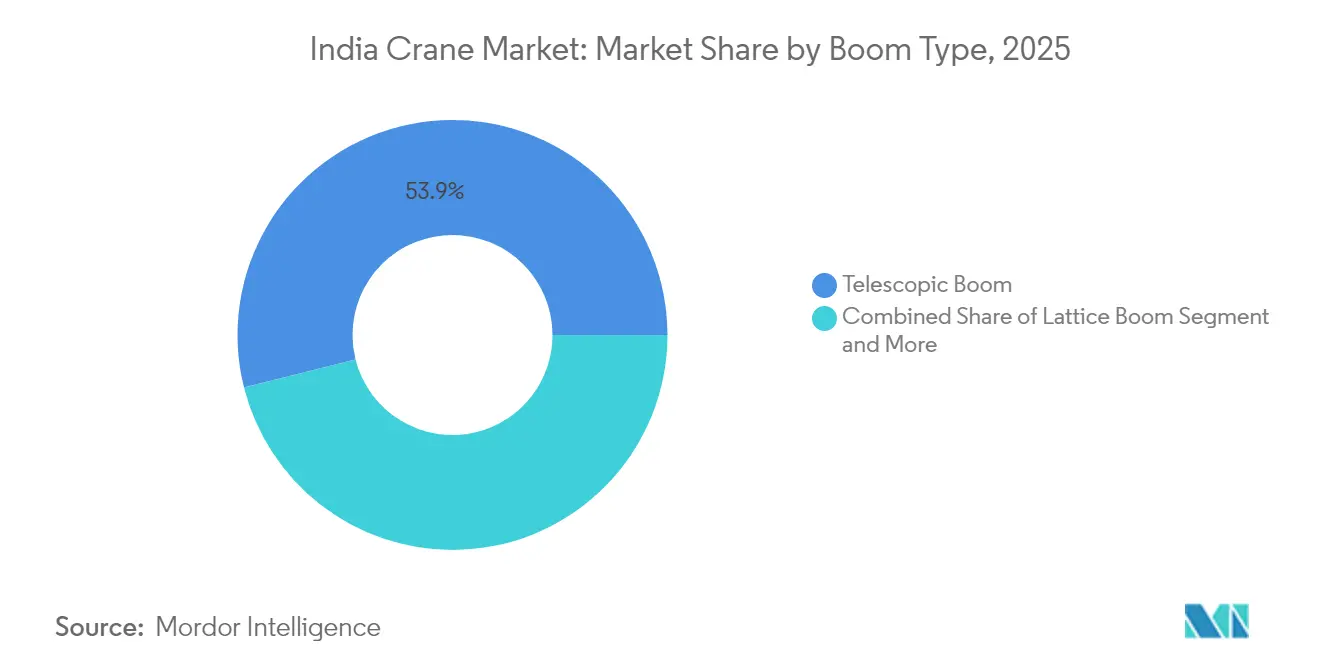
Telescopic booms delivered 53.92% revenue in 2025, favored for rapid setup and road mobility. Lattice booms’ 9.50% CAGR stems from superior reach-to-weight ratios valuable for erecting tall wind turbines and metro viaducts. Knuckle booms, though small in volume, solve space-constrained material handling in industrial plants and shipyards.
Telescopic innovations such as multi-section single-cylinder synchronization increase free-standing heights, challenging lattice supremacy in some mid-capacity lifts. Yet, lattice systems maintain low bending moments, supporting 120-meter hub installations. Rental owners therefore stock both boom types to match varying lift plans, ensuring utilization in the India crane market across infrastructure and industrial timelines.
By Power Source: Diesel Dominance Faces Electric Transition
Diesel cranes secured 82.45% revenue in 2025 as fuel access and refueling ease kept operating costs predictable. Electric cranes, however, posted a 10.18% CAGR, accelerated by port authorities and urban municipalities favoring zero-emission zones. Hybrid units bridge limitations, offering battery-assisted duty cycles that cut fuel use by up to 25% without sacrificing endurance.
Grid-connected projects, such as metro depots, now specify shore-powered electric crawlers to meet local air-quality rules, while harbor operators adopt battery cranes like Liebherr LHM 550 to curb marine-diesel particulate emissions. Infrastructure gaps in rural wind parks slow electric adoption, but OEMs develop containerized fast-charge stations to extend operational footprints. Policy incentives under FAME III could further tilt procurement, making drive-train choice a strategic variable in the India crane market.
Geography Analysis
Gujarat, Maharashtra, Tamil Nadu, and Karnataka collectively represent close significant share of crane demand, reflecting robust industrial corridors, port construction, and renewable capacity additions. Western India benefits from Sagarmala port modernization and petrochemical expansions that consume diversified lifting capacities. Northern India, spearheaded by Delhi NCR, channels metro-rail, RRTS, and Smart City projects that absorb a mix of tower, mobile, and crawler cranes.
Southern states propel wind-energy uptake, with Tamil Nadu and Karnataka hosting clustered turbine-installation campaigns requiring 600- to 800-ton crawlers. Bangalore’s IT hub and Hyderabad’s pharma clusters add steady industrial lifting. Eastern India, historically mining-centric, sees incremental gains from mechanized coal extraction and steel-plant upgrades, yet its aggregate share lags western and southern peers.
Regional rental hubs evolve near industrial parks, allowing fleet owners to redeploy assets swiftly among contiguous projects. Nevertheless, state-specific safety approvals create administrative hurdles for itinerant equipment, prompting larger fleets to maintain local compliance teams. Tier-2 and tier-3 urban centers emerge as untapped pockets where cost-sensitive mid-capacity mobiles dominate, widening the geographic dispersion of the India crane market.
Regulatory Landscape
Crane manufacturing and in-service safety in India are governed by a mix of vehicle regulations for road-going construction equipment and product safety standards for lifting equipment. Construction Equipment Vehicles (CEVs) operating on public roads fall under the Central Motor Vehicle Rules (CMVR), 1989, along with the Automotive Industry Standards (AIS) framework developed by the Automotive Industry Standards Committee (AISC) under the Ministry of Road Transport and Highways (MoRTH), with ARAI supporting standardization and certification for AIS compliance, including requirements for electric CEVs (AIS 174).
For equipment, Bureau of Indian Standards (BIS) codes remain key references for design, testing, and safe use, including IS 807 (design, erection, and testing of cranes and hoists), IS 14470 (test code and procedures), and IS 15419 (jib cranes). Trade remedies have also started shaping competitive dynamics: the Directorate General of Trade Remedies (DGTR) issued final findings on September 19, 2025 (File No. 6/24/2024-DGTR) in an anti-dumping investigation covering imports of certain cranes from China PR, which adds compliance and cost considerations for import-reliant supply strategies.
Value Chain Analysis
The India crane value chain covers steel and fabricated structures, hydraulic systems, powertrains, wire ropes, controls and electronics, and safety components, followed by assembly, testing, and certification before sale into OEM, EPC, and rental channels. Domestic OEMs and localized assembly by global players are supported by tiered suppliers, while testing and standardization touchpoints include AISC/AIS processes and BIS-aligned design and test practices that influence documentation, inspection, and acceptance for higher-risk categories.
Distribution is split between direct institutional sales (ports, large contractors, industrial plants), dealer networks for mobile cranes, and a large rental ecosystem that increasingly specifies telematics and uptime-centric service packages. Aftermarket capability (spares, field service, refurbishments) and financing shape total cost of ownership, particularly for MSME rental fleets facing 90-180 day receivable cycles. Upstream localization is also being reinforced by policy-linked manufacturing initiatives. In May 2026, the Ministry of Ports, Shipping and Waterways was reported to be progressing a maritime crane manufacturing support scheme (capital and operating support concepts under consideration) aimed at reducing import dependence in port cranes, which would pull more fabrication, electrification, and controls work into domestic supply bases.
Competitive Landscape
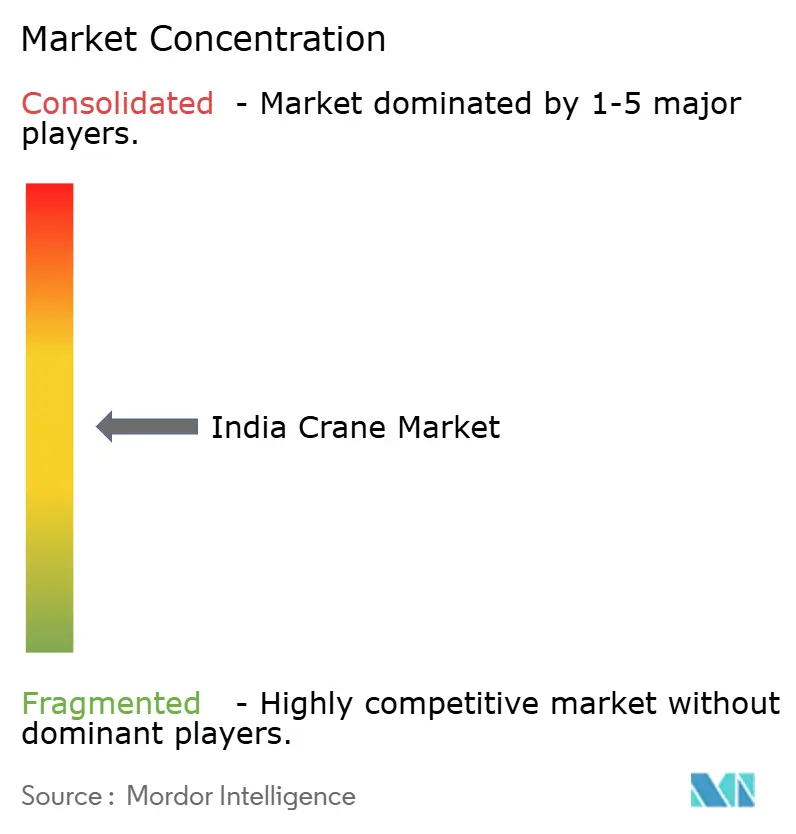
The India crane market remains moderately concentrated. ACE leverages an extensive dealer footprint and application-specific product tweaks to fend off global rivals. Chinese OEMs—SANY, XCMG, and Zoomlion—expand local assembly to dilute import duties and hedge rupee swings. SANY eyes INR 30,000 crore top-line by 2030 through portfolio diversification and Scheme X-compliant designs.
Collaborations intensify: ACE and Kato explore medium- and large-crane joint production, while Escorts Kubota aligns with Tadano for premium rough-terrain models. Technology becomes the next battleground as IoT diagnostics, autonomous controls, and electric drivelines differentiate offerings. Large rental firms influence road-maps by specifying telematics and quick-erection features. Regulatory rigor under BIS Scheme X consolidates share among capital-strong incumbents who can navigate certification costs, pointing to gradual upticks in overall concentration within the India crane market.
India Crane Industry Leaders
Action Construction Equipment Limited
Liebherr Group
Konecranes
Tata Hitachi
Kobelco Construction Equipment
- *Disclaimer: Major Players sorted in no particular order

Market Opportunities and Future Outlook
Ultra-heavy lifting for marquee transport corridors is opening a clearer demand lane for high-capacity crawler fleets, lift planning, and specialist rigging services. In July 2026, the Mumbai-Ahmedabad High-Speed Rail project reported completion of launching 13 heavy portal beams in Ahmedabad, including a 1,640-tonne unit at Sabarmati, using a 2,200-metric-tonne crawler crane, which is consistent with how very high capacity equipment is typically deployed through rentals and consortium-led lift execution.
Urban bridge and viaduct programs are also widening the tower-crane opportunity set, where constrained footprints and schedule compression increase the value of high free-standing heights and high duty cycles. In June 2026, Afcons Infrastructure used four Potain MCT 385 tower cranes for pylon construction on the Lonavala cable-stayed bridge as part of the Mumbai-Pune Expressway Missing Link project, indicating continued demand for high-spec tower cranes in complex civil works. On the supply side, policy is pointing toward deeper domestic value addition: the Union Budget 2026-27 proposed a Scheme for Enhancement of Construction and Infrastructure Equipment (CIE) to strengthen domestic manufacturing of technologically advanced equipment, supporting localized heavy-crane platforms, electrified drivetrains for ports and urban sites, and component ecosystems (controls, hydraulics, and safety systems).
Recent Industry Developments
- February 2026: Action Construction Equipment Limited (ACE) announced board approval for a joint venture in India with KATO Works Co. Ltd. to manufacture heavy cranes, covering truck cranes, crawler cranes, and rough terrain cranes. The approval formalizes a pathway for higher-capacity product localization and positions ACE to compete more directly in premium heavy-lift segments where technology and certification demands are higher.
- October 2025: An Indian container terminal operator ordered 30 Konecranes rubber-tired gantry (RTG) cranes featuring E-Hybrid technology, with delivery scheduled for Q1 2027. This large electrification-led order strengthens the installed base for hybrid yard equipment at Indian ports and supports a broader shift toward lower-emission terminal operations that can extend into adjacent port crane categories.
- July 2025: Liebherr delivered two electric LHM 550 mobile harbour cranes for Green Energy Resources at berth EQ1A in Visakhapatnam. The deployment highlights growing adoption of electric harbor lifting in India and increases competitive pressure on OEMs and suppliers to provide electrified duty cycles, service capability, and lifecycle support for port customers.


Research Methodology Framework and Report Scope
Market Definition and Coverage
For this study, the market is defined as revenues earned in India from selling cranes used to lift and move heavy loads across construction, industrial sites, utilities, mining, and ports, counted at the equipment level and captured in USD.
Scope exclusions: We exclude routine service-only revenue (annual maintenance, spares-only sales, and operator rentals without crane ownership transfer) and non-crane lifting equipment such as forklifts and hoists.
Segmentation Overview
- By Machine Type
- Mobile Cranes
- Fixed / Tower Cranes
- Marine & Port Cranes
- By Application
- Construction
- Mining and Excavation
- Marine and Offshore
- Industrial Manufacturing
- Energy and Utilities
- By Lifting Capacity
- Below 20 tons
- 20 - 100 tons
- 100 - 300 tons
- Above 300 tons
- By Boom Type
- Telescopic Boom
- Lattice Boom
- Knuckle Boom
- By Power Source
- Diesel
- Hybrid
- Fully-Electric
Data Sources, Market Sizing, and Validation
Desk Research
Desk research builds the basic demand picture and helps keep assumptions tied to measurable India signals. We typically start with public series and standards information from sources such as the Ministry of Road Transport and Highways, the Ministry of Ports, Shipping and Waterways, the Ministry of Mines, and the Ministry of Statistics and Programme Implementation, since these reflect activity levels that drive lifting needs.
We also review safety and compliance references such as BIS standards, plus customs trade statistics and tariff classifications, to sense import dependence for certain crane categories and components. Company annual reports, investor decks, and reputed press are then used to track product mix shifts, manufacturing capacity changes, and pricing direction. For additional cross-checks, we selectively use paid subscriptions for company financials and intelligence, patent databases, and shipment-level import or export records when the public trail is thin. These examples are not exhaustive, and many other sources were used for data collection, validation, and research clarification.
Primary Interviews and Surveys
Primary work is used to pressure-test the desk assumptions that most often move the market value, like order conversion timing, typical discounts in tenders, and the split between new sales and replacement demand. We speak with a mix of crane OEM-facing channels, rental fleet owners, EPC and project contractors, and end users in construction, industrial manufacturing, energy, mining, and port operations across major Indian demand centers.
Distribution of primary research fieldwork respondents
| Company type | Respondent position |
|---|---|
| Top tier: 27% | CXOs: 18% |
| Mid tier: 51% | Functional/Unit leaders: 26% |
| Smaller Players: 22% | Managers: 56% |
Market-Sizing & Forecasting
Sizing starts from a top-down build where India construction output signals, infrastructure project pipelines, port and logistics throughput, and industrial capex cues are translated into crane demand intensity by application, and then converted into value using observed price bands for major crane categories. To keep the output realistic, we corroborate with selective bottom-up approximations, using sampled unit shipments, distributor sell-through checks, and average selling price (ASP) ranges for key machine types.
Key inputs that typically matter for India cranes include new project starts and execution pace, rental penetration trends, lifting capacity mix (light versus heavy), duty-cycle use patterns by industry, import share movements, and diesel versus electric power preference changes in city construction. When product-level volumes are not directly visible, gaps are handled through conservative proxy ratios that are reviewed with primary respondents and adjusted only when multiple checks agree.
For forecasting, we rely on scenario analysis anchored to project award to execution timing, with assumptions refined through interviews on bid pipelines and fleet utilization. The final forecast is then reconciled back to macro indicators so the growth path stays consistent with the broader investment cycle.
Data Validation & Update Cycle
Outputs are validated through triangulation across independent indicators, followed by variance checks at the machine-type and application levels so any sharp jumps get investigated before sign-off. If a price or volume swing looks out of line with project activity, trade flows, or utilization feedback, the assumption is revisited and respondents are re-contacted for clarification.
Before publication, the model is reviewed in multiple steps by analysts to confirm arithmetic, unit conversions, and currency treatment are consistent across the historical and forecast periods. Reports refresh annually, and interim updates are made when material events occur, such as policy changes, large project announcements, or demand shocks. Right before delivery, we run a fresh scan so clients receive the latest updated view.
Mordor Intelligence's India Crane Market Estimate Compared With Other Published Estimates
Published market sizes for India cranes can look far apart, even when the growth story sounds similar, because each publisher draws the scope and pricing logic differently. The biggest differences usually come from what is counted as a crane sale, the year used for currency conversion, and how replacement demand is treated versus new project-driven demand.
Some sources also mix equipment revenue with rental and service turnover, or they apply a single blended ASP across very different lifting capacities, which can inflate or compress totals. Many figures are further shaped by whether port and marine cranes are included, how imports are treated in value terms, and how often assumptions are refreshed when steel prices and tendering discounts move. Some estimates fold in broader lifting and material-handling equipment revenue, then Mordor Intelligence counts only crane equipment sales in India by defined machine types and applications, with service-only revenue kept out of the market value.
Benchmark comparison
| Source | Market Size | Gaps in Research Methodology |
|---|---|---|
| Mordor Intelligence | USD 1.48 B (2025) | |
| Global Consultancy A | USD 1.03 B (2025) | Uses a narrower type split (fixed vs mobile) and can undercount port and specialized cranes, and the published view does not clarify how imports and channel margins are handled in the final value. |
| Industry Publisher B | USD 1.50 B (2025) | Reported as a broad infrastructure-linked crane spend number, with limited transparency on whether rental turnover and service contracts are included, which can push the value closer to project spend than equipment sales. |
Across the three figures, the spread is mainly explained by scope and pricing treatment rather than a disagreement on demand direction. By keeping the market tied to clear machine categories, checked price bands, and repeatable demand indicators, our estimate stays easier to reconcile with observable project activity and trade signals.


Key Questions Answered in the Report
What is the current value of the India crane market and its expected growth by 2031?
The market is valued at USD 1.58 billion in 2026 and is projected to reach USD 2.18 billion by 2031, reflecting a 6.70% CAGR.
Which crane type leads demand across India’s infrastructure projects?
Mobile cranes hold the largest share at 62.55% of 2025 shipments because their versatility suits roads, ports, and industrial sites.
Why are crawler cranes gaining momentum in India?
Crawler cranes post an 8.62% CAGR through 2031 due to renewable-energy and metro-rail projects requiring heavy-lift capabilities and long booms.
Which power source is growing fastest in Indian crane fleets?
Fully electric cranes record a 10.18% CAGR as ports, metro depots, and urban projects mandate lower emissions and quieter operations.
What is the biggest hurdle slowing crane deployment in India?
A shortage of certified operators and riggers constrains fleet utilization despite rising equipment availability.
Page last updated on:




