
India Consumer Speaker Market Size and Share
Market Overview
| Study Period | 2020 - 2031 |
|---|---|
| Forecast Data Period | 2026 - 2031 |
| Base Year Market Size (2025) | 36.71 Million units |
| Market Volume (2026) | 41.15 Million units |
| Market Volume (2031) | 72.78 Million units |
| Growth Rate (2026 - 2031) | 12.08 % |
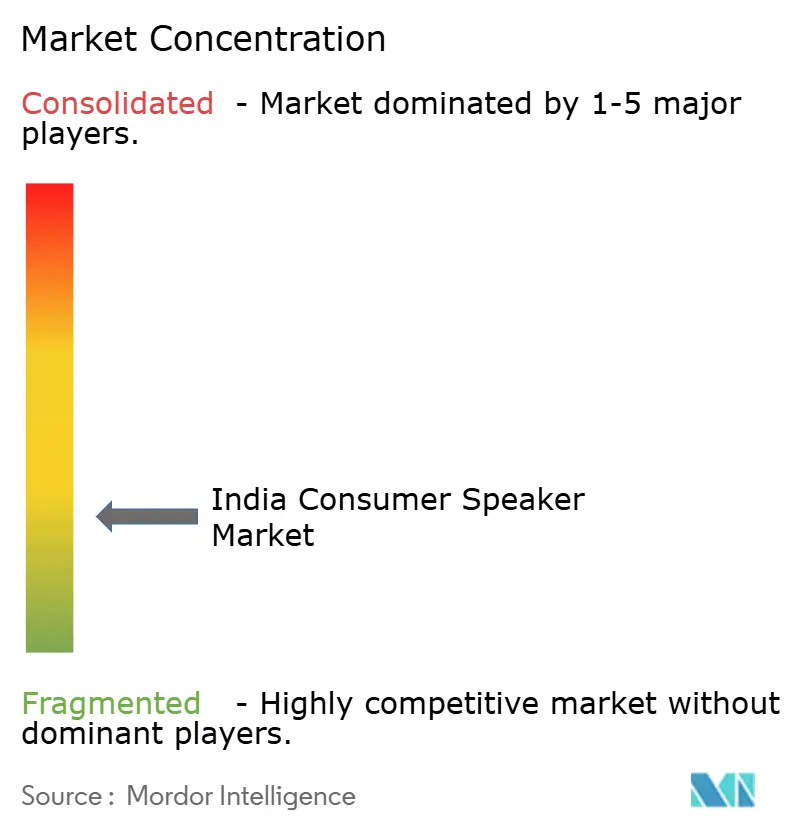
| Market Concentration | Low |
Major Players *Disclaimer: Major Players sorted in no particular order Image © Mordor Intelligence. Reuse requires attribution under CC BY 4.0. | |
India Consumer Speaker Market Analysis by Mordor Intelligence
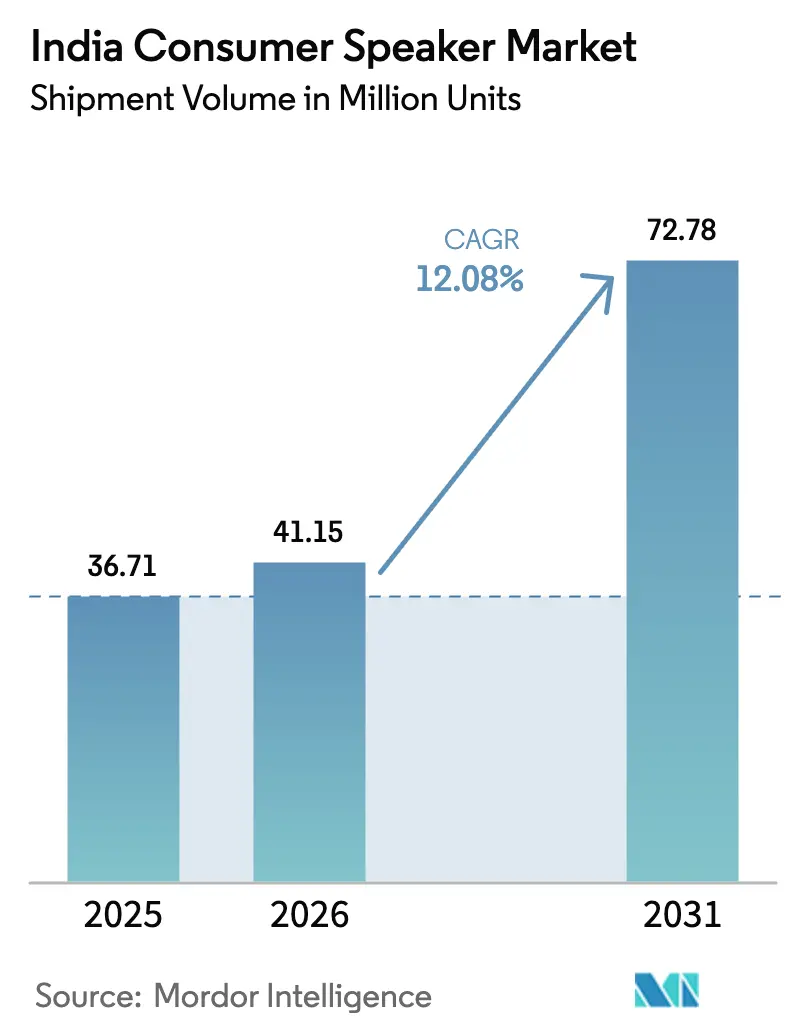
India Consumer Speaker market size in 2026 is estimated at 41.15 Million units, growing from 2025 value of 36.71 Million units with 2031 projections showing 72.78 Million units, growing at 12.08% CAGR over 2026-2031. Volume growth reflects steady gains in discretionary incomes, aggressive 5G and fiber roll-outs, and the government-led drive to anchor more audio production locally. Wider adoption of connected televisions is translating into attach rates for companion soundbars, while smartphone ubiquity keeps Bluetooth-only models relevant for price-sensitive buyers. Local firms such as boAt and Zebronics are capitalizing on production-linked incentives to shorten design-to-launch cycles and defend share against international brands. Supply-chain headwinds around rare-earth magnets remain a cost threat, yet the market continues to absorb premium models as urban consumers pay for multi-room audio and voice-assistant convenience. Competitive intensity is rising, but the sheer scale of demand from tier-2 and tier-3 cities sustains a broad playing field across price tiers.
Key Report Takeaways
- By device type, wireless speakers led with 51.64% of the India consumer speaker market share in 2025 and soundbars are advancing at a 13.05% CAGR through 2031.
- By connectivity, Bluetooth-only models commanded 67.58% share of the India consumer speaker market size in 2025 while dual BT + Wi-Fi configurations are expanding at 12.12% CAGR.
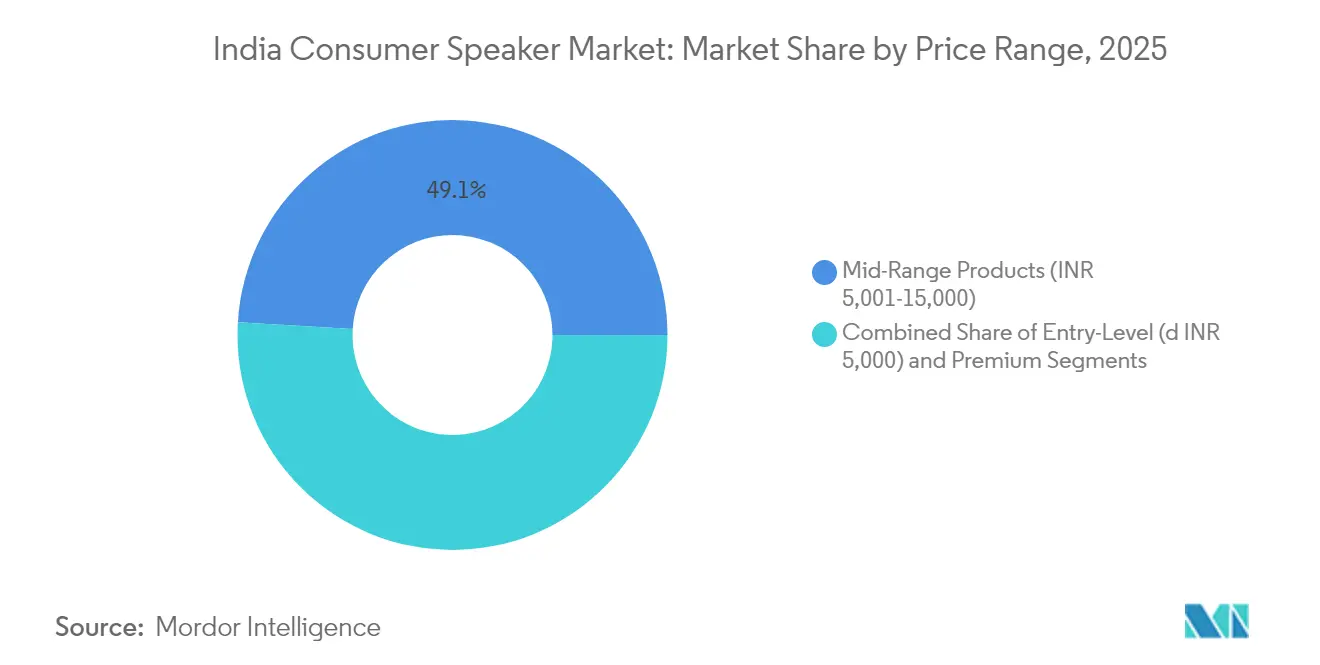
- By price range, mid-range products (INR 5,001-15,000) captured 49.05% of the India consumer speaker market size in 2025; premium units (≥ INR 15,001) are growing fastest at 12.74% CAGR.
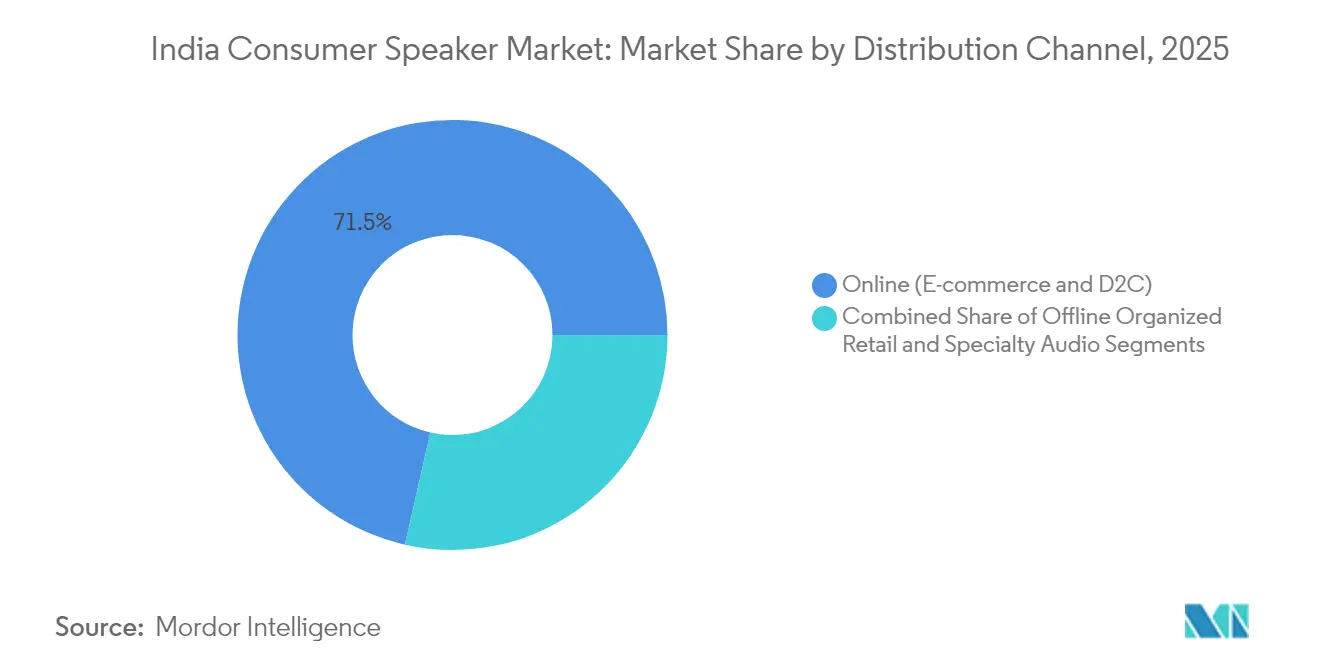
- By distribution channel, online platforms secured 71.45% share of the India consumer speaker market in 2025, whereas specialty audio stores are climbing at 12.94% CAGR.
- By region, West India accounted for 28.10% of the India consumer speaker market share in 2025 and North-East India is projected to expand at an 12.22% CAGR to 2031.
Note: Market size and forecast figures in this report are generated using Mordor Intelligence’s proprietary estimation framework, updated with the latest available data and insights as of 2026.
India Consumer Speaker Market Trends and Insights
Drivers Impact Analysis*
| Driver | (~) % Impact on CAGR Forecast | Geographic Relevance | Impact Timeline |
|---|---|---|---|
| Rapid 5G and Fiber Roll-out | +2.8% | National, with early gains in Mumbai, Delhi, Bangalore | Medium term (2-4 years) |
| Affordable Made-in-India SKUs | +2.1% | National, strongest in Tier-2/3 cities | Long term (≥ 4 years) |
| Surge in Voice-assistant Adoption | +1.9% | Urban centers, expanding to semi-urban markets | Medium term (2-4 years) |
| OTT and Gaming-led Premium Audio Demand | +1.7% | Metro cities, spill-over to Tier-1 urban areas | Short term (≤ 2 years) |
| Government PLI and Manufacturing Incentives | +1.4% | Manufacturing hubs in Tamil Nadu, Karnataka, Andhra Pradesh | Long term (≥ 4 years) |
| Expansion of Tier-2/3 Online Retail | +1.3% | Semi-urban and rural markets across all states | Medium term (2-4 years) |
| Source: Mordor Intelligence | |||


Rapid 5G and fiber roll-out
Telecom operators continue to light up 5G in urban clusters, enabling low-latency audio streaming and multi-room synchronization. Fiber penetration into tier-2 cities stabilizes home-network bandwidth, which boosts demand for Wi-Fi-capable speakers that run voice assistants reliably. Consistent connectivity is helping first-time buyers bypass legacy wired systems and jump straight to wireless units, accelerating upgrade cycles for households that already own Bluetooth-only models.
Affordable “Made-in-India” SKUs
Production-linked incentives and a sharper focus on component localization have lowered bill-of-materials costs while trimming import duties. Domestic assembly now covers dust-resistant casings, higher-capacity batteries, and regional-language voice prompts tailored to Indian usage patterns. The availability of feature-rich devices at sub-INR 10,000 price points draws first-time users in tier-3 districts into the India consumer speaker market and shields local brands from currency-related import shocks.
Surge in voice-assistant adoption
Speaker makers embed Alexa, Google Assistant, and proprietary AI engines that parse Hindi and other vernaculars with higher accuracy than previous generations. Improved natural-language processing makes smart speakers the control hub for smart-lighting, fan, and air-conditioning ecosystems in urban homes. Privacy-first firmware options that process select commands locally rather than in the cloud are emerging as selling points for digitally aware households.
OTT and gaming-led premium audio demand
Nearly every new smart television now ships with Dolby Atmos support, setting user expectations for immersive sound. Gamers, now a 450 million-strong cohort, demand low-latency, high-fidelity speakers that handle positional audio cues. Higher-income families pair large-screen TVs with 3.1- or 5.1-channel soundbars, while single-cabinet party speakers with > 80 W output remain popular for social gatherings, helping lift average selling prices.
Restraints Impact Analysis*
| Restraint | (~) % Impact on CAGR Forecast | Geographic Relevance | Impact Timeline |
|---|---|---|---|
| Data-privacy and Security Concerns | -1.8% | Urban markets with higher digital awareness | Short term (≤ 2 years) |
| Counterfeit and Grey-market Products | -1.5% | Tier-2/3 cities and online marketplaces | Medium term (2-4 years) |
| Semiconductor Supply-chain Volatility | -1.2% | National, affecting all price segments | Short term (≤ 2 years) |
| Low Indian-language NLP Accuracy | -0.9% | Rural and semi-urban non-English speaking markets | Medium term (2-4 years) |
| Source: Mordor Intelligence | |||
Data-privacy and security concerns
Households increasingly question always-on microphones and cloud storage of voice recordings. Brands now highlight physical mute switches, on-device processing, and transparent data-retention policies.[1]Government of India, Central Consumer Protection Authority press release archive, goi.gov.in Delay in consumer adoption of smart speakers is most visible among professionals wary of corporate or family conversations being captured inadvertently.
Counterfeit and grey-market products
Look-alike speakers undercut legitimate models by 20–40%, eroding brand equity and confusing buyers about expected sound quality. While enforcement has intensified, the volume of fake goods circulating through informal offline outlets and certain e-commerce listings still drains revenue from compliant manufacturers.
*Our forecasts treat driver/restraint impacts as directional, not additive. The impact forecasts reflect baseline growth, mix effects, and variable interactions.
Segment Analysis
By Device Type: Wireless leadership and soundbar momentum
Wireless speakers hold a 51.64% share of the India consumer speaker market in 2025, with smart sub-variants posting a significant CAGR through 2031. The cut-the-cord mindset matches a mobile-first culture where a smartphone acts as the primary audio source. Portable Bluetooth cylinders remain weekend companions, yet smart speakers are taking center stage as living-room gateways for home automation. Soundbars, although with a smaller base, benefit from smart TV proliferation; their forecast 13.05% CAGR places them as the fastest-expanding device class. Party speakers larger than 80 W maintain relevance for social events, sustaining a 27% volume slice. Hi-Fi towers, promoted as hybrid music-and-movie solutions, address listeners who seek better bass response without investing in multi-unit setups.
Mid-tier brands merge categories by adding detachable satellites to party speakers or voice assistants to traditional boomboxes. Samsung’s 20.1% global soundbar share highlights technological trickle-down that now influences domestic buying decisions. Local challengers reply with value-engineered wireless bundles that ship with karaoke microphones and RGB lighting to match cultural preferences for group entertainment. The device spectrum therefore ranges from pocket-sized 5 W sticks to 400 W tower rigs, ensuring every income band finds a fitting proposition in the India consumer speaker market.



By Connectivity: Bluetooth prevalence and dual-mode ascent
Bluetooth-only products accounted for 67.58% of the India consumer speaker market size in 2025, cementing their place as entry-level workhorses. Simplicity of pairing and ever-lower chip costs keep BOM structures lean. Yet dual BT + Wi-Fi units are arching upward at a 12.12% CAGR as households appreciate lossless streaming, multi-room grouping, and voice-command responsiveness. Pure Wi-Fi speakers serve a niche of audiophiles who prize uncompressed codecs, but they anchor brand portfolios as halo offerings.
Automatic source switching is becoming standard, allowing a speaker to prioritize Wi-Fi when available and revert to Bluetooth outdoors. Amazon Echo and Google Nest families exemplify this versatility, using tri-band antennas to sustain connectivity in congested urban homes. OEMs now bundle companion apps that map Wi-Fi coverage and suggest optimal placement, driving incremental upgrades for mesh routers. Connectivity diversification, therefore, accelerates ASP growth while future-proofing devices against protocol obsolescence.
By Price Range: Mid-range heft and premium surge
Mid-range devices between INR 5,001 and INR 15,000 secured 49.05% of the India consumer speaker market size in 2025. Economies of scale on drivers, batteries, and plastic enclosures allow brands to layer extra features, IPX ratings, LED lighting, and voice control without breaching affordability thresholds. Entry-level models below INR 5,000 still court first-time buyers, though razor-thin margins leave little headroom to absorb commodity cost spikes.
Premium units priced at or above INR 15,001 are registering the strongest 12.74% CAGR. Higher disposable incomes, EMI schemes, and influencer reviews that stress soundstage depth nudge up purchase values. Global labels such as Sennheiser place calibrated tweeters and proprietary DSPs to justify four-figure price tags in USD terms. Import duties remain a hurdle, yet selective SKD assembly in India cushions outlays for top-end variants, making the premium cluster an outsized contributor to revenue, if not volume, inside the India consumer speaker market.
By Distribution Channel: E-commerce scale and experiential retail revival
Online platforms captured 71.45% share of the India consumer speaker market in 2025, helped by flash sales, influencer-led unboxings, and same-day delivery in 50-plus cities. Direct-to-consumer storefronts push limited-edition collaborations and gather first-party data for rapid firmware iteration. While cashless payments and easy return policies fuel click-through rates, specialty audio stores are rebounding at a 12.94% CAGR. Shoppers chasing premium acoustics want in-person demos before parting with five-digit rupees, and retailers respond with treated listening rooms and bundled installation.
Organized multi-brand chains such as Croma added 149 outlets in FY 2024, signaling sustained faith in brick-and-mortar relevance. Omnichannel approaches now dominate strategy decks; a launch exclusive begins online, then migrates to offline displays for broader reach. Channel segmentation, therefore, pivots on basket value: mass-market models move fastest through virtual carts, while high-ticket SKUs lean on human consultants to articulate sonic nuances.
Geography Analysis
West India’s 28.10% share reflects concentrated urban wealth and entrenched organized retail. Mumbai and Pune host media conglomerates and film studios that propagate audio trends quickly, prompting early uptake of multi-channel systems. Gujarat’s export-oriented industrial clusters facilitate distribution not just within the state but across northern trade routes, maintaining high inventory turns for mid-range SKUs.
North-East India’s 12.22% CAGR signals the payoff from sustained infrastructure spending and digital-inclusion drives. Rail and road upgrades shorten transit times for consumer electronics, while state-financed fiber projects elevate broadband penetration. Speaker brands partner with local influencers who broadcast in regional dialects, aligning product marketing to cultural preferences and boosting brand recall in smaller townships.
Southern metros bring steady demand anchored in IT and startup employment, where work-from-home routines justify premium audio for video calls and entertainment. Chennai’s port enhances the availability of imported components for high-end speakers assembled locally. North India continues to reward aggressive pricing and wide distribution; bundled festival promotions in Delhi-NCR and Lucknow deliver volume spikes. Central and Eastern belts, from Bhopal to Kolkata, mature in tandem with retail mall growth, pushing multi-brand kiosks deeper into semi-urban catchments and enlarging the footprint of the India consumer speaker market.
Regulatory Landscape
Consumer speakers, including Bluetooth speakers and smart speakers (with or without display), fall under the Electronics and Information Technology Goods (Requirement of Compulsory Registration) Order, 2021, which links market access to Bureau of Indian Standards (BIS) registration under the CRS framework. Within this compliance track, the product-safety baseline for relevant audio/ICT equipment is moving from IS 616:2017 toward IS/IEC 62368-1:2023. BIS publishing migration guidance during 2026 also permits concurrent validity of both standards up to November 1, 2028, creating a defined transition window for new and existing models for brands and OEM/ODM partners.
Government manufacturing policy is also being reshaped around localization incentives and duty rationalization for electronics inputs. The PLI-LSEM ended on March 31, 2026, and was followed by the Cabinet-approved Mobile Phone Manufacturing Scheme (MPMS) for 2026-27 to 2030-31 (outlay cited at INR 62,500 crore). In 2026, MeitY actions referenced exemptions and reductions on selected electronics components, affecting landed costs for speaker makers that import key sub-assemblies while scaling India-based assembly and component sourcing.
Value Chain Analysis
The value chain for consumer speakers in India begins with upstream materials and components, including drivers and magnet assemblies, amplifiers/DSP and connectivity chipsets (Bluetooth/Wi-Fi), batteries for portables, plastics and enclosures, and packaging. The country still relies heavily on East and Southeast Asian supply for several of these inputs, which are then converted through domestic EMS and contract manufacturing into finished devices. For smart and multi-room use cases, downstream delivery includes firmware and app integration that connects speakers to broader home audio and voice services.
E-commerce and D2C channels dominate the downstream stack, accounting for the leading unit route in 2025, while organized retail and specialty audio stores remain important for higher-ticket soundbars and home theater bundles that rely on demos and installation. Government-backed component support is increasingly visible in the midstream. The Electronics Component Manufacturing Scheme (ECMS), notified on April 8, 2025 with an outlay of INR 22,919 crore and covering electromechanical components including speakers and microphones, is designed to deepen local value add beyond final assembly. At the same time, partnerships are pulling in private capacity and know-how, including EPACK Durable and South Korea-based Bumjin Electronics (announced July 2025) to manufacture soundbars, TV speakers, and Bluetooth audio products in India, which can shorten lead times and widen domestic sourcing options for brands across price tiers.
Competitive Landscape
The India consumer speaker market hosts major players, pointing to moderate concentration. boAt and Zebronics leverage domestic assembly to refresh catalogs every quarter and sustain attractive price-performance ratios.[4]boAt, “boAt’s Local Production Crosses 5 Crore Units,” economictimes.com Global majors Samsung, Sony, JBL, and Xiaomi, match with technology differentiation such as object-based surround processing, larger passive radiators, and proprietary AI tuning.
Price transparency in e-commerce squeezes margins, so brands bundle value-added services: extended warranties, in-app EQ presets, and subscription trials for music platforms. Supply-chain agility is a clear moat; firms with domestic plastic-injection and PCB capacities recover faster from component shortages. Collaborations between Indian upstarts and global audio specialists, exemplified by Noise partnering with Bose on earbuds, hint at future co-development models crossing over to speaker form factors.
Channel partnerships grow strategic weight. International companies court large retailers for exclusive shelf space, while homegrown labels double down on direct-to-consumer apps that capture granular usage analytics. Marketing spend is shifting from celebrity endorsements to community-led referrals on Discord and Telegram, indicating evolving playbooks even for established incumbents in the India consumer speaker market.
India Consumer Speaker Industry Leaders
Amazon.com, Inc.
Boat Ltd.(Imagine Marketing Limited)
Sony Group Corporation
Samsung Electronics Co., Ltd.
LG Electronics Inc.
- *Disclaimer: Major Players sorted in no particular order

Market Opportunities and Future Outlook
Localization beyond assembly stands out as a practical whitespace area, supported by multiple active policy and industry moves. ECMS (notified April 2025, INR 22,919 crore outlay) explicitly targets electronic components including speakers and microphones, and 2026 policy actions referenced duty exemptions and reductions on selected electronics inputs. Together, these measures can improve the economics for India-based manufacturing for brands that combine imported sub-assemblies with local conversion.
Product development is also shifting toward higher-value architectures where silicon, sensing, and software drive differentiation, as reflected in boAt working with Bengaluru-based HrdWyr on indigenous chip design for premium products (March 2026) and Amazon introducing new Echo speakers in India with custom silicon and an Omnisense sensor platform (May 2026). Premium home-audio and smart-home ecosystems further support demand for differentiated soundbars and Wi-Fi speakers sold through demo-led channels, while the large online-led route (71.45% unit share in 2025) keeps rapid launch cycles and seasonal promotions central to go-to-market. Capacity and supplier investments add another scaling path, including HARMAN’s planned investment of INR 345 crore to expand its Pune plant with a stated goal to raise production capacity by 50% by 2027, which supports both global brands and domestic labels as portfolios move toward multi-device, multi-room, and higher-watt portable categories.
Recent Industry Developments
- July 2026: Samsung introduced Music Studio 5 and Music Studio 7 Wi-Fi speakers in India, positioned around a multi-device audio ecosystem approach and industrial design differentiation. The launch expands premium Wi-Fi speaker options beyond Bluetooth-only models and supports higher-value home setups tied to connected TVs and smart-home usage.
- May 2026: Amazon launched Echo Dot Max and Echo Studio smart speakers in India, featuring custom AZ3 silicon and the Omnisense sensor platform. The upgrade signals continuing emphasis on on-device capability, sensing, and ecosystem integration, raising the competitive bar for smart-speaker hardware and software stacks.
- June 2024: boAt launched the Stone Lumos LED projector speaker in India, combining a projector form factor with a 60W audio proposition for social and at-home entertainment use cases. The product broadened the addressable portable speaker segment by blending audio with adjacent entertainment features that can help brands stand out in online-led retail.


Research Methodology Framework and Report Scope
Market Definition and Coverage
For this report, the market covers consumer-use speaker products sold in India for home and personal listening, including wireless speakers, soundbars, and hi-fi and party speakers. The sizing reflects shipments and replacement demand that flow through online and offline channels across Indian regions.
Scope exclusions: Professional PA systems and fixed commercial installation speakers used mainly in venues are excluded from this market.
Segmentation Overview
- By Device Type
- Wireless Speakers
- Smart Speakers
- Traditional Bluetooth Speakers
- Soundbars
- Hi-Fi and Party Speakers
- Wireless Speakers
- By Connectivity
- Bluetooth
- Wi-Fi
- Dual (BT + Wi-Fi) / Multi-room
- By Price Range
- Entry-level (≤ INR 5,000)
- Mid-range (INR 5,001-15,000)
- Premium (≥ INR 15,001)
- By Distribution Channel
- Online (E-commerce and D2C)
- Offline Organised Retail
- Specialty Audio Stores
- By Region
- North India
- South India
- West India
- East India
- Central India
- North-East India
Data Sources, Market Sizing, and Validation
Desk Research
Desk research was used to set the base structure of the model and to anchor assumptions that are hard to get consistently from one source. We reviewed public statistics and reference data such as Ministry of Electronics and Information Technology (MeitY) releases, Directorate General of Commercial Intelligence and Statistics trade tables, and customs tariff schedules to interpret import mixes for speaker and audio components. We also used publications from agencies such as the Telecom Regulatory Authority of India (TRAI) and the Ministry of Information and Broadcasting to understand connected-TV and broadband adoption, which often moves in the same direction as soundbar demand.
On the industry side, we referred to company annual reports, investor presentations, and product catalogs to map price bands, feature shifts (Bluetooth, Wi-Fi, multi-room), and distribution emphasis across metros and smaller cities. Patent databases were selectively checked to track feature pipelines that can influence ASP movement over time. Paid databases were used only for company financials and news screening to track launches, channel pushes, and supply-side developments that affect near-term volume. These sources are illustrative and not exhaustive, and we used many other public documents for data collection, validation, and clarification.
Primary Interviews and Surveys
Primary work focused on interviews and short surveys with brand-side sales leaders, channel partners (online and offline), and specialty audio retailers, followed by discussions with component and contract manufacturing contacts where relevant. We used these conversations to validate shipment seasonality (festive periods), mix shifts across soundbars and portable speakers, and realistic discounting patterns that affect run-rate volumes in India. Since this is a country market, we balanced coverage across major regions and city tiers to confirm that secondary data signals match what we saw on the ground.
Distribution of primary research fieldwork respondents
| Company type | Respondent position |
|---|---|
| Top tier: 28% | CXOs: 13% |
| Mid tier: 55% | Functional/Unit leaders: 37% |
| Smaller Players: 17% | Managers: 50% |
Market-Sizing & Forecasting
Sizing was built using a top-down and bottom-up approach, where national demand was reconstructed from India-specific adoption and replacement signals, and then cross-checked using selective supplier and channel math. In practice, we first estimated annual unit demand by linking household entertainment upgrades to speaker attach rates, and then the totals were split across wireless speakers, soundbars, and hi-fi and party speakers using mix shares validated by interviews.
A few inputs drove the output most: smart-TV and connected-device penetration, broadband and 4G to 5G usage trends, the share of sales moving through e-commerce, festive-season uplift factors, and the price-band mix (entry, mid-range, premium) that changes unit velocity. For forecasting, we ran scenario analysis so that upside and downside paths could be tied to variables respondents were comfortable defending, such as consumer discretionary spend, promo intensity, and availability of new connectivity features. Where bottom-up checks were incomplete, we handled gaps through ratio-based interpolation from observed channel splits and by adjusting for under-covered offline retail in smaller cities, and then re-validated with additional calls where variances looked large.
Data Validation & Update Cycle
Outputs were validated by comparing the model against independent signals such as category growth discussed in retail commentary, import and manufacturing directionality, and the implied price-band mix the unit totals would require. When unusually high jumps or drops were detected, we revisited assumptions like festive multipliers, online share shifts, or product-mix changes, and then re-contacted respondents to confirm what changed and why. Before sign-off, the work goes through multi-step analyst review so calculations, inputs, and segment splits remain consistent from the base year to the forecast years. Reports are refreshed annually, and interim updates are made when material events affect demand or supply, with a final pre-delivery check to ensure the latest view is delivered.
Mordor Intelligence's India Consumer Speaker Market Size Versus Other Published Estimates
Published market numbers for India consumer speakers often do not match because the underlying scope, unit versus value treatment, and channel coverage differ across publishers. Differences also show up when studies mix adjacent categories, use different base years, or apply exchange-rate and pricing assumptions that are not clearly tied back to what sells in India.
Home audio items like headphones and TWS earbuds sit outside Mordor Intelligence's scope here, which keeps the estimate focused on speaker-form factors such as wireless speakers, soundbars, and hi-fi and party speakers, reported in units for 2026. Other figures can look larger when broader consumer audio baskets are counted, or when value-based totals are presented without a transparent ASP build that reflects India price tiers and discounting.
Benchmark comparison
| Source | Market Size | Gaps in Research Methodology |
|---|---|---|
| Mordor Intelligence | USD 0.04 B (2026) | |
| Trade Journal A | USD 0.60 B (2025) | Uses a broader loudspeaker value bucket and does not clearly separate soundbars versus portable speakers, which can also fold in commercial or installed use and inflate value totals versus a consumer unit model. |
| Regional Consultancy B | USD 2.64 B (2026) | Appears to report revenue for an expanded consumer audio set, where adjacent products and services can be included, and the price and currency assumptions are not traceable to India price-band mix. |
Taken together, the spread is mainly explained by whether the publisher sizes speakers only, or a wider audio basket, and whether units are converted into value using explicit India-facing ASP logic. Our checks with channel feedback, price-tier splits, and seasonality patterns help keep the final number repeatable and aligned to what is actually sold through Indian consumer channels.


Key Questions Answered in the Report
How big is the India Consumer Speaker Market?
The India Consumer Speaker Market size is expected to reach 41.15 million units in 2026 and grow at a CAGR of 12.08% to reach 72.78 million units by 2031.
What is the current India Consumer Speaker Market size?
In 2026, the India Consumer Speaker Market size is expected to reach 41.15 million units.
Who are the key players in India Consumer Speaker Market?
Amazon Retail India Private Limited, Google India Private Limited, HARMAN International India Pvt Ltd (JBL), Sony India Private Limited and Imagine Marketing Pvt Ltd (Boat) are the major companies operating in the India Consumer Speaker Market.
What years does this India Consumer Speaker Market cover, and what was the market size in 2025?
In 2025, the India Consumer Speaker Market size was estimated at 41.15 million units. The report covers the India Consumer Speaker Market historical market size for years: 2019, 2020, 2021, 2022, 2023 and 2024. The report also forecasts the India Consumer Speaker Market size for years: 2026, 2027, 2028, 2029, 2030 and 2031.
What is the forecast volume for consumer speakers in India by 2031?
The India consumer speaker market is projected to reach 72.78 million units by 2031, reflecting a 12.08% CAGR from 2026.
Which device category is growing fastest?
Soundbars are forecast to expand at a 13.05% CAGR through 2031, outpacing other device types.
How important is online retail for speaker sales?
Online platforms accounted for 71.45% of unit shipments in 2025 and remain the dominant purchase route, although specialty stores are regaining traction.
Which price tier shows the highest growth momentum?
Premium speakers priced at or above INR 15,001 are advancing at a 12.74% CAGR as urban consumers trade up for better fidelity.
Which Indian region offers the fastest growth opportunity?
North-East India is forecast to grow at an 12.22% CAGR, benefiting from new connectivity infrastructure and rising vernacular content demand.
What key factor differentiates leading brands?
Local manufacturing depth and rapid product refresh cycles help top brands balance pricing flexibility with feature innovation.
Page last updated on:


 Your data is secure and never sold or shared.


