
Market Overview
| Study Period | 2020 - 2031 |
|---|---|
| Forecast Data Period | 2026 - 2031 |
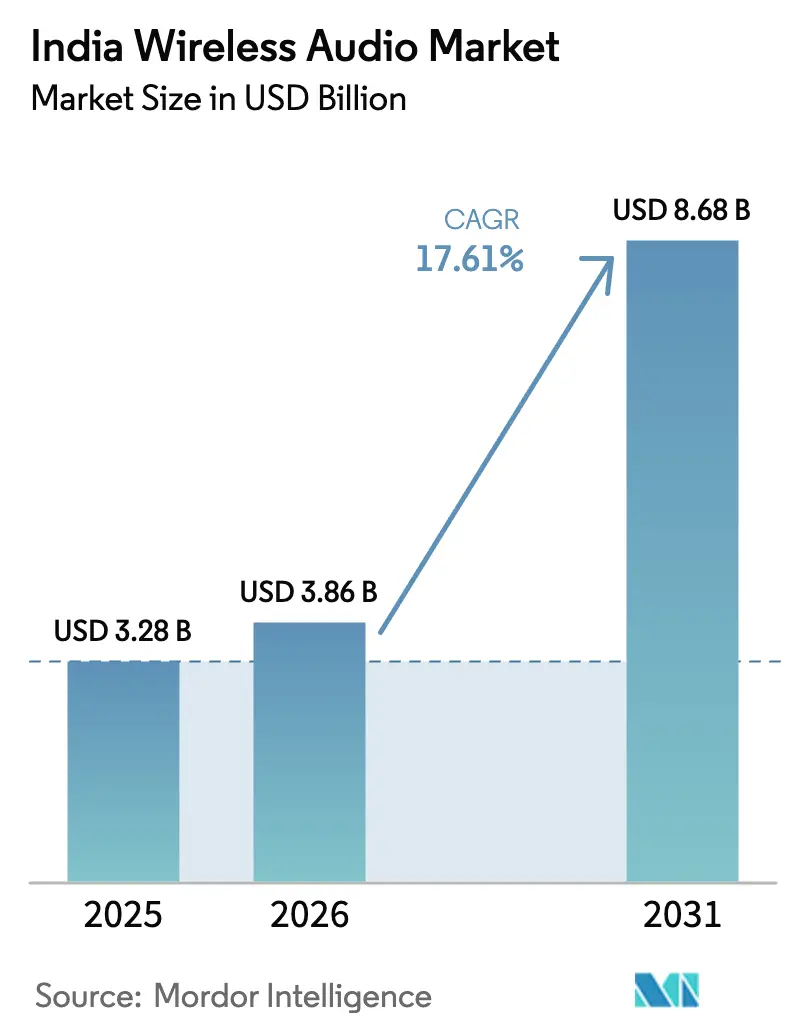
| Base Year Market Size (2025) | USD 3.28 Billion |
| Market Size (2026) | USD 3.86 Billion |
| Market Size (2031) | USD 8.68 Billion |
| Growth Rate (2026 - 2031) | 17.61 % |
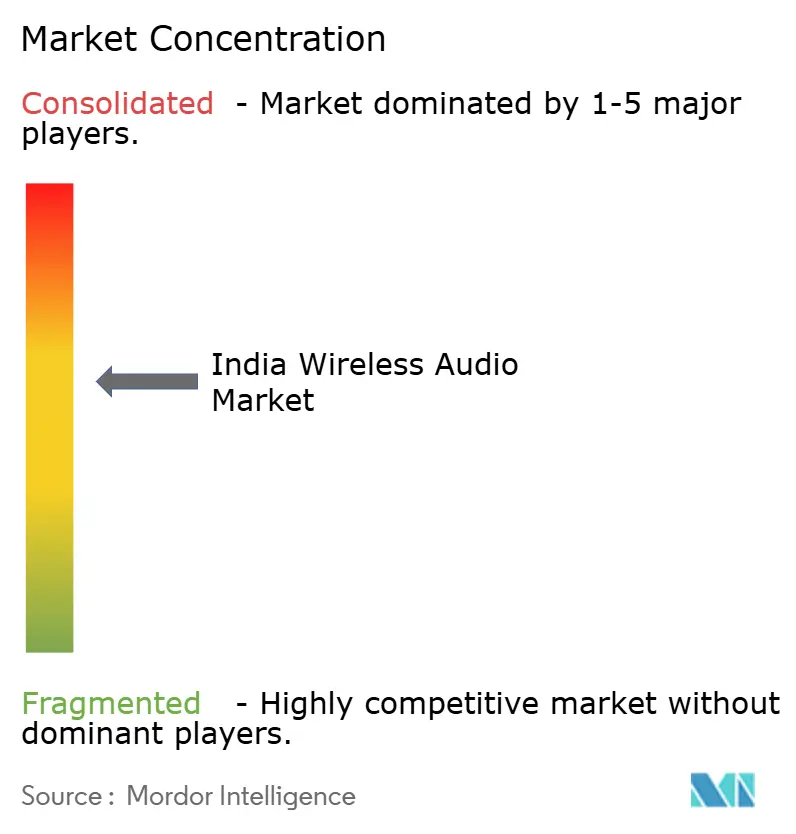
| Market Concentration | Medium |
Major Players *Disclaimer: Major Players sorted in no particular order Image © Mordor Intelligence. Reuse requires attribution under CC BY 4.0. | |
India Wireless Audio Market Analysis by Mordor Intelligence
India wireless audio market size in 2026 is estimated at USD 3.86 billion, growing from 2025 value of USD 3.28 billion with 2031 projections showing USD 8.68 billion, growing at 17.61% CAGR over 2026-2031. Rapid smartphone proliferation, affordable 5G rollouts, and local manufacturing incentives collectively push the India wireless audio market toward mass-market penetration. Active noise cancellation and spatial audio, once premium features, now appear in sub-INR 2,000 devices, while domestic firms achieve 85% local value addition, reducing landed costs and bolstering supply resilience. Online channels account for 74% of 2024 revenues, driven by quick-commerce logistics that deliver same-day fulfillment in major metros. Tier-2 and tier-3 cities emerge as new demand centers as vernacular audio content increases daily listening hours and encourages entry-level upgrades. Competitive intensity intensifies as chipset shortages restrict LC3 and LE-Audio deployments, creating execution risk for brands reliant on next-generation differentiators.
Key Report Takeaways
- By product type, true wireless earbuds captured 64.85% of India wireless audio market share in 2025, while the segment is projected to post a 19.05% CAGR through 2031.
- By distribution channel, online sales held 73.60% of the India wireless audio market size in 2025; offline retail is forecast to record the highest CAGR at 18.95% to 2031.
- By price band, the entry segment below INR 1,500 commanded 51.60% of the India wireless audio market size in 2025, whereas the same segment is poised to expand at an 18.55% CAGR through 2031.
- By end-user, consumer applications accounted for 88.20% of India wireless audio market share in 2025, while sports and fitness is advancing at an 17.85% CAGR during 2026-2031.
- boAt, Noise, and Boult collectively controlled 42.6% of 2024 shipments, with boAt alone holding 32.9% share and maintaining the category leadership needed to influence design standards.
Note: Market size and forecast figures in this report are generated using Mordor Intelligence’s proprietary estimation framework, updated with the latest available data and insights as of 2026.
India Wireless Audio Market Trends and Insights
Drivers Impact Analysis*
| Driver | (~) % Impact on CAGR Forecast | Geographic Relevance | Impact Timeline |
|---|---|---|---|
| Smartphone penetration and 5G affordability | +4.0% | National, with early gains in metro cities and tier-1 urban centers | Medium term (2-4 years) |
| Expansion of e-commerce and quick-commerce logistics | +3.6% | National, strongest in North India and West India corridors | Short term (≤ 2 years) |
| Domestic brands' aggressive TWS pricing | +2.9% | National, with spillover effects to South Asia markets | Short term (≤ 2 years) |
| Production-Linked Incentive (PLI) scheme boosting local hearables manufacturing | +2.5% | Manufacturing hubs in Tamil Nadu, Karnataka, Telangana, Maharashtra | Long term (≥ 4 years) |
| Rise of vernacular audio OTT and podcast platforms | +2.2% | Regional focus on Hindi belt, South India vernacular markets | Medium term (2-4 years) |
| Audio-quality differentiation (Dolby Atmos, spatial audio) in mid-range smartphones | +2.0% | Urban markets and tech-savvy consumer segments nationally | Short term (≤ 2 years) |
| Source: Mordor Intelligence | |||
Smartphone Penetration and 5G Affordability Drive Mass Adoption
India’s 750 million smartphone users convert the India wireless audio market into an indispensable peripheral landscape rather than a luxury accessory segment. Telecom operators prioritize tier-2 rollouts, Jaipur, Lucknow, and Chandigarh saw pilot 5G networks during 2024, narrowing the urban-rural divide and enabling lossless streaming that validates wireless upgrades. Policy frameworks under the National Digital Communications Policy further reduce coverage gaps, thereby reinforcing user expectations for seamless audio connectivity. As battery efficiency improves, entry-level devices achieve day-long playback, meeting the functional must-have criteria of first-time buyers. The resulting multiplier effect elevates device replacement cycles, pulling forward demand and supporting the 17.9% CAGR for the India wireless audio market.
E-commerce Expansion Reshapes Distribution Economics
Online dominance at 74% illuminates deep structural shifts in buyer behavior within the India wireless audio market. Flipkart and Amazon integrate same-day and next-day delivery promises across 20 top cities, stripping physical retailers of immediacy advantages. Domestic labels leverage direct-to-consumer models to harvest feedback, iterate designs quarterly, and push firmware updates that unlock new codec support, reinforcing brand stickiness. Quick-commerce players tap under-two-hour delivery windows for impulse buys tied to music launches or sporting events. The economics favor large-scale sellers able to absorb logistics fees while preserving razor-thin margins characteristic of the entry price band. This environment forces international brands to recalibrate retail mark-ups or risk share erosion to agile local competitors.
Domestic Brands Leverage Aggressive Pricing Strategies
boAt surpassed the 50 million “Made in India” milestone in August 2024, proving that value engineering and backward integration can meet global reliability benchmarks without premium price tags.[1]Source: Electronics For You, “Apple To Start AirPods Production In India Soon For US, Europe Exports,” electronicsforyou.biz Devices under INR 1,500 now feature Bluetooth 5.3 and hybrid ANC, compressing the feature hierarchy and accelerating commoditization. Price competition aligns with local consumer expectations shaped by low-cost data plans, but it compresses gross margins, compelling manufacturers to seek component localization beyond enclosures into micro-electromechanical systems (MEMS) microphones and power-management ICs. Continuous bill-of-materials optimization allows domestic players to defend share against premium-oriented multinationals despite marketing budget disparities.
PLI Scheme Catalyzes Manufacturing Ecosystem Development
The Production Linked Incentive framework reimburses up to 6% of incremental sales value for qualifying hearables, coaxing global suppliers into joint ventures with Indian EMS partners. Foxconn’s Telangana AirPods plant and Optiemus Infracom’s realme Buds line illustrate how foreign IP converges with domestic labor cost advantages. Cluster formation in Sriperumbudur and Hosur gathers PCB fabricators, injection-molders, and acoustic testing labs within 50 kilometers, reducing transit lead times and enabling just-in-sequence assembly. Long term gains include workforce upskilling in acoustic tuning and RF validation, supplying future generations of the India wireless audio market while increasing export competitiveness.
Restraints Impact Analysis*
| Restraint | (~) % Impact on CAGR Forecast | Geographic Relevance | Impact Timeline |
|---|---|---|---|
| Hearing-health concerns from prolonged usage | -2.0% | National, with regulatory focus from central health authorities | Medium term (2-4 years) |
| High price-sensitivity and grey-import competition | -1.7% | Border regions and major metropolitan areas with parallel import channels | Short term (≤ 2 years) |
| Chipset shortages delaying LC3 / LE-Audio roll-out | -1.4% | Global supply chain impact with manufacturing concentration effects | Short term (≤ 2 years) |
| Stricter e-waste and battery-disposal compliance costs | -1.2% | National, with state-level implementation variations | Long term (≥ 4 years) |
| Source: Mordor Intelligence | |||
Health Concerns Create Regulatory Compliance Challenges
The Directorate General of Health Services’ February 2025 advisory recommending sub-50 dB listening for under two hours daily elevates safety features to compliance checkpoints certification (IS 616:2017) now scrutinizes output pressure, forcing firmware-level volume-cap enforcement that increases validation costs. Tamil Nadu’s state-level alert on rising youth hearing loss signals potential patchwork regulations, compelling nationwide brands to pre-emptively standardize to the strictest rule set to avoid recall risks. As educational campaigns gain traction, some consumers may reduce daily listening hours, softening replacement demand and shaving 2.1 percentage points from the forecast CAGR of the India wireless audio market.
Price Sensitivity Limits Premium Segment Growth
Grey imports of AirPods and Sony WF-1000XM5 through parallel channels keep price floors low, compelling authorized resellers to subsidize or bundle offers to preserve footfall. Despite rising disposable incomes, cost-conscious buyers still favor sub-INR 1,500 devices for everyday use, relegating premium models to gifting or niche use cases. Multinationals design India-specific trims that remove wireless charging and multi-point pairing to reach INR 6,999 price tags, but brand dilution risk persists. Consequently, premium adoption curves lag GDP per-capita growth, creating a structural headwind against upscale migration in the India wireless audio market.
*Our forecasts treat driver/restraint impacts as directional, not additive. The impact forecasts reflect baseline growth, mix effects, and variable interactions.
Segment Analysis
By Product Type: TWS Leadership Accelerates Innovation Cycles
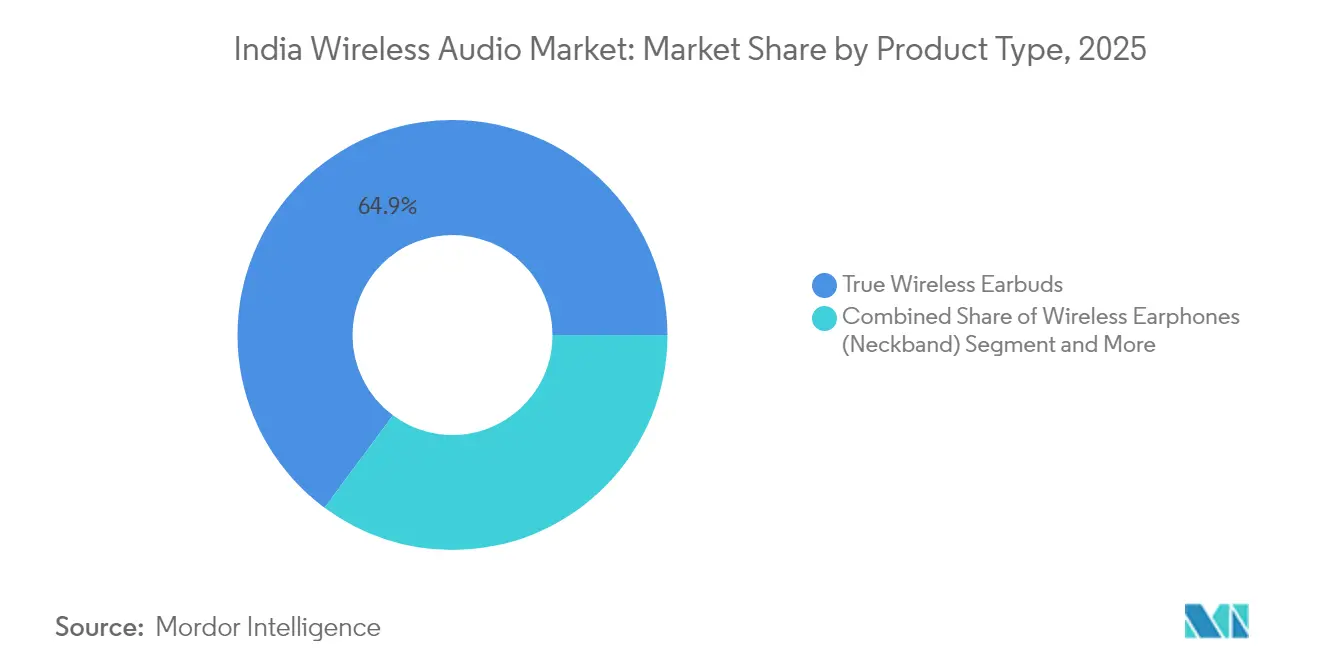
True wireless earbuds dominated with 64.85% share of the India wireless audio market size in 2025 and are forecast to post a 19.05% CAGR through 2031. Their untethered form factor aligns with Gen Z lifestyle expectations of seamless portability and on-the-go content capture. Neckband earphones held 22.35% share, appealing to cost-sensitive users who value battery longevity and physical security. Over-ear and on-ear headphones serve specialized segments such as gaming and studio mixing, retaining the balance of share under niche demand profiles.
Battery density, hybrid ANC, and low-latency gaming modes head the innovation roadmap as brands squeeze premium features into entry tiers to protect share. Local EMS partners introduce semi-automated SMT lines for compact driver assemblies that lower defect rates, supporting higher volume throughput. Meanwhile, multinational flagships position spatial audio as an aspirational upgrade path, hoping to extract value from audiophile niches. Regulatory testing under IS 616:2017 now spans all form factors, promoting a baseline quality that narrows perceived gaps between domestic and imported offerings, thus fuelling substitution within the India wireless audio market.



By Distribution Channel: Digital Commerce Transforms Market Access
Online storefronts contributed 73.60% to India wireless audio market size in 2025 and are projected to grow at 18.70% CAGR until 2031. Flash sales during festival seasons spike unit volumes, and embedded video reviews accelerate conversion by substituting in-store demos. Offline retail retained 26.40% share, particularly in tier-3 towns where experiential touch-and-feel remains critical before purchase.
Cash-on-delivery, EMIs, and no-cost returns lower adoption hurdles and build trust among first-time buyers. Same-day logistics extend beyond metros into 120 tier-2 locations, shrinking the historical delivery gap. In response, national retail chains launch store-within-store brand pods, providing live ANC comparisons to preserve relevance. Hybrid strategies emerge; brands push inventory via e-commerce while using pop-up kiosks at transit hubs for discovery. This omnichannel matrix strengthens reach and stabilizes unit flow across festival and wedding cycles, insulating revenue seasonality in the India wireless audio market.
By Price Band: Entry Segment Expansion Drives Market Democratization
Devices priced below INR 1,500 accounted for 51.60% of India wireless audio market share in 2025 and will advance at an 18.55% CAGR to 2031. Sub-USD 20 bill-of-materials targets shape design blueprints, mandating single-microphone ANC and generic plastic casings. Mid-range models between INR 1,500 and INR 4,999 captured 33.30% share, supported by urban aspirers seeking longer battery life and IP54 ratings for commute resilience. Premium units above INR 5,000 held 15.10% share, suiting brand enthusiasts and semi-professional creators.
Import duties of 20% incentivize local PCB population and final assembly, cushioning exchange-rate volatility. As die-shrink roadmaps lower SoC costs, premium features cascade downward, compressing perceived value gaps. Brands differentiate tiers through bundled subscriptions to vernacular podcasts or limited-edition colorways tied to cricket leagues. This price-band laddering sustains upgrade pathways while preserving segmentation clarity in the India wireless audio market.

By End-User: Consumer Applications Dominate with Fitness Emerging
Consumer uses drove 88.20% of shipments in 2025, reaffirming entertainment’s primacy in the India wireless audio industry. However, sports and fitness devices are slated for an 17.85% CAGR, propelled by sensor-integrated designs that measure heart rate and VO₂ max during workouts. Enterprise and professional segments comprised 7.00% share, driven by remote work call quality demands and audio-for-video production.
Wearable convergence accelerates; neckbands with in-line thermistors feed health-app dashboards, while TWS form factors integrate bone-conduction microphones for outdoor runs. Corporate procurement guidelines emphasize ENC for open-plan offices, nudging vendors to develop beam-forming solutions. As Gen Z’s device usage niches diversify into gaming and vlogging, micro-segmented SKUs emerge, enriching catalog depth and stretching lifecycle management capabilities across the India wireless audio market.
Regulatory Landscape
India wireless audio products sold or imported into the country fall under safety and radio approvals. Compliance is anchored by the Bureau of Indian Standards (BIS) through the Compulsory Registration Scheme, and Wireless Planning and Coordination (WPC) Equipment Type Approval (ETA) for Bluetooth devices under the Indian Wireless Telegraphy Act, 1933. BIS has notified the migration for relevant audio/video and ICT equipment from legacy standards such as IS 616:2017/IS 13252:2010 to IS/IEC 62368-1:2023. The concurrent validity window runs until November 1, 2028, which means brands and OEM/ODM partners have to manage dual-certification and retesting timelines as product portfolios refresh.
Market access is also affected by documentation tightening at the border and expanding product coverage. From April 2026, DGFT enforcement requires mandatory WPC ETA declaration at the time of customs filing for audio devices under HS code 8518, raising the bar for importers and parallel-channel suppliers that previously relied on looser paperwork. In January 2026, MeitY expanded the scope of mandatory BIS registration to explicitly include true wireless earbuds and neckband earphones. This pushes compliance deeper into the mass-market SKUs that account for most shipments, increasing the need for certification-ready design, labeling, and traceability across both online and offline channels.
Value Chain Analysis
The India wireless audio value chain begins with semiconductor and electro-acoustic components (Bluetooth audio SoCs, power-management ICs, batteries, drivers, MEMS microphones), which are mostly sourced globally. It then moves through EMS/ODM manufacturing, acoustic tuning and RF validation, packaging, and multichannel distribution, with e-commerce playing a central role. Policy support increasingly targets shifting more of the bill of materials and sub-assemblies onshore through programs such as the Electronics Component Manufacturing Scheme (ECMS). Approved in March 2025 with an outlay of INR 22,919 crore, ECMS focuses on passive component ecosystems, high-tech components, and sub-assemblies to raise domestic value addition and shorten lead times for large-volume categories such as TWS.
On the manufacturing side, local assembly and test are supported by incentives that reduce capex payback cycles for suppliers and contract manufacturers. Brands also coordinate design-for-compliance with BIS and WPC ETA requirements to avoid launch delays. SPECS (Scheme for Promotion of Manufacturing of Electronic Components and Semiconductors) adds a 25% capital expenditure incentive for essential components, supporting investment in fixtures, labs, and tooling used in speaker driver assembly, plastics, and PCB-related processes. Downstream, online-first demand (including quick-commerce in major cities) concentrates power with platforms and logistics partners, so inventory placement, returns handling, and after-sales service increasingly shape unit economics, particularly for entry-priced devices.
Competitive Landscape
The competitive environment features a blend of agile domestic manufacturers and premium international incumbents. boAt leads with 32.9% share, leveraging social-media micro-influencer campaigns and rapid SKU refreshes every six months. Noise follows at 9.7%, recently partnering with Bose to debut Master Buds and lift brand equity in the INR 5,000-plus tier. Boult, Truke, and Wings Lifestyle compete in the value segment, capturing students and first-time job-seekers.
International players maintain technology leadership but face pricing headwinds. Apple’s AirPods assembly in Telangana signifies a strategic shift to hedge geopolitical supply risk while chasing potential duty rebates. Samsung invests in codec co-development with local SoC partners to deliver spatial audio without inflating BOM. Sony banks on brand loyalty for audiophile and streamer sub-segments, bundling creation-suite software trials with its flagship over-ear models.
Strategic collaborations intensify. ODMs like Optiemus Infracom align with realme to roll out five million AIoT units annually, pooling capex and smoothing component procurement cycles. Component firms that supply micro-speakers and MEMS mics expand local assembly, reducing lead times and curbing currency exposure. As LC3 rollouts stall, software stack optimization becomes a battleground; brands push OTA updates that unlock multi-device pairing, enhancing perceived longevity and cutting churn within the India wireless audio market.
India Wireless Audio Industry Leaders
Imagine Marketing Ltd (boAt)
Samsung Electronics Co Ltd (Samsung, AKG, Infinity, JBL)
Apple Inc.
Sony Group Corporation
Bose Corporation
- *Disclaimer: Major Players sorted in no particular order

Market Opportunities and Future Outlook
One opportunity is using India as both a demand base and a launchpad for adjacent geographies, supported by improving supply-chain maturity and established online selling playbooks. In May 2026, Imagine Marketing Ltd (boAt) entered the Singapore market in partnership with Opptra, reflecting how high-volume Indian brands are packaging product-market fit along with e-commerce execution for Southeast Asian channels. As more brands pursue export and cross-border e-commerce, compliance readiness (BIS/WPC documentation discipline) and consistent after-sales service are becoming clearer differentiators against grey imports, with particular relevance for the sub-INR 1,500 segment that drives most volume.
Product whitespace is also forming around new form factors and ecosystem-led home audio, as companies extend beyond core TWS into speakers and soundbars while keeping pricing accessible. In July 2026, boAt launched the Stone 900 portable Bluetooth speaker in India (Bluetooth v5.3), reinforcing the push to mainstream newer connectivity features through mass channels and opening room for bundle-led strategies with smartphones, OTT audio subscriptions, or regional content tie-ups. Alongside hardware, creator and vernacular content ecosystems are being used as demand catalysts; for instance, boAt partnered with the Legacy platform in July 2026 to engage hip-hop creator communities, a route that can feed co-created SKUs, limited editions, and community-driven conversion in tier-2 and tier-3 cities where discovery is increasingly digital.
Recent Industry Developments
- July 2026: Samsung Electronics Co Ltd launched the Music Studio Series (Music Studio 5 and Music Studio 7) Wi-Fi speakers in India with Dolby Atmos, Q-Symphony, and SmartThings integration. The launch expands Samsung's premium wireless audio lineup in the Indian market, supporting multi-room setups. It strengthens Samsung's ecosystem integration and helps drive cross-device sales in the competitive Indian market.
- July 2026: Samsung Electronics Co Ltd launched the Sound Tower 2026 series of portable party speakers in India (models ST50F and ST40F). The expansion extends Samsung's presence in portable high-impact audio across urban and outdoor settings. It also reinforces brand visibility in multi-room and outdoor environments, supporting ecosystem synergies.
- June 2026: Imagine Marketing Ltd (boAt) launched Airdopes ProClip, an open-ear earbud manufactured at the Califonix facility in Noida. The product introduces a premium open-ear category in India's wireless audio, reflecting a shift toward higher value devices. Local manufacturing support also strengthens domestic capacity and supply resilience.


Research Methodology Framework and Report Scope
Market Definition and Coverage
For this study, the India wireless audio market covers consumer audio devices that connect without a wired signal, primarily Bluetooth. We measure it as retail value generated within India.
Scope exclusions: We exclude wired-only earphones/headphones and wired home-audio systems, along with professional studio, cinema, and industrial audio equipment.
Segmentation Overview
- By Product Type
- True Wireless Earbuds
- Wireless Earphones (Neckband)
- Wireless Headphones (Over / On-ear)
- By Distribution Channel
- Online
- Offline
- By Price Band
- Entry (less than INR 1,500)
- Mid-range (INR 1,500 - 4,999)
- Premium (above INR 5,000)
- By End-User
- Consumer
- Enterprise / Professional
- Sports and Fitness
Data Sources, Market Sizing, and Validation
Desk Research
Desk work sets the structure of the model, especially for unit demand cues, pricing bands, and feature mix. We review public datasets and official releases such as the Ministry of Electronics and Information Technology (MeitY) for electronics policy context, the Ministry of Commerce and Industry for trade direction, and customs-facing trade statistics that help explain import dependence and component flows.
On the market side, we use sources such as the Telecom Regulatory Authority of India (TRAI) for wireless subscriber signals, the Reserve Bank of India (RBI) for macro indicators that influence discretionary spending, and India's GST-related public updates where category-level consumption notes are discussed. To complement this, we read company filings, annual reports, investor presentations, and reputable press coverage to track product launches, channel shifts, and pricing moves, and then we sanity-check them with standard subscriptions used for company financials, news, patent lookups, and shipment-level trade data. This list is illustrative, and other public sources are also referred to for data collection, validation, and clarification.
Primary Interviews and Surveys
Primary interviews and surveys are used to turn broad signals into usable assumptions, especially wireless audio attach rates, replacement cycles, and how pricing shifts during major sale events. We speak with a mix of brand-side executives, distributors, large-format retail teams, online channel operators, and component or contract manufacturing contacts across key Indian demand centers and supply hubs, so gaps from desk research can be closed and then cross-checked before finalizing outputs.
Distribution of primary research fieldwork respondents
| Company type | Respondent position |
|---|---|
| Top tier: 37% | CXOs: 15% |
| Mid tier: 42% | Functional/Unit leaders: 39% |
| Smaller Players: 21% | Managers: 46% |
Market-Sizing & Forecasting
Sizing starts with a top-down build that reconstructs India demand from addressable device users and penetration, then it is converted into value using observed price bands by form factor and channel. To keep the numbers grounded, we also run selective bottom-up checks using sampled unit volumes from channel checks, an average selling price (ASP) times the volume build for common price tiers, and supplier and distributor feedback on sell-in versus sell-through trends.
Inputs that matter in this market include smartphone installed base and upgrade pace, true wireless adoption within total ear-worn audio, online versus offline mix, promotional season intensity (festival and end-of-year events), the shift toward features such as active noise cancellation, and import duty or local assembly signals that can change street pricing. Where gaps exist in unit splits or ASP ladders, we use conservative bridging based on adjacent categories, then re-test the assumption with interview feedback before it stays in the model.
For forecasting, we use scenario analysis supported by simple time series smoothing for price and mix, since the category changes quickly with promotions and feature-led upgrades. The final outlook is adjusted only after drivers are aligned with what channel and industry participants expect for demand, pricing, and availability over the forecast period.
Data Validation & Update Cycle
Validation is done in layers so that one noisy input does not swing the final value. Our team checks outputs against independent signals such as shipment direction, channel inventory comments, and major price changes, and then reviews any abnormal jumps by year, form factor, or channel.
Before sign-off, assumptions are reviewed by another analyst, and follow-up calls are triggered when pricing, penetration, or channel share moves do not match what the desk and interview inputs suggest. The report is refreshed annually, and interim updates are considered when material events occur, such as major policy shifts, sudden pricing resets, or a demand shock. Right before delivery, a final pass is completed so clients receive the latest updated view.
Mordor Intelligence's India Wireless Audio Market Size Versus Other Published Estimates
Published market values for India wireless audio can differ significantly, even when publishers are trying to cover similar product demand. The spread usually comes from how each publisher defines the device set, which year is treated as the base, and how pricing is averaged across online deals and offline retail.
The main gap comes from whether neckbands, TWS earbuds, wireless headphones, and wireless speakers are all counted together at full retail value, where Mordor Intelligence keeps the scope to the wireless audio device market in India and anchors totals to a 2025 value of USD 3.28 B before projecting forward.
Benchmark comparison
| Source | Market Size | Gaps in Research Methodology |
|---|---|---|
| Mordor Intelligence | USD 3.28 B (2025) | |
| Industry Tracker A | USD 1.30 B (2024) | Often reflects only the true wireless stereo (TWS) segment by value, which leaves out neckbands, wireless headphones, and wireless speakers, and it can also use shipment-value conventions instead of full retail value. |
| Market Research Publisher B | USD 4.40 B (2024) | Commonly focuses on earphones and headphones as a product family, which can pull in wired items or different form-factor boundaries, and it may apply broad ASP assumptions that do not fully separate deep discount periods from regular pricing. |
The table shows that differences mainly stem from what is included and how prices are treated during heavy promotion periods. By tying the steps to clear demand and pricing inputs, and by checking totals with channel and industry interviews, the estimate remains repeatable and easier to reconcile across years.


Key Questions Answered in the Report
What is the current value of the India wireless audio market?
The market stands at USD 3.86 billion in 2026 and is projected to reach USD 8.68 billion by 2031.
Which product type leads unit sales?
True wireless earbuds lead with 64.85% share of 2025 revenues and are forecast to grow at a 19.05% CAGR.
How important is online retail to industry revenues?
Online channels accounted for 73.60% of 2025 sales, supported by quick-commerce logistics and festival flash events.
What role does the PLI scheme play?
Production incentives reimburse up to 6% of incremental sales, attracting investments such as Foxconn’s Telangana AirPods plant.
Page last updated on:


 Your data is secure and never sold or shared.


