
India Blood Glucose Monitoring Devices Market Size and Share
Market Overview
| Study Period | 2020 - 2031 |
|---|---|
| Forecast Data Period | 2026 - 2031 |
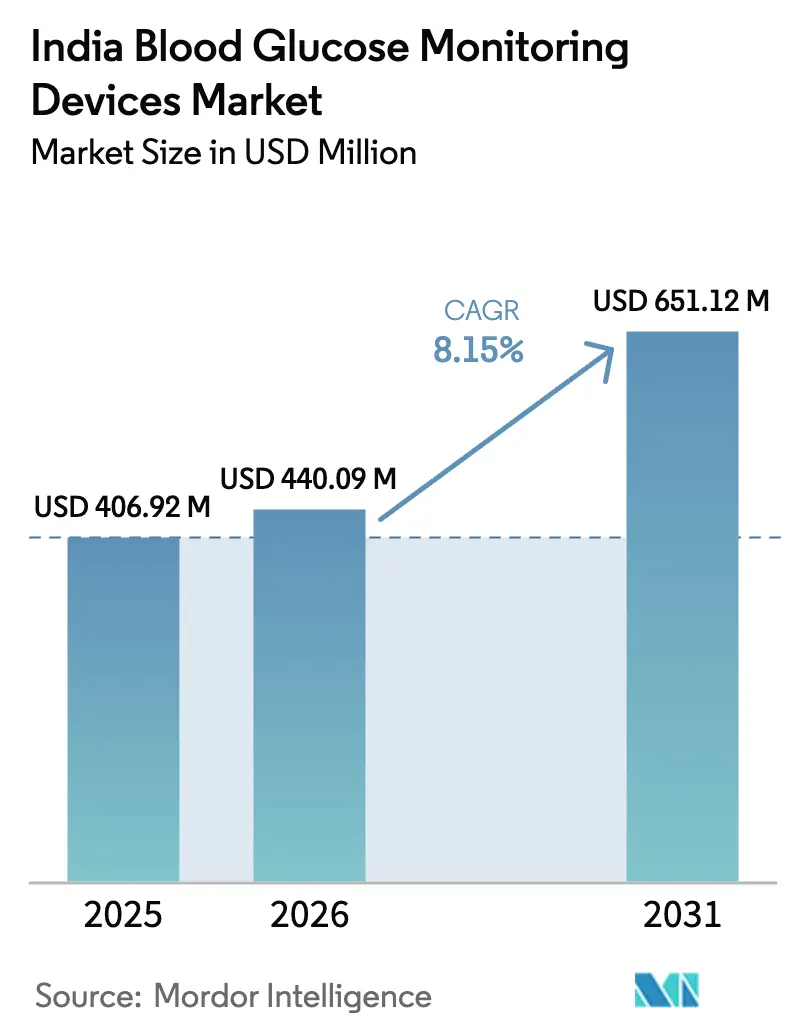
| Base Year Market Size (2025) | USD 406.92 Million |
| Market Size (2026) | USD 440.09 Million |
| Market Size (2031) | USD 651.12 Million |
| Growth Rate (2026 - 2031) | 8.15 % |
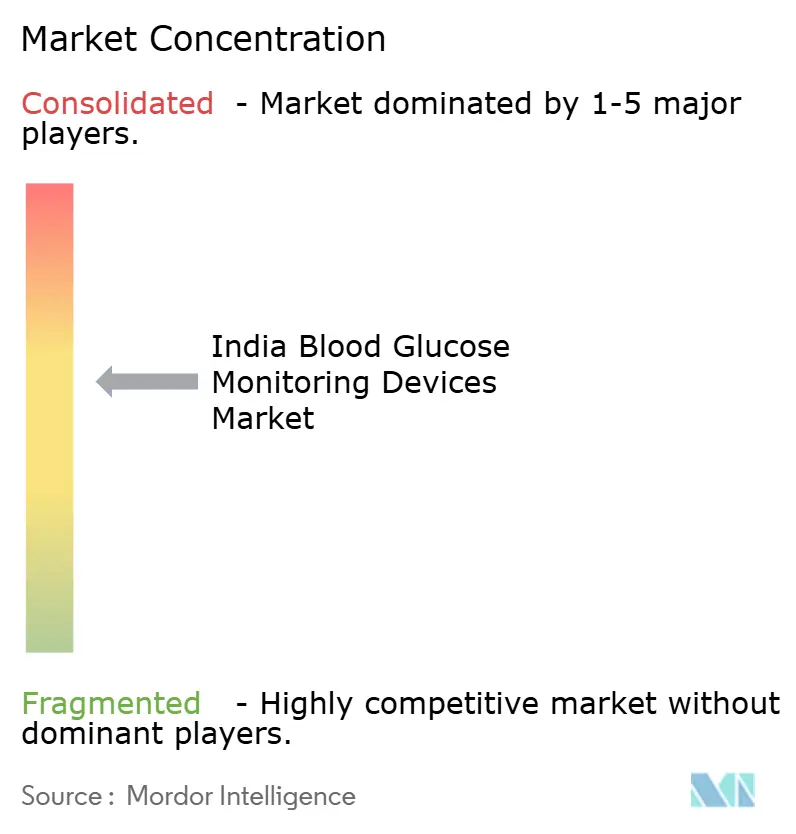
| Market Concentration | Medium |
Major Players *Disclaimer: Major Players sorted in no particular order Image © Mordor Intelligence. Reuse requires attribution under CC BY 4.0. | |
India Blood Glucose Monitoring Devices Market Analysis by Mordor Intelligence
The India blood glucose monitoring devices market size was valued at USD 406.92 million in 2025 and estimated to grow from USD 440.09 million in 2026 to reach USD 651.12 million by 2031, at a CAGR of 8.15% during the forecast period (2026-2031). Rising diabetes prevalence, aggressive policy support for affordable devices, and the rapid shift toward digitally enabled care are underpinning this expansion. Wider Jan Aushadhi distribution of low-priced test strips is doubling per-patient testing frequency, while tele-diabetes platforms have normalized remote monitoring in more than 40% of urban consultations[1]. Growing e-pharmacy penetration, production-linked incentives for domestic manufacturing, and new insurance guidance on continuous glucose monitoring reimbursement are further broadening access to advanced technologies. At the same time, manufacturers face cost pressure from grey-market strips and fragmented prescribing habits that still favor legacy glucometers, although ongoing regulatory crackdowns and targeted physician education are starting to close these gaps.
Key Report Takeaways
- By product type, self-monitoring blood glucose devices led with 83.70% of the India blood glucose monitoring devices market share in 2025, while continuous glucose monitoring systems are projected to expand at an 8.78% CAGR through 2031.
- By end user, home-care settings accounted for 52.74% of the India blood glucose monitoring devices market size in 2025 and are advancing at a 8.91% CAGR during 2026-2031.
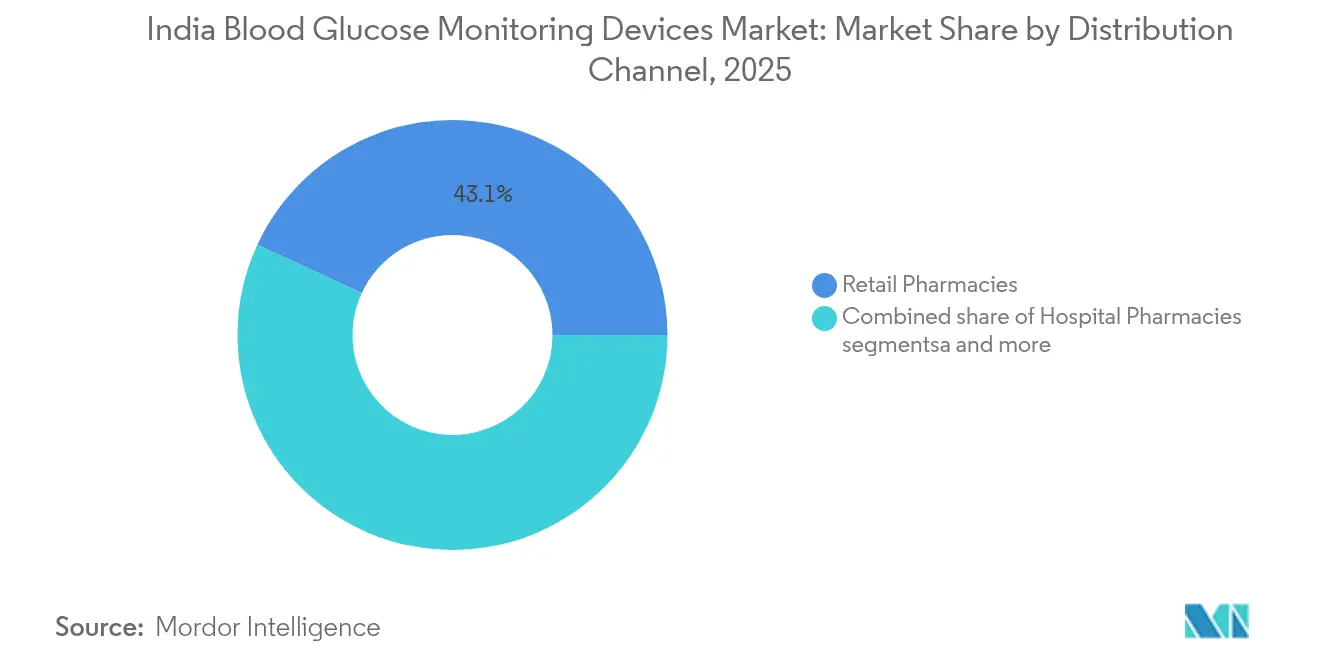
- By distribution channel, retail pharmacies held 43.10% revenue share in 2025, whereas online pharmacies record the fastest growth at 8.73% CAGR to 2031.
Note: Market size and forecast figures in this report are generated using Mordor Intelligence’s proprietary estimation framework, updated with the latest available data and insights as of 2026.
India Blood Glucose Monitoring Devices Market Trends and Insights
Drivers Impact Analysis*
| Driver | (~) % Impact on CAGR Forecast | Geographic Relevance | Impact Timeline |
|---|---|---|---|
| Growing diabetes prevalence & earlier screening | +2.1% | National, with higher concentration in urban metros | Long term (≥ 4 years) |
| Rapid penetration of affordable SMBG strips via Jan Aushadhi stores | +1.8% | National, with accelerated gains in Tier 2/3 cities | Medium term (2-4 years) |
| Widespread adoption of tele-diabetes platforms post-COVID-19 | +1.5% | National, with early adoption in Karnataka, Tamil Nadu, Maharashtra | Short term (≤ 2 years) |
| GST reductions on essential diabetes devices | +1.2% | National | Medium term (2-4 years) |
| Insurance regulator mandating CGM reimbursement | +0.9% | Urban centers with organized healthcare systems | Long term (≥ 4 years) |
| App-linked loyalty programs boosting test-strip adherence | +0.7% | Metro cities and Tier 1 urban areas | Short term (≤ 2 years) |
| Source: Mordor Intelligence | |||
Growing Diabetes Prevalence & Earlier Screening
National screening drives have identified an addressable base of more than 100 million people, including 25-30 million undiagnosed cases, lifting demand across all categories in the India blood glucose monitoring devices market. Screening at primary-care facilities now detects disease five to seven years earlier than a decade ago, stretching each patient's lifetime need for monitoring devices to as long as three decades. Intensive screening in semi-urban belts is accelerating device uptake among younger cohorts that show higher comfort with connected solutions. This shift is also guiding policymakers to support reimbursement for continuous monitoring because early adopters achieve superior glycemic control, lowering long-run complication costs. Collectively, these factors add more than +2.0 percentage points to the forecast CAGR of the India blood glucose monitoring devices market.
Rapid Penetration of Affordable SMBG Strips via Jan Aushadhi Stores
The Jan Aushadhi network supplies strips at half to one-tenth the branded price, cutting monthly monitoring outlay to INR 300-500 and doubling average weekly testing frequency. Affordable consumables are unlocking latent demand in Tier 2/3 cities where branded glucometer ownership languished below 15% as recently as 2022. Higher test-strip throughput improves glycemic control, reinforcing device stickiness and encouraging private manufacturers to introduce value-engineered meters tailored for these price-sensitive markets. The surge in strip volumes exerts significant positive pressure on the India blood glucose monitoring devices market, reflected in a +1.8% uplift to CAGR forecasts.
Widespread Adoption of Tele-diabetes Platforms Post-COVID-19
Remote consultations have normalized, with urban usage exceeding 40% and tribal pilot projects closing access gaps for 104 million underserved citizens. Studies covering more than 7,000 patients recorded a 9.6% drop in fasting glucose and a 58.5% fall in hypoglycemia when digitally supported self-monitoring guided real-time counseling. Government backing via the Ayushman Bharat Digital Mission, which links over 800 health-tech apps, ensures that meter data flows directly into electronic health records. Strong early evidence of clinical benefit spurs iterative demand for IoT-enabled meters and continuous sensors, adding +1.5% to overall growth momentum.
GST Reductions on Essential Diabetes Devices
Policy debate within the GST Council suggests classification of essential monitoring products alongside life-saving drugs, which already enjoy concessional taxes. A cut from 12-18% to 5% would shave 10-13% off consumer prices, especially benefiting high-value CGM kits that currently rely on imports subject to customs duties. Manufacturers anticipate volume lift sufficient to offset margin compression, implying another +1.2% to CAGR forecasts once the reform takes effect.
Restraints Impact Analysis*
| Restraint | (~) % Impact on CAGR Forecast | Geographic Relevance | Impact Timeline |
|---|---|---|---|
| Fragmented physician Rx habits favouring legacy glucometers | -1.4% | National, with higher impact in rural and semi-urban areas | Long term (≥ 4 years) |
| Grey-market import of low-quality strips diluting brand trust | -1.1% | Border states and major trade hubs | Medium term (2-4 years) |
| Low public-hospital budget for CGM procurement | -0.8% | Public healthcare system nationwide | Long term (≥ 4 years) |
| Data-privacy concerns over cloud-linked monitoring apps | -0.5% | Urban educated segments | Short term (≤ 2 years) |
| Source: Mordor Intelligence | |||
Fragmented Physician Rx Habits Favoring Legacy Glucometers
General practitioners deliver 70% of diabetes care but allocate only three to five minutes per visit, limiting discussion of advanced monitoring tools. As a result, many continue prescribing older glucometers they first encountered in medical school. Rural clinicians, serving two-thirds of the population, rarely receive manufacturer training on continuous systems, perpetuating brand inertia that slows CGM diffusion. Inconsistent guidance across multiple providers confuses patients and depresses adherence to optimal testing regimes. This entrenched conservatism removes roughly 1.4 percentage points from projected CAGR for the India blood glucose monitoring devices market.
Grey-Market Import of Low-Quality Strips Diluting Brand Trust
Counterfeit strips, often entering through informal border trade, retail at prices up to 70% lower than regulated products but can deviate 20% from actual glucose levels. Patients who experience inaccurate readings sometimes abandon self-monitoring altogether, undermining long-term demand. The Central Drugs Standard Control Organization launched random sampling drives, yet enforcement remains patchy in Punjab, West Bengal, and Rajasthan. Brand owners face added marketing costs to rebuild consumer confidence, shaving 1.1 percentage points off growth forecasts.
*Our forecasts treat driver/restraint impacts as directional, not additive. The impact forecasts reflect baseline growth, mix effects, and variable interactions.
Segment Analysis
By Product Type: SMBG Dominance Faces CGM Disruption
Self-monitoring blood glucose devices generated 83.70% of 2025 revenue, primarily via meter-strip bundles sold at INR 800-1,500 and replenished with low-cost consumables distributed through Jan Aushadhi outlets. Test strips remain the largest contributor because each new reader drives recurring consumable demand. However, continuous glucose monitoring sensors outpace overall market growth at an 8.78% CAGR as price points fall and clinical outcome data becomes mainstream. The potential launch of a domestic INR 1,000/month CGM solution by FY26 could reset affordability and spur mass adoption.
The SMBG base maintains steady expansion because first-time buyers in Tier 2/3 cities continue to prefer upfront affordability and simple operation. Yet endocrinologists in metros are shifting high-risk patients to continuous sensors that capture glycemic variability and minimize nocturnal hypoglycemia. If domestic price compression materializes, the India blood glucose monitoring devices market size for CGM could triple its 2024 base by 2030, progressively eroding SMBG share. Leading brands now bundle cloud dashboards with traditional meters to defend position, reflecting the converging feature set between the two categories.


By End User: Home-Care Settings Drive Market Evolution
Home-care collected 52.74% of 2025 revenue, a lead reinforced by pandemic-era telemedicine that normalized remote dosage adjustment. Patients prefer testing at home to avoid transport cost and lost wages, especially where clinics remain distant. Hospitals and clinics rely on intermittent public budgets that often exclude advanced sensors; thus continuous systems still see limited use in inpatient settings. Nevertheless, tertiary centers in metros run pilot CGM programs for gestational and pediatric diabetes, demonstrating tangible outcome gains that could justify future procurement.
Ongoing loyalty-app promotions and auto-replenishment subscriptions expand testing compliance in urban homes. Policy focus on non-communicable disease management inside Ayushman Arogya Mandirs is also encouraging rural households to accept home monitoring under community-health-worker guidance. These forces combine to support a 8.91% CAGR in the home segment through 2031. Clinics continue accounting for complex case management and periodic calibration but will cede transaction volume to the home-care arena as devices become plug-and-play with smartphone back-ends.
By Distribution Channel: Online Pharmacies Reshape Market Access
Retail pharmacies captured 43.10% of 2025 value owing to entrenched neighborhood presence, yet online outlets are recording an 8.73% CAGR on the back of same-day fulfillment and aggressive discounting. Acquisition-driven scale, as seen in Reliance-Netmeds and Tata 1mg, extends reach into Tier 3 cities where physical outlets struggle to stock wide SKU ranges. Hospital pharmacies remain vital for acute-care supplies but face budget ceilings that limit innovation.
Urban millennials opt for app-based ordering even for first-time glucometer purchase because onboarding videos and chatbot counseling replicate in-store guidance. Rural adoption lags but climbs as logistic networks expand under the Digital India initiative. Manufacturers tailor channel strategy by reserving premium CGM sensors for tightly controlled e-pharmacy and hospital sales to curb counterfeit risk, while pushing entry-level SMBG bundles through Jan Aushadhi and conventional chemists.
Regulatory Landscape
Blood glucose monitoring devices in India (including glucometers, test strips, and continuous glucose monitoring systems categorized as in-vitro diagnostics) come under the Drugs and Cosmetics Act, 1940, and are handled through the Medical Devices Rules, 2017 (MDR 2017). Day-to-day oversight is carried out by the Central Drugs Standard Control Organization (CDSCO) through the Central Licensing Authority (CLA), with device classification into Class A, B, C, and D based on risk, which then determines the registration and licensing pathway for import and domestic manufacture.
Under MDR 2017, system-based licensing and product grouping are relevant for glucose monitoring sets (meter, strips, and control solutions). This affects how companies structure dossiers and manage post-market changes across bundled SKUs. CDSCO has also referenced acceptance criteria for blood glucose test strips and reagents through prior circulars and guidance, which in turn shapes surveillance activity and enforcement related to low-quality or counterfeit strips.
Value Chain Analysis
The India blood glucose monitoring devices value chain begins with upstream sourcing of electrochemical biosensors, enzymes and reagents for strips, microelectronics and semiconductors, and plastics and precision components. It then moves into device design, assembly or full-stack manufacturing, and quality testing aligned to MDR 2017 requirements for IVDs. For CGM, the chain is more import-intensive because sensor and electronics complexity is higher, while SMBG meters and consumables allow broader local assembly and packaging, with recurring strip demand serving as a key annuity layer for many brands.
Downstream, products reach customers through hospital pharmacies, retail chemists, and rapidly expanding online pharmacies. Public-interest channels such as Jan Aushadhi influence both pricing and volume for strips. The Department of Pharmaceuticals has used the Production Linked Incentive (PLI) scheme for medical devices to support investment across device categories, encouraging localization of critical inputs and manufacturing capacity to reduce exposure to import lead times and improve domestic supply continuity.
Competitive Landscape
Global majors Abbott, Roche, and Medtronic dominate advanced technology supply but confront pricing headwinds in a market where sophisticated devices are still imported. Abbott’s FreeStyle platform leads CGM penetration, yet its recent withdrawal of a low-cost sensor underscores profitability challenges. Domestic champion Morepen Laboratories holds significant share of SMBG meters and is doubling capacity while developing an INR 1,000/month CGM slated for FY26.
Strategic alliances are redefining competition: Abbott and Medtronic plan to integrate FreeStyle Libre with closed-loop insulin pumps, targeting patients on intensive therapy with an end-to-end digital ecosystem. Wearable innovators such as GOQii and Eyva test non-invasive sensors that could open adjacent wellness segments. The Production Linked Incentive scheme underwrites 19 device projects, helping local firms upgrade from assembly to full-stack manufacturing, which may compress costs for both sensors and strips[2]. Overall, the top five suppliers account for slightly under 60% of revenue, reflecting a moderately concentrated arena that is steadily diffusing as indigenous capacity grows.
India Blood Glucose Monitoring Devices Industry Leaders
-
Abbott
-
F. Hoffmann-La Roche Ltd
-
Medtronic plc.
-
Ascensia Diabetes Care Holdings AG
-
Arkray Inc.
- *Disclaimer: Major Players sorted in no particular order
Market Opportunities and Future Outlook
White space is most visible at the affordability and digital-care interface, where adoption rises when consumables are priced lower and readings can be shared remotely. In the market context, the Jan Aushadhi channel has already brought down strip outlay to roughly INR 300-500 per month, while the Ayushman Bharat Digital Mission, which links over 800 health-tech apps, offers a practical conduit for uploading readings into patient records and tele-diabetes workflows. That combination creates room for manufacturers and platforms to differentiate through app-linked adherence tools, automated replenishment, and clinician dashboards that work with both traditional meters and CGM.
Localization also adds another opportunity layer in manufacturing and sourcing. The Department of Pharmaceuticals PLI framework and the broader medtech localization agenda emphasize capabilities around sensors, reagents, and electronics upstream of both SMBG strips and CGM systems. With public hospitals constrained on advanced sensor procurement and grey-market strips weakening trust in some channels, offerings that combine verified supply, tighter channel control (notably through organized e-pharmacies), and standardized product-grouping strategies under MDR 2017 create actionable whitespace for both multinational and domestic suppliers.
Recent Industry Developments
- June 2026: Ascensia Diabetes Care launches CONTour Comfort pen needles expanding Contour portfolio. The launch expands CGM/ SMBG accessories market and strengthens the Contour ecosystem. The action enhances user experience and adherence, supporting Contour ecosystem growth.
- February 2026: Abbott launches next-gen FreeStyle Libre 2 Plus in India. The launch expands CGM device availability in India and broadens real-time monitoring options. It strengthens Abbott’s digital health ecosystem in India via real-time monitoring and alerts.
- February 2026: Abbott & Novo Nordisk India partner to commercialize Extensior semaglutide in India. The partnership broadens diabetes management portfolio in the country beyond monitoring devices. It broadens access to comprehensive diabetes care through a combined product offering.
Research Methodology Framework and Report Scope
Market Definition and Coverage
For this methodology, the India blood glucose monitoring devices market covers revenue generated from products used to measure glucose levels for diabetes management and screening in home and clinical settings across India.
Scope exclusions: We exclude diabetes drugs, insulin delivery devices, and general lab analyzers that are not used for routine glucose monitoring at the patient or point-of-care level.
Segmentation Overview
- By Product Type
- Self-Monitoring Blood Glucose (SMBG) Devices
- Glucometer Devices
- Test Strips
- Lancets
- Continuous Glucose Monitoring (CGM) Systems
- Sensors
- Durables (Receivers and Transmitters)
- Self-Monitoring Blood Glucose (SMBG) Devices
- By End User
- Hospitals & Clinics
- Home-Care Settings
- Diagnostic Centers
- By Distribution Channel
- Hospital Pharmacies
- Retail Pharmacies
- Online Pharmacies
Data Sources, Market Sizing, and Validation
Desk Research
We started with public health and regulatory signals to frame demand and product availability, and then used those inputs as guardrails for the model. Common inputs came from sources such as the International Diabetes Federation (IDF) diabetes estimates, National Health Mission and NPCDCS program updates, Ministry of Health and Family Welfare publications, and open guidance and notices from CDSCO.
On the supply side, we checked import and trade direction using Government of India commerce statistics and customs-linked trade summaries (where accessible). Pricing context was supported with public tender portals and hospital procurement notices. To avoid relying only on narrative claims, we also used company annual reports, investor presentations, and reputed press coverage for mix shifts such as CGM adoption and strip usage patterns. Where a private subscription was used, it was limited to company financial intelligence, news and financial screening, patent databases, and shipment-level import or export views that help validate what is already visible in public sources. These examples are indicative only, and we also referred to other sources for data collection, validation, and clarification.
Primary Interviews and Surveys
Primary work was used to translate broad diabetes prevalence into a realistic purchasing pool, and to test assumptions around device replacement cycles and consumable usage. We spoke with a mix of device distributors, channel partners, clinicians, and procurement stakeholders across metro and non-metro demand centers, then cross-checked adoption and pricing logic with industry experts who monitor CGM and SMBG use trends.
Distribution of primary research fieldwork respondents
| Company type | Respondent position |
|---|---|
| Top tier: 34% | CXOs: 15% |
| Mid tier: 51% | Functional/Unit leaders: 41% |
| Smaller Players: 15% | Managers: 44% |
Market-Sizing & Forecasting
The core sizing started from a top-down demand pool build-up, where diabetes population signals were translated into monitoring users, then converted into annual device and consumable value using usage and price assumptions. To keep the output grounded, totals were corroborated with selective bottom-up checks such as sampled average selling price (ASP) by channel, distributor sell-in patterns, and a light roll-up of visible supplier revenues when disclosures were clear.
Key inputs that moved the model included diagnosed and treated diabetes share, SMBG testing frequency by patient type, CGM penetration in intensive insulin users, sensor change frequency, device replacement cycles, and the mix between offline retail, e-pharmacy, and institutional procurement. We also adjusted for India-specific pricing realities like strip price bands, bundle offers, and the gap between list price and realized price in tenders.
For forecasting, we relied mainly on scenario analysis supported by expert consensus on adoption curves, since CGM uptake and pricing are not always smooth year to year. Where time series were stable, we ran simple time-series checks to avoid overreacting to one-off spikes, and gaps in bottom-up validation were handled through conservative ranges that were later narrowed during follow-up calls.
Data Validation & Update Cycle
Outputs were validated through triangulation across demand indicators, channel feedback, and the internal consistency of unit and price math. We also checked for sharp jumps that do not match known adoption or pricing movement. When a variance appeared, we isolated the driver first (penetration, usage, or ASP), then revisited assumptions in a second-round review before sign-off.
This report is refreshed annually, and interim updates are done when material events occur, such as major reimbursement changes, regulatory actions, or supply shifts that can move pricing. Before delivery, a final analyst pass is completed so clients receive the latest updated view based on the most recent signals available.
Mordor Intelligence's India Blood Glucose Monitoring Devices Market Sizing Compared With Other Published Estimates
Published market values for India glucose monitoring often do not match because each publisher draws the line differently between what counts as a device sale and what is treated as a recurring consumable stream, and they also choose different base years. Differences also come from how fast CGM adoption is assumed to rise, and whether pricing is modeled using list prices or realized prices after channel discounts.
The biggest gap drivers in India are usually whether CGM sensors are fully counted in value, whether institutional procurement pricing is captured, and how replacement and testing frequency are translated into annual volumes. Some studies also report a more aggressive trajectory by applying high penetration rates without enough local checks, while others keep an older currency timing that can shift USD value in a noticeable way.
Benchmark comparison
| Source | Market Size | Gaps in Research Methodology |
|---|---|---|
| Mordor Intelligence | USD 406.92 M (2025) | |
| Trade Publication A | USD 366.53 M (2024) | Uses an earlier year and does not clearly separate recurring CGM sensor and strip value from durable device value, which can understate the steady consumables run rate. |
| Industry Tracker B | USD 440.09 M (2026) | Leans on a forward-year headline and may apply faster CGM penetration and price progression without fully adjusting for tender-driven price compression in institutional buying. |
The spread across the table mostly comes from timing and what is included as recurring value, especially sensors and strips, and from how quickly adoption is allowed to ramp in the forecast. When those items are handled through clear usage and replacement assumptions and then cross-checked with channel pricing reality, the resulting number is easier to trace and repeat. This is the approach applied here, and it explains the level reported by Mordor Intelligence.
Key Questions Answered in the Report
How large is the India blood glucose monitoring devices market in 2026?
The market is valued at USD 440.09 million in 2026 and is on track to reach USD 651.12 million by 2031.
What is the forecast CAGR for blood glucose monitoring devices in India?
Aggregate revenue is set to rise at an 8.15% CAGR between 2026 and 2031.
Which product category dominates sales?
Self-monitoring blood glucose devices lead with 83.70% share, though continuous systems are gaining fastest.
Why are home-care settings growing quickest?
Tele-medicine adoption and Jan Aushadhi strip affordability make at-home testing more convenient and cost-effective, driving a 8.91% CAGR.
How are online pharmacies changing device distribution?
E-pharmacies leverage fast delivery and deep discounts, posting 8.73% CAGR and expanding access to advanced meters beyond metros.
What policy moves could lower device costs?
Proposed GST cuts on essential medical devices and Production Linked Incentive grants for local manufacturing aim to reduce end-user prices and raise domestic output.