
Market Overview
| Study Period | 2020 - 2031 |
|---|---|
| Forecast Data Period | 2026 - 2031 |
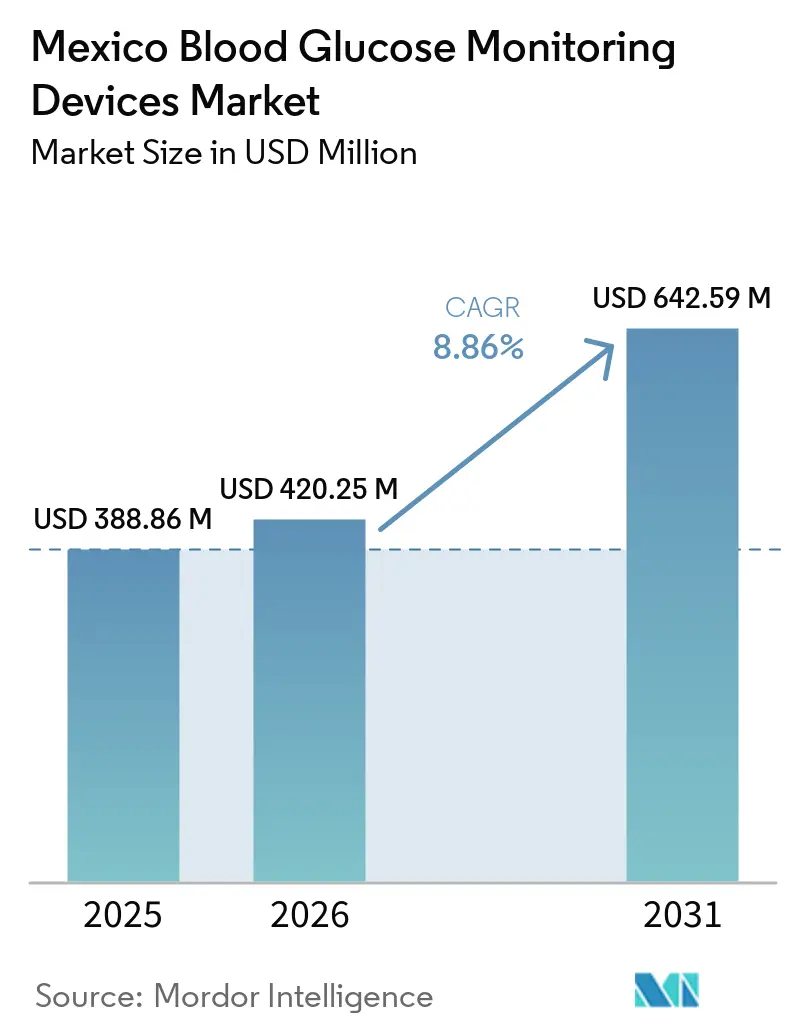
| Base Year Market Size (2025) | USD 388.86 Million |
| Market Size (2026) | USD 420.25 Million |
| Market Size (2031) | USD 642.59 Million |
| Growth Rate (2026 - 2031) | 8.86 % |
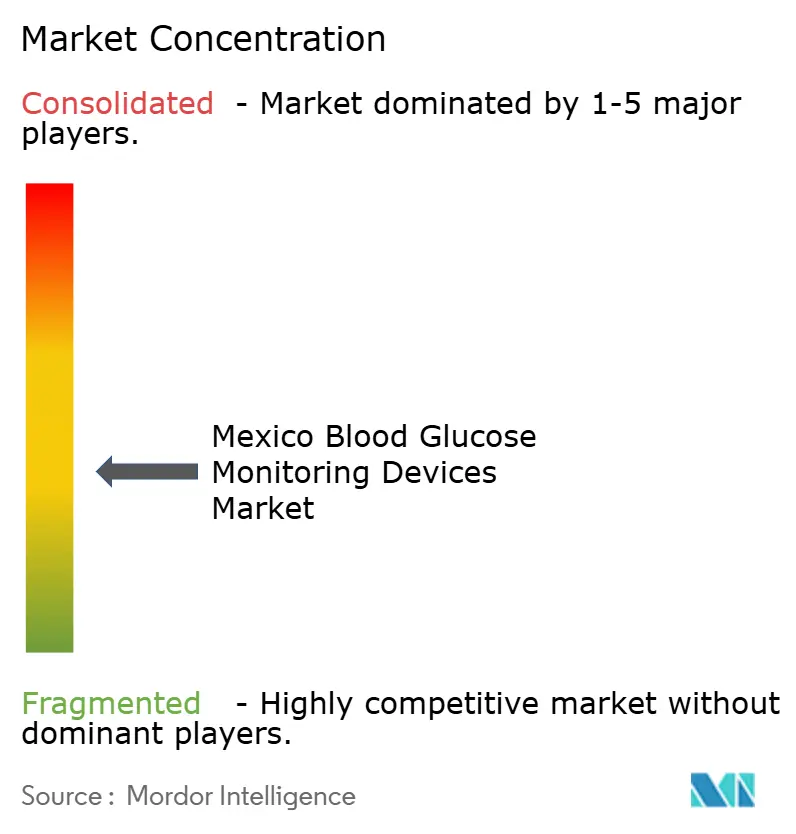
| Market Concentration | Medium |
Major Players *Disclaimer: Major Players sorted in no particular order Image © Mordor Intelligence. Reuse requires attribution under CC BY 4.0. | |
Mexico Blood Glucose Monitoring Devices Market Analysis by Mordor Intelligence
The Mexico Blood Glucose Monitoring Devices Market size is expected to grow from USD 388.86 million in 2025 to USD 420.25 million in 2026 and is forecast to reach USD 642.59 million by 2031 at 8.86% CAGR over 2026-2031.
The Mexican blood glucose monitoring devices market is supported by a large diabetes burden and a substantial pool of adults whose condition has not been diagnosed. Mexico had 13.6 million adults with diabetes in 2024, and 41.3% of cases were undiagnosed, which leaves many people outside routine monitoring pathways. The Mexican blood glucose monitoring devices market continues to rely on self-monitoring blood glucose products because public care networks routinely use meters, strips, and lancets. Continuous glucose monitoring is expanding through specialist and private care, where connected sensors can support more frequent treatment decisions. Product access will increasingly depend on reimbursement, regulatory processing, and the ability of suppliers to maintain sensor and strip availability.
Key Report Takeaways
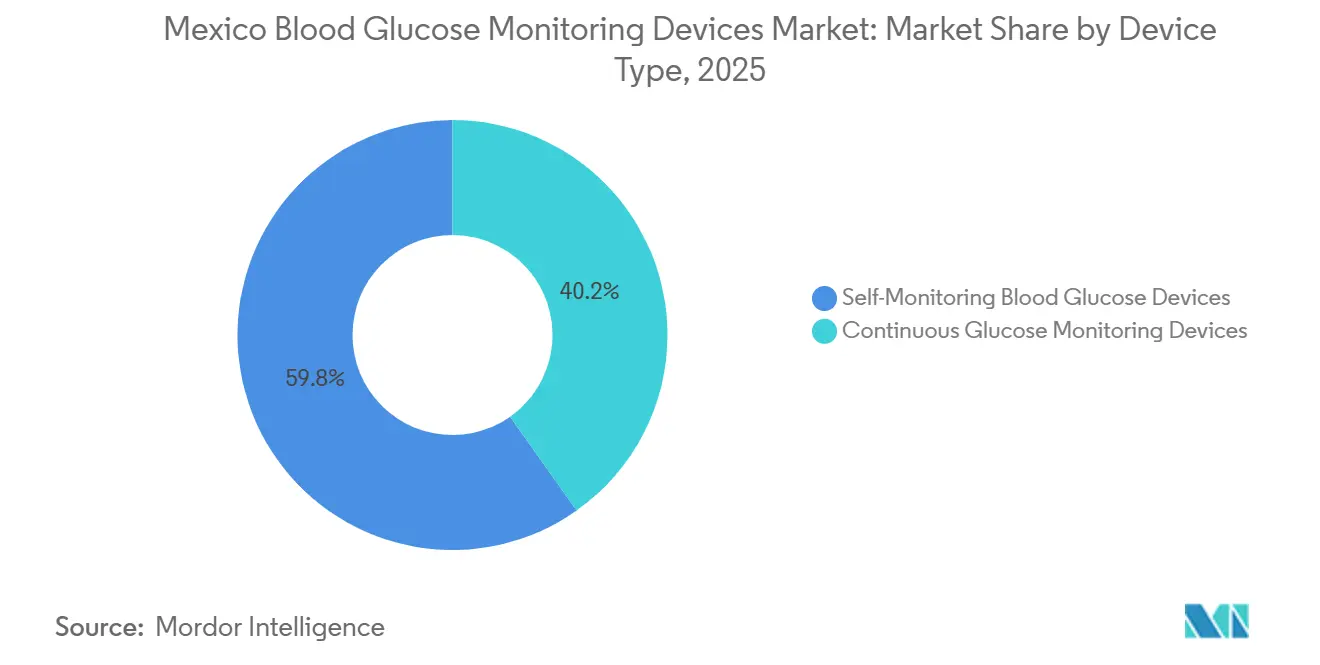
- By device type, SMBG devices held 59.79% of the Mexican blood glucose monitoring devices market share in 2025, while CGM devices are forecast to grow at a 9.71% CAGR through 2031.
- By patient type, Type 2 diabetes accounted for 65.65% of revenue in 2025, while Type 1 diabetes is projected to grow at a 10.26% CAGR through 2031.
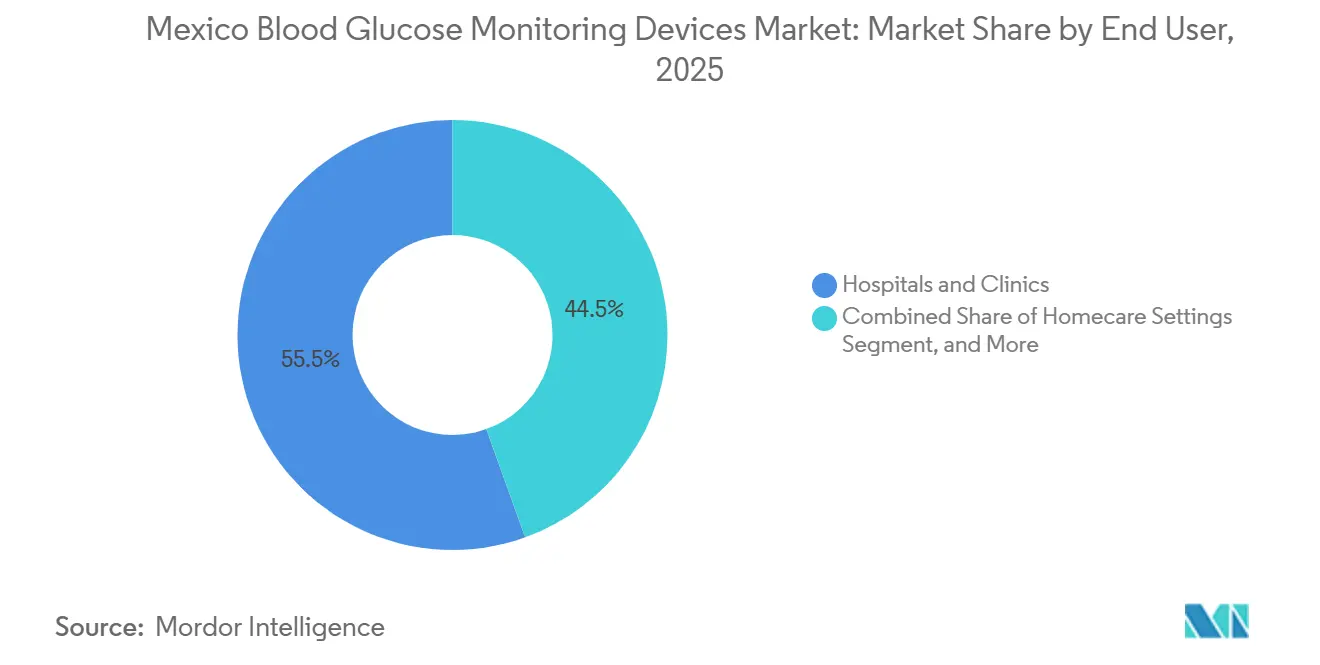
- By end-user, hospitals and clinics held 55.48% of revenue in 2025, while diagnostic centers are forecast to expand at a 10.73% CAGR through 2031.
Note: Market size and forecast figures in this report are generated using Mordor Intelligence’s proprietary estimation framework, updated with the latest available data and insights as of January 2026.
Market Trends and Insights
Drivers Impact Analysis of Mexico Blood Glucose Monitoring Devices Market*
| Driver | (~) % Impact on CAGR Forecast | Geographic Relevance | Impact Timeline |
|---|---|---|---|
| Rising Diabetes Burden and Undiagnosed Cases | +2.5% | National, with a higher burden in Central and North-Pacific regions | Long term (≥ 4 years) |
| Expanding Demand for Routine Home Monitoring | +1.8% | National, with earlier acceleration in Mexico City, Monterrey, and Guadalajara | Medium term (2-4 years) |
| CGM Adoption in Private and Specialist Care | +1.5% | Mexico City, Monterrey, and Guadalajara | Medium term (2-4 years) |
| Growing Digital Health and Connected Monitoring | +1.2% | Urban Mexico and semi-urban hubs with 4G and 5G access | Medium term (2-4 years) |
| Mexican Expert Consensus for Flash CGM in Higher-Risk Type 2 Diabetes | +0.8% | National, with early use through SMNE endocrinology networks | Short term (≤ 2 years) |
| Public Procurement of Test Strips and Diagnostic Supplies | +1.0% | National public procurement channels | Short term (≤ 2 years) |
| Source: Mordor Intelligence | |||
Rising Diabetes Burden and Undiagnosed Cases
Mexico’s diabetes burden creates durable demand for monitoring products across the Mexican blood glucose monitoring devices market. ENSANUT 2021-2024 reported Type 2 diabetes prevalence of 17.0%, while only 33.0% of diagnosed people achieved glycemic control below an HbA1c level of 7%.[1] This pattern indicates that many people already receiving treatment may require more regular monitoring and clinical follow-up. The International Diabetes Federation estimated 5.6 million undiagnosed diabetes cases in Mexico in 2024, representing a sizable group that could enter care as screening improves. ENSANUT Continua 2023 found that 27.7% of eligible adults had been screened during the prior year, compared with a national target of 33.3%.[2] The Mexican blood glucose monitoring devices market can therefore gain patients through both diagnosed disease management and higher screening coverage.
Expanding Demand for Routine Home Monitoring
Routine monitoring at home remains important because diabetes treatment extends beyond clinic visits. The Federación Mexicana de Diabetes provides a self-monitoring manual for people with Type 1, Type 2, and gestational diabetes, reinforcing the role of home measurement in day-to-day disease management.[3] Meters, strips, and lancets are familiar products for patients and clinicians, and they are more accessible than sensor-based systems. Their recurring use supports demand even when patients cannot afford continuous monitoring. The Mexican blood glucose monitoring devices market is also supported by public facilities that use these supplies in routine care. As more people receive a diagnosis, home testing can become a regular part of treatment rather than an occasional clinical procedure. This reinforces the need for reliable supply channels across both urban and non-metropolitan settings.
CGM Adoption in Private and Specialist Care
Continuous glucose monitoring is gaining use in private and specialist settings within the Mexican blood glucose monitoring devices market. Abbott launched FreeStyle Libre 2 Plus in Mexico in October 2025 with real-time alarms and connected features, widening access to a more advanced CGM offering. The product’s rollout in Mexico City reflects the importance of urban endocrinology networks and private-care channels during the early stage of adoption. Dexcom reported results from its CONNECT randomized controlled trial in 2026, showing improved glucose control for adults with Type 2 diabetes who were not using insulin. Such evidence may broaden clinician interest in CGM beyond insulin-intensive treatment. Specialist referral centers are likely to remain important because clinicians there can guide sensor selection, data interpretation, and ongoing use. The Mexican blood glucose monitoring devices market will therefore depend on clinical adoption as well as consumer willingness to pay.
Growing Digital Health and Connected Monitoring
Connected monitoring is shifting the value of glucose devices from a single reading toward data sharing and ongoing patient support. FreeStyle Libre 2 Plus connects with Abbott’s digital ecosystem, including the LibreLinkUp application, which can enable the sharing of glucose information with caregivers and clinicians. Dexcom introduced an AI-based Smart Food Logging feature in 2025 and a consumer-focused Stelo app experience in 2026, showing how device suppliers are linking glucose data with behavioral context. These platforms may make connected sensors more useful for patients who need regular feedback between appointments. LifeScan also reported improved diabetes outcomes from pairing OneTouch meters with a Spanish-language digital management application in a Hispanic population. The Mexican blood glucose monitoring devices market may see stronger pressure on basic devices that cannot share information or integrate with remote care. The effect will likely appear first in private urban care and then extend to other connected-care settings.
Restraints Impact Analysis of Mexico Blood Glucose Monitoring Devices Market*
| Restraint | (~) % Impact on CAGR Forecast | Geographic Relevance | Impact Timeline |
|---|---|---|---|
| High Out-of-Pocket Cost of CGM and Consumables | -2.0% | National, with the greatest effect in rural and semi-urban areas with limited private insurance | Long term (≥ 4 years) |
| Limited Public Reimbursement for Continuous Monitoring | -1.5% | National public health systems | Long term (≥ 4 years) |
| Uneven Access to Monitoring Devices and Test Strips Across Care Settings | -1.2% | Non-metropolitan states, southern areas, and high-deprivation municipalities | Medium term (2-4 years) |
| Sensor Replacement, Supply Continuity, and Prescription Friction | -0.8% | National, with greater pressure in public-hospital procurement channels | Medium term (2-4 years) |
| Source: Mordor Intelligence | |||
High Out-of-Pocket Cost of CGM and Consumables
The cost of sensors and repeated replacement remains a persistent barrier to broader CGM use. CGM requires regular purchases rather than a one-time meter purchase, which can make continuous use difficult for households paying out of pocket. This constraint is especially relevant outside the upper-income segment and areas with limited private insurance. The Mexican blood glucose monitoring devices market can therefore show faster sensor growth in private channels than in the wider population. A PAHO review identified inequitable access to diabetes technology in Mexico, including differences between private centers and IMSS facilities. Cost also affects adherence because patients may interrupt monitoring when replacement products are not affordable. Manufacturers will need to balance premium features with pricing and channel arrangements that support continued use.
Limited Public Reimbursement for Continuous Monitoring
Public diabetes care supports conventional monitoring supplies more consistently than CGM sensors. IMSS reported that CADIMSS delivers integrated Type 2 diabetes care to a large patient population through structured clinical teams. This leaves many people dependent on fingerstick testing even when sensor-based monitoring may be clinically appropriate. The Mexican blood glucose monitoring devices market may therefore remain divided between public-sector SMBG demand and private-sector CGM adoption. The gap is particularly material for insulin-dependent people who need uninterrupted measurement. Any future reimbursement change would have a significant effect on device choice, but broad near-term coverage cannot be assumed from the available evidence.
*Our forecasts treat driver/restraint impacts as directional, not additive. The impact forecasts reflect baseline growth, mix effects, and variable interactions.
Mexico Blood Glucose Monitoring Devices Market Segment Analysis
By Device Type:
Conventional Testing Holds the Largest Revenue Base While CGM ExpandsSMBG devices held 59.79% of 2025 revenue, giving conventional testing the largest position in the Mexican blood glucose monitoring devices market. Glucometers, test strips, and lancets are used across homecare, hospitals, and diagnostic settings. Their relative affordability supports broad access compared with sensor-based options. Test strips and lancets also generate recurring demand because they are used repeatedly. IMSS purchasing and clinical care pathways continue to support this established use of conventional supplies. Roche’s Accu-Chek portfolio is registered and marketed in Mexico, illustrating the established availability of meter-based products. The Mexican blood glucose monitoring devices market will continue to depend on this installed base through the forecast period.
CGM devices are projected to expand at a 9.71% CAGR through 2031, faster than the conventional device category, supporting continued growth in mexico continuous glucose monitoring adoption. Abbott’s 2025 Mexican launch of FreeStyle Libre 2 Plus added real-time alarms and connected functionality to the local CGM offer. These features address needs that intermittent measurement cannot fully meet, especially for patients requiring closer glucose oversight. The category’s expansion is nevertheless limited by the cost of sensors and the absence of broad public reimbursement. CGM is likely to grow first through endocrinology practices and private pharmacies in large cities. The Mexico blood glucose monitoring devices market will thus combine a high-volume SMBG base with a smaller but faster-moving sensor category. Adoption will depend on whether suppliers can convert clinical interest into sustained patient use.
By Patient Type:
Type 2 Diabetes Provides the Largest Revenue Base While Type 1 Diabetes Grows FasterType 2 diabetes accounted for 65.65% of revenue in 2025, reflecting its large patient population and extensive need for routine monitoring. ENSANUT 2021-2024 reported Type 2 diabetes prevalence of 17.0% in Mexico. The segment includes people using oral therapies, non-insulin injectable therapies, and insulin. Monitoring intensity increases where glycemic control is poor or treatment is more complex. The Mexican expert consensus creates a clearer basis for using flash CGM among higher-risk Type 2 patients. This supports a gradual move toward more advanced monitoring for selected patients. The Mexican blood glucose monitoring devices industry remains closely tied to the needs of this large patient group.
Type 1 diabetes is forecast to grow at a 10.26% CAGR through 2031, the highest rate among patient types. People with Type 1 diabetes generally have a more immediate need for frequent and continuous glucose information. PAHO identified unequal access to technology between private and public care settings as an important challenge for people with Type 1 diabetes in Mexico. Abbott and Medtronic announced a global partnership to connect FreeStyle Libre CGM systems with Medtronic insulin-delivery devices. Such integration can strengthen the use case for sensor-based monitoring among insulin-dependent patients. Gestational diabetes remains a smaller segment, but clinical evidence presented by Dexcom in 2025 may support future interest in CGM within obstetric care. The Mexican blood glucose monitoring devices market will need distinct products and support approaches for each patient type.
By End-user:
Hospitals and Clinics Lead While Diagnostic Centers Grow FasterHospitals and clinics accounted for 55.48% of end-user revenue in 2025, making them the largest channel in the Mexican blood glucose monitoring devices market. Mexico’s diabetes care pathway is strongly connected to public clinical facilities and structured follow-up programs. The IMSS CADIMSS model uses multidisciplinary teams and monthly consultations for Type 2 diabetes care. These settings support steady use of meters, strips, and lancets. Hospitals also provide a key point for diagnosis, treatment adjustment, and device education. Their importance is likely to continue because many patients enter diabetes care through public institutions. The Mexican blood glucose monitoring devices market, therefore, needs suppliers that can meet formal procurement and service requirements.
Diagnostic centers are forecast to grow at a 10.73% CAGR through 2031, the highest rate across end-user settings. Growth reflects the broader movement of testing and follow-up closer to patients outside large hospital environments. Homecare also remains important because self-monitoring is part of daily management for people with Type 1, Type 2, and gestational diabetes. Specialty diabetes facilities have a smaller revenue base but are important in the early adoption of CGM. These clinics can assess patients with complex needs and support data interpretation. The Mexican blood glucose monitoring devices market can gain from wider diagnostic access, but supply and clinician capability must keep pace. Growth in these channels may extend more advanced monitoring beyond the largest hospital systems.

Geography Analysis
The Central region held a Type 2 diabetes prevalence of 21.1% and the North-Pacific region recorded 20.7% during 2021-2024, creating a major need for centers for the Mexican blood glucose monitoring devices market. Glycemic control in Mexico City and the Pacific-Central region remained below 30%, indicating that monitoring needs remain substantial in these areas. Private CGM sales and specialist prescribing are concentrated in Mexico City, Monterrey, and Guadalajara. Abbott launched FreeStyle Libre 2 Plus in Mexico City in October 2025, which reflects the importance of metropolitan specialist and pharmacy networks. These cities have more private-care capacity and more established routes for advanced-device adoption. Northern border areas may also have greater awareness of CGM products because of their proximity to the United States.
Southern states and high-deprivation municipalities depend more heavily on public health supply chains. Prediabetes prevalence was higher in the most deprived municipalities at 22.5%, compared with 17.6% in low-deprivation municipalities. This places prevention and routine monitoring needs in places that can have fewer specialist services. The Mexican blood glucose monitoring devices market must therefore address both commercial concentration in large cities and access gaps in less-resourced communities. Meters and strips are likely to remain the principal tools in areas served mainly through IMSS-Bienestar and other public routes. Consistent distribution is essential because irregular supplies can interrupt routine self-monitoring.
Digital platforms may help extend clinical oversight beyond the three largest metropolitan markets. Connected monitoring can allow patients to share readings with clinicians without repeated travel to a specialist center. This opportunity depends on device availability, network access, and clinical workflows that can act on shared data. The Mexican blood glucose monitoring devices market may benefit as diagnostic centers and mid-sized cities add connected-care capacity. However, technology adoption will not remove cost and supply barriers in lower-income areas. Geographic growth will remain uneven while reimbursement and specialist access differ across the country. National suppliers will need a mixed approach that combines public procurement, pharmacy distribution, and specialist engagement.
Competitive Landscape
The Mexican blood glucose monitoring devices market has different competitive conditions in SMBG and CGM. Abbott, Roche, LifeScan, Ascensia Diabetes Care, Arkray, Bionime, Nipro, Sinocare, and Trividia Health are established in conventional monitoring categories. Competition in this category centers on tender participation, price, product availability, and pharmacy presence. Roche markets multiple Accu-Chek meter products in Mexico. CGM is less mature and has been led by Abbott’s FreeStyle Libre platform. Abbott’s 2025 launch of FreeStyle Libre 2 Plus added a higher-function sensor option with alarms and a connected application. This creates a more differentiated proposition than basic strip-based testing.
Companies are increasingly competing through ecosystem design rather than the device alone. Abbott and Medtronic formed a global partnership to connect Abbott CGM technology with Medtronic automated insulin delivery and smart injection systems. Dexcom’s 2026 CONNECT trial results also provide company-backed clinical evidence for use among people with Type 2 diabetes not using insulin. These moves show that clinical evidence, applications, and treatment integration are becoming important competitive tools. They can support patient retention when the device is used within a wider care routine. Competitive positions will continue to depend on clinical trust, affordability, supply continuity, and the capacity to work across private and public channels
Mexico Blood Glucose Monitoring Devices Industry Leaders
-
F. Hoffmann-La Roche Ltd.
-
Medtronic
-
Eli Lilly and Company
-
Novo Nordisk A/S
-
Sanofi
- *Disclaimer: Major Players sorted in no particular order
Mexico Blood Glucose Monitoring Devices Market Companies Covered in this Report
- Abbott Laboratories
- Ascensia Diabetes Care Holdings AG
- AgaMatrix
- Arkray
- Acon Laboratories
- Bionime
- Dexcom
- Eli Lilly and Company
- Roche
- Lifescan
- Medtronic
- Novo Nordisk
- Nipro
- Sinocare
- Senseonics
- Sanofi
- Trividia Health, Inc.
Read Analysis of Mexico Blood Glucose Monitoring Devices Companies
Recent Industry Developments in Mexico Blood Glucose Monitoring Devices Market
- February 2026: Trividia Health, Inc. announced that it is initiating a labeling correction to revise the Owner’s Booklets/System Instructions for Use for all TRUE METRIX, TRUE METRIX AIR, TRUE METRIX GO, and TRUE METRIX PRO Blood Glucose Monitoring Systems (collectively, the “Products”) distributed in Mexico.
- October 2025: Abbott launched FreeStyle Libre 2 Plus in Mexico, the company’s most advanced integrated CGM platform offering real-time alarms and a connected app ecosystem. The launch, held in Mexico City, marks the first time real-time CGM alert functionality is commercially available in the Mexican market.
Mexico Blood Glucose Monitoring Devices Market Report Scope
This market covers the value of products used to measure and track blood glucose in the Mexico, spanning self-monitoring tools and continuous glucose monitoring systems, with revenues captured at the device and consumables level.
Scope exclusions: We exclude diabetes drugs, general lab chemistry analyzers not used for glucose monitoring workflows, and non-medical wellness gadgets that do not measure glucose.
The Mexico Blood Glucose Monitoring Devices Market is segmented into device type, patient type, and end-user. The market is segmented by device type into self-monitoring blood glucose devices and continuous glucose monitoring devices. Self-monitoring blood glucose devices are further categorized into glucometers, test strips, and lancets. Continuous glucose monitoring devices are divided into sensors and durables. Based on patient type, the market is segmented into Type 1 diabetes, Type 2 diabetes, and gestational diabetes. By end-user, the market is segmented into hospitals and clinics, homecare settings, diagnostic centers, and specialty diabetes facilities. The report also covers the estimated market sizes and trends across Mexico. The report offers the market size and forecasts in value (USD) for the above segments.
Segmentation Overview
By Device Type
| Self-Monitoring Blood Glucose Devices | Glucometers |
| Test Strips | |
| Lancets | |
| Continuous Glucose Monitoring Devices | Sensors |
| Durables |
By Patient Type
| Type 1 Diabetes |
| Type 2 Diabetes |
| Gestational Diabetes |
By End-user
| Hospitals & Clinics |
| Homecare Settings |
| Diagnostic Centers |
| Specialty Diabetes Facilities |
| By Device Type | Self-Monitoring Blood Glucose Devices | Glucometers |
| Test Strips | ||
| Lancets | ||
| Continuous Glucose Monitoring Devices | Sensors | |
| Durables | ||
| By Patient Type | Type 1 Diabetes | |
| Type 2 Diabetes | ||
| Gestational Diabetes | ||
| By End-user | Hospitals & Clinics | |
| Homecare Settings | ||
| Diagnostic Centers | ||
| Specialty Diabetes Facilities | ||
Key Questions Answered in the Report
What is the projected value of Mexican blood glucose monitoring devices in 2031?
The Mexican blood glucose monitoring devices market is projected to reach USD 642.59 million by 2031, growing at an 8.86% CAGR from 2026.
Which device category has the largest revenue position in Mexico?
SMBG devices held 59.79% of revenue in 2025 because meters, strips, and lancets remain widely used in public and homecare settings.
Why is continuous glucose monitoring growing in Mexico?
CGM is supported by specialist use, connected features, and clinical guidance for higher-risk people with Type 2 diabetes, although cost remains a barrier.
Which patient group accounts for the most glucose monitoring revenue?
Type 2 diabetes accounted for 65.65% of revenue in 2025, reflecting the large diagnosed population and continuing need for glucose management.
Which end-user channel is growing fastest for glucose monitoring devices?
Diagnostic centers are forecast to grow at a 10.73% CAGR through 2031 as testing and follow-up expand beyond hospital settings.