
Market Overview
| Study Period | 2020 - 2031 |
|---|---|
| Forecast Data Period | 2026 - 2031 |
| Base Year Market Size (2025) | USD 302.21 Million |
| Market Size (2026) | USD 347.42 Million |
| Market Size (2031) | USD 697.67 Million |
| Growth Rate (2026 - 2031) | 14.96 % |
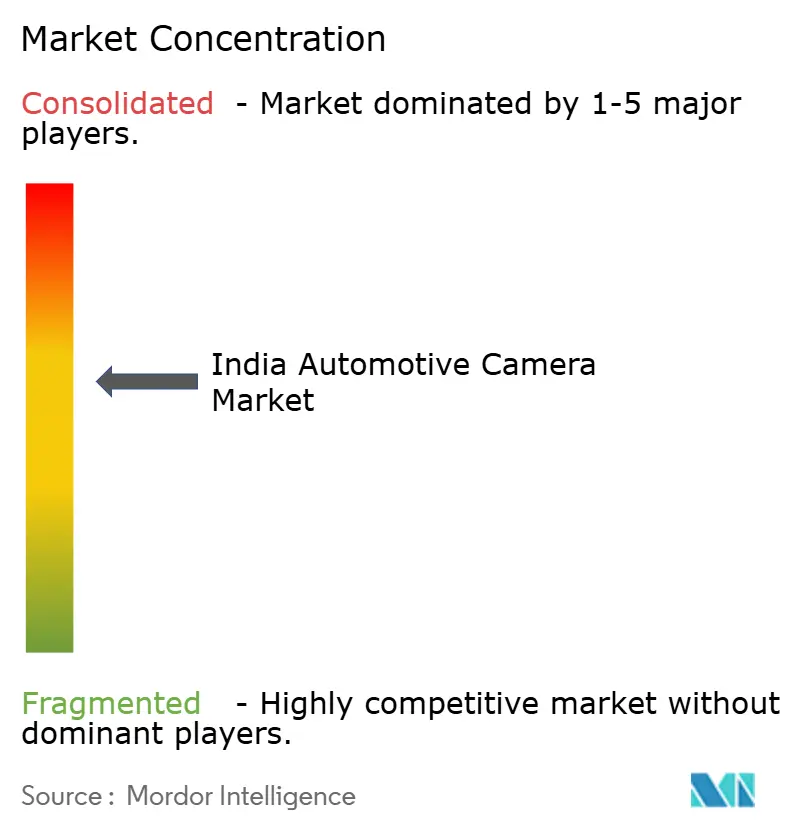
| Market Concentration | Medium |
Major Players *Disclaimer: Major Players sorted in no particular order Image © Mordor Intelligence. Reuse requires attribution under CC BY 4.0. | |
India Automotive Camera Market Analysis by Mordor Intelligence
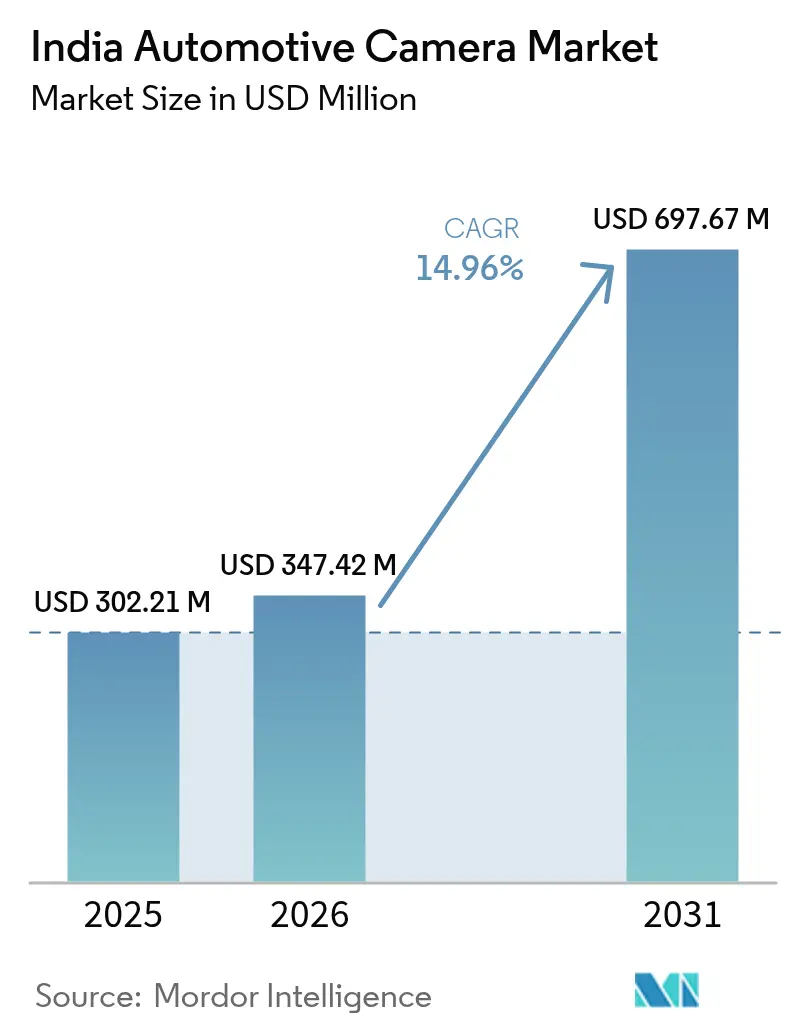
The India automotive camera market size was valued at USD 302.21 million in 2025 and estimated to grow from USD 347.42 million in 2026 to reach USD 697.67 million by 2031, at a CAGR of 14.96% during the forecast period (2026-2031). This robust growth rests on a blend of safety regulations, manufacturing incentives, and consumer demand that makes India an important production and adoption hub for vehicle-mounted cameras. Stricter AIS-150 and Bharat NCAP rules, the premium hatchback and SUV boom, and lower CMOS costs keep volumes rising even in price-sensitive segments. OEMs lead adoption because integrated cameras streamline compliance, while localization policies reduce currency and logistics risks. Competitive intensity remains balanced as global Tier-1s partner with Indian suppliers to deepen local content and weather foreign-exchange swings.
Key Report Takeaways
- By vehicle type, passenger vehicles led the Indian automotive camera market with 71.63% of the share in 2025, while commercial vehicles are projected to expand at a 16.98% CAGR through 2031.
- By camera type, viewing cameras captured 62.74% of the Indian automotive camera market in 2025; sensing cameras are forecast to grow at an 18.12% CAGR between 2026 and 2031.
- By application, parking and surround-view systems accounted for 56.95% of the Indian automotive camera market in 2025, whereas ADAS applications are set to advance at a 17.29% CAGR to 2031.
- By resolution, the 2–5 MP segment held 60.05% of the Indian automotive camera market in 2025, while cameras above 5 MP are expected to post a 16.85% CAGR over the next five years.
- By sales channel, OEM-fit solutions dominated the Indian automotive camera market, with 80.62% of the market in 2025; the aftermarket segment is anticipated to record a 15.84% CAGR through 2031.
- By mounting location, rear-view modules comprised 51.21% of the Indian automotive camera market in 2025, whereas front-view cameras are poised for a 16.72% CAGR during 2026-2031.
- By region, North India commanded 36.29% of the Indian automotive camera market in 2025, while South India is projected to log a 16.63% CAGR through 2031.
Note: Market size and forecast figures in this report are generated using Mordor Intelligence’s proprietary estimation framework, updated with the latest available data and insights as of 2026.
India Automotive Camera Market Trends and Insights
Drivers Impact Analysis*
| Driver | (~) % Impact on CAGR Forecast | Geographic Relevance | Impact Timeline |
|---|---|---|---|
| Stricter AIS-150 and Bharat NCAP Safety Mandates | +3.2% | National, early lead in North and West | Medium term (2-4 years) |
| Rising Demand for Parking-Assist and ADAS | +2.8% | Metro and Tier-1 urban centers | Short term (≤ 2 years) |
| Volume Growth in Premium Hatchbacks and SUVs | +2.4% | National, strongest in North and West | Medium term (2-4 years) |
| Declining CMOS Costs and Localized Supply Chains | +2.1% | Manufacturing hubs in South and West | Long term (≥ 4 years) |
| PLI Incentives for Domestic Camera Modules | +1.9% | South, West, selective North | Long term (≥ 4 years) |
| Usage-Based Insurance Analytics | +1.3% | Urban markets nationwide | Medium term (2-4 years) |
| Source: Mordor Intelligence | |||
Stricter AIS-150 and Bharat NCAP Safety Mandates
Regulatory frameworks reshape the Indian automotive camera market as AIS-150 compels electronic stability control and advanced braking across vehicle categories beginning 2026. Bharat NCAP scores tie directly to camera-enabled ADAS, prompting Mahindra, Hyundai, and Tata to add Level 2 functions in mid-tier trims to secure higher ratings[1]. Phased timelines help firms spread investment, yet small OEMs grapple with certification costs that ultimately favor suppliers holding proven safety credentials. Consumer awareness grows as NCAP star labels appear in showroom marketing, reinforcing camera demand nationwide.
Rising Demand for Parking-Assist and Surround-View Features
As urban areas grapple with congestion and dwindling parking spaces, there's a rising interest in camera-based driver assistance systems. Technologies like parking aids and surround-view cameras are in high demand, especially in premium vehicles that now boast sophisticated multi-camera setups for navigating tight city streets. Meanwhile, budget-friendly rear-view cameras are making waves in the aftermarket, with many drivers opting to enhance older vehicles for improved visibility. The surge in parking-related insurance claims underscores the growing consumer reliance on these visual aids, solidifying their presence across various vehicle segments.
Declining CMOS Camera Costs and Localized Supply Chains
Falling module costs, driven by lower semiconductor prices and increased production, enable automakers to add camera systems to affordable vehicles. This is making advanced safety and convenience features more common in entry-level models. Manufacturers are shortening delivery timelines and qualifying for government production-linked incentives through strategic partnerships. For instance, Motherson Sumi Systems’ Vision Systems division is increasing local content. By localizing more components, these collaborations boost supply chain efficiency and competitiveness in a market increasingly influenced by policy-driven manufacturing goals[2]. Deep localization softens forex shocks and nurtures supplier ecosystems in Karnataka, Tamil Nadu, and Maharashtra, where production clusters thrive.
Usage-Based Insurance Analytics Leveraging Camera Data
Insurers tap real-time driving footage for risk scoring, offering premium cuts of 10-15% to fleets installing cameras. The Insurance Regulatory and Development Authority now endorses usage-based products, sparking interest among logistics fleets that see dual gains in safety and insurance savings. Privacy rules under the Digital Personal Data Protection Act 2023 mandate informed consent, pushing suppliers to build secure data protocols that garner trust without dampening growth potential.
Restraints Impact Analysis*
| Restraint | (~) % Impact on CAGR Forecast | Geographic Relevance | Impact Timeline |
|---|---|---|---|
| Up-Front Cost Premiums in Sub-INR 10-Lakh Cars | -1.8% | National, sharpest in rural and semi-urban markets | Short term (≤ 2 years) |
| Harsh Climatic and Road-Dust Conditions | -1.4% | North and West during monsoon and dust-storm seasons | Medium term (2-4 years) |
| FX-Linked Import Dependence on Image Sensors | -1.1% | Nationwide with tight supply-chain concentration | Medium term (2-4 years) |
| Consumer Privacy Concerns on In-Cabin Monitoring | -0.9% | Urban clusters with greater privacy awareness | Long term (≥ 4 years) |
| Source: Mordor Intelligence | |||
Harsh Climatic and Road-Dust Conditions Impairing Sensors
Indian summers top 50 °C, monsoons bring torrents, and seasonal dust storms coat windscreens. These extreme fog lenses cause condensation in housings and degrade electronics[3]. Owners often ignore frequent cleaning, leading to image loss that erodes trust. Suppliers respond with rugged IP-rated units and hydrophobic coatings, inflating bills of material and lengthening test cycles at dedicated climatic chambers.
Consumer Privacy Concerns on In-Cabin Monitoring
Driver-facing cameras enable fatigue detection and insurance analytics, yet raise personal-data questions. Urban buyers, especially in tech-savvy cities, hesitate to accept always-on monitoring, slowing adoption in passenger cars. The Digital Personal Data Protection Act enforces consent and data-storage limits, so suppliers must include robust opt-in workflows and edge-processing features that avoid cloud upload when possible, adding design complexity and cost.
*Our forecasts treat driver/restraint impacts as directional, not additive. The impact forecasts reflect baseline growth, mix effects, and variable interactions.
Segment Analysis
By Vehicle Type: Passenger Dominance Drives Market Expansion
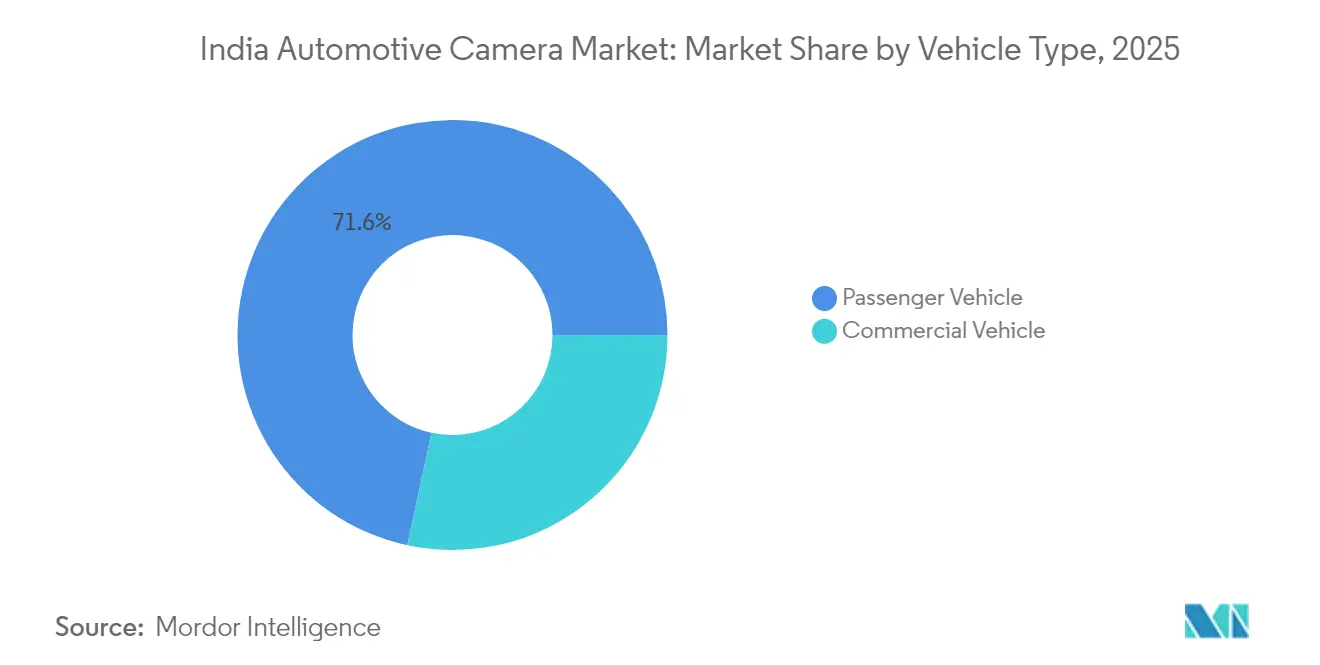
Passenger models generated 71.63% of 2025 revenue, underscoring the Indian automotive camera market's focus on consumer safety features. Commercial fleets, however, will post a 16.98% CAGR as electrification rules and logistics digitization spur mandatory monitoring. Passenger-car demand matches rising disposable income and technology differentiation, while fleet operators chase lower insurance premiums and accident liability reductions.
Commercial sales cycles are longer, yet telematics-linked discounts yield rapid ROI. OEM line-fit solutions simplify compliance and warranty management for both segments, although retrofits still appeal to budget-minded transporters upgrading legacy trucks. Passenger car camera take-rates escalate with every model refresh, driven by competitive launches from Mahindra, Hyundai, and Tata that now bundle basic ADAS under INR 20 lakh (~ USD 22,500).

By Camera Type: Sensing Technology Acceleration
Viewing units held 62.74% of shipments in 2025 as consumers prioritized parking ease. Sensing cameras will advance at an 18.12% CAGR through 2031, fueled by stereo configurations supporting lane-keeping and collision avoidance. Mono setups dominate entry-level builds thanks to lower cost, while stereo platforms emerge in premium crossovers touting Level 2 assistance.
The Indian automotive camera market size for sensing modules gains as processors drop in price and vision algorithms run efficiently on vehicle controllers. Upgrade complexity introduces calibration service revenue for workshops and gives software-centric suppliers a fresh edge. Viewing cameras remain relevant but cede share as NCAP-driven active safety rules migrate from premium to mid-range trims.
By Application: ADAS Emerges as Growth Leader
Parking and surround-view held a 56.95% share in 2025 because maneuvering hazards remain top of mind for city drivers. Still, ADAS will rise at a 17.29% CAGR as OEMs advance collision warning, auto emergency braking, and lane-departure systems to satisfy star-rating norms.
Driver monitoring gains fleet traction, though privacy sensitivity tempers private-car uptake. The application mix underlines an evolution from passive viewing toward active risk prevention, moving the Indian automotive camera market toward higher value content with incremental software revenue streams.
By Resolution: Higher Definition Drives Premium Adoption
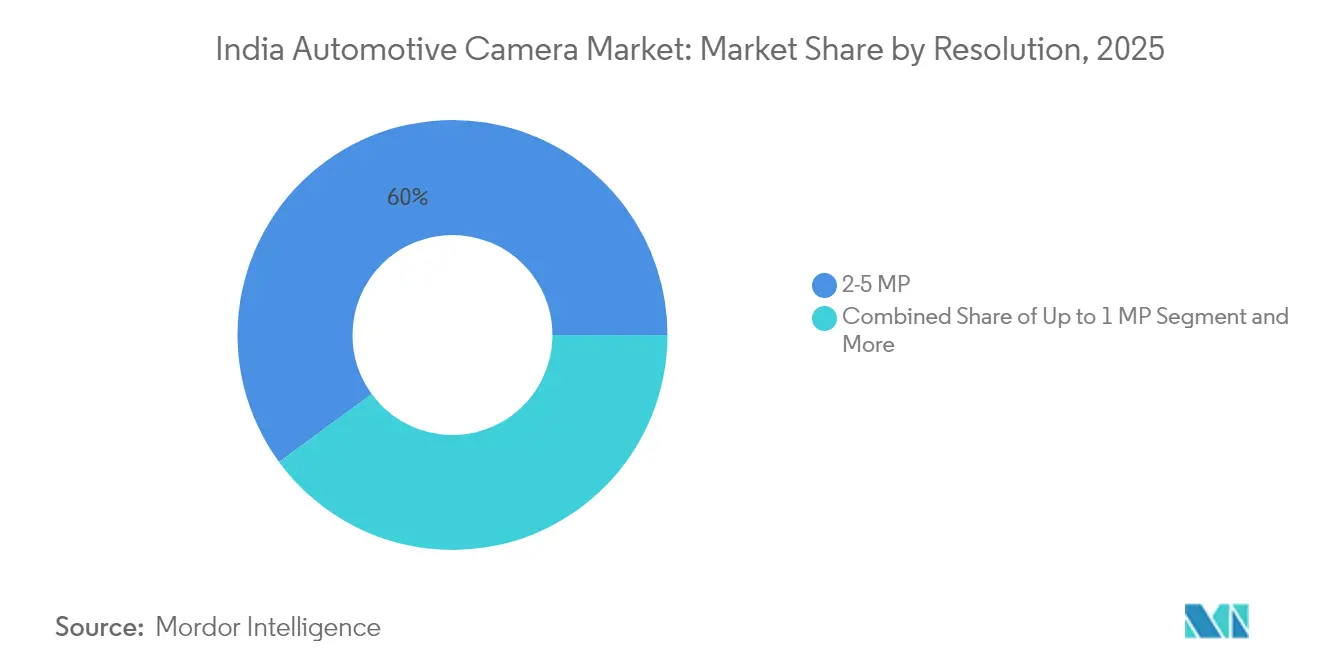
Cameras rated 2-5 MP owned 60.05% of 2025 volumes, balancing clarity and cost. Units above 5 MP will climb 16.85% CAGR because ADAS logic needs crisp data at a longer range. Sub-1 MP parts fade except in bargain rear-view kits for small cars.
High-definition images require stronger SoCs and thermal design margins, and chipmakers now offer automotive-grade ISP packages. Production lines upgrade optics and clean-room processes to meet tighter tolerances, gradually lowering per-unit deltas and spreading HD adoption down the price ladder.
By Sales Channel: OEM Integration Dominates
OEM-fit captured 80.62% of 2025 shipments, proving in-plant integration wins on warranty and calibration quality. Aftermarket kits will still clock 15.84% CAGR, mainly rear-view sets sold through accessory chains to owners wanting budget compliance.
Complex ADAS retrofits stay niche because they need network access, coding, and precise alignment that only factories guarantee. As OEMs standardize cameras in mid trims, economies of scale narrow the price gap to aftermarket, further consolidating share.
By Mounting Location: Front-View Systems Gain Momentum
Rear-view modules kept a 51.21% share in 2025, aided by parking and heavy-vehicle rules. Front-view units will log 16.72% CAGR alongside ADAS growth that mandates forward recognition. Side-view and interior placements fill blind-spot monitoring and driver-fatigue niches, respectively, but remain smaller layers of the Indian automotive camera market.
Front sensors demand aerodynamic housings and heated lens keepers for monsoon resilience, inviting specialist component makers. Interior cameras face privacy scrutiny but win favor with commercial fleets where compliance outweighs concerns.
Geography Analysis
North India generated 36.29% of 2025 turnover thanks to clusters in Haryana and Uttar Pradesh that host major OEMs such as Maruti Suzuki and Honda. Proximity to the National Capital Region speeds design iterations and brings supplier density that trims logistics expenses. Seasonal dust storms and temperature swings test camera robustness, yet robust service networks limit downtime.
South India will outpace all regions at a 16.63% CAGR through 2031. Karnataka’s electronics belt and Tamil Nadu’s auto corridor attract camera R&D investment, anchored by engineering talent from local institutes. Bangalore and Chennai act as validation hubs where global Tier-1s tune ADAS algorithms for Indian roads, reinforcing the Indian automotive camera market position as an export-capable tech center.
West India leverages Maharashtra’s manufacturing base and Gujarat’s port access to secure component flow and finished-vehicle exports. State incentives lure new factories, and a vast supplier pool supports complex camera assemblies. East and North-East zones remain small today, but rising vehicle ownership and highway expansion will open fresh lanes for camera vendors eyeing underserved territories.
Regulatory Landscape
India automotive camera fitment is shaped by the Central Motor Vehicle Rules (CMVR) under the Ministry of Road Transport and Highways (MoRTH), with technical standards developed through the Automotive Industry Standards Committee (AISC) supporting the CMVR-Technical Standing Committee (CMVR-TSC). On the type-approval side, AIS-001 (Part 1) (Rev.2):2023 defines requirements for devices for indirect vision, including camera-monitor systems, and aligns India with UN R46-style technical expectations, which feeds into OEM design targets and supplier validation routines.
Mandates and safety programs also reinforce camera adoption in both passenger and commercial vehicles. AIS-145 specifies reverse parking alert system requirements for M and N categories, sustaining demand for rear-view camera modules and related alert features. MoRTH notifications that enable electronic monitoring and enforcement for road safety (including dashboard cameras and ANPR-based systems) add momentum to camera-led compliance and monitoring use cases. Standards such as AIS 186 (Blind Spot Information System) and AIS 187 (Moving Off Information System) moving through approval and notification pathways further clarify the route for higher-content, camera-based active safety packages.
Value Chain Analysis
The India automotive camera value chain covers image sensors and ISPs (often import-linked), lenses and optical components, module assembly (housing, sealing, connectors, calibration), embedded software and perception algorithms, and downstream integration into ECUs and domain controllers for ADAS and surround-view. Tier-1s and large domestic component groups typically handle system engineering and OEM line-fit supply, while Indian plants increasingly take on assembly, testing, and calibration to meet OEM takt times and quality requirements under Indian climatic conditions.
Localization is strengthening around manufacturing hubs in Tamil Nadu, Karnataka, Maharashtra, and Gujarat, supported by OEM proximity and incentives for domestic electronics. Capacity moves, such as Valeo adding HD surround-view camera manufacturing at Sanand and Visteon starting in-house high-resolution camera production in Chennai (USD 10 million investment), show a shift toward local assembly and validation even when critical sensors remain globally sourced. Logistics and compliance elements, including customs classification for LVDS camera parts and type-approval alignment to AIS frameworks, influence landed cost, supplier selection, and how far camera modules can be localized versus imported as subassemblies.
Competitive Landscape
The Indian automotive camera market is moderately concentrated, as the top five players command near-45% revenue. Bosch, Continental, and Valeo apply decades of ADAS expertise and leverage partnerships for local production. Bosch’s memorandum with Tata Electronics underscores deeper semiconductor roots. At the same time, Continental’s new Aumovio identity spotlights software-defined vehicles and camera-centric safety. Valeo scales its Fish-Eye architecture for compact cars to meet cost targets.
Domestic majors seize PLI funds to close technology gaps. Motherson Sumi Systems pushes localized content and eye-tracking modules, whereas Uno Minda broadens electronics capacity for EV and ICE lines. Competitive levers include harsher climate validation, lower total cost, and faster homologation cycles. White space remains in fleet-oriented driver monitoring and retrofit twins for the insurance market. Technology convergence invites chipmakers and smartphone camera suppliers that offer advanced imaging IP, spurring alliances like Magna’s tie-up with NVIDIA aimed at high-compute ADAS roadmaps.
Regulatory certifications enable certain suppliers to deliver NCAP-compliant systems punctually, giving them a competitive edge. This differentiation often relegates smaller entrants to niche positions or tier-2 roles, as they may lack the resources or expertise to meet stringent certification requirements.
India Automotive Camera Industry Leaders
-
Continental AG
-
Magna International Inc
-
Robert Bosch GmbH
-
Valeo SA
-
Autoliv Inc.
- *Disclaimer: Major Players sorted in no particular order
Market Opportunities and Future Outlook
An opportunity in India sits with cost-optimized ADAS architectures that increase camera penetration without taking systems beyond mass-market price bands. Demand signals support this direction, with CyberMedia Research (CMR) reporting in May 2026 that ADAS-equipped car sales in India grew 49% year-on-year in Q1 2026, and most of these vehicles featuring Level 2 systems. That keeps front camera demand tied to broader ADAS take-rate expansion. Supplier roadmaps geared to Indian traffic conditions, including Mobileye positioning SuperVision and Navigate-on-Pilot for local driving behaviors, also create scope for India-specific perception tuning, calibration services, and validation toolchains.
Commercial-vehicle safety and monitoring offer another practical lane for camera suppliers, supported by ongoing OEM and fleet interest in driver monitoring, forward sensing, and compliance-friendly solutions that can be linked to usage-based insurance programs. Data governance is also shaping design and delivery priorities, since the Digital Personal Data Protection Act 2023 elevates consent and data handling expectations for in-cabin and connected camera use cases. This creates space for edge-processing, secure storage, and India-hosted data workflows. At the same time, expanding local manufacturing footprints (for example, Sanand and Chennai investments) support faster OEM programs and reduce lead-time exposure for camera modules and surround-view systems.
Recent Industry Developments
- June 2026: Valeo expanded its VSS360 manufacturing footprint in Sanand, accelerating local production for front camera modules in the commercial vehicle segment. This move strengthens camera supply and reduces lead times for national trucking fleets.
- May 2026: Valeo announced a contract with a leading Indian OEM to supply the Valeo Smart Safety 360 (VSS360) platform, combining a smart front camera with three radars, with manufacturing planned at Sanand for the commercial vehicle segment. The win links localized production with higher-content ADAS packages and expands camera demand beyond parking use cases into forward-sensing deployments.
- January 2024: Maruti Suzuki announced an investment of INR 3.5 billion in Gujarat to set up its second automobile plant, with annual capacity targeted at 1 million units and operations planned for FY 2028-29. The additional vehicle output capacity supports higher OEM-fit feature penetration, including camera-based safety and convenience systems, across high-volume passenger models.
Research Methodology Framework and Report Scope
Market Definition and Coverage
For this methodology, the India automotive camera market includes the revenue generated from camera modules and systems installed in vehicles sold and used in India, covering both factory-fit and replacement demand across common mounting positions.
Scope exclusions: We exclude non-automotive imaging devices, consumer action cameras, and cameras used only for external road infrastructure monitoring.
Segmentation Overview
- By Vehicle Type
- Passenger Vehicle
- Hatchback
- Sedan
- Sport Utility Vehicle and Multi-Purpose Vehicle
- Commercial Vehicle
- Light Commercial Vehicle
- Medium and Heavy Commercial Vehicle
- Passenger Vehicle
- By Camera Type
- Viewing Camera
- Sensing Camera
- Mono
- Stereo
- By Application
- ADAS
- Parking & Surround View
- Driver Monitoring
- By Resolution
- Up to 1 MP
- 2-5 MP
- Above 5 MP
- By Sales Channel
- OEM-Fit
- Aftermarket
- By Mounting Location
- Front View
- Rear View
- Side View
- Interior/In-Cabin
- By Region
- North
- South
- West
- East & North-East
Data Sources, Market Sizing, and Validation
Desk Research
Desk work started with building the India vehicle production and sales context and then linking it to camera penetration by application. We referenced public sources such as SIAM releases, MoRTH notifications, and ARAI and BIS publications for safety and fitment direction, which helped us anchor where camera adoption typically accelerates.
To keep inputs realistic, we also reviewed sources such as DGFT trade statistics, UN Comtrade series, and relevant peer reviewed engineering papers on camera technology, performance, and cost trends. Company annual reports, investor decks, and press coverage were used to sanity-check product mix shifts, localization progress, and OEM program timing. Where needed, paid subscriptions were used for company financial intelligence, patent databases, and shipment level import and export visibility to cross-check the direction of volumes and pricing. The sources listed above are illustrative and not exhaustive, and other public and paid references were also used for data collection, validation, and clarification.
Primary Interviews and Surveys
Primary work was used to pressure-test penetration, camera count per vehicle, and realistic price ranges by mounting position and resolution, which is hard to infer cleanly from public documents. We spoke with OEM-side engineering and procurement contacts, component suppliers, distributors, and installers across major auto hubs, and we used these discussions to validate the split between OEM-fit and aftermarket demand within India.
Distribution of primary research fieldwork respondents
| Company type | Respondent position |
|---|---|
| Top tier: 29% | CXOs: 14% |
| Mid tier: 51% | Functional/Unit leaders: 37% |
| Smaller Players: 20% | Managers: 49% |
Market-Sizing & Forecasting
The core model is built using a top-down approach where India vehicle sales and parc signals are translated into a camera demand pool by applying application-wise fitment and camera-per-vehicle assumptions. Results are then corroborated with selective bottom-up approximations, such as sampled pricing by channel and roll-ups from a limited set of supplier and distributor revenue ranges, and then any outliers are corrected.
Key inputs that shape the totals include passenger versus commercial vehicle mix, penetration of reverse and surround view features, ADAS-related camera attach rates, OEM-fit versus aftermarket split, typical resolution mix, and average selling price movement tied to localization and sensor cost changes. For forecasting, we used scenario analysis supported by variable-level views gathered in interviews, and then scenarios were tied back to expected safety-rating pull, platform refresh cycles, and planned feature additions in high-volume vehicle lines. Where the cross-check roll-ups had gaps, we filled them using channel mark-up ranges and a conservative pricing band, and then the implied ASP was revalidated with installers and procurement teams.
Data Validation & Update Cycle
Validation is done through multiple checks so that any single input does not drive the final value. We compare the model outputs against independent signals like vehicle production and sales direction, import patterns for relevant components, and the implied camera count per vehicle by application, and then anomalies are reviewed before sign-off.
A second analyst review is used to re-check assumptions, conversions, and year alignment, followed by targeted re-contacts when a variance looks material or when a new rule or platform launch changes fitment logic. Reports are refreshed annually, with interim adjustments for material events that can move pricing, currency, or demand, and then a fresh pass is completed before delivery so clients receive the latest view.
Mordor Intelligence's India Automotive Camera Market Sizing Compared With Other Published Estimates
Published market sizes for India automotive cameras can look different because the timing and calculation choices are not the same, even when the market name looks identical. Differences usually come from which price basis is used, how OEM-fit and aftermarket are treated, and whether camera counts are modeled at the feature level or assumed as a flat attach rate.
When the model is refreshed, the gaps often start with currency timing and ASP updates, where older price points can stay in a model even after localization and resolution mix change the average selling price. By re-checking base-year pricing bands and penetration assumptions close to the cut-off and then confirming them through installer and procurement feedback, the value lands where it does in Mordor Intelligence.
Benchmark comparison
| Source | Market Size | Gaps in Research Methodology |
|---|---|---|
| Mordor Intelligence | USD 302.21 M (2025) | |
| Industry Publisher A | USD 348.10 M (2025) | Often applies a wider technology basket (for example, explicitly counting thermal cameras) and can retain higher price points without re-basing to India channel-checked ASPs by mounting position and resolution. |
| Sector Research House B | USD 391.56 M (2025) | Commonly assumes quicker feature penetration in the base year, which can lift camera-per-vehicle counts and keep blended ASPs elevated versus the bands observed across OEM-fit and aftermarket channels. |
Looking at the spread, the largest drivers are how quickly ASPs are refreshed and whether penetration is built from application-level adoption versus one blended attach rate. Our approach keeps each step traceable to a defined demand pool and repeatable checks, which makes the final value easier to explain and update.
Key Questions Answered in the Report
What is the 2026 value of the India automotive camera market?
The market is valued at USD 347.42 million in 2026.
How fast will revenue grow through 2031?
Revenue is projected to rise to USD 697.67 million, reflecting a 14.96% CAGR during 2026-2031.
Which camera type is gaining ground the quickest?
Sensing cameras will expand at an 18.12% CAGR through 2031.
Which region is the fastest-growing market?
South India is on track for a 16.63% CAGR thanks to strong electronics ecosystems.
Which vehicle class uses the most cameras today?
Passenger cars account for 71.63% of 2025 shipments.