
Market Overview
| Study Period | 2020 - 2031 |
|---|---|
| Market Size (2026) | USD 6.38 Billion |
| Market Size (2031) | USD 15.98 Billion |
| Growth Rate (2025 - 2030) | 20.16 % |
| Fastest Growing Market | Asia-Pacific |
| Largest Market | North America |
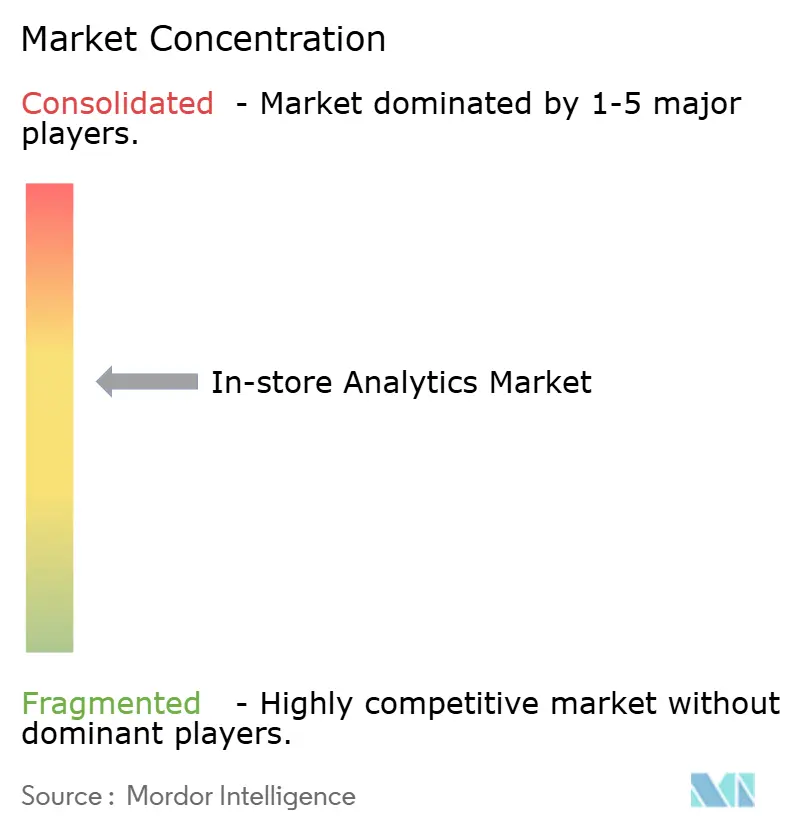
| Market Concentration | Medium |
Major Players *Disclaimer: Major Players sorted in no particular order Image © Mordor Intelligence. Reuse requires attribution under CC BY 4.0. | |
In-store Analytics Market Analysis by Mordor Intelligence
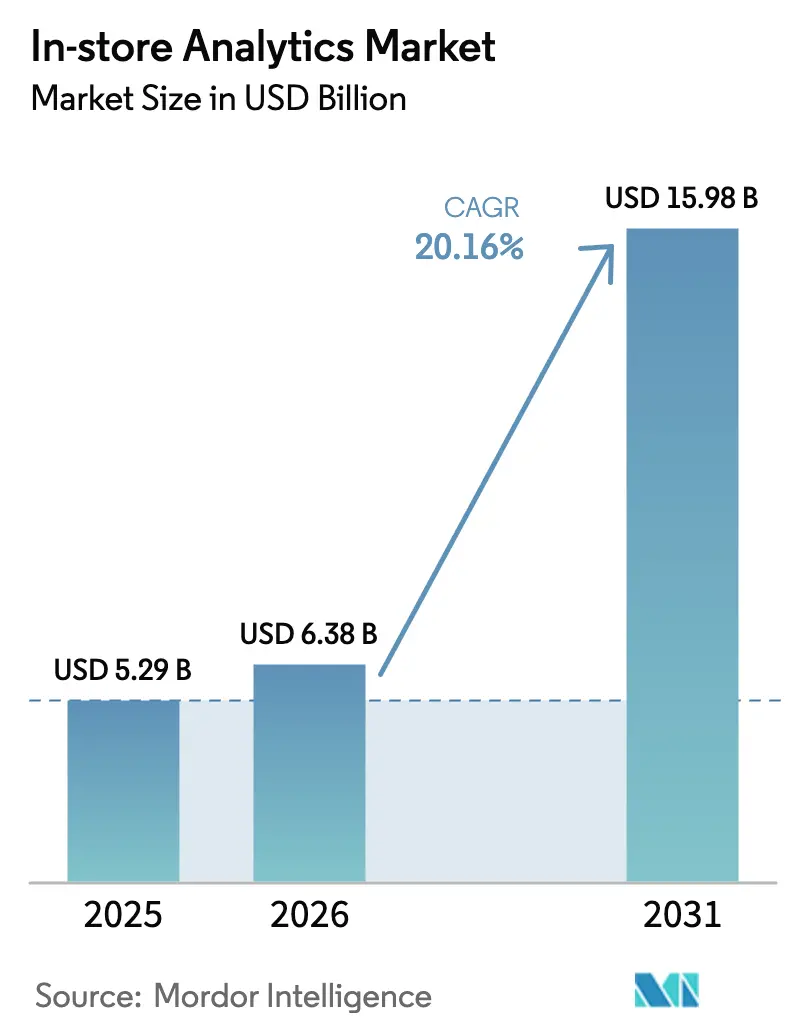
The in-store analytics market size is expected to increase from USD 5.29 billion in 2025 to USD 6.38 billion in 2026 and reach USD 15.98 billion by 2031, growing at a CAGR of 20.16% over 2026-2031. The widening adoption of edge-enabled cameras, sensor meshes, and on-device AI chips is accelerating capital reallocation away from legacy point-of-sale systems toward real-time shopper-intelligence stacks.[1]Google Cloud, “Vision AI for Retail,” cloud.google.com Retailers see a direct revenue lift from dynamic pricing engines that recalibrate shelf labels within seconds, delivering basket-size gains of 5%-22% and providing the investment rationale for denser sensor deployments. Cloud platforms now bundle retail-specific computer vision APIs, compressing time-to-insight and enabling regional chains to match the analytical sophistication of national competitors. Meanwhile, compliance-ready governance frameworks are reducing regulatory friction, allowing European grocers to meet GDPR Article 22 audit mandates while preserving hybrid edge-cloud flexibility.
Key Report Takeaways
- By component, software accounted for 70.01% of 2025 revenue, while services are advancing at 28.40% CAGR as retailers outsource implementation to close skills gaps.
- By deployment, cloud deployments captured 64.83% of 2025 revenue and are growing at 29.70% CAGR because hyperscalers embed retail-specific AI models into infrastructure offerings.
- By organization size, large enterprises held 62.11% of 2025 revenue, yet small and medium enterprises are expanding at 31.20% CAGR on the back of low-code SaaS bundles.
- By application, customer management led applications with 36.86% 2025 revenue, whereas marketing management is the fastest growing use case at 30.01% CAGR through 2031.
- By geography, North America commanded 38.32% of 2025 revenue, while Asia-Pacific is registering the quickest regional expansion at 27.40% CAGR.
Note: Market size and forecast figures in this report are generated using Mordor Intelligence’s proprietary estimation framework, updated with the latest available data and insights as of January 2026.
Market Trends and Insights
Drivers Impact Analysis of In-store Analytics Market*
| Driver | (~) % Impact on CAGR Forecast | Geographic Relevance | Impact Timeline |
|---|---|---|---|
| Cloud-Native & Edge-Enabled Deployments | +4.2% | Global, with North America and Europe leading adoption | Medium term (2-4 years) |
| Need for Better Customer Service & Enhanced Shopping Experience | +3.8% | Global, particularly strong in North America and the Asia-Pacific | Short term (≤ 2 years) |
| Real-Time Computer Vision & Video Analytics Breakthroughs | +4.5% | Global, with APAC manufacturing hubs accelerating hardware innovation | Medium term (2-4 years) |
| Dynamic Pricing Models Driven by In-Store Data | +3.1% | North America and Europe, expanding to APAC urban centers | Short term (≤ 2 years) |
| Integration of In-Store Analytics with Retail Media Networks | +2.9% | North America core, spill-over to Europe and select APAC markets | Medium term (2-4 years) |
| On-Device AI Chips Powering Battery-Free Shelf Cameras | +2.4% | Global, with early pilots in North America and Japan | Long term (≥ 4 years) |
| Source: Mordor Intelligence | |||
Cloud-Native and Edge-Enabled Deployments
Hyperscalers now expose shelf-compliance and planogram-verification APIs via simple REST calls, eliminating the need for in-house model training and shrinking deployment cycles from months to days. AWS Edge Manager for Retail supports over-the-air camera firmware updates, synchronizing inference results with centralized data lakes in near real time. Intel-optimized OpenVINO appliances process up to 30 video streams at <75 watts, balancing performance and energy consumption for European supermarkets.[2]Intel, “OpenVINO Deployments in European Supermarkets,” intel.com Serverless compute, lightweight containers, and 5G backhaul collectively democratize advanced analytics once reserved for Fortune 500 retailers. As retailers standardize on hybrid stacks, vendors able to orchestrate seamless edge-to-cloud workflows win a disproportionate share.
Need for Better Customer Service and Enhanced Shopping Experience
Automated shelf-gap detection reduces out-of-stock incidents by 30%, freeing associates to focus on high-value engagement that lifts comparable-store sales by 4%.[3]Zebra Technologies, “SmartSight Platform Results,” zebra.com Occupancy heatmaps integrated with queue-management algorithms trigger staff redeployment when wait times exceed three minutes, improving checkout throughput in more than 2,000 Japanese convenience stores. Video analytics also power hyper-personalized interactions; pilots dispatch associates armed with loyalty data whenever dwell time in front of a category exceeds pre-set thresholds. These use cases satisfy 68% of consumers who say knowledgeable staff is the primary reason to visit physical stores over e-commerce. By merging digital signals with in-store context, retailers elevate service without swelling payroll costs.
Real-Time Computer Vision and Video Analytics Breakthroughs
Transformer-based vision models enable sub-100 millisecond inference on edge devices, unlocking real-time decisions that shape staffing and merchandising. A single Jetson AGX Orin now tracks multiple objects across 16 cameras, quadrupling coverage compared with the previous generation. Synthetic data fused with federated learning trims demographic bias by 23%, strengthening compliance with emerging fairness mandates. Shrinking form factors remove HVAC dependence, easing retrofits in older stores. Together these breakthroughs reposition computer vision from a back-office audit tool to a frontline decision engine.
Dynamic Pricing Models Driven by In-Store Data
Electronic shelf labels linked to real-time demand let grocers adjust prices up to 12 times daily, lifting revenue by 5%-22% in multi-country pilots. SAP’s optimization module ingests inventory velocity detected by shelf cameras and recalibrates markdown cadences, already live across 150 retailers. French regulators now require electronic price changes to be logged and auditable for 12 months, setting a compliance template for the wider European Union. Structured guardrails therefore coexist with data-driven price agility, allowing scale rollouts without sparking consumer backlash.
Restraints Impact Analysis of In-store Analytics Market*
| Restraint | (~) % Impact on CAGR Forecast | Geographic Relevance | Impact Timeline |
|---|---|---|---|
| Lack of Personnel Skills to Operationalize Insights | -2.7% | Global, particularly acute in emerging markets and SME segments | Medium term (2-4 years) |
| High Up-Front Sensor & Camera Retrofit Costs | -3.2% | Global, with stronger impact on independent retailers and regional chains | Short term (≤ 2 years) |
| Retailer Data-Sovereignty Concerns Over Cloud Storage | -2.1% | Europe and Asia-Pacific, driven by GDPR and localization mandates | Medium term (2-4 years) |
| Rising Energy Costs of GPU-Edge Appliances | -1.8% | Europe and select Asia-Pacific markets with high electricity tariffs | Short term (≤ 2 years) |
| Source: Mordor Intelligence | |||
Lack of Personnel Skills to Operationalize Insights
Firms face AI-skills gaps, with retail analytics positions staying open 50% longer than general IT roles, hampering time-to-value for projects. Mid-market chains lacking in-house data scientists often struggle to translate terabytes of video data into merchandising actions. Vendors counter by embedding automated insight generation that surfaces prioritized recommendations without manual querying. Yet these tools still assume a baseline level of statistical competence, widening the performance gap between digital leaders and laggards.
High Up-Front Sensor and Camera Retrofit Costs
North American retailers, 64% of whom were surveyed by Deloitte, cited the cost of a single retrofit as a significant hurdle. The retrofit process, which involves the installation of ceiling cameras, GPU edge servers, and upgraded networks, can cost between USD 50,000 and 150,000 per store. This substantial investment poses a challenge for many retailers, particularly smaller businesses. However, sensor-as-a-service models are emerging as a viable alternative to mitigate these costs. These models bundle essential components, including hardware, software, and ongoing support, into monthly subscription fees, reducing the initial financial outlay by as much as 80%. Despite this cost-saving approach, stores with annual revenues under USD 5 million often face payback periods of several years. This extended timeline for return on investment is creating a growing divide within the retail market. Larger retail chains, with their greater financial resources, can efficiently amortize these investments over time. In contrast, independent stores, constrained by limited budgets, are either delaying the adoption of these technologies or opting for less accurate, low-fidelity counters as a compromise.
*Our forecasts treat driver/restraint impacts as directional, not additive. The impact forecasts reflect baseline growth, mix effects, and variable interactions.
In-store Analytics Market Segment Analysis
By Component:
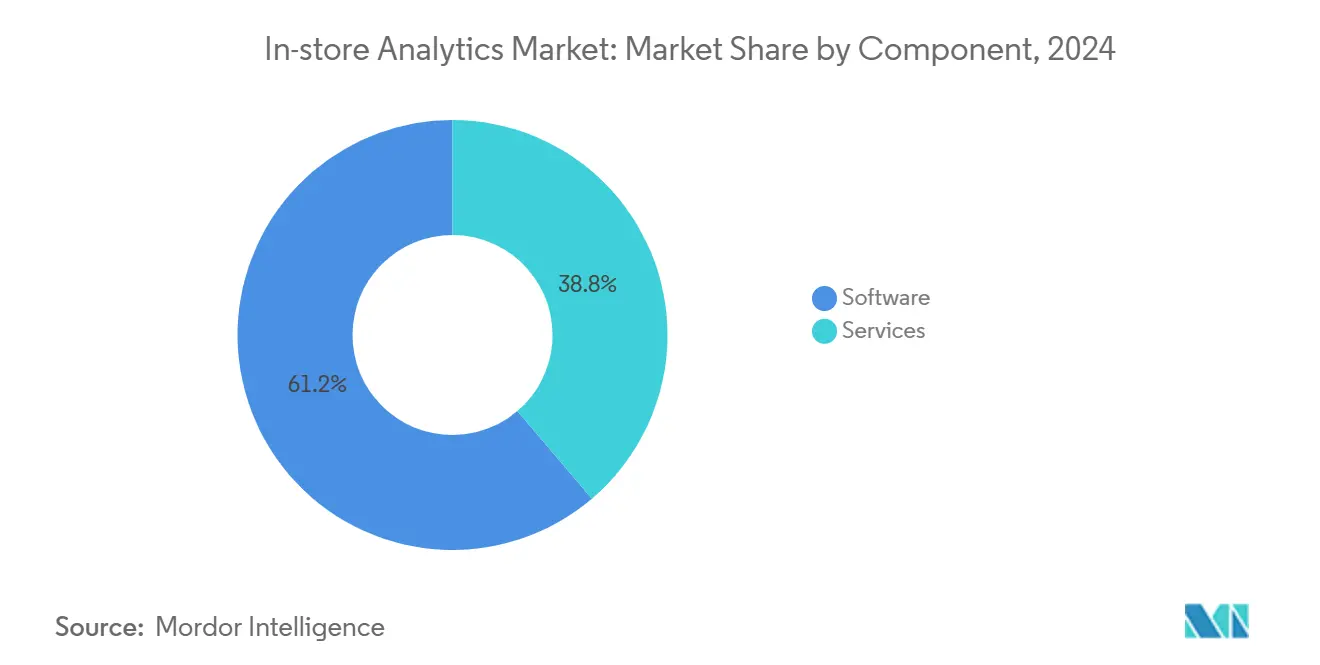
Services Surge as Retailers Seek Turnkey DeploymentsServices are expanding at 28.40% CAGR through 2031, outpacing the overall in-store analytics market growth because retailers outsource integration and managed analytics to close internal talent shortages. Software retained 70.01% of 2025 revenue as SaaS platforms delivered vision APIs and dashboards via subscription, yet complexity in marrying these tools with ERP, point-of-sale, and supply-chain systems drives demand for professional services. Capgemini expanded retail-analytics headcount by 35% in 2025, reflecting rising turnkey project volumes. IBM consulting engagements incorporating watsonx governance averaged USD 2.5 million per client, underscoring the premium for compliance-ready architectures.
Software itself is bifurcating between horizontal platforms and vertical solutions optimized for specific store formats. Oracle’s Retail AI Foundation embeds demand-forecasting and shrink-detection models directly into its cloud ERP, cutting deployment timelines from six months to six weeks for existing customers. Vendors offering vendor-agnostic integration layers enable retailers to combine best-of-breed components while averting lock-in, sustaining double-digit services revenue growth.


By Deployment:
Hybrid Architectures Blend Cloud Scale with Edge LatencyCloud deployments commanded 64.83% of 2025 revenue and are growing at 29.70% CAGR as hyperscalers insert retail-specific AI models into infrastructure offerings, streamlining updates and central analytics. Yet latency-sensitive use cases like autonomous checkout or real-time theft detection still require on-premises inference engines. The pragmatic outcome is a hybrid topology where edge appliances process video locally to stay within sub-50 millisecond targets, while aggregated insights feed cloud data lakes for machine-learning retraining. AWS Outposts for Retail co-locate rack-mounted AWS servers in store backrooms, maintaining residency for sensitive biometric data while exposing the broader AWS service catalog.
Microsoft Azure’s collaboration with Trax preprocesses shelf images on associate smartphones before cloud validation, cutting egress fees by 60% and cycling planogram feedback in under 90 seconds. Anticipated passage of the EU AI Act by 2027 amplifies demand for audit logs and region-resident infrastructure, cementing hybrid as the default architecture in regulated markets.
By Organization Size:
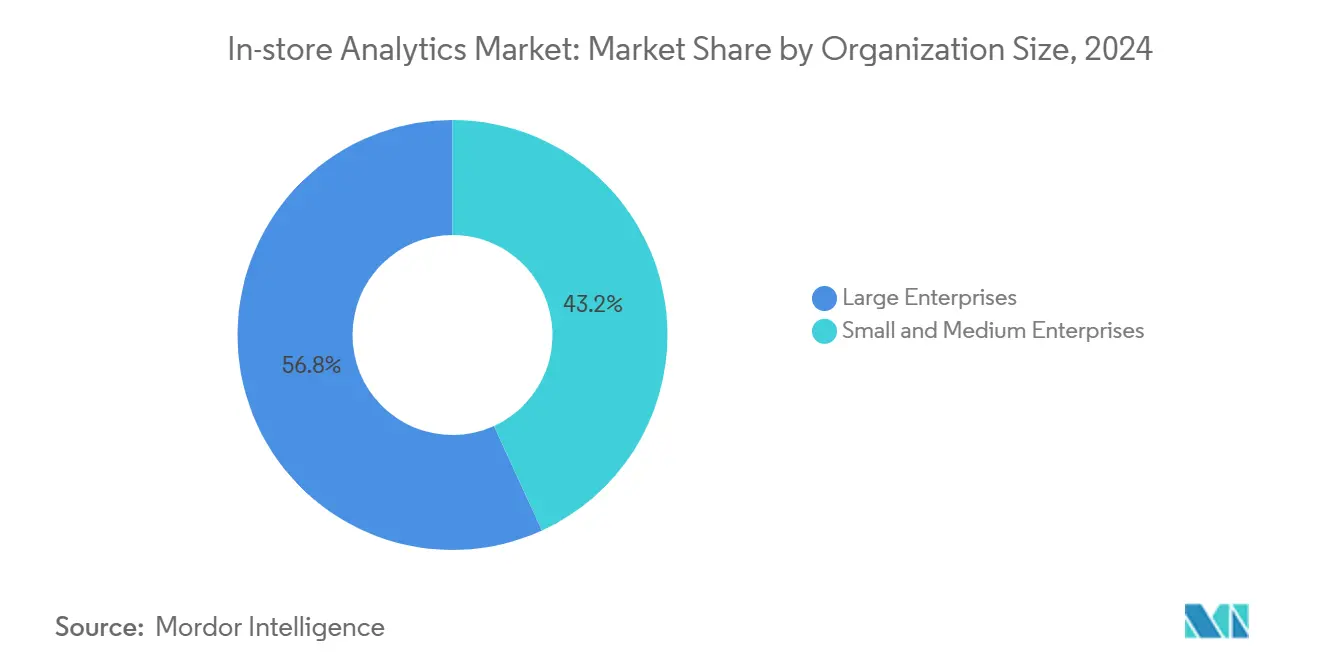
SMEs Accelerate Adoption via Modular SaaSSmall and medium enterprises (SMEs) are expanding at 31.20% CAGR, the swiftest pace across size bands, as modular SaaS platforms slash entry barriers. Dor Technologies offers door-mounted foot-traffic sensors at USD 99 per month with zero upfront fees, enabling more than 3,000 independents to embrace basic analytics during 2025. Cloud4Wi infers dwell time from anonymized Wi-Fi pings and now covers 5,000 locations across Europe and Latin America. These plug-and-play models democratize data insights but still leave SMEs juggling interpretation, leading vendors to embed prescriptive recommendations that automate translation from metric to action.
Large enterprises, which held 62.11% of 2025 revenue, continue to dominate in absolute spending because they can fund multi-year rollouts and negotiate enterprise license agreements. However, as federated-learning frameworks and low-code dashboards mature, the adoption gap between large chains and SMEs is narrowing, broadening the in-store analytics market addressable base.
By Application:
Marketing Management Gains as Retail Media ScalesCustomer management led 2025 revenue at 36.86%, encompassing loyalty optimization and queue management that elevate shopper satisfaction. Marketing management is the fastest growing segment at 30.01% CAGR through 2031, fueled by links between in-store analytics and booming retail media networks that price digital end-caps based on real-time foot traffic. Store-operations management remains foundational as labor-scheduling and shrink-prevention gains deliver quick ROI, particularly for grocers with thin margins. Merchandise management gains traction in fashion and electronics where rapid product cycles reward visual accuracy.
Regulatory scrutiny around AI-driven pricing propels risk and compliance management software uptake. Johnson Controls’ Sensormatic module now logs every automated price change for 12 months to meet French audit rules, signaling a broader trend toward embedded compliance. Unified video pipelines that support multiple applications simultaneously improve capital efficiency and accelerate ROI across departmental budgets.
Geography Analysis
North America and APAC In-store Analytics Market
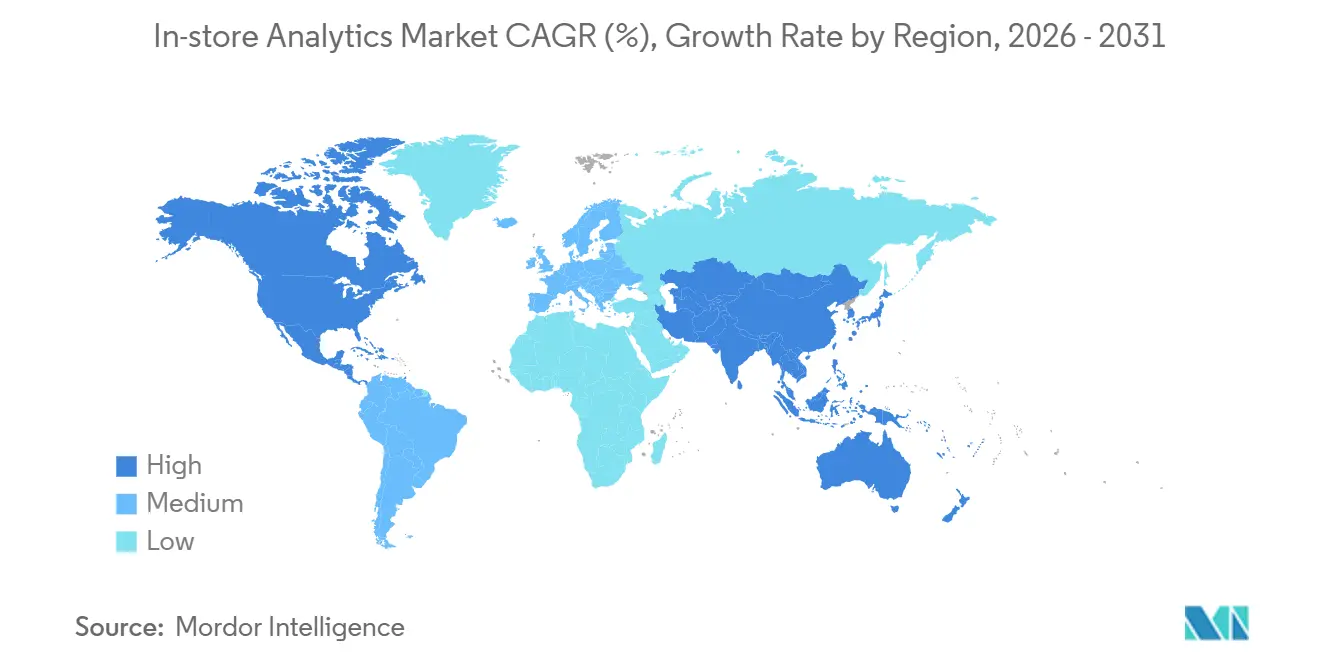
North America contributed 38.32% of 2025 revenue as mature omnichannel infrastructures and high labor costs justify automation investments. Pilot deployments of autonomous-checkout models by chains like Amazon Fresh showcase near-term demand for sub-second inference, sustaining leadership in the in-store analytics market. Asia-Pacific is the fastest expanding region at 27.40% CAGR, underpinned by China’s social-commerce fusion, India’s Unified Payments Interface enabling digital-first store formats, and Japan’s aging workforce driving robotics investment. These factors compound to accelerate the in-store analytics market size across APAC urban centers despite heterogeneous infrastructure baselines.
Europe and South America In-store Analytics Market
Europe faces GDPR-linked compliance overhead that initially slows adoption, yet premium grocers in Germany and the United Kingdom now deploy computer vision to curb food waste and meet ESG reporting mandates. Electronic shelf labels tied to dynamic pricing have already become mainstream among French supermarkets following the Directorate General’s 2025 guidelines, illustrating how clear rules can unlock pent-up demand. South America shows growing uptake in modern-trade formats, while currency volatility and capital constraints limit pace among domestic chains.
MEA In-store Analytics Market
Middle Eastern smart-city initiatives in Dubai and Riyadh mandate sensor-ready retail infrastructure, enabling malls to embed analytics at construction rather than retrofit stages. African adoption remains embryonic beyond South Africa and Nigeria due to power instability and bandwidth costs, though franchisees of global quick-service brands pilot low-power occupancy sensors to optimize staffing. Vendors tailoring deployment to regional regulatory and infrastructure realities will capture outsize share as emerging markets mature.

Regulatory Landscape
Across major markets, in-store analytics deployments are shaped by privacy, biometric, and automated decision-making rules that affect video analytics, shopper tracking, and dynamic pricing workflows. In the European Union, the AI Act (Regulation (EU) 2024/1689) adds retail-relevant transparency requirements (including Article 50 disclosures) for certain consumer-facing AI uses in physical spaces, while GDPR obligations such as DPIAs for large-scale video monitoring in publicly accessible areas continue to influence solution design and vendor selection. These requirements are reinforcing governance features such as audit trails, technical documentation, and edge processing to reduce exposure of personal data.
In the United Kingdom, the ICO enforces UK GDPR principles including "data protection by design and by default" (Article 25), pushing retailers and vendors toward minimization, privacy-preserving analytics, and stronger security controls such as encryption. The UK Data (Use and Access) Act 2025 (Royal Assent: 19 June 2025) updates aspects of the national data framework and sits alongside procurement expectations around data protection compliance for public-sector buyers. In the United States, CCPA/CPRA obligations around data "selling" or "sharing" for cross-context behavioral advertising require notice and opt-out mechanisms, influencing how in-store identifiers and analytics outputs are activated for marketing use cases.
Competitive Landscape
In the in-store analytics market, the top five vendors command a combined revenue share of approximately 35%-40% for 2025, highlighting a significant opportunity for niche specialists. Major enterprise software players, including SAP, Oracle, and IBM, integrate analytics into their ERP and CRM suites. By doing so, they capitalize on their established user bases instead of directly competing on standalone analytics features. While this strategy pressures pricing for dedicated analytics firms, it simultaneously introduces integration challenges, creating opportunities for consultancies and systems integrators. Startups carve out their niches: Trax specializes in CPG planogram compliance, RetailNext focuses on omnichannel journey analytics, and Scanalytics champions privacy-preserving floor sensors.
Technology stands as the primary competitive differentiator. NVIDIA’s Metropolis partner program boasts over 200 ISVs, with their applications pre-validated on Jetson hardware. This strategy not only solidifies NVIDIA's ecosystem but also increases switching costs for retailers. A surge in patent filings related to privacy-preserving on-device anonymization hints at impending regulatory scrutiny. Venture capital is flowing into companies like Axelera AI, which are pioneering neuromorphic chips. Their focus is on energy-efficient, sub-watt shelf cameras that operate without batteries. As major players seek to bolster their portfolios and accelerate market entry, M&A activity is set to escalate. This trend is tightening the concentration of the in-store analytics market, yet still leaves space for innovative newcomers focusing on cost, power, and compliance enhancements.
Regional dynamics also play a crucial role in shaping the in-store analytics market. North America leads in adoption due to its advanced retail infrastructure and high investment in technology. Europe follows closely, driven by stringent data privacy regulations and a focus on sustainability. Meanwhile, the Asia-Pacific region is witnessing rapid growth, fueled by expanding retail sectors in countries like China and India. These regional variations create diverse opportunities for vendors to tailor their offerings and address specific market needs effectively.
In-store Analytics Industry Leaders
Capgemini SE
RetailNext Inc.
Happiest Minds Technologies Ltd.
Capillary Technologies Global Pte. Ltd.
Thinkinside SRL
- *Disclaimer: Major Players sorted in no particular order
In-store Analytics Market Companies Covered in this Report
- Capgemini SE
- RetailNext Inc.
- Happiest Minds Technologies Ltd.
- Capillary Technologies Global Pte. Ltd.
- Thinkinside SRL
- Trax Technology Solutions Pte. Ltd.
- Cloud4Wi Inc.
- Amoobi SA
- Hoxton Analytics Ltd.
- Motionloft Inc.
- SAP SE
- Oracle Corporation
- IBM Corporation
- Cisco Systems Inc.
- Zebra Technologies Corporation
- Johnson Controls International plc (Sensormatic Solutions)
- Scanalytics Inc.
- Dor Technologies Inc.
- ShopperTrak (Part of Sensormatic)
- Pathr.ai Inc.

Market Opportunities and Future Outlook
Large-scale "connected store" programs are expanding the addressable market from isolated traffic counting toward unified execution platforms that combine electronic shelf labels, shelf monitoring, and workflow automation. Examples in 2026 include Carrefour signing an industrial partnership with Vusion to deploy smart store technology (ESLs, smart rails, and AI-driven cameras) across French hypermarkets and supermarkets, and Walmart de Mexico expanding Vusion EdgeSense connected-store deployment across Walmart Express stores, with a stated plan to extend to larger formats. This momentum creates whitespace for integration layers that unify sensor feeds with ERP/POS and compliance-ready logging, particularly where dynamic pricing and electronic price changes require auditable histories.
Retailers are also adopting new data-capture modalities that expand use cases and vendor opportunities beyond fixed cameras, including robotics and "store execution" copilots. In June 2026, B&R Stores rolled out Simbe Robotics Tally inventory robots in select Nebraska locations to capture shelf-level availability, pricing, and placement data, supporting more frequent on-shelf monitoring without dense camera retrofits. In parallel, Hanshow launched xPilot in collaboration with Microsoft (NRF 2026 APAC) as an AI-powered execution assistant that connects in-store IoT data with digital twin approaches, creating demand for vendors that can normalize data, orchestrate tasks, and operationalize insights for associates. Privacy-first behavioral analytics is also shaping buying decisions, highlighted by WHSmiths multi-year partnership with VisionR announced in May 2026 for computer vision and real-time analytics across travel retail locations.
Recent Industry Developments in In-store Analytics Market
- April 2026: Capgemini launched Frontline AI for Retail, a voice-first assistant aimed at unifying in-store data and delivering real-time guidance to store employees. The update points to a shift from dashboards toward frontline, conversational interfaces as retailers look to operationalize insights despite persistent analytics skills gaps.
- November 2025: RetailNext partnered with Seed Group (The Private Office of Sheikh Saeed bin Ahmed Al Maktoum) to expand retail analytics and AI-powered insights across Dubai and the UAE. The agreement strengthens channel access and localization support in a market where smart-city investments are accelerating sensor-ready retail infrastructure.
- May 2024: RetailNext partnered with pass_by to integrate geospatial insights with RetailNext Aurora sensors to forecast store performance up to 90 days in advance. By combining external mobility signals with in-store sensing, the offering moves beyond measurement toward forward planning for staffing, merchandising, and site-level optimization.


In-store Analytics Market Report Scope and Research Methodology
Market Definition and Coverage
This market covers software and services that help retailers measure what shoppers do inside physical stores, then convert those observations into actionable insights for merchandising, store operations, and customer engagement.
Scope exclusions: We exclude pure e-commerce analytics, general enterprise BI tools that are not designed for in-store use, and non-analytics hardware sold without an analytics layer.
Segments Covered in This Report
- By Component
- Software
- Services
- By Deployment
- Cloud
- On-Premises
- By Organization Size
- Large Enterprises
- Small and Medium Enterprises
- By Application
- Customer Management
- Risk and Compliance Management
- Store Operations Management
- Merchandise Management
- Other Applications
- By Geography
- North America
- United States
- Canada
- Mexico
- South America
- Brazil
- Argentina
- Rest of South America
- Europe
- Germany
- United Kingdom
- France
- Italy
- Spain
- Rest of Europe
- Asia Pacific
- China
- Japan
- South Korea
- India
- Australia
- New Zealand
- Rest of Asia-Pacific
- Middle East and Africa
- Middle East
- United Arab Emirates
- Saudi Arabia
- Turkey
- Rest of Middle East
- Africa
- South Africa
- Nigeria
- Kenya
- Rest of Africa
- Middle East
- North America
Data Sources, Market Sizing, and Validation
Desk Research
Desk work starts by building a clearer view of the demand environment for store digitization and measurement. We rely on public references such as US Census retail trade releases, Eurostat retail turnover and ICT usage tables, World Bank macro indicators, OECD digital economy publications, and guidance from privacy regulators including the European Data Protection Board on consent and in-store tracking practices.
We then cross-check adoption signals and vendor direction using sources such as annual reports, earnings call transcripts, product documentation, reputable press coverage, and retail and analytics association publications. For additional validation, we also use paid subscriptions for company financials and intelligence, patent lookups, and news and financials to track launches, pricing cues, and major contract wins. These desk sources are illustrative, and we use additional public references to fill gaps and confirm assumptions where needed.
Primary Interviews and Surveys
Primary input is used to pressure-test what we see in public data, especially for typical deployment mixes, budget priorities, and how retailers define an in-store analytics project versus adjacent IT spend. We speak with solution providers, channel partners, and retail users across APAC, EMEA, and the Americas. When privacy rules, pricing, or store expansion plans shift, we re-contact the relevant experts to update the assumptions behind the market model.
Distribution of primary research fieldwork respondents
| Company type | Respondent position | Region |
|---|---|---|
| Top tier: 31% | CXOs: 17% | APAC: 48% |
| Mid tier: 49% | Functional/Unit leaders: 38% | EMEA: 31% |
| Smaller Players: 20% | Managers: 45% | Americas: 21% |
Market-Sizing & Forecasting
Sizing is built using a top-down structure where retailer store footprints and technology adoption indicators are translated into an addressable spend pool for in-store measurement and analytics. We then corroborate the results with selective bottom-up approximations, such as sampled vendor revenue splits, channel checks, and a simple ASP times volume logic for common deployment patterns, before adjusting the totals.
Inputs are selected to be practical to validate. These include the number of modern retail stores and new store openings, cloud versus on-premises preference for analytics workloads, typical camera and sensor penetration tied to store format, spend intensity by large retailers versus SMEs, and the pace of privacy and consent requirements that can slow rollouts or shift spending toward edge processing.
Forecasts are run using scenario analysis supported by a light multivariate regression on leading indicators such as retail sales growth, store expansion, and the direction of IT spending. We then review the curve with interview feedback so the trajectory stays realistic across retailer segments. Where bottom-up data is missing for smaller markets, we use region-level benchmarks and adoption ranges, and then revisit assumptions with additional interviews until the gap narrows.
Data Validation & Update Cycle
Outputs are checked against independent signals such as retail digitization spending, store count trends, and reported growth patterns for analytics subscriptions. Variance checks are run across regions and deployment types, and outliers are investigated by reviewing the underlying driver inputs. If needed, we re-contact sources to confirm what changed.
Before sign-off, the work goes through multiple analyst review steps to ensure arithmetic, unit consistency, and year-to-year movements make sense. Reports are refreshed annually, with interim updates when major events occur, and a final pre-delivery review is completed so clients receive the most current view available at that time.
Mordor Intelligence's In Store Analytics Market Sizing Compared With Other Published Estimates
Published market sizes for in-store analytics can differ substantially because studies do not always count the same spending bucket, and the base year, currency timing, and assumed price path are often handled differently.
Hardware-only sales of cameras, sensors, and networking gear sits outside Mordor Intelligence's scope, which is one reason some broader figures land higher when they bundle in non-analytics infrastructure and wider smart retail spending. Another common gap comes from how cloud subscriptions are annualized, whether professional services are counted fully, and how quickly adoption is assumed to rise across smaller retailers, where budgets and rollout speed vary by region.
Benchmark comparison
| Source | Market Size | Gaps in Research Methodology |
|---|---|---|
| Mordor Intelligence | USD 6.38 B (2026) | |
| Global Consultancy A | USD 5.06 B (2024) | Uses an earlier base year and may treat parts of in-store analytics as a subset of broader retail analytics, which can understate newer camera and sensor led analytics subscriptions that scaled after 2024. |
| Industry Publisher B | USD 1.53 B (2024) | Appears to apply a narrower definition and may exclude services and several application areas, and the smaller base value suggests more conservative inclusion of enterprise deployments and multi-site rollouts. |
Taken together, the spread is mainly explained by scope bundling and base-year timing, not by one single growth assumption. By tying the model to store footprint signals, adoption ranges, and a transparent subscription and services treatment, our number is easier to reconcile with real buying patterns and can be updated as new inputs arrive.


Key Questions Answered in the Report
What is the current value of the in-store analytics market?
The market stands at USD 6.38 billion in 2026 and is on track to reach USD 15.98 billion by 2031.
How fast is the in-store analytics market expected to grow?
It is projected to clock a 20.16% CAGR during the 2026-2031 forecast window.
Which component segment is expanding the quickest?
Services lead in growth, climbing at 28.40% CAGR as retailers seek turnkey deployments.
Which region is showing the highest growth momentum?
Asia-Pacific is advancing at 27.40% CAGR thanks to social-commerce integration and digital-first store formats.
Page last updated on:





