
Hyperkalemia Treatment Market Size and Share
Market Overview
| Study Period | 2020 - 2031 |
|---|---|
| Forecast Data Period | 2026 - 2031 |
| Historical Data Period | 2020 - 2024 |
| Growth Rate | 16.47 % |
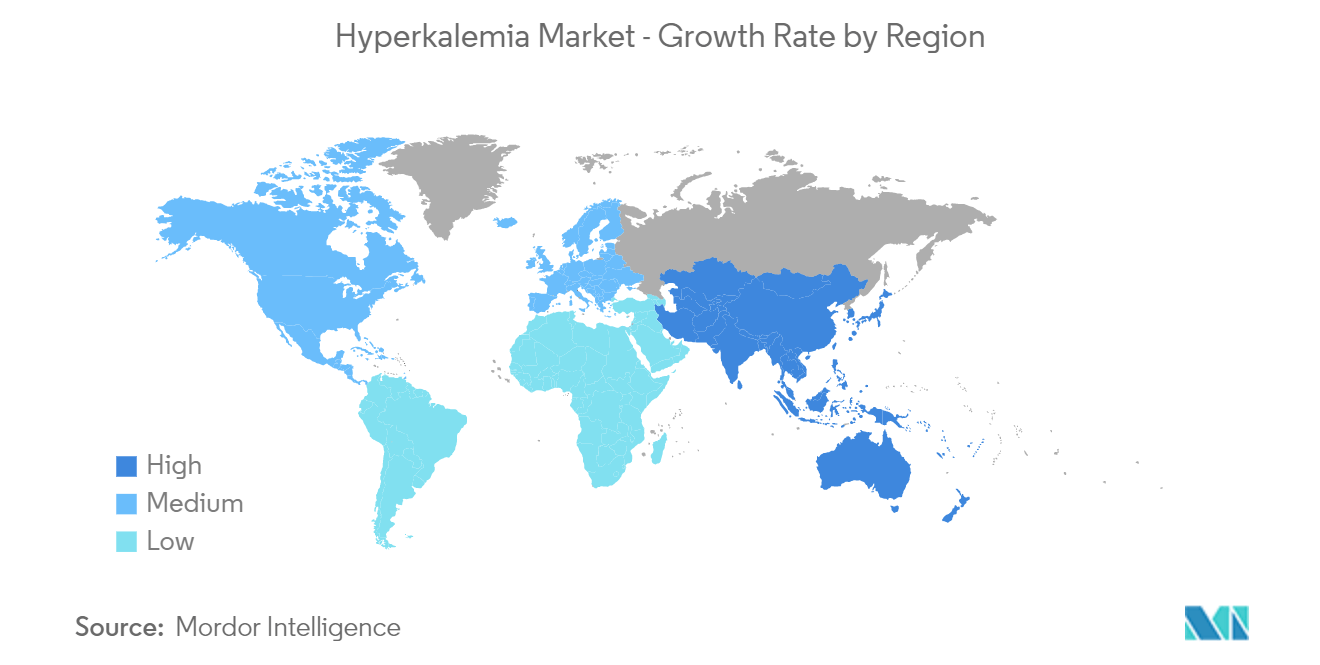
| Fastest Growing Market | Asia-Pacific |
| Largest Market | North America |
| Market Concentration | Medium |
Major Players *Disclaimer: Major Players sorted in no particular order Image © Mordor Intelligence. Reuse requires attribution under CC BY 4.0. | |
Hyperkalemia Treatment Market Analysis by Mordor Intelligence
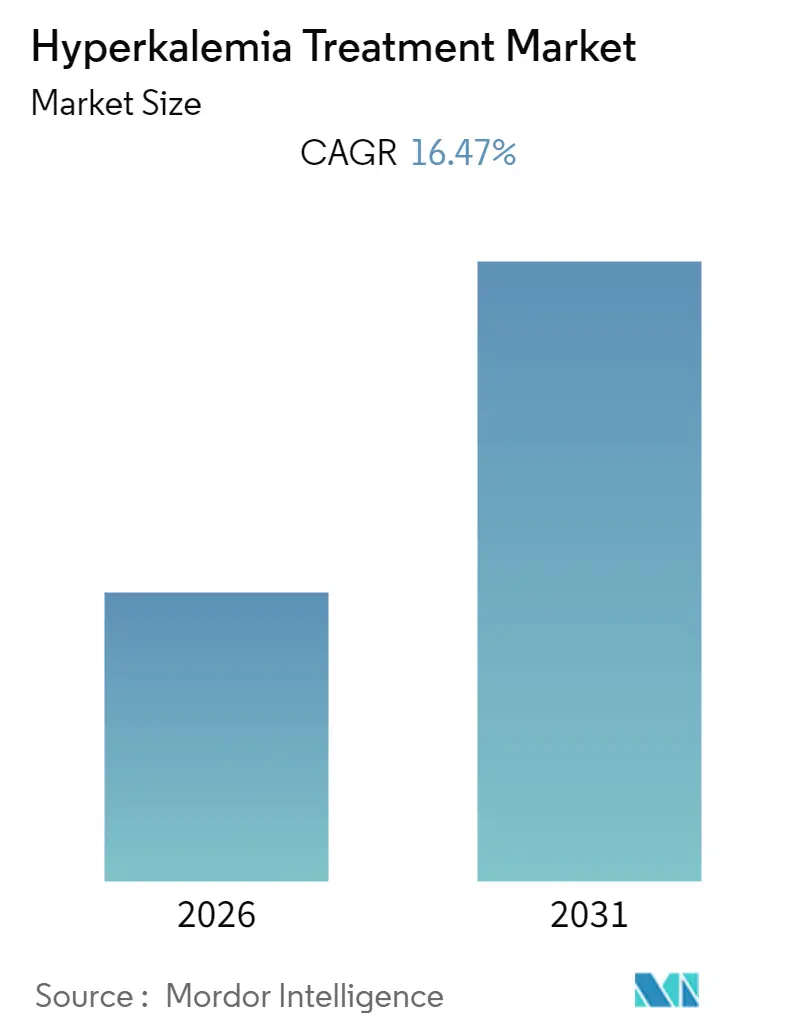
The Hyperkalemia Treatment Market size is expected to register a CAGR of 16.47% during the forecast period (2026-2031).
The Hyperkalemia Treatment Market is expected to register a CAGR of 16.79% during the forecast period.
The COVID-19 pandemic impacted the market significantly during the pandemic phase. Since the beginning of the pandemic, there have been numerous discussions regarding the impact of COVID-19 on several areas of human health, and hyperkalemia is no exception. Several scientists conducted observational studies to find the correlation between hyperkalemia and COVID-19. For instance, according to an article published by PubMed in August 2021, there have been numerous reports of electrolyte issues, notably potassium imbalances, as frequent clinical symptoms of COVID-19. In this research, scientists have explored how SARS-CoV-2 may alter potassium homeostasis by reducing epithelial sodium channels' activity (ENaC) and explained the prevalence of hypokalemia. and concluded that there is a correlation between COVID-19 and hyperkalemia. Thus, the use of drugs to treat hyperkalemia increased during the pandemic. However, as the pandemic has subsided currently, the market is expected to have stable growth during the forecast period of the study.
Factors such as the increasing prevalence of hyperkalemia, the rising focus on research and development, and an increasing number of strategic alliances among major market players are anticipated to drive the market's growth. For instance, the article published by Healthline in March 2022 stated that high potassium levels, or hyperkalemia (HK), affect 40% to 50% of people with chronic kidney disease (CKD) globally, and nearly 40% of people with congestive heart failure (CHF) develop high potassium levels.
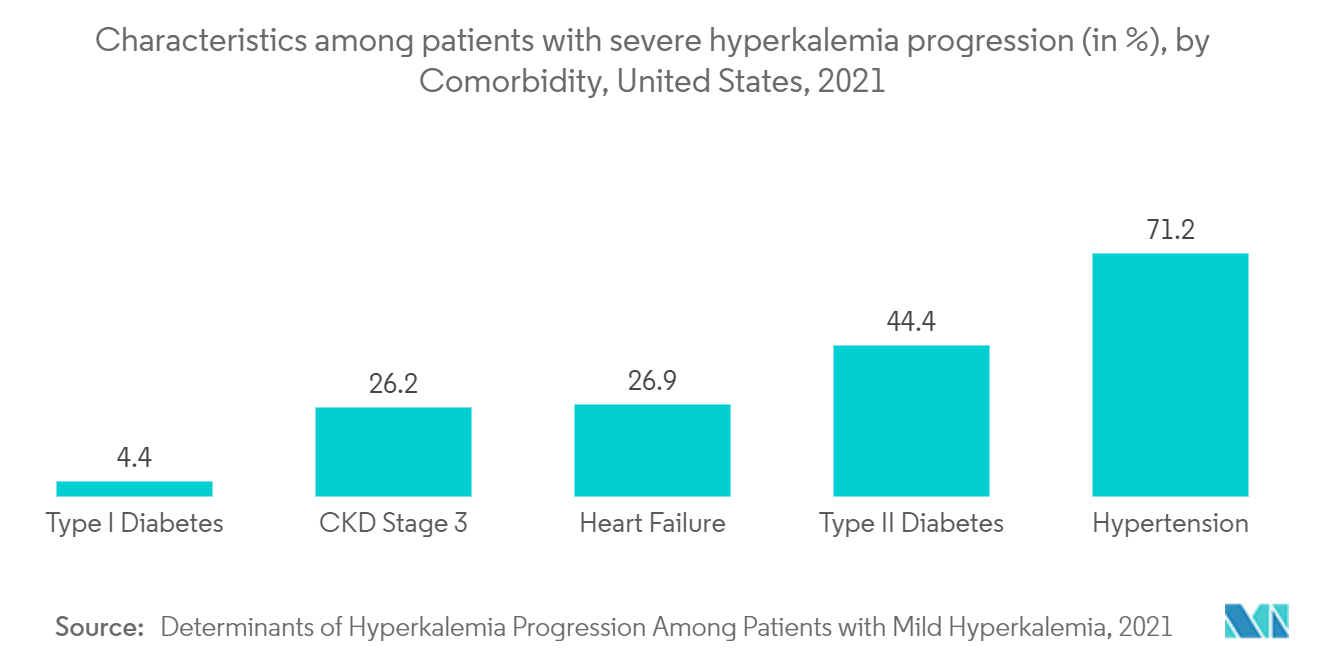
In addition, another article published by PubMed Central in October 2021 stated that when the research was conducted to characterize the progression of HK and identify the risk factors for HK progression, greater rates of HK progression were observed in individuals with advanced CKD stages, while higher potassium levels were also found among heart failure, hypertension, and diabetes patients. Such disease prevalence is expected to necessitate the availability of drugs and diagnostics to the target population, contributing to the market's growth.
Therefore, owing to the above-mentioned factors, such as the increasing prevalence of hyperkalemia and the rising focus on research and development, the market studied is expected to grow over the forecast period. However, the high cost of drugs is anticipated to hinder market growth over the forecast period.
Note: Market size and forecast figures in this report are generated using Mordor Intelligence’s proprietary estimation framework, updated with the latest available data and insights as of 2026.
Global Hyperkalemia Treatment Market Trends and Insights
Chronic Hyperkalemia Segment is Anticipated to Witness Significant Growth Over the Forecast Period
Heart failure (HF) and chronic kidney disease (CKD) patients frequently have chronic hyperkalemia (cHK), a significant medical condition that can have detrimental effects and call for cautious management by cardiologists or nephrologists. Therefore, owing to the severity of the disease, the cHK segment is anticipated to witness growth over the forecast period.
According to the data updated by the National Kidney Foundation in 2022, it was shown that when HK develops abruptly and potassium levels become extremely high, patients can experience chest pain, nausea, vomiting, shortness of breath, and heart palpitations. Also, severe or chronic hyperkalemia can be a life-threatening condition that necessitates urgent medical attention for the patient's survival. Thus, the seriousness of the disease among the target population is expected to fuel the demand for drugs available for treatment, which is anticipated to drive market growth.
Furthermore, the research article published by PubMed in June 2021 mentioned that when a cohort study of 1,499 patients with cHK and CKD, heart failure, or diabetes mellitus was conducted with a 36-month follow-up,, the annual healthcare cost per patient with cHK was calculated to be double that of mild hyperkalemia. Hence, the burden of the condition requires more targeted drugs or therapies for treatment, which is further expected to drive segment growth.
As a result of factors such as the high prevalence of hyperkalemia, the segment is expected to grow during the analysis period.


North America is Expected to Hold a Significant Share in the Market Over the Forecast Period
North America is anticipated to witness growth over the forecast period and have a significant market share. Among other countries in the region, the United States is leading the market due to factors such as an increase in healthcare expenditure, increasing research and developments, and the rising prevalence of hyperkalemia.
As per the article published by PubMed in October 2021, HK contributes to nearly 800,000 emergency department visits annually in the United States, and the prevalence of the disease is growing owing to the aging population and the growth in associated comorbidities. Such a high burden of disease in the country is anticipated to demand the availability and development of advanced and effective drugs in the country. thereby driving the overall market growth in the region.
Furthermore, according to an article published by the Canadian Medical Association Journal in December 2021, in Canada, emergency department use is high among patients with CKD. Observational studies have associated hyperkalemia with increased hospital and intensive care unit admissions in Canada, and it was found that hyperkalemia accounts for 48% of all ambulatory care-sensitive conditions among patients on dialysis. Hence, the high burden of hyperkalemia in Canada is also expected to drive market growth.
In addition, the data updated by the CDC in February 2022 shows that in the United States, nearly 37 million adults are estimated to have CKD, and 40% of people who live with severely reduced kidney function are not aware of having CKD. Additionally, as per the source mentioned above, approximately 360 people begin dialysis treatment for kidney failure every 24 hours in the country. Thus, the burden of CKD is anticipated to increase the risk of hyperkalemia among the target population. This is expected to create urgent treatment options for the condition. which is further predicted to drive the market's growth over the analysis period.
Therefore, owing to the factors mentioned above, such as the increasing prevalence of hyperkalemia and chronic kidney disease, the market studied is anticipated to witness growth in the region.

Competitive Landscape
The hyperkalemia treatment market is consolidated globally and regionally and is dominated by a few players. A few key players in the market are AstraZeneca, Ardelyx, CSL Limited (Vifor Pharma Management Ltd.), Sanofi SA, and Perrigo Company PLC, among others.
Hyperkalemia Treatment Industry Leaders
Sanofi S.A.
Perrigo Company plc
CSL Limited (Vifor Pharma Management Ltd.)
AstraZeneca
Ardelyx
- *Disclaimer: Major Players sorted in no particular order


Market Opportunities and Future Outlook
Opportunities are being created as guideline and label actions shift potassium binders earlier in the treatment pathway for chronic kidney disease (CKD) and heart failure populations. In April 2026, NICE in England and Wales issued draft guidance broadening access for sodium zirconium cyclosilicate (Lokelma) for persistent hyperkalaemia in CKD stage 3b to 5 or heart failure at serum potassium levels at or above 5.5 mmol/L, supporting use beyond hospital-only settings. In parallel, March 2026 updates to the Lokelma product monograph in Canada point to ongoing regulator scrutiny of warnings and precautions, reinforcing the need for differentiated safety messaging and monitoring tools alongside therapy adoption.
Beyond label expansion, the next set of opportunities centers on additional use cases and continued pipeline progression. Acute-care management remains an active evidence area, with February 2026 randomized trial results reporting clinical benefit when patiromer was added to standard care for acute hyperkalemia in emergency department settings, supporting protocol-driven use in time-sensitive pathways. Pipeline activity also supports longer-term product diversification, including a multicenter Phase 3 study initiated in December 2024 for WS016 (NCT07251309) with a primary completion timeline extending into 2026, while legacy resins continue to be refreshed commercially, as shown by ANI Pharmaceuticals marketing an updated Kionex (sodium polystyrene sulfonate) suspension in the United States in May 2024.
Recent Industry Developments
- April 2026: AstraZeneca reported that NICE issued final draft guidance (TA1148) for Lokelma (sodium zirconium cyclosilicate) in England and Wales, broadening access for persistent hyperkalaemia. The update lowered the serum potassium initiation threshold from 6.0 mmol/L to 5.5 mmol/L and removed the requirement for specialist initiation, creating a clearer route for primary care use and faster uptake across eligible CKD and heart failure patients.
- March 2026: Health Canada authorized an updated Lokelma product monograph for AstraZeneca Canada, including changes to Warnings and Precautions related to cardiovascular impacts. The revision increases the emphasis on risk communication and monitoring in clinical adoption, which is shaping formulary discussions and prescribing confidence for chronic management.
- May 2024: ANI Pharmaceuticals began marketing an updated Kionex (sodium polystyrene sulfonate) suspension in the United States following regulatory listing. The product refresh supports continuity of supply for a long-used therapy class and affects price and access dynamics in settings where newer potassium binders are not adopted or face reimbursement constraints.


Research Methodology Framework and Report Scope
Market Definition and Coverage
This market is defined as revenues generated from drug therapies used to manage elevated blood potassium levels, covering acute stabilization and longer-term potassium reduction in routine clinical care across major healthcare settings.
Scope exclusions: We exclude diagnostic testing revenues, physician service fees, and broader renal replacement therapy revenues not directly tied to hyperkalemia drug treatment.
Segmentation Overview
- By Drug
- Sodium Zirconium Cyclosilicate
- Beta2 Agonist
- Sodium Polystyrene Sulfonate
- Other Drugs
- By Type of Disease
- Acute Hyperkalemia
- Chronic Hyperkalemia
- Geography
- North America
- United States
- Canada
- Mexico
- Europe
- Germany
- United Kingdom
- France
- Italy
- Spain
- Rest of Europe
- Asia-Pacific
- China
- Japan
- India
- Australia
- South Korea
- Rest of Asia-Pacific
- Middle East and Africa
- GCC
- South Africa
- Rest of Middle East and Africa
- South America
- Brazil
- Argentina
- Rest of South America
- North America
Data Sources, Market Sizing, and Validation
Desk Research
Desk work starts by building the disease and treatment context using public health and clinical references, and then translating that into measurable demand signals. Sources such as the CDC, NIH and NLM resources, the WHO, and FDA labeling and safety updates help anchor how hyperkalemia is treated and where newer therapies are positioned in practice.
To support the market model, we also review sources such as national health statistics releases, peer-reviewed nephrology and cardiology journals, and company filings and investor presentations for revenue mix clues, followed by checks across patent databases to understand innovation timing and possible generic pressure signals. The sources noted above are illustrative only, and many other public documents and datasets were also consulted to fill gaps, validate assumptions, and clarify data points.
Primary Interviews and Surveys
Primary work is used to pressure-test what we see in published sources, especially around therapy adoption, switching behavior, and typical pricing and discounting patterns across care settings. We speak with a mix of clinicians, pharmacy and formulary stakeholders, distributors, and industry participants across APAC, EMEA, and the Americas, so assumptions about treated patient share and utilization are not driven by a single health system view.
Distribution of primary research fieldwork respondents
| Company type | Respondent position | Region |
|---|---|---|
| Top tier: 37% | CXOs: 17% | APAC: 52% |
| Mid tier: 46% | Functional/Unit leaders: 40% | EMEA: 29% |
| Smaller Players: 17% | Managers: 43% | Americas: 19% |
Market-Sizing & Forecasting
Sizing is built using top-down logic where epidemiology and care pathways are translated into a treated demand pool, and then converted to value using region-appropriate therapy mix and pricing. In practice, hyperkalemia prevalence, the share linked to CKD and heart failure, hospitalization and emergency encounter patterns, and the split between acute and chronic treatment needs are tracked and then applied to likely treatment rates.
Once the demand pool is formed, pricing is handled through an ASP ladder by therapy class and setting (hospital use tends to follow different contracting than retail pharmacy), and then adjusted for expected net price movement over time. Bottom-up checks are then used to keep totals realistic, including supplier revenue cues from public filings, channel checks with pharmacies, and sampled volume times ASP sanity tests when data gaps appear. For forecasting, scenario analysis is used around key swing factors such as the adoption pace of newer potassium binders, guideline and label-driven utilization, and the expected rate of chronic therapy continuation, and then reviewed with experts so the forward path stays practical.
Data Validation & Update Cycle
Validation is done by triangulating the modeled totals against independent signals such as therapy uptake commentary, region-level drug availability, and observed pricing direction, and then investigating any large variances before sign-off. If an outlier appears, we re-check the treated pool logic, the currency conversion timing, and the ASP assumptions, and then re-contact relevant respondents when the reason is not clear.
A multi-step internal review is followed so the assumptions, calculations, and outputs are consistent across regions and years. Reports are refreshed annually, and interim updates are triggered when material events occur such as major label changes or policy shifts. Before delivery, a final pass is completed so clients receive the latest updated view available at that time.
Mordor Intelligence's Hyperkalemia Treatment Market Size Versus Other Published Estimates
Published market sizes for hyperkalemia treatment can vary a lot, even when the topic name looks similar, because the counted therapies, pricing basis, and time cutoffs are not always aligned. Differences also show up when one study weights acute use heavily while another model is driven mainly by chronic maintenance demand.
A common gap driver is how prices are converted and updated over the year, since net pricing for branded therapies can shift with contracting and mix changes, and currency timing can move the USD value even if volumes are steady. Another source of spread is product scope, where some estimates stay drug-only with a narrow class list, while others include adjacent interventions or different channel boundaries, and the refresh cadence with consistent FX timing and ASP re-checks used in Mordor Intelligence keeps the number tied to the latest observable pricing and utilization signals.
Benchmark comparison
| Source | Market Size | Gaps in Research Methodology |
|---|---|---|
| Mordor Intelligence | USD 0.79 B (2024) | |
| Global Consultancy A | USD 1.23 B (2024) | Uses a drugs-only framing with its own class mapping and channel assumptions, which can lift value if acute hospital use and retail refill dynamics are blended without a consistent net ASP ladder by setting. |
| Industry Publisher B | USD 0.79 B (2024) | Reports revenue with a limited therapy list and a distribution-channel lens, and the higher CAGR indicates a faster adoption curve that may not fully reflect persistence and discontinuation patterns in chronic care. |
The table suggests the biggest differences usually come from therapy inclusion rules and the way net pricing and channels are treated, rather than from disagreement about disease burden. When we align treated patient pools with realistic utilization by setting and then sanity-check the result against independent demand signals, the output becomes easier to track and replicate across years.


Key Questions Answered in the Report
What is the current Hyperkalemia Treatment Market size?
The Hyperkalemia Treatment Market is projected to register a CAGR of 16.47% during the forecast period (2026-2031)
Who are the key players in Hyperkalemia Treatment Market?
Sanofi S.A., Perrigo Company plc, CSL Limited (Vifor Pharma Management Ltd.), AstraZeneca and Ardelyx are the major companies operating in the Hyperkalemia Treatment Market.
Which is the fastest growing region in Hyperkalemia Treatment Market?
Asia-Pacific is estimated to grow at the highest CAGR over the forecast period (2026-2031).
Which region has the biggest share in Hyperkalemia Treatment Market?
In 2025, the North America accounts for the largest market share in Hyperkalemia Treatment Market.
What years does this Hyperkalemia Treatment Market cover?
The report covers the Hyperkalemia Treatment Market historical market size for years: 2019, 2020, 2021, 2022, 2023 and 2024. The report also forecasts the Hyperkalemia Treatment Market size for years: 2026, 2027, 2028, 2029, 2030 and 2031.
Page last updated on:





