
Hydrogen Liquefaction Market Size and Share
Market Overview
| Study Period | 2021 - 2031 |
|---|---|
| Market Size (2026) | USD 3.05 Billion |
| Market Size (2031) | USD 4.52 Billion |
| Growth Rate (2026 - 2031) | 8.23 % |
| Fastest Growing Market | Asia-Pacific |
| Largest Market | North America |
| Market Concentration | High |
Major Players *Disclaimer: Major Players sorted in no particular order Image © Mordor Intelligence. Reuse requires attribution under CC BY 4.0. | |
Hydrogen Liquefaction Market Analysis by Mordor Intelligence
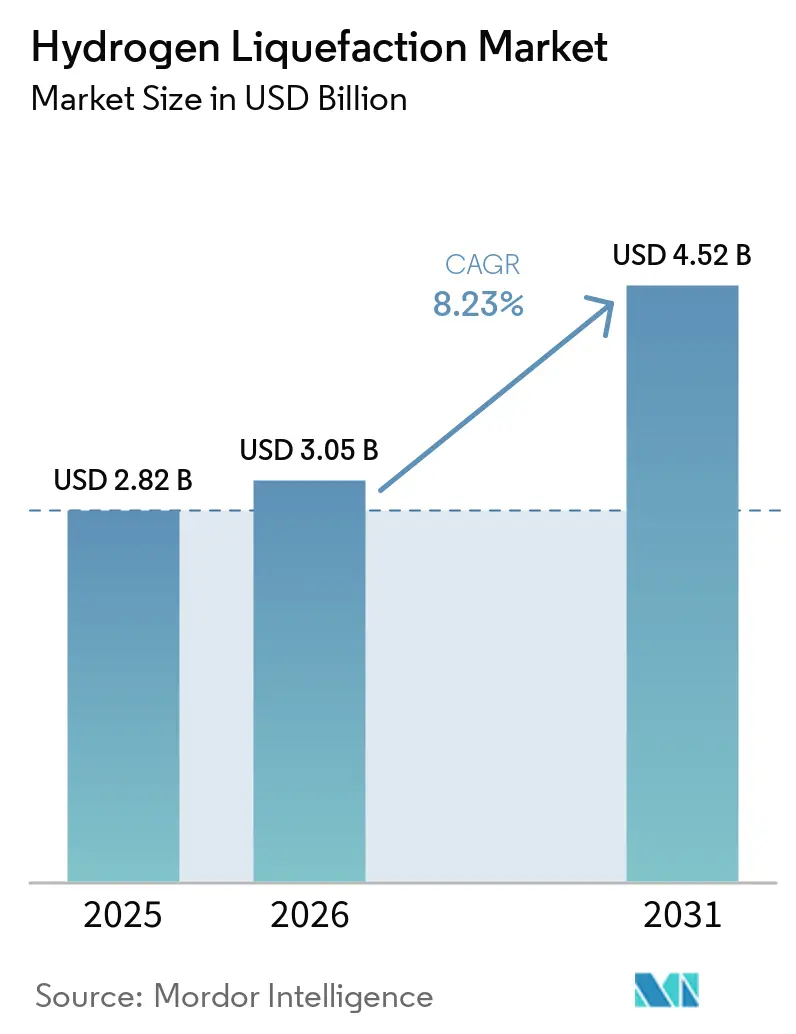
The hydrogen liquefaction market size was valued at USD 2.82 billion in 2025 and is estimated to grow from USD 3.05 billion in 2026 to USD 4.52 billion by 2031, at a CAGR of 8.23% during the forecast period (2026-2031). The hydrogen liquefaction market is supported by space program procurement, transport decarbonization requirements, and hydrogen-importing countries that prefer cryogenic liquid as a carrier. Long-term offtake agreements, particularly in aerospace, provide project developers with greater certainty than spot demand and can support capacity investment ahead of broad commercial demand. Electricity costs, boil-off during storage and transfer, and a limited specialist supplier base remain key constraints on project economics and delivery schedules. Industrial gas companies are combining established supply relationships with cryogenic logistics capabilities, while equipment suppliers are serving projects across multiple regions. Market opportunities depend on aligning process design with local energy costs, storage requirements, and the needs of large, contracted buyers.
Key Report Takeaways
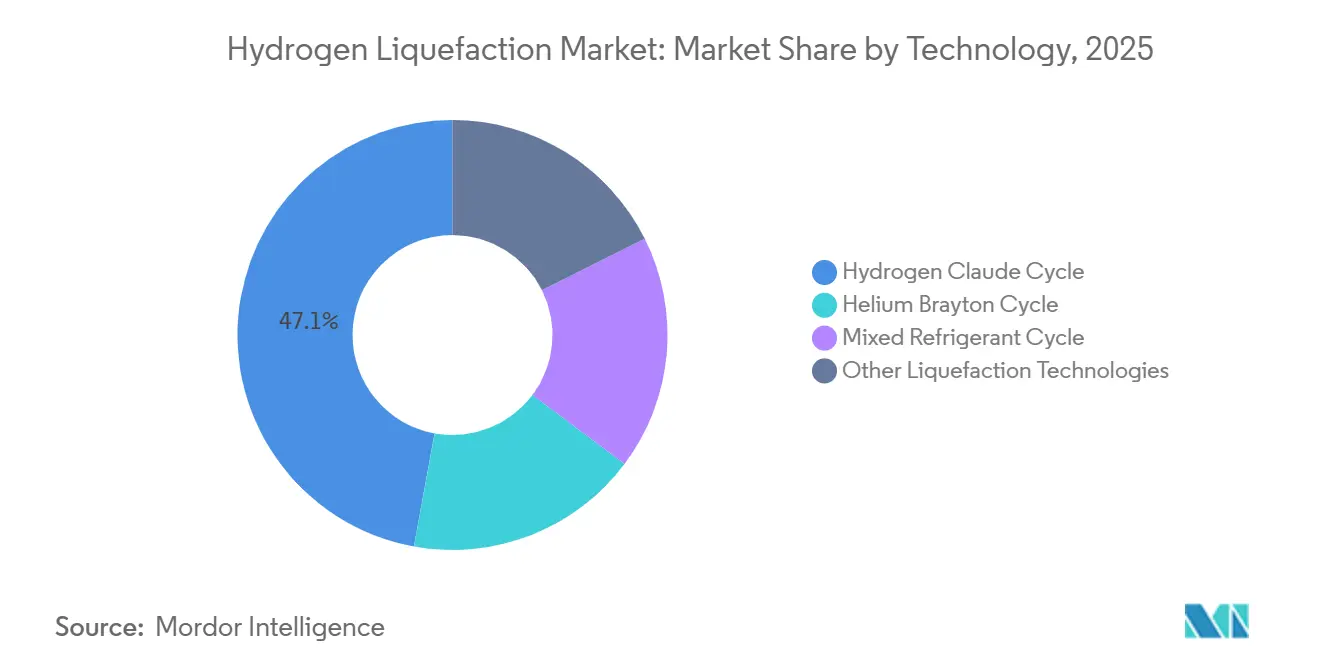
- By technology, the Hydrogen Claude Cycle held 47.13% of the hydrogen liquefaction market share in 2025, while the Mixed Refrigerant Cycle is forecast to expand at an 8.75% CAGR through 2031.
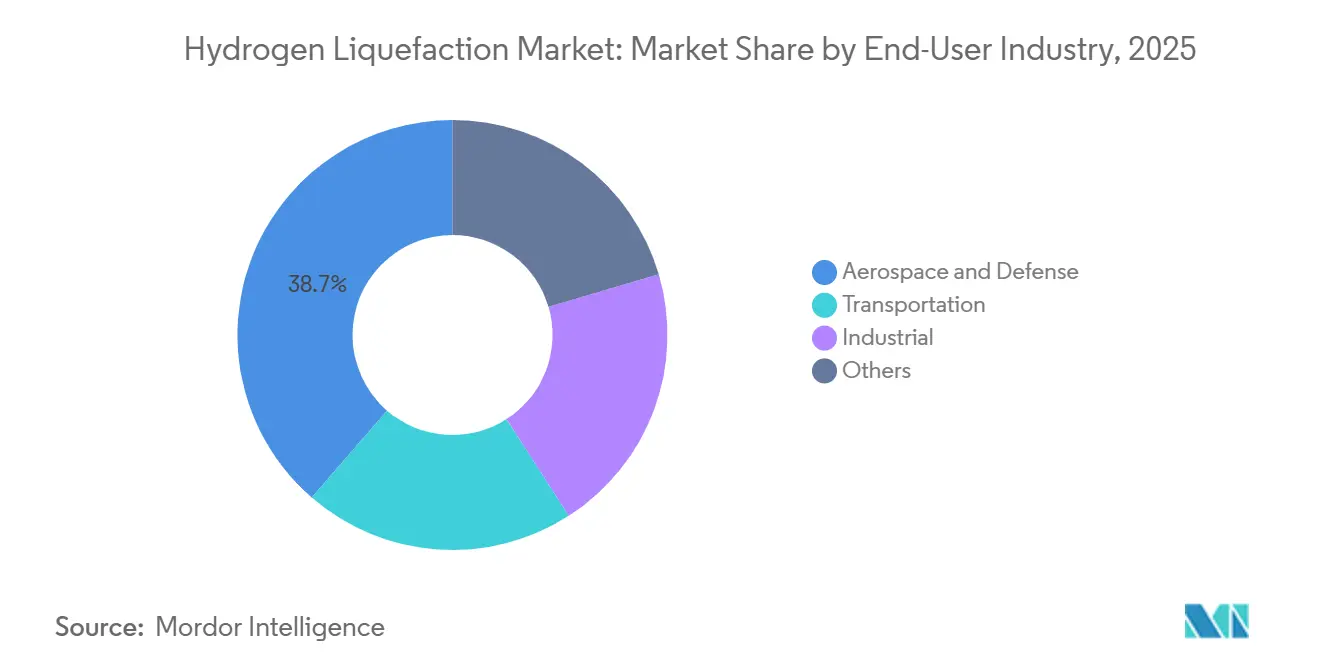
- By end-user industry, aerospace and defense accounted for 38.65% of the hydrogen liquefaction market share in 2025, while transportation is forecast to expand at a 9.12% CAGR through 2031.
- By geography, North America held 40.38% in 2025, while Asia-Pacific is forecast to grow at an 8.67% CAGR through 2031.
Note: Market size and forecast figures in this report are generated using Mordor Intelligence’s proprietary estimation framework, updated with the latest available data and insights as of January 2026.
Global Hydrogen Liquefaction Market Trends and Insights
Drivers Impact Analysis*
| Drivers | (~) % Impact on CAGR Forecast | Geographic Relevance | Impact Timeline |
|---|---|---|---|
| Hydrogen Demand from Aerospace Launch and Lunar Programs | +2.4% | North America core, with spillover to Europe and Asia-Pacific (APAC) launch sites | Short term (≤ 2 years) |
| Heavy-Duty Fuel-Cell Mobility and Depot-Scale Refueling | +1.8% | North America and Europe, with early gains in California, the United Kingdom, and Germany | Medium term (2-4 years) |
| Asia-Pacific Gigawatt-Scale Liquefaction and Import Infrastructure | +1.9% | Asia-Pacific core, including Japan, South Korea, and Australia, export nodes | Medium term (2-4 years) |
| Cross-Border Hydrogen Trade Corridors and Export Hubs | +1.2% | Global, concentrated in European import corridors and the Australia-Japan supply chain | Medium term (2-4 years) |
| Lower-Energy Ortho-Para Conversion and Advanced Cryogenic Systems | +0.5% | Global, with initial adoption in plants of at least 30 tons per day (TPD) in China, the European Union, and North America | Long term (≥ 4 years) |
| Source: Mordor Intelligence | |||
Hydrogen Demand from Aerospace Launch and Lunar Programs
Liquid hydrogen procurement is receiving renewed strategic attention from United States space programs. In January 2026, Air Products secured NASA contracts worth more than USD 140 million to supply liquid hydrogen to the Kennedy Space Center, Cape Canaveral Space Force Station, Marshall Space Flight Center, and Stennis Space Center. The contracts cover supply through the end of the decade, providing contracted suppliers with a clearer basis for planning equipment and logistics capacity. The planned Artemis program schedule also sustains recurring propellant demand through lunar mission hardware and related ground operations. This procurement structure can reduce early-demand risk for hydrogen liquefaction market participants, as project decisions are supported by firm public-sector requirements rather than short-term fuel purchasing. It also allows suppliers to plan storage, transport, and production around defined delivery points and a known institutional customer.
Heavy-Duty Fuel-Cell Mobility and Depot-Scale Refueling
Heavy-duty fuel-cell truck deployments are increasing the need for hydrogen supply at fleet depots rather than only at public retail stations. Hyroad Energy began fueling and servicing IMC Logistics' hydrogen fleet at its Fontana, California depot in September 2026, demonstrating how supply infrastructure can be integrated into a fleet operator's own site. Shell reported that its California heavy-duty hydrogen locations completed more than 2,500 transactions and dispensed more than 88,000 kg of hydrogen during 2025. In June 2026, the California Energy Commission awarded USD 30 million under GFO-24-612 for medium- and heavy-duty depot charging and hydrogen refueling infrastructure. These operational and funding signals support dedicated supply agreements and provide the hydrogen liquefaction market with a path toward localized, repeatable consumption. Depot demand can also directly connect vehicle deployment schedules to supply planning, storage capacity, and refueling equipment decisions.
Asia-Pacific Gigawatt-Scale Liquefaction and Import Infrastructure
Japan is developing liquid hydrogen infrastructure as part of a broader energy-security strategy. In January 2026, Kawasaki Heavy Industries began a demonstration of its KM Comp-H₂ centrifugal hydrogen compressor at Harima Works under a project supported by the New Energy and Industrial Technology Development Organization (NEDO)'s Green Innovation Fund. The company stated that the compressor has a footprint one-seventh that of current reciprocating equipment and can reduce electricity consumption by 3% to 4%. In August 2026, the company began construction of an 18-ton-per-day hydrogen production facility in the Kawasaki Coastal Area to supply the adjacent terminal via a high-pressure pipeline. These linked investments strengthen the hydrogen liquefaction market by integrating production, compression, storage, and terminal operations into a single domestic supply chain. Placing equipment development alongside planned handling infrastructure can also shorten the learning cycle for integrated systems.
Cross-Border Hydrogen Trade Corridors and Export Hubs
Cross-border hydrogen trade requires transport routes that are both technically feasible and commercially viable. The International Energy Agency reported that announced hydrogen pipeline projects total more than 40,000 km by 2035, although only 9% have committed investment or operational status. The same review stated that shipping pure hydrogen in liquid form costs at least USD 2/kg and requires more than 10 kWh/kg for liquefaction or reconversion. Fraunhofer UMSICHT found that hydrogen imports via Amsterdam and Duisburg can be technically feasible and potentially competitive for specified routes, including options involving liquid hydrogen and liquid organic hydrogen carriers[1]Fraunhofer UMSICHT, “Hydrogen Imports via Amsterdam and Duisburg Are Technically Feasible and Have the Potential to Be Competitive,” Fraunhofer UMSICHT, umsicht.fraunhofer.de. As import routes develop, export locations may need liquefaction capacity before demand centers reach their expected consumption levels, thereby expanding the addressable project base for the hydrogen liquefaction market. Route design, therefore, remains closely linked to port capability, storage availability, and the distance between import terminals and industrial users.
Restraints Impact Analysis*
| Restraints | (~) % Impact on CAGR Forecast | Geographic Relevance | Impact Timeline |
|---|---|---|---|
| High Electricity Intensity and Liquefaction Cost | -1.5% | Global, most acute in the European Union and island economies with high power tariffs | Medium term (2-4 years) |
| Boil-Off Losses and Cryogenic Handling Complexity | -0.8% | Global, particularly damaging in long-haul maritime supply chains, including Australia-Japan routes | Long term (≥ 4 years) |
| Limited Standardization and Specialist Supplier Capacity | -0.5% | Global, particularly constraining in South America, the Middle East, and Africa | Long term (≥ 4 years) |
| Source: Mordor Intelligence | |||
High Electricity Intensity and Liquefaction Cost
Electricity represents the highest operating cost for many liquid hydrogen facilities and strongly influences private investment decisions. Commercial plants consume 10 to 15 kWh of electricity per kilogram of liquid hydrogen, equivalent to 30% to 45% of the fuel's energy content. A 2026 assessment estimated levelized liquefaction costs of USD 1.70-1.80/kg in China, USD 2.20-2.60/kg in the United States, and USD 3.00-3.40/kg in the European Union for the plant case studied. Air Products signed a 75 GWh annual renewable power purchase agreement with RWE for its Rotterdam facility, aligning the project with its renewable electricity requirements. The hydrogen liquefaction market, therefore, faces a combined power-price and compliance challenge that favors established companies with access to contracted electricity and certified supply chains. Sites without comparable power arrangements may face a higher threshold to secure financing or long-term buyers.
Boil-Off Losses and Cryogenic Handling Complexity
Boil-off reduces the usable quantity of liquid hydrogen when heat enters storage and transfer systems. A 2025 study in Cryogenics found that local-area cooling and broad-area cooling could reduce daily boil-off rates to 0.011% and 0.004%, respectively, under the evaluated storage conditions. These approaches can reduce losses but add capital requirements and operational complexity to storage systems. Research published in the Journal of Marine Science and Technology reported a 0.26% daily boil-off rate for liquid hydrogen carriers on assessed international voyages[2]“Comparison of Measured and Calculated Heat Ingress into Cargo Tanks of Liquefied Hydrogen Carriers During International Voyages,” Journal of Marine Science and Technology, link.springer.com. The hydrogen liquefaction market must account for these losses in the economics of delivered fuel, particularly when liquid hydrogen is shipped over long distances. Storage design, voyage length, and transfer practices can therefore affect the quantity of product that reaches the end customer.
*Our forecasts treat driver/restraint impacts as directional, not additive. The impact forecasts reflect baseline growth, mix effects, and variable interactions.
Segment Analysis
By Technology: Claude Cycle Leads Large-Scale Supply, While Mixed Refrigerant Systems Support Flexible Operations
The Hydrogen Claude Cycle accounted for 47.13% of the hydrogen liquefaction market in 2025, reflecting its established role in large industrial and aerospace supply programs. Its position is based on process reliability, operating experience, and suitability for high-volume production. A 2026 peer-reviewed study showed that an improved dual-pressure Claude cycle design could achieve a specific energy consumption of 11.95 kWh/kg in the evaluated liquid-nitrogen precooling case. This result supports continued process optimization without requiring a complete change in plant configuration. Kawasaki Heavy Industries is also testing its KM Comp-H₂ centrifugal compressor to reduce the footprint and electricity consumption of hydrogen liquefaction equipment.
The Mixed Refrigerant Cycle is projected to grow at an 8.75% CAGR from 2026 to 2031. Its growth is linked to plants that need to respond to the changing availability of renewable electricity. A 2026 study modeled a 100-tons-per-day (TPD) mixed-refrigerant-precooled plant and found that its control strategy could restore stable operation within 22 to 96 minutes after significant feed disturbances. This flexibility is relevant for facilities located near wind or solar generation. The Helium Brayton Cycle and other emerging configurations remain smaller in scale, but they can serve applications where compact equipment and operational reliability are prioritized over the lowest energy use.



By End-User Industry: Aerospace and Defense Provides Contracted Demand, While Transportation Expands Depot Consumption
Aerospace and defense held 38.65% of the overall market in 2025. The segment supports capacity investment because buyers can use long-term, fixed-price procurement arrangements. NASA awarded Air Products and Chemicals, Inc. and Plug Power contracts totaling USD 147.2 million for 36.95 million pounds of liquid hydrogen under terms extending to 2030. The award provides a clear demand signal for suppliers serving launch and ground-support operations. Industrial uses in ammonia, refining, and metals also create steady demand, particularly where sites are distant from pipeline systems.
Transportation is forecast to register a 9.12% CAGR through 2031, the highest rate among end-user industries. Growth is driven by heavy-duty fleet operations that require consistent fuel quantities at depots and along key freight routes. Shell's reported California activity shows that heavy-duty hydrogen stations are handling measurable transaction counts and fuel throughput. The California Energy Commission's 2026 awards add public support for medium- and heavy-duty refueling infrastructure. As fleet operators move from pilot vehicles to scheduled operations, they are more likely to require contracted supply rather than occasional purchases.
Geography Analysis
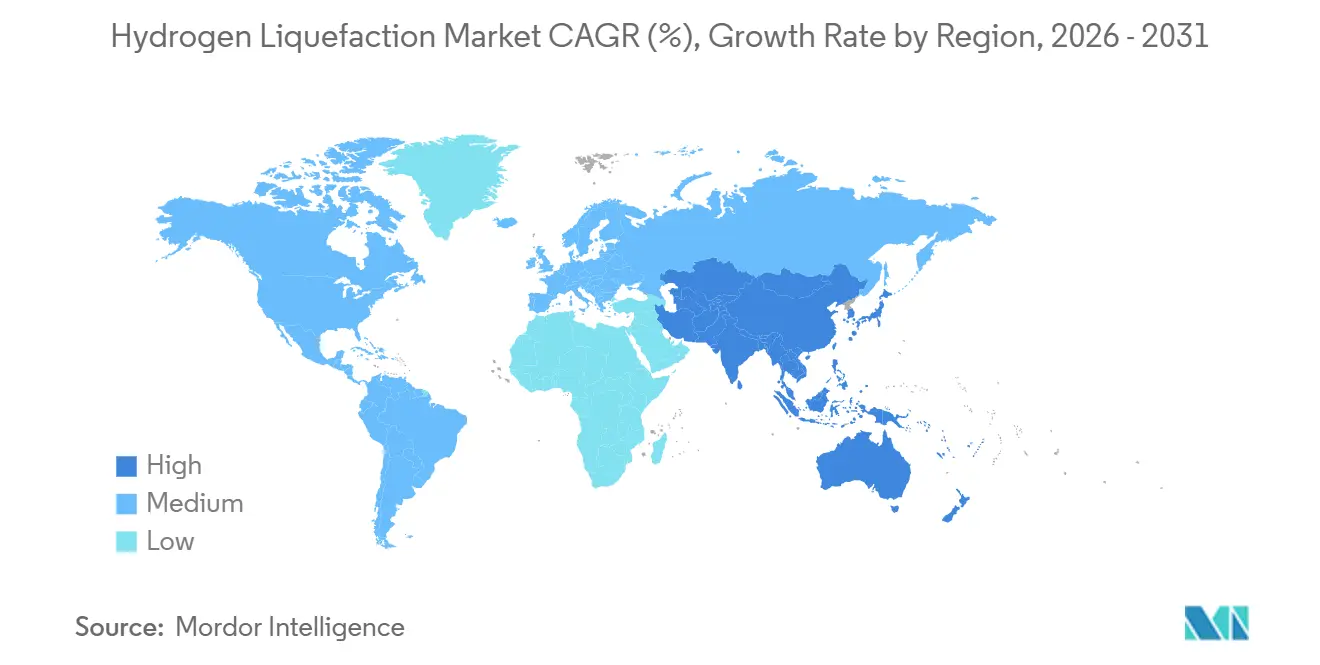
North America accounted for 40.38% of the hydrogen liquefaction market in 2025, supported by established industrial gas networks and continued demand from the aerospace sector. NASA-related liquid hydrogen procurement remains an important anchor for regional supply arrangements. Plug Power and Olin commissioned a 15-TPD (tons per day) liquid hydrogen plant in St. Gabriel, Louisiana, in April 2025. Plug Power stated that its combined domestic capacity reached 40 TPD across Georgia, Tennessee, and Louisiana. The region includes both established suppliers with aerospace contracts and newer providers using depot-integrated distribution models.
Europe continues to build a policy and infrastructure base for renewable hydrogen. Air Products' Rotterdam project is linked to a 75 GWh annual renewable electricity agreement with RWE, demonstrating how plant development is tied to both power procurement and compliance with renewable fuel requirements. Fraunhofer UMSICHT found that selected import routes through Amsterdam and Duisburg could be technically feasible and potentially competitive. The European hydrogen liquefaction market is shaped by import terminal planning, access to renewable electricity, and industrial demand centers. These conditions support larger certified projects but can increase requirements for smaller developers.
Asia-Pacific is expected to expand at an 8.67% CAGR from 2026 to 2031. Japan is building an integrated supply chain in the Kawasaki Coastal Area, where Kawasaki Heavy Industries began construction of an 18-ton-per-day hydrogen production facility in August 2026 that will supply the adjacent liquid hydrogen terminal via a high-pressure pipeline. China has a potential cost advantage in the assessed dual-pressure Claude-cycle case, with levelized costs estimated at USD 1.70-1.80/kg. South America, the Middle East, and Africa remain early-stage opportunities, as renewable resources can support export projects, while specialist equipment supply and consistent regulatory frameworks remain limited.

Competitive Landscape
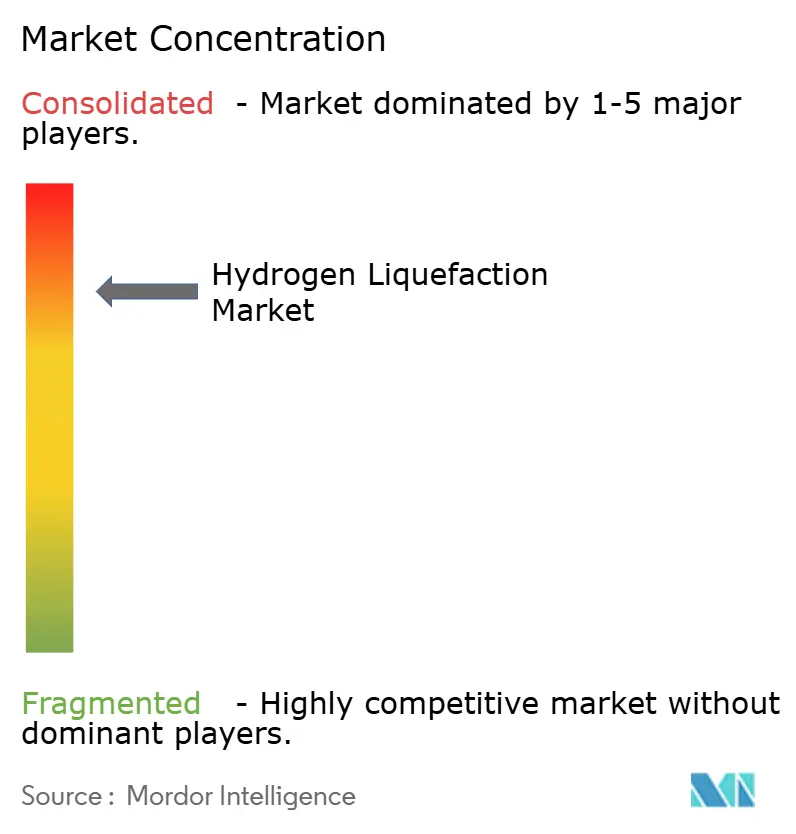
The hydrogen liquefaction market is consolidated. Air Liquide, Air Products, and Linde hold differentiated positions based on their liquefaction experience, long-term relationships with industrial and aerospace customers, and cryogenic logistics networks. Their scale allows them to manage project risks spanning power supply, regulation, storage, and delivery. Air Products' renewable power agreement for Rotterdam illustrates how large suppliers are linking project development with electricity sourcing. The market also includes equipment-focused companies that serve multiple customers without owning hydrogen production assets.
Kawasaki Heavy Industries is pursuing an integrated position in Asia through compressor development, hydrogen production, and terminal-linked infrastructure. Its KM Comp-H₂ demonstration, which started in January 2026, focuses on a centrifugal compressor for hydrogen liquefaction plants. In August 2026, the company began construction of production equipment to supply the Kawasaki terminal via a dedicated pipeline. This approach links component development with planned liquid hydrogen handling infrastructure, potentially allowing the company to control more interfaces across the domestic value chain.
Chart Industries and NIKKISO serve the market by supplying liquefaction and cryogenic equipment. Chart Industries received an order from Element Resources for a hydrogen liquefier, liquid hydrogen transport equipment, and ISO containers, highlighting the role of equipment suppliers in project delivery. NIKKISO reported hydrogen infrastructure contracts in 2025, including equipment for hydrogen-fueled ships. New entrants can find opportunities in modular and distributed systems, but must meet the same energy, storage, and handling standards as established suppliers. The market remains competitive, as large suppliers hold established contracts while equipment specialists can participate across independent projects.
Hydrogen Liquefaction Industry Leaders
Linde PLC
Air Liquide
Air Products and Chemicals, Inc.
Chart Industries
Kawasaki Heavy Industries, Ltd.
- *Disclaimer: Major Players sorted in no particular order

Recent Industry Developments
- September 2026: Nel ASA entered a framework agreement with Hydrasun to establish Proton Exchange Membrane (PEM) electrolyzer assembly and integration capabilities in Europe. This complements Nel's existing production facility in Wallingford, US, and expands its delivery capacity for European hydrogen infrastructure projects.
- August 2026: Kawasaki Heavy Industries commenced construction of an 18-ton/day hydrogen production facility at the Kawasaki Coastal Area, Kanagawa. The facility uses steam methane reforming to supply the adjacent Kawasaki Liquid Hydrogen (LH₂) Terminal via a high-pressure hydrogen pipeline, demonstrating an integrated domestic LH₂ supply chain at commercial scale.


Global Hydrogen Liquefaction Market Report Scope
Hydrogen liquefaction is an energy-intensive cryogenic process that cools hydrogen gas to its boiling point of approximately -253°C, converting it into a liquid. At this temperature, hydrogen transitions from a gaseous state to a liquid state, significantly reducing its physical space requirements.
The hydrogen liquefaction market is segmented by technology, end-user industry, and geography. By technology, the market is segmented into hydrogen claude cycle, helium brayton cycle, mixed refrigerant cycle, and other liquefaction technologies. By end-user industry, the market is segmented into aerospace and defense, transportation, industrial, and others. The report also covers market size and forecasts for hydrogen liquefaction across 15 countries in major regions. The market sizes and forecasts are provided in terms of value (USD).
| Hydrogen Claude Cycle |
| Helium Brayton Cycle |
| Mixed Refrigerant Cycle |
| Other Liquefaction Technologies |
| Aerospace and Defense |
| Transportation |
| Industrial |
| Others |
| Asia-Pacific | China |
| India | |
| Japan | |
| South Korea | |
| ASEAN Countries | |
| Rest of Asia-Pacific | |
| North America | United States |
| Canada | |
| Mexico | |
| Europe | Germany |
| United Kingdom | |
| France | |
| Italy | |
| NORDIC Countries | |
| Rest of Europe | |
| South America | Brazil |
| Argentina | |
| Rest of South America | |
| Middle East and Africa | Saudi Arabia |
| South Africa | |
| Rest of Middle East and Africa |
| By Technology | Hydrogen Claude Cycle | |
| Helium Brayton Cycle | ||
| Mixed Refrigerant Cycle | ||
| Other Liquefaction Technologies | ||
| By End-User Industry | Aerospace and Defense | |
| Transportation | ||
| Industrial | ||
| Others | ||
| By Geography | Asia-Pacific | China |
| India | ||
| Japan | ||
| South Korea | ||
| ASEAN Countries | ||
| Rest of Asia-Pacific | ||
| North America | United States | |
| Canada | ||
| Mexico | ||
| Europe | Germany | |
| United Kingdom | ||
| France | ||
| Italy | ||
| NORDIC Countries | ||
| Rest of Europe | ||
| South America | Brazil | |
| Argentina | ||
| Rest of South America | ||
| Middle East and Africa | Saudi Arabia | |
| South Africa | ||
| Rest of Middle East and Africa | ||


Key Questions Answered in the Report
What is current market size of Hydrogen Liquefaction Market?
The hydrogen liquefaction market size was valued at USD 2.82 billion in 2025 and is estimated to grow from USD 3.05 billion in 2026 to USD 4.52 billion by 2031, at a CAGR of 8.23% during the forecast period (2026-2031).
Which hydrogen liquefaction technology leads current demand?
The Hydrogen Claude Cycle led with 47.13% in 2025 because it is widely used for large industrial and aerospace supply programs. In the hydrogen liquefaction market, its reliability and fit with high-volume output continue to outweigh marginal efficiency improvements for many contracted projects.
Why is liquid hydrogen important for aerospace programs?
NASA procurement contracts support recurring demand for liquid hydrogen for launch and ground operations through the end of the decade. For the hydrogen liquefaction market, these contracts give suppliers greater visibility over delivery volumes, logistics planning, storage needs, and production capacity requirements. Contracted public demand is especially relevant while commercial hydrogen demand remains uneven across regions and end uses.
Which end-user segment is growing fastest for liquid hydrogen?
Transportation is the fastest-growing end-user segment, with a projected 9.12% CAGR through 2031. The hydrogen liquefaction market can benefit as heavy-duty fleets require regular depot fuel deliveries, storage capacity, and reliable supply agreements along established freight routes. California refueling activity and public depot infrastructure awards show how fleet operations can create recurring localized demand.
Page last updated on:


 Your data is secure and never sold or shared.


